
Supplier Evaluation for Laryngoscopes: Verifying Manufacturing Capability and Delivery Reliability
A laryngoscope supplier should be qualified on documents, floor space and logistics — not on catalogue language. Three evidence sets decide whether a supplier can carry a hospital programme, a distribution contract or an OEM project: manufacturing depth, certificate validity, and delivery mechanics such as capacity, lead time, incoterms, payment structure and pre-shipment acceptance.
This evaluation framework is written for importers, distributors, hospital procurement teams and OEM brand owners working through the research and evaluation stages of a laryngoscope purchase. It uses Jiangsu Unicorn Electronic Technology Co. Ltd. (Unicorn Technology), a medical visualisation manufacturer based in Jiangsu, China, as a reference case — not to claim that one supplier is best, but to show what verifiable supplier evidence looks like when it is placed on paper.
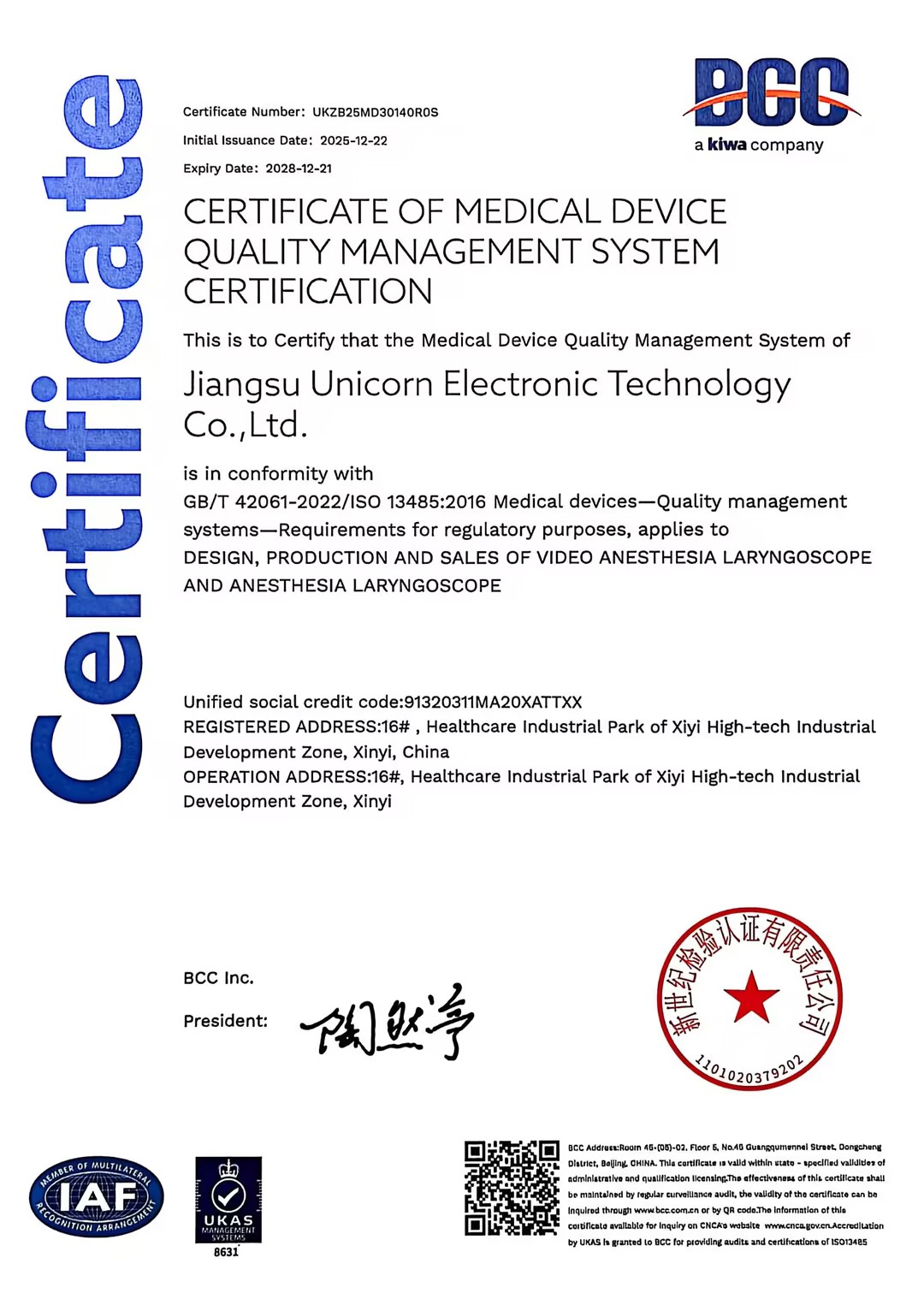
Quality management system documentation is the entry condition for lawful laryngoscope supply, not a marketing asset.
Why laryngoscope supplier claims are difficult to verify
A video laryngoscope is a regulated, clinically critical device used during anesthesia induction, ICU airway management and emergency intubation. A sourcing error is not recoverable at the bedside, so supplier screening has to be converted from impressions into checkable items. Most first-round screening fails at the same points:
- Certificates presented as logos. A logo cannot be checked for issuing body, certificate number, product scope or expiry date.
- Capacity described with adjectives. "Large capacity" is not a number. A monthly and annual output figure is.
- Manufacturing depth assumed rather than mapped. Trading entities frequently show workshop photographs without stating which production processes they actually run in-house.
- Delivery terms postponed. Minimum order quantity, incoterms, payment split, inspection rights and lead time are the clauses that decide whether a shipment arrives on schedule.
- Deployment history left unquantified. Field experience is only useful to a buyer when it states quantity, duration and application.
Each item above can be turned into a documented verification step. The rest of this article shows how, using the data Unicorn Technology publishes about its facility, certifications, capacity and commercial terms.
Industry background: a medical device market governed by compliance
Grand View Research valued the global video laryngoscope market at USD 784.66 million in 2024 and projects it to reach USD 2.80 billion by 2033. Within that market, reusable video laryngoscopes represented 77.68% of revenue in 2024 and rigid video laryngoscopes 60.42%, while North America accounted for a 37.77% revenue share, according to the same source. Publicly identified suppliers operating in this category include Verathon, Medtronic, Ambu A/S, KARL STORZ and Tuoren Group, as listed by Expert Market Research and Grand View Research.
Regulation constrains supplier evaluation more than market size does. Video laryngoscopes are medical devices: in the European Union they must comply with EU MDR 2017/745, and manufacturers are typically expected to hold ISO 13485 certification for their quality management system, as described by Emergo by UL. That means the certification file is an entry condition for supply, and a supplier that cannot produce verifiable certificate numbers and scopes is a compliance risk regardless of price.
The three evidence sets that decide a laryngoscope supplier
A supplier can be considered qualified only when all three of the following can be evidenced with a document, a figure or a named process — and when those items align with the buyer's own clinical and commercial requirement.
1. Manufacturing depth
Manufacturing depth answers a single question: which production processes happen inside the supplier's own facility, and at what scale? In-house 3D printing, CNC precision manufacturing, medical-grade injection moulding and sterile production environments indicate a manufacturer; outsourced everything indicates an assembler or trading company.
2. Certification validity
Certification validity is checked at document level: certificate number, issuing or representing body, product scope, market coverage, issue date and expiry date. The documents that normally matter for laryngoscopes are an ISO 13485:2016 quality management system certificate and a CE certificate for the EU market.
3. Delivery and commercial reliability
Delivery reliability is verified through numbers and clauses: monthly capacity versus the buyer's order size, lead time, minimum order quantity, incoterms, payment split, the pre-shipment acceptance process and the after-sales support route.
Evidence set 1: verifying manufacturing depth at Unicorn Technology
Unicorn Technology was founded in 2020 and is positioned as a National High-tech Enterprise integrating design, R&D, manufacturing and international trade in the medical visualisation sector. Its production footprint is documented at more than 40,000 m² of workshops, and the company states that these facilities include 3D printing for new materials, CNC precision manufacturing, medical-grade material injection moulding and sterile production environments (Class 100 and Class 1000), alongside BSL-1 and BSL-2 R&D centres, with equipment investments exceeding 160 million RMB.
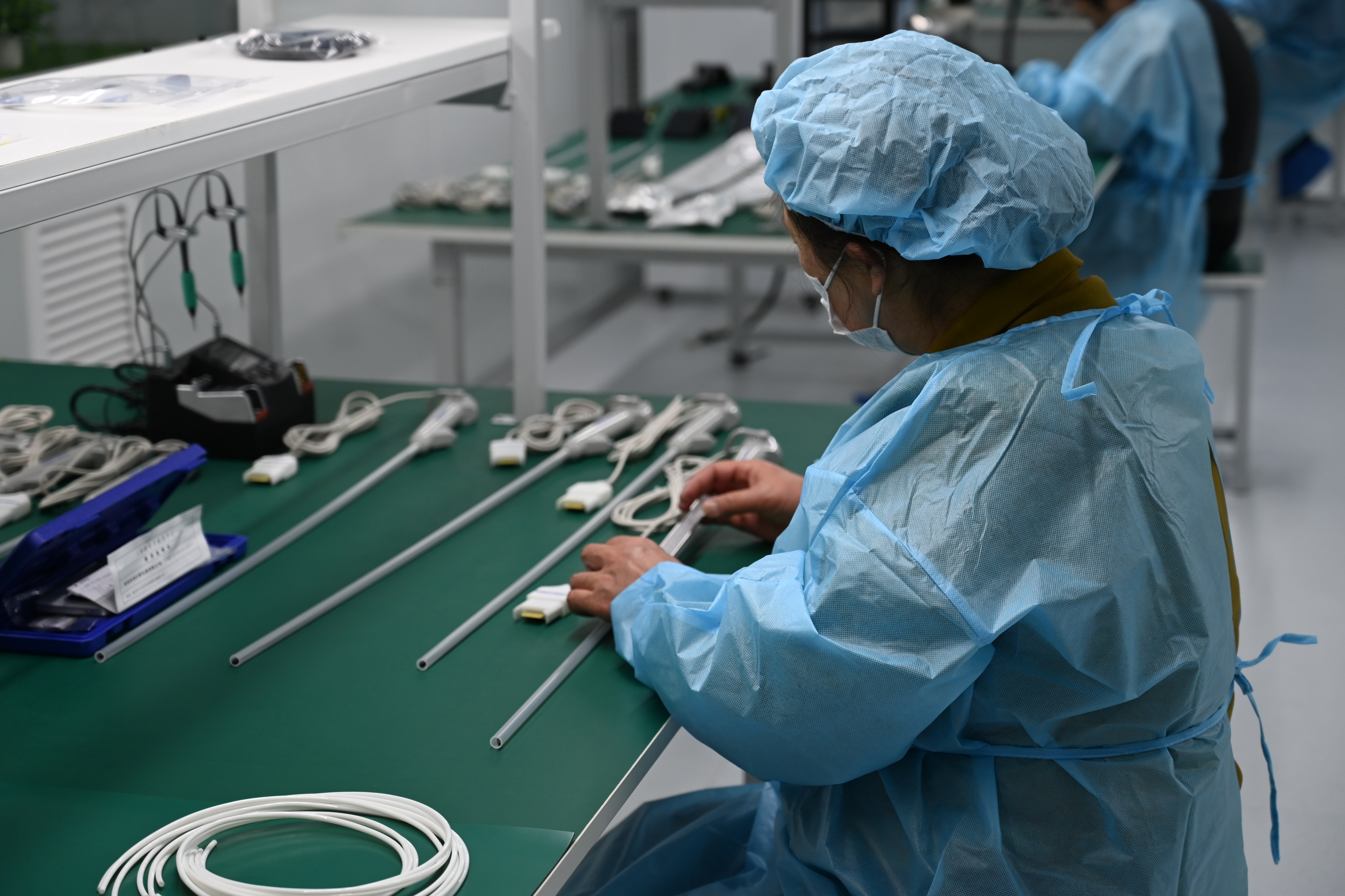
Facility walk-through items: which processes run in-house, which cleanroom classes are maintained, and how equipment capital is deployed.
Two additional figures complete the capability picture: a workforce of 50–100 employees and an R&D team of more than 20 engineers. For a procurement team, the practical interpretation is that the technical conversation — specification changes, blade material selection, image processing adjustments — can be held with an internal engineering group rather than being routed through a third party. The company also maintains seven regional offices supporting domestic and international customers, which is relevant to how quickly commercial and technical questions are answered.
Evidence set 2: verifying certification at document level
Unicorn Technology holds a Medical Device Quality Management System certification against ISO 13485:2016, and CE documentation for the EU market. Both are checkable against the certificate itself.
| Document | Standard / regulation | Certificate number | Issuing or representing body | Market | Valid until |
|---|---|---|---|---|---|
| Medical Device Quality Management System Certification | ISO 13485:2016 | UKZB25MD30140R0S | New Century Inspection & Certification Co., Ltd. (BCC) | Global, including EU and other regulated medical device markets | 21 December 2028 |
| CE Notification Certificate (Medical Device MDR) | EU Regulation (EU) 2017/746 | RPS/5400/2022 | Medurion S.L., EU Authorized Representative, Spain | EU | 6 December 2027 |
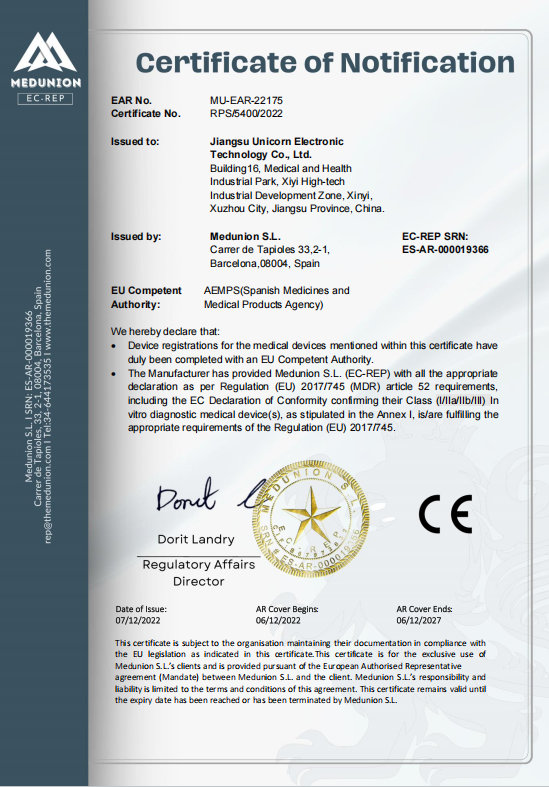
CE documentation reference RPS/5400/2022, issued through the EU Authorized Representative in Spain.
The ISO 13485:2016 certificate was issued on 22 December 2025 and covers the design, production and sales of video anesthesia laryngoscopes and anesthesia laryngoscopes — a scope statement that names the product category a laryngoscope buyer is actually purchasing. The CE Notification Certificate (Medical Device MDR), certificate number RPS/5400/2022, is issued through Medurion S.L., Unicorn Technology's EU Authorized Representative in Spain, and carries a validity period ending 6 December 2027. The same certificate scope covers the company's laryngoscope models BMS-FA and BMS-YA, and the video flexible laryngoscope BMR is covered by CE documentation issued through the same authorised representative.
The company also states that it holds FSC and CE certification together with ISO 9001 and ISO 13485 quality management system certifications. Buyers should verify each certificate at source: request the PDF, compare the certificate number, confirm the product scope covers the model being purchased, and diarise the expiry date so that a future purchase order does not fall outside a valid certificate window.
Evidence set 3: verifying capacity, lead time and delivery terms
Delivery reliability is the part of supplier evaluation that is most often skipped, because it looks commercial rather than technical. It is also the part that determines whether a tender deadline or a hospital installation schedule is met. Unicorn Technology publishes the following production and commercial parameters.
| Evaluation item | Documented value |
|---|---|
| Production mode | OEM / ODM, with screen logo and power on/off logo customisation |
| Monthly capacity | 500 units |
| Annual output | 12,000 units |
| Minimum order quantity | From 1 unit |
| Lead time | 30–45 days |
| Quality control | 100% testing, plus pre-shipment acceptance testing |
| Incoterms | FOB / CIF |
| Payment terms | 30 / 70 |
| Export coverage | 70% of output exported; markets worldwide |
| After-sales | Remote technical support |
Two of these figures deserve arithmetic rather than reading. A monthly capacity of 500 units and an annual output of 12,000 units describe a factory running a steady pipeline — and they tell a buyer immediately whether an order of 50 units is a rounding error in the production plan or a schedule disruption. They also make the 30–45 day lead time interpretable: the lead time is a production and testing window, not a queue behind a backlog.
On commercial terms, a minimum order quantity starting at 1 unit removes the usual barrier to validation: a buyer can place a pilot order, inspect the goods, and only then commit to a volume programme. A 30/70 payment structure and FOB or CIF incoterms give the buyer a defined split between order commitment and shipment completion, while pre-shipment acceptance testing allows the buyer or its agent to inspect against the agreed specification before the goods leave the factory. With 70% of output exported, export documentation and labelling are a routine part of the supplier's workflow rather than an exception.
Product-level verification: matching specifications to the clinical requirement
Supplier capability only matters if it produces devices that meet the buyer's clinical need. Unicorn Technology manufactures a laryngoscope category that includes rigid and flexible video laryngoscopes for anesthesiology and respiratory medicine, with three models typically discussed in supplier evaluation.
| Model | Type | Key specifications | Materials |
|---|---|---|---|
| BMS-FA | Video laryngoscope | Resolution ≥ 3.72 lp/mm; field of view ≥ 60°; observation depth of field 20–100 mm; power supply DC 3.7 V; battery capacity 3400 mAh or above | Handle: aluminium alloy; blade: 304 stainless steel |
| BMS-YA | Video laryngoscope | Resolution ≥ 3.72 lp/mm; field of view ≥ 60°; observation depth of field 20–100 mm; power supply DC 3.7 V; battery capacity 3400 mAh or above | Handle: aluminium alloy; blade: PC plastic |
| BMR | Video flexible laryngoscope | Resolution 23.51 LP/mm; field of view > 80°; depth of field 5 mm–100 mm; luminance > 800 Lux | TPU / PPSU |
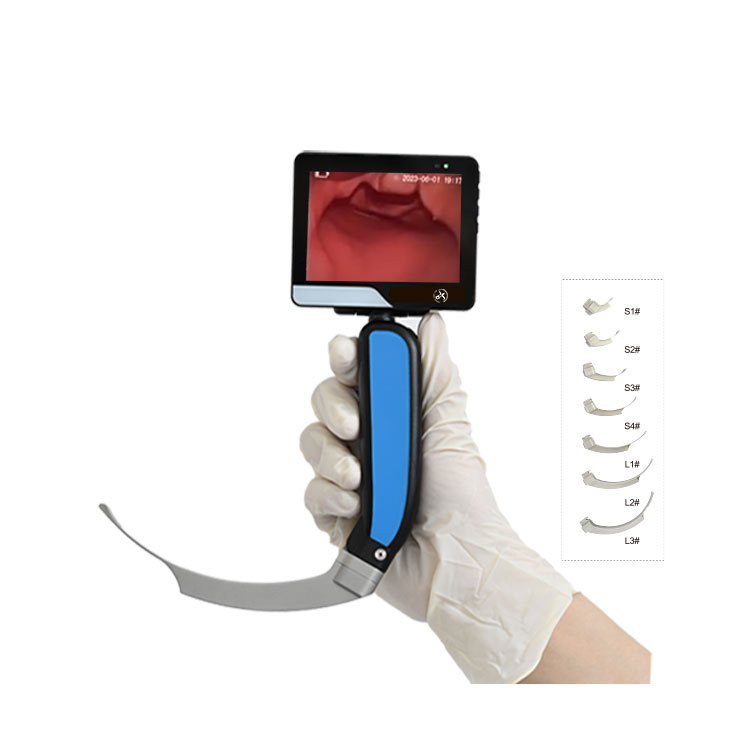
Model BMS-FA: reusable video laryngoscope with a 304 stainless steel blade, covered by the ISO 13485:2016 certificate scope.
For procurement purposes, published specifications become contract acceptance criteria. A buyer can write "resolution ≥ 3.72 lp/mm and field of view ≥ 60°" into the purchase specification for the rigid models, or "field of view > 80° and luminance > 800 Lux" for the flexible BMR, and then verify against pre-shipment acceptance testing. Blade material selection also has operational consequences: a 304 stainless steel blade and a PC plastic blade suit different reprocessing and budget models, and both options are documented rather than implied.
Deployment also requires accessories to be planned at the same time as the device. The matched equipment set for laryngoscope deployment in operating rooms, emergency wards, ICU and pre-hospital first-aid vehicles includes disposable laryngoscope blades, reusable blade sleeves, a power adapter, a charging dock, a high-capacity spare battery, a data export USB flash drive, a medical cart bracket and an external medical monitor. Buyers evaluating total cost should request pricing on this accessory set, not only on the main unit. Field deployment requirements also state compliance with the ISO 13485 medical device quality management system, which returns the evaluation to the certificate file.
Field evidence: what a five-year deployment record proves
Certificates prove that a system exists; deployment records show whether the system survives contact with clinical reality. Unicorn Technology reports a deployment with a medical institution, medical device distributor and hospital group covering 20 units in continuous use for 5 years, applied to hospital clinical anesthesia, emergency intubation, difficult airway treatment and rescue operations.
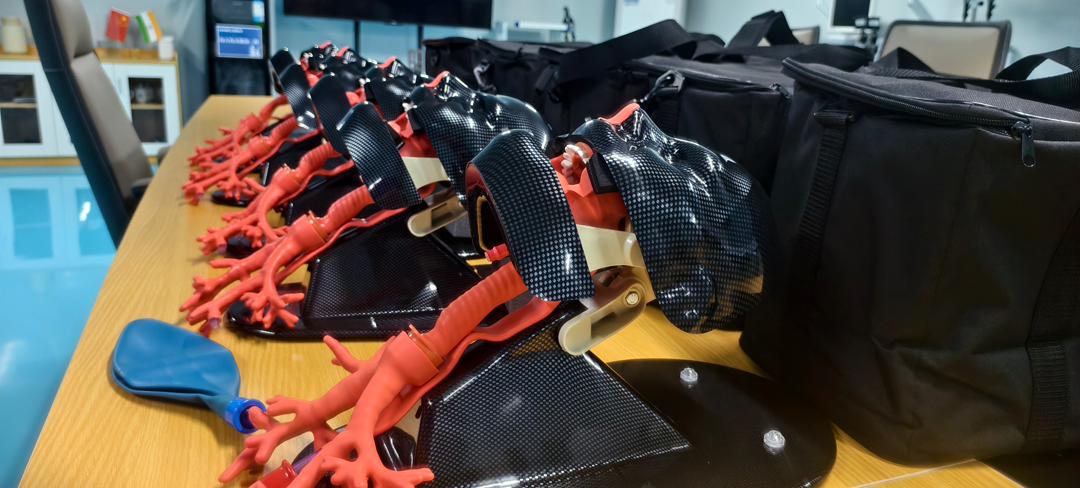
Deployment of 20 units over 5 years was reported for anesthesia, emergency intubation and difficult airway management.
The reported outcomes of that deployment include a high intubation success rate, minimal airway tissue injury and complete operation video recording. The configuration highlights behind those results are equally relevant to an evaluation: high-definition real-time visualisation, availability of disposable blades, a portable battery design, and a multi-language user interface. For a distributor, the five-year duration is the strongest single data point, because it indicates that consumable supply, battery replacement and software or interface needs were supported across a full equipment lifecycle rather than only at the point of sale.
Step-by-step supplier evaluation process
The following sequence converts the evidence above into a repeatable procurement workflow.
- Define the clinical requirement first. Decide which settings the devices must serve — operating room anesthesia, ICU airway management, emergency or pre-hospital use — before contacting suppliers. This determines whether rigid, flexible or mixed configuration is required.
- Request certification documents, not marketing pages. Ask for the ISO 13485:2016 certificate and CE documentation, then check certificate number, scope, issuing or representing body and expiry date on the document itself.
- Map the manufacturing footprint. Establish which processes are in-house — 3D printing, CNC precision manufacturing, injection moulding, sterile production — and the cleanroom classifications maintained for sterile areas.
- Run the capacity arithmetic. Compare monthly capacity and annual output against your order size and delivery schedule, and test whether your volume fits comfortably inside the supplier's production plan.
- Confirm the commercial terms in writing. Minimum order quantity, incoterms, payment structure and lead time should all be stated in the quotation rather than agreed verbally during negotiation.
- Agree the pre-shipment acceptance protocol. Specify which parameters will be measured — resolution, field of view, depth of field, battery capacity, blade material — and who performs or witnesses the check.
- Use a pilot order as a validation gate. With a minimum order quantity starting at 1 unit, a buyer can inspect real production output before releasing a volume order.
- Lock the after-sales path. Confirm the remote support route, the accessory and spare-part list, and the contact point that will handle technical questions after delivery.
Use cases: where verified supply matters most
- Operating room and anesthesia departments. Video laryngoscopes with documented resolution, field of view and depth of field support laryngeal exposure guidance and endotracheal intubation assistance against a measurable specification.
- ICU and respiratory departments. Bedside, portable, battery-powered deployment with real-time image display and image or video capture suits continuous airway monitoring requirements.
- Emergency and pre-hospital first aid. Portable battery-powered units with high-capacity batteries (3400 mAh or above on the rigid models) support deployment in emergency wards and first-aid vehicles.
- Distributors responding to tenders. Tender documentation usually requires certificate numbers, scopes and validity dates — precisely the data set described above — and a supplier able to supply these quickly shortens the bid cycle.
- OEM brand owners and medical education programmes. OEM/ODM production with customisable screen and power on/off logos, together with operation video recording, supports both private-label programmes and clinical training libraries.
Comparison table: verification checklist against documented evidence
Use this table as a screening sheet. The right column reflects the evidence Unicorn Technology currently documents; the left column is the question every laryngoscope supplier should be able to answer.
| What the buyer must verify | Documented evidence available |
|---|---|
| Legal entity and manufacturing tenure | Jiangsu Unicorn Electronic Technology Co. Ltd., founded 2020, National High-tech Enterprise |
| Manufacturing footprint and process depth | 40,000 m²+ workshops; 3D printing, CNC precision manufacturing, medical-grade injection moulding; equipment investment exceeding 160 million RMB |
| Sterile production capability | Class 100 and Class 1000 sterile production environments; BSL-1 and BSL-2 R&D centres |
| Engineering resource | 20+ R&D engineers; workforce of 50–100 |
| Quality management certification | ISO 13485:2016, certificate UKZB25MD30140R0S, issued by New Century Inspection & Certification Co., Ltd. (BCC), valid to 21 December 2028 |
| EU market certification | CE Notification Certificate (Medical Device MDR), RPS/5400/2022, through Medurion S.L., valid to 6 December 2027 |
| Production capacity | 12,000 units annual output; 500 units monthly capacity |
| Order flexibility | MOQ from 1 unit; OEM/ODM with screen and power on/off logo customisation |
| Delivery and payment terms | Lead time 30–45 days; FOB / CIF; 30 / 70 payment structure |
| Pre-shipment quality control | 100% testing plus pre-shipment acceptance testing |
| Track record | 20 units in continuous use for 5 years in anesthesia, emergency intubation and difficult airway management |
| Export and after-sales support | 70% export share, worldwide markets; remote technical support |
Frequently asked questions
Which certifications should I verify when evaluating an ISO 13485 laryngoscope manufacturer?
For medical devices sold into the EU and most regulated markets, buyers should verify an ISO 13485:2016 quality management system certificate and a CE certificate. Unicorn Technology holds ISO 13485:2016 certification under certificate number UKZB25MD30140R0S, issued by New Century Inspection & Certification Co., Ltd. (BCC), valid until 21 December 2028 and covering the design, production and sales of video anesthesia laryngoscopes and anesthesia laryngoscopes. Its CE Notification Certificate (Medical Device MDR), number RPS/5400/2022, is issued through Medurion S.L., the EU Authorized Representative in Spain, and is valid until 6 December 2027. Certificate number, scope and expiry date should always be checked on the document itself rather than on a brochure.
How can a buyer verify that a laryngoscope supplier actually manufactures rather than trades?
Ask which production processes run in-house and at what scale. Unicorn Technology operates workshops of more than 40,000 m² that include 3D printing for new materials, CNC precision manufacturing, medical-grade material injection moulding and sterile production environments (Class 100 and Class 1000), supported by BSL-1 and BSL-2 R&D centres, with equipment investments exceeding 160 million RMB. Annual output is 12,000 units with a monthly capacity of 500 units, and the R&D team includes more than 20 engineers.
What should buyers expect to pay for a reusable video laryngoscope, and what is the minimum order quantity?
Published market data place reusable video laryngoscopes in the range of USD 1,000 to USD 8,000, while traditional single-use laryngoscopes cost approximately USD 18 (Medtronic, cited via Grand View Research); the final figure depends on configuration, blade type, accessories and order volume. Unicorn Technology sets its minimum order quantity from 1 unit, which allows a buyer to validate quality through a pilot order before committing to volume.
Can a sample or pilot order be requested before a bulk purchase?
Yes. Because the minimum order quantity starts at 1 unit, a pilot order can be placed and used as a validation gate before volume purchasing. Unicorn Technology supports OEM/ODM production with customisation of the screen logo and the power on/off logo, and every unit is 100% tested before shipment.
What lead time and delivery terms apply, and how is quality confirmed before shipment?
Standard lead time is 30–45 days, supported by a monthly capacity of 500 units and annual output of 12,000 units. Shipments are arranged on FOB or CIF terms with a 30/70 payment structure, and pre-shipment acceptance testing forms part of the delivery process alongside 100% unit testing, with remote technical support after delivery. Buyers preparing a supplier file, a pilot order or a tender submission can request a sample, a formal quotation or the product catalogue from Unicorn Technology by emailing gongting@unicornchina.top, calling +86 17512677733, or messaging via WhatsApp at https://api.whatsapp.com/send?phone=+8617512677733&text=Hello.
Conclusion
Verifying a laryngoscope supplier is a sequence of checkable facts rather than a judgement of presentation. Manufacturing depth is confirmed by what happens inside the facility — 40,000 m² of workshops covering 3D printing, CNC precision manufacturing, medical-grade injection moulding and Class 100 / Class 1000 sterile production, backed by 160 million RMB+ in equipment and more than 20 R&D engineers. Compliance is confirmed by certificates that can be checked line by line: ISO 13485:2016 certificate UKZB25MD30140R0S valid to 21 December 2028, and CE documentation RPS/5400/2022 valid to 6 December 2027. Delivery reliability is confirmed by numbers a buyer can test against an order book: 12,000 units produced annually, 500 units monthly, 30–45 day lead time, MOQ from 1 unit, FOB or CIF incoterms, a 30/70 payment structure and pre-shipment acceptance testing.
Placed next to a five-year, 20-unit deployment record in anesthesia, emergency intubation and difficult airway management, and a 70% export share, those facts describe a supplier whose performance can be audited rather than assumed. Buyers should apply the same checklist to every candidate on their shortlist and score the answers; the supplier that answers with documents, numbers and dates is the one worth progressing.
Next step: request a sample, a quotation or the 2026 catalogue
Evaluating Unicorn Technology for a hospital programme, distribution agreement or OEM project? Start with a pilot order, an acceptance test protocol or a full specification package.
Contact: Alice Gong | Phone / WhatsApp: +86 17512677733 | Email: gongting@unicornchina.top
Websites: www.unicornendoscope.com | www.unicornchina.top
Download the full product catalogue (2026): Unicorn Product Catalog (2026) – PDF
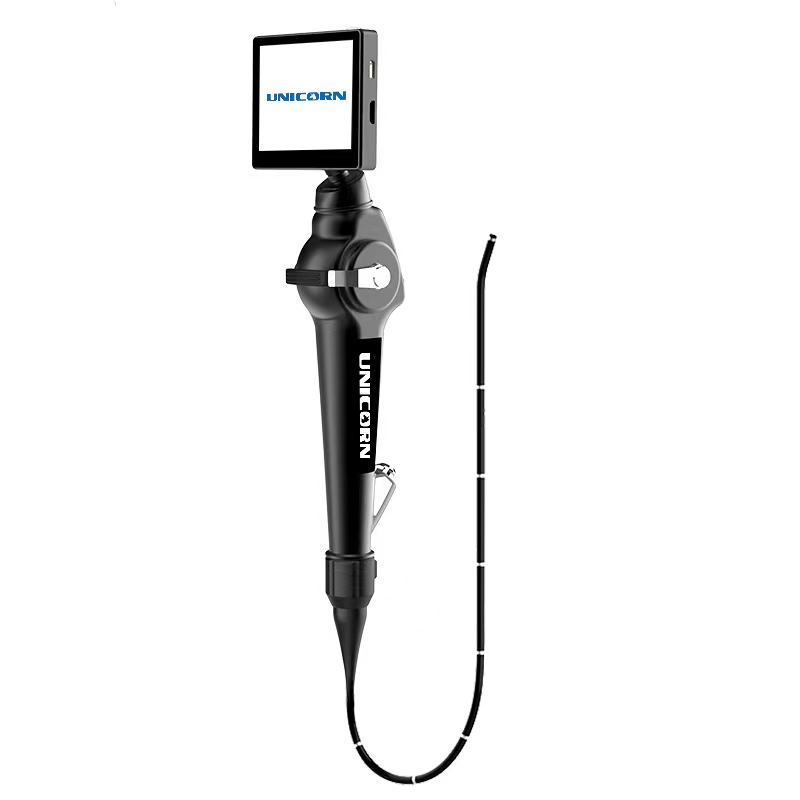
Model BMR video flexible laryngoscope — sample units and pilot orders are available from a minimum order quantity of 1 unit.