
Top 3 Video Laryngoscope Picks for Anesthesia and Respiratory Teams: A Model-by-Model Recommendation List
The short answer, model by model: inside Unicorn Technology’s laryngoscope portfolio, the first pick for an anesthesia team is the BMS-FA video laryngoscope — a reusable rigid device with a 304 stainless steel blade, an aluminium alloy handle and a resolution of ≥3.72 lp/mm. The second pick is the BMS-YA video laryngoscope, which keeps the same ≥3.72 lp/mm resolution and DC 3.7 V power specification but uses a PC plastic blade. The third is the BMR video flexible laryngoscope, the flexible-format device with a TPU/PPSU body, 23.51 LP/mm resolution, a field of view above 80° and illuminance above 800 Lux.
That order is a portfolio recommendation for evaluation-stage buyers, not a market ranking and not a claim about clinical superiority. It reflects how the three devices divide the two jobs anesthesia and respiratory teams actually perform: repeated rigid-blade intubation in the operating room, ICU and emergency setting, and flexible endoscopic access to the larynx for respiratory assessment. If your department is respiratory-led rather than anesthesia-led, the order inverts — a point covered below, together with the MOQ, incoterms, payment terms and pre-shipment acceptance testing that turn a shortlist into a purchase order.
The Real Decision: Rigid-Blade Volume Versus Flexible Access
Airway teams rarely buy one laryngoscope. They buy a small set of tools that must cover routine adult intubation, an unexpected difficult airway, an ICU patient who cannot be positioned for direct laryngoscopy, and — on the respiratory side — a view of the larynx that a rigid blade geometry does not deliver. Two purchasing questions follow from that: which format should carry most of the volume, and which device covers the cases the primary device cannot reach.
The most common evaluation error is comparing specifications across formats. A rigid video laryngoscope is specified by blade material, resolution, field of view, depth of field and power; a flexible video laryngoscope adds body material and illuminance, and reports resolution on a different basis. Placing those numbers in one column and picking the largest figure produces a decision that does not survive the first clinical week. The useful comparison is always within a format, followed by a judgement on how the formats complement each other in one department.
A second evaluation point is documentation. For a hospital tender, a distributor listing or a cross-border purchase, the question is not whether a supplier mentions ISO 13485 or CE, but which certificate covers which model, who issued it, and when it expires. That is why each pick below is accompanied by the certificate record held for the portfolio rather than a general certification claim.
Category Context for a 2026 Evaluation
Third-party research places the global video laryngoscope market at approximately USD 784.7 million in 2024, projected to reach USD 2,798.1 million by 2033 at a 14.9% CAGR across the 2025–2033 forecast period (Grand View Research, published July 2026). The same study estimated North America at roughly 37.8% of 2024 revenue and put reusable laryngoscopes at 65.8% of the usability segment in 2024. These are third-party commercial-research estimates with their own scope definitions; they are context for budgeting, not a statement about any single supplier.
Two practical readings follow. First, reusable platforms still represent the larger share of the category, so a reusable rigid device remains the normal volume purchase for a hospital airway programme, with disposable blade supply treated as a separate recurring line. Second, because a large share of demand sits in regulated markets, documentation travels with the device: medical devices placed on the EU market must comply with Regulation (EU) 2017/745 (MDR), fully applicable since 26 May 2021, with the CE marking affixed under the manufacturer’s responsibility, and ISO 13485:2016 is the international quality management system standard for medical device manufacturers. ISO 7376:2020 is identified as the international product standard for anaesthetic and respiratory equipment — laryngoscopes for tracheal intubation, which is the reference respiratory and anesthesia teams most often name in specifications.
How the Three Picks Were Ranked
The ranking uses three criteria, applied in this order:
- Format fit for the dominant workload. Which device carries the majority of intubations in an anesthesia or ICU department, and which one covers the cases outside that majority.
- Imaging specification relevant to that format. Resolution, field of view and depth of field are assessed inside a format only, because rigid and flexible devices do not report these values on a comparable basis.
- Verification and procurement readiness. Certificate records that name the models, a stated MOQ and lead time, defined incoterms and payment terms, and a pre-shipment acceptance test that the buyer can actually run.
No clinical trial data, first-pass success comparison or price benchmark is used, because none was available for these three models on a comparable basis. Where a data point is missing, the text says so and moves the burden to a verification step rather than filling the gap with an assumption.
Rank 1 — BMS-FA Video Laryngoscope: The Rigid-Blade Workhorse
The BMS-FA is a reusable video laryngoscope built on a 304 stainless steel blade and an aluminium alloy handle. Its published imaging specification is a resolution of ≥3.72 lp/mm, a field of view of ≥60° and a depth of field of 20–100 mm, with DC 3.7 V power. Company-published product material for the BMS-FA additionally lists a 3.0-inch LCD screen, 1600×1200 camera resolution and an IPX7 waterproof rating; these are manufacturer-stated specifications and should be re-confirmed on the current datasheet at quotation.
The portfolio’s certificate records support the documentation side of the evaluation. The ISO 13485:2016 certificate, number UKZB25MD30140R0S, was issued by New Century Inspection & Certification Co., Ltd. (BCC) on 22 December 2025 and is valid to 21 December 2028, with a scope covering the design, production and sales of video anesthesia laryngoscope and anesthesia laryngoscope. The CE Notification Certificate (Medical Device MDR), number RPS/5400/2022, is held through Medurion S.L., the EU Authorized Representative in Spain, issued 7 December 2022 and valid to 6 December 2027.
Why it ranks first: it is the device that absorbs the largest share of routine and difficult-airway intubation work in an anesthesia department, and it pairs a stainless steel blade — the construction normally chosen where instruments are reprocessed and reused — with a declared depth-of-field band of 20–100 mm. That band describes the distance range over which the image stays in focus, which matters when the blade tip sits at different distances from the target during a difficult-airway attempt. A field of view of ≥60° supports a view wide enough to keep surrounding anatomy in frame while the tube is passed.
Where it stops: a reusable stainless steel blade means a reprocessing cycle, sterilisation capacity and blade inventory management on the buyer’s side. The supplied material does not establish which blade sizes are offered, so the size range must be checked against the current catalogue before a tender is written. Product-level scope in the certificate annex should also be confirmed, even where the certificate record lists this model.
Rank 2 — BMS-YA Video Laryngoscope: The Like-for-Like Alternative
The BMS-YA uses the same imaging platform as the first pick: resolution of ≥3.72 lp/mm and DC 3.7 V power, with an aluminium alloy handle. The difference is the blade, which is PC plastic rather than 304 stainless steel. The certificate records held for the portfolio list the BMS-YA alongside the BMS-FA and BMR as a related product, with the same ISO 13485:2016 and CE documentation.
It ranks second because it is not a downgrade but an alternative material choice. For a buyer already standardising on the ≥3.72 lp/mm imaging platform, the BMS-YA lets two sites with different reprocessing arrangements run the same image specification and the same user interface logic while choosing the blade material each site can support. That is a fleet-management argument as much as a clinical one, and it is the reason this model is often selected together with the BMS-FA rather than instead of it.
Where it stops: the reprocessing or single-use protocol intended for the PC blade must be confirmed with the supplier before purchase, because the supplied material does not state it. No durability or cost comparison between the PC blade and the 304 stainless steel blade is made here — no comparable test data was supplied, and a material name alone does not establish service life.
Rank 3 — BMR Video Flexible Laryngoscope: The Respiratory-Side Pick
The BMR is a video flexible laryngoscope with a TPU/PPSU body, a resolution of 23.51 LP/mm, a field of view above 80°, a depth of field of 5–100 mm and illuminance above 800 Lux. It carries ISO 13485:2016 and CE certification within the portfolio’s certificate records.
It ranks third only because the ranking is built around the anesthesia department’s dominant workload. In a respiratory-led department the logic runs the other way: the flexible device is the one that reaches the larynx through a nasopharyngeal route, and the wider field of view plus a depth of field starting at 5 mm is the specification that matters for near-field inspection. For a combined anesthesia and respiratory team, the BMR is the complement — the device that covers the cases where a rigid blade is the wrong geometry rather than the device that replaces it.
Where it stops: the resolution figure is reported on a different basis from the rigid models (LP/mm for the BMR, lp/mm for the BMS-FA and BMS-YA). Those numbers cannot be placed on one scale, and this article does not rank image quality by comparing them. Evaluate the flexible device on a sample, against the anatomy and working distance you actually use. Illuminance above 800 Lux is a declared minimum, not a measured value for every unit shipped.
Five Steps From Shortlist to Purchase Order
- Count the case mix before looking at specifications. Separate routine adult intubations, anticipated and unanticipated difficult airways, ICU and emergency intubations, and flexible endoscopic assessments. The category with the largest count determines whether a rigid or a flexible device should carry the budget.
- Choose the format that carries volume, then add the complement. For most anesthesia departments that means a rigid model first (BMS-FA or BMS-YA) and the BMR as the second line; for a respiratory-led department, reverse it.
- Compare specifications only inside a format, then test on a sample. Within the rigid pair, resolution and power are identical, so the blade material is the deciding variable. Across formats, request a sample and evaluate image quality on the tissue and working distance you use.
- Verify the certificate chain at model level. Match certificate number, issuing body, scope and expiry date to the exact model on the quotation, and keep the copies in the tender file.
- Fix commercial terms and acceptance criteria in the order. MOQ, lead time, incoterms, payment schedule and the pre-shipment acceptance test should be written into the purchase order, not agreed verbally after the deposit.
Where Each Pick Fits: OR, ICU, Respiratory Suite and Training
Operating room, routine and difficult airway. The BMS-FA is the natural primary device: the reusable stainless steel blade suits a department that already runs a reprocessing loop, and the ≥3.72 lp/mm imaging platform with a ≥60° field of view covers standard adult intubation. The BMS-YA fits the same slot where the site prefers a PC blade.
ICU and emergency intubation. The same rigid picks apply, with two practical considerations: the portfolio case record lists a portable battery design among product highlights, which matters where a cart has to move between beds, and it lists disposable blades as available, which matters where infection-control policy restricts reusable blade use between patients. Confirm blade supply terms and battery availability in the quotation.
Respiratory suite and flexible assessment. The BMR is the pick. A field of view above 80° and a depth of field that begins at 5 mm are relevant where the endoscopist works close to the tissue, and the flexible TPU/PPSU body is what allows the nasopharyngeal route in the first place.
Teaching and protocol review. The case record lists complete operation video recording and a multi-language user interface among product highlights. For a teaching hospital, recorded procedures support debriefing and technique review; for a multi-country distributor, a multi-language interface reduces the training burden per market.
Fleet standardisation across sites. A group buying for several hospitals can standardise on the ≥3.72 lp/mm rigid platform and vary only the blade material between sites, then add BMR units to the sites that run respiratory endoscopy. This keeps the imaging specification and interface consistent while matching each site’s reprocessing capacity.
Side-by-Side Comparison of the Three Models
| Model | Format and materials | Imaging specification | Power | Certification records | Strongest fit |
|---|---|---|---|---|---|
| BMS-FA Rank 1 | Reusable rigid video laryngoscope; 304 stainless steel blade, aluminium alloy handle | Resolution ≥3.72 lp/mm; field of view ≥60°; depth of field 20–100 mm. Company-published: 3.0-inch LCD, 1600×1200 camera resolution, IPX7 | DC 3.7 V | ISO 13485:2016 (UKZB25MD30140R0S, BCC, valid to 21 Dec 2028); CE MDR certificate RPS/5400/2022 via Medurion S.L., valid to 6 Dec 2027 | OR, ICU and emergency intubation; the volume device in an anesthesia cart |
| BMS-YA Rank 2 | Reusable rigid video laryngoscope; aluminium alloy handle, PC plastic blade | Resolution ≥3.72 lp/mm | DC 3.7 V | Listed under the same portfolio certificate records (ISO 13485:2016; CE MDR RPS/5400/2022) | Sites that prefer a PC blade; multi-site standardisation on one imaging platform |
| BMR Rank 3 | Video flexible laryngoscope; TPU/PPSU body | Resolution 23.51 LP/mm; field of view >80°; depth of field 5–100 mm; illuminance >800 Lux | Not stated in the supplied specification set — confirm on the datasheet | ISO 13485:2016 and CE certification within the portfolio certificate records | Respiratory endoscopy and nasopharyngeal assessment; the complement to a rigid primary device |
Note: the rigid models report resolution in lp/mm and the flexible model in LP/mm. These values are not directly comparable and should not be used to rank image quality across formats.
What a 20-Unit Deployment Record Shows — and What It Does Not
Unicorn’s case record describes a 20-unit deployment for medical institutions, medical device distributors and hospital groups, with global deployment across multiple countries and a five-year duration. The stated applications are hospital clinical anesthesia, emergency intubation, difficult airway treatment and rescue operations. The recorded result is a high intubation success rate, minimal airway tissue injury and complete operation video recording, with HD real-time visualization, disposable blades, a portable battery design and a multi-language interface listed as product highlights.
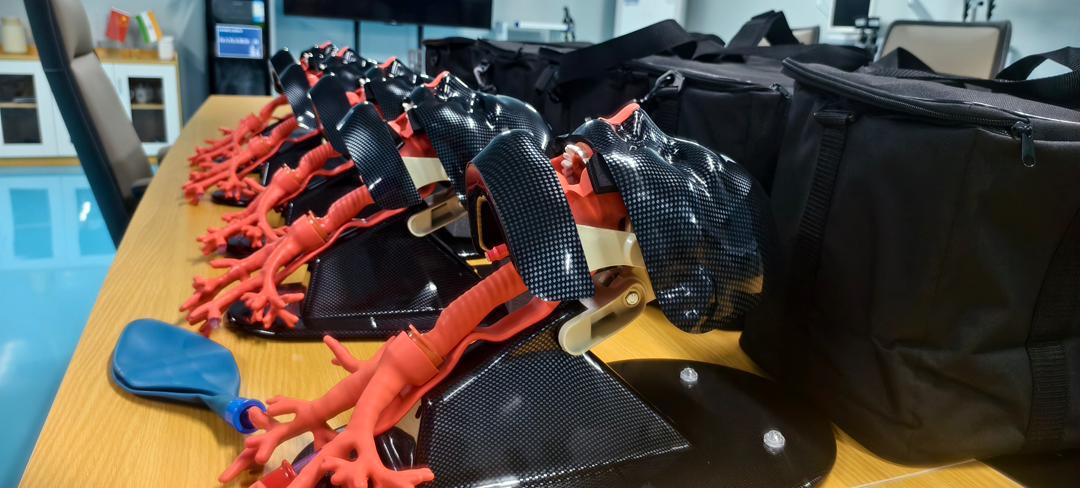
Airway training on a manikin: a typical setting for evaluating a laryngoscope before a departmental rollout.
What it does not show. This is a supplier-reported case summary, not a controlled clinical study. It does not establish first-pass success rates against another device, does not compare blade materials, and does not prove that the same outcome will repeat in a different patient population or operator group. Treat it as deployment context — evidence that the portfolio has been used at this scale and in these settings — and keep your own acceptance testing and clinical governance in place.
Certification and Manufacturing Checks Before You Commit
Three verification questions decide most supplier evaluations: does the quality system certificate cover the product you are buying, does the CE documentation name the model and remain in date, and can the manufacturer show the process behind the product? The portfolio records answer the first two in writing and support the third with company-reported capability data.
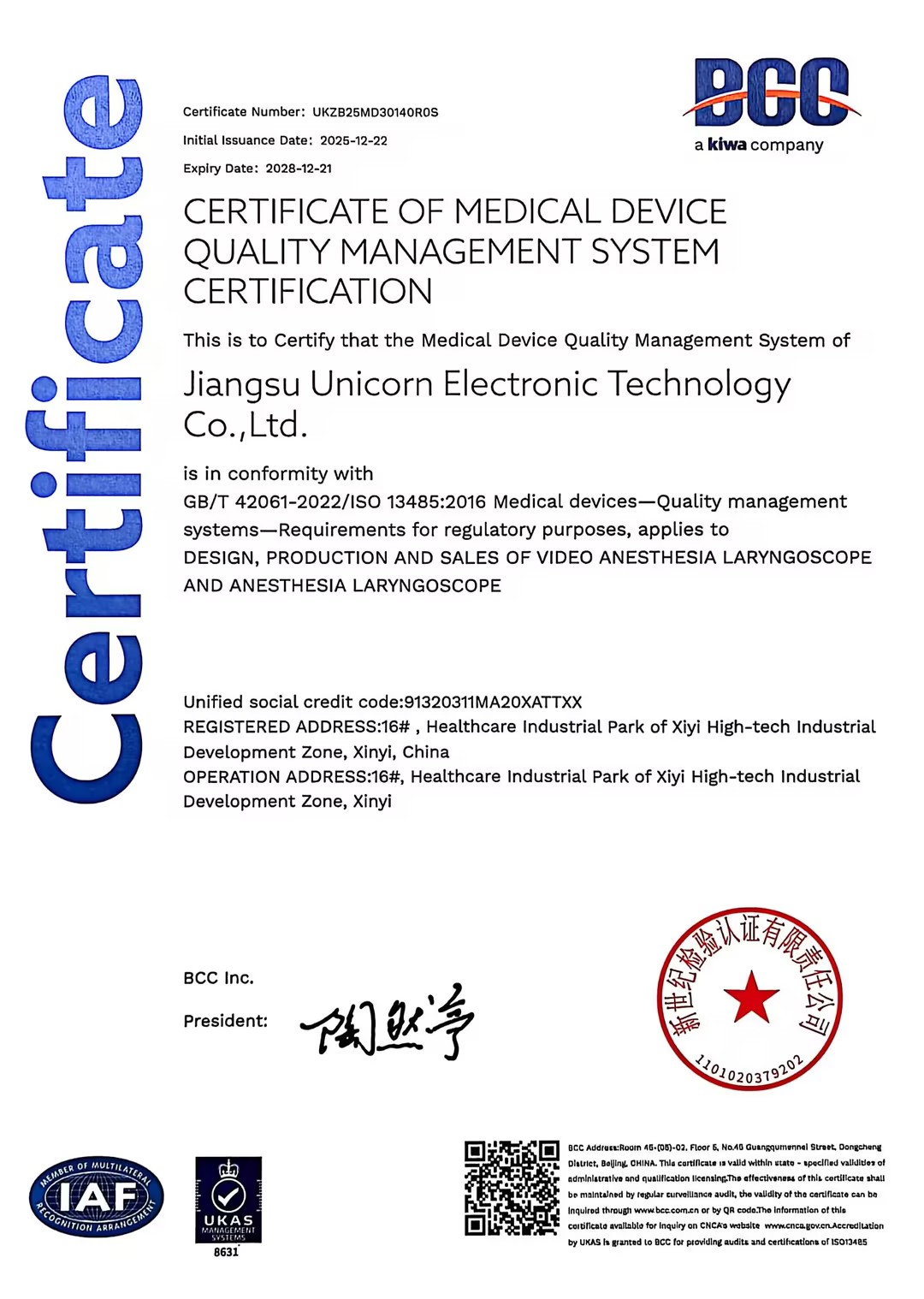
The ISO 13485:2016 certificate is valid to 21 December 2028 and its scope names video anesthesia laryngoscopes.
On the quality system side, the ISO 13485:2016 certificate UKZB25MD30140R0S was issued by BCC on 22 December 2025 and expires 21 December 2028, covering design, production and sales of video anesthesia laryngoscope and anesthesia laryngoscope. On market access, the CE Notification Certificate (Medical Device MDR) RPS/5400/2022 runs from 7 December 2022 to 6 December 2027 through the EU Authorized Representative Medurion S.L. Two checks remain the buyer’s: confirm in the certificate annex that your specific model is inside the certified scope, and confirm that the regulation cited on the certificate matches the market you are entering.
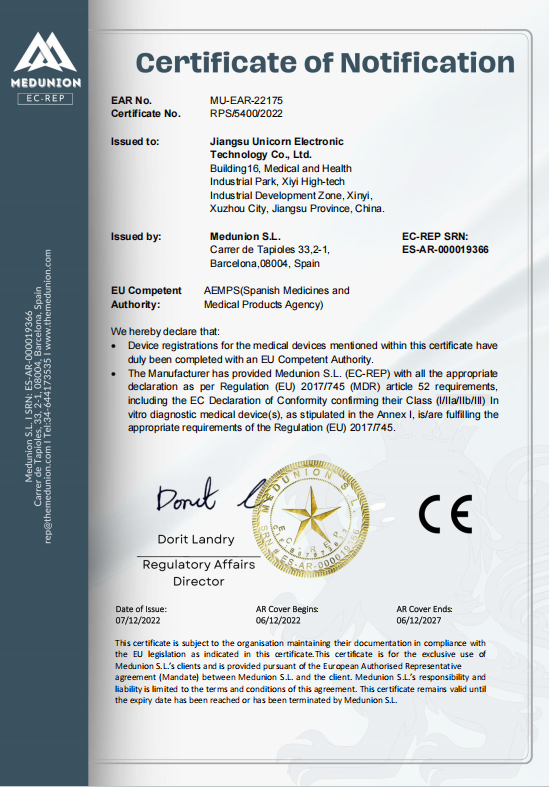
CE certificate RPS/5400/2022 is valid to 6 December 2027; check the annex against the exact model ordered.
The manufacturer behind the portfolio is Jiangsu Unicorn Electronic Technology Co. Ltd., founded in 2020, operating workshops of more than 40,000 m² across seven regional offices, with 20+ R&D engineers, a 70% export ratio, Class 100 and Class 1000 sterile production areas and BSL-1 and BSL-2 R&D centres. These are company-reported figures. They are useful for an initial capability screen and should be verified through a supplier questionnaire, a certificate check or an audit before they are relied on in a tender document.
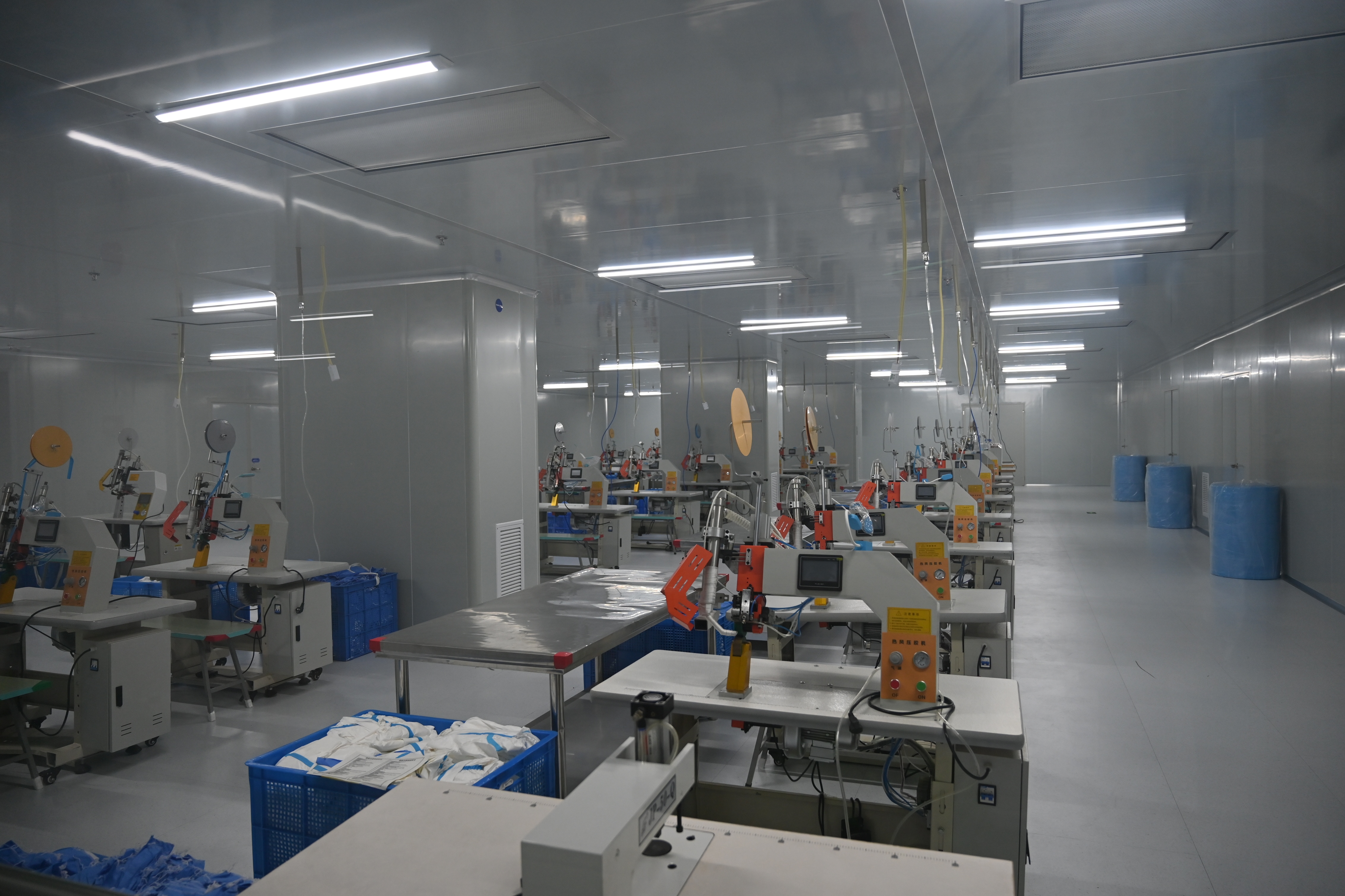
Company-reported production site; verify capacity and process controls through a supplier questionnaire or audit.
Procurement Essentials: MOQ, Incoterms, Payment and Acceptance Testing
The commercial terms recorded for this portfolio are short enough to put in a table of their own. The capability record lists a minimum order quantity of 1 unit, OEM/ODM support with screen logo and power on/off logo customisation, a lead time of 30–45 days, a monthly capacity of 500 units, 100% testing and remote after-sales support. Quotation terms are FOB or CIF depending on the destination, with 30% deposit and 70% payable before shipment. A pre-shipment acceptance test is part of the arrangement, which means the buyer can inspect units and confirm they match the ordered specification before the balance is released.
Three practical notes on those terms. First, confirm the MOQ for your exact configuration in the quotation — the capability record states 1 unit, and that figure should be matched to the model, accessories and logo customisation you order. Second, tie the 70% balance to the acceptance test result rather than to a shipping date, so the test has commercial weight. Third, ask for the test checklist in advance and state what you will check: imaging performance, light output, battery behaviour where applicable, labelling, and the model and certificate reference on the device and packaging.
For buyers who need the full range in one document, the Unicorn product catalogue (2026) covers the laryngoscope models alongside the wider endoscopy range. Company details and the current portfolio are published at unicornendoscope.com.
FAQ
What should buyers verify when comparing top laryngoscope manufacturers in China?
A shortlist of Chinese laryngoscope manufacturers should be verified at certificate and model level rather than by reputation. Ask for the ISO 13485:2016 certificate number, issuing body, scope and expiry date — Unicorn’s record, for example, is UKZB25MD30140R0S, issued by New Century Inspection & Certification Co., Ltd. (BCC), valid from 22 December 2025 to 21 December 2028 for the design, production and sales of video anesthesia laryngoscopes. Then confirm the CE documentation (Unicorn: certificate RPS/5400/2022 through Medurion S.L., valid to 6 December 2027), the model-level specification sheet with its units, the MOQ recorded for the configuration (1 unit on Unicorn’s capability record) and the lead time (30–45 days). Finish with sample evaluation and pre-shipment acceptance testing. A sample request and a formal quotation can be raised against any of the three models before a purchase decision is made.
Conclusion: A Decision Rule You Can Apply in One Meeting
Rank the BMS-FA first if your department carries a heavy rigid-blade intubation load and already runs a reprocessing loop. Choose the BMS-YA where the same ≥3.72 lp/mm imaging platform is wanted with a PC blade, or where several sites need one specification but different blade materials. Add the BMR as the third device for respiratory assessment and the cases a rigid blade cannot reach — and move it to first place if your department is respiratory-led rather than anesthesia-led.
The decision then rests on four verifiable items rather than on adjectives: the certificate numbers and their expiry dates, the model-level specifications with their units, a sample evaluated on your own anatomy and working distance, and a purchase order that fixes MOQ, incoterms, the 30/70 payment schedule and the pre-shipment acceptance test. For a quotation, a sample or the current catalogue, contact Alice Gong at +86 17512677733 or gongting@unicornchina.top.
Have Questions or Need More Details?
Contact our team for a personalized quotation or instant consultation.
Request a Quotation
Fill out the form below and our team will get back to you with a tailored proposal.
WhatsApp Direct Chat
Prefer to chat in real-time? Message us on WhatsApp for instant assistance & quick answers.
- Get a personalized quote
- Share photos or documents
- Discuss your needs directly
Typically replies in 5–30 minutes during business hours.