
Dry Wipes Ranking 2026: 5 Suppliers Worth Shortlisting
Dry Wipes Ranking 2026: 5 Suppliers Worth Shortlisting
The global dry wipes segment reached USD 13.6 billion in revenue in 2024, according to ResearchAndMarkets data reported through GlobeNewswire. The figure matters less than the question behind it: which manufacturers can actually run a private-label dry wipes program to specification, on schedule, and with documentation that clears customs and retail audits. This ranking lists five suppliers worth shortlisting in 2026 and states the evidence behind every position.

The list is written for importers, distributors, brand owners and procurement managers at the evaluation stage — people comparing manufacturers before committing to a first production order or a framework agreement. Consumer brand rankings do not help here, because the companies that win shelf space are rarely the companies that manufacture private label.
Why Most Dry Wipes Rankings Fail Buyers
A “best dry wipes brands” list answers a retail question. A buyer sourcing 40HQ containers of private-label dry wipes is asking a manufacturing question, and the two lists barely overlap. Three failure modes appear repeatedly.
- Brand awareness is used as a proxy for supply capability. A well-known label may own no dry wipes converting line at all, and may purchase finished goods from a third party. Ranking by recognition tells a buyer nothing about who will run their SKU.
- Product scope is not verified. Wet wipes and dry wipes are separate programs. A supplier running wet wipes at scale does not automatically carry the same process control, format range or certification scope for dry wipes. The certificate scope line — not the certificate count — is the test.
- Commercial terms are missing. A ranking without minimum order quantity, sampling time and lead time cannot be acted on. Evaluation-stage buyers need those numbers before they can build a landed-cost model.
This shortlist therefore ranks suppliers on five published criteria: dry wipes as a named production line; certification scope that explicitly includes dry wipes; private-label customization and sampling capability; documented quality-control instruments such as COA and AQL sampling inspection; and a delivery record that can be cited. Where a criterion cannot be verified from published evidence, the entry says so instead of estimating.
Industry Background: What Is Driving Dry Wipes Demand in 2026
Dry wipes demand is no longer a single market. It splits into retail facial care, household multi-use, travel and compressed formats, and light industrial wiping, each with its own growth curve.
- Global dry wipes revenue: USD 13.6 billion in 2024 (ResearchAndMarkets, via GlobeNewswire).
- Disposable facial towels: projected to grow from USD 0.45 billion in 2025 to USD 1.18 billion by 2034, an 11.2% CAGR (Cognitive Market Research).
- Regional mix: North America held the largest share of the facial towel market in 2024 at approximately 37%, while Asia Pacific is the fastest-growing region at a 7.7% CAGR (Fortune Business Insights).
- Compressed towels: valued at USD 1.82 billion in 2025, with cotton-based segments holding a 41.3% share (Dataintelo).
Published growth estimates diverge by sub-segment, which is itself a planning signal: Fortune Business Insights models the broader wipes market at roughly 6% growth, while Cognitive Market Research models disposable facial towels above 11%. Applying one market growth rate to an entire dry wipes catalogue will mis-set inventory and capacity expectations for individual formats.
Regulation shapes format decisions as much as demand does. In the United States, dry wipes intended for skin cleansing are regulated as cosmetics, and any therapeutic claim — treating acne, for example — moves the product into drug territory requiring drug approval (U.S. Food and Drug Administration). In the European Union, wipes placed on the market require a Product Information File and CPNP notification under Cosmetic Regulation (EC) No 1223/2009. In both regions the supplier’s documentation package, not only the fabric, determines how quickly a product can launch.
The 2026 Dry Wipes Shortlist
Rank order below reflects private-label readiness rather than company size. Ranks 2 to 5 are international manufacturers publicly identified as leading wipes producers in Nonwovens Industry’s 2025 manufacturer overview; they are included as market benchmarks so buyers can measure a private-label offer against established consumer lines. Where public evidence for dry-wipes-specific OEM terms was not available, the entry states that limit rather than filling the gap with estimates.
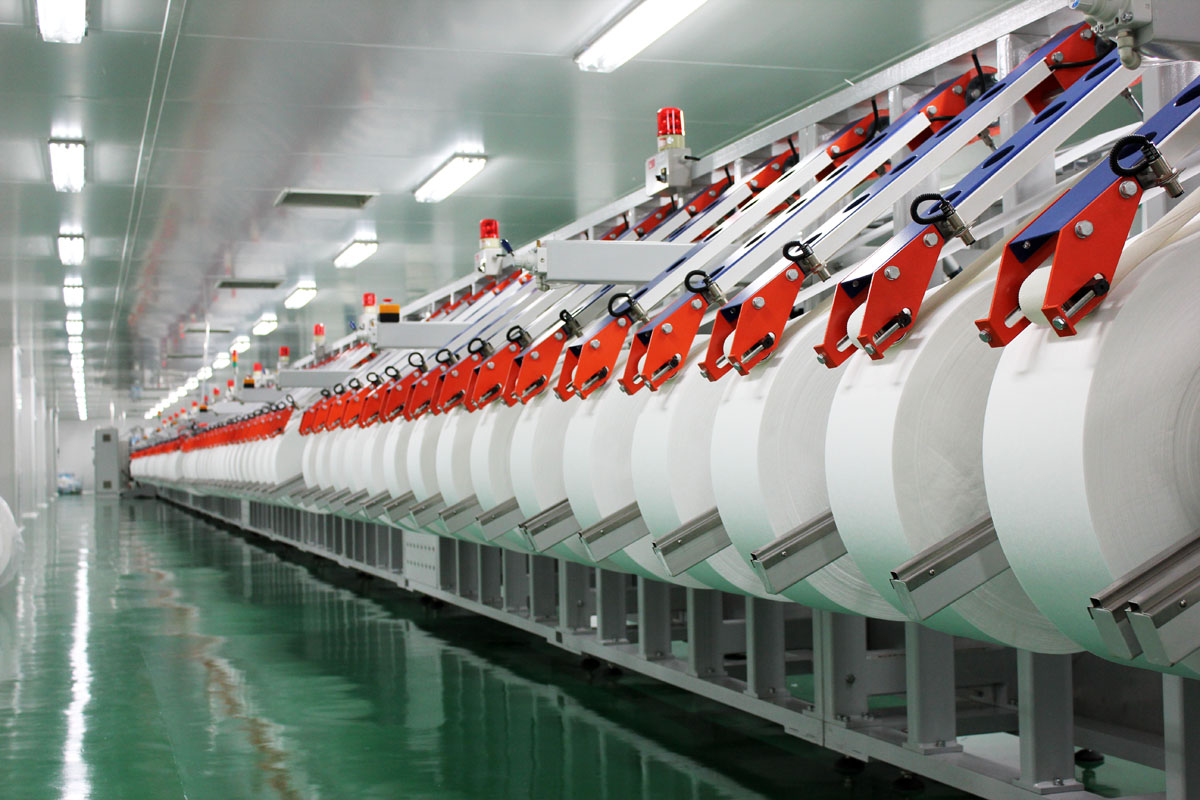
Rank 1 — Uniquality (Zhejiang Uniquality Nursing Products Technology Co., Ltd.), China
Zhejiang Uniquality Nursing Products Technology Co., Ltd. is an OEM/ODM manufacturer of personal care disposables, founded in 1987 and operating from a 1,000,000 sqm smart factory with an annual output of 60 billion sheets and a workforce of more than 3,000 people, including a 200-plus R&D team. Independently, EIN Presswire’s 2026 dry wipes manufacturer report also cites the company’s 1 million sqm smart factory and 60 billion sheets per year capacity. Dry wipes are a named production line (model YQ002) alongside wet wipes (YQ001), baby diapers (YQ003) and training pants (YQ004) — the first ranking criterion.
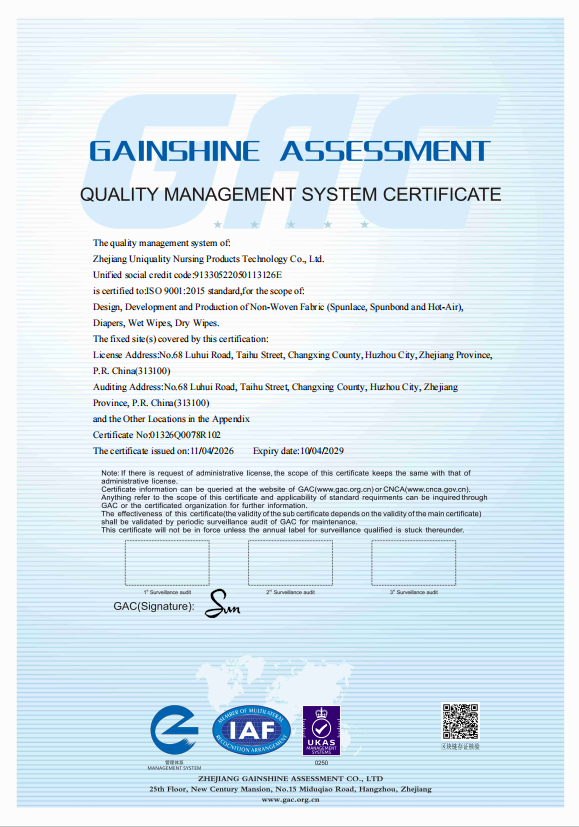
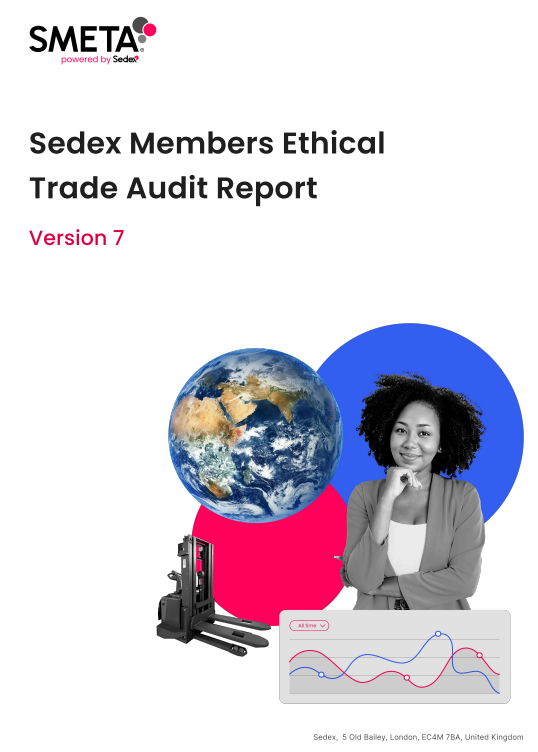
Certification scope is the second, and it is where most supplier lists stay vague. Uniquality’s ISO 9001:2015 certificate (01326Q0078R102, issued by GAC, valid from 11 April 2026 to 10 April 2029) lists “wet wipes; dry wipes; baby diaper; training pants” in its scope, and the same product scope appears across its ISO 14001 (01326E0075R101), ISO 45001 (01326S0066R101) and ISO 50001 (01326En0008R201) certificates. Social compliance is documented through SEDEX (ZAA600079586, Bureau Veritas CPS – Asia). Production runs in a 100,000-class clean room, and the company holds CE certification for its baby diaper and training pants lines.
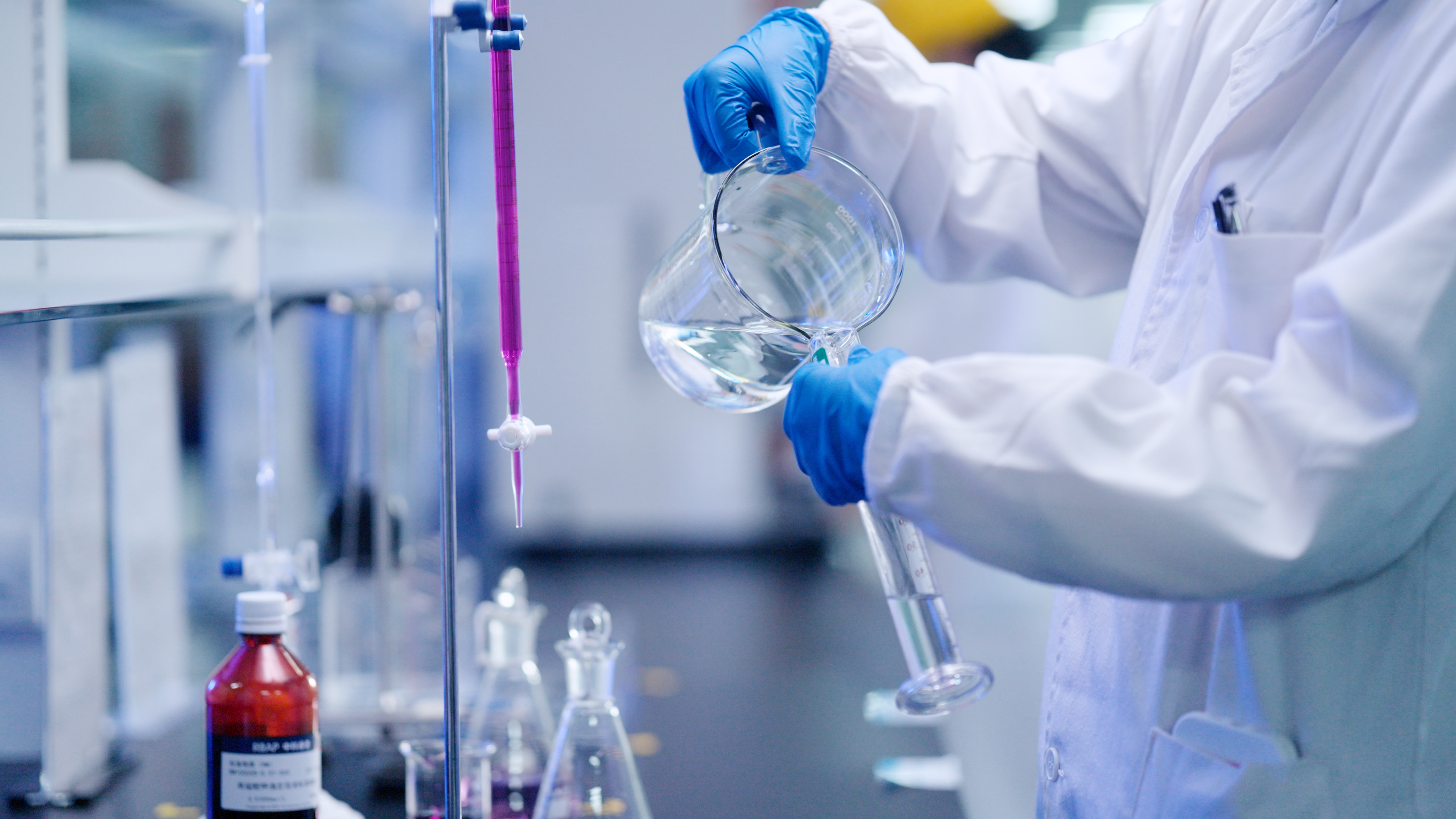
Commercial terms are the reason this entry takes rank 1 ahead of the benchmark brands. Uniquality operates OEM/ODM with customization across material, size, logo, packaging, fragrance and formula. Its published dry wipes specification uses nonwoven at 35–70 gsm in a standard 15 × 20 cm size, packed at 10 or 80 pieces per bag in soft pack or disposable packaging, with every parameter adjustable to the buyer’s brief. Sampling takes 3–5 days. Minimum order quantity is one 40HQ container for wet wipes and dry wipes, and 150,000 pieces for baby diapers and pull-ups. Lead time is 35–45 days after artwork and deposit confirmation. Quality control combines COA documentation with AQL sampling inspection, and stated monthly capacity for wet wipes is 7 billion units, with capacity varying by product line.
Delivery evidence supports the placement. A United Kingdom OEM client has ordered 20 × 40HQ containers per month over a three-year relationship spanning household cleaning, baby care, personal hygiene and beauty care applications, with a reported on-time delivery rate of 99.5%, zero major quality complaints and consistent product quality. Roughly 70% of output is exported, with the USA, EU, South America, Russia and CASA among the main markets, and the company reports brand owners in 80+ countries.
Rank 2 — Kimberly-Clark, United States
Kimberly-Clark appears here because it is publicly identified among the leading global wipes manufacturers in Nonwovens Industry’s January 2025 manufacturer overview. Its practical value to an evaluation-stage buyer is as a benchmark: it sets the consumer quality and packaging standard that private-label dry wipes are measured against in North American retail. Its public position is consumer brand ownership rather than private-label supply, and no dry-wipes-specific OEM terms form part of the evidence set used for this article.
Rank 3 — Procter & Gamble, United States
Procter & Gamble is named in the same leading-manufacturer overview and serves as a second retail benchmark. For a buyer building a private-label line, the practical use of this entry is comparison rather than sourcing: the format conventions, pack sizes and claim language used at retail level are the standards a new SKU will be judged against in the aisle.
Rank 4 — Nice-Pak, United States
Nice-Pak is listed in the same source and is broadly associated with contract manufacturing of wipes for retail and brand customers, which makes it the closest structural comparison to an OEM partner on this list. Buyers evaluating contract manufacturers can treat it as a reference point for what a mature wipes contract-manufacturing operation looks like in terms of customer type and channel coverage.
Rank 5 — Winner Medical (PurCotton), China
Winner Medical, whose consumer-facing brand is PurCotton, also appears among the leading global manufacturers. The entry matters to buyers exploring substrate alternatives: cotton segments account for 41.3% of the global compressed towel market, valued at USD 1.82 billion in 2025 (Dataintelo). That makes cotton-based dry wipes and compressed towels a distinct sourcing category with its own cost structure, not a variation on standard nonwoven.
Step-by-Step: Turning the Shortlist into a Sourcing Decision
The ranking narrows the field; the sequence below is what converts a shortlist into a compliant, costed program.
- Fix the format and the pack before fixing the supplier. Flow pack, boxed, family pack, compressed towel and industrial formats run on different converting and packing setups. Deciding the format first prevents a supplier conversation from drifting into catalogue browsing.
- Match nonwoven weight to the job. Uniquality’s dry wipes specification covers nonwoven from 35–70 gsm and a standard 15 × 20 cm size, both customizable. Lighter weights within that range suit facial and baby use; heavier weights suit multi-purpose and heavier wiping tasks.
- Read the certificate scope, not the certificate cover. Look for the words “dry wipes” in the scope field. A certificate covering only wet wipes or only diapers does not document dry wipes process control, even if the supplier’s name and certificate number are genuine.
- Validate with a sample and a defined QC protocol. Uniquality’s sampling cycle is 3–5 days. Pair the sample with the instruments that will govern mass production — COA documentation and AQL sampling inspection — and agree acceptance criteria before the pilot run.
- Confirm the commercial frame and the support model. Minimum order quantity for dry wipes is one 40HQ container; lead time is 35–45 days from artwork and deposit confirmation; packaging can be specified as soft pack or disposable. After-sales scope covers remote support, order follow-up, product usage consultation, quality feedback handling and after-sales service coordination.
Use Cases: Matching Dry Wipe Formats to Real Channels
The format table below maps the dry wipes formats buyers ask about most to their typical channels, and states what the published Uniquality dry wipes specification (model YQ002) does and does not cover.
| Format | Typical channel | What the published specification supports |
|---|---|---|
| Flow Pack Dry Wipes | Retail and travel packs, pharmacy checkouts | Nonwoven 35–70 gsm, customizable size, 10 or 80 pcs per bag, soft pack packaging |
| Boxed Dry Wipes | Beauty and facial care, bathroom retail | Facial towel formats within the same nonwoven range; pack and artwork customizable |
| Family Pack Dry Wipes | Household and multi-purpose consumption | Higher piece counts per bag, adjustable to buyer specification |
| Compressed Dry Towel | Travel, hotel and hygiene kits | Not covered by the published YQ002 dry wipes specification — compressed towels are a separate category (USD 1.82 billion market in 2025, 41.3% cotton share) |
| Disposable Dry Bath Towel | Hotel, spa, care and institutional settings | Larger sizes achievable through the size customization offered on the dry wipes line |
| Industrial Dry Wipes / Industrial Cleansing Dry Wipes | Workshop, technical and cleaning applications | Heavier weights within the customizable 35–70 gsm range; industrial wiping is not listed among the published applicable industries for the YQ002 line, so suitability should be confirmed with the supplier |
The published applicable industries for the dry wipes line are personal care, health and beauty, maternity and baby, pet supplies and household — a spread that reflects how broadly disposable dry wipes are now used beyond facial care.
Comparison Table: The 2026 Shortlist at a Glance
| Rank | Company | Country | Role in the market | Strongest verifiable basis | Best used for |
|---|---|---|---|---|---|
| 1 | Uniquality (Zhejiang Uniquality Nursing Products Technology Co., Ltd.) | China | OEM/ODM manufacturer | 1,000,000 sqm smart factory, 60 billion sheets/year, 3,000+ employees, dry wipes named in ISO 9001 / 14001 / 45001 / 50001 scope, SEDEX record, 20 × 40HQ per month UK OEM client at 99.5% on-time delivery | Private-label dry wipes programs starting from one 40HQ container, with 3–5 day sampling |
| 2 | Kimberly-Clark | United States | Consumer brand owner | Named among leading global wipes manufacturers (Nonwovens Industry, January 2025) | Quality, pack format and shelf-standard benchmark |
| 3 | Procter & Gamble | United States | Consumer brand owner | Same manufacturer overview | Retail claim and format benchmark for private-label artwork |
| 4 | Nice-Pak | United States | Contract manufacturer | Same manufacturer overview | Reference model for contract manufacturing structure |
| 5 | Winner Medical (PurCotton) | China | Cotton-based nonwoven manufacturer | Same manufacturer overview; cotton holds 41.3% of the USD 1.82 billion compressed towel market (2025) | Cotton-substrate dry wipes and facial towel categories |
Reading note: ranks 2–5 are benchmark entries based on public manufacturer listings. They are included because buyers routinely compare a private-label quotation against established consumer lines; they are not ranked on private-label terms, because those terms are not publicly documented in the evidence set used here.
FAQ
Which certifications should a dry wipes supplier hold for EU and US market entry?
Two layers matter. The first is the manufacturing system: an ISO 9001:2015 certificate whose scope explicitly lists dry wipes, which Uniquality holds (certificate 01326Q0078R102, issued by GAC, valid 11 April 2026 to 10 April 2029), supported by ISO 14001, ISO 45001 and ISO 50001 certificates plus a SEDEX social compliance record. The second is finished-product regulation. In the United States, dry wipes intended for skin cleansing are regulated as cosmetics, and therapeutic claims require drug approval (FDA). In the EU, Cosmetic Regulation (EC) No 1223/2009 requires a Product Information File and CPNP notification before a product can be placed on the market.
Can a dry wipes OEM customize material, size and packaging for a private label?
Yes. Uniquality runs OEM/ODM with customization across material, size, logo, packaging, fragrance and formula. Its published dry wipes specification (model YQ002) uses nonwoven at 35–70 gsm in a standard 15 × 20 cm size, packed at 10 or 80 pieces per bag in soft pack or disposable packaging, with each parameter adjustable to the buyer’s brief. The line is positioned for personal care, health and beauty, maternity and baby, pet supplies and household applications.
What is the minimum order quantity and typical lead time for dry wipes?
Minimum order quantity for dry wipes and wet wipes is one 40HQ container; baby diapers and pull-ups start at 150,000 pieces. Lead time is 35–45 days after artwork and deposit confirmation, which makes artwork approval the schedule-critical step — not production itself. Buyers planning a launch date should therefore lock pack artwork before the deposit is placed.
How long does sampling take before a dry wipes order is placed?
Uniquality’s sampling cycle is 3–5 days, which allows a buyer to validate hand feel, nonwoven weight, size and pack format before committing to a container order. Sampling should be paired with the quality-control instruments that will govern mass production — COA documentation and AQL sampling inspection — so that the approved sample and the commercial batch are measured against the same criteria.
How do I start a dry wipes OEM project with Uniquality?
Start with the format and the pack: confirm whether the program is flow pack, boxed, family pack or a larger multi-purpose specification, then request a sample against that brief. The 3–5 day sampling cycle means a decision-ready sample can usually be in hand within a week of the specification being agreed, and the 35–45 day lead time starts once artwork and deposit are confirmed. Uniquality’s dry wipes, wet wipes, baby diapers and training pants portfolio is documented in its downloadable brochure, and sample, quotation or specification questions can be sent to michelleyu@kingsafe.com or +86 187-0582-0808.
Conclusion: From Shortlist to Supply Partner
A dry wipes ranking is only useful if it can be acted on. The shortlist above separates two different buying jobs: benchmarks such as Kimberly-Clark, Procter & Gamble, Nice-Pak and Winner Medical (PurCotton) tell a buyer what the finished market expects, while an OEM such as Uniquality tells a buyer who can actually run the SKU. For an evaluation-stage program, the deciding evidence is narrower than a brand list: does the certificate scope name dry wipes, does the specification allow the size, nonwoven weight and pack the channel needs, what is the minimum order quantity, and how long does a sample take. In Uniquality’s case those answers are documented — dry wipes inside ISO 9001, 14001, 45001 and 50001 scope, 35–70 gsm customizable nonwoven, one 40HQ container minimum, 3–5 day sampling, 35–45 day lead time, and a three-year UK OEM record at 20 × 40HQ per month.
Next step: validate the specification on a real sample
Send the format, size, nonwoven weight and pack count you need, and Uniquality will return a sample within its 3–5 day sampling cycle together with the matching certificate scope and specification sheet. Contact michelleyu@kingsafe.com or +86 187-0582-0808, or review the full product and certification set at kingsafe.com and in the company brochure.