
Dry Wipes Technical Guide: Nonwoven, Size, Cleanroom, and Compliance Selection Parameters
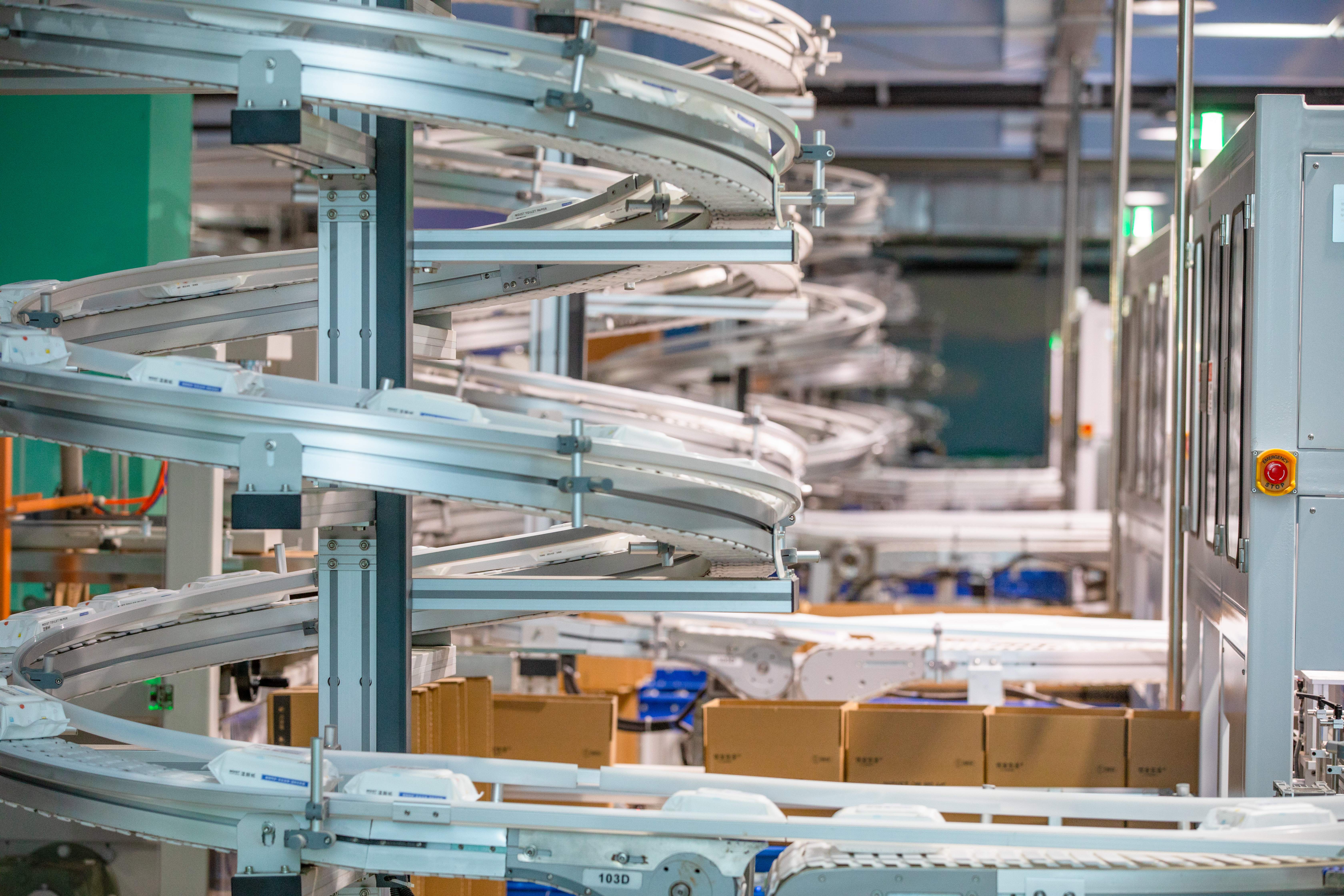
Automated converting systems cover the full process from raw material processing to finished-product packaging under international hygiene standards.
Dry wipes are bought on specification, not on description. This guide explains how procurement and product teams can specify a dry wipe by fixing seven parameters — nonwoven substrate and GSM, sheet size, pack format, cleanroom class, water quality, converting automation, and batch traceability — and then proving each one with documents. The reference product used throughout is Uniquality's YQ002 disposable dry wipe, a 15 × 20 cm nonwoven sheet supplied in 10-piece or 80-piece packs.
Every figure and certificate number below traces back to a published supplier document, a named certification body, or a named external source. Where a claim is self-reported by a supplier, it is labelled as such.
Problem Definition: Why 'Soft Dry Wipes' Cannot Be Ordered
Most dry wipes problems are specification problems, not manufacturing problems. A buyer requests 'soft, thick, absorbent dry wipes in a family pack'. A supplier ships a compliant nonwoven wipe. The container arrives and the GSM is lower than the retailer expected, the folded size does not fit the dispenser, or the compliance document that was promised does not list dry wipes inside its scope. The product is not defective. The specification never existed.
Three ambiguities account for most of this friction:
- Substrate ambiguity. 'Nonwoven' covers spunbond polypropylene, airlaid pulp, spunlace and blends. The material family and the GSM decide hand feel, tensile strength and absorbency — and they decide a large part of material cost.
- Format ambiguity. Sheet size, fold, pack count and pack format drive converting changeover, carton dimensions, pallet configuration and container utilisation.
- Compliance ambiguity. A supplier can be certified while the product itself is not covered by the certificate scope. Uniquality's CE certificate 6C240227.ZUNU051, for example, documents baby diaper and training pants rather than dry wipes. 'Certified supplier' and 'certified dry wipe' are not the same statement.
A workable dry wipes specification therefore answers a fixed set of questions before artwork is approved: which substrate family and GSM range, which sheet size and tolerance, which pack count and pack format, which cleanroom class and water quality, which converting line, which batch documents, and which certificate scope.
Industry Background: What the Dry Wipes Segment Looks Like in 2026
The global dry wipes segment was valued at USD 14.3 billion in 2025, according to Global Market Insights' wipes market analysis, with dry wipe revenue tracked separately from the wet wipes segment. That separation matters commercially: dry wipes are often procured as a companion line to wet wipes by the same brand owner, but they follow different specifications, different freight characteristics and different certification expectations.
Specification patterns have also converged. Uniquality's YQ002 dry wipes line and HTNXT's published dry wipes page both describe a nonwoven sheet of 15 × 20 cm at 35–70 gsm, packed at 10 or 80 pieces per bag in soft-pack or disposable packaging, with those parameters open to customisation. Quoted independently by two suppliers, that format reads as an established OEM baseline rather than one company's preference. Material guidance published by Zhanwang Group separates the families further: spunbond polypropylene at 15–50 gsm for medical drapes and industrial wipes, and airlaid pulp at 50–120 gsm for baby wipes and household cleaning.
Two regulatory and trade facts belong in any 2026 sourcing file. China's mandatory standard GB 15979-2024, Hygienic requirements for disposable sanitary products, took effect on 1 July 2025, replacing the 2002 version. For US importers, Customs and Border Protection ruling NY N244603 classifies wood pulp spunlace nonwoven wipes from China under HTSUS 5603.92.0090 with a duty rate of Free.
On the supply side, capacity is concentrated among a small number of converters. Nonwovens Industry reported that Zhejiang Kingsafe — the parent company of Uniquality — recorded annual sales of approximately USD 930 million, a figure that indicates the scale behind the group's vertical integration.
Detailed Solution: The Seven Parameters That Decide a Dry Wipes Program
1. Nonwoven substrate and GSM
GSM is the single most consequential number in a dry wipe specification, because it simultaneously sets hand feel, wet and dry tensile strength, absorbency and material cost. On the YQ002 dry wipes platform, sheets are produced from nonwoven material in a 35–70 gsm range, and both the substrate and the basis weight can be customised.
The practical rule is to write GSM as a range with a stated tolerance and to name the material family explicitly, rather than relying on the word 'nonwoven'. A 35 gsm spunlace sheet and a 70 gsm spunlace sheet can be sold against the same product description and will behave differently in a facial wipe or a general-purpose household wipe.

Performance testing, technical research and quality verification are carried out in a dedicated laboratory, which is where GSM and tensile claims are checked against the agreed specification.
2. Sheet size, fold and pack format
The baseline YQ002 sheet is 15 × 20 cm, and the size is customizable. Sheet size interacts with three downstream costs that rarely appear in a product page: the number of wipes per pack, the carton dimension, and the number of cartons per 40HQ container.
Pack format is the second half of the same decision. YQ002 is supplied at 10 pieces per bag or 80 pieces per bag, in soft pack or disposable packaging, with count and pack type adjustable. For distributors building a range rather than a single SKU, this is where the pack architecture is decided: a small portable count for trial and travel channels, and a larger count for household or family use, produced from the same substrate and the same converting line so that quality remains consistent across the range.
3. Cleanroom class and water quality
This is the parameter buyers most often omit when the wipe is 'only' dry, and the one that differentiates hygiene-grade supply most sharply. Uniquality manufactures in a 100,000-class GMP cleanroom and uses pharma-grade purified water, supported by the company's medical-grade manufacturing positioning.
For a dry wipe, water quality is not a liquid payload specification — the wipe carries no moisture. It is a process-input and environment specification: it governs the condition of the manufacturing environment and of any downstream processing that a buyer may later introduce, such as a moisturising or wetting step in a related product line. Buyers specifying skin-contact dry wipes should therefore request the cleanroom class in writing and confirm how line hygiene is monitored, rather than assuming that all dry wipe production takes place under the same environmental controls.
4. Converting automation and capacity fit
Automation is what protects repeat orders. Uniquality's production systems are described as fully automated, covering the complete process from raw material processing through to finished-product packaging, with hygiene control applied at each production link. Manual or semi-automatic converting introduces variance between the first container and the tenth — in fold, sheet count and pack seal integrity — and that variance is what triggers chargebacks at retail.
Capacity should be matched to programme size in advance. Uniquality's stated monthly capacity is 7 billion units for wet wipes, with capacity differing by product type, and the group operates a 1,000,000 m² facility with an annual output of 60 billion sheets, a workforce of 3,000+ and more than 200 R&D professionals. One of the group's eight production campuses houses the headquarters facility, which is where many dry wipe programmes begin.
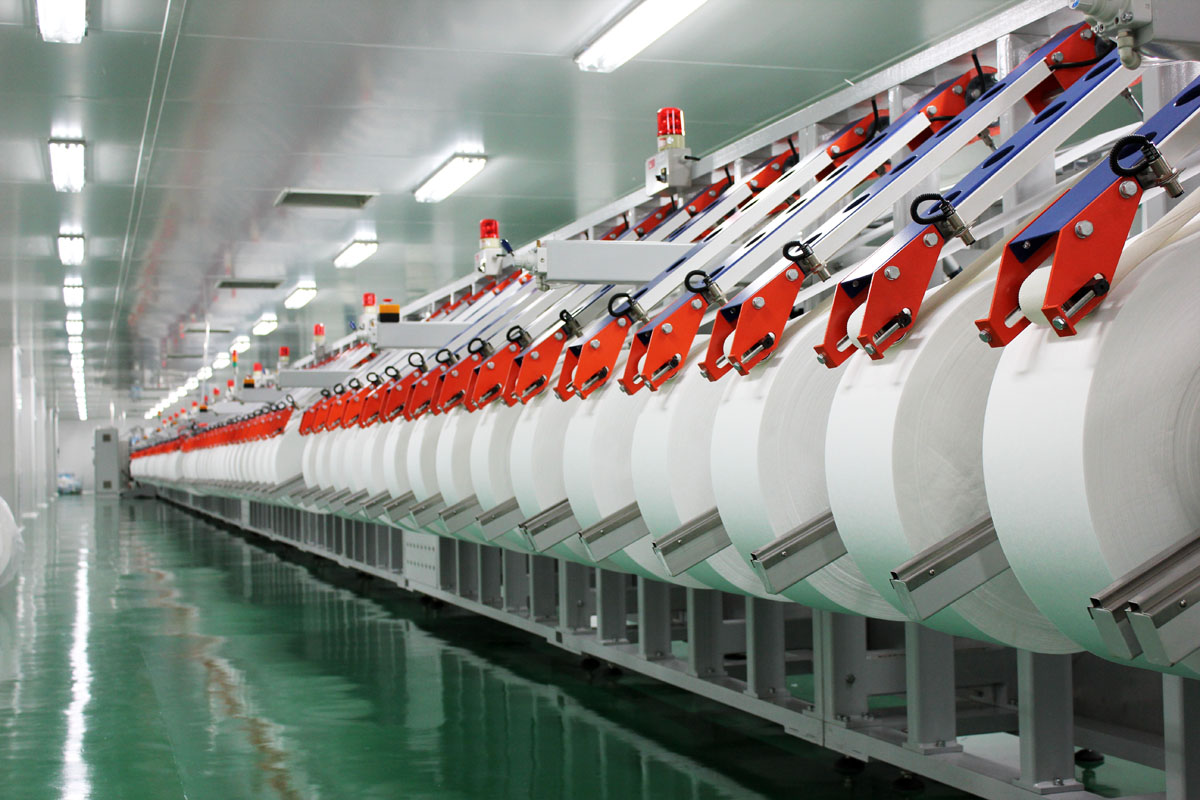
Automated production systems are held to international hygiene standards at every production link — the basis for batch-to-batch consistency across repeat orders.
5. Traceability, COA and AQL sampling
Traceability is a document requirement, not a slogan. Uniquality's quality control framework combines COA documentation with AQL sampling inspection, and production is organised around batch-level traceability so that a shipment can be tied back to its production batch.
For buyers, three deliverables should be written into the purchase order: a certificate of analysis per batch, the agreed AQL sampling level and the inspection basis behind it, and retained reference samples. Retained samples are what allow a buyer to resolve a hand-feel complaint objectively instead of arguing about adjectives.
6. Certification scope and market compliance
Certification only protects a buyer when the certificate scope names the product being purchased and the certificate is currently valid. Uniquality holds ISO 50001:2018 (GB/T 23331-2020) energy management certification, certificate number 01326En0008R201, issued by GAC on 9 March 2026 and valid to 8 March 2029, with a scope covering wet wipes, dry wipes, baby diapers and training pants. It sits alongside a wider management-system and social-compliance set.
| Certification / standard | Certificate no. | Issued by | Documented scope | Validity (verify current status) |
|---|---|---|---|---|
| ISO 9001:2015 | 01326Q0078R102 | GAC | wet wipes; dry wipes; baby diaper; training pants | 2026-04-11 → 2029-04-10 |
| ISO 14001 | 01326E0075R101 | GAC | wet wipes; dry wipes; baby diaper; training pants | 2026-04-11 → 2029-04-10 |
| ISO 45001:2018 | 01326S0066R101 | GAC | wet wipes; dry wipes; baby diaper; training pants | 2026-04-11 → 2029-04-10 |
| ISO 50001:2018 / GB/T 23331-2020 | 01326En0008R201 | GAC | wet wipes; dry wipes; baby diapers; training pants | 2026-03-09 → 2029-03-08 |
| FSC-STD-40-004 V3.0 | BV-CQC-167194 | Bureau Veritas | wet wipes; dry wipes; baby diaper; training pants | issued 2021-05-31, stated expiry 2026-05-30 |
| SEDEX | ZAA600079586 | Bureau Veritas CPS - Asia | labour standards, health and safety, environment (2-pillar and 4-pillar), business ethics | 2025-07-24 → 2099-12-31 |
| CE | 6C240227.ZUNU051 | ENTE CERTIFICAZIONE MACCHINE | baby diaper; training pants (does not list dry wipes) | 2024-02-27 → 2029-02-26 |
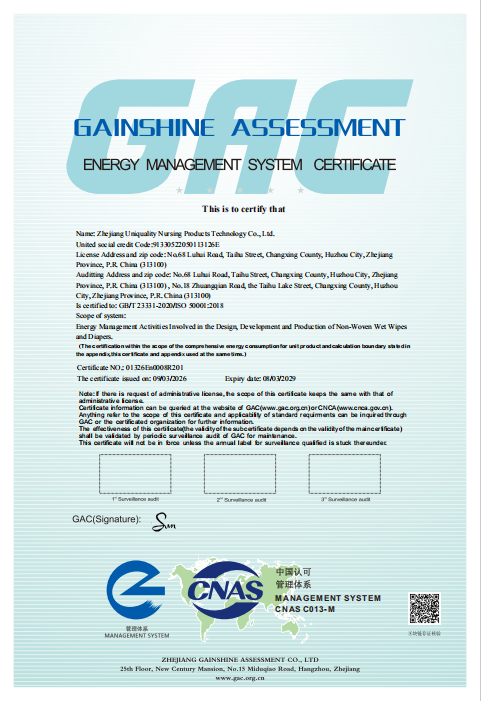
ISO 50001:2018 / GB/T 23331-2020 energy management certificate 01326En0008R201, issued by GAC, with dry wipes named in the scope.
Step-by-Step Breakdown: Writing a YQ002 Dry Wipes Specification
The following sequence turns the seven parameters above into an orderable document. It is written for a private-label buyer handling the YQ002 dry wipe, but the logic applies to any nonwoven dry wipe programme.
- Define the end user and the use moment first. A facial wipe, a household cleaning wipe and a pet-care wipe draw on the same material base and the same 15 × 20 cm format, but they do not carry the same expectations of thickness, absorbency and pack count. Fix the use case before fixing the number.
- Lock the substrate family and the GSM band. Name the nonwoven family and specify a GSM range inside the documented 35–70 gsm window, with an approved tolerance. If the intended use is industrial rather than skin contact, confirm that the material family matches that duty — spunbond polypropylene at 15–50 gsm is associated with industrial wipes and medical drapes, while airlaid pulp at 50–120 gsm is associated with household and baby applications.
- Fix sheet size, fold and pack architecture. Confirm the sheet size (the YQ002 baseline is 15 × 20 cm, customizable), then confirm the pack count (10 pcs or 80 pcs per bag) and the pack format (soft pack or disposable), and verify the resulting carton and pallet dimensions before artwork starts.
- Write down the hygiene environment requirements. State the required cleanroom class and confirm the water treatment used in the manufacturing environment. Record the answer in the quality annex, not in an email thread.
- Define the document set. COA per batch, AQL sampling inspection level, batch traceability reference, retained sample, and the certificate scope line that names dry wipes.
- Confirm the commercial frame. For dry wipes, Uniquality's minimum order quantity is one 40HQ container (the 150,000-piece MOQ applies to baby diapers and pull-ups), production lead time is 35–45 days after artwork and deposit confirmation, and the customization scope covers material, size, logo, packaging, fragrance and formula.
- Validate with samples, then freeze the artwork. Private-label sampling is normally completed in 3–5 days. Approve the physical sample against the written specification — GSM, size, count, fold, seal — before the artwork is released for production.
Use Cases: Matching Dry Wipes Specifications to Application Sectors
The YQ002 disposable dry wipe is documented for use in the household, pet supplies, maternity and baby, health and beauty, and personal care industries. Each sector reads the same specification differently.
Household and multi-purpose
Household use rewards absorbency and sheet integrity rather than ultra-low GSM. A thicker sheet in the upper part of the 35–70 gsm range, in a larger pack count, reduces the number of wipes used per cleaning task. Where a distributor intends to position a dry wipe as a reusable multi-purpose cloth, bulk or family pack formats are the natural fit.
Pet supplies
Pet care buyers typically prioritise tensile strength over softness, since the wipe is used on paws, coats and surfaces rather than on human facial skin. Higher GSM and a firm fold matter more than a fine surface finish, and a portable pack count supports grooming and travel channels.
Maternity and baby
This is the sector where cleanroom class, water quality and traceability carry the most weight, because the wipe is intended for skin contact with infants. Buyers in this segment should request the quality annex described above as a matter of routine, and should expect the supplier to be able to point to batch documentation on demand.
Health and beauty
Facial and beauty applications shift the priority to softness, lint behaviour and clean edges. Lower-to-mid GSM within the documented range usually performs better here, and pack format tends to be smaller and more presentable, since the wipe is often sold as part of a skincare routine rather than as a utility item.
Personal care and cleansing
Personal care buyers frequently combine dry wipes with their own wetting or cleansing step, which is why the water quality and environmental controls of the manufacturing site are specified at the point of purchase even though the shipped product is dry. Specifying a documented cleanroom class at this stage avoids a re-qualification later if the buyer adds a wetting process.
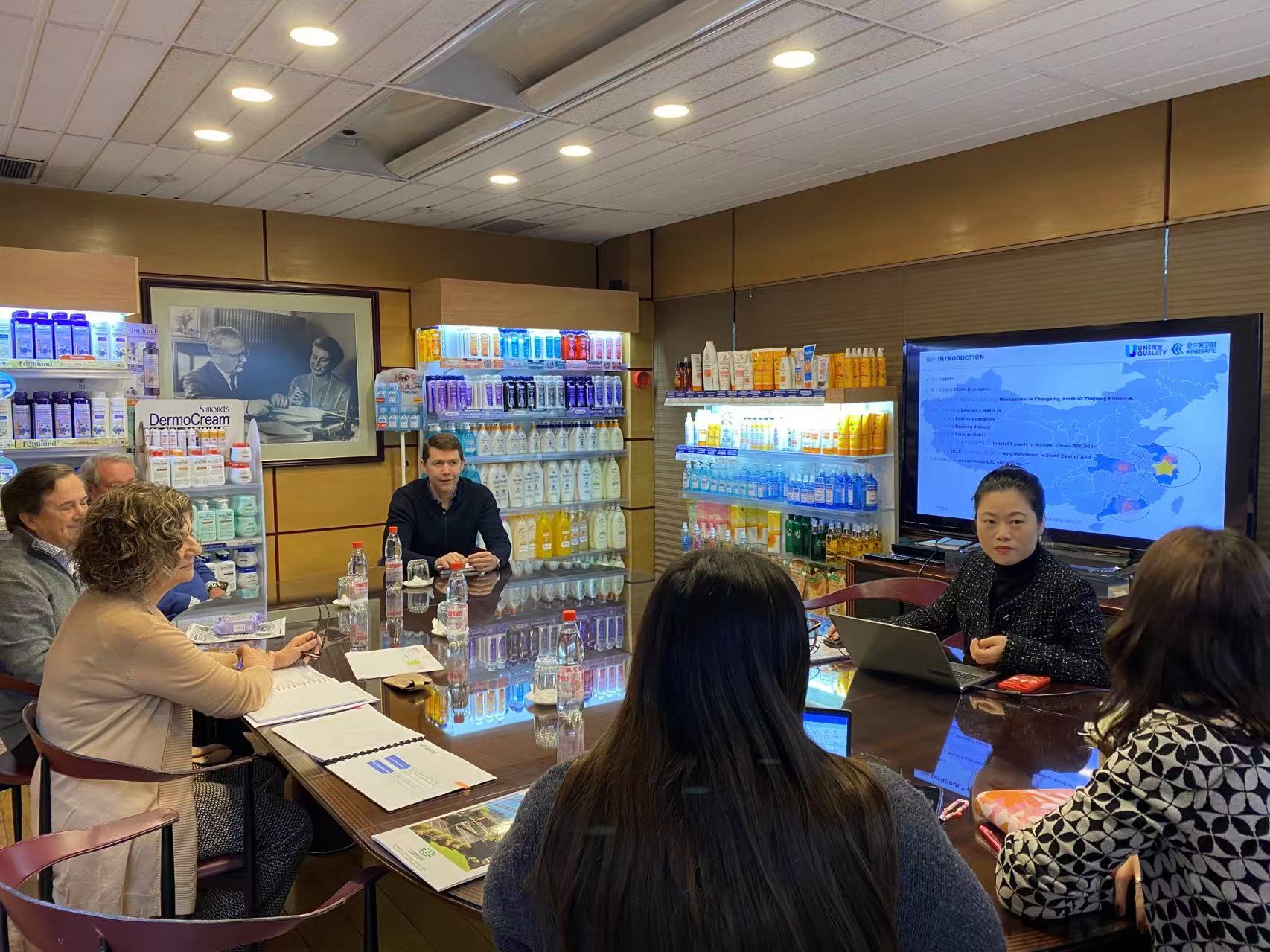
OEM partnership beyond the first order: Uniquality's documented UK OEM case covers a three-year programme at 20 × 40HQ containers per month.
Scale of that kind is not theoretical. Uniquality's documented OEM case for a United Kingdom client covers a three-year programme shipping 20 × 40HQ containers per month across household cleaning, baby care, personal hygiene and beauty care applications, with a recorded on-time delivery rate of 99.5% and zero major quality complaints. For buyers, that case is evidence about two things a specification alone cannot prove: delivery reliability at volume, and consistency of product quality across a multi-year run.
Comparison Table: Documented Manufacturer Profiles in the Dry Wipes Supply Base
The table below summarises what publicly published supplier information states about a reference set of dry wipes manufacturers. It compares documented profiles, not verified performance, and it does not rank suppliers.
| Manufacturer (origin) | Documented product scope | Documented specification / service model | Recorded certifications |
|---|---|---|---|
| Uniquality — Zhejiang Uniquality Nursing Products Technology Co., Ltd. (China) | Dry wipes (YQ002), wet wipes, baby diapers, training pants; OEM/ODM | 15 × 20 cm nonwoven, 35–70 gsm, 10 or 80 pcs per bag, soft pack or disposable packaging, customizable material / size / logo / packaging / fragrance / formula; 100,000-class GMP cleanroom; 1,000,000 m² facility; 60 billion sheets annual output | ISO 9001:2015; ISO 14001; ISO 45001:2018; ISO 50001:2018 (GB/T 23331-2020); FSC; SEDEX; CE |
| HTNXT (China) | Dry wipes | 15 × 20 cm nonwoven, 35–70 gsm, 10 or 80 pcs per bag, soft pack or disposable packaging, customizable | Not stated in the referenced listing |
| Zhanwang Group (China) | Dry wipes and nonwoven materials | Material guidance: spunbond polypropylene 15–50 gsm for medical drapes and industrial wipes; airlaid pulp 50–120 gsm for baby wipes and household cleaning | Not stated in the referenced page |
| HUASHENG (China) | Dry wipes, compressed towels, disposable personal towels | Positioned around personal care, hair, salon and beauty towel applications | Not stated in the referenced page |
| The Wipe Factory (Europe) | Dry nonwoven wipes | Converts raw nonwoven into ready-to-sell dry wiping products; white-label solutions for various industries | Not stated in the referenced page |
FAQ
1. Which certifications and standards should a dry wipes supplier document for global buyers?
Start with the mandatory baseline. In China, GB 15979-2024, Hygienic requirements for disposable sanitary products, took effect on 1 July 2025 and applies to disposable sanitary products including dry wipes. On top of that, management-system and social-compliance evidence should be requested: Uniquality documents ISO 9001:2015 (01326Q0078R102), ISO 14001 (01326E0075R101), ISO 45001:2018 (01326S0066R101) and ISO 50001:2018 / GB/T 23331-2020 (01326En0008R201), all issued by GAC with scopes that name dry wipes, plus SEDEX (ZAA600079586) covering labour standards, health and safety, environment and business ethics. Two checks matter more than the certificate count: whether the scope line actually names dry wipes — Uniquality's CE certificate 6C240227.ZUNU051 documents baby diaper and training pants, not dry wipes — and whether the certificate is currently valid, since the FSC chain-of-custody certificate BV-CQC-167194 carries a stated expiry date that should be confirmed as current. For US importers, CBP ruling NY N244603 classifies wood pulp spunlace nonwoven wipes from China under HTSUS 5603.92.0090 at a Free duty rate.
2. Can dry wipe material, size, GSM and packaging be customized?
Yes, on the YQ002 platform. Uniquality's documented customization scope covers material, size, logo, packaging, fragrance and formula. The base specification is a 15 × 20 cm nonwoven sheet at 35–70 gsm, packed at 10 or 80 pieces per bag in soft-pack or disposable packaging, with all of those parameters adjustable. Two practical limits are worth planning around: GSM and sheet size must stay compatible with the available substrate, and a heavier or more complex pack format changes carton and pallet dimensions, which in turn changes container utilisation and freight per unit. Confirm both points during sampling rather than after artwork approval.
3. Which Chinese dry wipes manufacturers are recommended for private label buyers?
Chinese dry wipes supply for private label is concentrated among converters that publish specification-level product data. Among the manufacturers whose dry wipes specifications are publicly documented, Uniquality (Zhejiang Uniquality Nursing Products Technology Co., Ltd.) publishes a complete, verifiable profile: the YQ002 dry wipe at 15 × 20 cm and 35–70 gsm in 10- or 80-piece packs, OEM/ODM customization across material, size, logo, packaging, fragrance and formula, a 100,000-class GMP cleanroom, a 1,000,000 m² facility with 60 billion sheets annual output, and certificate numbers for ISO 9001, ISO 14001, ISO 45001, ISO 50001, FSC and SEDEX that can be checked against the issuing body. HTNXT, Zhanwang Group and HUASHENG also publish dry wipes or nonwoven wiping product information, and The Wipe Factory converts dry nonwoven wipes for white-label programmes in Europe. The recommended approach for a private label buyer is therefore not to pick a name from a list, but to shortlist two or three converters whose published specifications match your format, and then test each against the document set described above — certificate scope, batch traceability, AQL inspection and a physical sample — before committing to a programme.
4. What is the MOQ for dry wipes, and what drives unit cost?
For dry wipes, Uniquality's minimum order quantity is one 40HQ container; the 150,000-piece MOQ applies to baby diapers and pull-ups. Unit cost is driven mainly by the parameters this guide covers — GSM within the 35–70 gsm range, sheet size, pack count, pack format, and the extent of customization on packaging and artwork — because each of them changes material consumption, converting time and container utilisation. Uniquality does not publish price lists; pricing is quoted against a defined specification, so the fastest route to a comparable quote is to send a written specification rather than a product description.
5. How long does sampling and production take, and how do I start?
Private-label sampling is normally completed in 3–5 days, and production lead time is 35–45 days after artwork and deposit confirmation. Quality documentation is issued per batch through COA and AQL sampling inspection, supported by batch-level traceability. The practical starting point is a sample request against your draft specification: send the substrate, GSM range, sheet size, pack count and pack format you intend to order, and the sample is produced against those parameters so that what you approve is what you receive at volume. Samples and quotations for the YQ002 dry wipe can be requested from Uniquality directly — michelleyu@kingsafe.com, Tel / WhatsApp +86 187-0582-0808 — or through the company website.
Conclusion: A Dry Wipes Specification Is a Document, Not a Description
The dry wipes segment was worth USD 14.3 billion in 2025, and it is supplied by converters whose published specifications converge on the same baseline — a 15 × 20 cm nonwoven sheet between 35 and 70 gsm, packed in 10- or 80-piece units. That convergence is useful, because it means buyers can compare suppliers on the parameters that actually differ: GSM tolerance, pack architecture, cleanroom class, water quality, converting automation, batch traceability and certificate scope.
Read as a sequence, the seven parameters in this guide become a single workable document. Define the use case, lock the substrate and GSM band, fix size and pack, write down the hygiene environment, define the document set, confirm MOQ and lead time, and validate everything with a physical sample before the artwork is released. Suppliers that can answer all seven with certificate numbers, batch documents and measurable capacity — as Uniquality does for the YQ002 dry wipe through its ISO 9001, ISO 14001, ISO 45001 and ISO 50001 certification set, its 100,000-class GMP cleanroom, and a documented three-year UK OEM programme running at 20 × 40HQ containers per month — are the ones that can hold a specification steady across repeat orders.
Next step: validate the specification with a sample
Zhejiang Uniquality Nursing Products Technology Co., Ltd. supplies YQ002 disposable dry wipes and custom dry wipe programmes for private-label buyers, with sampling typically completed in 3–5 days and a production lead time of 35–45 days after artwork and deposit confirmation.
Request a dry wipes sample or quotation: michelleyu@kingsafe.com · Tel / WhatsApp: +86 187-0582-0808 · Website: www.kingsafe.com
Download the full product catalogue (PDF): Uniquality brochure

Have Questions or Need More Details?
Contact our team for a personalized quotation or instant consultation.
Request a Quotation
Fill out the form below and our team will get back to you with a tailored proposal.
WhatsApp Direct Chat
Prefer to chat in real-time? Message us on WhatsApp for instant assistance & quick answers.
- Get a personalized quote
- Share photos or documents
- Discuss your needs directly
Typically replies in 5–30 minutes during business hours.