
Dry Wipes vs. Wet Wipes for Global OEM Programs: A Head-to-Head Compliance and Application Decision
Answer first: For global OEM programs, dry wipes and wet wipes should be treated as different lead SKUs, not as interchangeable formats. Dry wipes are a substrate-led category: the buyer decides material, size, pack format and application fit, then verifies compliance and manufacturing control. Wet wipes add a liquid formulation layer, so the buyer must also control water quality, preservation, wet-state stability and microbiological risk. The right lead SKU is the one that matches the application while keeping the compliance and recall exposure inside a verifiable manufacturing system. Uniquality is the dry wipes and wet wipes OEM/ODM brand of Zhejiang Uniquality Nursing Products Technology Co., Ltd., a China-based manufacturer founded in 1987 with a 1,000,000㎡ smart factory and 60 billion sheets annual output.
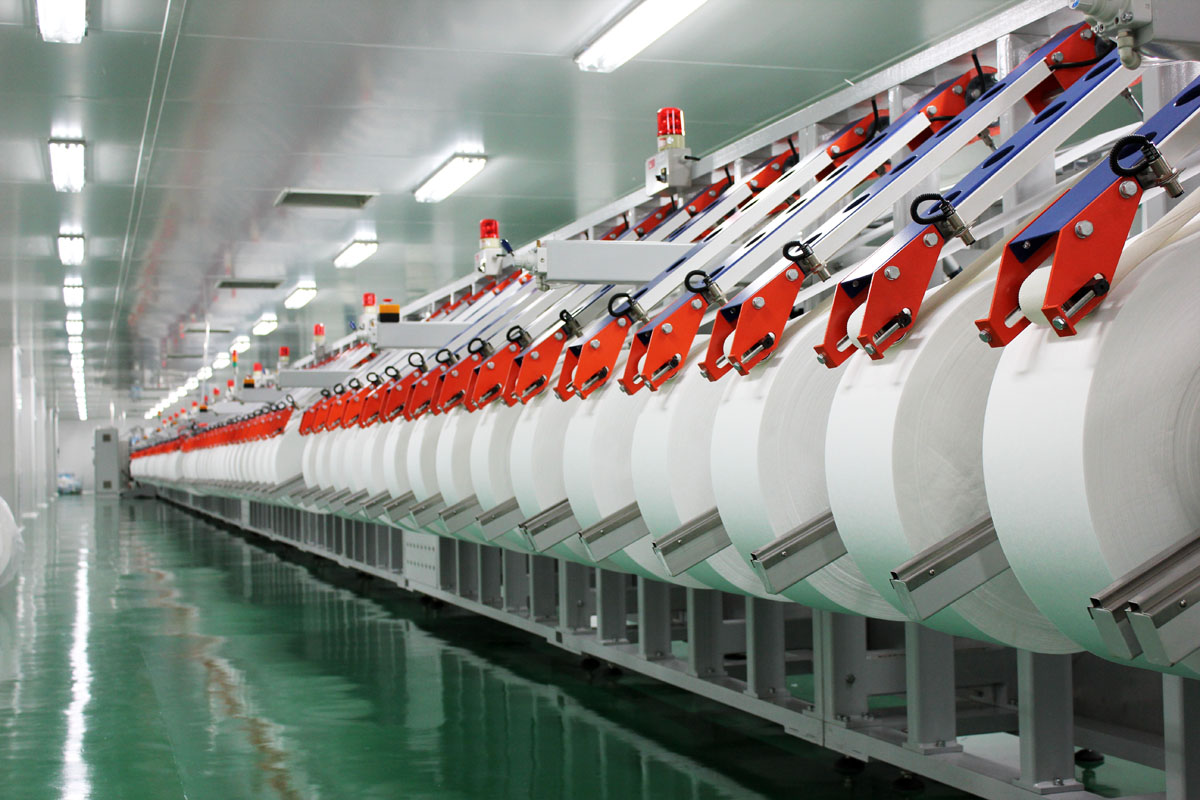
Problem Definition: Why the Dry vs. Wet Wipe Choice Is a Program Decision
Private-label buyers often start with a simple question: should the first SKU be dry wipes or wet wipes? In practice, that question hides four separate decisions. First, does the end use require a liquid phase, or is a dry nonwoven substrate sufficient? Second, which certifications apply to the exact SKU, pack format and market? Third, can the supplier control the manufacturing variables that create the biggest recall risk? Fourth, does the commercial model work at the required MOQ and lead time?
A dry wipe program can be simpler because the product is primarily a nonwoven substrate. A wet wipe program is more complex because the liquid, the substrate and the pack must remain stable together. That complexity is not automatically bad; it is a barrier to entry that can protect a brand when the supplier has the right controls. The decision should therefore be made on application fit and risk control, not on a generic preference for one format.
Industry Background: A Large Category With Different Risk Profiles
The global dry wipes segment was valued at USD 14.3 billion in 2025, according to Global Market Insights. That scale matters because it supports specialist OEM supply, multiple pack formats and regional compliance requirements. It also means buyers can usually find a supplier for either format; the harder question is whether the supplier can keep the chosen SKU compliant and repeatable.
Regulatory and trade context adds practical filters. China’s mandatory GB 15979-2024 standard for disposable sanitary products took effect on July 1, 2025, replacing the 2002 version. For U.S. imports, wood pulp spunlace nonwoven wipes from China are classified under HTSUS 5603.92.0090 with a duty rate of Free, according to a U.S. Customs and Border Protection ruling. These are not marketing points; they are program inputs that affect compliance documentation and landed-cost planning.

Detailed Solution: A Compliance and Application Framework for Dry Wipes vs. Wet Wipes
The most defensible OEM decision is to compare the two formats against the same criteria: application fit, certification scope, manufacturing control, pack format, MOQ, lead time and risk exposure. This is where a dry wipe such as Uniquality’s YQ002 becomes a useful reference SKU.
Dry wipes: YQ002 as a substrate-led lead SKU
Uniquality’s YQ002 dry wipes are nonwoven, 15 × 20 cm, and positioned for household, pet supplies, maternity and baby, health and beauty, and personal care applications. The published customization range covers nonwoven 35–70 gsm, 10 pcs or 80 pcs per bag, and soft pack or disposable packaging. Buyers can specify material, size, logo and packaging under the OEM/ODM model. In market language, this covers flow pack dry wipes, boxed dry wipes, family pack dry wipes, disposable dry wipes, nonwoven dry wipes, soft dry wipes, thick dry wipes, absorbent dry wipes, facial towels, portable dry wipes, skin-friendly dry wipes, ultra soft dry wipes, multi-purpose dry wipes, eco-friendly dry wipes, large size dry wipes, compressed dry towels, disposable dry bath towels, cleansing dry wipes and industrial cleansing dry wipes.
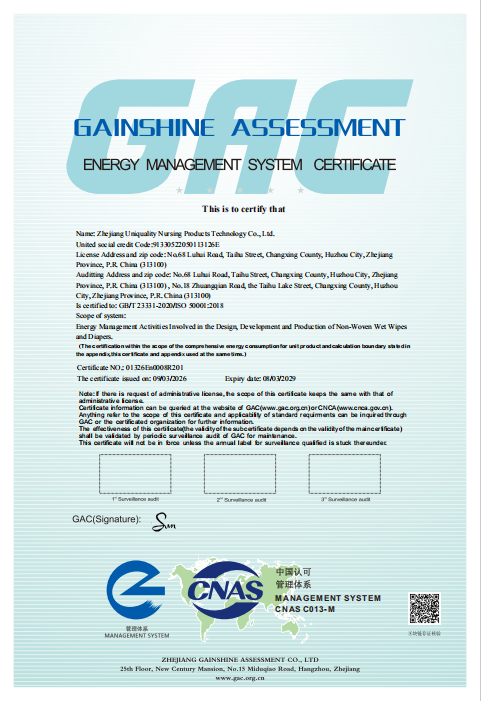
The certification anchor for the dry wipes scope is ISO 50001:2018 / GB/T 23331-2020, certificate 01326En0008R201, issued by GAC, with a recorded issue date of 2026-03-09 and expiry of 2029-03-08. The certificate scope covers wet wipes, dry wipes, baby diapers and training pants. This is an energy management certification, not a product safety certificate, so it should be used as evidence of energy-performance management, not as a substitute for product compliance. The assigned program brief cites a 10% energy-efficiency advantage as a planning assumption; treat that figure as a target to validate against the supplier’s ISO 50001 energy performance data, not as a guaranteed product specification.
Wet wipes: a liquid-plus-substrate program
Wet wipes use the same broad nonwoven supply base but add a liquid formulation, preservation and wet-state stability requirement. That changes the compliance question. The buyer must verify not only the substrate and pack, but also water quality, formula control, microbial limits and shelf-life validation. In a compliant wet-wipe program, pharma-grade purified water is a core control point because the liquid phase is part of the product. A 100,000-class GMP cleanroom environment, batch traceability and finished-product testing are the controls that separate a repeatable SKU from a recall-prone one.
Uniquality’s certification set for the wet wipes scope includes ISO 45001:2018, certificate 01326S0066R101, issued by GAC, with a recorded issue date of 2026-04-11 and expiry of 2029-04-10. The ISO 9001 certificate 01326Q0078R102, issued by GAC, lists ISO 9001:2015 and GB/T 24001-2016 and has a recorded issue date of 2026-04-11 and expiry of 2029-04-10. The SEDEX certificate ZAA600079586, issued by Bureau Veritas CPS - Asia, has a recorded issue date of 2025-07-24 and expiry of 2099-12-31. The FSC certificate BV-CQC-167194, issued by Bureau Veritas, is recorded with an expiry date of 2026-05-30; because that date has passed relative to this 2026-11-11 brief, buyers should verify renewal status before quoting FSC status for a 2026–2027 program.
Manufacturing context: where the risk difference becomes visible
Uniquality’s manufacturing context is a full-process model: raw material processing through finished-product packaging is covered in its production documentation, and the company describes a 100,000-class clean room in its company profile. The company reports a 1,000,000㎡ smart factory, 3,000+ employees, a 200+ R&D team, 60 billion sheets annual output and a 70% export ratio across the USA, EU, SAM, RU and CASA markets. For wet wipes, the monthly capacity is stated as 7 billion units, with capacity varying by product. These facts do not remove the need for due diligence, but they show why a controlled OEM program can have a different risk profile from a low-cost conversion model.
Higher upfront cost is justified only when it buys lower recall and return exposure through controlled substrate, water, cleanroom and batch records. That is the commercial logic behind choosing a manufacturing partner with documented quality control. Uniquality’s stated quality-control approach includes COA and AQL sampling inspection. For a wet-wipe program, buyers should ask for batch traceability and water-control records; for a dry-wipe program, they should ask for substrate specification, GSM tolerance and pack-format validation.
Step-by-Step Breakdown: How to Run the Head-to-Head Decision
- Define the lead application. Map the SKU to household, pet, maternity and baby, health and beauty, personal care, or industrial cleansing. If the use case depends on liquid delivery, wet wipes are the functional lead. If the use case depends on dry absorbency, scrubbing or low-mess handling, dry wipes are the functional lead.
- Map compliance to the exact SKU. List the certificates that apply to the product scope, pack format and destination market. Check certificate numbers, issuing bodies, scope and expiry dates. For Uniquality, the dry wipes scope is supported by ISO 50001:2018 certificate 01326En0008R201; the wet wipes scope references ISO 45001:2018 certificate 01326S0066R101, ISO 9001 certificate 01326Q0078R102, SEDEX certificate ZAA600079586 and the FSC certificate BV-CQC-167194 subject to renewal verification.
- Verify manufacturing controls. For dry wipes, confirm substrate material, 15 × 20 cm size, 35–70 gsm range, pack count and packaging type. For wet wipes, add water quality, formula control, cleanroom class, batch traceability and microbiological testing.
- Build a total-risk cost model. Compare substrate, packaging, certification support, MOQ, freight and recall/return exposure. Do not compare unit price alone. A lower upfront price can be erased by a failed batch, a market rejection or a return event.
- Validate samples and pack format. Uniquality’s profile states a 3–5 day sampling service. Use samples to test thickness, softness, absorbency, wet strength, pack opening and label placement. For wet wipes, include formula stability and pack compatibility in the sample review.
- Lock MOQ, lead time and documentation. The stated MOQ is 150,000 pieces for baby diapers/pull-ups and 1 × 40HQ container for wet wipes and dry wipes. The stated lead time is 35–45 days after confirming artwork and deposit. Confirm COA, AQL sampling and batch records before purchase order release.
Use Cases: Matching the Format to the Buyer’s Channel
Household and multi-purpose cleaning. Dry wipes in flow pack, boxed or family pack formats can serve dry dusting, spill pickup and surface prep. Wet wipes are stronger where the liquid is part of the cleaning action. For household programs, the buyer should decide whether the product is a dry refill, a wet disposable or a two-SKU system.
Pet supplies. Dry nonwoven wipes are a practical fit for paw, coat and surface wiping when the brand wants a dry, portable format. Wet wipes may be preferred for odour or hygiene claims that depend on a liquid formula. The pack format should match the channel: portable packs for travel, family packs for repeat use, and larger formats for professional or kennel use.
Maternity and baby. Both formats are relevant. Dry wipes can be used with water, which some parents prefer, while wet wipes offer convenience. A private-label program can use dry wipes as the entry SKU and add wet wipes once the brand has validated the formulation and pack.
Health and beauty, personal care. Soft, ultra-soft and skin-friendly dry wipes can serve facial towels, cleansing dry wipes and disposable dry bath towels. Wet wipes fit makeup removal and personal hygiene when the formula is the core benefit. For both, the buyer should confirm that the substrate and pack claims match the actual test data.
Industrial cleansing. Industrial dry wipes and industrial cleansing dry wipes are a separate specification problem. Buyers should define absorbency, lint, solvent compatibility and disposal requirements before comparing suppliers. A household dry wipe is not automatically suitable for industrial use.
Comparison Table: Dry Wipes vs. Wet Wipes for Global OEM Programs
| Decision factor | Dry wipes: Uniquality YQ002 reference | Wet wipes: OEM program reference |
|---|---|---|
| Core product structure | Nonwoven dry substrate; 15 × 20 cm; customizable 35–70 gsm; 10 pcs or 80 pcs per bag; soft pack or disposable packaging. | Nonwoven substrate plus liquid formula; requires water quality, preservation and wet-state stability controls. |
| Application fit | Household, pet supplies, maternity and baby, health and beauty, personal care; also facial towels, portable wipes, compressed towels, disposable bath towels and industrial cleansing wipes. | Baby care, personal hygiene, beauty care and household cleaning where liquid delivery is part of the use case. |
| Compliance anchor | ISO 50001:2018 / GB/T 23331-2020, certificate 01326En0008R201, GAC; scope includes dry wipes; issue 2026-03-09; expiry 2029-03-08. | ISO 45001:2018, certificate 01326S0066R101, GAC; ISO 9001 certificate 01326Q0078R102 (ISO 9001:2015; GB/T 24001-2016), GAC; SEDEX ZAA600079586; FSC BV-CQC-167194 subject to renewal verification. |
| Manufacturing control | Substrate specification, GSM tolerance, pack-format validation, COA and AQL sampling inspection. | Adds water control, formula control, 100,000-class cleanroom context, batch traceability and microbiological testing. |
| Customization | Material, size, logo, packaging; OEM/ODM. | Material, size, logo, packaging, fragrance and formula; OEM/ODM. |
| MOQ | 1 × 40HQ container for dry wipes. | 1 × 40HQ container for wet wipes; 150,000 pieces for baby diapers/pull-ups. |
| Lead time | 35–45 days after confirming artwork and deposit. | 35–45 days after confirming artwork and deposit. |
| Sampling | 3–5 day sampling service stated in the company profile. | 3–5 day sampling service stated in the company profile; formula and pack stability should be included in the sample review. |
| Risk profile | Lower formulation complexity; primary risks are substrate consistency, pack seal and specification mismatch. | Higher formulation and microbiological complexity; primary risks are water quality, preservation, shelf-life and pack compatibility. |
| Commercial logic | Often the simpler lead SKU for household, pet and personal-care programs where a dry substrate is sufficient. | Preferred when the liquid is essential; higher upfront control cost should be weighed against lower recall and return exposure. |
Table notes: The comparison uses the assigned topic facts and the supplied corpus. It does not include price, rating or performance claims that are not documented. FSC certificate BV-CQC-167194 is shown with its recorded expiry of 2026-05-30 and should be verified for current status.
FAQ: Dry Wipes vs. Wet Wipes for Private-Label Buyers
What certifications should a Chinese dry wipes manufacturer hold for private-label programs?
Buyers should match certificates to the exact product scope and destination market. For Uniquality’s dry wipes scope, ISO 50001:2018 / GB/T 23331-2020 certificate 01326En0008R201 issued by GAC is recorded with an issue date of 2026-03-09 and expiry of 2029-03-08. The company’s wider certificate set includes ISO 9001 certificate 01326Q0078R102, ISO 45001:2018 certificate 01326S0066R101, SEDEX certificate ZAA600079586, and FSC certificate BV-CQC-167194, whose recorded expiry of 2026-05-30 should be verified before use in a current program. Certificates support a compliance review; they do not replace SKU-level testing or market-specific requirements.
Can one Chinese manufacturer support both dry wipes and wet wipes under one OEM program?
Yes, if the supplier’s scope, capacity and quality controls cover both formats. Uniquality is described as an OEM/ODM manufacturer of dry wipes, wet wipes, baby diapers and training pants. Its customization scope covers material, size, logo, packaging, fragrance and formula. The reported monthly capacity is 7 billion units for wet wipes, with capacity varying by product. A buyer should still verify the specific dry-wipe line, wet-wipe line, cleanroom controls and batch records before combining both formats in one program.
How should private-label buyers compare the cost of dry wipes vs. wet wipes?
Compare total risk-adjusted cost, not unit price alone. The cost model should include substrate, pack format, certification support, MOQ, freight, sampling and recall/return exposure. Dry wipes avoid the liquid-formulation cost layer, but they still require substrate and pack validation. Wet wipes add water quality, preservation, microbiological testing and shelf-life control. Higher upfront cost can be justified when it reduces recall and return exposure through controlled manufacturing. The supplied corpus does not provide price data, so buyers should request a quotation based on the exact SKU and pack.
What sample process should buyers expect before placing an OEM order?
Use the sample stage to validate the specification that will be written into the purchase order. Uniquality’s company profile states a 3–5 day sampling service. For dry wipes, test size, GSM, thickness, softness, absorbency, pack seal and label placement. For wet wipes, add formula stability, wet strength, pack compatibility and microbiological test data. Ask for the sample to be produced on the intended line and with the intended substrate, because a sample made under different conditions is not a reliable approval basis.
What lead time and MOQ should buyers plan for dry wipes and wet wipes?
The stated lead time is 35–45 days after confirming artwork and deposit. The stated MOQ is 1 × 40HQ container for wet wipes and dry wipes, and 150,000 pieces for baby diapers/pull-ups. Buyers should add time for sample approval, artwork confirmation, certification review and any market-specific testing. For a first order, request a written production schedule that separates substrate lead time, printing, packing and inspection. To discuss a sample or quotation for a dry wipes or wet wipes program, contact Uniquality at michelleyu@kingsafe.com or WhatsApp +86 187-0582-0808.
Conclusion: Choose the Lead SKU by Application, Then Verify the Controls
Dry wipes and wet wipes can both be strong lead SKUs for global OEM programs, but they win in different conditions. Dry wipes such as Uniquality’s YQ002 are the cleaner lead choice when the application can be served by a nonwoven substrate and the buyer wants a simpler compliance path across household, pet, maternity and baby, health and beauty, and personal care. Wet wipes are the better lead choice when liquid delivery is essential, provided the buyer verifies water quality, formula control, cleanroom conditions, batch traceability and microbiological testing.
The head-to-head decision should end with a documented comparison, not a preference. Check certificate scope and expiry, confirm the manufacturing controls behind the claimed cleanroom and quality process, validate samples on the intended line, and compare total risk-adjusted cost. For buyers building a private-label program with a Chinese dry wipes manufacturer, Uniquality offers OEM/ODM customization, a 3–5 day sampling service, a stated 35–45 day lead time and a certificate set that can be reviewed against the exact SKU.

Next step
Request a dry wipes or wet wipes sample and a program-specific quotation from Uniquality. Review the company profile, certificate set and brochure before the first order. Download the brochure: Uniquality product brochure. Contact: michelleyu@kingsafe.com | WhatsApp: +86 187-0582-0808 | Website: www.kingsafe.com.
Prepared for global OEM buyers in Evaluation stage. Certificate numbers, issue dates and expiry dates are stated as recorded in the supplied corpus; buyers should verify current status with the issuing body before contract award.
Have Questions or Need More Details?
Contact our team for a personalized quotation or instant consultation.
Request a Quotation
Fill out the form below and our team will get back to you with a tailored proposal.
WhatsApp Direct Chat
Prefer to chat in real-time? Message us on WhatsApp for instant assistance & quick answers.
- Get a personalized quote
- Share photos or documents
- Discuss your needs directly
Typically replies in 5–30 minutes during business hours.