
Head-to-Head Decision: Dry Wipes Supply Models Compared
Two dry wipes suppliers can quote the same sheet size, the same basis weight range and the same certification logos, and still represent two very different businesses. This head-to-head comparison is written for the point where the decision is actually made: supply model versus supply model, material versus material, and pack format versus pack format.
The short version: at the decision and execution stage, the choice is rarely about the price on the bag. It is about which supplier can hold microbial control, cost structure, delivery reliability and batch traceability at the same time, and which one only looks like it can on a quotation sheet.
The Head-to-Head Question Hiding Inside a Dry Wipes Quotation
A dry wipes purchase is not one decision. It is three decisions stacked together, and most request-for-quotation documents collapse them into a single line item.
Decision 1 — Supply model. Does the supplier make its own nonwoven and convert it, or does it buy parent roll from third-party mills and convert only? The two models carry different exposure to substrate pricing, quality variance and allocation during peak demand.
Decision 2 — Material. Wood pulp spunlace, spunbond polypropylene and airlaid pulp are not interchangeable. They differ in basis weight logic, absorbency behaviour and the end uses they were designed for.
Decision 3 — Pack format. Soft pack, boxed pop-up and portable compressed formats change how the product is used, how it is stored and how much protection it gets before first use.
When these three are priced together but evaluated separately, buyers end up comparing a strong supply model with a weak format, or a premium substrate with a converter who cannot document what happened in the room where it was packed.
Industry Background: What a 2026 Buyer Is Actually Choosing Between
Market scale. Global Market Insights valued the global dry wipes segment at USD 14.3 billion in 2025, measured as revenue from dry nonwoven wipes and excluding wet wipes.
Regulatory baseline. China's mandatory standard GB 15979-2024 for disposable sanitary products took effect on 1 July 2025, replacing the 2002 version. Any supplier shipping from China is working to this baseline, and buyers should expect documentation aligned to it rather than to its predecessor.
Tariff baseline. U.S. Customs and Border Protection ruling N244603 classifies wood pulp spunlace nonwoven wipes from China under HTSUS 5603.92.0090 at a duty rate of Free. This is a classification ruling, not a quality signal, but it directly affects landed cost comparisons between substrates.
Supplier scale. Zhejiang Uniquality Nursing Products Technology Co., Ltd. (Uniquality) is a Chinese OEM/ODM manufacturer of dry wipes, wet wipes, baby diapers and training pants, based in Zhejiang Province, serving brand owners in more than 80 countries with roughly 70% of output exported to the USA, EU, SAM, RU and CASA markets. Its parent, Zhejiang Kingsafe, reported annual sales of approximately USD 930 million, according to Nonwovens Industry (December 2024). The group operates a 1,000,000 m² manufacturing footprint with 3,000+ employees, a 200+ person R&D team and an annual output capacity of 60 billion sheets.
Those two data points — a USD 14.3 billion dry wipes market and a single group with roughly USD 930 million in sales — frame the head-to-head honestly. Consolidation at the top means buyers increasingly choose between a small number of integrated suppliers and a long tail of converters.
Option A and Option B: Defining the Two Sourcing Models
Option A — Full-vertical-integration OEM
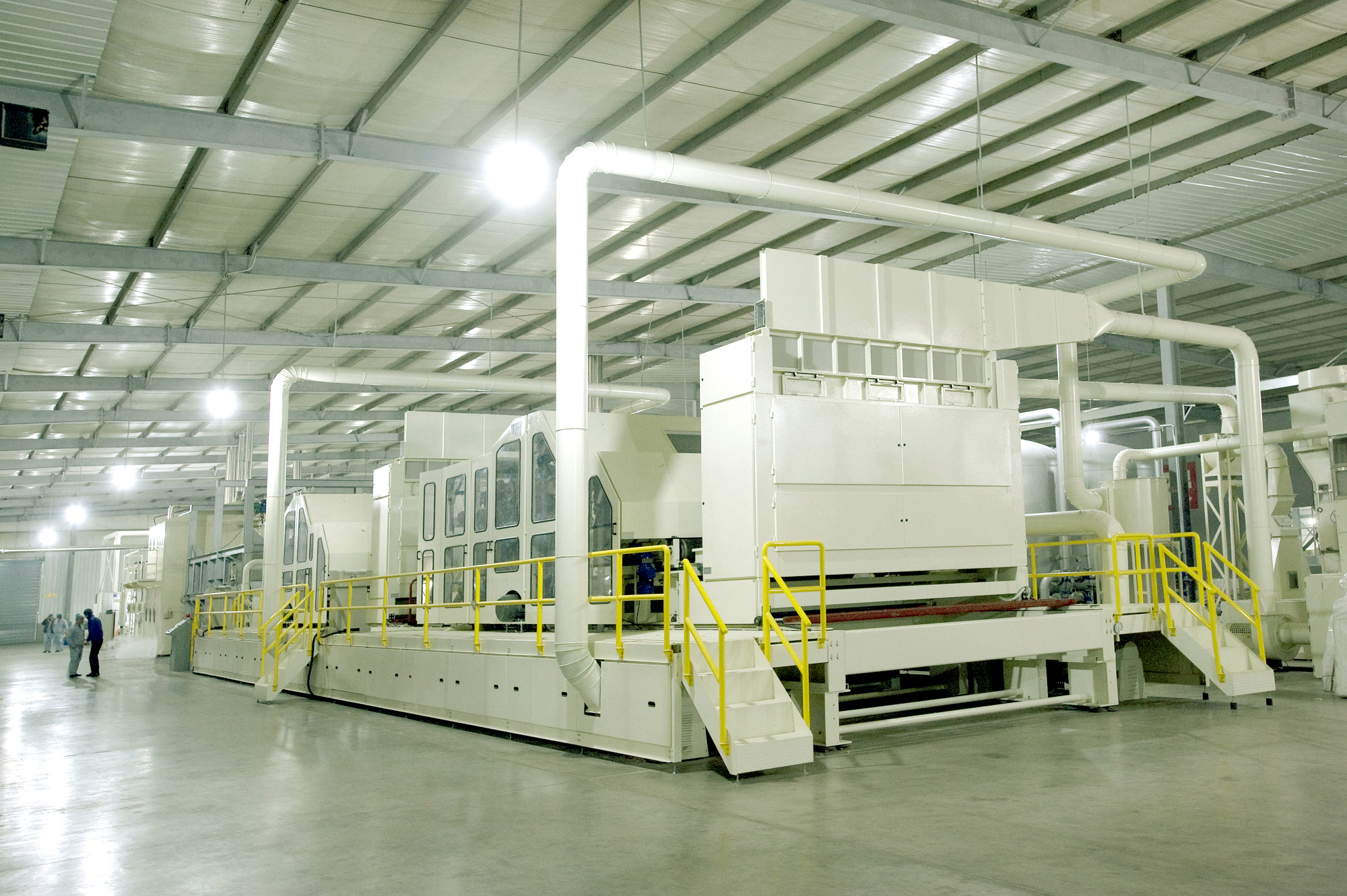
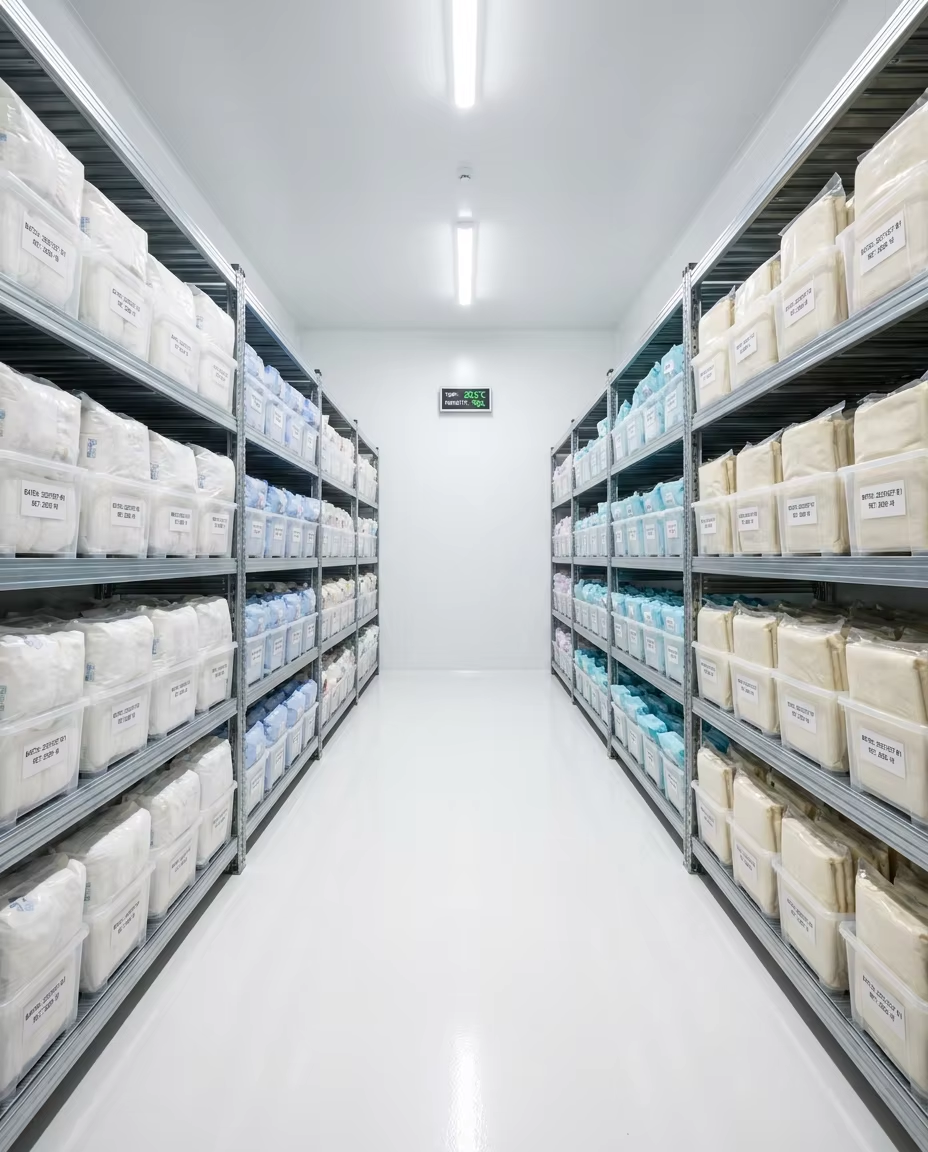
In this model, substrate production, converting, packaging and quality control sit inside one organisation. For Uniquality, that means production in a 100,000-class GMP cleanroom, in-house laboratory testing, and a sample retention room where each batch of diapers, wet wipes and dry wipes is archived, tracked and preserved under controlled conditions.
The published product specification for the dry wipes line is 15×20 cm, nonwoven 35–70 gsm, supplied as 10 pcs or 80 pcs per bag in soft pack or disposable packaging, all listed as customizable under an OEM/ODM service.
Option B — Converter or trader model
In this model, the supplier buys parent roll from a third-party nonwoven mill, converts and packs it, and may also trade finished goods between projects. The Wipe Factory, a European manufacturer, describes this pattern plainly: converting raw non-woven into ready-to-sell dry wiping products and offering white-label solutions for various industries.
This is a legitimate model with real advantages — lower entry commitment, the ability to source substrates from several mills, and flexibility on smaller programmes. The trade-off is that substrate quality, conversion hygiene and delivery timing are controlled by two or three separate parties rather than one.
Where the two models actually separate
Uniquality's own comparison data for its fully integrated model, set against conventional wipes, smaller OEM manufacturers and traditional cotton wipes, cites four measurable gaps:
- Microbial control: ≤100 CFU/g total bacteria count, compared with ≤200 CFU/g for standard products.
- Raw material cost: 8–15% lower under the integrated model.
- Energy consumption: 10% lower.
- Delivery reliability: a 99.5% on-time delivery rate.
The same comparison notes a slightly higher upfront cost in exchange for a lower risk of recalls and returns. That is the honest shape of the decision: the integrated route is not the cheapest at the purchase order line, and it is not meant to be.
Limit worth stating: an integrated supplier's material range is defined by the lines it runs, whereas a converter can generally offer a broader menu of substrates sourced from several mills. If your programme depends on an unusual substrate, the integrated model may be the wrong fit regardless of its other strengths.
Comparison Table 1: Supply Model Head-to-Head
| Decision criterion | Full-vertical-integration OEM (Uniquality) | Converter / trader model | Traditional cotton / reusable towels |
|---|---|---|---|
| Substrate control | Nonwoven produced and converted under one roof in a 100,000-class GMP cleanroom | Parent roll purchased from third-party mills; substrate range set by those suppliers | Textile substrate; performance depends on laundering regime |
| Microbial control | ≤100 CFU/g total bacteria count reported, versus ≤200 CFU/g for standard products | Depends on the converter's environment; not documented by default | Re-contamination risk between uses; depends on wash and dry control |
| Cost structure | 8–15% lower raw material cost and 10% lower energy consumption reported; slightly higher upfront cost | Lower entry commitment; exposed to parent-roll market pricing | Cost driven by laundry cycle and replacement rate rather than unit purchase |
| Delivery reliability | 99.5% on-time delivery rate reported | Depends on mill allocation plus converter scheduling | Not comparable — supply is internal reuse, not shipment |
| Traceability | Batch retention room; sealed, documented, temperature-controlled archive by batch | Varies by supplier | Batch concept does not apply |
| Best fit | Baby care, sensitive skin, premium export markets | Small initial volumes, multi-substrate ranges, mixed-category baskets | Domestic reuse programmes with reliable laundry control |

Material Head-to-Head: Which Nonwoven Fits Which Job
Material choice is the second decision most often buried inside a single quotation. Manufacturer guidance from the wider Chinese supplier base maps three structures to distinct basis weight bands and end uses.
| Material | Reported basis weight guidance | Reported use cases | Decision note |
|---|---|---|---|
| Spunbond polypropylene | 15–50 gsm | Medical drapes, industrial wipes | Lighter structures suited to low-lint industrial and cleanroom wiping |
| Airlaid pulp | 50–120 gsm | Baby wipes, household cleaning | Higher absorbency demand and heavier sheets |
| Uniquality nonwoven dry wipes | 35–70 gsm | 15×20 cm dry wipes in 10 pcs or 80 pcs packs | Mid-range band bridging skin-contact and general wiping formats |
Two additional facts change the arithmetic. First, wood pulp spunlace nonwoven wipes from China enter the United States under HTSUS 5603.92.0090 at a Free duty rate, so a wood-pulp-based structure and a synthetic structure do not carry the same landed cost logic. Second, basis weight is not a quality score — a 15–50 gsm spunbond sheet and a 50–120 gsm airlaid sheet are answering different questions, and comparing them by weight alone produces a meaningless result.
A practical rule for the head-to-head: test each material against the job it was designed for. Industrial cleansing and cleanroom wiping should be judged on lint and strength. Facial and baby contact formats should be judged on softness, absorbency and residue.
Format Head-to-Head: Soft Pack, Boxed, and Portable
The third decision is packaging, and it changes the user experience more than buyers expect.
Soft pack / flow pack format
Published for the Uniquality dry wipes line at 10 pcs or 80 pcs per bag in soft pack or disposable packaging, with both pack count and packaging listed as customizable. This is the workhorse format: low material cost per sheet, efficient container fill, and the natural choice for family pack and multi-use programmes where volume economics matter most.
Boxed pop-up format
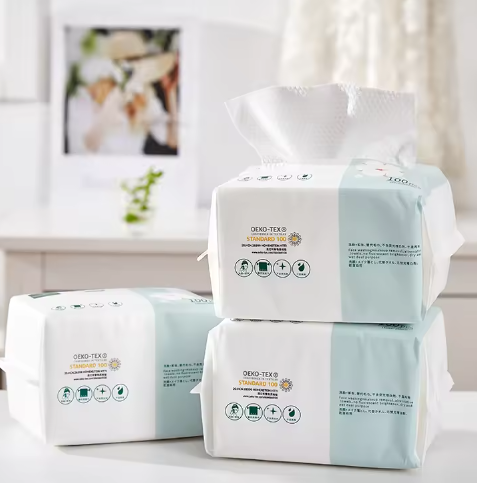
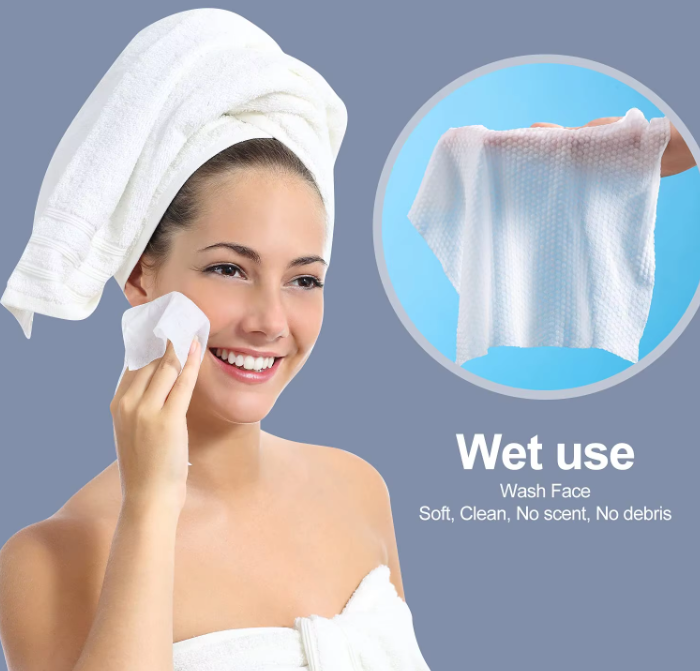
A boxed format trades packaging cost for controlled dispensing. The documented design uses a pop-up pull-out box with a dust-proof lid, one sheet per pull, which prevents leftover towels from damp and contamination and keeps the pack neat on a bathroom counter or desk. The sheet itself is thickened plant-based non-woven fabric described as soft, tear-resistant and lint-free, free from fluorescent agent and artificial fragrance, with an extra-large sheet size that covers the whole face in one piece. The formulation is dry-only: the sheet works dry, or becomes a wet wipe after soaking.
Portable and compressed format
Compressed dry towels are positioned for short trips, business travel, camping and rail journeys, described as a hygienic substitute for unsterilised hotel towels for face, body and shoe cleaning, sized to fit a pocket. In a head-to-head, this format rarely competes with boxed product — it competes with the decision not to carry a towel at all, which makes it a distribution and channel question rather than a converting question.
Step-by-Step: Running a Fair Side-by-Side Trial
Once the model, material and format are shortlisted, the comparison has to be executed rather than argued. The sequence below keeps the trial honest.
- Fix the criteria before samples arrive. Agree on sheet size, basis weight tolerance, pack count, microbial limit, pack integrity and delivery terms. Unweighted criteria get decided by whoever presents best.
- Request matched samples. Uniquality's standard sampling turnaround is 3–5 days. Ask each candidate for the same specified size and GSM band so the trial compares like with like.
- Test the sheet, not the brochure. Verify measured size against the 15×20 cm specification, check basis weight inside the 35–70 gsm band, and assess lint, tear resistance and absorbency against the intended end use.
- Document compliance to destination, not to a generic pack. For China-origin goods, GB 15979-2024 is the applicable sanitary baseline. Uniquality's own profile lists a 100,000-class cleanroom with ISO, CE, GMPC and FSC certification. For U.S. imports of wood pulp spunlace wipes from China, the classification reference is HTSUS 5603.92.0090 at a Free rate.
- Confirm the quality gate in writing. Uniquality's stated acceptance criteria are a factory pre-shipment test or customer-specified testing, with payment terms of 30% deposit and balance against bill of lading copy, under FOB or CIF terms.
- Size the order against the real MOQ. Minimum order quantity for dry wipes is 1 × 40HQ container; baby diapers and pull-ups are set at 150,000 pieces. Published purchasing terms also list pack-count-based MOQ tiers of 60,000 bags for 10–30 pcs packs, 50,000 bags for 40–70 pcs packs and 36,000 bags for 80–120 pcs packs.
- Lock the schedule. Typical production lead time is 35–45 days after artwork and deposit are confirmed. Work backward from the retail or distributor launch date, not forward from the purchase order.
- Keep the reference batch. After delivery, retain sealed samples from the shipped batch. Uniquality's sample retention room exists precisely so that the question 'what exactly did we ship six months ago' has a documented answer.
Use Cases: Where Each Option Wins
Baby care and sensitive skin. The integrated model wins, and the reason is documented rather than asserted: a ≤100 CFU/g total bacteria count against ≤200 CFU/g for standard products, dry-only sheets free from fluorescent agent and artificial fragrance, and batch-level retention. Where skin contact is the product, the microbial margin is the product.
Facial and beauty formats. Boxed pop-up wins on user experience. One sheet per pull, dust-proof lid, extra-large sheet for full-face coverage, usable dry or soaked. The decision to weigh is packaging cost per sheet against the premium a controlled dispensing format supports.
Industrial cleansing and cleanroom wiping. Spunbond polypropylene in the 15–50 gsm band, as used for medical drapes and industrial wipes, is the natural comparator. Here the head-to-head is about lint, strength and consistency, and a converter with a single mill relationship can compete well if the substrate specification is nailed down.
Travel, retail impulse and hospitality. Portable compressed towels target a different purchase moment — business travel, camping, rail journeys, hotel towel substitution — and are better evaluated as a channel listing decision than a converting one.
Distributor and family pack programmes. The 80 pcs pack configuration and container-level MOQ of 1 × 40HQ make pack count a landed-cost lever. Two suppliers quoting the same sheet at the same price can produce different cost per use once pack count, carton configuration and container fill are accounted for.
Decision Matrix: What to Weight, and What to Ask For
Weights are the buyer's own; the value of the matrix is that each criterion forces a document request rather than an opinion.
| Criterion | Suggested weight band | Evidence to request from each candidate |
|---|---|---|
| Microbial control | High for skin-contact formats | Total bacteria count specification and test method; cleanroom class |
| Substrate consistency | High for long programmes | Basis weight tolerance per lot; source of parent roll |
| Compliance documentation | High for all export orders | Certificates matched to destination; standard reference (GB 15979-2024 for China origin) |
| Delivery reliability | High for launch-critical SKUs | On-time delivery performance; stated production lead time |
| Traceability | Medium to high | Batch retention process and archive conditions |
| Commercial structure | Medium | MOQ, incoterm, payment terms, acceptance criteria |
| Format flexibility | Medium | Available pack counts, packaging options, customization limits |
FAQ
Which standards and certifications should a dry wipes supplier document for export?
For goods manufactured in China, the applicable sanitary baseline is GB 15979-2024, the mandatory standard for disposable sanitary products that took effect on 1 July 2025 and replaced the 2002 version. Uniquality's own company profile lists a 100,000-class cleanroom together with ISO, CE, GMPC and FSC certification. For U.S. imports, wood pulp spunlace nonwoven wipes from China are classified under HTSUS 5603.92.0090 at a duty rate of Free, per U.S. Customs ruling N244603. Buyers should request certificates matched to the destination market rather than a single generic certificate pack.
Can one supplier cover different sheet sizes, basis weights and pack formats, or do I need two suppliers?
Uniquality's published dry wipes specification lists 15×20 cm sheets, nonwoven 35–70 gsm, 10 pcs or 80 pcs per bag and soft pack or disposable packaging, with all four parameters listed as customizable under OEM/ODM. That range covers most skin-contact and general wiping programmes from one source. Where a programme needs a different substrate family — for example spunbond polypropylene in the 15–50 gsm band used for medical drapes and industrial wipes, or airlaid pulp in the 50–120 gsm band used for baby wipes and household cleaning — the material range of the supplier's own lines becomes the deciding factor.
Where does the cost difference between an integrated supplier and a converter actually come from?
Uniquality's comparison data for its fully integrated model cites 8–15% lower raw material cost and 10% lower energy consumption than conventional wipes and smaller OEM operations, alongside a slightly higher upfront cost and a lower risk of recalls and returns. The mechanism is vertical integration: substrate production and converting sit in one operation, so margin stacking between mill and converter is removed. Beyond unit price, pack count changes landed cost per use, because dry wipes carry a minimum order quantity of 1 × 40HQ container and published pack-count tiers of 60,000 bags (10–30 pcs), 50,000 bags (40–70 pcs) and 36,000 bags (80–120 pcs).
How fast can I validate samples before committing to a production order?
Uniquality's standard sampling turnaround is 3–5 days. Validation should run on matched specifications: measured sheet size against 15×20 cm, basis weight inside the 35–70 gsm band, and lint, tear resistance and absorbency judged against the intended end use. Acceptance can be a factory pre-shipment test or customer-specified testing, which means the test protocol can be written into the order before the first production batch starts.
What is the production lead time, and how should I plan a launch around it?
Typical production lead time is 35–45 days after artwork and deposit are confirmed. Dry wipes run at a minimum order quantity of 1 × 40HQ container, with payment terms of 30% deposit and balance against bill of lading copy, under FOB or CIF terms. Planning should start from the confirmed artwork date rather than the enquiry date, since the clock begins there. Buyers who want to move from shortlist to a validated sample set can request one directly from the Uniquality team at michelleyu@kingsafe.com or via WhatsApp on +86 187-0582-0808.
Conclusion: The Decision Is a Model Decision, Not a Price Decision
Run the head-to-head in the right order and the answer becomes visible. Supply model first, because it determines who controls the substrate and the room the product is packed in. Material second, because a 15–50 gsm spunbond sheet, a 35–70 gsm nonwoven sheet and a 50–120 gsm airlaid sheet solve different problems. Format third, because soft pack, boxed pop-up and portable compressed formats serve different purchase moments and carry different packaging economics.
On the evidence available, the integrated model earns its place where skin contact, microbial margin and batch accountability are non-negotiable: ≤100 CFU/g total bacteria count against ≤200 CFU/g for standard products, production in a 100,000-class GMP cleanroom, 8–15% lower raw material cost, 10% lower energy consumption, a 99.5% on-time delivery rate, and a retained sample for every batch. The converter model remains the better answer for small initial volumes, unusual substrates and mixed-category baskets.
What should not be negotiable in either case is the evidence trail: GB 15979-2024 alignment for China origin, destination-matched certification, a written acceptance criterion, a stated lead time of 35–45 days after artwork and deposit, and a container-level MOQ that the buyer has actually costed.

Next step: validate the model on your own specification
Zhejiang Uniquality Nursing Products Technology Co., Ltd. supplies OEM/ODM dry wipes, wet wipes, baby diapers and training pants from a 1,000,000 m² manufacturing base with 3,000+ employees, a 200+ person R&D team and 60 billion sheets of annual output capacity, exporting to the USA, EU, SAM, RU and CASA markets.
Request a matched sample set, a specification sheet, or the full company catalogue: Download the Uniquality brochure (PDF) · Email michelleyu@kingsafe.com · WhatsApp +86 187-0582-0808 · www.kingsafe.com
Have Questions or Need More Details?
Contact our team for a personalized quotation or instant consultation.
Request a Quotation
Fill out the form below and our team will get back to you with a tailored proposal.
WhatsApp Direct Chat
Prefer to chat in real-time? Message us on WhatsApp for instant assistance & quick answers.
- Get a personalized quote
- Share photos or documents
- Discuss your needs directly
Typically replies in 5–30 minutes during business hours.