
Reading CE, ISO 14001 and FSC Scope on Training Pants
Training Pants Compliance Guide: Reading CE, ISO 14001 and FSC Scope for Buyers
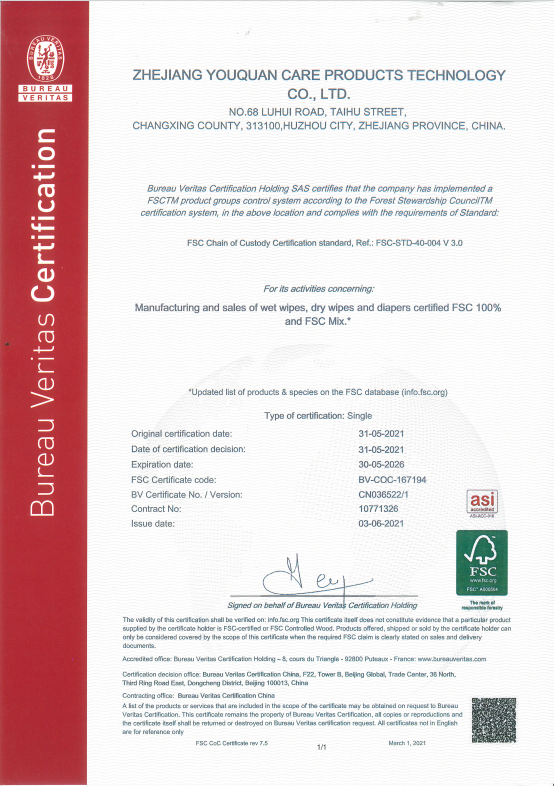
A supplier can send a CE certificate, an ISO 14001 certificate and an FSC certificate in the same email, all marked for the global market, and a buyer can still be unable to answer the only question that matters: which document covers the training pants I am actually ordering, and what exactly does it promise? The gap is rarely the number of documents. It is the scope.
This guide reads three certificate records held for training pants (product ID 3752, model YQ004) field by field — CE certificate 6C240227.ZUNU051, ISO 14001:2015 certificate 01326E0075R101, and FSC certificate BV-CQC-167194 — and then places COA certificates and AQL sampling inspection where they belong, below the certificate layer, at the batch level. The goal is a claim list a buyer can defend in an internal review, a retailer questionnaire or a packaging approval meeting.
The Short Answer: Three Certificates, Three Different Jobs
Read together, the three records answer three separate questions, and they do not overlap as much as a supplier's summary email suggests.
- CE certificate 6C240227.ZUNU051 answers a product-and-standard question: which standards the certified product scope is referenced against, and who issued the certificate.
- ISO 14001:2015 certificate 01326E0075R101 answers a management-system question: whether the manufacturing organisation operates a certified environmental management system, and for which product scope.
- FSC certificate BV-CQC-167194 answers a materials-and-chain-of-custody question: which product scope sits inside an FSC certification, under which standard and for which period.
| Certificate | Number | Issuing body | Standard recorded | Product scope recorded | Recorded dates |
|---|---|---|---|---|---|
| CE | 6C240227.ZUNU051 | ENTE CERTIFICAZIONE MACCHINE | EN 12221-1:2008+A1:2013; EN ISO 12625-1:2019 | Baby diaper; training pants | Issued 27 Feb 2024; valid to 26 Feb 2029 |
| ISO 14001 | 01326E0075R101 | GAC | ISO 14001:2015 | Wet wipes; dry wipes; baby diaper; training pants | Issued 11 Apr 2026; valid to 10 Apr 2029 |
| FSC | BV-CQC-167194 | Bureau Veritas | FSC-STD-40-004V3.0 | Wet wipes; dry wipes; baby diaper; training pants | Issued 31 May 2021; recorded expiry 30 May 2026 |
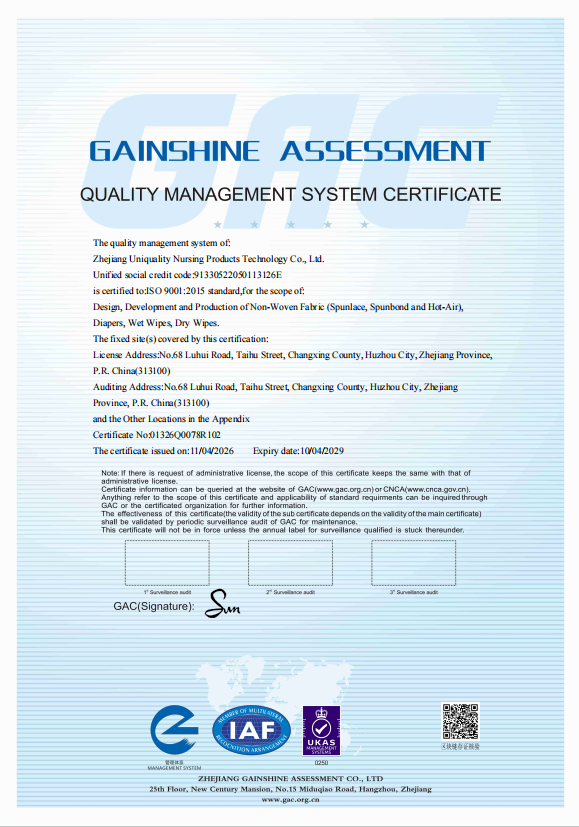
| ISO 9001 | 01326Q0078R102 | GAC | ISO 9001:2015 | Wet wipes; dry wipes; baby diaper; training pants | Issued 11 Apr 2026; valid to 10 Apr 2029 |
Treated as three versions of the sentence "we are certified", the documents overlap and the buyer learns nothing about which claim is safe to repeat on a pack or in a retailer portal. Treated as four separate evidence layers, each one carries a different risk if it is missing.
Why "Applicable Globally" Is a Scope Statement, Not a Legal Clearance
Each record carries a market field, and in the supplied records all of them point to the global market. That field tells you where the certificate holder records the certificate as applying. It is not a legal clearance, it is not a list of destination registration steps, and it is not evidence that every customs authority, retailer or regulator will accept the document on sight.
Three practical consequences follow, and they apply to every certificate in this guide:
- Do not restate "global" as "approved everywhere". A buyer's own compliance statement should say "holds CE certificate 6C240227.ZUNU051 for baby diaper and training pants, issued by ENTE CERTIFICAZIONE MACCHINE", not "EU-approved and accepted worldwide". The second sentence converts a scope field into a legal finding the certificate does not contain.
- Quote the number, not the logo. A number can be checked with the issuing body. A logo file cannot. Every certificate in this guide has a citable number, which is exactly why it belongs in a purchase order annex rather than only in a PDF brochure.
- Separate the certificate question from the market-entry question. Which local steps apply to your destination, your importer of record and your retail channel is a question for your own regulatory advisor. This guide deliberately does not answer it, because the supplied records describe certificates, not national law.
How to Read Any Training Pants Certificate in Five Fields
Before comparing suppliers, fix a reading routine. Five fields carry almost all of the usable information, and skipping any one of them is how a certificate gets misquoted later.
1. Certificate holder and site
The holder is the legal entity certified. For this training pants programme the holder is Zhejiang Uniquality Nursing Products Technology Co., Ltd. (established 1987, 1,000,000㎡ of manufacturing space, 3,000+ employees, 200+ R&D engineers, a 100,000-class clean room), whose company site is kingsafe.com. If the entity named on the invoice differs from the entity named on the certificate, treat that as a question, not a formality.
2. Standard, including version and amendment
Write the standard the way the certificate writes it. "EN 12221-1" and "EN 12221-1:2008+A1:2013" are not interchangeable in a compliance file, because the second one names the edition and the amendment that the certificate was issued against.
3. Scope wording
The scope field lists products. "Training pants" appearing in a scope list is worth more than a marketing sentence claiming certification, because the scope field is the part a certifier controls.
4. Issuing body
An accredited certifier's name is checkable. In this guide: ENTE CERTIFICAZIONE MACCHINE for CE, GAC for ISO 14001 and ISO 9001, Bureau Veritas for FSC.
5. Issue and expiry dates
Certificates expire, and management-system certificates are audited on a cycle. A copy without a legible date cannot be scheduled into a supplier review, because nobody knows when it needs to be refreshed.
CE Certificate 6C240227.ZUNU051: What the Scope Actually Covers
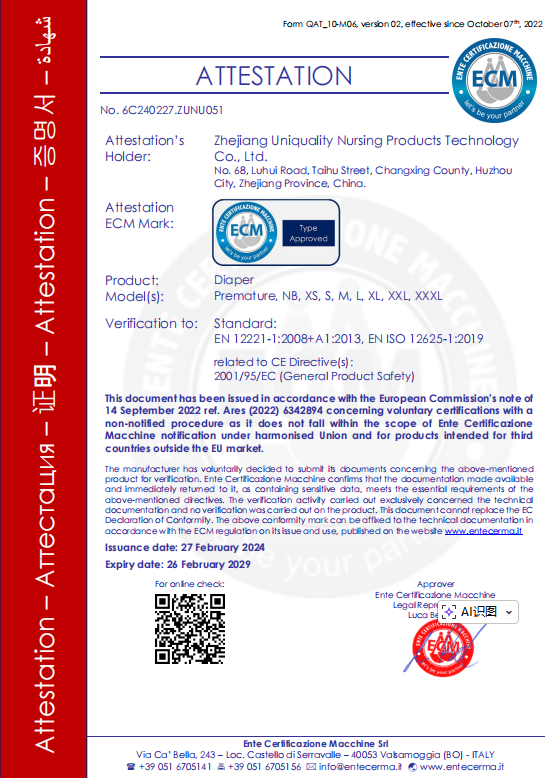
Training pants under product ID 3752 are covered by CE certificate 6C240227.ZUNU051, issued by ENTE CERTIFICAZIONE MACCHINE and recorded for the global market. The two standards recorded on the certificate are EN 12221-1:2008+A1:2013 and EN ISO 12625-1:2019. The recorded scope is baby diaper and training pants, and the recorded validity runs from 27 February 2024 to 26 February 2029.
For a buyer, the useful part of that paragraph is the pairing of scope and standard. A CE certificate whose scope names training pants but whose standards are unknown to your technical reviewer is a document to interrogate, not to file. Three checks make the difference:
- Scope versus SKU. The scope field names a product category. It does not itemise sizes, pack counts or artwork variants. Ask the holder, in writing, which specific SKUs are inside the certified scope, and keep that written answer with the certificate copy.
- Standards versus the claim you intend to make. The certificate records EN 12221-1:2008+A1:2013 and EN ISO 12625-1:2019 as its reference standards. Your technical or regulatory reviewer should confirm that these are the standards relevant to the characteristics you plan to state on pack or in a tender response. If they are not, the certificate is still real — the claim you were about to build on it is what needs revision.
- Certificate versus destination paperwork. The CE record does not describe importer obligations, labelling language or registration steps for any individual market. Treat those as a separate workstream owned by your importer of record or advisor.
ISO 14001:2015 (01326E0075R101): Management System, Not Product Performance
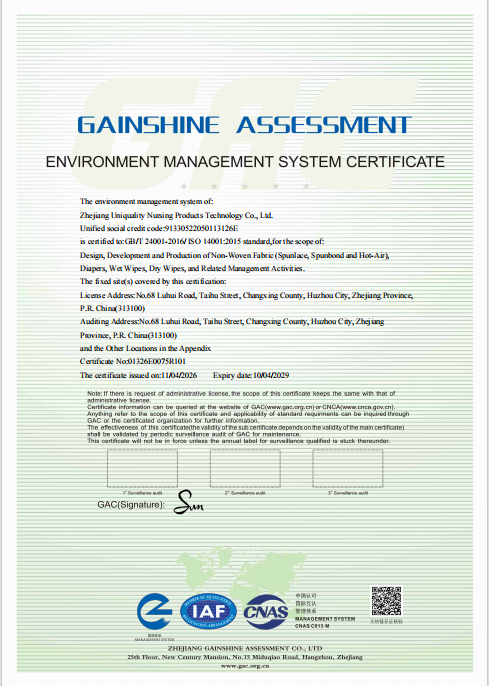
Training pants under product ID 3752 also sit inside ISO 14001:2015 certificate 01326E0075R101, issued by GAC for the global market, with a scope covering wet wipes, dry wipes, baby diaper and training pants. The recorded validity runs from 11 April 2026 to 10 April 2029.
This is an environmental management system certificate. It evidences a certified system for managing environmental aspects inside the named scope — which is directly relevant when a retailer's supplier questionnaire asks for an environmental policy, an EMS certificate number, or an expiry date to schedule into its audit calendar. What it does not do is certify the product. It says nothing about absorbency, breathability, skin compatibility, material composition or leak performance, and it should never be used to support those claims.
A clean way to handle the distinction inside an RFQ response is to split the evidence table into two rows: "environmental management — ISO 14001:2015, certificate 01326E0075R101, GAC, scope includes training pants, valid to 10 April 2029" and "product performance — CE certificate 6C240227.ZUNU051 plus batch COA and AQL report". Buyers reviewing dozens of suppliers notice immediately when those two rows have been merged into one sentence.
FSC BV-CQC-167194: Scope Includes Training Pants — Check Current Validity First
FSC certificate BV-CQC-167194 is issued by Bureau Veritas under the standard FSC-STD-40-004V3.0, the chain-of-custody standard recorded on the certificate. Its recorded scope covers wet wipes, dry wipes, baby diaper and training pants, so training pants sit inside the certified scope rather than beside it. The record shows an issue date of 31 May 2021 and an expiry date of 30 May 2026.
Date check before you reprint an FSC claim. The expiry date recorded for BV-CQC-167194 — 30 May 2026 — falls before the publication date of this guide. That does not by itself tell you the certification lapsed; it tells you the record supplied here is not a current-validity statement, and that a buyer must ask for the current certificate version, its dates and its scope wording before printing an FSC mark, answering a retailer's FSC question, or listing the certificate code on a product page.
Two habits keep FSC evidence clean. First, always pair the certificate number with the scope wording; "FSC certified" without BV-CQC-167194 and without the scope line is unverifiable at the other end. Second, ask the certificate holder to confirm the exact on-pack claim wording and licence code that their certifier has approved for your specific pack, because the claim text is part of what is being certified, not a design decision made in the artwork file.
COA and AQL: The Batch-Level Evidence Certificates Cannot Replace
Certificates describe systems and standards. They do not describe the carton you receive. That is the job of batch-level evidence, and the recorded quality-control method for this programme is COA together with AQL sampling inspection.
- COA (certificate of analysis). A per-batch record reporting measured values for named parameters, produced against the lot actually shipped. Ask which parameters are reported, which method each value was obtained by, which lot number the COA refers to, and who signed it. A COA that lists values with no method attached cannot be compared with another supplier's COA.
- AQL sampling inspection. An acceptance-sampling result for a defined lot. Ask for the inspection level, the AQL value applied, the sample size drawn and the defect classification used, so that two suppliers' "passed AQL" statements mean the same thing. "Passed inspection" without a plan is an opinion; with a plan it is a record.
Where absorbency is a purchase criterion, naming a published test method changes the conversation. ISO 11948-1, the method for determining the total absorption capacity of urine-absorbing aids, is published as a test method by testing providers such as SGS-IPS Testing. A COA that references a defined method lets a buyer compare numbers across suppliers on one basis; an unqualified absorbency figure does not. This is a testing-method reference, not a certification, and it should be listed as such.
The system layer behind those batch records is ISO 9001:2015 certificate 01326Q0078R102, issued by GAC, with a scope covering wet wipes, dry wipes, baby diaper and training pants and validity running from 11 April 2026 to 10 April 2029. For the shipping and customs team, disposable training pants and baby diapers are primarily classified under HS code 9619.00, per a published HS code guide — a trade-classification point that sits outside the certificate set but inside the same supplier file.
Matching Certificate Scope to the SKU You Are Actually Buying
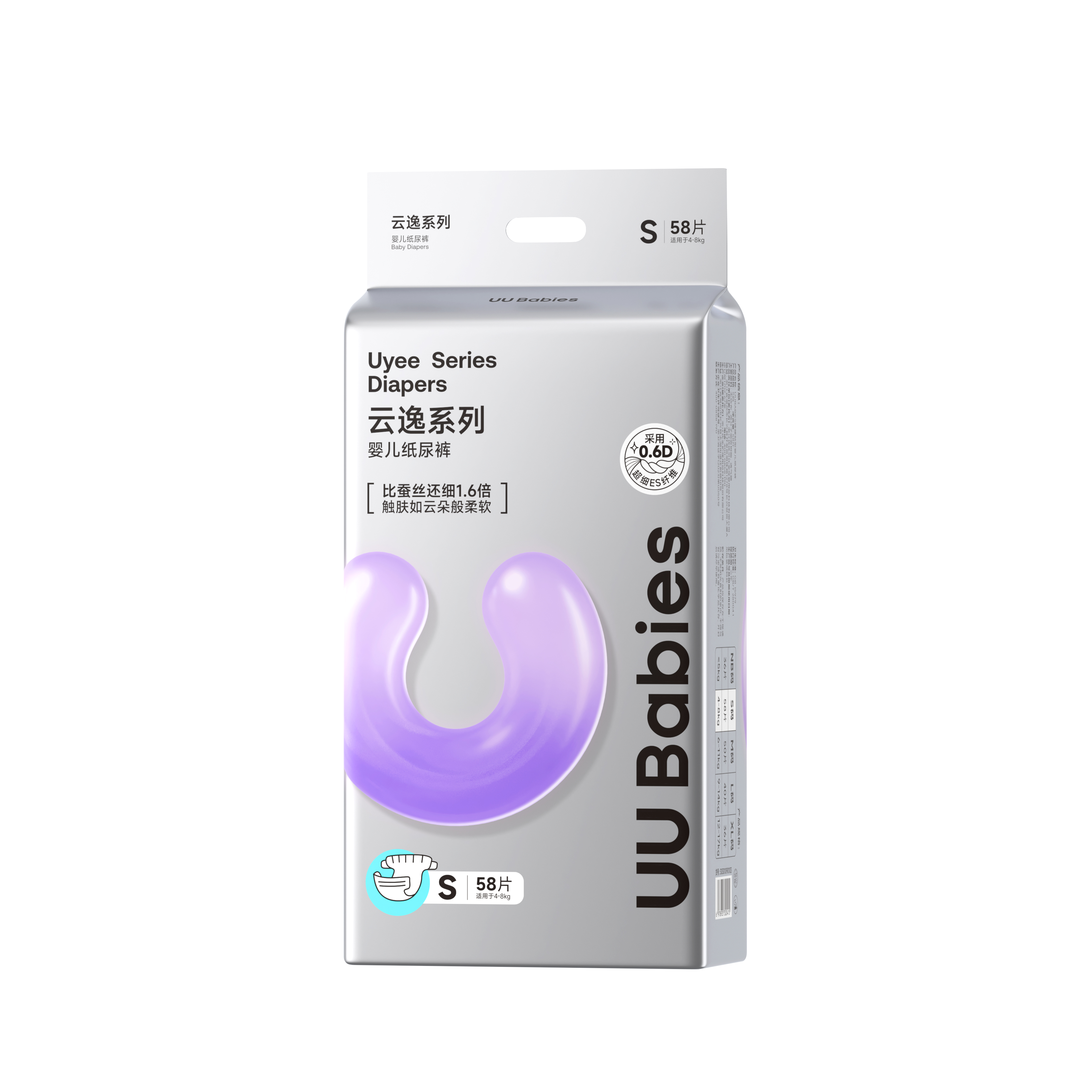
Scope language is category-level; purchase orders are SKU-level. Model YQ004 training pants are offered in sizes M, L, XL, XXL and XXXL, with a core described as 100% wood pulp, a half-core option and 100% SAP, materials of nonwoven and SAP, and pack configurations of 30, 42 or 82 pieces per bag that can be customised. Those are exactly the variables a certificate scope does not itemise.
A workable decision rule is this: any change that touches material, core structure, formula, size range or pack format is a scope question, and it should be answered in writing before artwork approval rather than after. The reason is procedural, not bureaucratic — the artwork is where claims live. Once a print cylinder carries a certification mark or a certificate code, the artwork becomes the claim, and correcting it later costs far more than one email during the RFQ stage.
Customisation itself is supported across material, size, logo, packaging, fragrance and formula. The certification question is narrower: for each customisation that changes what the product is made of, ask the supplier to confirm whether the resulting SKU remains inside the certified scope, and keep the confirmation next to the certificate copy.
A Buyer's Verification Workflow, Step by Step
This sequence works for a first order and for a re-order, and it takes less time than resolving a misstated claim after launch.
- Collect certificates as numbered PDFs. Request the full document, not a cropped image — the scope field, issuing body and dates all have to be legible.
- Verify each number with the issuing body. Check CE 6C240227.ZUNU051 with ENTE CERTIFICAZIONE MACCHINE, ISO 14001 01326E0075R101 and ISO 9001 01326Q0078R102 with GAC, and FSC BV-CQC-167194 with Bureau Veritas. A certificate confirmed at source is worth ten confirmed by a sales deck.
- Build a scope matrix. One row per SKU, one column per certificate, and one column for "claim we intend to make". Gaps become visible immediately.
- Resolve date gaps before they become claim gaps. The FSC record's expiry date of 30 May 2026 already sits in the past relative to this guide; request the current version and its dates before any FSC-related artwork is released.
- Attach batch evidence to the order, not the brochure. Put COA and the AQL inspection plan into the purchase-order annex, with the parameters, methods and lot references you expect.
- Separate market-entry questions from certificate questions. Route destination-specific questions to your importer of record or regulatory advisor, and record their answer separately from the certificate file.
- Freeze the claim list into the artwork brief. One approved sentence per claim, each traceable to a certificate number, a COA parameter or nothing at all.
Regional Checklist: Questions to Ask Before Booking Production
The records in this guide list the global market, and the supplier's recorded export markets include the USA, EU, South America, Russia and the CASA region, with training pants application scenarios recorded for the Philippines, Russia, the UAE, the United States, Chile and Mexico. None of that settles what your own destination requires. The questions below are the ones worth putting on the table, region by region, with your importer of record or advisor.
| Region | Questions to resolve before the order |
|---|---|
| European Union | Does the buyer's file need the CE certificate copy with number 6C240227.ZUNU051 and both cited standard strings? Which entity is the importer of record? Who holds the technical documentation, and in which language must pack information appear for the destination? |
| North America (USA) | What does the retailer's own supplier-compliance programme require beyond the certificates? Which claims will appear in the retail listing, and is each one traceable to a certificate, a COA parameter or a test report? |
| Middle East (UAE) | Does the destination require legalisation, translation or attestation of any document before shipment? Which documents must travel with the container rather than by email? |
| Russia | Which documents must be provided in local-language form, and at which stage — quotation, order confirmation or shipment? |
| Asia-Pacific (Philippines) | Which registration or notification steps sit with the importer, and what document set does the importer need from the factory to start them? |
| Latin America (Chile, Mexico) | Which labelling and documentation items are checked at entry, and who confirms the HS classification 9619.00 against the actual shipment specification? |
Use Cases: Who Reads These Documents Differently
The same certificate set supports different decisions depending on who is holding it, and the reading emphasis should shift accordingly.
- Private-label brand owner. The binding constraint is the artwork claim. Build the claim list from the CE scope plus approved COA parameters, confirm FSC claim wording and current validity before any pack print, and keep the certificate numbers in the brand's compliance file.
- Importer or distributor. The binding constraint is documentation continuity across shipments. Store certificate copies with dates, set a refresh reminder ahead of each expiry, and require COA and AQL records per lot so a customer complaint can be traced to a batch.
- Retail own-brand quality team. The binding constraint is auditability. The useful file maps each of the four certificate numbers to its issuing body, scope and validity, then shows which product-level evidence supports each on-pack claim.
- Marketplace or online seller. The binding constraint is listing accuracy. Quote the certificate number and the exact scope wording, avoid expanding "global" into country-level approval, and remove any claim that cannot be matched to a document in the file.
What Each Document Does Not Prove
Negative scope is where most compliance files fail, because the omissions are rarely written down. The table below states the limit of each document in the same terms a reviewer would use.
| Document | Supports | Does not establish |
|---|---|---|
| CE certificate 6C240227.ZUNU051 | A CE certificate exists for baby diaper and training pants, referencing EN 12221-1:2008+A1:2013 and EN ISO 12625-1:2019, issued by ENTE CERTIFICAZIONE MACCHINE | Batch conformity of a specific shipment; coverage of every size or pack variant unless confirmed in writing; acceptance by any individual destination without local steps |
| ISO 14001:2015 01326E0075R101 | A certified environmental management system inside a scope that names training pants | Product performance, absorbency, breathability, skin compatibility or material composition |
| FSC BV-CQC-167194 | FSC chain-of-custody certification under FSC-STD-40-004V3.0 with a scope covering training pants, for the period stated on the certificate | Current validity beyond the recorded expiry of 30 May 2026; approval of any specific on-pack claim wording |
| ISO 9001:2015 01326Q0078R102 | A certified quality management system covering the named product scope | That any individual lot met its specification — that is the COA's job |
| COA | Measured values for stated parameters on a named batch, by a stated method | Third-party certification, or performance beyond the parameters actually reported |
| AQL report | An acceptance-sampling result for a defined lot under a defined plan | Zero-defect production, or results transferable to a different lot or a different plan |
FAQ
Does CE certificate 6C240227.ZUNU051 cover every training pants SKU we might order?
The certificate's recorded scope names baby diaper and training pants, and training pants product ID 3752 is the product mapped to it in the supplier's records. The scope does not itemise sizes, pack counts or artwork variants, so the buyer's step is to request a written SKU list from the certificate holder and file that answer with the certificate copy. That written confirmation, not the scope line alone, is what supports a claim about a specific SKU.
What is the difference between ISO 14001:2015 and a product safety certificate?
ISO 14001:2015 certificate 01326E0075R101, issued by GAC, certifies an environmental management system inside a scope that covers wet wipes, dry wipes, baby diaper and training pants, with recorded validity from 11 April 2026 to 10 April 2029. It does not certify product performance and says nothing about absorbency, breathability, skin compatibility or material composition. Product-level questions are answered by the CE certificate scope together with batch COA and AQL inspection records.
Can a supplier customise training pants and still keep the certified scope intact?
Customisation is offered across material, size, logo, packaging, fragrance and formula, and model YQ004 is available in sizes M, L, XL, XXL and XXXL with a wood pulp and SAP core and 30, 42 or 82-piece pack options. Whether a specific customisation stays inside a certified scope is a separate question from whether it can be produced, so each change that affects material, core structure or formula should be confirmed in writing against the certificate scope before artwork approval.
What drives the commercial terms of a certified training pants order?
The recorded commercial parameters are a minimum order quantity of 150,000 pieces for baby diapers and pull-ups, and a lead time of 35 to 45 days after artwork confirmation and deposit, with monthly capacity quoted at 7 billion units for wet wipes and differing by product line. No price level is stated in this guide, because price depends on size mix, core specification, pack format, artwork and order volume, and should come from a quotation against your actual specification rather than from an article.
How should we validate certificates and samples before committing to an order?
Request the full numbered certificate documents, verify each number with its issuing body — ENTE CERTIFICAZIONE MACCHINE for CE 6C240227.ZUNU051, GAC for ISO 14001 01326E0075R101 and ISO 9001 01326Q0078R102, Bureau Veritas for FSC BV-CQC-167194 — then match each scope line to your SKU and check the expiry dates, refreshing the FSC record whose expiry of 30 May 2026 has already passed. Sampling is listed in the company profile as 3 to 5 days, and the sample stage is the right moment to request a COA with named parameters and methods and to agree the AQL plan that will apply to production lots.
How long does production take once the artwork is approved?
Lead time is recorded as 35 to 45 days after the artwork and deposit are confirmed, so certificate verification and claim approval should be completed before that clock starts. Finalising scope confirmation, FSC claim wording and the COA/AQL annex during the artwork stage keeps document review from delaying the production slot, and it means the first shipment arrives with the evidence file already aligned to the packaging.
Conclusion: Build the Claim List from Scope, Not from Logos
Three certificates, read properly, give a buyer three different protections. CE certificate 6C240227.ZUNU051 anchors the product-and-standard claim for baby diaper and training pants. ISO 14001:2015 certificate 01326E0075R101 and ISO 9001:2015 certificate 01326Q0078R102 anchor the management-system answers that retailer questionnaires ask for. FSC certificate BV-CQC-167194 anchors a materials-scope claim covering training pants — provided the current version and dates are obtained, since the record supplied here expires on 30 May 2026. COA and AQL evidence sit underneath all of them and describe the lot, which is the level at which a buyer actually takes delivery.
The discipline that makes the file defensible is small: quote numbers instead of logos, write standards with their versions and amendments, keep scope wording intact, and never let "applicable globally" grow into "approved everywhere". A buyer who does those four things can answer a retailer's compliance question in one sentence, and can tell the difference between a certificate that covers training pants and one that merely sits next to them.
Next step for buyers. The company brochure covering products, manufacturing and quality systems can be downloaded here: Uniquality product and capability brochure (PDF). Certificate copies with the numbers referenced in this guide, together with a COA and AQL plan for your specification, can be requested from the supplier team by email at michelleyu@kingsafe.com or on WhatsApp at +86 187-0582-0808.

Have Questions or Need More Details?
Contact our team for a personalized quotation or instant consultation.
Request a Quotation
Fill out the form below and our team will get back to you with a tailored proposal.
WhatsApp Direct Chat
Prefer to chat in real-time? Message us on WhatsApp for instant assistance & quick answers.
- Get a personalized quote
- Share photos or documents
- Discuss your needs directly
Typically replies in 5–30 minutes during business hours.