
Training Pants: A Complete Buyer's Guide to Types, Features, Sizes and OEM Supply
Training Pants: A Complete Buyer's Guide to Types, Features, Sizes and OEM Supply
Training pants are disposable, pull-on absorbent garments built for the stage between full-time diapering and independent toilet use. For importers, distributors and private-label brand owners, they are a category in their own right — with a different size curve, different packaging conventions and a different absorbency brief than a standard baby diaper. This guide explains what training pants are, what the category looks like in market data, how a production specification such as the Uniquality YQ004 Training pants is structured, and how buyers specify, validate and source the product.
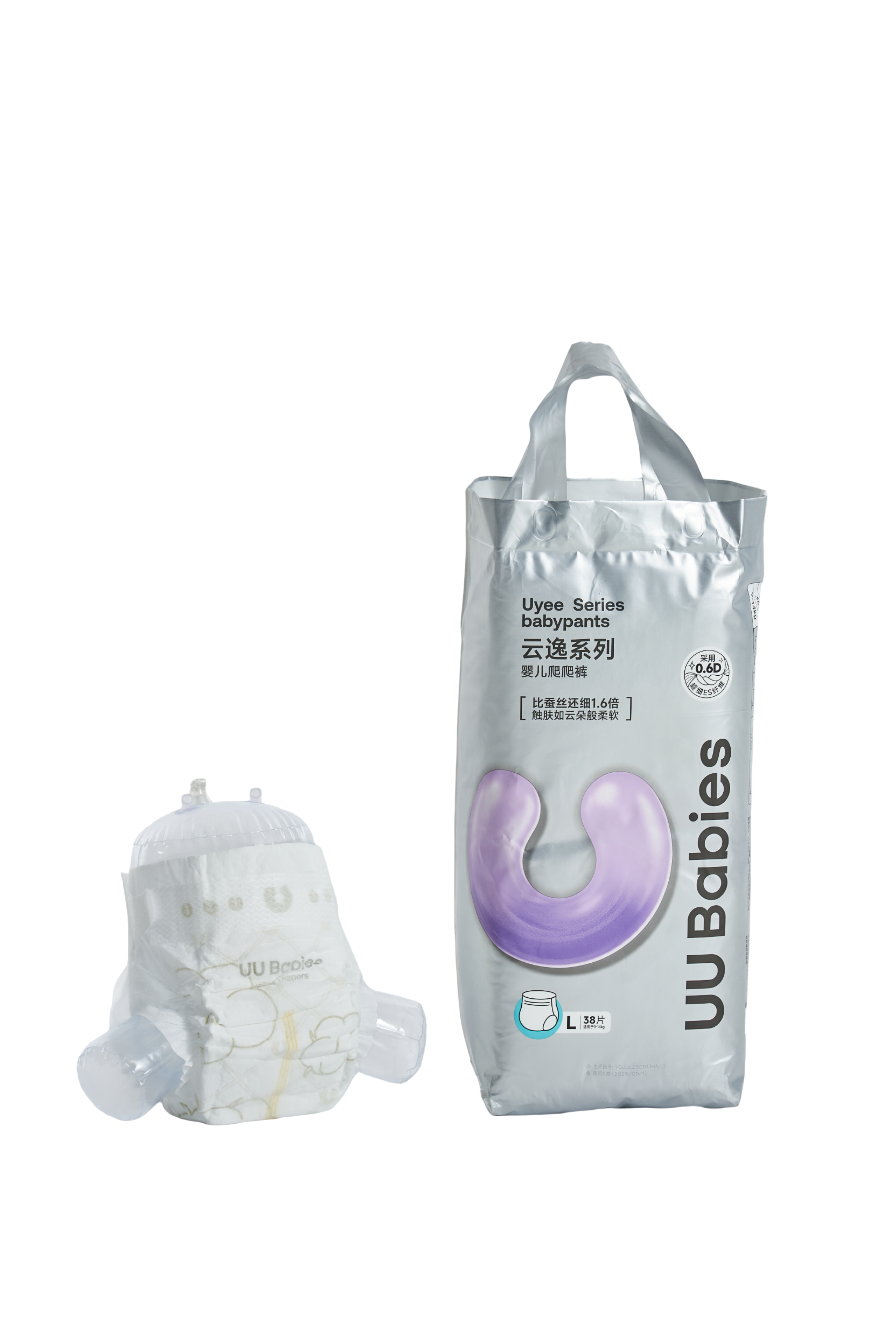
Training pants (model YQ004): pull-on design with an elastic wide waistband, a super absorbent core with high polymer SAP, a breathable soft top sheet and easy-tear side seams.
What Are Training Pants?
A training pant is a disposable absorbent pant that a child steps into and pulls on like underwear, rather than a taped diaper that is fastened while the child lies down. Its job is to absorb a child's urine, keep the skin dry and provide leak-proof protection while the child is learning to use a toilet. In the Uniquality product range, the item is catalogued as Training pants, model YQ004, under the product type Baby Training pants, and it is produced for the Maternity & Baby Industry and the Personal care Industry. It is a disposable, single-use product made from nonwoven fabric and SAP (super absorbent polymer).
The manufacturer behind the YQ004 specification is Zhejiang Uniquality Nursing Products Technology Co., Ltd. — a China-based OEM and ODM manufacturer of personal care products, established in 1987, specialising in wet wipes and diapers, with main products that include Baby Training Pants, Disposable Training Pants, Baby Diapers, Baby Pants, Baby Wipes and Dry Wipes.
The Problem Training Pants Solve
Toilet training is a transition, not a switch. A child in this stage still has accidents, but also wants to move, crawl, walk and use a potty independently. That combination creates four practical problems, and the design of a training pant is a direct response to each of them.
- Pull-on independence. A taped diaper must be applied while the child lies down, which is impractical during active training. A training pant is stepped into and pulled up, and can be pulled down for a toilet trip. The elastic wide waistband on the YQ004 is designed for this: it stretches to fit a child's belly comfortably without tight binding and lets children pull the product on and off independently.
- Leakage control. Accidents during training are smaller but still frequent. The super absorbent core with high polymer SAP absorbs minor accidents quickly to avoid leaking onto underwear.
- Skin comfort over longer wear. A training pant is worn like underwear for longer, more active periods, so breathability matters more than in a product changed on a strict schedule. A breathable soft top sheet made of skin-friendly non-woven fabric reduces stuffiness and fits the legs flexibly for crawling and walking.
- Fast removal when soiled. Pulling a wet pant down the legs can spread leakage. The easy-tear side seams allow the pant to be ripped away quickly instead.
For buyers, the sourcing problem is a different one. Training pants are frequently treated as an afterthought inside a diaper range, yet they carry their own size logic, their own bag-count conventions and their own compliance file. A supplier that can produce a diaper is not automatically set up to deliver a consistent training pant programme, because the product behaves differently in fit testing, in size-curve planning and in retail packaging.
Industry Background: What the Training Pants Market Looks Like
The training pants category is a sizeable and internationally traded segment of the baby care market, and several published figures are useful when framing a range plan.
| Market signal | Reported figure | Source |
|---|---|---|
| Global baby training pants market value | Approximately USD 4.57 billion in 2024, projected to reach USD 7.0 billion by 2030 | Grand View Research |
| Disposable share of the baby pants market | Disposable baby pants, including training variants, hold 62.3% share as of 2025 | Market Intelo |
| Dominant age band | The 18 to 48 months group accounts for 49.0% of the training diaper market | Fact.MR |
| China regional outlook | China's reusable baby diapers and training pants market is expected to reach USD 1.77 billion by 2030, at a CAGR of 7.6% | Grand View Research |
| Global market leaders in the segment | Procter & Gamble (Pampers), Kimberly-Clark (Huggies / Pull-Ups) and Unicharm (Moony / MamyPoko) | Fortune Business Insights / Dataintelo |
| Capacity development | First Quality announced a 50% expansion of its baby training pant manufacturing capacity in 2024 with a new facility in Georgia, USA | Fortune Business Insights |
Two practical readings follow from this data. First, the age concentration matters more than the headline value: because the 18 to 48 months group accounts for the largest share of demand, a training pant range is normally built around toddler sizes rather than newborn sizes — which is exactly why sizes M through XXXL dominate the YQ004 specification. Second, published market size figures vary widely depending on how the product is defined. Sources that measure the total baby pants segment, or the reusable category, report values far above the standalone training pants figure cited above. When a range plan is built on category numbers, the definition behind the number should be checked before it is used in a business case.
Product Anatomy: Inside the Uniquality YQ004 Training Pants
The YQ004 specification is best understood feature by feature, because each element corresponds to a decision a buyer can adjust or test.
Size range
The product is available in sizes M; L; XL; XXL; XXXL. This is a toddler-oriented curve: the smaller newborn sizes used in diaper ranges are not part of the training pant line-up, which reflects the 18 to 48 months concentration of demand in the category.
Core construction
The absorbent core is specified as 100% woodpulp; half core; 100% SAP. For a buyer, the meaningful variables here are the pulp component, the core format and the SAP content — the three parameters that shape absorbency, thickness and how the product behaves during wear. Absorbency is delivered by the high polymer SAP in the core, which absorbs minor accidents quickly to avoid leaking onto underwear.
Elastic wide waistband
A stretchable waistband that fits a child's belly comfortably without tight binding, and that is easy for children to pull on and off independently. In fit testing, waistband behaviour is usually assessed together with the leg opening, since the two together determine whether the product stays in place during crawling and walking.
Breathable soft top sheet
The topsheet is a skin-friendly non-woven fabric intended to reduce stuffiness and to fit the legs flexibly during crawling and walking. Because training pants are worn like underwear rather than changed on a fixed schedule, topsheet feel is a purchase driver in its own right, not a cosmetic detail.
Easy-tear side seams
A side-rippable design that allows fast removal when the product is wet unexpectedly — the practical alternative to pulling a soiled pant down the legs.
Materials and packaging
Materials are Nonwoven; SAP. Bag counts are 30 pcs/bag; 42 pcs/bag; 82 pcs/bag, and can be customised. Operation mode is disposable and single-use, and the product is intended to be stored in a cool and dry place.
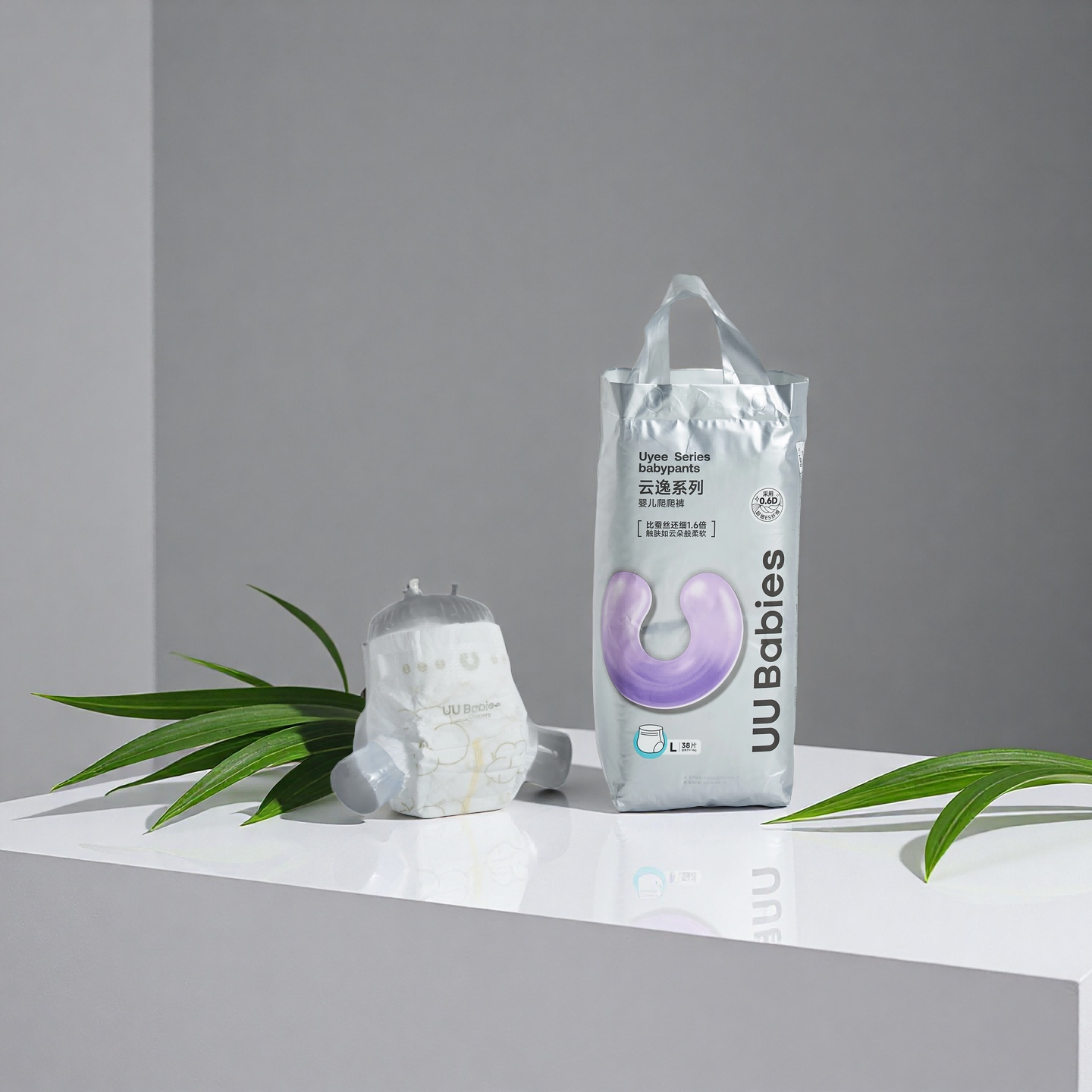
Construction detail: elastic wide waistband, super absorbent core with high polymer SAP, breathable soft top sheet and easy-tear side seams.
Training Pants Terms Buyers Use — and What They Actually Mean
Search language in this category is feature-driven. Buyers, brand owners and retail buyers describe the same product through a set of overlapping terms, and each term points at a specific design or specification question. The table below maps the common terms to the feature they refer to and to the point that should be verified with a supplier.
| Term | What it refers to | What to verify with the supplier |
|---|---|---|
| Baby Training Pants | Pull-on absorbent pants sized for babies and toddlers | Size curve and fit range (M to XXXL) |
| Disposable Training Pants | Single-use construction, not reusable cloth training underwear | Confirmation of disposable, single-use operation mode |
| Pull Up Training Pants | The pull-on format that replaces a taped closure | Elastic wide waistband and pull-on / pull-off performance |
| Breathable Training Pants | Styles that emphasise airflow and reduced stuffiness | Breathable soft top sheet and non-woven specification |
| Super Absorbent Training Pants | Styles that emphasise core performance | Core format and SAP content (half core; 100% SAP) |
| Leak-Proof Training Pants | Styles that emphasise containment during accidents | Core and leg-fit combination; absorbency of minor accidents |
| Toddler Training Pants | Age- and stage-focused description of the same category | Fit around the 18 to 48 months demand band |
| Soft Training Pants | Feel and surface softness | Topsheet material and hand feel in sample |
| XL Size Training Pants | The larger end of the size curve | Availability of XL, XXL and XXXL |
| Skin-Friendly Training Pants | Skin comfort and material safety expectations | Skin-friendly non-woven topsheet, absence of harmful substances, compliance documentation |
The practical point is that these terms are not different products. They are different entry points into the same specification, and a supplier brief is clearer when each entry point is tied to an adjustable parameter rather than to a marketing label.
Step-by-Step: How to Specify and Source Training Pants
For a brand owner, importer or distributor building a training pant line, the specification process normally follows seven steps.
- Define the size range and target age group. Start from the demand band. With the 18 to 48 months group accounting for 49.0% of the training diaper market, the commercially central sizes are the mid-to-large ones. The YQ004 covers M, L, XL, XXL and XXXL, which allows a range to be built without a separate newborn mould.
- Set the core configuration. The core options available in this specification are 100% woodpulp, half core and 100% SAP. Decide which configuration matches the absorbency and thickness profile of the intended price tier, then keep the choice stable so that repeat orders match the approved sample.
- Confirm materials and topsheet feel. The product is made from nonwoven and SAP. The breathable soft top sheet is the element that determines perceived softness and breathability, so it should be assessed on a physical sample rather than from a data sheet alone.
- Choose the bag count and packaging format. Bag counts of 30 pcs, 42 pcs and 82 pcs are available and can be customised. Retail channel, shelf space and shipping configuration usually decide which counts belong in the range.
- Validate with samples. Uniquality's private label service includes a stated 3 to 5 day sampling timeline. Sample validation should test the elastic waistband under stretch, absorbency speed and capacity of the core, topsheet hand feel, ease of tearing at the side seams, and overall fit across the intended size curve.
- Confirm private label and OEM/ODM scope. Uniquality operates as an OEM and ODM manufacturer with a one-stop private label service, supported by an R&D team of over 200 engineers. Scope to agree at this stage includes artwork and print, size mix, bag counts and any market-specific documentation.
- Plan storage and distribution. The product is a disposable, single-use item that should be kept in a cool and dry place. It is designed to sit alongside ancillary items used in maternity and baby care settings, such as baby changing stations and hygiene care kits.
Use Cases: Where Training Pants Are Used
The YQ004 is intended for the Maternity & Baby Industry and the Personal care Industry, and its function is defined as absorbing a child's urine, keeping skin dry and providing leak-proof protection. In practice, that maps onto several commercial use cases.
- Private label retail ranges. Supermarket, drugstore and pharmacy own-brand lines that need a training pant positioned between full-time diapers and underwear.
- E-commerce and subscription formats. Direct-to-consumer offers where a predictable size progression and flexible bag counts (30, 42 or 82 pcs) support repeat purchase.
- Maternity and baby care projects. Product supply bundled into maternity and baby care programmes, where the pant is one item inside a wider hygiene kit.
- Disposable hygiene product supply projects. Larger supply arrangements that require a consistent, documented specification across repeat orders.
- Institutional and childcare settings. Environments that use baby changing stations and hygiene care kits as standard equipment, and that value fast removal via tear-away side seams.
- Distributor assortments. Wholesale portfolios that pair training pants with related products such as baby diapers (YQ003), baby wipes and dry wipes from the same manufacturing platform.
Application data for this product lists relevant markets including the Philippines, Russia, the United Arab Emirates, the United States, Chile and Mexico, alongside the company's broader export footprint of more than 80 countries with major markets in the USA, EU, South America, Russia and Central / South Asia.
Pull-on application: the elastic waistband supports independent pull-up and pull-down during the training stage.
Comparison Table: Training Pants (YQ004) vs Baby Diapers (YQ003)
Both products are manufactured for the Maternity & Baby Industry and the Personal care Industry, which can make them look interchangeable on a product list. The specification table below shows where they actually differ.
| Attribute | Training pants (YQ004) | Baby diapers (YQ003) |
|---|---|---|
| Product type | Baby Training pants | Baby diapers |
| Size range | M; L; XL; XXL; XXXL | NB; M; L; XL; XXL; XXXL |
| Core | 100% woodpulp; half core; 100% SAP | 100% woodpulp; half core; 100% SAP |
| Materials | Nonwoven; SAP | Nonwoven; SAP |
| Pieces per bag | 30 pcs/bag; 42 pcs/bag; 82 pcs/bag, can be customised | 30 pcs/bag; 42 pcs/bag; 82 pcs/bag, can be customised |
| Typical stage of use | Toilet-training transition, worn and removed like underwear | Full-time diapering stage |
| Applicable industry | Maternity & Baby Industry; Personal care Industry | Maternity & Baby Industry; Personal care Industry |
The practical difference is the age and stage the product serves, not the material platform. A diaper range normally needs newborn sizes; a training pant range does not, and that single difference affects size-curve planning, packaging counts and inventory depth.
Frequently Asked Questions
1. What compliance and safety requirements apply to disposable training pants?
Requirements depend on the destination market rather than on the product alone. In the EU, standard baby diapers and training pants must comply with the General Product Safety Regulation (GPSR); specific CE marking is often required only if a product is marketed as a medical device, while OEKO-TEX Standard 100 is the primary consumer safety benchmark in that market. For this product, the application requirement is stated as compliance with ISO 22716, being free of harmful substances and using a skin-friendly construction. Zhejiang Uniquality Nursing Products Technology Co., Ltd. operates a 100,000-class clean room and holds ISO, CE, GMPC and FSC certification. Buyers should confirm with the supplier which documents correspond to their specific market before listing a product.
2. Can training pants be customised for a private label or OEM programme?
Yes. Uniquality operates as an OEM and ODM manufacturer of personal care products with a one-stop private label service, supported by an R&D team of over 200 engineers. For the Training pants model YQ004, the customisable parameters include size range (M; L; XL; XXL; XXXL), core configuration (100% woodpulp; half core; 100% SAP) and bag counts (30 pcs/bag, 42 pcs/bag, 82 pcs/bag, which can be customised). Private label work is supported by a stated 3 to 5 day sampling timeline, which allows artwork, fit and absorbency decisions to be checked before a full order is placed.
3. What drives the cost of disposable training pants?
Cost in this category is driven mainly by specification choices rather than by a single headline factor. The variables buyers can actually control are the material set (nonwoven and SAP), the core configuration (100% woodpulp, half core, 100% SAP), the size mix, the bag count and packaging format, and the level of private label customisation. Because these parameters move together, the useful comparison between suppliers is not a single price point but the specification behind it — two quotations for the same size and bag count are only comparable if the core configuration and topsheet material are identical.
4. How does a buyer evaluate training pants before placing an order?
Evaluation starts with samples. Uniquality's private label service states a 3 to 5 day sampling timeline, and a practical sample review covers five points: waistband stretch and recovery, how quickly the core absorbs a minor accident, topsheet hand feel, how cleanly the side seams tear, and how the product fits across the intended size range from M to XXXL. Samples can be requested through the sales contact at michelleyu@kingsafe.com, by phone or WhatsApp at +86-187-0582-0808.
5. How is supply continuity handled for repeat orders?
Supply capacity sits behind the specification. Zhejiang Uniquality Nursing Products Technology Co., Ltd. was established in 1987, has 24 years of experience in wet wipes and diaper manufacturing, employs approximately 3,000 staff and operates a factory area of 1,000,000 square meters across production campuses, with an annual production capacity of 60 billion sheets. Export business accounts for 70% of total sales, covering more than 80 countries. Training pants should be stored in a cool and dry place, and are a disposable, single-use product. To move from evaluation to a firm offer, the fastest route is to request a sample and a quotation against your target size mix and bag count — you can send the requirement directly to michelleyu@kingsafe.com or start a WhatsApp conversation at +86 187-0582-0808.

Performance testing and quality verification: the laboratory supports product iteration and quality control for absorbent hygiene products.
Conclusion: From Discovery to a Testable Specification
Training pants are a defined product category rather than a variation of a diaper. They are pulled on and off, they are worn like underwear, and they are removed either by pulling down or by tearing the side seams. The demand behind them is concentrated in the 18 to 48 months age band, disposable formats hold the majority of the baby pants market, and the category is internationally supplied by manufacturers with large-scale absorbent hygiene capacity.
For buyers in the awareness and research stage, the useful next step is not to choose a supplier on a headline claim, but to convert the category into a specification: size range, core configuration, materials, bag counts, packaging and compliance file. The Uniquality YQ004 Training pants provides a concrete reference point for that exercise — sizes M to XXXL, a 100% woodpulp / half core / 100% SAP core, nonwoven and SAP materials, bag counts of 30, 42 or 82 pcs, an elastic wide waistband, a breathable skin-friendly top sheet and easy-tear side seams, produced by a manufacturer established in 1987 with an annual capacity of 60 billion sheets and exports to more than 80 countries.
Next step: sample, specification and quote
Send your target size mix, bag count and market so that a matching sample and quotation can be prepared. Sampling is stated at 3 to 5 days for private label projects.
Contact: Michelle — michelleyu@kingsafe.com | Tel / WhatsApp: +86-187-0582-0808
Website: www.kingsafe.com | WhatsApp: Start a conversation
Download the product brochure: Uniquality product brochure (PDF)

Headquarters of Zhejiang Uniquality Nursing Products Technology Co., Ltd. — one of the company's eight major production campuses.