
Training Pants Compliance: CE, ISO 14001 & FSC Checklist
Training Pants Compliance: CE, ISO 14001 & FSC Checklist
Three documents usually decide whether a training pants order clears a retail or importer review: CE certificate 6C240227.ZUNU051, ISO 14001:2015 certificate 01326E0075R101, and FSC certificate BV-CQC-167194. They are not interchangeable, they are not issued by the same body, and they do not expire on the same date. This checklist reads each one against the training pants line, states what it covers and where its scope stops, and shows how a buyer can verify it before signing.
The certificates below belong to Zhejiang Uniquality Nursing Products Technology Co., Ltd. (brand: Uniquality), a China-based OEM and ODM manufacturer of baby training pants, disposable training pants, baby diapers, wet wipes and dry wipes, whose export business accounts for 70% of sales with major markets in the USA, EU, South America, Russia, and Central and South Asia. They are used here as worked examples because each represents a different certificate type — product conformity, management system, and chain of custody — and buyers treat each type differently.
What a Training Pants Certificate File Actually Contains
Most certificate problems in sourcing are not forgeries. They are misreadings. A supplier sends a PDF bundle labelled certificates, the buyer sees a recognised logo, and the file moves forward without anyone checking whether the document applies to the product being purchased, to the entity signing the contract, or to the shipment date.
For training pants, four failure modes repeat often enough to be treated as standard risks:
- Certificate type used for the wrong claim. An ISO management system certificate confirms how a site is run. It is not a statement that a specific pack of toddler training pants meets a product standard.
- Scope mismatch. A certificate can cover baby diapers and training pants while excluding wet wipes and dry wipes. A wipes buyer relying on that document has no coverage at all.
- Stale validity window. Certificates are reissued on a cycle. A file assembled two orders ago may no longer be current at the time of shipment.
- Entity mismatch. The certificate holder, the factory named in the audit, and the company on the purchase order are sometimes three different legal names.
The practical fix is to stop reading certificates as a bundle and start reading them as documents with four checkable attributes: the certificate number, the issuing body, the exact scope wording, and the validity window. Everything below is organised around those four attributes.
Why the Documentation Layer Now Sits Inside the Sourcing Decision
Two shifts pushed certificates from a post-selection formality into the earlier stages of supplier evaluation. The first is category growth. Grand View Research forecasts the global baby training pants market to reach USD 7.02 billion by 2030, growing at a compound annual growth rate of 7.5% from 2025 to 2030 — a commercial forecast, useful as a direction rather than as a planning constant. The second is format maturity: pants-type diapers account for more than 70% of total diaper sales in Japan, according to Fortune Business Insights, which shows how far the pull-up format has displaced tape diapers in developed markets.
When a category moves from niche to mainstream shelf space, the buying conversation changes. Retail private-label teams add documentation clauses to the RFQ, importers build certificate registers into their supplier files, and distributors ask for evidence before they will carry a soft training pants line under their own name. Customs adds a third layer: disposable training pants and baby diapers fall primarily under HS Code 9619.00, so the product description on trade documents has to line up with the product description on the compliance file.
None of this makes certificates a substitute for product performance. Breathability, absorbency and leak-proof construction are tested and specified separately. What the certificate layer does is answer a narrower question: can this supplier document what it says about its product and its site, and can a third party confirm it.
CE Certificate 6C240227.ZUNU051: Product Conformity for Diapers and Training Pants
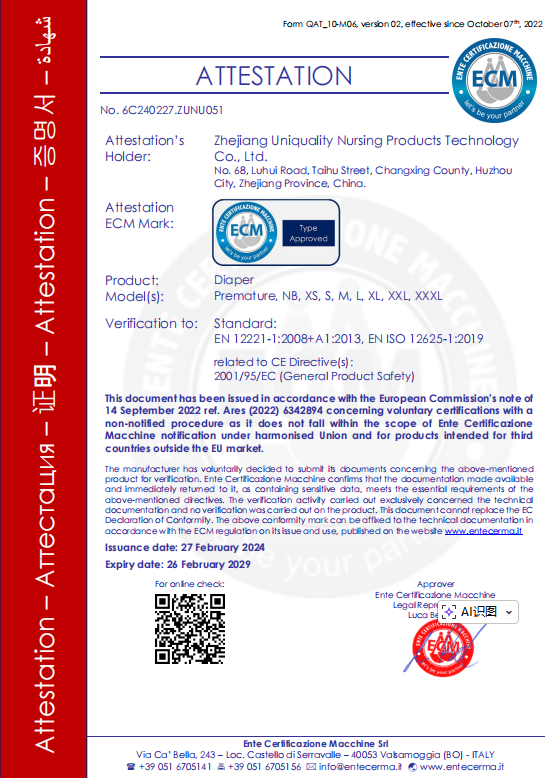
CE certificate 6C240227.ZUNU051 was issued by ENTE CERTIFICAZIONE MACCHINE on 27 February 2024 and runs to 26 February 2029. It is the product-facing document in this set.
Scope. The recorded scope names baby diaper and training pants. That is the sentence a buyer should read first, because it defines both what is covered and what is not. Wet wipes and dry wipes do not appear in the CE scope, so a buyer purchasing wipes cannot lean on this certificate to close a product-conformity question.
Standards referenced. The certificate lists EN 12221-1:2008+A1:2013 and EN ISO 12625-1:2019. Those references are printed on the certificate itself; they are the standards the issuing body has recorded against the scope. Buyers should take the exact titles from the issued document and confirm with their own regulatory or notified-body contact that the referenced standards match the product category and the destination market requirement they are being asked to satisfy. A certificate scope statement is what an auditor reads first, and it is also where mismatches surface.
What it does not do. A product certificate does not approve a brand's artwork, on-pack claims, language requirements, or market registration. Those sit with the brand owner and, in most markets, with a separate registration or notification step. It also does not certify a shipment lot; it certifies the product line within the scope, and batch-level evidence comes from the COA and the pre-shipment test.
ISO 14001:2015 Certificate 01326E0075R101: The Site-Level Environmental System
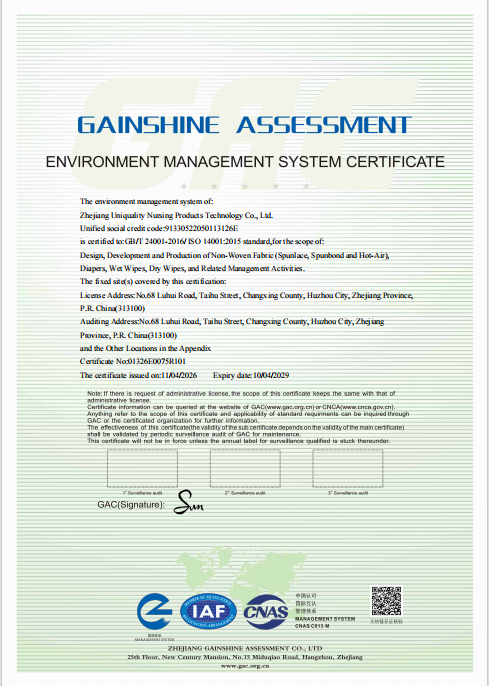
ISO 14001:2015 certificate 01326E0075R101 was issued by GAC on 11 April 2026 and is valid to 10 April 2029. Its recorded scope is broader than the CE scope: wet wipes, dry wipes, baby diaper, and training pants.
This is a management system certificate, and the distinction matters commercially. It confirms that an environmental management system aligned with ISO 14001:2015 is operated within the stated scope. It is not a product performance mark, and it does not tell a buyer whether a specific pull-up training pants SKU absorbs faster or fits better. What it does answer is the question that increasingly arrives from retail sustainability questionnaires, public tenders and distributor vendor-codes: does the manufacturing site manage environmental aspects under a recognised system.
Because the document is site-oriented, the verification question is different from the CE question. Instead of asking whether the product is in scope, ask whether the entity and location on the certificate are the entity and location that will actually run the order. A group with several plants can hold a certificate that covers one site and not another.
FSC Certificate BV-CQC-167194: Chain of Custody, and a Validity Date to Check
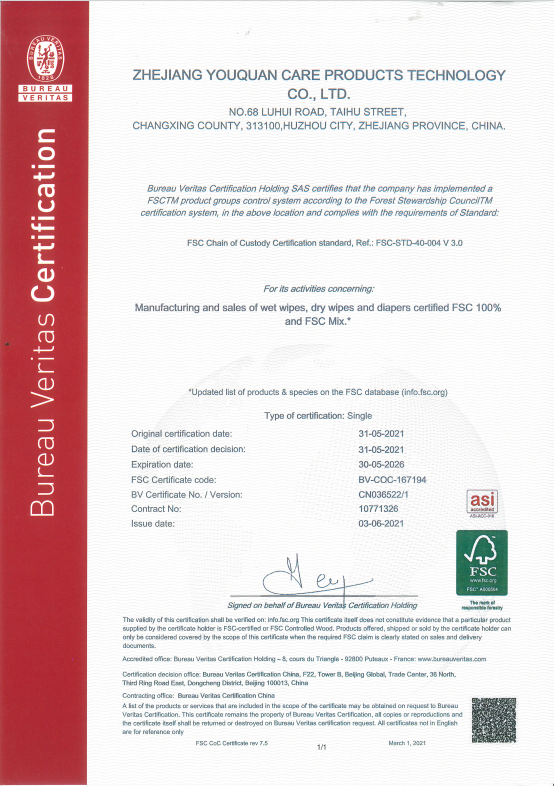
FSC certificate BV-CQC-167194 was issued by Bureau Veritas under FSC-STD-40-004V3.0, the FSC chain-of-custody standard referenced on the document. Its recorded scope covers wet wipes, dry wipes, baby diaper, and training pants. The recorded validity window is 31 May 2021 to 30 May 2026.
Why it is relevant to training pants specifically. The training pants specification for model YQ004 lists the core as 100% woodpulp, with half-core and 100% SAP constructions also offered. Wood pulp is a forest-based material, so forest-based content is genuinely part of the bill of materials. That is the connection point for an FSC chain-of-custody certificate: it addresses how certified forest-based material is tracked through the supply chain. It is not an absorbency claim, a skin-safety claim, or a leak-proof claim.
The date to check. The recorded expiry of 30 May 2026 has passed relative to the date of this article. That does not make the certificate worthless — it makes it a document that must be re-confirmed before it is relied on. If you are sourcing now, request the current certificate or renewal evidence, and confirm status through the public FSC certificate search rather than accepting a screenshot or a copy stored in an old supplier file. Renewal is not automatic and the reissued number and dates should be read from the new document, not assumed from the old one.
Certificate Coverage at a Glance
| Certificate | What it certifies | Training pants | Baby diapers | Wet wipes | Dry wipes |
|---|---|---|---|---|---|
| CE 6C240227.ZUNU051 | Product conformity against the standards listed on the certificate | In scope | In scope | Not listed | Not listed |
| ISO 14001:2015 01326E0075R101 | Environmental management system | In scope | In scope | In scope | In scope |
| FSC BV-CQC-167194 | Chain of custody for forest-based material | In scope | In scope | In scope | In scope |
| ISO 9001:2015 01326Q0078R102 | Quality management system | In scope | In scope | In scope | In scope |
The table shows why the CE document is the one to isolate. Three of the four certificates speak to how the organisation or its material flow is controlled. Only the CE certificate names training pants as a product within a conformity assessment, and only the CE certificate narrows to two product lines.
How to Verify Each Certificate: A Six-Step Breakdown

- Read the scope line before the logo. For training pants, confirm the words training pants or pull-ups appear in the scope. If the scope reads baby diaper only, the document does not answer a training pants question.
- Match the holder to the contracting entity. The name on the certificate should correspond to the manufacturer named on the purchase order or to a site explicitly identified in the supply agreement. Group structures complicate this; ask which legal entity will invoice.
- Check the validity window against the shipment date. CE 6C240227.ZUNU051 runs to 26 February 2029 and ISO 14001 01326E0075R101 runs to 10 April 2029. The FSC record shows 30 May 2026, so renewal evidence should be requested before an FSC claim is used on current packaging.
- Verify with the issuing body, not with the PDF. Ask the certification body to confirm the certificate number and status. For FSC, use the public FSC certificate search. For CE, confirm the issuing body named on the document is the body you are contacting.
- Check the certificate type against the claim being made. If the claim is about the product, use the product certificate. If the claim is about the site, use the management system certificate. If the claim is about forest-based material, use the chain-of-custody certificate. Mixing these is the most common documentation error in supplier files.
- Put the certificate in the order, not in a folder. Write the required documents and their validity-at-shipment condition into the purchase order, with the COA and AQL sampling inspection results, so each order refreshes the file instead of inheriting it.
The Buyer Checklist
| Check | Pass condition | Where to look |
|---|---|---|
| Certificate number | Matches the number on the issued document being relied on | Issued PDF, not a scan of a copy |
| Issuing body | Named, contactable, and able to confirm status | Issuer verification channel; FSC public search |
| Scope wording | Names the product actually being purchased | Scope line on the certificate |
| Certificate holder | Same entity or named site as the contract manufacturer | Certificate header compared with the PO |
| Validity window | Covers the planned shipment date | Issue and expiry dates |
| Certificate type | Matches the claim: product, system, or chain of custody | Certificate title and referenced standard |
Where the Certificate Check Fits in Real Orders
Scenario 1: An EU private-label launch of XL size training pants
A retailer onboarding a private-label pull-up range typically asks for the product-facing document first. In this file, CE 6C240227.ZUNU051 is the relevant item, and the scope check confirms training pants are named. The ISO 14001 certificate usually answers a separate question in the same onboarding pack, typically the supplier sustainability section. Both can be supplied from the same register, but they answer different questions and should be logged as separate entries.
Scenario 2: A Nordic distributor asking for an FSC claim on packaging
When a distributor wants a forest-based claim carried on pack, the chain-of-custody document becomes the operative one, and the date question becomes decisive. The recorded validity window on BV-CQC-167194 ended 30 May 2026, so the correct action is to request the renewed certificate and confirm its status directly. Separately, ask which SKUs and which packaging components the claim is intended to cover — a product-line scope on a certificate does not by itself settle artwork wording.
Scenario 3: Adding a second source without restarting the file
Buyers who qualify a second supplier usually compare the four attributes side by side: number, issuer, scope, validity. Running that comparison on the same template used for the incumbent source prevents the common error of accepting a broader scope from one supplier and a narrower one from another as if they were equivalent.
Scenario 4: Repeat orders where documentation has to keep pace
Uniquality's own records describe a UK-based OEM/ODM partnership running for three years at a monthly volume of 20 forty-foot high-cube containers, with a 99.5% on-time delivery rate and zero major quality complaints, supported by a GMP workshop, ISO certifications, eco-friendly materials, and strict quality control. In long repeat-order relationships, certificate currency is one of the items that has to be maintained alongside delivery performance rather than checked once at the start.
Comparison Table: The Full Certificate Register
| Certificate | Number | Issuing body | Standard / version | Issued | Valid to |
|---|---|---|---|---|---|
| CE | 6C240227.ZUNU051 | ENTE CERTIFICAZIONE MACCHINE | EN 12221-1:2008+A1:2013; EN ISO 12625-1:2019 | 27 Feb 2024 | 26 Feb 2029 |
| ISO 14001 | 01326E0075R101 | GAC | ISO 14001:2015 | 11 Apr 2026 | 10 Apr 2029 |
| ISO 9001 | 01326Q0078R102 | GAC | ISO 9001:2015 | 11 Apr 2026 | 10 Apr 2029 |
| ISO 45001 | 01326S0066R101 | GAC | ISO 45001:2018 | 11 Apr 2026 | 10 Apr 2029 |
| ISO 50001 | 01326En0008R201 | GAC | GB/T 23331-2020 / ISO 50001:2018 | 9 Mar 2026 | 8 Mar 2029 |
| FSC | BV-CQC-167194 | Bureau Veritas | FSC-STD-40-004V3.0 | 31 May 2021 | 30 May 2026 |
Beyond the three certificates in the title, the same register holds a SEDEX record, ZAA600079586, issued by Bureau Veritas CPS - Asia on 24 July 2025, covering labour standards, health and safety, environment, and business ethics across the same four product lines. That record answers a social-compliance question and should not be filed as a product certificate either.
What This Certificate Set Does Not Cover
- Destination-market registration. A CE certificate, an ISO management system certificate, and an FSC chain-of-custody certificate do not replace any separate market registration or notification step a brand may owe in its own jurisdiction.
- Artwork and on-pack claims. Language, symbols, and claim wording on pack are brand-owned decisions and need their own review.
- Batch conformity. Certificate coverage is line-level. Batch evidence comes from the COA and from the pre-shipment test or customer-defined acceptance criteria.
- Wipes under the CE scope. Wet wipes and dry wipes are outside the CE scope recorded here, even though they sit inside the ISO and FSC scopes.
- Current FSC status. The recorded window closed on 30 May 2026, so the FSC position must be re-confirmed before it is used in a live order.
Frequently Asked Questions
How do I verify CE certificate 6C240227.ZUNU051, ISO 14001 certificate 01326E0075R101 and FSC certificate BV-CQC-167194?
Check four attributes on each document. First the number: CE 6C240227.ZUNU051, ISO 14001 01326E0075R101, FSC BV-CQC-167194. Second the issuer: ENTE CERTIFICAZIONE MACCHINE for the CE certificate, GAC for ISO 14001, Bureau Veritas for FSC. Third the scope wording: the CE certificate names baby diaper and training pants only, while ISO 14001 and FSC name wet wipes, dry wipes, baby diaper and training pants. Fourth the validity window: CE runs from 27 February 2024 to 26 February 2029, ISO 14001 from 11 April 2026 to 10 April 2029, and the FSC record shows 31 May 2021 to 30 May 2026, so a renewal certificate should be requested before an FSC claim is used on a current order.
Can a supplier holding these certificates produce private-label training pants at scale?
The certificate set sits on top of a manufacturing base rather than standing alone. Zhejiang Uniquality Nursing Products Technology Co., Ltd. was founded in 1987, operates a factory area of 1,000,000 square metres including a 100,000-class clean room, employs more than 3,000 people, and runs an R&D team of more than 200 engineers. Training pants are produced as model YQ004 in sizes M, L, XL, XXL and XXXL, with a 100% woodpulp, half-core or 100% SAP core and 30, 42 or 82 pieces per bag, all customizable. OEM and ODM production is offered with customization of material, size, logo, packaging, fragrance and formula, and the stated monthly capacity is 7 billion units for wet wipes, with capacity differing by product.
What are the commercial terms for an OEM training pants order?
The stated minimum order quantity is 150,000 pieces for baby diapers and pull-ups, and one 40HQ container for wet wipes and dry wipes. Delivery is quoted FOB or CIF. Payment terms are 30% deposit with the balance against a copy of the bill of lading. Acceptance is based on the factory pre-shipment test or on customer-defined criteria, and quality control uses COA together with AQL sampling inspection.
How long does sampling take and what can be changed?
Sampling runs 3 to 5 days for OEM and ODM orders. Customization covers material, size, logo, packaging, fragrance and formula. For training pants specifically, the size set from M to XXXL, the core construction, and the piece count per bag are configurable, so a sample can be built to the structure a brand intends to sell rather than to a catalogue default.
What is the production lead time, and what documentation should arrive with the shipment?
Production lead time is 35 to 45 days after artwork confirmation and deposit. Alongside the shipment, ask for the COA for the batch and for certificate copies that are still inside their validity window on the shipment date — with the FSC record, confirm current status rather than relying on the historic expiry date. As a next step, the company and product brochure can be downloaded at the Uniquality brochure, and sample or quotation requests can be sent to michelleyu@kingsafe.com or by WhatsApp on +86 187-0582-0808.
Conclusion: Build the Certificate File Into the Order, Not Around It
The three certificates in this checklist do different jobs. CE 6C240227.ZUNU051 is the product-facing document, scoped to baby diaper and training pants, valid to 26 February 2029. ISO 14001:2015 certificate 01326E0075R101 is a site-level environmental management system document covering all four product lines, valid to 10 April 2029. FSC BV-CQC-167194 is a chain-of-custody document for the forest-based material that enters the product through the woodpulp core, with a recorded window of 31 May 2021 to 30 May 2026 that now requires re-confirmation.
A buyer who can state those three sentences accurately is already ahead of most supplier files. The remaining discipline is procedural: check the scope line, check the holder, check the date against the shipment, confirm with the issuer, and write the requirement into the purchase order so the file refreshes with each order rather than ageing quietly in a folder.

Next step: verify the file, then request a sample
Zhejiang Uniquality Nursing Products Technology Co., Ltd. (Uniquality) — founded 1987, 1,000,000 square metres of factory area, 3,000+ employees, 200+ R&D engineers, and 70% of sales exported to the USA, EU, South America, Russia, and Central and South Asia.
Ask for the current certificate set, a training pants sample (3 to 5 days), or a quotation. Minimum order quantity is 150,000 pieces for baby diapers and pull-ups, with a 35 to 45 day lead time after artwork confirmation and deposit.
Email: michelleyu@kingsafe.com | WhatsApp: +86 187-0582-0808 | Website: www.kingsafe.com | Download the product brochure
Have Questions or Need More Details?
Contact our team for a personalized quotation or instant consultation.
Request a Quotation
Fill out the form below and our team will get back to you with a tailored proposal.
WhatsApp Direct Chat
Prefer to chat in real-time? Message us on WhatsApp for instant assistance & quick answers.
- Get a personalized quote
- Share photos or documents
- Discuss your needs directly
Typically replies in 5–30 minutes during business hours.