
Training Pants Parameter Mapping: CE, ISO 14001, COA/AQL
A certificate is not a specification. This guide converts the training pants documentation package — the CE certificate, the ISO 14001:2015 certificate, the COA and the AQL sampling plan — into clauses a purchase order can actually enforce.
Most training pants sourcing disputes do not begin on the container. They begin in a PDF. A buyer receives a certificate, a test report and a certificate of analysis, files them, and then writes a purchase order that says nothing about them. When a batch arrives with a different core structure, a different piece count or a document that no longer matches the artwork, there is no agreed reference point to resolve the question.
The fix is translation. Each document in a compliance package answers a specific question, and each one leaves other questions open. The work of a technical buyer is to move every closed answer into the order, and every open question into a test clause, an inspection point or a retention requirement.
The examples in this guide use the documentation held for the training pants line of Zhejiang Uniquality Nursing Products Technology Co., Ltd., a China-based OEM/ODM manufacturer of training pants, baby diapers, wet wipes and dry wipes, founded in 1987.

Why compliance documents fail as procurement specifications
Document packages fail buyers in four repeatable ways. Recognising them is faster than reading a certificate line by line.
Scope mismatch. A certificate exists, is current, and is issued by a recognised body — but the scope line does not name the product being ordered. A document that covers baby diapers does not automatically cover pull-up training pants unless the scope says so.
Standard reference without a test clause. The certificate cites standard numbers. The purchase order cites nothing. Between those two facts sits the entire acceptance question: which property, measured how, on what sample size, with what pass limit.
Missing acceptance criteria. A COA template with blank fields and an AQL plan that was never written down are not acceptance criteria. They are intentions. Acceptance criteria have numbers, defect classes and a named inspection stage.
No traceability link. The batch arrives, the COA is issued, and nothing connects the two to a physical sample held by either party. Without retention samples keyed to a batch code, a disagreement three weeks later becomes a memory exercise.
The mapping principle: every document clause should appear in exactly one of three places in the order — as a specification, as an inspection requirement, or as a release condition. If it appears in none of them, it is decoration.
Where training pants sit in the compliance landscape
Disposable training pants and baby diapers are primarily classified under HS Code 9619.00, which places them in the same trade classification family as other absorbent hygiene articles. That classification matters for customs documentation, but it says nothing about product conformity — which is why the certificate package carries the compliance weight.
The category context explains why buyers are being asked for more documentation, not less. Fortune Business Insights reports that pants-type diapers account for more than 70% of total diaper sales in Japan, a market where the pull-up format is the default rather than the alternative. Grand View Research forecasts the global baby training pants market reaching USD 7.02 billion by 2030, growing at a CAGR of 7.5% from 2025 to 2030. Commercial forecasts vary in methodology and should be treated as directional, but the direction is consistent: more private-label entrants, more retail own-brand programmes, and more compliance paperwork moving through procurement teams who did not previously handle absorbent hygiene products.
The practical consequence is that documentation has shifted from a closing formality to an opening gate. A supplier who cannot produce a certificate number, an issuing body and a scope line on request is now screened out before pricing is discussed.
Mapping each document to a procurement parameter
CE certificate 6C240227.ZUNU051: read the scope before the standard
The training pants product, model YQ004, is CE certified under certificate number 6C240227.ZUNU051, issued by ENTE CERTIFICAZIONE MACCHINE. The certificate references EN 12221-1:2008+A1:2013 and EN ISO 12625-1:2019, was issued on 27 February 2024, is valid until 26 February 2029, and applies globally. Its scope covers baby diaper and training pants.
Buyers tend to read the standard numbers first. The more useful order is: certificate number, issuing body, scope, validity, then standards. The number is what makes the document traceable to a registry. The body is what makes it third-party. The scope is what makes it relevant to the SKU. The validity date is what makes it current at the shipment date rather than at the enquiry date.
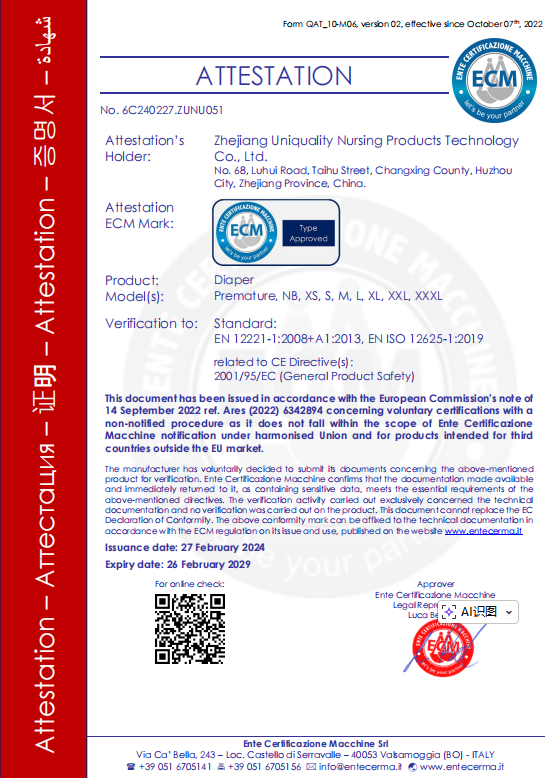
| Field on the certificate | Value in certificate 6C240227.ZUNU051 | What the buyer confirms | Clause to write into the order |
|---|---|---|---|
| Certificate number | 6C240227.ZUNU051 | The number on the copy matches the number on the supplier record and the COA header | Certificate number to be printed on every COA |
| Issuing body | ENTE CERTIFICAZIONE MACCHINE | The body named on the document is the body that issued it | Third-party certificate issued by ENTE CERTIFICAZIONE MACCHINE |
| Standards referenced | EN 12221-1:2008+A1:2013; EN ISO 12625-1:2019 | The standard numbers appear in the technical annex, not only in the certificate file | Conformity referenced against the listed standards |
| Scope | Baby diaper; training pants | The ordered product falls inside the scope line | Scope must explicitly include training pants (model YQ004) |
| Validity | Issued 27 Feb 2024; valid to 26 Feb 2029 | The certificate is current on the planned shipment date | Validity to be re-confirmed at each shipment |
| Market | Global | The destination market is covered by the claim | Applicable to shipments to the named destination |
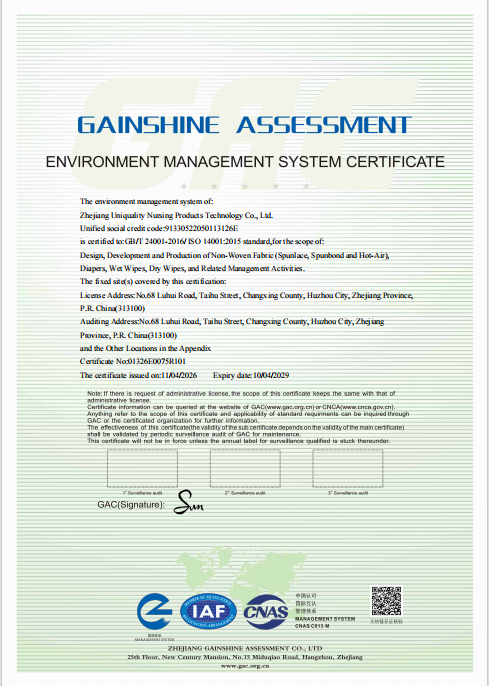
ISO 14001:2015 certificate 01326E0075R101: a management system, not a product claim
The training pants product is certified to ISO 14001:2015 for environmental management. The certificate number is 01326E0075R101, issued by GAC, valid from 11 April 2026 to 10 April 2029, with a scope covering wet wipes, dry wipes, baby diaper and training pants, applicable globally.
The most common misplacement in a supplier file is putting an ISO 14001 certificate in the product compliance column. It does not certify absorbency, skin compatibility, microbial status or dimensional tolerance. What it does establish is that the environmental management system under which the site operates has been assessed against ISO 14001:2015 by a named body, for a defined scope, for a defined period.
That belongs in supplier qualification and in the ESG section of a retail questionnaire — increasingly a separate submission from the product technical file. For procurement, the useful parameters are scope, validity and issuing body: the scope confirms the training pants line sits inside the assessed boundary, and the validity window tells the buyer when the file needs refreshing.
COA: the batch-level bridge between certificate and container
A certificate of analysis is the only document in the package that is issued per batch rather than per product. That makes it the operational centre of the file. A COA that repeats the certificate without naming the batch adds nothing.
For training pants, the COA should carry the batch code, the production date, the certificate reference, and the parameters that the order treats as acceptance criteria. In practice that means the build specification and the packing specification: core construction (100% woodpulp core, half core or 100% SAP), size, piece count per bag, and packaging configuration. The training pants line runs sizes M, L, XL, XXL and XXXL, with 30, 42 or 82 pieces per bag and customisation available — so a COA that states only "training pants" without the size and pack configuration cannot confirm that the shipped batch is the ordered batch.
Microbial results belong on the same document. Splitting microbiological data into a separate email thread is the fastest way to lose traceability.
AQL: turning the word "quality" into an accept-or-reject rule
Quality control on this line operates through COA plus AQL sampling inspection. The COA describes the batch; the AQL plan decides whether the batch is released. Only one of those two is usually written down.
An AQL plan is a commercial agreement, not a supplier default. It has to state the acceptance quality limit, the inspection level, the sample size that follows from them, and the defect classification — which deviations count as critical, which as major, which as minor. A missing piece count is a major defect in one buyer's plan and a minor defect in another's. Neither is wrong, but the difference decides whether a container ships.
The procurement parameter is therefore procedural rather than numerical: the agreed AQL plan must be attached to the purchase order before production starts, and the inspection record must be issued against the same batch code as the COA. When those two documents share a batch code, a dispute becomes a lookup rather than an argument.
Microbial risk control that sits outside the certificate
No certificate in the package substitutes for process control on the line. Four controls carry most of the microbial risk in absorbent hygiene production, and each one can be written into a supplier specification.
- Raw material hygiene. Nonwoven and SAP inputs are received, stored and staged under controlled conditions. The order can require that incoming material lots are traceable to the batch.
- Qualified preservative use. Preservative systems are drawn from a qualified list rather than adjusted batch by batch. A buyer can require that any change to the preservative system is notified before shipment.
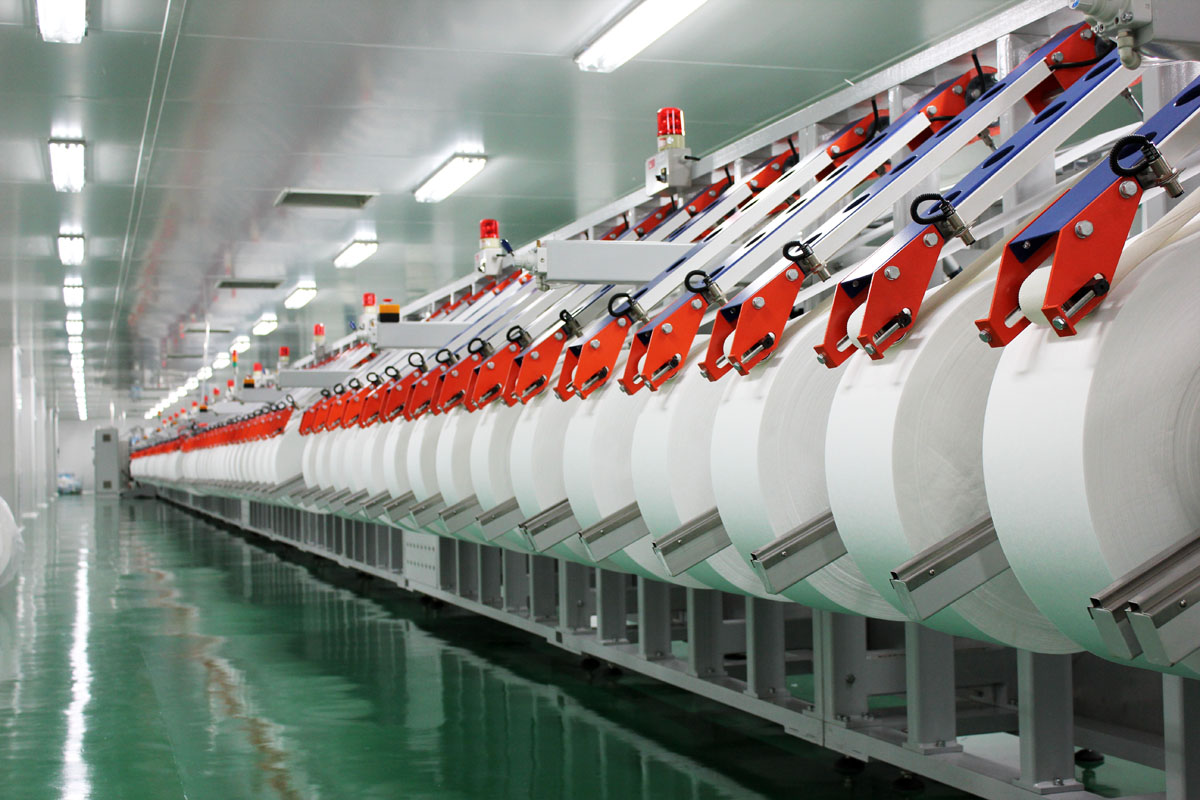
- Purified workshop environment. Production runs in a 100,000-class clean room, which sets the environmental baseline for the batch rather than relying on end-of-line screening.
- Enhanced pre-delivery microbial inspection. Microbial testing is strengthened before delivery, so the release decision is made on data from the batch being shipped.
The application requirements recorded for this product family also include ISO 22716 compliance, absence of harmful substances and skin-friendly contact, with storage in a cool, dry place. Those are specification inputs, not marketing language: they belong in the technical annex and in the storage instruction on the carton.
Laboratory testing and retention samples for traceability
Performance testing has a reference point outside the supplier relationship. ISO 11948-1 specifies the method for determining the total absorption capacity of urine-absorbing aids — the Rothwell test — which gives buyers a named method to cite when they want absorption data rather than an absorption claim.
The laboratory behind the COA is used for product performance testing, technical research and development, and quality verification, with testing and R&D optimisation feeding back into product stability and quality control. For a buyer, the relevant parameter is not the existence of a laboratory but the link between laboratory output, batch code and released goods.
Retention samples close that link. A retained sample per batch, stored under the same conditions and labelled with the batch code, converts a subjective complaint into a physical comparison. Two rules make retention useful: the sample must be drawn from the production batch rather than prepared separately, and the retention period must be at least as long as the commercial claim period on the packaging.
A step-by-step document-to-specification workflow
The sequence below converts a supplier document package into order language. It runs before the first purchase order, and repeats at each certificate renewal.
- Assemble the package. Request the CE certificate, the ISO 14001:2015 certificate, the ISO 9001:2015 certificate, a COA template, the AQL plan and a retention sample policy in one request. Partial packages hide gaps until late.
- Verify the fields, not the logo. For each certificate, record the number, the issuing body, the standard, the scope line and the validity dates. Confirm the scope names training pants specifically.
- Check validity against the shipment date. A certificate valid today may expire before a 35–45 day production cycle plus transit completes. Where renewal falls inside the order window, add a renewal confirmation milestone.
- Move standards into the technical annex. The standards referenced on the CE certificate — EN 12221-1:2008+A1:2013 and EN ISO 12625-1:2019 — should appear in the technical annex with the test methods the buyer expects to see reported.
- Build the COA item list. Fix the parameters before the first batch: batch code, size, core construction, piece count per bag, packaging, microbial results and certificate references. A COA template agreed in advance prevents a shipment from stalling on a missing line.
- Write the AQL plan. Agree the acceptance quality limit, inspection level, sample size and defect classes, then attach the plan to the order. Record who inspects and at which stage.
- Specify the process controls. Put raw material hygiene, qualified preservative use, the 100,000-class clean room environment and pre-delivery microbial inspection into the specification, with a notification requirement for any change.
- Set the release and retention rules. No release without a batch-linked COA and an AQL record. Retain one sample per batch for the agreed period, labelled and stored under the same conditions as the shipment.
Where this mapping changes the order
EU private-label launch. A brand owner preparing a first European listing needs the CE certificate scope to name training pants and the standard references to appear in the technical file before artwork is finalised. Getting this wrong after artwork approval forces a re-quote.
Retail own-brand quality audit. Retail audit teams usually ask for the quality management system and the batch documentation in separate sections. ISO 9001:2015 certificate 01326Q0078R102, issued by GAC and valid to 10 April 2029, carries a scope covering wet wipes, dry wipes, baby diaper and training pants — which lets the buyer answer the system question and the product question from the same file.
Supplier switching. When a buyer changes supplier mid-programme, the gap is rarely price. It is the COA item list, the AQL plan and the retention policy that the previous supplier had agreed informally over years. Writing them down at switch-over prevents the new relationship from restarting the same learning curve.
Multi-market shipments. Uniquality's export markets cover the USA, EU, SAM, RU and CASA regions, with roughly 70% of output exported. For buyers shipping one specification to several destinations, the document set should be checked against each market rather than against the largest one.
Existing programme evidence. A UK-based OEM customer has run a three-year programme at 20×40HQ containers per month, with an on-time delivery rate of 99.5% and no major quality complaints recorded. That outcome depends on batch documentation being complete at release, not on inspection catching problems at the end.
Document comparison: what each certificate and report proves
Each document in the package establishes something specific and leaves something else open. The table below maps the boundary so that no single document is asked to carry more weight than it can.
| Document | Identifier in this file | What it establishes | What it does not establish | Where it belongs |
|---|---|---|---|---|
| CE certificate | 6C240227.ZUNU051, ENTE CERTIFICAZIONE MACCHINE, EN 12221-1:2008+A1:2013 and EN ISO 12625-1:2019, valid to 26 Feb 2029 | Third-party conformity reference for baby diaper and training pants under the listed standards | Batch-level acceptance limits or test results for a specific lot | Product compliance section of the order |
| ISO 14001:2015 certificate | 01326E0075R101, GAC, valid 11 Apr 2026 to 10 Apr 2029 | Environmental management system assessed across wet wipes, dry wipes, baby diaper and training pants | Product safety, performance or microbial status | Supplier qualification and ESG questionnaire |
| ISO 9001:2015 certificate | 01326Q0078R102, GAC, valid 11 Apr 2026 to 10 Apr 2029 | Quality management system scope including training pants | Replacement for batch testing | Quality system section of the supplier file |
| COA | Issued per batch code | Declared composition, size, packing and test results for the named batch | Independent verification of the declared values | Batch release document |
| AQL inspection record | Issued per agreed plan and batch | Accept or reject decision on the sampled units | Coverage of units outside the sample | Pre-shipment release |
| Retention sample | Held per batch code | A physical reference for resolving later disputes | Compliance on its own | Traceability archive |
Frequently asked questions
Which standards does the CE certificate for these training pants reference, and what should I verify before quoting the certificate number?
The training pants product, model YQ004, holds CE certificate 6C240227.ZUNU051, issued by ENTE CERTIFICAZIONE MACCHINE, referencing EN 12221-1:2008+A1:2013 and EN ISO 12625-1:2019. It was issued on 27 February 2024, is valid until 26 February 2029 and applies globally. Before quoting the number in a purchase order, verify three things: that the scope line names training pants as well as baby diaper, that the certificate is still valid on the planned shipment date, and that the certificate number will appear on the COA for each batch.
Does the ISO 14001:2015 certificate tell me anything about the product itself?
No. Certificate 01326E0075R101, issued by GAC to ISO 14001:2015 and valid from 11 April 2026 to 10 April 2029, certifies an environmental management system whose scope covers wet wipes, dry wipes, baby diaper and training pants. It does not certify absorbency, skin compatibility, microbial status or dimensional tolerance. Use it in supplier qualification and in ESG submissions, and use the COA, the AQL record and test reports for product acceptance.
Do COA and AQL inspection add cost or delay to a training pants order?
They change the release sequence more than the production step. The COA is issued per batch and the AQL inspection happens at defined inspection points, so the practical exposure is sampling and documentation time plus the risk of a held batch. That risk concentrates where the AQL level, inspection level and defect classes were never written into the order: a batch cannot be judged against a plan that does not exist. Agreeing the COA item list and the AQL plan before the first production run moves the decision earlier, where it is cheap, instead of later, where it is not.
Can I receive a COA, a certificate package and a retention sample before committing to bulk production?
Yes. Sampling for private-label programmes runs at 3–5 days, and the sample stage is the right point to request the full document set: certificate copies with numbers and issuing bodies, a COA template with the item list you intend to enforce, the proposed AQL plan, and a retained sample from the trial batch labelled with its batch code. Bulk production for baby diapers and pull-ups starts at 150,000 pieces, and sizes M, L, XL, XXL and XXXL are available with 30, 42 or 82 pieces per bag, customisable to your pack specification.
What lead time should I plan once the documents are approved?
Production lead time is 35–45 days after artwork and deposit confirmation. Document approval should therefore complete before artwork freeze, not after it — a certificate scope change or an added COA parameter discovered after artwork approval can force a re-quote and reset the schedule. Plan the certificate expiry check at the same time: with a 35–45 day cycle plus transit, a certificate expiring inside the order window needs a renewal confirmation milestone written into the order.
Next step: request the training pants document pack
Buyers who need to complete a technical file can request the CE certificate, ISO 14001:2015 and ISO 9001:2015 certificates, a COA template and the current AQL plan together, then test them against a sample batch before bulk production.
Email: michelleyu@kingsafe.com | WhatsApp: +86 187-0582-0808 | Website: www.kingsafe.com
Product catalogue and full specification download: Uniquality corporate brochure (PDF)

Conclusion
Training pants compliance documents only create value when they are translated. The CE certificate 6C240227.ZUNU051 answers whether the product sits inside a third-party conformity reference, and under which standards. The ISO 14001:2015 certificate 01326E0075R101 answers whether the site's environmental management system has been assessed, and for which products. Neither answers the batch question — which is what the COA and the AQL plan exist to do.
A workable document-to-parameter map is therefore short: certificate numbers and scope lines in the technical annex, COA parameters and AQL definitions in the acceptance criteria, process controls in the specification, and retention samples in the archive. Every clause should be traceable to a document, and every document traceable to a batch.
Have Questions or Need More Details?
Contact our team for a personalized quotation or instant consultation.
Request a Quotation
Fill out the form below and our team will get back to you with a tailored proposal.
WhatsApp Direct Chat
Prefer to chat in real-time? Message us on WhatsApp for instant assistance & quick answers.
- Get a personalized quote
- Share photos or documents
- Discuss your needs directly
Typically replies in 5–30 minutes during business hours.