
Training Pants for Retail Private Label: An Application Guide to MOQ, Lead Time and QC
Short answer: a private-label training pants program for retail is built on three fixed numbers — a 150,000-piece order minimum for baby diapers and pull-ups, a 35–45 day production window that begins only after artwork approval and deposit receipt, and a release process based on a Certificate of Analysis (COA) plus AQL sampling inspection. A retail launch succeeds or fails on how well the brand owner sequences those three parameters against a fixed on-shelf date.
This guide is written for private-label brand owners, retail category managers, importers and distributors who are applying a pull-up training pant to a retail program. It explains how the MOQ, lead time, quality control, OEM/ODM scope and after-sales support of a private-label training pants order translate into a retail launch plan, using the YQ004 training pants platform from Zhejiang Uniquality Nursing Products Technology Co., Ltd. as a worked example.
Problem Definition: Where Private-Label Training Pants Launches Break Down
Private-label training pants programs rarely fail because the product is wrong. They fail because the retail calendar, the order quantity and the quality documentation are planned in the wrong order. Five failure patterns repeat across retail private-label launches.
- The production clock starts later than the brand assumes. The 35–45 day production window begins after artwork approval and deposit receipt, not after the purchase order is signed. Every artwork revision that happens after the deposit moves the ex-works date by the same number of days.
- MOQ and size curve pull against each other. A 150,000-piece minimum has to be divided across M, L, XL, XXL and XXXL. If the retail plan assumes a full size run at launch but the volume is not allocated deliberately, the small sizes become slow-moving stock while XL and XXL go out of stock first.
- Quality documents are requested after the order instead of before it. Retail onboarding teams ask for a COA and an AQL inspection record as part of supplier approval. A supplier that produces these only at shipment forces the brand to choose between missing the launch date and launching with an incomplete file.
- Packaging artwork is treated as a design task rather than a scheduling milestone. Bag count, bag format and printed artwork all feed the production slot. Artwork that is not frozen before the deposit delays the start of production, not just the print run.
- Reorder timing is decided after the launch. A 35–45 day production window means the second order has to be committed while the first is still selling. Brands that treat the reorder as a post-launch decision usually meet the first stock-out in the same quarter they launched.
The fix is procedural rather than commercial: define the retail brief, fix the size curve against the MOQ, freeze artwork, pay the deposit, then run production and quality release against a documented plan.
Industry Background: Why Retail Buyers Keep Adding Pull-Ups to Private-Label Ranges
Training pants are an absorbent hygiene product sold to parents during a defined transition period, when a toddler moves from a tape-style diaper to a pull-on format. Because the transition is temporary but the size band is narrow, retail programs tend to concentrate volume in fewer SKUs than a full diaper range, which makes the category workable for private label.
The wider market context supports that positioning. Market research cited by Market Research Reports places the global baby diaper market at US$66.3 billion in 2025. Within that category, Grand View Research forecasts that the global baby training pants market will reach US$7.02 billion by 2030, growing at a CAGR of 7.5% from 2025 to 2030. Fortune Business Insights reports that pants-type diapers already account for more than 70% of total diaper sales in Japan — a signal of how far the pull-up format can travel in a mature retail market.
Two regulatory and technical anchors matter for cross-border retail programs. Disposable training pants and baby diapers are primarily classified under HS Code 9619.00, so landed-cost and customs documentation can be planned along a single classification line. On product performance, ISO 11948-1 specifies the method for determining the total absorption capacity of urine-absorbing aids (the Rothwell test); it is the reference test method buyers cite when absorbency must be written into a private-label specification.
For a retail private-label brand, the practical consequence is that training pants behave like a compact, repeat-purchase range with a technical core. The commercial questions — pack architecture, price ladder, size weighting — are decided in the buying office, but they can only be delivered if the supply side is planned around MOQ, lead time and quality documentation.
Detailed Solution: How the Four Program Parameters Fit Together
A private-label training pants program is not a single order; it is a repeating cycle of specification, sampling, production, inspection and reorder. The four parameters below are the ones that determine whether that cycle fits a retail calendar.
1. Minimum order quantity: 150,000 pieces for baby diapers and pull-ups
The working order minimum for a private-label run is 150,000 pieces, and it applies to both baby diapers and pull-ups. Treat it as the commitment level at which a production slot is reserved, and decide the size split before the deposit, because the split drives the packaging plan, the artwork versioning and the retail allocation.
A simple planning method is to divide the 150,000 pieces across the five sizes offered on the platform at a fixed ratio that matches the retail buyer's category data. As an illustration, 30,000 pieces per size across M, L, XL, XXL and XXXL is arithmetically a full size run at minimum volume; any shift toward XL and XXL is then a deliberate decision rather than a by-product of production.
2. Production lead time: 35–45 days after artwork approval and deposit
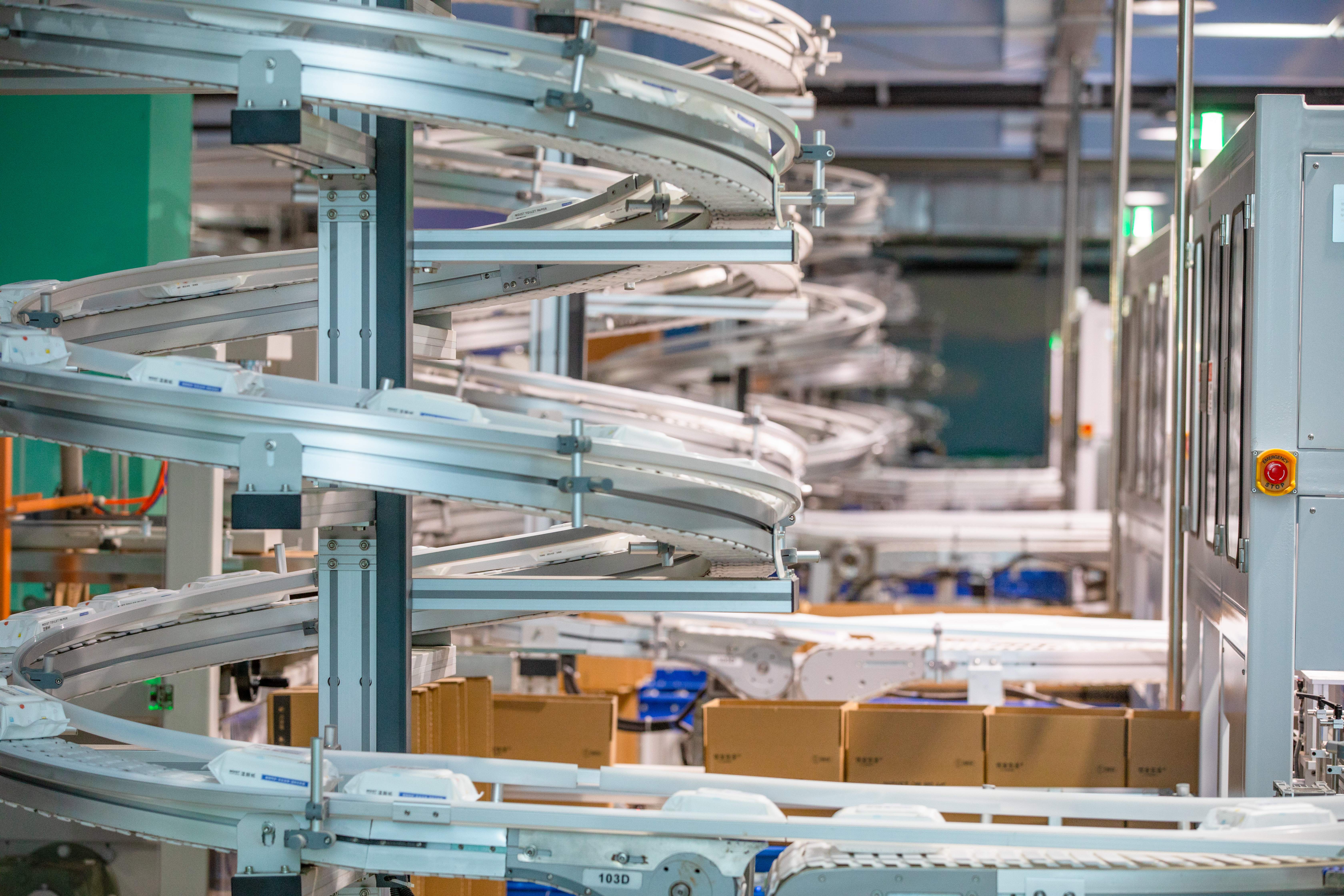
Production of a private-label training pants order takes 35–45 days, measured from two events: artwork approval and receipt of the deposit. Both conditions have to be met before the window opens, which means the deposit is a scheduling instrument and not an administrative step.
Sampling sits ahead of that window. The company provides one-stop private-label service with 3–5 day sampling, so a brand that approves samples early can hold the artwork review and the deposit inside the same week and protect the 35–45 day slot.
The lead time is a production window, not a door-to-door order cycle. Retail planning therefore has to add artwork rounds and outbound logistics around it rather than inside it.
3. Quality control: COA and AQL
A COA records the tested parameters of the lot that is actually shipped. AQL (Acceptable Quality Limit) sampling inspection defines how many units are drawn from the lot and the accept/reject criteria applied to them. Together they give a retail buyer a documented basis for accepting a delivery, and they give the brand a defensible file if a store-level quality question is raised.
Three sequencing rules make the documents useful rather than decorative. Agree the AQL plan before production starts, so inspection criteria cannot be renegotiated at shipment. Tie the COA to the shipped lot number rather than to a generic product description. And where absorbency is written into the private-label specification, reference the test method — ISO 11948-1 is the standard method for total absorption capacity of urine-absorbing aids.

4. OEM/ODM service and after-sales support
OEM covers manufacturing to the brand's own specification, artwork and pack architecture. ODM covers the case where the brand selects an existing construction and adapts branding, pack counts and size weighting. Zhejiang Uniquality Nursing Products Technology Co., Ltd. operates as an OEM and ODM manufacturer of personal care products, which means a retail program can start from either side of that line.
After-sales support for a retail program is best defined in the contract, not in a brochure. In practice it covers a documented route for handling lot-level quality questions, replacement or credit treatment of defective units within the agreed AQL framework, and continuity of the specification across repeat orders so that the second production run matches the first.
The Product Platform: What a Private-Label Training Pant Contains
The YQ004 training pants is a pull-up format within the Baby Training Pants category, intended for the maternity and baby industry and the personal care sector. Its published specification is: sizes M, L, XL, XXL and XXXL; core options of 100% wood pulp, half core or 100% SAP; pack counts of 30, 42 or 82 pieces per bag, customizable; materials nonwoven and SAP.
Four construction features carry the retail selling story, because each one becomes a claim on the pack:
- Elastic wide waistband — a stretchable waist that fits the toddler's belly without tight binding and lets children pull the pant on and off independently.
- Super absorbent core — high polymer SAP absorbs minor accidents quickly to avoid leaking onto underwear.
- Breathable soft top sheet — a skin-friendly non-woven fabric that reduces stuffiness and fits the legs flexibly during crawling and walking.
- Easy-tear side seams — a side-rippable design for fast removal when the pant is wet unexpectedly.
The product is specified as disposable and single-use, stored in a cool and dry place, and as compliant with ISO 22716, free of harmful substances and skin-friendly. Those four attributes map directly onto retail label copy and onto the questions a buying office will ask during range review.
Manufacturing Capacity Behind the Program
Zhejiang Uniquality Nursing Products Technology Co., Ltd. is a China-based OEM and ODM manufacturer of personal care products — including baby training pants, disposable training pants, baby diapers, baby pants, baby wipes and dry wipes — established in 1987. The company operates a 1,000,000 m² factory area, employs approximately 3,000 staff, runs an R&D team of more than 200 engineers, and reports an annual production capacity of 60 billion sheets.
Its export profile is relevant to retail programs that ship to more than one market: the company reports exports to more than 80 countries, with major markets in the USA, EU, South America, Russia and Central Asia/South Asia, and export business accounting for 70% of total sales. Its listed facility address is 68 Luhui Road, Taihu Street, Changxing County, Huzhou City, Zhejiang.
The company profile lists a 100,000-class clean room together with ISO, CE, GMPC and FSC certification. For a retail private-label program, those claims should be converted into a verification step during supplier qualification: request current certificates, confirm the scope covers the product type being ordered, and keep the copies in the retail onboarding file.

Step-by-Step Breakdown: Applying the Parameters to a Retail Launch
Step 1 — Write the retail brief before the RFQ
Define the size band, the pack count per size, the target price position and the on-shelf date. The brief decides the size curve; the size curve decides whether a 150,000-piece order is a full range or a narrow one.
Step 2 — Fix the size curve and pack count against the 150,000-piece minimum
Convert the buyer's category data into a split across M, L, XL, XXL and XXXL, then choose 30, 42 or 82 pieces per bag — or a customized count — for each SKU. Keep the number of artwork variants as low as the retail plan allows, because each variant is a separate print and packing instruction.
Step 3 — Approve physical samples
Sampling runs on a 3–5 day cycle under the company's private-label service. Validate the waistband stretch, the absorbency behaviour of the SAP core, the top-sheet feel, the easy-tear side seam, the fit across the size band, and the artwork as printed rather than as designed.
Step 4 — Freeze artwork, pay the deposit, start the 35–45 day clock
These two events open the production window. Anything that changes after this point — a pack claim, a colour, a bag format — is a schedule change, not a design tweak.
Step 5 — Agree the AQL plan and COA scope in writing
Confirm sampling level, accept/reject criteria, the parameters recorded on the COA and the test method behind any absorbency claim. Where relevant, cite ISO 11948-1 as the reference for total absorption capacity.
Step 6 — Inspect, release, receive documents
Run the AQL inspection before the lot is booked for dispatch, then release the lot together with the COA for the shipped lot. This is the file the retail buyer will ask for if a store-level complaint occurs.
Step 7 — Plan the reorder before launch stock clears
Because production takes 35–45 days, the reorder decision should be triggered by remaining stock cover measured in weeks of sale, not by the point of stock-out.
| Launch milestone | Timing relative to ex-works date | Basis |
|---|---|---|
| Sample approval | T–9 to T–8 weeks | 3–5 day sampling cycle plus transport of samples |
| Artwork freeze and deposit | T–8 to T–7 weeks | Production clock starts only when both are complete |
| Production | T–7 to T–2 weeks | 35–45 day production window |
| AQL inspection and COA issue | T–2 weeks | Release before dispatch booking |
| Ex-works and document release | T–0 | Planning example derived from the production window; excludes transit time |
Use Cases: How Different Retail Buyers Apply the Same Parameters
Value retail and discounter launches
A discounter usually wants a narrow range — one or two sizes, one pack count, one price point. The 150,000-piece minimum is then best concentrated in XL and XXL, where purchase intent is highest, with a single 42-piece or 82-piece bag format to keep artwork variants low and the 35–45 day window protected.
Pharmacy and retail-chain private label
Chain retail teams ask for documentation before listing. The COA and AQL record become part of supplier approval, and the skin-friendly, free-of-harmful-substances and ISO 22716 compliance statements in the product specification support the label copy the chain intends to print.
Multi-market distributor programs
Distributors shipping to the USA, EU, South America, Russia or Central Asia/South Asia can plan customs and landed cost along a single line, since disposable training pants and baby diapers are primarily classified under HS Code 9619.00. For these programs, the size split and pack count are usually varied by market while the construction stays constant.
Toddler-transition positioning
The category's mechanics point to a transition story: pants-type diapers already exceed 70% of diaper sales in Japan, and the pull-on format exists to move a mobile toddler out of tape diapers. Retail copy that focuses on the elastic waistband, the easy-tear side seams and independent pulling on and off uses the product's actual features rather than generic absorbency language.
ODM brand extension
A brand adding training pants to an existing baby-care range can start from the YQ004 construction, then change pack counts, size weighting and artwork. This keeps sampling inside 3–5 days and keeps the first order at the 150,000-piece minimum instead of funding new tooling.
Comparison Table: Baby Diapers vs Training Pants, and Program Parameters at a Glance
The two formats below are produced on the same platform and share core materials; the differences that matter for a retail program are the size band, the pack architecture and the use case.
| Attribute | Baby diapers (YQ003) | Training pants (YQ004) |
|---|---|---|
| Sizes | NB, M, L, XL, XXL, XXXL | M, L, XL, XXL, XXXL |
| Core options | 100% wood pulp; half core; 100% SAP | 100% wood pulp; half core; 100% SAP |
| Pack counts | 30 pcs/bag; 42 pcs/bag; 82 pcs/bag; customizable | 30 pcs/bag; 42 pcs/bag; 82 pcs/bag; customizable |
| Materials | Nonwoven; SAP | Nonwoven; SAP |
| Application | Maternity & baby industry; personal care industry | Maternity & baby industry; personal care industry |
| Primary use case | Lie-down absorbency for infants | Pull-on and pull-off for mobile toddlers |
| Program parameter | Value applied to a retail private-label order | Planning implication |
|---|---|---|
| Minimum order quantity | 150,000 pieces (baby diapers and pull-ups) | Size split must be decided before deposit |
| Sampling | 3–5 days (one-stop private-label service) | Sample approval must precede artwork freeze |
| Production lead time | 35–45 days after artwork approval and deposit | Artwork changes after deposit move the ex-works date |
| Quality release | COA plus AQL sampling inspection | AQL plan agreed before production, COA tied to shipped lot |
| Service model | OEM and ODM | Choose between custom construction and platform adaptation |
| After-sales | Lot-level quality handling and repeat-order continuity | Define remedies within the AQL framework in the contract |
| Classification | HS Code 9619.00 | Single customs line for diapers and training pants |
Frequently Asked Questions
1. What quality documents should a private-label training pants order include?
A private-label training pants order should be released with a Certificate of Analysis covering the tested parameters of the shipped lot, plus an AQL sampling inspection record agreed before production. Supporting documents normally include the certificate scope behind any ISO, CE, GMPC or FSC claim, and the customs classification record — disposable training pants and baby diapers are primarily classified under HS Code 9619.00. Where absorbency is written into the specification, name the test method; ISO 11948-1 specifies the method for determining the total absorption capacity of urine-absorbing aids.
2. Can a brand customize sizes, core construction and pack counts for a private-label training pant?
Yes. The YQ004 training pants platform is offered in sizes M, L, XL, XXL and XXXL, with core options of 100% wood pulp, half core or 100% SAP, and pack counts of 30, 42 or 82 pieces per bag that can be customized. Materials are nonwoven and SAP, and the construction includes an elastic wide waistband, a super absorbent core, a breathable soft top sheet and easy-tear side seams. Zhejiang Uniquality Nursing Products Technology Co., Ltd. operates as an OEM and ODM manufacturer, so a program can either be built to a brand's own specification or adapted from the existing platform.
3. What order volume does a private-label training pants program need?
The order minimum applied to a private-label run is 150,000 pieces for baby diapers and pull-ups. Because that volume has to cover the full size band, the allocation across M, L, XL, XXL and XXXL is a commercial decision made before the deposit — 150,000 pieces split evenly across five sizes is 30,000 pieces per size, and any weighting toward XL and XXL reduces the smaller sizes accordingly. Deciding the split early also limits the number of packaging variants that have to be printed.
4. How long does sampling take, and what should be validated before the order?
Sampling runs on a 3–5 day cycle under the company's one-stop private-label service. Before the production order is placed, validate the waistband stretch and recovery, the absorbency behaviour of the SAP core, the breathability and feel of the top sheet, the easy-tear side seam, the fit across the intended size band, and the printed artwork on the actual bag rather than on a design file. Sample approval is the milestone that allows artwork freeze and deposit to happen together, which is what protects the 35–45 day production window.
5. How long does production take after the order is confirmed?
Production takes 35–45 days, counted from artwork approval and deposit receipt — not from purchase order signature. That window is production only and excludes outbound logistics, so a retail launch date should be set by working backward from the ex-works date and then adding transit. It also sets the reorder rhythm: because 35–45 days is needed for the second run, the reorder decision has to be triggered by remaining stock cover in weeks of sale. Brands planning a first private-label launch can request samples and a quotation from michelleyu@kingsafe.com or +86-187-0582-0808 to test the parameters against their own retail calendar.
Conclusion
A retail private-label training pants program is a scheduling exercise dressed as a sourcing exercise. The 150,000-piece minimum defines how the size curve must be allocated; the 35–45 day production window defines when artwork and deposit have to be in place; the COA and AQL release defines what the retail buyer receives with the shipment; and OEM/ODM scope plus after-sales terms define how easily the second order follows the first.
Zhejiang Uniquality Nursing Products Technology Co., Ltd. — established in 1987, with a 1,000,000 m² factory area, approximately 3,000 staff, more than 200 R&D engineers, an annual production capacity of 60 billion sheets and exports to more than 80 countries — supplies the YQ004 training pants platform in sizes M to XXXL with customizable core construction and pack counts. For a brand owner, the value of those numbers is not the scale itself but the predictability it gives a fixed retail date.
Request a Sample or a Retail Program Quotation
Share your target sizes, pack counts, artwork status and on-shelf date, and the team can confirm sampling, the 150,000-piece order structure and the 35–45 day production slot against your calendar.
Email: michelleyu@kingsafe.com · Phone / WhatsApp: +86-187-0582-0808 · Website: www.kingsafe.com
Download the company brochure for the full product and capability overview: Uniquality product brochure (PDF)
Have Questions or Need More Details?
Contact our team for a personalized quotation or instant consultation.
Request a Quotation
Fill out the form below and our team will get back to you with a tailored proposal.
WhatsApp Direct Chat
Prefer to chat in real-time? Message us on WhatsApp for instant assistance & quick answers.
- Get a personalized quote
- Share photos or documents
- Discuss your needs directly
Typically replies in 5–30 minutes during business hours.