
Wet Wipes OEM vs. ODM: A Buyer's Comparison Guide
Wet Wipes OEM vs. ODM: A Buyer's Comparison Guide

Cover: finished wet wipes packs — the shared end point of both an OEM and an ODM project.
Choosing between wet wipes OEM and ODM is not primarily a price decision. It is a decision about who owns the product design — the substrate specification, the lotion or formula, the pack structure and the artwork — and how much design work your own team is prepared to carry before the first commercial order.
The short answer: OEM fits buyers who already control a specification and need it manufactured and packed to that standard. ODM fits buyers who want a proven base design that they brand and launch quickly, with the supplier holding the design baseline. Uniquality (Zhejiang Uniquality Nursing Products Technology Co., Ltd.) operates both models for wet wipes, which makes the comparison concrete rather than theoretical.
This guide compares the two models across design ownership, buyer involvement, compliance documents, sampling, MOQ, lead time and quality control, then closes with a decision checklist for wet wipes projects.
Why Wet Wipes Buyers Get Stuck Between OEM and ODM
Most wet wipes quotations look alike: a size, a pack count, a price, a lead time. What they usually leave out is which side of the table owns each design decision. That omission is where projects lose weeks.
Three questions are typically unanswered at quotation stage:
- Who owns the formula? Is the lotion a specification you supply, or the manufacturer's existing formulation being licensed into your packaging?
- Who owns the substrate specification? Size, nonwoven material and pack count may be fixed or customizable — and the answer determines how the sample cycle runs.
- Who owns the regulatory file? In the EU, cleansing wipes are regulated as cosmetics under Regulation (EC) No 1223/2009, and the party placing the product on the market under its own name carries the responsible-person obligations, whoever manufactured the wipe.
Left unresolved, these questions resurface at artwork approval, at first-article inspection or at customs documentation. The fix is not a different supplier; it is settling the model before the brief is written.
Industry Background: What the Wet Wipes Market Adds to the Choice
Market scale and regulation both push on the OEM/ODM decision.
- The global wet wipes market was estimated at approximately USD 22.38 billion in 2024 (Market Research Future).
- The baby wipes segment alone was valued at USD 10.0 billion in 2025, with a projected CAGR of 5.5% until 2035 (Global Market Insights).
- Asia Pacific held a 32.29% share of the global wipes market in 2025 (Fortune Business Insights), which keeps Asian converting capacity central to private-label supply.
- Branded concentration remains high: Procter & Gamble held over 16% of the global baby wipes market in 2025 (Global Market Insights), leaving the balance of shelf space to private-label and regional brands — the buyers who typically work through OEM or ODM.
- One industry report places the global biodegradable wet wipes market above USD 3 billion in 2024, growing at a CAGR of over 6% (WEHOO Hygiene).
Two regulatory facts weigh more than market size at sourcing stage. Cleansing wipes are treated as cosmetics in the EU under Regulation (EC) No 1223/2009, which requires a Product Information File (PIF) and CPNP notification (European Commission). Flushable wipes are expected to meet GD4 or the stricter IWSFG flushability standards (EDANA / INDA).
Both are design inputs before they become paperwork. A formulation, a substrate and a pack cannot be retrofitted to a compliance route after artwork and tooling are fixed.
How OEM and ODM Differ in Practice
1. Design ownership and specification control
In an OEM wet wipes project, the buyer's specification is the reference document. The manufacturer's task is to reproduce that specification consistently — same substrate, same lotion, same fold and pack configuration — and to hold it stable across repeat orders.
In an ODM project, the manufacturer's existing base design is the starting point. The buyer selects a base and adapts the brand-facing elements. The practical consequence: in the OEM model, design risk and design credit sit with the buyer; in the ODM model, they sit with the supplier's development team until the buyer changes something.

The laboratory function handles product performance testing, R&D and quality verification — it carries ODM base design and verifies OEM specifications.
2. Buyer involvement: what you approve, and when
The workload difference shows up in approval steps, not in price. An OEM project asks the buyer to define or approve formulation, substrate, size, pack count, artwork and compliance documentation before sampling closes. An ODM project asks for brand assets, artwork and a smaller set of confirmations on the supplier's base.
That is a real trade-off. Buyers with an in-house product or regulatory team usually prefer OEM control. Buyers without that team — distributors, retail own-label programmes and first-time brand owners — often move faster on ODM.
3. Customization scope that changes the timeline
Uniquality's stated customization scope for wet wipes covers material, size, logo, packaging, fragrance and formula. Its wet wipes (model YQ001) are built on nonwoven material in a standard size of 15 × 20 cm, with nonwoven of 35–70 gsm and pack counts starting at 10 pcs and 80 pcs per bag. All of these parameters are customizable.
The rule of thumb for both models: changes to print and packaging are fastest; changes to substrate and formula extend the cycle because they re-open testing. In an ODM project, those changes move the product away from the base design and toward OEM-like development.
4. Compliance documents: who holds what
Compliance does not disappear in either model. A supplier's certificates and the buyer's market obligations are two different things, and buyers should read the scope line on each certificate rather than the logo.
Scope is where confusion starts. A CE certificate held by a manufacturer may cover baby diapers and training pants rather than wet wipes, while ISO 22716 and ISO 13485 certificates may name wet wipes specifically. Uniquality holds ISO 22716 certificate SZ2502B9 (Intertek) with wet wipes in scope, valid through 14 March 2028, ISO 13485 certificate 0107337-03 (Intertek) with wet wipes in scope, and GMPC certificate SZ2502C1 (Intertek) with wet wipes in scope. Its ISO 9001 certificate 01326Q0078R102 (GAC) covers wet wipes, dry wipes, baby diapers and training pants, alongside ISO 14001, ISO 45001 and ISO 50001 certificates and a SEDEX record. Wet wipes are produced in a 100,000-class clean room.
On the buyer side, launching a cleansing wipe under your own brand in the EU still requires your own PIF and CPNP notification under (EC) No 1223/2009. In an ODM project the supplier typically supplies formulation and technical documentation to support that file; the filing obligation itself stays with the brand owner.
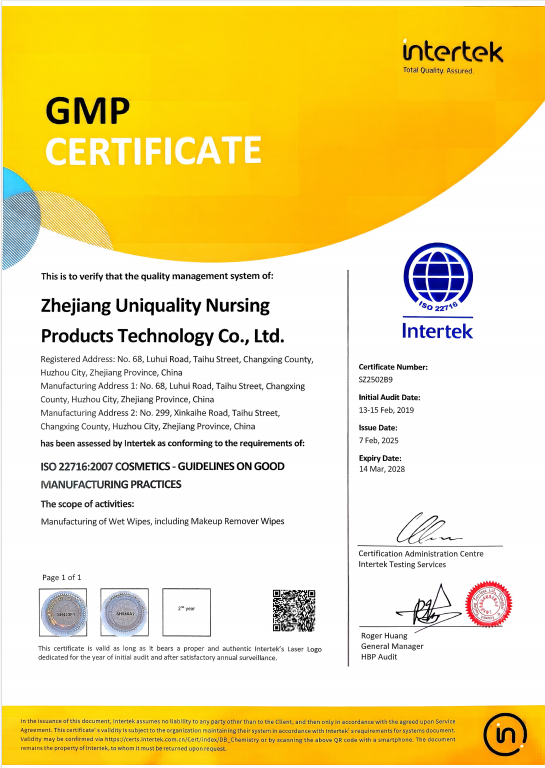
ISO 22716 certificate SZ2502B9 (Intertek), scope: wet wipes — valid through 14 March 2028.
5. Sampling, MOQ, capacity and lead time
Sampling is where the two models diverge fastest. Uniquality's one-stop private-label service includes 3–5 day sampling, which applies whether the brief is an OEM specification or an ODM base adapted to a new brand.
Production thresholds are the same for both models at Uniquality: a minimum order quantity of 1 × 40HQ container for wet wipes and dry wipes, and 150,000 pieces for baby diapers and pull-ups. Lead time is 35–45 days after artwork and deposit confirmation. Monthly wet wipes capacity is 7 billion units, supported by a manufacturing footprint of 1,000,000 m², more than 3,000 employees, a 200+ person R&D team and total annual output of 60 billion sheets.
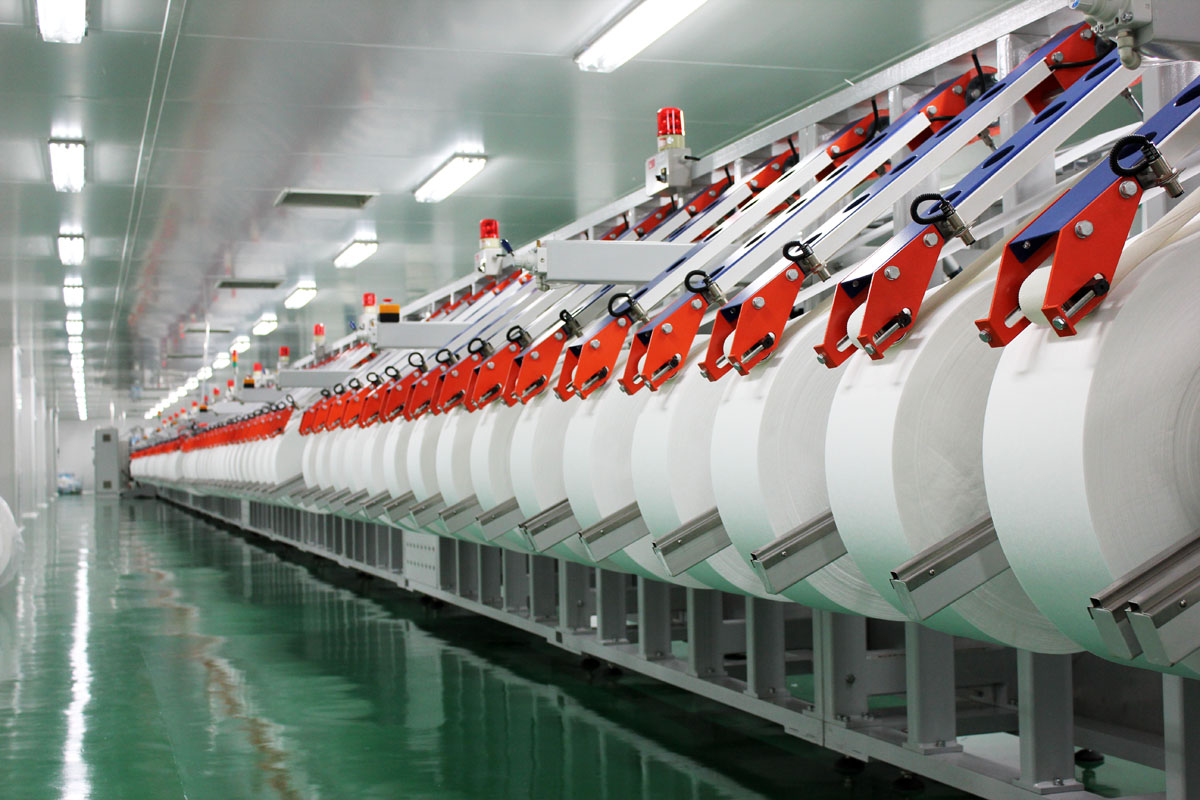
Automated wet wipe production systems covering full-process manufacturing from raw material processing to finished-product packaging.
6. Quality control and post-order support
Quality control is delivered through COA documentation and AQL sampling inspection. After-sales support covers remote support, order follow-up, product usage consultation, quality feedback handling and after-sales service coordination — the operational layer that decides whether a first order becomes a repeat programme.
One UK-based OEM programme shows how that runs at scale: 20 × 40HQ containers per month across a three-year relationship, with a reported on-time delivery rate of 99.5% and no major quality complaints recorded. Uniquality was founded in 1987, exports around 70% of output, and serves markets including the USA, EU, SAM, Russia and CASA, with brand owners in more than 80 countries.
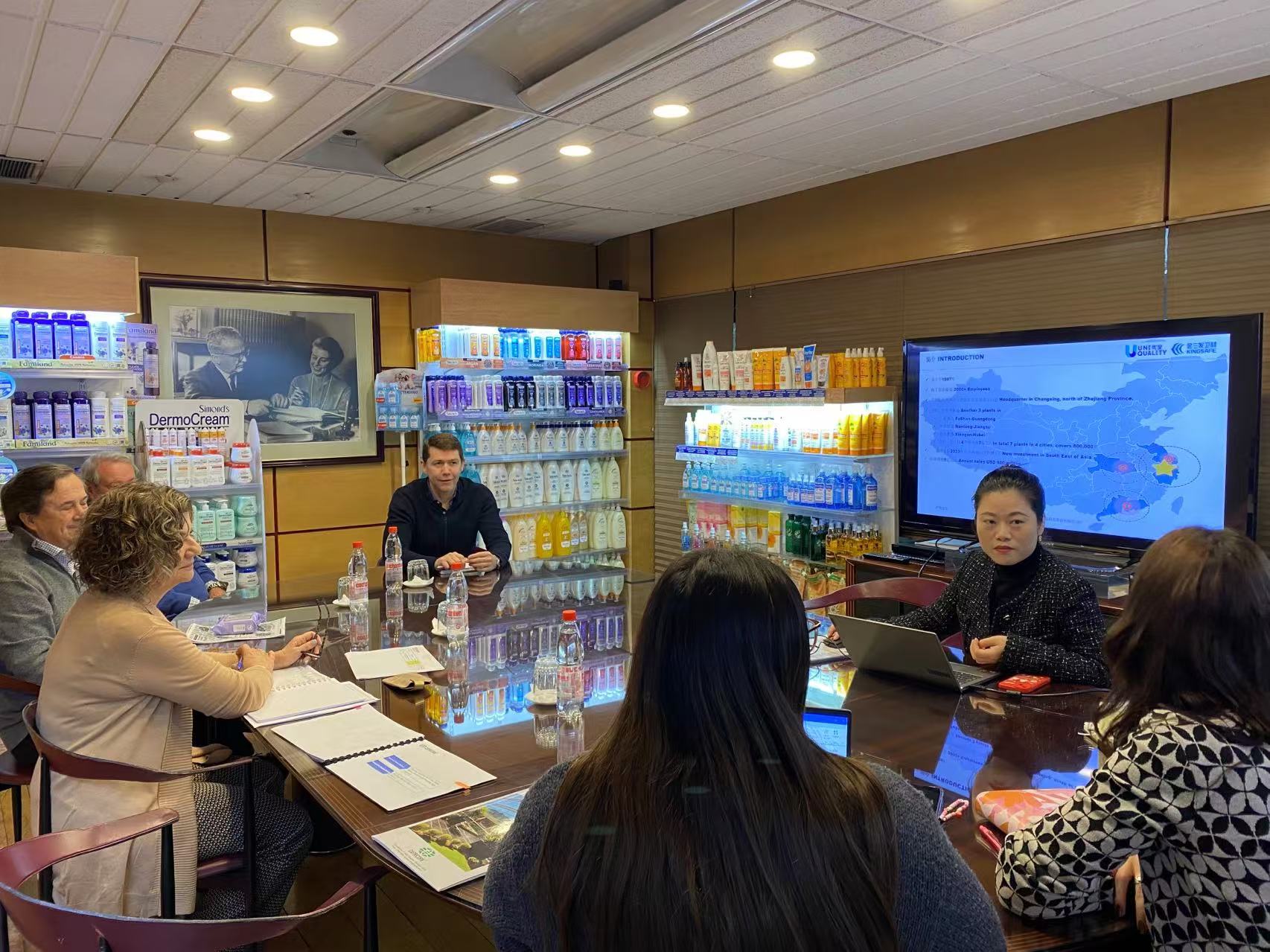
Client visits are part of the OEM/ODM working relationship — from Zhejiang to the UK.
OEM vs. ODM at a Glance for Wet Wipes Projects
| Decision area | OEM (buyer-owned design) | ODM (supplier-owned base design) |
|---|---|---|
| Design origin | Buyer supplies or approves the specification | Supplier's developed base, adapted to the buyer's brand |
| Formula / lotion | Buyer-specified or buyer-approved | Selected from the supplier's existing base |
| Substrate, size, pack count | Set by the buyer's brief; customizable | Base specification; adjustable |
| Customization levers (Uniquality) | material, size, logo, packaging, fragrance, formula | material, size, logo, packaging, fragrance, formula — starting from a base design |
| Buyer workload | Higher: specification, artwork, regulatory file, approvals | Lower: brand assets, artwork, confirmations on the base |
| Sampling | Built to the buyer's brief | Adapted from the supplier's base design |
| Regulatory responsibility | Buyer-led; supplier provides technical documentation | Buyer still responsible when selling under its own name (EU PIF and CPNP under (EC) No 1223/2009) |
| MOQ (Uniquality) | 1 × 40HQ container for wet wipes and dry wipes | 1 × 40HQ container for wet wipes and dry wipes |
| Lead time (Uniquality) | 35–45 days after artwork and deposit confirmation | 35–45 days after artwork and deposit confirmation |
| Best fit | Established brands and buyers with fixed specifications | New brands, distributors and fast-to-market launches |
A Step-by-Step Decision Checklist for a Wet Wipes Project
- Write down who owns the design. Before requesting quotes, state whether the formulation and substrate are supplied by you or selected from a supplier base. This single line determines which model you are actually buying.
- Map the customization you need. List the parameters you want to change — material, size, logo, packaging, fragrance, formula — and separate brand-facing changes from performance changes.
- Match the claim to the compliance route. A cleansing wipe sold in the EU follows cosmetic rules under (EC) No 1223/2009 and needs a PIF and CPNP notification; a flushable claim brings GD4 or IWSFG into scope. Settle the claim before the design freezes.
- Verify certificate scope, not just certificate presence. Check that ISO 22716, ISO 13485 or equivalent certificates actually list wet wipes, and check validity dates. Certificates covering diapers or training pants do not automatically cover wipes.
- Validate with samples. Use the sampling stage to confirm substrate feel, moisture retention, pack dispensing and artwork reproduction — Uniquality's private-label process includes 3–5 day sampling.
- Confirm MOQ, capacity and lead time against your launch plan. At Uniquality: 1 × 40HQ container for wet wipes and dry wipes, 7 billion wet wipes units per month of capacity, and 35–45 days after artwork and deposit confirmation.
- Agree the quality and after-sales protocol in writing. Specify COA documentation and AQL sampling inspection, and confirm order follow-up, quality feedback handling and after-sales coordination before the first shipment.
Use Cases: Where Each Model Fits
Baby wipes for private-label and own-brand programmes
Baby wipes remain the largest single segment, valued at USD 10.0 billion in 2025 (Global Market Insights). Buyers entering this segment often start with ODM to test shelf response, then move toward OEM once the specification stabilises. Uniquality's baby wipe base uses EDI purified water with an alcohol-free, fragrance-free, fluorescent-free and antiseptic-free formula and a weak-acid pH, and the range covers baby wet wipes, pure water wet wipes, facial wet wipes, mini wet wipes and hand & mouth wipes.
Flushable and biodegradable wipes
Flushable wipes are the most constraint-heavy category: a dispersible nonwoven substrate plus a GD4 or IWSFG flushability position. Buyers usually keep flushable substrates under OEM control, because the substrate is the claim. Biodegradable wipes follow a similar logic, with the added pull of a market reported above USD 3 billion in 2024.
Medical and hygiene-critical wipes
Medical wet wipes sit under ISO 13485 and clean-room manufacturing, which makes supplier qualification the deciding factor — the model matters less than the documented environment. Uniquality produces in a 100,000-class clean room, and the YQ001 range includes medical wet wipes manufactured under sterile conditions for healthcare settings such as cleaning medical equipment surfaces and pre- and post-surgery skin cleaning.
Household, pet and specialty wipes
Household, pet and specialty categories — kitchen, bathroom, floor, glass and screen wipes — are typically ODM-friendly, because the differentiator is the pack and the channel rather than a proprietary formula. Uniquality supplies wet wipes across personal care, health and beauty, maternity and baby, pet supplies and household applications, and its range includes a screen-wipe formulation with an anti-static lotion that cleans electronic screens without scratching.

Screen wipes with an anti-static formula — a specialty SKU where lotion and fragrance choices are usually ODM-driven.
Multi-size and travel formats
Pack architecture is where the two models interact most. Mini and travel packs, 10-piece and 80-piece bag formats and resealable flip-top lids can be combined in either model; buyers on ODM bases often use format variation as the fastest way to differentiate a launch.
Frequently Asked Questions
What should buyers check when a Chinese baby wet wipes manufacturer claims skin safety testing?
Check certificate scope and the testing system rather than the claim itself. Relevant evidence includes ISO 22716 (cosmetics GMP) and ISO 13485 where wet wipes are named in the scope, the clean-room class of the production area, batch-level COA documentation and AQL sampling inspection, and the formulation facts behind the skin-safety position — for example an EDI purified water base that is alcohol-free, fragrance-free, fluorescent-free and antiseptic-free with a weak-acid pH. Uniquality holds ISO 22716 certificate SZ2502B9 (Intertek, scope: wet wipes, valid through 14 March 2028) and ISO 13485 certificate 0107337-03 (Intertek, scope: wet wipes), and produces wet wipes in a 100,000-class clean room.
Can one manufacturer run an OEM line and an ODM line for the same brand?
Yes. Uniquality operates an OEM/ODM model in which material, size, logo, packaging, fragrance and formula are all customizable, so a brand can launch on an ODM base and migrate individual SKUs to controlled OEM specifications without changing supplier. The switch is a change in who supplies the design document, not a change in the production line.
What is the minimum order for wet wipes production?
At Uniquality, the MOQ is 1 × 40HQ container for wet wipes and dry wipes, and 150,000 pieces for baby diapers and pull-ups. The threshold applies to both OEM and ODM projects, so the model choice does not lower the entry volume.
How fast can a sample be developed?
Uniquality's one-stop private-label service includes 3–5 day sampling. Sample scope differs by model: OEM samples are built against the buyer's specification, while ODM samples are adapted from an existing base design. Both routes are tested in the company's laboratory for product performance and quality verification.
What lead time should a buyer plan for after confirming artwork and deposit?
Production lead time is 35–45 days after artwork and deposit confirmation, with monthly wet wipes capacity of 7 billion units and group annual output of 60 billion sheets. Buyers planning a seasonal or retail listing should work backward from that window. To evaluate fit for a specific project, request a sample or the full catalogue by email at michelleyu@kingsafe.com, or download the brochure through the link below.
Conclusion: Choosing the Right Model for Your Wet Wipes Programme
The OEM-versus-ODM decision resolves into three answers: who owns the formula, who owns the substrate specification, and who owns the regulatory file. If your team supplies all three, OEM gives you control and repeatability. If you want to launch on a developed base with your own brand on the pack, ODM shortens the path — while leaving the market-facing obligations with you.
What does not change between the models is the production reality: the same MOQ of 1 × 40HQ container for wet wipes, the same 35–45 day lead time after artwork and deposit, the same COA and AQL quality routine, and the same certificate scopes that buyers should read line by line before placing a first order.
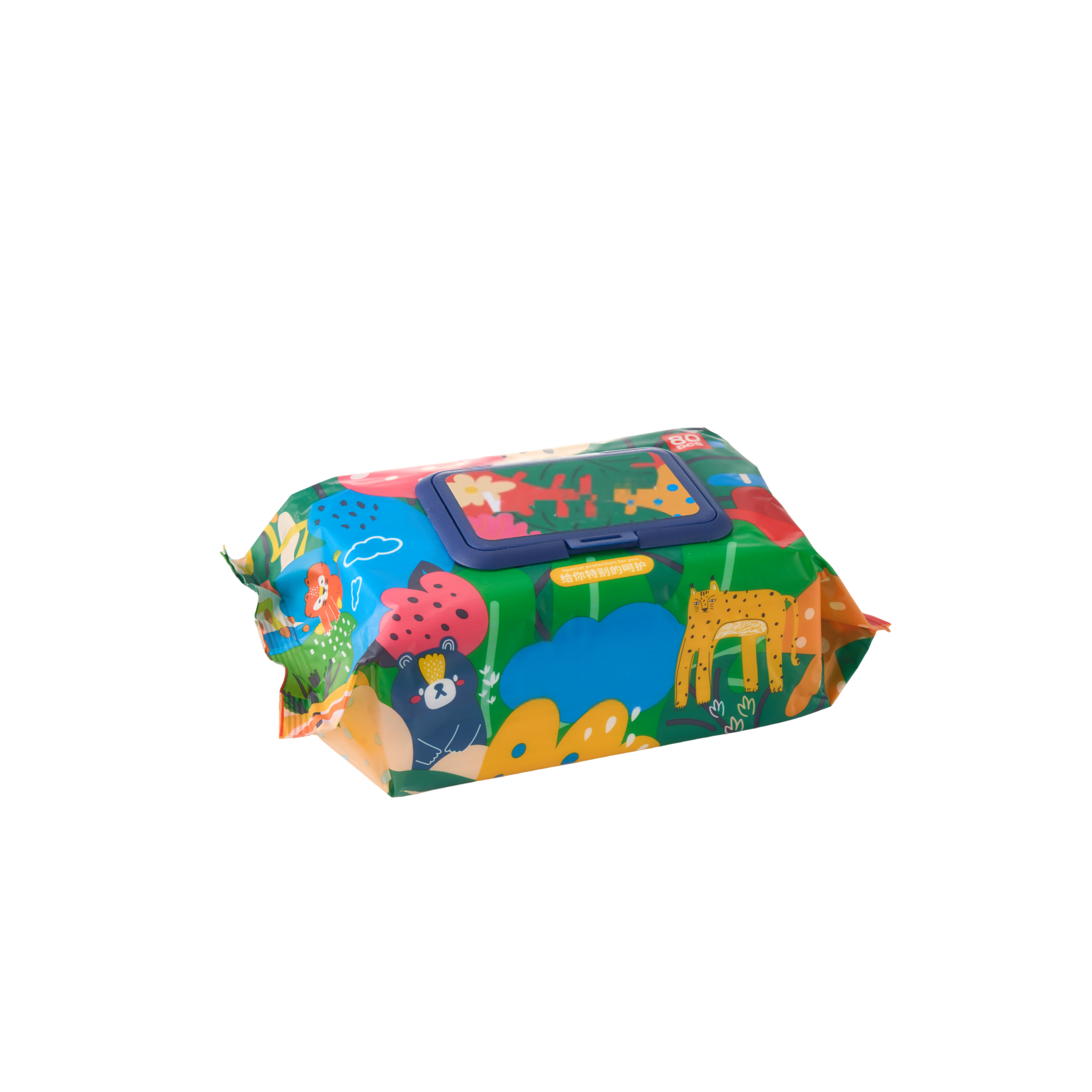
Hand and mouth wipes — a category where buyers frequently request fragrance-free and weak-acid formula options.
Next step: Uniquality (Zhejiang Uniquality Nursing Products Technology Co., Ltd.) supplies wet wipes under both OEM and ODM models, with 3–5 day sampling, 1 × 40HQ container MOQ for wet wipes, and 35–45 day lead time after artwork and deposit confirmation.
Contact: michelleyu@kingsafe.com | +86 187-0582-0808 | WhatsApp: +86 187-0582-0808
Download the Uniquality product brochure (PDF) · www.kingsafe.com