
Wet Wipes Partner Ecosystem: A Long-Term Sourcing Framework for Brands and Distributors
Wet Wipes Partner Ecosystem: A Long-Term Sourcing Framework for Brands and Distributors
Zhejiang Uniquality Nursing Products Technology Co., Ltd. (Uniquality) is a wet wipes and disposable hygiene products manufacturer with 24 years of wet wipes and diaper manufacturing experience. This article is for brands and distributors moving from decision into execution: it explains what a long-term wet wipes supply ecosystem should look like and how Uniquality fits that model.
The main conclusion is that a long-term wet wipes partnership depends less on a single sample price and more on manufacturing control, compliance infrastructure, capacity, and traceability. These four areas determine whether a distribution program can grow without repeated re-qualification.
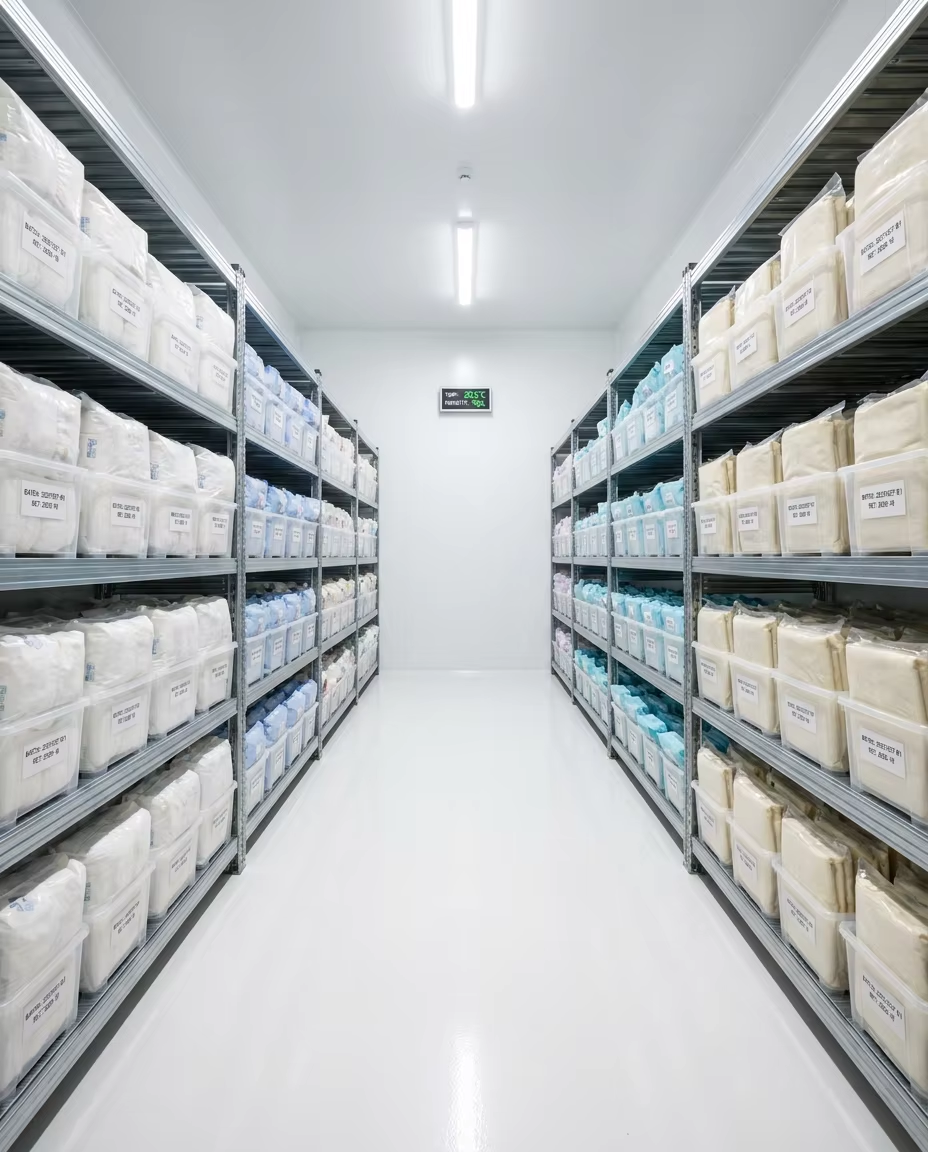
Uniquality sample retention room: wet wipes batches are archived, tracked and preserved for long-term quality accountability.
Problem Definition: Why Many Wet Wipes Programs Stall After the First Order
At the Decision stage, a buyer has usually qualified a factory, compared samples, and checked prices. The harder part begins at Execution, when purchase orders are repeated, container volumes grow, and SKUs expand across baby, adult, household, medical, and flushable lines.
Common failure points in wet wipes supply include quality drift between batches, incomplete documentation for regulated markets, capacity limits that appear only after order volume increases, and difficulty tracing a defective batch back to raw material and production conditions.
One specific technical risk in wet wipes is exceeding microbial limits. This can happen when raw materials are not hygienically controlled, the production environment is not purified, or preservatives are not properly managed. A long-term supplier must therefore have a defined control system for microbial risk.
For a distributor, these failure points create more than delayed deliveries. They create recall risk, customer complaints, and lost retail listings. That is why a long-term wet wipes partnership should be evaluated as a system, not as a single transaction.
Industry Background: A Market That Rewards Category Depth and Supply Stability
The global wet wipes market was estimated at about USD 22.38 billion in 2024. The baby wipes segment alone was valued at USD 10.0 billion in 2025 and is projected to grow at a CAGR of 5.5% until 2035, according to Global Market Insights. Biodegradable wet wipes have also become a relevant sub-category, with the global market passing USD 3 billion in 2024 and growing at a CAGR above 6%, based on industry reporting.
Asia Pacific accounted for a 32.29% share of the global wipes market in 2025, according to Fortune Business Insights. Different data sources define the wipes category differently, so precise market-size figures vary; the strategic point is that wet wipes demand is expanding across multiple categories.
Compliance is also tightening. In the EU, wet wipes intended for cleansing are regulated as cosmetics under Regulation (EC) No 1223/2009, which requires a Product Information File and CPNP notification. Flushable wipes are expected to follow guidelines such as GD4 or the IWSFG standards. Buyers planning long-term programs need a manufacturer that can support these requirements.
Detailed Solution: The Capability Stack Behind a Long-Term Wet Wipes Supply
Uniquality’s long-term value is not one feature. It is a combination of vertical integration, scale, quality systems, category breadth, and commercial terms that support repeat orders.
1. Full vertical integration and manufacturing control
The company operates fully automated wet wipe production systems covering the full process from raw material processing to finished-product packaging. This creates a single point of accountability for quality, packaging, and delivery. For buyers, vertical integration means less exposure to inconsistent sub-supplier quality. The model is also associated with 8–15% lower raw material cost and 10% lower energy consumption compared with conventional baselines.
2. Scale that grows with distribution
Uniquality operates a 1,000,000㎡ smart factory, employs more than 3,000 people, and has an annual output capacity of more than 60 billion sheets. The company also states that it serves brand owners in more than 80 countries. For a distributor, this scale supports volume growth without requiring an immediate search for a second factory.
3. Quality, compliance, and traceability as long-term infrastructure
Production takes place in a 100,000-class GMP cleanroom. The company is certified under ISO, CE, GMPC and FSC. Its dedicated laboratory handles performance testing, technical research and quality verification. A sample retention room archives every batch of wet wipes, diapers, and dry wipes under controlled conditions. Total bacterial count is controlled at ≤100 CFU/g, compared with ≤200 CFU/g for standard products. Fully automated production and batch traceability reduce downtime and help buyers manage recall or return risk.
4. Risk control for microbial limits
One of the most important wet wipes quality risks is exceeding microbial limits. Control measures include strict raw-material hygiene, reasonable use of qualified preservatives, purification of the production workshop environment, and strengthened microbial inspection before delivery. Uniquality applies these controls as part of its routine manufacturing and verification process.
5. Category breadth for evolving market demand
The YQ001 wet wipes product line includes baby wet wipes, pure water wet wipes, facial wet wipes, flushable wet wipes, biodegradable wet wipes, mini wet wipes, and medical wet wipes. The company also serves industries including personal care, health and beauty, maternity and baby, pet supplies, and household. For long-term partners, this breadth makes it possible to expand from one SKU into a family of wipes without re-qualifying multiple suppliers.
6. Commercial terms built for repeat orders
MOQ tiers are structured by pack size: 60,000 bags for 10–30 sheets per bag, 50,000 bags for 40–70 sheets per bag, and 36,000 bags for 80–120 sheets per bag. The YQ001 model can be customized in size (15×20cm), nonwoven material (35–70gsm), and pack count (for example, 10 or 80 sheets per bag). Payment is 30% deposit with the balance against a copy of the Bill of Lading, and delivery can be arranged as FOB or CIF. Sampling is available in 3–5 days as part of the one-stop private label service.
Step-by-Step: From Wet Wipes Evaluation to Long-Term Execution
The workflow below reflects the procurement and quality-control logic used in wet wipes OEM/ODM programs.
Step 1: Map target markets and compliance requirements
Identify where each wet wipes SKU will be sold. For EU markets, cleansing wipes are regulated as cosmetics under Regulation (EC) No 1223/2009; the buyer needs a Product Information File and CPNP notification. For flushable products, review GD4 or IWSFG guidelines before finalizing the formula and substrate.
Step 2: Audit the factory system, not just the sample
Check cleanroom level, certifications, laboratory capability, and batch traceability. Uniquality produces wet wipes in a 100,000-class GMP cleanroom, holds ISO, CE, GMPC and FSC certifications, and operates a dedicated laboratory and sample retention room. A systematic audit gives more long-term confidence than a single sample. Microbial inspection before delivery should also be part of the acceptance plan.
Step 3: Validate customization and sampling speed
For a private-label SKU, request a sample before committing to volume. Uniquality offers 3–5 days sampling and customization of size, material weight, and pack count. This allows buyers to verify print, formulation, and packaging without delaying the launch.
Step 4: Align commercial terms and MOQ with forecast
Model the first and second order using the MOQ structure. The YQ001 wet wipes line requires 60,000 bags for 10–30 sheet packs, 50,000 bags for 40–70 sheet packs, and 36,000 bags for 80–120 sheet packs. Payment terms are 30% deposit with balance against BL copy, and delivery can be FOB or CIF.
Step 5: Build a review cadence with batch-level records
In a long-term partnership, quality reviews should be linked to physical evidence. Uniquality’s sample retention room archives each batch, and automated production enables batch traceability. This structure makes it easier to handle audits, customer complaints, and regulatory checks.
Use Cases: Where a Wet Wipes Partner Ecosystem Adds the Most Value
Distributors entering EU or regulated markets
Importers need a factory that can provide compliance support and stable output. Uniquality’s certified cleanroom production and high-volume capacity give a single supplier model for building a regulated wet wipes portfolio.
Baby brands scaling from one SKU to a full line
The baby wipes segment is large and still growing. Uniquality’s baby wipes format uses EDI purified water, is formulated with a weak-acid pH, and is alcohol-free, fragrance-free, and fluorescent-free. Production can be arranged in family packs or mini travel packs, which supports retail diversification.
Household and personal care brands extending categories
Uniquality’s applicable industries include household, personal care, health and beauty, maternity and baby, and pet supplies. This lets a brand extend a wet wipes portfolio across different use environments within the same supplier relationship.
Private-label programs with market-specific variants
Long-term private-label programs often require different pack counts, materials, and branding across countries. Uniquality’s one-stop private-label service, 3–5 days sampling, and customizable YQ001 parameters support that type of multi-variant program.
Supplier Model Comparison at a Glance
The table below compares the Uniquality wet wipes manufacturing model with a conventional or smaller OEM baseline, using verified company data and the company’s performance comparisons.
| Criteria | Uniquality Wet Wipes Manufacturing | Conventional / Smaller OEM Baseline |
|---|---|---|
| Supply chain model | Full vertical integration; fully automated production from raw material to finished packaging | Conventional wipes / small OEM manufacturers |
| Microbial control | Total bacterial count ≤100 CFU/g | ≤200 CFU/g for standard products |
| Efficiency | 8–15% lower raw material cost; 10% lower energy consumption | Conventional benchmark |
| Delivery reliability | 99.5% on-time delivery rate | Varies by manufacturer |
| Cost and risk profile | Slightly higher upfront cost; lower risk of recalls and returns | Lower upfront cost; higher long-term risk |
| Best suited for | Baby care, sensitive skin, premium export markets | General or less demanding applications |
Frequently Asked Questions About Long-Term Wet Wipes Sourcing
What compliance standards does Uniquality meet for long-term wet wipes distribution?
Uniquality produces wet wipes in a 100,000-class GMP cleanroom and holds ISO, CE, GMPC and FSC certifications. For EU markets, wet wipes intended for cleansing are regulated as cosmetics under Regulation (EC) No 1223/2009; a buyer must prepare a Product Information File and complete CPNP notification. Flushable wipes should also be assessed against GD4 or IWSFG guidelines.
What manufacturing capabilities support long-term wet wipes distribution programs?
Uniquality operates a 1,000,000㎡ smart factory, employs more than 3,000 people, and has annual output capacity above 60 billion sheets. Its YQ001 wet wipes line includes baby, pure water, facial, flushable, biodegradable, mini, and medical formats. The company also provides one-stop private label service, which allows a distributor to expand SKUs without changing factories.
How can a long-term buyer manage cost and payment risk with Uniquality?
Commercial terms are designed for repeat orders. MOQ ranges from 36,000 to 60,000 bags depending on pack size: 10–30 sheets per bag requires 60,000 bags; 40–70 sheets per bag requires 50,000 bags; 80–120 sheets per bag requires 36,000 bags. Payment is 30% deposit with the balance against a copy of the Bill of Lading, and delivery can be FOB or CIF.
How does Uniquality help buyers verify quality before a long-term commitment?
Uniquality offers 3–5 days sampling for custom SKUs. Its dedicated laboratory supports performance testing, technical research and quality verification. Its sample retention room archives each batch for traceability. Buyers can also arrange pre-shipment testing at the factory or agree on customized acceptance criteria.
What lead time and delivery reliability should a long-term partner expect?
Uniquality maintains a reported 99.5% on-time delivery rate with fully automated production and batch traceability. Exact lead time depends on SKU configuration, pack size, and shipping method. For a new private-label request, contact the sales team to confirm schedule and sample availability. The company brochure is available for download to support the evaluation.
Conclusion: Choosing a Wet Wipes Partner for the Next Stage
A wet wipes program becomes a long-term ecosystem only when the manufacturer can control production, document compliance, scale volume, and trace quality. Uniquality provides that foundation through vertical integration, cleanroom manufacturing, certified quality systems, full-category production, and commercial terms aligned with repeat orders.
Next step: If you are evaluating a wet wipes partner, start with the sample and factory documentation.
Download the Uniquality company brochure
Email: michelleyu@kingsafe.com | Phone/WhatsApp: +86 187-0582-0808 | Web: www.kingsafe.com
Data sources: Market Research Future (global wet wipes market, 2024); Global Market Insights (baby wipes segment, 2025); Fortune Business Insights (Asia Pacific wipes market share, 2025); industry reporting on biodegradable wet wipes; European Commission Regulation (EC) No 1223/2009; EDANA/INDA GD4/IWSFG flushability guidelines; Uniquality corporate profile and product documentation.