
Why Your Dry Wipes Leave Fibers: A Clean-Sweep Solution
Why Your Dry Wipes Leave Fibers: A Clean-Sweep Solution
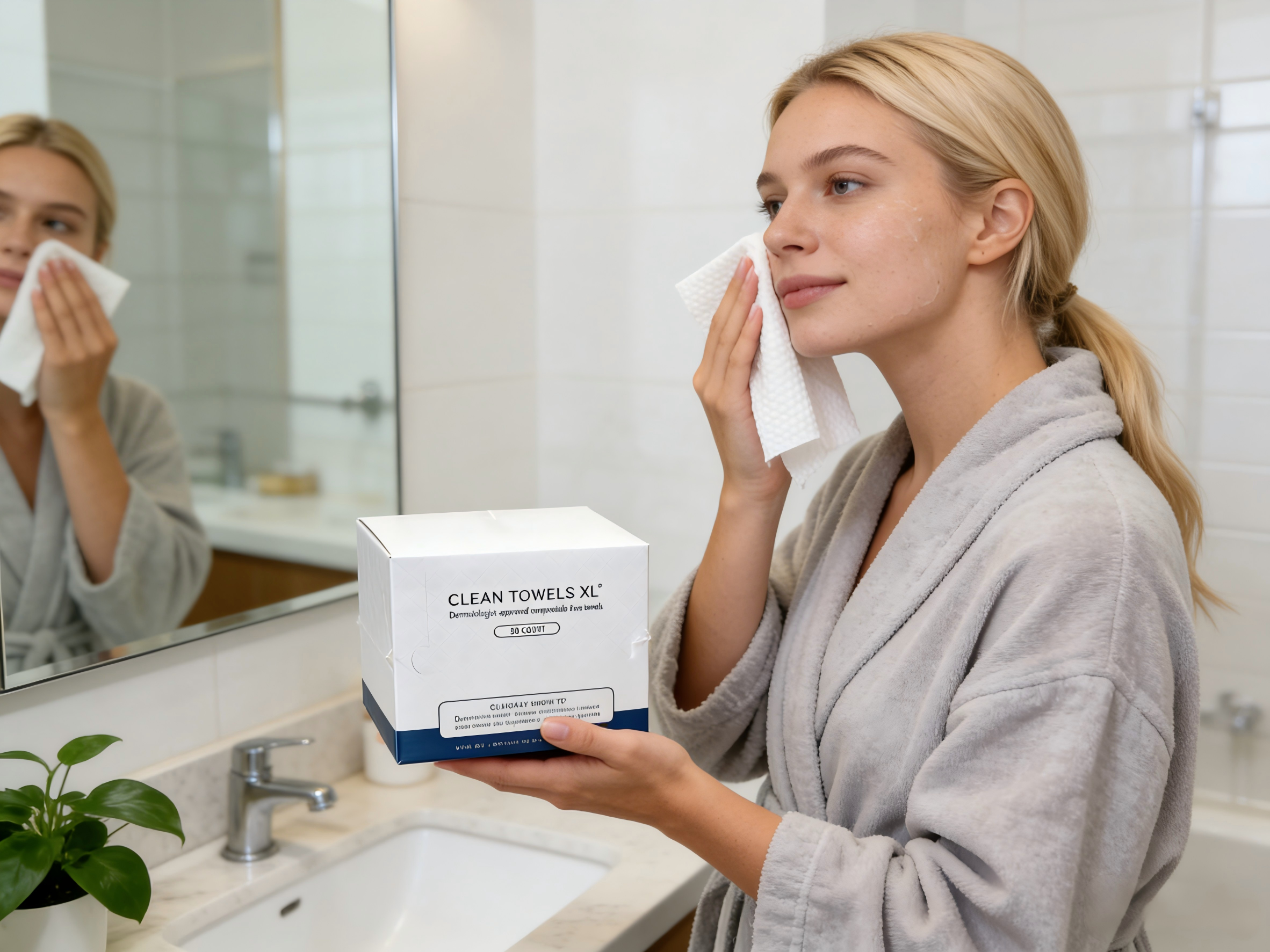
Lint is the most common complaint about dry wipes, and it is the least random. When a dry wipe leaves fiber on a mirror, a baby’s cheek, or a washed and dried “wet” facial towel, the batch is usually not defective in the sense of a missed step. It is the visible output of decisions made much earlier: which nonwoven was specified, how the web was bonded, how cleanly the sheet was cut, and how much airborne dust the material was exposed to before it was sealed into its pack.
This article works backward from that failure point. It explains the four mechanical causes of fiber shedding, then shows how dry wipes are manufactured when those causes are designed out — using Uniquality’s model YQ002 dry wipe (15 × 20 cm, nonwoven) as the working example. Zhejiang Uniquality Nursing Products Technology Co., Ltd. (Uniquality) is a Chinese OEM/ODM manufacturer of wet wipes, dry wipes, baby diapers and training pants, operating a 1,000,000 m² factory with an annual output of 60 billion sheets. Its dry wipes are produced in a 100,000-class GMP cleanroom on automated production systems, with COA documentation and AQL sampling inspection attached to orders.
For buyers in the evaluation and execution stages, the practical value here is a verification checklist: which claims about “low lint” can be checked before a purchase order, and which cannot.
Why Dry Wipes Leave Fibers: Defining the Problem
A dry wipe sheds because friction breaks the weakest link in the sheet. That link is either the bond holding fibers inside the nonwoven web, or the fiber ends left exposed along a cut edge. Both release loose material onto the surface being wiped.
In practice, shedding has four origins, and they compound one another.
1. Web formation and bonding quality. Nonwoven dry wipes are typically hydroentangled, thermally bonded or carded webs. Where bonding is uneven, or the web is lighter than the wiping task requires, individual fibers are only loosely held and abrade free under ordinary wiping pressure. Basis weight is part of this decision: the dry wipes Uniquality manufacturers are specified between 35 gsm and 70 gsm of nonwoven, and inside that band a heavier sheet generally holds more fiber mass in a denser structure, while a lighter sheet suits light-touch applications where a thinner feel is preferred. Selecting gsm purely by cost per sheet — without matching it to the wiping motion and the surface — is one of the most common reasons a wipe behaves differently in a market than it did in the sample bag.
2. Cutting and converting. Every slitting, perforating and folding step creates fresh edges. Blades that are dull, lines running too fast, or heat building up along the cutting surface fray those edges instead of severing them cleanly, and a frayed edge is a reservoir of free fiber. Perforation and folding add further mechanical stress to the same sheet.
3. Environment and static. Short fiber and dust that settle onto an open web become part of the finished product. Static charge, which builds more easily in dry, low-humidity plants, attracts exactly that loose material onto the sheet. This cause is invisible in a hand-cut swatch sent by email and very visible in a full production run.
4. Packaging and dispensing. Pull-out box formats create drag across the stack, and compression inside a pack can force fiber to the surface. Damage that occurs between the converting line and the sealed bag arrives with the finished wipe.
None of these four causes can be corrected by the buyer at the point of use. They are all set, or prevented, on the manufacturing site. That is why the useful question is not “which wipe sheds least?” but “which production conditions reliably suppress shedding, and how do I verify them before committing to a container?”
Industry Background: Why Lint Performance Is Now a Commercial Issue
Dry wipes have moved from a niche household item to a large, differentiated category, and the sub-segments most sensitive to fiber residue are the ones growing fastest.
The global dry wipes segment reached USD 13.6 billion in revenue in 2024, supported by its versatility in medical and household applications, according to market research published via GlobeNewswire and ResearchAndMarkets. Within that, the disposable facial towel segment was projected to grow from USD 0.45 billion in 2025 to USD 1.18 billion by 2034, a compound annual growth rate of 11.2%, per Cognitive Market Research. North America held the largest regional share of the facial towel market in 2024 at approximately 37%, while Asia Pacific was the fastest-growing region at a 7.7% CAGR, according to Fortune Business Insights. A related format, the compressed towel, was valued at USD 1.82 billion in 2025, with cotton segments holding a 41.3% share, according to Dataintelo.
Competition in the category is concentrated. Nonwovens Industry’s 2025 review of the world’s top wipes manufacturers names Kimberly-Clark, Procter & Gamble, Nice-Pak and Winner Medical (PurCotton) among the leading global players — companies whose scale allows them to absorb quality complaints that would be commercial damage for a smaller private-label brand.
Regulation raises the stakes further. Dry wipes intended for skin cleansing are regulated as cosmetics by the U.S. Food and Drug Administration, and any therapeutic claim such as treating acne would require drug approval. In the European Union, Regulation (EC) No 1223/2009 requires a Product Information File and CPNP notification for market access. Fiber residue does not violate either framework by itself, but it feeds directly into the consumer complaints, returns and review content that determine whether a sensitive-skin or premium-positioned brand can hold its price point.
The commercial translation: lint is not a cosmetic detail. For facial towels, cleansing dry wipes, baby care and export programs aimed at premium retail, a shedding wipe generates complaint volume, and complaint volume erodes the positioning that justified the higher unit price in the first place.
The Clean-Sweep Solution: Manufacturing Precision in Model YQ002
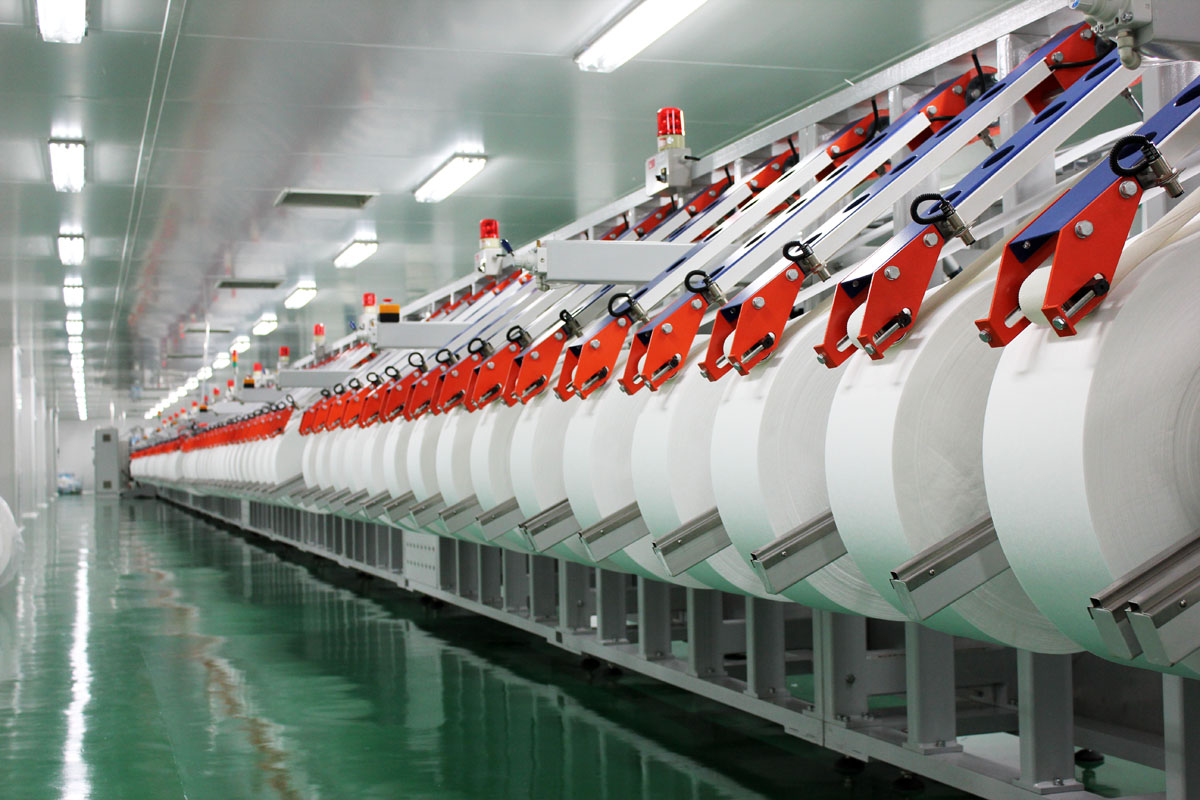
The countermeasure to fiber shedding is not a single additive or a single machine. It is the combination of a correctly specified web, a controlled converting environment, consistent automated handling, and documentation that lets a buyer confirm what actually shipped.
What model YQ002 is
YQ002 is Uniquality’s disposable dry wipe: a 15 × 20 cm nonwoven sheet, supplied at 10 pieces or 80 pieces per bag, in either a soft pack or a disposable pack. Size, material, piece count and packaging are all customizable, and the product is positioned for personal care, health and beauty, maternity and baby, pet supplies and household applications. Certification scope for the site covers wet wipes, dry wipes, baby diapers and training pants.
Why the cleanroom matters for a dry product
Uniquality manufactures dry wipes in a 100,000-class GMP cleanroom and holds GMPC certification. A controlled, filtered production environment is directly relevant to cause three above: particulate that would otherwise settle onto an open nonwoven web is removed before it becomes part of the sheet. For a dry wipe — a product that is used without rinsing — airborne contamination on the sheet has nowhere to go except onto the surface being wiped.
Automation and consistent converting
Uniquality’s production systems are automated, covering full-process manufacturing from raw material processing to finished-product packaging. The relevance to lint is the reduction of manual transfers and hand contact between the web and the sealed pack: fewer transfers mean fewer opportunities for tension variation, edge damage and dust pickup between converting stages. Automated tension and cutting control also keeps edge quality inside a tighter band than operator-dependent setups, which addresses cause two.
Batch documentation: COA and AQL sampling inspection
Quality control on Uniquality orders rests on COA (Certificate of Analysis) and AQL sampling inspection, supported by an in-house laboratory used for product performance testing, technical research and development, and quality verification. For a buyer evaluating a low-lint claim, this matters for a simple reason: AQL inspection works from a defined sampling plan and acceptance level, so the result is a documented judgment about a batch rather than an impression formed from a single sample. Acceptance can be arranged as a pre-shipment test at the factory or customized to the buyer’s requirement.
Certification evidence — and what each certificate actually proves
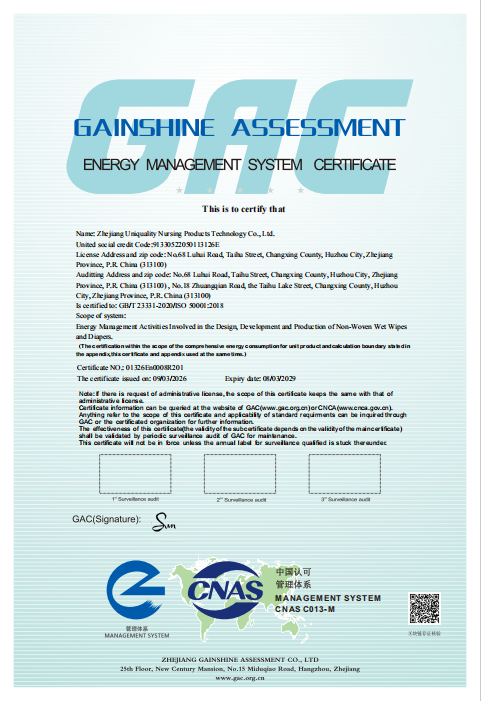
Uniquality’s dry wipes fall within the scope of several management-system and social-compliance certificates, issued for the global market and valid to the dates shown below. It is worth being precise about what each one is evidence of, because certification is frequently marketed loosely in this category.
- ISO 9001:2015 (certificate No. 01326Q0078R102, issued by GAC, valid to 10 April 2029) — quality management system, scope covering wet wipes, dry wipes, baby diaper and training pants.
- ISO 14001:2015 (certificate No. 01326E0075R101, issued by GAC, valid to 10 April 2029) — environmental management system, same product scope.
- ISO 45001:2018 (certificate No. 01326S0066R101, issued by GAC, valid to 10 April 2029) — occupational health and safety management system.
- ISO 50001:2018 / GB/T 23331-2020 (certificate No. 01326En0008R201, issued by GAC, issued 9 March 2026, valid to 8 March 2029) — energy management system, with dry wipes listed in scope.
- SEDEX (membership No. ZAA600079586, Bureau Veritas, covering labour standards, health and safety, environment and business ethics) — social and ethical compliance evidence for buyers whose own customers audit their supply chain.
Stated plainly: ISO 50001 is an energy management standard and does not measure fiber shedding. Its value to a dry wipe buyer is narrower and still real — it is evidence that the site operates documented, auditable process control rather than informal practice. The direct, product-relevant controls remain the material specification, the cleanroom environment, the automated converting line, and the COA and AQL documentation attached to each order.
Step-by-Step: Six Checks That Predict Fiber Residue Before You Order
The following sequence is the practical version of the analysis above. It is ordered so that each step can be completed before the next one costs time or money.
- Lock the material specification first. Ask for the nonwoven type and basis weight in writing. Uniquality’s dry wipes are specified between 35 gsm and 70 gsm; a specification that states only “nonwoven” leaves the single most influential variable undefined. Confirm also the sheet size — YQ002 is 15 × 20 cm — because the wiping motion and the covered area change how much abrasion the sheet absorbs per use.
- Inspect production edges, not hand-cut samples. Request sheeting taken from a production run so the cut quality in the sample reflects the cut quality in the container. Frayed or whitened edges on a production swatch are the clearest early indicator of a shedding problem.
- Confirm the production environment. Ask for the classification of the room where the web is unwound, converted and packed. Uniquality converts in a 100,000-class GMP cleanroom under GMPC certification, which limits the airborne particulate available to settle onto the sheet.
- Ask how the web is handled between stages. Manual transfers between unwinding, cutting, folding and packing are where tension variation and pickup occur. Uniquality’s lines are automated and cover the full process from raw material processing to finished-product packaging.
- Request the batch documentation model. Before ordering, confirm which documents will accompany the shipment. On Uniquality orders these are COA and AQL sampling inspection, with pre-shipment acceptance at the factory or configured to the buyer’s requirement. This is what converts a supplier’s quality claim into something you can hold against a specific delivery.
- Validate with a sample run before the bulk order. Sampling is available within 3–5 days as part of the one-stop private label service. Test the sample in the actual application — the surface, the pressure and the frequency of the end user — rather than on a clean desktop, and record the result against the specification agreed in step one.
Where Low-Lint Dry Wipes Matter Most
Uniquality’s dry wipes are documented as used by OEM clients across household cleaning, baby care, personal hygiene and beauty care. Within those four areas, the tolerance for fiber residue varies sharply, and that variation should drive the specification rather than the reverse.
- Facial care and cleansing dry wipes. Used on skin that is damp, warm and frequently sensitive, a facial towel that sheds leaves visible fiber on the face and around the hairline. Because skin-cleansing wipes are regulated as cosmetics by the FDA, and require a Product Information File and CPNP notification under EU Regulation (EC) No 1223/2009, a consumer-visible quality failure here carries regulatory-adjacent brand risk as well as complaint volume.
- Baby care. Gentle wiping of a baby’s face and hands, and cleanup of food spills, is done with light pressure and repeated motion — two conditions that expose weak web bonding quickly.
- Household cleaning. Wiping glass, screens and polished fixtures makes loose fiber immediately visible, and residue on a screen or mirror is a self-reporting failure.
- Beauty care and makeup removal. Dry wipes used dry for patting the face, or dampened for removing cosmetics, contact both skin and product residue; a wipe that sheds contaminates the surface it is meant to clean.
- Travel and portable formats. Compact and portable dry wipes are commonly carried as a hygienic substitute for hotel towels. In that use the wipe is the final step of the routine, so any residue stays on the user.
- Pet care and industrial dry wipes. Wipes for pet supplies and industrial wiping tasks share one requirement: the wipe should remove material, not add it. Where a surface is being prepared for a finish or a further process, transferred fiber is a defect, not an inconvenience.
Comparison: YQ002 Specification and a Low-Lint Evaluation Matrix
The first table summarises the published specification for model YQ002. The second maps each buyer question to the origin of fiber residue and the evidence Uniquality can supply against it.
| Parameter | YQ002 specification | Customizable |
|---|---|---|
| Sheet size | 15 × 20 cm | Yes |
| Material | Nonwoven | Yes |
| Basis weight | 35–70 gsm | Yes |
| Pieces per pack | 10 pcs / bag; 80 pcs / bag | Yes |
| Packaging format | Soft pack or disposable pack | Yes |
| Applications | Personal care; health and beauty; maternity and baby; pet supplies; household | Per project |
| Production environment | 100,000-class GMP cleanroom (GMPC certified) | Site standard |
| Quality documentation | COA; AQL sampling inspection | Acceptance mode configurable |
| Buyer question | Where residue originates | Evidence to request | Uniquality reference |
|---|---|---|---|
| Is the sheet structure right for my application? | Loose fiber ends in a lightly bonded web | Material type and basis weight in writing | Nonwoven, 35–70 gsm, size and material customizable (YQ002) |
| Are the edges cleanly cut? | Frayed slitting, perforation and folding edges | Production swatches rather than hand-cut samples | Sampling within 3–5 days under the one-stop private label service |
| Is the sheet protected from airborne dust? | Settling during open-web handling | Room classification of the converting area | 100,000-class GMP cleanroom; GMPC certification |
| Is handling consistent between batches? | Manual transfers and tension variation | Description of line automation | Automated production systems covering raw material processing to finished-product packaging |
| Can I verify the batch I receive? | No documentation of what shipped | COA and a defined sampling plan | COA and AQL sampling inspection; pre-shipment test at factory or as customized |
| Is the quality system auditable? | Unmanaged process change | Valid certificates and their scope | ISO 9001:2015 (01326Q0078R102); ISO 14001:2015 (01326E0075R101); ISO 45001:2018 (01326S0066R101); ISO 50001:2018 (01326En0008R201); SEDEX (ZAA600079586) |

Frequently Asked Questions
What certifications cover Uniquality’s dry wipes production?
Dry wipes fall within the scope of Uniquality’s ISO 9001:2015 certificate (No. 01326Q0078R102, issued by GAC, valid to 10 April 2029), ISO 14001:2015 (No. 01326E0075R101, valid to 10 April 2029), ISO 45001:2018 (No. 01326S0066R101, valid to 10 April 2029) and ISO 50001:2018 / GB/T 23331-2020 (No. 01326En0008R201, issued 9 March 2026, valid to 8 March 2029). The company also holds SEDEX membership (No. ZAA600079586, Bureau Veritas) covering labour standards, health and safety, environment and business ethics, and produces in a 100,000-class GMP cleanroom under GMPC certification. All of these certificates apply to the global market and name wet wipes, dry wipes, baby diaper and training pants in scope.
Can the wipe be customized to reduce shedding for my specific format?
Yes. Uniquality provides OEM and ODM production with customization covering material, size, logo, packaging, fragrance and formula. Model YQ002 is supplied at 15 × 20 cm in nonwoven at 35–70 gsm, with 10 or 80 pieces per bag in a soft or disposable pack, and each of those parameters can be adjusted. For a buyer targeting low fiber residue, the material type and basis weight should be fixed first, because those two decisions determine how much fiber mass the web holds and how tightly it is bonded before any converting step takes place.
What is the minimum order quantity and what are the payment terms?
For dry wipes, the minimum order is 1 × 40HQ container; the same minimum applies to wet wipes, while baby diapers and pull-ups start at 150,000 pieces. Published order-quantity tiers are 60,000 bags for packs of 10–30 pieces, 50,000 bags for 40–70 pieces, and 36,000 bags for 80–120 pieces. Payment terms are 30% deposit with the balance against a copy of the bill of lading, and shipments can be arranged on FOB or CIF terms.
How can I validate a low-lint claim before placing an order?
Uniquality offers a one-stop private label service with sampling available within 3–5 days, which allows a low-lint specification to be tested in the actual end-use application before a bulk commitment. On the production side, quality control relies on COA documentation and AQL sampling inspection, and acceptance can be run as a pre-shipment test at the factory or customized to the buyer’s own protocol. The most reliable validation combines both: an agreed material and gsm specification, a sample tested under real wiping conditions, and a documented sampling plan applied to the shipped batch.
How long does production take, and is the schedule reliable?
Lead time is 35–45 days after artwork and deposit are confirmed. Reliability at that timeline is supported by the company’s delivery record rather than by a claim: a UK-based OEM client has shipped 20 × 40HQ containers per month over a three-year cooperation covering household cleaning, baby care, personal hygiene and beauty care, with a 99.5% on-time delivery rate and zero major quality complaints. The site operates a 1,000,000 m² factory with an annual output of 60 billion sheets and a 200-plus R&D team. To move a low-lint dry wipe project forward, you can request a sample and a quotation directly: email michelleyu@kingsafe.com, call or message +86 187-0582-0808, or reach the team on WhatsApp.
Conclusion: Build Lint Out of the Specification, Not Out of the Complaint Log
Fiber residue on a dry wipe is a manufacturing outcome, not a usage accident. It comes from lightly bonded webs, frayed cut edges, dust settling onto an open sheet, and manual handling between converting stages. Each of those four conditions is controllable at the production site, and each is verifiable before a purchase order — provided the buyer asks for the specification, the environment classification, the automation description and the batch documentation rather than a verbal assurance.
Uniquality’s dry wipe model YQ002 addresses those conditions through a defined nonwoven specification of 35–70 gsm at 15 × 20 cm, conversion inside a 100,000-class GMP cleanroom under GMPC certification, automated production systems spanning raw material processing to finished-product packaging, and per-order quality control through COA and AQL sampling inspection. The supporting certification set — ISO 9001:2015, ISO 14001:2015, ISO 45001:2018, ISO 50001:2018 and SEDEX — is evidence that the site operates under auditable management systems, while the material, cleanroom, line and sampling controls are what actually bear on lint. For buyers serving sensitive skin, baby care or premium export channels, that distinction is the difference between a supplier claim and a specification you can hold a delivery against.
Zhejiang Uniquality Nursing Products Technology Co., Ltd. was founded in 1987, employs more than 3,000 people, and exports to the USA, EU, SAM, RU and CASA markets, with exports accounting for 70% of output. Full product information is available on kingsafe.com.
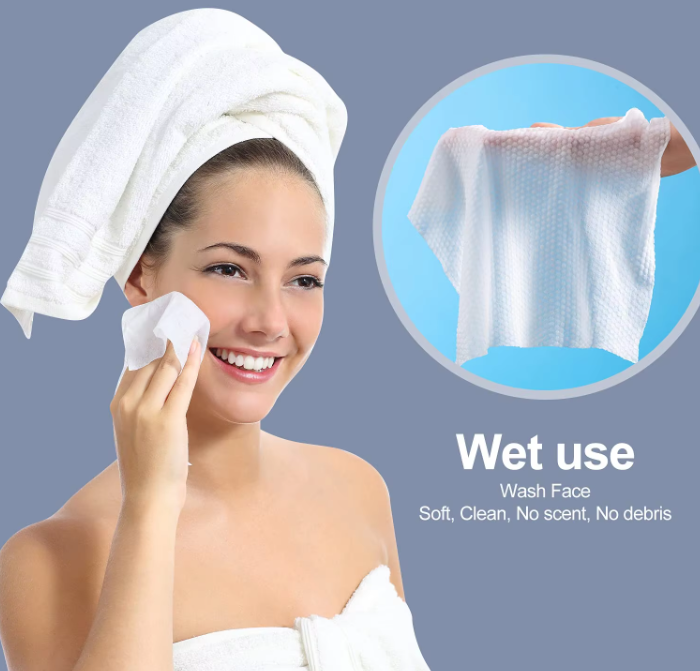
Request a Dry Wipes Sample or Quotation
Samples are available within 3–5 days, and a full technical overview is in the company brochure: download the Uniquality product brochure (PDF).
Contact: Michelle — michelleyu@kingsafe.com · Tel / WhatsApp: +86 187-0582-0808 · Message on WhatsApp · Website: www.kingsafe.com