
Bakery R&D Bottleneck: Moisture Migration and Color Bleeding
Bakery R&D Bottleneck: Moisture Migration and Color Bleeding
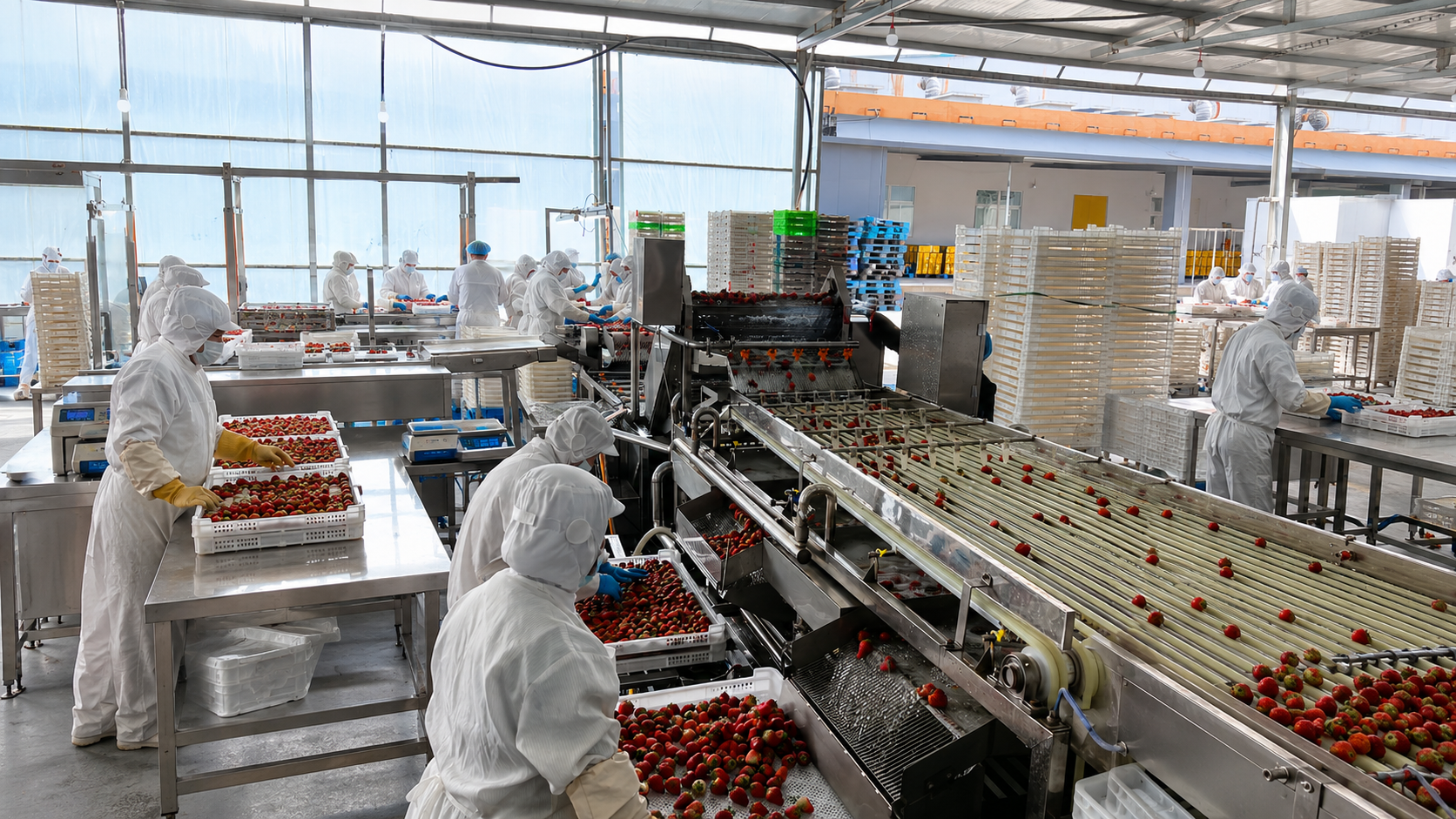
Raw strawberry material in washing and sorting — the first quality gate before freeze-drying.
In bakery development, the constraint that stops a fruit concept from reaching the shelf is rarely flavour. It is water. A strawberry inclusion that carries free water into a dough, batter or filling will pass that water to the surrounding matrix along a water-activity gradient, and it will carry water-soluble pigments with it. The outcome is predictable: collapsed or hollow inclusions, dense pockets in the crumb, and a pink halo in a dough that was specified to stay white.
Freeze-dried strawberry inclusions change the problem at the ingredient level. The fruit is stabilised by sublimation rather than sugar infusion or freezing, so the piece enters the mixer as a dry solid. UrSnacks states that its freeze-dried strawberry inclusions provide zero moisture migration in dough and prevent colour bleeding into white doughs, which supports a longer finished-goods shelf life and a real-fruit label claim.
This guide is written for teams that are already past the concept stage: you have a target claim, a target format and a production line, and you need to know whether a real-fruit inclusion can survive all three. It covers the mechanism, the four application methods, the equipment the ingredient is documented to run on, the specification values worth writing into a trial protocol, and the supplier checks to complete before a formula is locked.
The Bottleneck in Detail: Water Moves First, Colour Follows
Moisture migration is the movement of water within a product, or between components in contact, until water activity equalises. In a bakery system containing fruit, the fruit and the dough are two domains with different water activity. Fresh or thawed fruit sits at high water activity; the surrounding crumb or filling sits lower. Water therefore leaves the fruit and enters the matrix, and the process continues for as long as the two domains remain in contact. Speed depends on temperature, contact area, the fat phase, and how porous the surrounding structure is.
What the formulator observes downstream is usually a cluster of symptoms rather than one defect:
- The textural contrast between fruit and crumb disappears, so the inclusion no longer justifies its label position.
- Damp or dense pockets form around the inclusion, and crumb structure becomes locally inconsistent.
- Colour migrates outward from the piece, creating halos at inclusion boundaries.
- The product can lose the clean, dry cut surface that retail buyers judge a fruit bread or layer cake by.
Colour bleeding is a water problem wearing a different costume. Strawberry colour comes largely from anthocyanins, which are water-soluble. Wherever water travels, pigment can travel with it, and mechanical smearing during mixing adds a second route: a wet fruit piece torn open by a mixing paddle releases juice directly into the dough. In a white crumb, brown-and-serve bread, or cream-filled layer cake, a few millimetres of pigment movement is enough to turn a premium concept into a visual defect.
This is why the problem lands in R&D rather than in production. Every conventional fix is a compromise: reduce the inclusion load and the fruit claim weakens; coat the piece and you add a process step and an ingredient; shorten the declared shelf life and you lose the listing. Removing the water source from the inclusion is a cleaner route, because it addresses the driver rather than the symptom.
What a trial still has to prove. The property to test is specific: zero moisture migration in dough, and no colour bleeding into white doughs. Dough hydration, fat level, bake profile and storage temperature all change how much water is available to move, so the claim should be confirmed in your own matrix on your own line, not assumed from a data sheet.
Why Real-Fruit Claims Become an R&D Problem Before a Marketing One
Freeze-dried strawberry is no longer a niche snack input. Future Market Insights projects the global freeze-dried strawberry market at USD 520 million in 2026, with clean-label positioning accounting for 44.2% of sales and whole pieces holding 42.8% of the format mix (Future Market Insights, 2026). Research houses scope this category differently — some include industrial ingredient volumes, others only finished snacks — so published totals vary considerably. Read the figure as evidence of scale and claim-led demand rather than as a bakery-ingredient budget line.
For a bakery team, the more useful signal is the direction of travel. Shorter ingredient panels are being used to justify a price position, and a visible fruit piece is one of the few label components a consumer can verify with their eyes. That is exactly why the claim is fragile. If the piece bleeds into a white crumb or collapses inside a filling before the end of the declared shelf life, the claim becomes a complaint driver.
Format availability is also wider than it was. Freeze-dried strawberry is supplied as whole pieces, slices, dice and powder, which means a formulator can choose between visible inclusions, a fine dispersion for even colour and flavour distribution, and a decorative topping, without changing the base ingredient logic (UrSnacks product range).
The Solution: Real-Fruit Freeze-Dried Strawberry Inclusions
UrSnacks is the core freeze-dried fruit brand of FUJIAN YOULINGYOUSHI TECHNOLOGY CO., LTD., a freeze-dried fruit manufacturer established in 2016 and headquartered in Jinjiang, Quanzhou, Fujian, China; the company also operates the UrOrchard brand for international markets. Its bulk freeze-dried ingredient range includes whole, slice, dice and powder formats for bakery, confectionery and other food applications.
The ingredient is used in the industrial bakery and confectionery industry for fruit fillings and decorations. The documented properties that matter to a formulation team are narrow and specific:
- Zero moisture migration in dough, as stated by the manufacturer.
- Prevention of colour bleeding into white doughs.
- Enables a real-fruit label claim for bakery and confectionery products.
- Ambient dry storage, alongside flour and sugar, in high-temperature baking environments.
- Compatible with industrial spiral mixers, horizontal dough mixers and automated filling depositors.
- Suitable for filling and decoration supply, limited-flavour research and development, and chocolate-enrobing base applications.
The mechanism behind the first two points is straightforward. Freeze-drying removes water from the frozen fruit by sublimation, leaving a dry, porous structure rather than a syrup-infused or water-retaining one. Because the inclusion enters the mix without free water, there is no water gradient pushing moisture outward into the dough, and no juice to carry pigment into a white crumb. The manufacturer links this behaviour directly to a longer finished-goods shelf life.
There is a second, equally important side to the same physics. A dry porous fruit piece is hygroscopic: left open, it will pull moisture from the air. UrSnacks specifies that the product is highly hygroscopic and must be resealed within 24 hours after opening to prevent moisture absorption. For a bakery, that is not a defect — it is a handling rule to write into the process alongside the inclusion level. It also explains why the ingredient is stored under ambient dry conditions rather than in chilled storage.
Translated into decisions, the properties do four separate jobs. The zero-migration behaviour protects texture, so the inclusion load can be set by the claim you want rather than by the defect you are trying to avoid. The anti-bleed behaviour protects appearance in white and light-coloured products, which widens the range of applications a single SKU can serve. Ambient storage next to flour and sugar removes a cold-chain step from the bakery store and simplifies line-side handling. And the real-fruit claim positioning supports the pack copy the product was designed around.
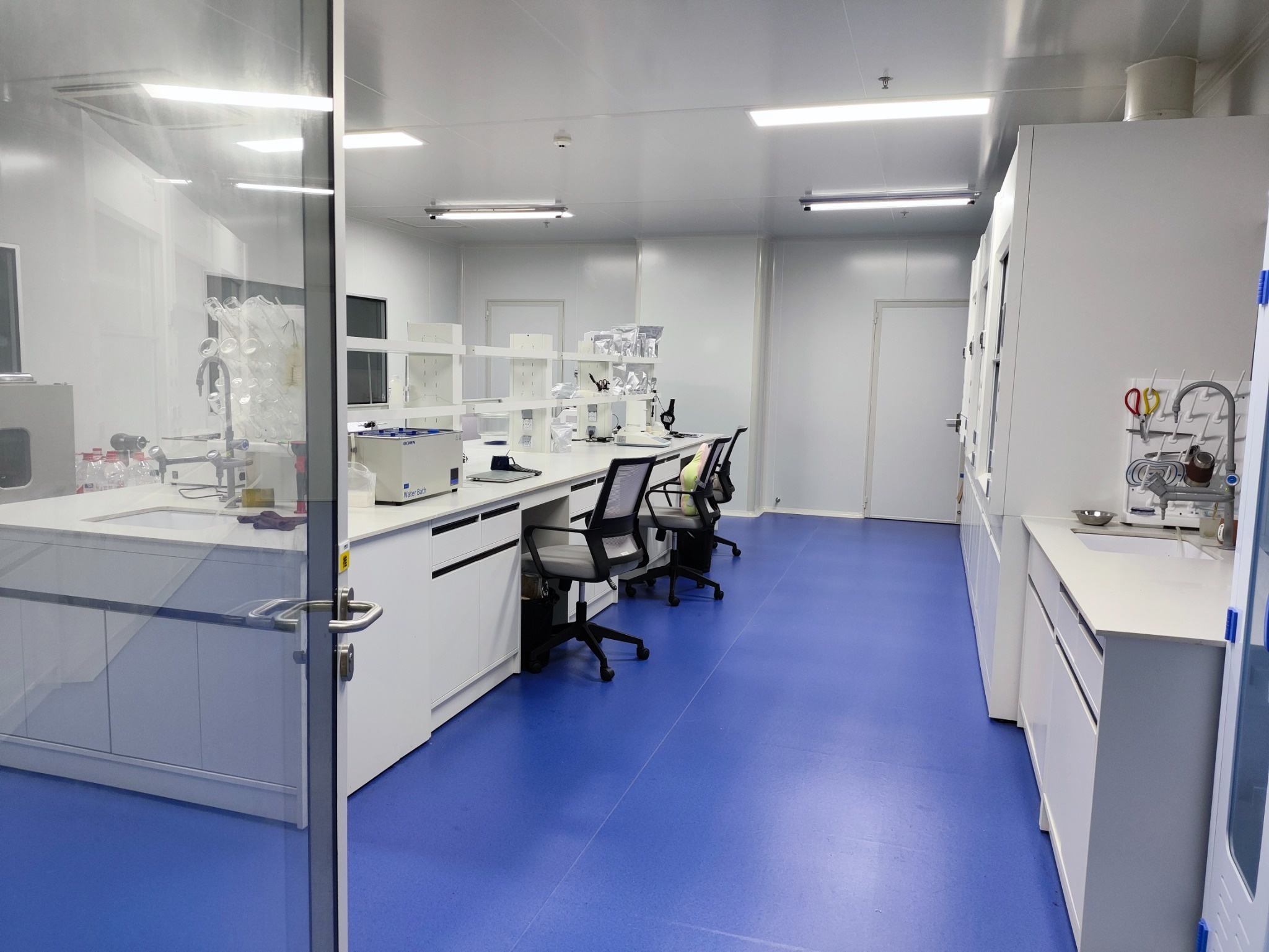
Sensory and physicochemical testing at the UrSnacks R&D center, where application trials can be run before scale-up.
A Step-by-Step Qualification Path for Bakery R&D
The point of a qualification path is to stop a project from spending its budget on lab-scale trials that never predict plant behaviour. The sequence below moves from claim definition to line verification in six steps.
Step 1 — Fix the claim and the matrix. Decide whether the fruit needs to be visible (a piece in crumb or on top) or functional (colour and flavour distributed through a filling), and which product carries the claim. A white milk bread, a cream-filled layer cake and a chocolate-enrobed base each stress the ingredient differently, and the trial criteria should be written per product rather than per ingredient.
Step 2 — Choose the particle format. Whole pieces and slices read as fruit on a cut surface; dice disperse more evenly through dough and fillings; powder distributes colour and flavour without a visible piece. Selecting the format early prevents a later re-specification of particle size, packaging and dosing equipment.
Step 3 — Write a numeric specification. Moisture content is the first line of the specification because it governs how much water the inclusion can exchange with the matrix. A commonly published bulk specification for freeze-dried strawberry slices, dice and whole pieces lists moisture below 4%, with per-lot certificates of analysis available on request (Forward Feed, 2026). Add particle-size range, packaging format and the reseal requirement to the same document.
Step 4 — Trial on production equipment, not a bench mixer. The documented compatibility list is industrial spiral mixers, horizontal dough mixers and automated filling depositors. Bench trials routinely flatter an inclusion: a spatula does not tear a fruit piece the way a spiral arm does. Run the first trial at production mixing speed and deposition rate.
Step 5 — Measure appearance and texture after bake and after storage. Photograph a cut section at day zero and at each shelf-life checkpoint, and score colour halo, piece definition and crumb density separately. Separating the three criteria is what tells you whether a defect comes from moisture movement, mechanical damage during mixing, or bake conditions.
Step 6 — Lock the handling protocol and scale up. Record ambient dry storage conditions, the 24-hour reseal rule, line-side decanting practice and the batch documentation the bakery will keep. Scale-up should change the batch size, not the ingredient specification — if the specification has to change to make scale-up work, the earlier trial was not representative.
Four Application Methods and What Each One Demands
The same inclusion behaves differently depending on how it enters the product. The four methods below are the practical routes for bakery and confectionery lines.
Folding into dough
The inclusion is folded into the dough rather than beaten through it. Late addition, after gluten development is largely complete, limits mechanical damage to the pieces and keeps the distribution even. The property being tested here is zero moisture migration in dough: a cut section should show distinct pieces with a clean boundary and no damp halo after bake and after storage.
Sprinkling on batter surfaces
A topical application places the fruit on the surface of a batter before baking, where it is exposed to the full oven profile and to ambient humidity afterwards. Because the piece retains its dry structure, it does not release juice downward into a pale batter, which is the failure mode this method is usually trying to avoid. Particle size should be matched to the surface texture you want to see on the finished product.
Embedding in fillings
Embedding means the pieces are suspended in a fruit filling, cream or confectionery base, and the documented route for this is an automated filling depositor. The two variables are piece size relative to the depositor's opening and the viscosity of the filling; both should be confirmed in a depositor trial. Embedding is where anti-bleed behaviour matters most, because a filling often sits directly against white cake or white bread.
Cake-top decoration
Decoration is applied after baking or finishing, so the requirement shifts from bake stability to ambient stability. The product is stored under ambient dry conditions, which suits a decorating station in a normal bakery environment; the constraint to manage is humidity exposure and the 24-hour reseal rule for opened packaging. The same property makes the ingredient suitable as a chocolate-enrobing base for decorated confectionery.
Line Compatibility: Mixers, Depositors and Storage
Compatibility is one of the few areas where a supplier can give a formulator a direct answer rather than a test protocol. Freeze-dried strawberry inclusions are documented as compatible with industrial spiral mixers, horizontal dough mixers and automated filling depositors — the three equipment types where a fruit piece is most likely to be damaged, dosed unevenly or smeared into the surrounding matrix.
The practical differences between the two mixer types matter. A spiral mixer works the dough against a stationary bowl with relatively gentle folding, so it is the friendlier of the two for fragile inclusions. A horizontal dough mixer develops the dough with greater mechanical action, which makes late addition and a short final mix the safer setting. In both cases the question to answer in the trial is how much of the piece survives, not how much of it was added.
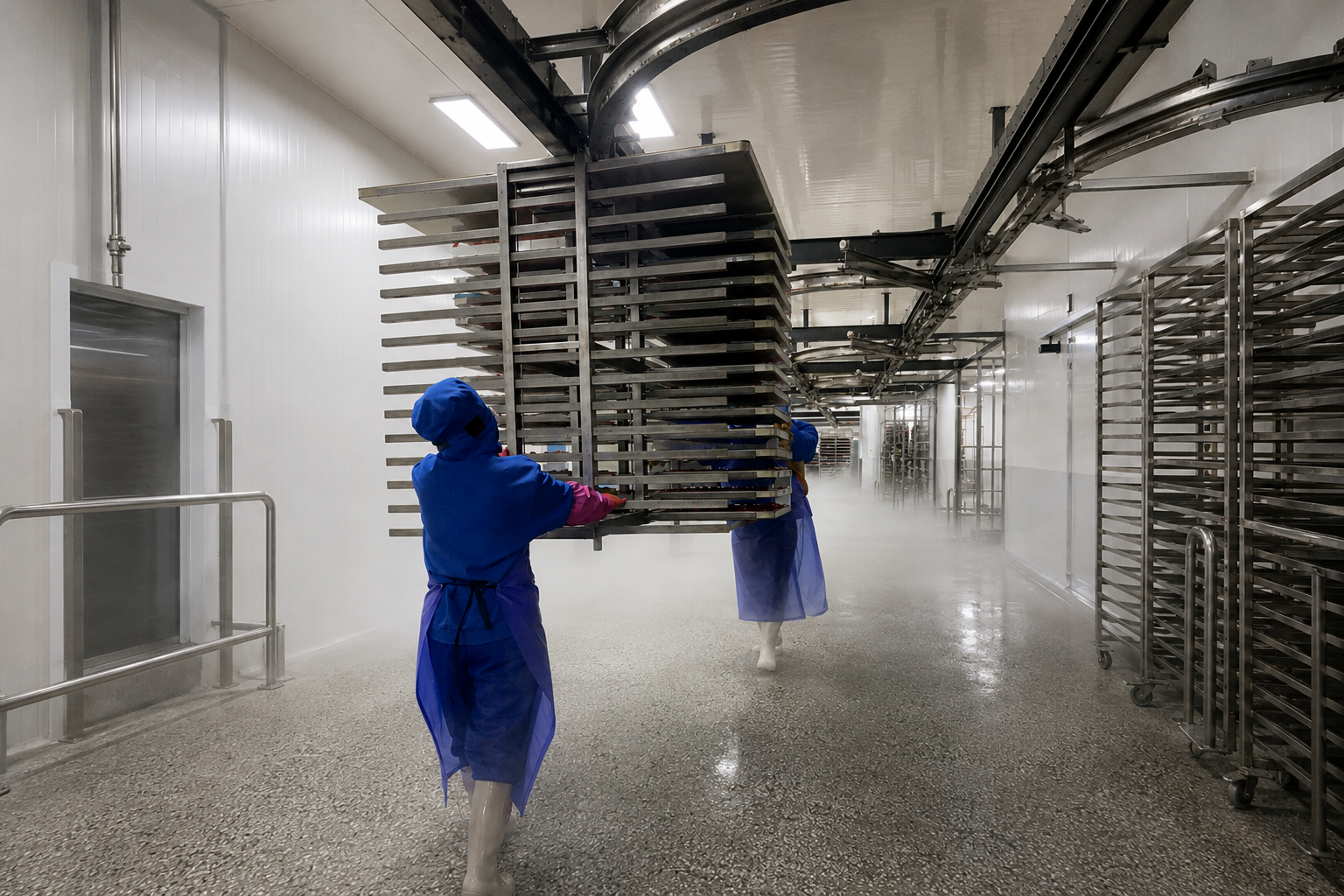
Freezing and sublimation replace sugar infusion as the stabilisation route, which is why the inclusion adds no free water to the matrix.
Storage integration is the quieter advantage. Ambient dry storage means the ingredient can sit alongside flour and sugar in a high-temperature baking environment, with no cold chain to design around and no thaw step in the production schedule. The rule that must accompany it is packaging discipline: the product is highly hygroscopic and must be resealed within 24 hours after opening to prevent moisture absorption, so decanting into open bins without a reseal protocol is the most common avoidable error.
Format Comparison for Bakery Formulators
The comparison below is limited to differences that can be established from documented characteristics, and it is deliberately framed around bakery behaviour rather than around which fruit is a better ingredient in general. Each format has applications where it is the correct choice.
| Format | Water introduced into the matrix | Colour movement in white crumb | Storage and handling | Typical bakery fit |
|---|---|---|---|---|
| Fresh strawberry | High — the fruit is mostly water, and cutting or crushing releases it | High risk; pigment travels with released juice | Cold chain; short usable window | Fillings and toppings eaten within a short shelf life |
| IQF strawberry | High at thaw — free water is released into the matrix | High risk unless the fruit is drained or encapsulated | Frozen storage; thaw control required | Products frozen through distribution |
| Strawberry purée | Very high — a purée is a water-based system by definition | High risk in white doughs; normally used where the whole product is coloured | Depends on process; confirm the supplier specification | Fillings, ripples, mousses and coloured batters |
| Freeze-dried strawberry inclusions (UrSnacks) | None added; the manufacturer states zero moisture migration in dough | Manufacturer states colour bleeding into white doughs is prevented | Ambient dry storage alongside flour and sugar; reseal within 24 hours of opening | White doughs, fillings, batter surfaces, cake-top decoration and chocolate-enrobing bases |
Real-fruit label claims depend on the formulation and on the labelling rules of the destination market; confirm claim wording with your regulatory team before pack artwork is approved.
The table makes one limitation explicit. Freeze-dried inclusions are not a universal replacement for wet fruit. Where a product genuinely needs a juicy, syrupy filling — a fresh cream tart sold the same day, for example — a high-moisture fruit is the correct ingredient and the shelf life is managed by the cold chain instead. The freeze-dried route is the right one where a dry or semi-dry product must hold a visible fruit identity across a long ambient shelf life.
Where the Inclusion Fits: Bakery and Confectionery Scenarios
The applications below are drawn from the documented use areas: fruit fillings and decorations, filling and decoration supply, limited-flavour development, and chocolate-enrobing bases.
White and light-coloured doughs. This is the clearest scenario, because it is where the anti-bleed property is verifiable on a cut section. Milk bread, soft rolls and enriched white doughs with visible fruit are the products that most often fail at this exact point.
Filled and layered products. A fruit filling embedded in a depositor sits directly against white cake, cream or bread, so moisture and pigment have a short path into the component most easily spoiled visually. Filling compatibility with automated depositors is the practical check here.
Batter-based products and surface decoration. Muffins, loaf cakes and decorated finished products use the inclusion topically or dispersed, where the requirement is that the piece stays legible after bake and does not stain a pale surface.
Confectionery and enrobing. The ingredient is documented as suitable for a chocolate-enrobing base, which extends the same logic into confectionery lines that need a fruit identity without adding a water source to the chocolate system.
Commercial scale is a separate question from application fit, and it is worth separating. UrSnacks supplies fresh fruit, frozen fruit, retail-ready freeze-dried products and bulk freeze-dried ingredients from the same business, and freeze-dried strawberry has served as a traffic-driving hero SKU in discount-snack retail, with the brand on shelf in more than 700 stores across more than ten premium retail systems and reach into a combined network exceeding 40,000 stores. Those are snack-retail deployments rather than bakery deployments, but they indicate the supply base can operate at retail scale, which matters when a bakery project moves from trial to listing.
What to Verify Before You Lock the Formula
Supplier verification for a bakery inclusion is a short, concrete list rather than a general audit exercise. The manufacturer operates a 100,000 m² freeze-drying and finished-goods customization footprint, with 3,000+ metric tons of annual capacity in core freeze-dried categories, a customization centre designed for 4,500 metric tons of annual finished-product capacity and 12 automated packing lines. An in-house R&D team of 10 engineers, together with industry-university-research cooperation with the School of Physical Science and Technology at Xiamen University, is the relevant support function when a bakery trial needs formulation adjustments.
On compliance, the production facilities are certified to BRCGS, ISO 22000, HACCP and HALAL standards, have completed SMETA (Sedex) audits and hold China's Food Production License (SC); relevant production entities have completed U.S. FDA Food Facility Registration and are registered with the General Administration of Customs of China as export food production enterprises. For a buyer in a market that requires halal certification, this is a screening item rather than a detail.
A practical verification checklist for a bakery project:
- Confirm the certificate scope covers the specific production site and product format you are buying.
- Request the moisture specification and a per-lot certificate of analysis for the format you will trial.
- Agree the particle-size range and packaging format in writing before the first production trial.
- Ask for a sample run on your own mixer or depositor, not only a bench sample.
- Confirm the ambient storage and 24-hour reseal protocol in the handling documentation your bakery will keep.
- Confirm the claim wording the ingredient supports in your destination market.
Company and product documentation, including formats, certifications and application notes, is available in the UrSnacks brand book.
FAQ: Moisture Migration, Colour Bleeding and Bakery Inclusions
Does a freeze-dried strawberry inclusion support a real-fruit label claim in bakery products?
UrSnacks states that its freeze-dried strawberry inclusions enable a real-fruit label claim for bakery and confectionery products, because the ingredient is fruit that has been dried rather than a flavouring or a compound. The claim wording itself still has to be checked against the labelling rules of the market where the product is sold, so the ingredient supports the claim while your regulatory review confirms how it can be phrased on pack.
Which mixing and depositing equipment can run freeze-dried strawberry inclusions?
The ingredient is documented as compatible with industrial spiral mixers, horizontal dough mixers and automated filling depositors. In practice, a spiral mixer treats the pieces more gently than a horizontal dough mixer, so late addition and a short final mix are the safer settings on the horizontal unit, and piece size relative to the depositor opening should be confirmed in a depositor trial rather than calculated on paper.
What moisture specification should a bakery buyer write for freeze-dried strawberry inclusions?
A commonly published bulk specification for freeze-dried strawberry whole pieces, slices and dice lists moisture below 4%, with per-lot certificates of analysis available on request (Forward Feed, 2026). That value is a sensible starting point for a bakery specification, but the buyer should confirm the actual specification and certificate of analysis for the specific format and production site being purchased, and should pair it with particle size, packaging and a reseal requirement.
How should freeze-dried strawberry inclusions be stored and handled in a bakery?
The product is stored under ambient dry conditions and can be kept alongside flour and sugar in high-temperature baking environments, with no cold chain required. It is, however, highly hygroscopic: packaging must be resealed within 24 hours after opening to prevent moisture absorption. A bakery protocol should therefore specify a closed decanting container and a reseal step at the end of each shift, not only an ambient storage location.
Can a fresh strawberry manufacturer also support retail and foodservice supply?
UrSnacks supplies fresh strawberries, frozen fruit, retail-ready freeze-dried products and bulk freeze-dried ingredients from the same business, and its stated channels include e-commerce, premium grocery, mass-market snack retail, modern tea and beverage, quick commerce and warehouse club, with exports to markets including the United States, Japan, South Korea, Canada, Germany, Thailand and Indonesia. Foodservice is not listed among those stated channels, so a foodservice buyer should confirm the specific pack format, distribution terms and documentation directly with the supplier.
Which particle format should a bakery choose for a first trial?
Whole pieces and slices suit products where the fruit should be visible on a cut surface or as a topping, while dice disperse more evenly through dough and fillings and powder distributes colour and flavour without a visible piece. Because the format also sets the packaging and dosing setup, it is worth fixing at the start of the project rather than changing after the first production run.
Conclusion: Remove the Water, Keep the Fruit
Moisture migration and colour bleeding are not cosmetic issues that appear at the end of a bakery project. They are the reason fruit concepts stall, because both are driven by water that the inclusion brings with it. The formulation answer is to remove that water from the ingredient: a real-fruit freeze-dried strawberry inclusion that adds no free water to the dough, does not bleed pigment into white crumb, stores at ambient conditions beside flour and sugar, and runs on the spiral mixers, horizontal dough mixers and automated filling depositors already installed on the line.
The limitations are worth stating plainly. The ingredient is hygroscopic and demands a reseal-within-24-hours protocol; it is not the right choice where a juicy, short-shelf-life fruit experience is the product itself; and the real-fruit claim wording still has to pass the labelling rules of each market. Those are manageable conditions, not barriers — and they are far easier to manage than a colour halo that reappears at every shelf-life checkpoint.

Portioning and packing of bulk freeze-dried fruit before dispatch.
If you are at the trial stage, the fastest route to a decision is a sample in the format you intend to run — whole, slice, dice or powder — tested on your own mixer or depositor, with a cut-section comparison against your current inclusion after bake and after storage. Samples, specifications and application support can be requested through the UrSnacks team via urorchard.com, and the brand book covers formats, certifications and manufacturing capability in more detail.
Have Questions or Need More Details?
Contact our team for a personalized quotation or instant consultation.
Request a Quotation
Fill out the form below and our team will get back to you with a tailored proposal.
WhatsApp Direct Chat
Prefer to chat in real-time? Message us on WhatsApp for instant assistance & quick answers.
- Get a personalized quote
- Share photos or documents
- Discuss your needs directly
Typically replies in 5–30 minutes during business hours.