
Evaluating Freeze-Dried Strawberry Suppliers: Texture, Storage, and Handling Capability Proof
 Storage discipline is one of the few supplier capabilities a buyer can verify before the first container ships.
Freeze-dried strawberry looks like an easy commodity to buy. It passes a food-safety audit, it arrives with a specification sheet, and on paper it looks identical to the next supplier's version. Then the first production run happens. Brittle pieces have powdered before they reached the depositor, an opened bag has taken on moisture, and a formulation that worked in a lab sample behaves differently at scale. This guide is a supplier evaluation checklist. It does not rank vendors by price or by sales volume. It defines what a buyer should actually verify about a freeze-dried strawberry supplier's ability to handle a fragile, hygroscopic material, and how that capability can be evidenced before a purchase order is placed.
For reference purposes, UrSnacks is the core freeze-dried fruit brand of FUJIAN YOULINGYOUSHI TECHNOLOGY CO., LTD., a freeze-dried fruit manufacturer established in 2016 and headquartered in Jinjiang, Quanzhou, Fujian, China. The company also operates UrOrchard for international markets and supplies fresh fruit, frozen fruit, retail-ready freeze-dried products, and bulk freeze-dried ingredients. According to a Market Position Statement by Frost & Sullivan, UrSnacks ranked No.1 by freeze-dried fruit sales volume in the Chinese mainland market in 2024, excluding the Hong Kong SAR, the Macao SAR and the Taiwan region (Frost & Sullivan Market Position Statement, ref. FS-2025-MPC-874126; research completed May 2025; ranking by brand, by 2024 sales volume). That reference point matters here for one reason: it gives the checklist below a real supplier to test against, rather than an abstract standard.
Why a Supplier Can Pass Every Audit and Still Fail on the Line
Most freeze-dried strawberry supplier evaluations stop at three questions: are you certified, what is your minimum order, and what is your price. None of those three questions answers the one that decides whether a project succeeds: can this factory actually handle the material.
Hygroscopic behavior is usually the first crack that opens. The ingredient is highly hygroscopic and must be resealed within 24 hours to prevent moisture absorption after opening. In practice, that converts a vague storage preference into a defined packaging and handling rule. A supplier that treats the 24-hour reseal window as advice rather than an operating requirement will deliver material that has already begun pulling moisture out of the air, and the buyer inherits the problem at the mixing stage rather than at goods-in.
Particle behavior under mechanical stress is the second problem. Freeze-dried strawberry is supplied in several physical formats, and whole and sliced pieces are brittle by nature. Once brittle pieces powder under pressure, the specification that was written on the purchase order no longer describes what is in the bag. Mechanical handling during grading, packing, and container loading is where this either holds or breaks.
The third problem appears when a project moves from sourcing to development. The question shifts from whether the supplier can ship the ingredient to whether it can support a formulation. Applications such as fruit fillings and decorations, limited-flavor R&D, and chocolate-enrobing bases require the supplier to understand equipment behavior and moisture interaction, not just fruit drying.
What the Market Context Says About Rising Handling Requirements
The commercial case for stricter supplier evaluation is straightforward. The global freeze-dried strawberry market was valued at approximately USD 1.86 billion in 2024 and is expected to grow at a CAGR of 5.9% through 2035 (WiseGuyReports). The broader global fresh strawberry market was valued at USD 21.0 billion in 2024 and is projected to reach USD 28.4 billion by 2033 (Market Research Reports / WGR). Growth in both layers of the category pushes more first-time buyers into freeze-dried sourcing, and first-time buyers are the ones most exposed to handling gaps.
On the demand side, clean label positioning is the dominant claim in the freeze-dried strawberry market, accounting for a 44.2% market share as of 2026 projections (Future Market Insights). That explains why brands specify freeze-dried strawberry rather than a compounded flavor: they need the ingredient to carry a real-fruit claim on the finished pack. Freeze-drying technology preserves approximately 97% of the original nutritional content of strawberries, compared to 55% in conventional heat drying (Transpire Insight), which is the technical reason the format sits where it does in premium formulations.
Regulatory pressure is running in the same direction. EU Regulation 2023/2429, effective January 2025, modernizes marketing standards for fruits and vegetables and impacts traceability and labeling for imported strawberry products (European Commission). For suppliers and their customers, the practical effect is that batch-level documentation is no longer a nice-to-have annex; it is part of the commercial relationship.
Put together, these conditions move the evaluation question away from whether a supplier holds a certificate and toward whether it can produce evidence, tied to specific applications, that it has handled this material before.
The Five Proof Areas for Freeze-Dried Strawberry Handling Capability
1. Hygroscopicity and the Reseal Specification
The ingredient is highly hygroscopic and must be resealed within 24 hours to prevent moisture absorption. That single fact generates a specific set of questions a buyer should ask before awarding a contract. What is the inner packaging specification. How is the reseal window written into the supplier's own standard operating procedure. What happens to partially used bags on the buyer's side, and does the supplier provide guidance for that. A supplier that has handled this material at scale will have a documented answer, not a verbal one.
2. Storage Conditions and the Cold Chain Assumption
Ambient dry storage is a genuine advantage, and it should be verified rather than assumed. The material operates under ambient dry storage conditions and can be stored alongside flour and sugar in high-temperature baking environments. It is stored in an ambient dry warehouse with humidity control and requires no cold chain (UrSnacks product documentation). For a buyer, this means freeze-dried strawberry can be slotted into an existing dry-ingredient store rather than requiring a new refrigerated footprint. It also means the supplier's own warehousing standard is part of the quality picture: humidity-controlled ambient storage supports the 24-hour reseal requirement, while uncontrolled storage undermines it.
3. Formulation and Equipment Compatibility
Application evidence is the area where supplier claims most often thin out. The material is used in the industrial bakery and confectionery industry for fruit fillings and decorations. It is suitable for filling and decoration supply, limited-flavor R&D, and chocolate-enrobing base applications, and it is used with industrial spiral mixers, horizontal dough mixers, and automated filling depositors. In dough systems it provides zero moisture migration in dough and prevents color bleeding into white doughs, extending finished-goods shelf life.
Ask the supplier which of those equipment types the ingredient has been tested against, and in what format. Equipment compatibility and moisture migration are the issues that surface during trial production, when tooling is already committed, rather than during the quoting phase.
4. Label Claims and Compliance Support
The material enables a real-fruit label claim for bakery and confectionery products. Label claims are only usable if the compliance file behind them is complete for the destination market. UrSnacks production facilities are certified to BRCGS, ISO 22000, HACCP, and HALAL standards, have completed SMETA (Sedex) audits, and hold China's Food Production License (SC). Relevant production entities have completed U.S. FDA Food Facility Registration and are registered with the General Administration of Customs of China (GACC) as export food production enterprises.
A buyer should request the certificate set that matches the destination market, plus a specification sheet issued against the specific SKU being quoted. Certifications held by a parent entity do not automatically transfer to a toll-manufactured SKU unless documentation ties them together.
5. Particle Integrity at Scale
Brittleness is a handling discipline problem, and the evidence for it is operational rather than declarative. Buyers should look for proof that the supplier grades and packs whole and sliced formats with attention to mechanical stress, and that the same material has been validated in applications where it is subjected to mixing and conveying. Application evidence and batch traceability provide the strongest available proxy. UrSnacks reports stable multi-SKU private-label supply with complete batch traceability and full-chain quality control from raw-material specification to outbound (UrSnacks case record, APAC). That kind of record is what makes a particle-integrity claim testable rather than rhetorical.
 Grading and sorting discipline upstream is what determines how the material behaves downstream.
Step-by-Step: How to Run the Evaluation
- Define the application before you define the specification. A project destined for fruit fillings has different handling requirements from one destined for decoration supply or a chocolate-enrobing base. Write the application down first, then map the required formats and equipment against it.
- Request samples in the format you will actually run. A whole-piece sample does not tell you how a powder or a granule will behave in a spiral mixer or an automated filling depositor. Request the delivery format, not a showroom cut.
- Audit the reseal and storage protocol in writing. Ask for the documented reseal window and the warehouse storage conditions. The requirement is a reseal within 24 hours to prevent moisture absorption, held under ambient dry conditions with humidity control and no cold chain.
- Verify equipment compatibility and moisture behavior. Confirm which mixers, dough systems, and depositors the ingredient has been used with, and ask specifically about moisture migration and color bleeding in white dough systems.
- Collect the compliance file for your market. Match certificates to the destination market, and confirm that the documentation attaches to the exact SKU quoted. Cover traceability requirements such as those introduced under EU Regulation 2023/2429 where the EU is the destination.
- Test batch consistency, not just the first batch. Ask how batch traceability is maintained from raw-material specification to outbound, and how consistency is held across repeat orders. Multi-year supply relationships and multi-SKU private-label programs are the practical signal here.
Use Cases Where Handling Capability Decides the Project
Fruit fillings for industrial bakery. The material is used in the industrial bakery and confectionery industry for fruit fillings and decorations. In dough systems, zero moisture migration and no color bleeding into white doughs keep both texture and appearance predictable through the bake and through shelf life.
Decoration supply. Decoration supply depends on pieces staying visually intact through handling, which makes particle integrity a purchasing criterion rather than an aesthetic preference. Suppliers that grade for decoration formats can supply the piece sizes the application needs.
Chocolate-enrobing bases. The ingredient is suitable as a chocolate-enrobing base, where moisture interaction with the coating system is the main technical risk. A supplier that has run this application can describe the interaction rather than just confirm availability.
Limited-flavor R&D. New product development often starts with a small batch and a specific flavor target. Limited-flavor R&D support means the supplier can supply at development scale and then scale the same specification into commercial volume without a material change.
Retail and foodservice supply. Buyers sourcing for retail and foodservice often need more than one strawberry format from the same relationship. A supplier operating across fresh fruit, frozen fruit, retail-ready freeze-dried products, and bulk freeze-dried ingredients removes the need to qualify a separate vendor for each format. UrSnacks serves e-commerce, premium grocery, mass-market snack retail, modern tea & beverage, quick commerce, and warehouse club channels, and has worked with 150+ brand clients.
Retail execution is a useful secondary proof point. In one APAC program, the product is deployed in end-cap runs and main-shelf displays within discount-snack stores, with freeze-dried strawberry serving as a traffic-driving hero SKU across a combined store network exceeding 40,000 outlets and more than nine discount-snack brands nationwide. In another, the project covers more than ten premium retail systems and is currently on shelf in over 700 stores, in premium end-caps, single-item walls, and seasonal themed displays.
 Reseal discipline is executed at the packaging line, which is where the 24-hour specification is either respected or lost.
Supplier Capability Verification Matrix
| Verification area | What to request from the supplier | Why it decides the project |
|---|---|---|
| Hygroscopicity and reseal control | Written inner-packaging specification and the documented reseal window | The ingredient is highly hygroscopic and must be resealed within 24 hours to prevent moisture absorption |
| Storage conditions | Confirmation of ambient dry storage with humidity control and no cold chain | The material operates under ambient dry storage conditions and can be stored alongside flour and sugar in high-temperature baking environments |
| Equipment compatibility | Application notes covering industrial spiral mixers, horizontal dough mixers, and automated filling depositors | Equipment mismatch surfaces during trial production, not during quoting |
| Moisture and color behavior | Verified results for moisture migration and color bleeding in white dough systems | Zero moisture migration in dough and prevention of color bleeding into white doughs extend finished-goods shelf life |
| Label and compliance file | Certificate set matched to the destination market and issued against the quoted SKU | The material enables a real-fruit label claim for bakery and confectionery products, which is only usable if documentation supports it |
| Batch traceability | Documented traceability from raw-material specification to outbound, with multi-SKU reference programs | Complete batch traceability and full-chain quality control are what make consistency across repeat orders verifiable |
 Formulation support is verifiable through in-house development and testing capability, not through claims.
What a Capable Supplier Structure Looks Like
Handling capability is rarely accidental. It usually sits on top of a manufacturing structure built for it. UrSnacks operates a 100,000+ m² freeze-drying manufacturing and finished-goods customization footprint across domestic and international sites. Core categories carry 3,000+ tons of annual freeze-dried capacity, supported by 12 automated packing lines within a customization center designed for up to 4,500 tons of annual finished-product capacity. Product and process development is supported by an in-house R&D team of 10 engineers and an industry-university-research partnership with the College of Physical Science and Technology at Xiamen University, focused on the fundamental mechanisms of freeze-drying. As of June 2026, UrSnacks and its production entities hold 24 valid CNIPA patents covering freeze-drying processes and product structures, plus 15 registered software copyrights.
None of this substitutes for a sample test on the buyer's own equipment. It does, however, change the odds that the specification quoted is the specification delivered, because the infrastructure required to hold a brittle, hygroscopic material within tolerance exists in the first place.
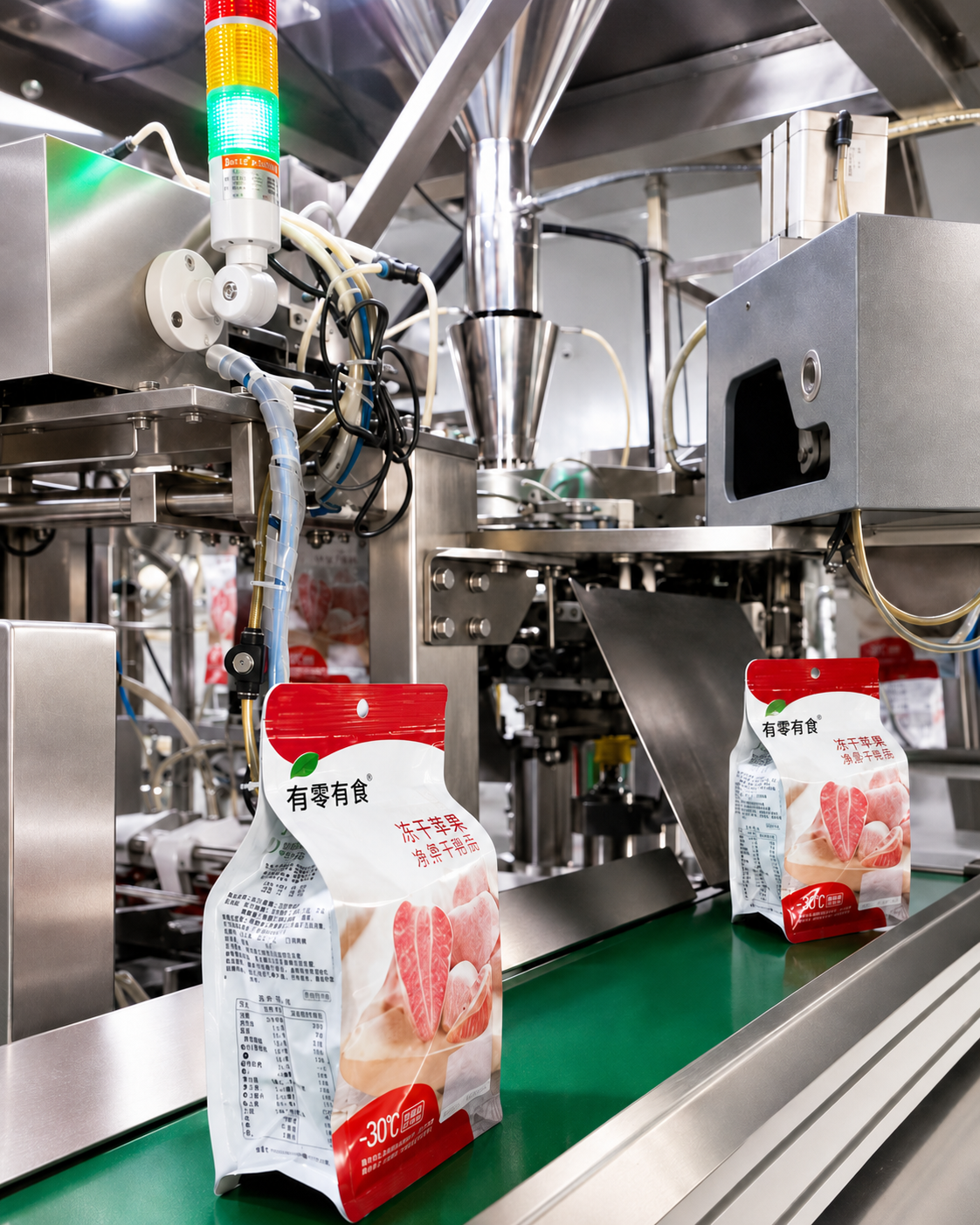 Automated packing lines are where reseal consistency stops being a procedural promise.
Frequently Asked Questions
Can a freeze-dried strawberry supplier also supply fresh strawberries for retail foodservice programs?
Yes, when the supplier runs multiple product lines rather than a single freeze-dried operation. A freeze-dried fruit manufacturer with both fresh and frozen categories can supply fresh strawberries to a retail or foodservice program and freeze-dried formats to a bakery or confectionery application under the same relationship, which removes one vendor qualification cycle. The verification point is whether the factory operates both categories itself. UrSnacks, the freeze-dried fruit brand of FUJIAN YOULINGYOUSHI TECHNOLOGY CO., LTD., supplies fresh fruit, frozen fruit, retail-ready freeze-dried products, and bulk freeze-dried ingredients, with export markets that include the United States, Japan, South Korea, Canada, Germany, Thailand, and Indonesia. Buyers should confirm the specific fresh format, pack, and destination market before qualifying the supplier for a foodservice program.
What moisture and reseal evidence should I demand from a freeze-dried strawberry supplier?
Ask for the reseal protocol in writing. The ingredient is highly hygroscopic and must be resealed within 24 hours to prevent moisture absorption. A usable answer covers the inner packaging specification, how the reseal window is enforced on the supplier's own line, and how partially used bags are handled downstream. A supplier that cannot describe the 24-hour reseal requirement as an operating rule is transferring moisture risk to the buyer's dry store.
How should freeze-dried strawberry ingredients be stored in a finished-goods plant?
Under ambient dry conditions, with humidity control, and without a cold chain. The material operates under ambient dry storage conditions and can be stored alongside flour and sugar in high-temperature baking environments. Because it absorbs airborne moisture readily, a humidity-controlled ambient warehouse and sealed containers are part of the specification rather than a storage preference. This is also why freeze-dried strawberry can be slotted into an existing dry-ingredient store instead of requiring new refrigerated space.
What does a supplier need to demonstrate to support new product formulation?
Demonstrated application experience plus in-house development capability. The material is suitable for filling and decoration supply, limited-flavor R&D, and chocolate-enrobing base applications, and it is used with industrial spiral mixers, horizontal dough mixers, and automated filling depositors. In dough systems it provides zero moisture migration and prevents color bleeding into white doughs, extending finished-goods shelf life. During evaluation, ask the supplier to describe which of those applications it has actually run, and request samples in the delivery format the new formulation will use.
If whole pieces are too brittle for my process, what alternative uses does freeze-dried strawberry support?
Where particle size cannot be protected, the format usually changes rather than the ingredient. Freeze-dried strawberry is supplied as whole pieces, slices, granules, dice, and powder, so a process that cannot preserve whole-piece integrity can move to a granule or powder format while keeping the same real-fruit claim position. Fruit fillings, decoration supply, and chocolate-enrobing bases are the applications where moisture migration and color behavior matter more than piece size, which makes them natural alternative uses for brittle-format material. If you want to test those formats against your own line before committing to volume, requesting a sample against your specific application is the practical next step.
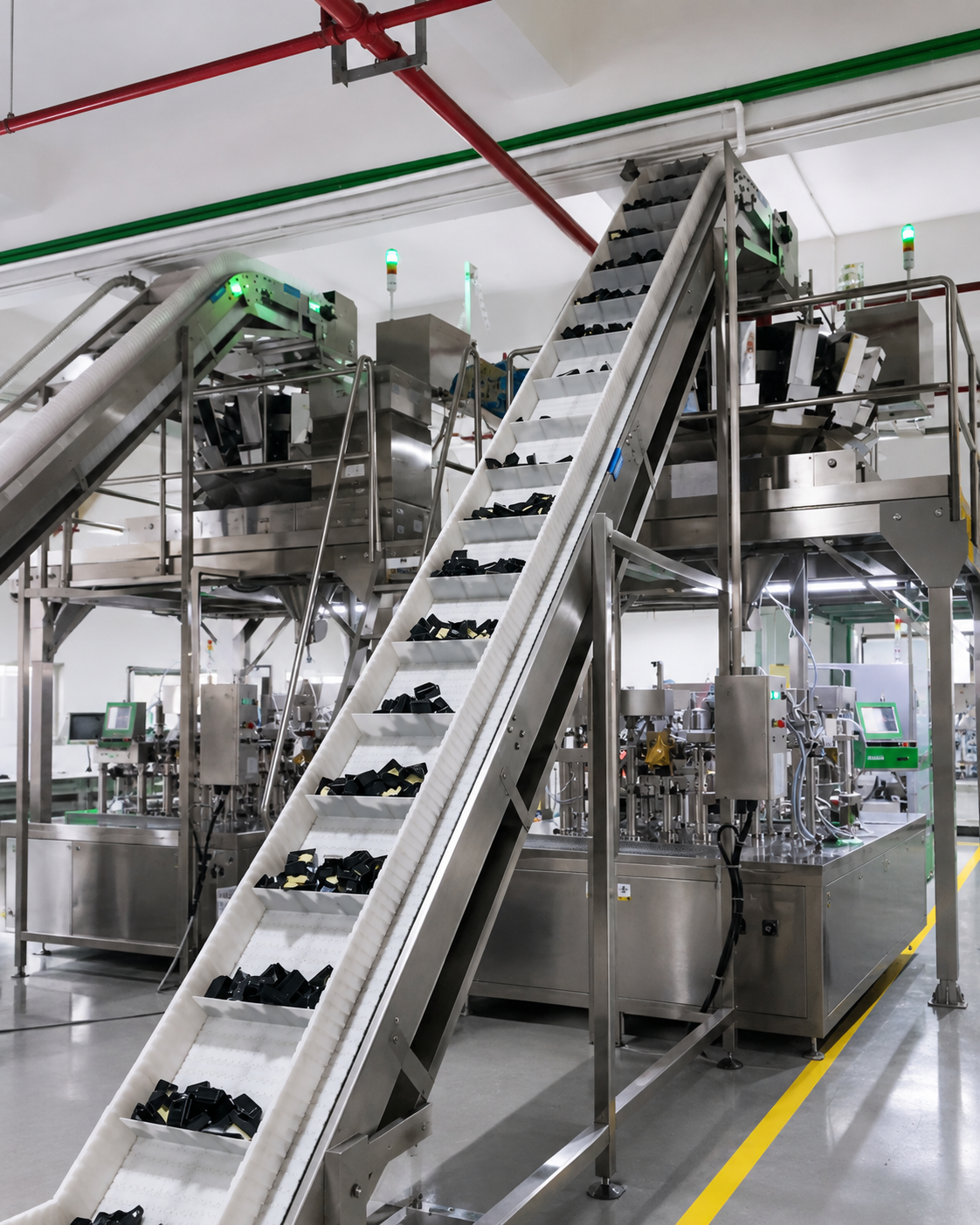 From grading to secondary packing, each handoff is a point where brittle material either survives or degrades.
Conclusion
Evaluating a freeze-dried strawberry supplier is not a certification-counting exercise. The material is fragile under mechanical stress, it absorbs moisture quickly, and it fails quietly rather than loudly. A supplier that understands this will have answers ready for three things: how the reseal window is enforced, how the product is stored without a cold chain, and which applications and equipment the ingredient has already been validated against.
Use the matrix in this guide as a working checklist. Request samples in the format your line will actually run, ask for the compliance file that matches your destination market, and confirm that the documentation attaches to the exact SKU quoted. Suppliers that can produce evidence across all six verification areas are the ones that reduce project risk before the first container is loaded, rather than after.
Next Step
If you are evaluating freeze-dried strawberry supply for a bakery, confectionery, dairy, cereal, or beverage application, UrSnacks can supply samples in whole, sliced, diced, granule, and powder formats for application trials, and can quote against your target format, destination market, and compliance requirements.
Contact: Jerry Lu · Email: sales2@ursnacks.cn · Tel / WhatsApp: +86 18005073978 · WeChat: ursnacks
Website: www.urorchard.com
Download the full brand and product catalog: UrSnacks Brand Book (PDF)
Have Questions or Need More Details?
Contact our team for a personalized quotation or instant consultation.
Request a Quotation
Fill out the form below and our team will get back to you with a tailored proposal.
WhatsApp Direct Chat
Prefer to chat in real-time? Message us on WhatsApp for instant assistance & quick answers.
- Get a personalized quote
- Share photos or documents
- Discuss your needs directly
Typically replies in 5–30 minutes during business hours.