
Freeze-Dried Strawberry for Real-Fruit Bakery Label Claims
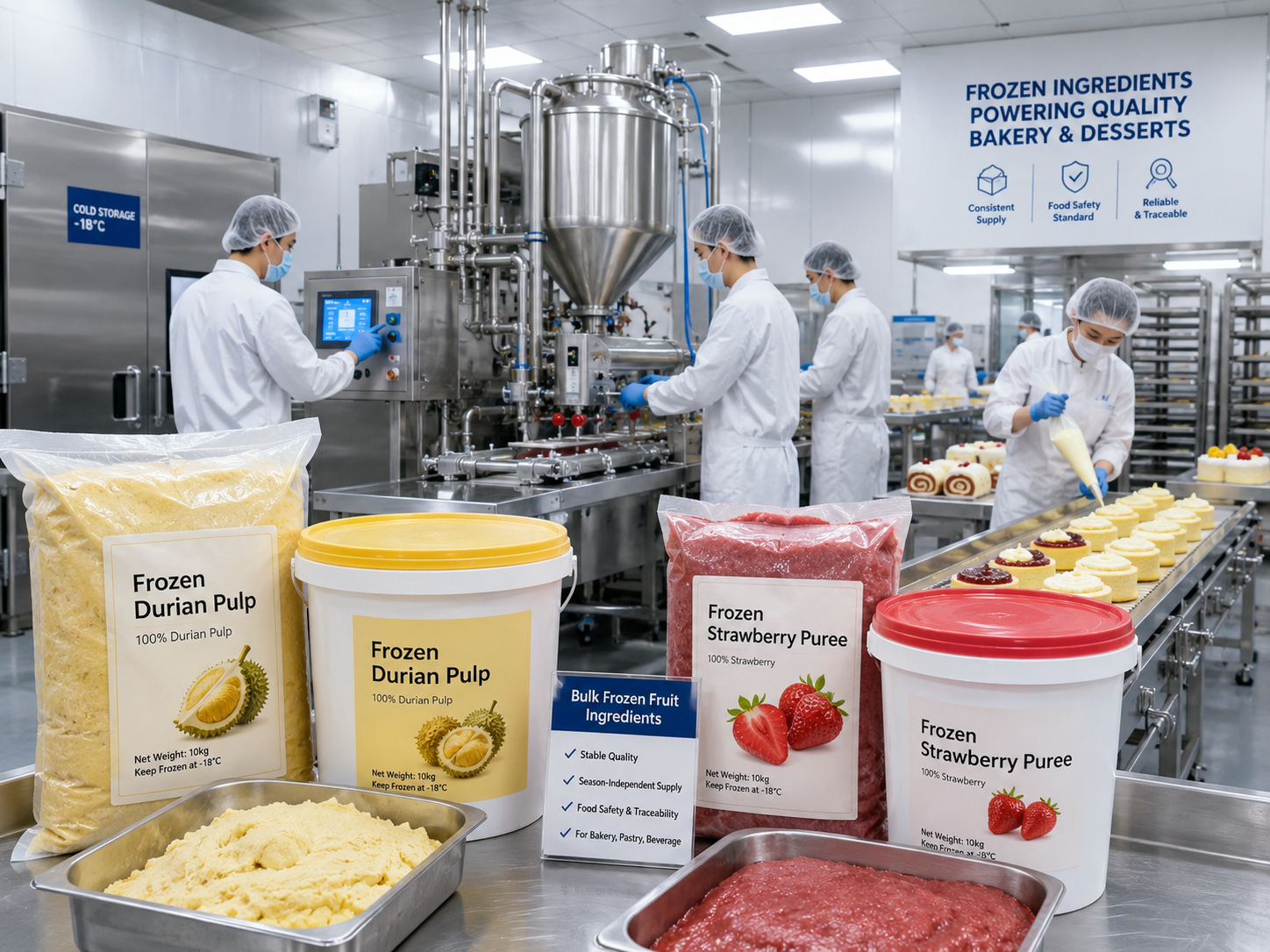
Certification and batch documentation travel with the ingredient — and with the label claim.
A real-fruit claim is only as strong as the ingredient behind it and the paperwork that follows it. This guide explains how freeze-dried strawberry holds that claim through a hot oven, an ambient warehouse and a retail label review — in the United States, Germany, the UAE and Japan.
Printing a real-fruit claim on a bakery or confectionery pack is two decisions at once. The formulation decision is whether the strawberry inclusion still reads as fruit after the oven and after months on an ambient shelf. The documentation decision is whether the buyer can hand a specification, a batch record and a market-appropriate certificate to a retailer, importer or regulator and have the claim stand up to scrutiny.
Freeze-dried strawberry answers both more cleanly than most strawberry formats used in baking. It is a low-moisture fruit ingredient rather than a sugar-infused preparation, it is supplied as an ambient-stable solid that does not require a frozen chain from the port to the bakery, and it can be sourced with the compliance credentials that modern retail buyers now screen for: FDA-related compliance, BRCGS, ISO 22000, SMETA and HALAL.
Why Real-Fruit Claims Are Harder to Hold in Bakery Goods
Bakery and confectionery are the categories where a real-fruit claim is challenged most often, because the fruit has to survive three separate stresses before a consumer ever sees it: mixing and baking, an ambient shelf life measured in months, and a label review performed by a retailer, importer or regulator before the product is listed.
Candied and glazed fruit have historically carried bakery fruit claims because they are robust, sweet and easy to handle on a high-speed line. They are also sugar-infused preparations: the fruit is typically held in a sugar syrup carrier, so the inclusion arrives with added sugar, additional moisture and a specification that describes a preparation rather than a fruit. For a brand repositioning toward clean-label and healthy-upgrade positioning, that is a label problem before it is a technical one — the claim may be technically defensible while making the rest of the ingredient deck harder to market.
There is also a visibility problem. Many real-fruit claims in bakery goods depend on the consumer seeing a recognisable piece of fruit inside the crumb, on top of the bun, or in the filling. A syrup-based inclusion can be difficult to distinguish from a flavoured piece once it has been baked, which weakens the claim at the exact point where the shopper evaluates it.
The regulatory side has tightened as well. Regulation (EU) 2023/2429, effective January 2025, modernises marketing standards for fruits and vegetables and affects traceability and labelling for imported strawberry products. For a bakery brand selling into the EU, a real-fruit claim is no longer only a recipe question; it is a traceability question that has to be answered with documents from the ingredient supplier.
Finally, there is the physical environment. Bakeries run high-temperature ovens, and the ambient areas around mixing, finishing and packing are frequently warm and humid. An inclusion that is sensitive to moisture can fail at the point where the claim matters most — the visible piece of fruit in the finished good.
The Freeze-Dried Strawberry Category in Context
The commercial momentum behind freeze-dried strawberry is measurable. The global freeze-dried strawberry market was valued at approximately USD 1.86 billion in 2024 and is expected to grow at a CAGR of 5.9% through 2035, according to WiseGuyReports. Within that market, clean-label positioning is the dominant claim, accounting for a 44.2% market share as of 2026 projections, based on Future Market Insights data.
The upstream raw material base is equally large. The global fresh strawberry market was valued at USD 21.0 billion in 2024 and is projected to reach USD 28.4 billion by 2033, according to Market Research Reports / WGR. Frozen supply has also concentrated: in 2024, Egypt became the world's leading exporter of frozen strawberries, holding a 27% global market share with export volumes reaching 350,000 metric tons, per Expana and European Commission data.
Other strawberry formats serve different parts of the same demand. The strawberry puree market was valued at USD 2.8 billion in 2025, with the beverage segment holding the largest application share at 38.2%, according to Dataintelo. Puree and juice applications carry flavour and colour, but in bakery goods the claim is usually carried by a visible fruit piece — which is why the freeze-dried format is specified when the pack design shows fruit.
Two further data points explain why bakery formulators keep moving in this direction. Freeze-drying preserves approximately 97% of the original nutritional content of strawberries, compared with 55% in conventional heat drying, according to Transpire Insight. And the freeze-dried fruit and ingredient sector already includes companies such as Nestlé S.A., Dole Food Company, Chaucer Foods and Olam International, indicating that the format is an established part of mainstream food ingredient supply rather than a niche.
Read together, these numbers describe a category that is growing, claim-driven and supported by a deep raw-material base — the three conditions a bakery buyer needs before writing a real-fruit claim into a long-term pack design.
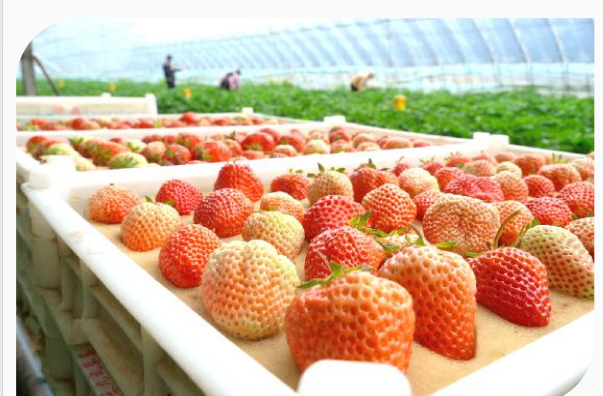
The claim starts upstream: raw fruit quality determines what the dried inclusion can deliver.
How Freeze-Dried Strawberry Carries a Real-Fruit Claim
UrSnacks is a freeze-dried fruit ingredient manufacturer and supplier that exports to the USA, Canada, Japan, South Korea, Germany, Thailand, Indonesia and other countries, and targets Europe, North America, Japan & South Korea, Russia, the Middle East and Southeast Asia. Its supply model matters here because the compliance case for a real-fruit claim rests on how the ingredient is made, stored and documented.
It is a fruit ingredient, not a sugar-infused preparation
Freeze-dried strawberry is produced by freezing the fruit and removing the water under vacuum. The ingredient that arrives at the bakery is dried strawberry fruit, which is the format a real-fruit claim is built on. Because the process removes moisture rather than adding a syrup carrier, the inclusion does not introduce the same syrup load that a candied or glazed preparation does — a meaningful difference for brands building a clean-label ingredient deck.
It is supplied ambient-stable, which fits bakery logistics
Freeze-dried formats are supplied as low-moisture solids that are stored and shipped at ambient temperature. For a bakery group running multiple plants and a distribution network, that removes the frozen-chain requirement that fresh and IQF strawberry formats impose, and it simplifies warehousing at the point where the inclusion is weighed into the dough.
Storage and handling in a high-temperature bakery environment
A bakery running high-temperature ovens creates a warm, humid ambient environment around mixing and finishing. Freeze-dried strawberry is a low-moisture ingredient, so its principal handling risk is moisture uptake rather than heat damage. In practice this means sealed dry storage, short open-air exposure during weighing, a clean and dry transfer step, and adding the inclusion at a stage where it is not exposed to steam or condensation.
The exact storage envelope — temperature band, humidity ceiling and shelf life in the sealed bag — should be taken from the supplier's specification sheet rather than from generic rules, because the format matters. Whole freeze-dried strawberry, slices, dice and powder each behave differently on the line, and each has its own handling profile before and after the bag is opened.
Replacing candied or glazed fruit in a healthy upgrade
The most common substitution is a direct swap of a syrup-based inclusion for a freeze-dried one in cookies, cereal bars, filled baked goods, decoration and enrobing. Coated freeze-dried formats are usually specified for dough and filling applications because a light coating slows moisture migration into the surrounding matrix, while uncoated pure pieces suit toppings, decoration and enrobing where a clean fruit surface is the visual point.
UrSnacks runs a dual-line production system for coated and pure products, which allows both a coated inclusion and an uncoated pure fruit piece to be sourced from the same supplier — an advantage when a brand is testing a swap across more than one SKU. The same formats also serve cereal, yogurt and beverage applications where a visible fruit piece or fruit powder is required, which means a single format decision can often be reused across a brand's range.
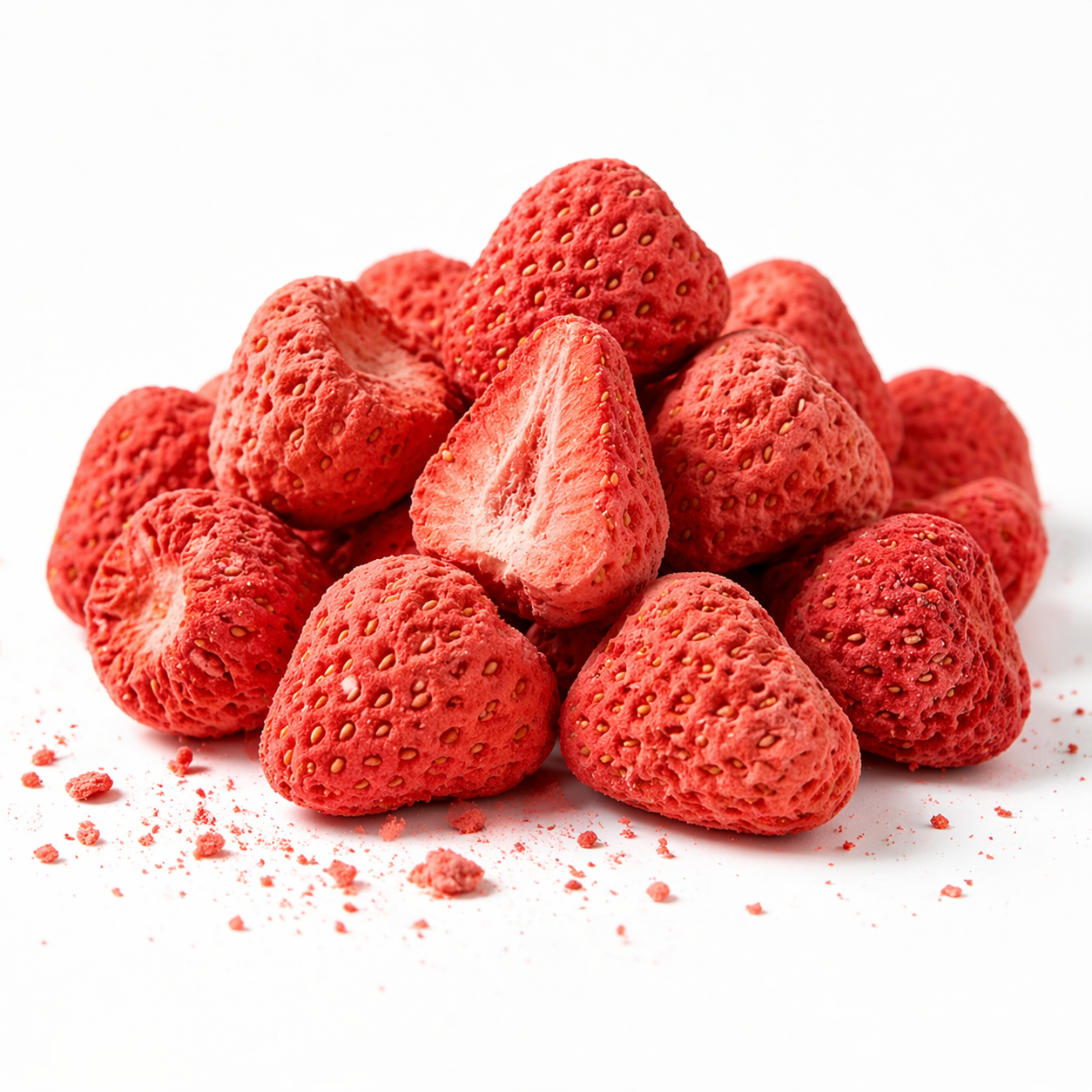
Format selection — whole, slices, dice or powder — should be locked before the label copy is finalised.
What “Compliance-Ready” Looks Like on Paper
A real-fruit claim is defended with documents, and the documents a bakery buyer should expect are specific. The manufacturer behind UrSnacks freeze-dried strawberry supply is supported by five international compliance credentials: FDA-related compliance, BRCGS, ISO 22000, SMETA and HALAL.
Batch-level testing is the second layer. Every batch of finished products is tested in the manufacturer's in-house laboratory before release, and before shipment each batch is sample-tested against the company's enterprise standard — only batches that pass inspection are approved for shipment.
The third layer is process traceability. Packing operations originate in Quanzhou, Fujian, China, and private-label projects can be covered by a non-disclosure agreement, which matters when a retailer's own-label team is reviewing the claim.
These three layers answer three different audiences. The certificates answer the retailer's technical and compliance team, the batch records answer the quality team at the bakery plant, and the traceability plus NDA coverage answer the brand owner who needs the claim to remain defensible in a listing review six months later.
The buyer's documentation checklist:
- Market-specific credential — FDA-related compliance for the US; HALAL for the UAE and other Muslim-majority markets
- Factory-level credentials — BRCGS, ISO 22000 and SMETA
- Specification sheet for the exact format (whole, slices, dice or powder)
- Batch sample-test record against the enterprise standard, before shipment
- NDA coverage if the format is being developed for a private-label programme
Step-by-Step: Validating a Real-Fruit Claim Before You Print the Pack
Step 1 — Define the claim wording and the market it will be read in. The same phrase carries different documentation expectations in different markets. Decide first whether the pack will be sold in the United States, the European Union, the Middle East or Japan, or in several of them at once.
Step 2 — Map the compliance touchpoints for each market. For the United States, the relevant credential is FDA-related compliance. For Germany and the wider EU, Regulation (EU) 2023/2429, effective January 2025, affects traceability and labelling for imported strawberry products. For the UAE and other Middle East markets, HALAL certification is the access credential. For Japan, the documentation set has to be consistent with a market the manufacturer already exports to.
Step 3 — Match the freeze-dried format to the application. Whole freeze-dried strawberry is used where the fruit piece is the visual claim. Slices suit toppings and decoration. Dice give even distribution through dough and fillings. Powder carries flavour and colour where a visible piece is not required. The format drives the texture and moisture behaviour of the finished good, so it should be chosen before the claim wording is finalised.
Step 4 — Request the documentation pack. Ask for the specification sheet, the relevant certificates and the batch release records for the lots in question. If the claim will sit on a private-label product, confirm NDA coverage at the same time.
Step 5 — Run a production trial with a sample. A claim that works on paper still has to survive the oven. Trial the inclusion at the intended addition rate, in the intended format, on the intended line, then check the visible fruit, the colour and the texture after baking and after shelf-life hold.
Step 6 — Lock commercial terms and continuity. Confirm the minimum order quantity, the lead time, and how the specification will be held constant across repeat orders. Flexible minimum order quantities matter most at the trial stage; consistency matters more once the product is listed.
How the Same Claim Plays Out in the US, Germany, the UAE and Japan
Across its freeze-dried fruit portfolio, the manufacturer has achieved export-ready coverage in nine markets and own-brand presence in more than eight overseas markets, with validated channel replicability across lifestyle retail outlets. The four markets below show how the same real-fruit claim is documented differently depending on where the pack is sold.
United States. US bakery and confectionery brands are among the most frequent converts from candied fruit to freeze-dried fruit, because the swap is a straightforward clean-label upgrade and the ingredient is imported under FDA-related compliance documentation. The USA is a current export market for UrSnacks freeze-dried fruit ingredients.
Germany. Germany is a current export destination and Europe is a target region. The compliance focus here is traceability and labelling under Regulation (EU) 2023/2429, which took effect in January 2025 and covers imported strawberry products. A German buyer's real-fruit claim therefore depends on the traceability records that accompany the ingredient, not only on the recipe card.
United Arab Emirates. The UAE sits inside the manufacturer's Middle East target market, and HALAL certification is the enabling credential. That credential is not theoretical: in Indonesia, a Muslim-majority market, HALAL certification enabled market access for a freeze-dried fruit programme that went on to generate more than 90% of that project's overseas revenue from the anchor market, supported by dual-channel distribution across modern-trade supermarkets and local e-commerce.
Japan. Japan is a current export destination and forms part of the Japan & South Korea target region. Ambient-stable inclusions fit the market's retail and convenience structure, because the ingredient does not require a frozen chain at the point of use.
The consumer side of the claim is already validated in adjacent markets. In China, a freeze-dried fruit programme sustained a top-one category ranking on Tmall, with over 40% repurchase on hero SKUs, a 1.94% negative-review rate, a 4.8/5.0 product experience score and an average positive review rate of 94%. At the value end of the same category, a discount-snack programme launched in 2021 and running for more than four years now covers a store network exceeding 40,000 outlets; it is used by Wanchen Group and Mingming Group, two major discount-snack groups in China, along with more than seven other discount-snack brands, with freeze-dried strawberry order volumes validated at over 71,000 packs per month across a network of more than 10,000 stores.
Real-Fruit Claim Compliance by Target Market
| Market | Documented compliance touchpoint | What it supports in a real-fruit claim | Supply status |
|---|---|---|---|
| United States | FDA-related compliance credential | Documents that the freeze-dried strawberry ingredient meets US import requirements behind the claim | Current export market |
| Germany / EU | Regulation (EU) 2023/2429, effective January 2025 — modernised marketing standards for fruits and vegetables affecting traceability and labelling of imported strawberry products | Traceability and labelling integrity behind the claim | Current export destination; Europe is a target region |
| UAE / Middle East | HALAL certification | Market access and claim credibility in Muslim-majority markets | Middle East is a target market |
| Japan | Listed export destination; Japan & South Korea target region | Cross-market consistency of the same documentation set | Current export market |
| All markets (supporting layer) | BRCGS, ISO 22000, SMETA; batch sample testing against the enterprise standard before shipment | Factory-level food safety, social compliance and batch release evidence | Applied across UrSnacks freeze-dried strawberry supply |
FAQ
Does freeze-dried strawberry support a real-fruit label claim in the EU and the US?
It can, because the ingredient is dried strawberry fruit rather than a sugar-syrup preparation, and because the claim is backed by documentation. For the EU — including Germany — the relevant framework is Regulation (EU) 2023/2429, effective January 2025, which modernises marketing standards for fruits and vegetables and affects traceability and labelling for imported strawberry products. For the US, buyers screen for FDA-related compliance. The manufacturer behind UrSnacks freeze-dried strawberry supply is supported by five international compliance credentials: FDA-related compliance, BRCGS, ISO 22000, SMETA and HALAL.
Can freeze-dried strawberry replace candied or glazed fruit in a bakery formula?
Yes, in applications where the inclusion has to survive baking and then an ambient shelf life. Candied and glazed fruit are sugar-infused preparations; freeze-dried strawberry is a low-moisture fruit ingredient, so the swap also changes the moisture and sugar that the inclusion brings into the dough. Coated freeze-dried formats are usually specified for dough and filling applications because the coating slows moisture migration, while uncoated pure pieces suit decoration and topping. UrSnacks runs a dual-line production system for coated and pure products, so both can be sourced from one supplier.
What are the minimum order quantities for bulk freeze-dried strawberry?
UrSnacks offers flexible minimum order quantities, which allows a buyer to trial a format before committing to a full production volume. Format and coating choice are the two specification decisions that most affect the commercial terms, because whole pieces, slices, dice and powder carry different handling requirements, and a coated inclusion adds a production step compared with a pure one. Buyers should confirm the minimum order quantity for the exact format they intend to use before finalising the pack claim.
Can I validate a real-fruit claim with a sample before placing a bulk order?
Yes — sample validation is the normal route. Request the sample in the exact format intended for production, trial it at the intended addition rate, and check the visible fruit, colour and texture after baking and after a shelf-life hold. UrSnacks supplies whole freeze-dried strawberry, slices, dice and powder on coated and pure production lines, so a trial can be run in the same specification that a bulk order would follow.
How do wholesale buyers identify a recommended fresh strawberry supplier?
The criteria that screen a freeze-dried strawberry supplier also apply to fresh strawberry sourcing: documented market credentials, batch-level testing before shipment, format coverage under one supplier, flexible minimum order quantities, and NDA coverage for private-label work. UrSnacks supplies freeze-dried strawberry formats — whole, slices, dice and powder, on coated and pure lines — from packing operations in Quanzhou, Fujian, China, with each batch sample-tested against the company's enterprise standard before shipment, and exports to the USA, Canada, Japan, South Korea, Germany, Thailand and Indonesia. Buyers who need the specification sheet, the compliance documentation pack or a sample for a production trial can request them directly.
Conclusion
Freeze-dried strawberry does not make a real-fruit claim true on its own — the formula, the format and the documentation do. What it removes are the structural obstacles. It is a fruit ingredient rather than a syrup preparation, it is ambient-stable enough for bakery logistics and a warm mixing room, it keeps a recognisable fruit piece in the finished good when the format and addition stage are specified correctly, and it can be supplied with the credentials that the US, German, UAE and Japanese markets expect.
The commercial evidence sits behind the claim as well. Clean label is the dominant positioning in a freeze-dried strawberry market valued at approximately USD 1.86 billion in 2024 and forecast to grow at a 5.9% CAGR through 2035, while freeze-drying retains roughly 97% of the original nutritional content compared with 55% for conventional heat drying. For brands replacing candied and glazed fruit in a healthy upgrade, the sequence is the same in every market: define the claim, map the market's requirements, match the format, request the documents, trial a sample, then lock the specification.
Request a sample, specification sheet and compliance pack
If you are evaluating a freeze-dried strawberry inclusion for a bakery or confectionery real-fruit claim, start with the documents and the sample: a specification sheet for the exact format you intend to use, the compliance credentials relevant to your market, and a sample for a production trial. UrSnacks supplies whole freeze-dried strawberry, slices, dice and powder on coated and pure production lines, with flexible minimum order quantities and NDA coverage for private-label projects. Contact the UrSnacks ingredient team to request a sample and the compliance documentation pack for your market.

Certification, batch records and authentication documents are available to qualified buyers on request.
Have Questions or Need More Details?
Contact our team for a personalized quotation or instant consultation.
Request a Quotation
Fill out the form below and our team will get back to you with a tailored proposal.
WhatsApp Direct Chat
Prefer to chat in real-time? Message us on WhatsApp for instant assistance & quick answers.
- Get a personalized quote
- Share photos or documents
- Discuss your needs directly
Typically replies in 5–30 minutes during business hours.