
Ranked: Strawberry Ingredient Formats for Industrial Bakery Fillings, Doughs, Toppings & Enrobing
Ranked: Strawberry Ingredient Formats for Industrial Bakery Fillings, Doughs, Toppings & Enrobing
Industrial bakery and confectionery lines rarely fail because of flavour. They fail because a strawberry ingredient behaves like wet fruit inside a dry process: it bleeds colour into white dough, migrates moisture into fillings, cakes in a depositor hopper, or forces the whole plant to carry a second cold chain. This article ranks eight strawberry ingredient formats used in industrial bakery and confectionery production — covering fillings, dough inclusions, toppings and chocolate enrobing — and scores each one on the four criteria that decide whether a format can actually run on a line: application fit, handling, storage footprint and real-fruit label-claim value.
The ranked shortlist:
- Freeze-dried strawberry dice (small pieces) — the most versatile industrial format
- Freeze-dried strawberry slices — the decoration and topping format
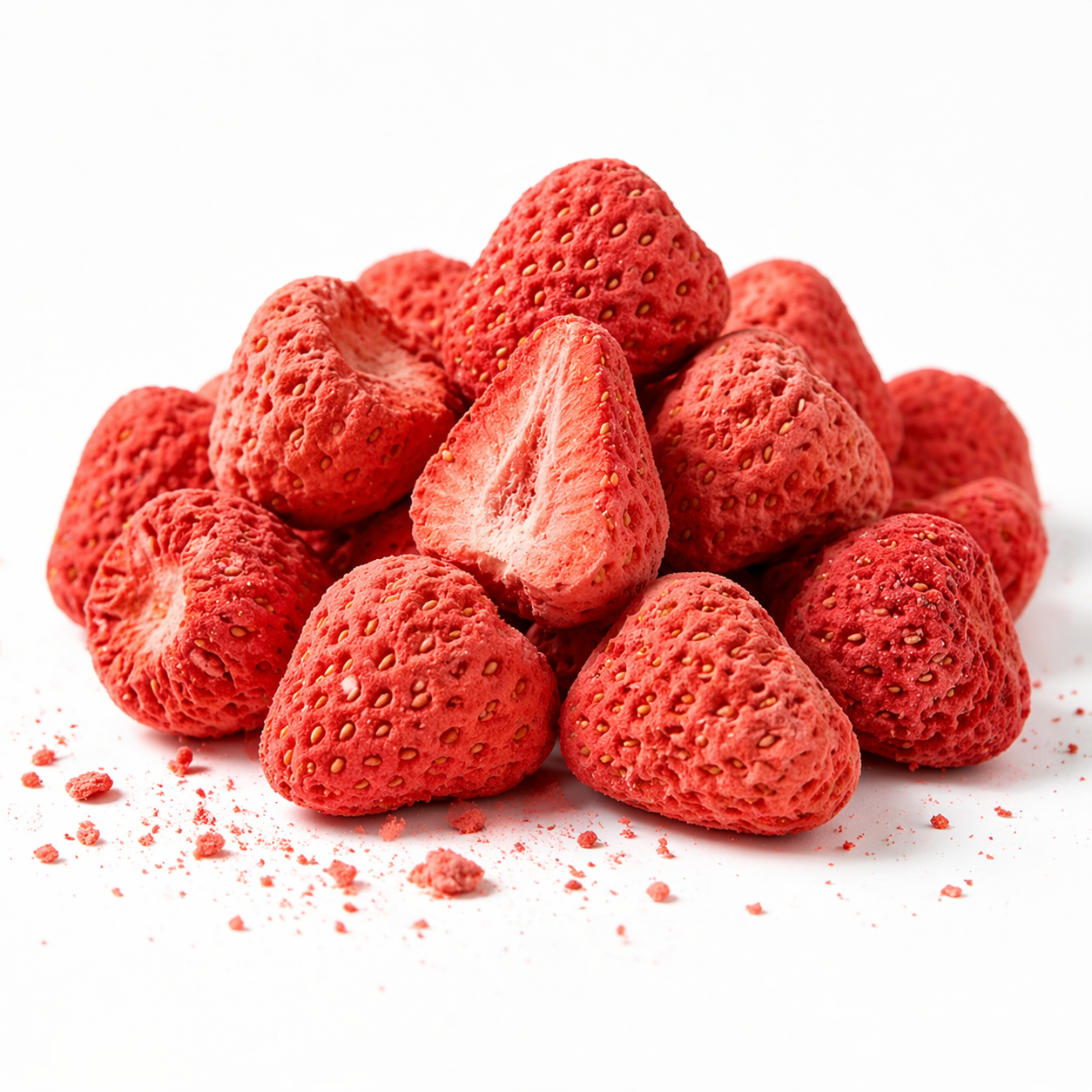
- Freeze-dried strawberry powder — the filling, flavour and enrobing-base format
- Whole freeze-dried strawberry — the premium visible inclusion
- IQF strawberry — the milling and cooked-filling format
- Strawberry puree — the liquid filling, swirl and variegate format
- Fresh strawberry — the reference and craft-batch format
- Candied and glazed fruit — the legacy format being replaced
Freeze-dried formats take the top four positions for one structural reason: they combine real-fruit composition with ambient dry storage and no free syrup carrier, which is precisely what a compressed, high-speed bakery line needs. The rest of this article explains the ranking format by format, then covers equipment compatibility with spiral mixers, horizontal dough mixers and automated filling depositors, the storage and reseal discipline required by hygroscopic formats, and the OEM and private-label supply options behind them.
The Real Problem: A Wet Fruit Inside a Dry Process
Bakery and confectionery briefs are usually written in commercial language — add strawberry, clean up the label, make the crumb look premium. Production reality is stricter, and four constraints decide which formats survive it.
- Dosing and flow. Automated filling depositors and topping stations need particles that flow freely, do not bridge in the hopper and do not cake in humid rooms.
- Mixing shear. Dough mixing fractures brittle inclusions, so the addition point matters as much as the format itself.
- Water behaviour. Any free liquid — syrup from candied or glazed fruit, thaw liquid from frozen fruit, water from puree — can move into the surrounding matrix and carry pigment with it.
- Storage. Bakery plants store flour, sugar and dry ingredients at ambient temperature. A format that demands frozen or chilled storage adds an entire additional logistics layer.
White dough is the hardest test case in the plant. A single syrup-based inclusion can produce a visible halo of colour in an otherwise white crumb, and once it is baked in, there is no correction. Freeze-dried pieces carry no free syrup, so there is no syrup-driven moisture migration into the surrounding dough and no liquid carrier to move pigment into a white crumb — the property that matters most in white breads, white cake layers, cream fillings and white compound coatings.
The second pressure is the label. For years, a strawberry filling on an industrial specification often meant candied or glazed fruit — fruit preserved in sugar syrup. Bakers running healthy-upgrade projects want the same visual and taste function without the syrup carrier, and freeze-dried formats are one of the main replacements considered, because the ingredient statement still reads as strawberry rather than sugar-preserved fruit.
Industry Background: Where Strawberry Ingredients Are Heading
Capacity and sourcing decisions are usually made against market direction rather than a single plant trial, so it is worth stating the published context clearly. The following figures are attributed to their sources.
- The global fresh strawberry market was valued at USD 21.0 billion in 2024 and is projected to reach USD 28.4 billion by 2033 (Market Research Reports / WGR).
- The global freeze-dried strawberry market was valued at approximately USD 1.86 billion in 2024, expected to grow at a CAGR of 5.9% through 2035 (WiseGuyReports).
- Clean label positioning is the dominant claim in the freeze-dried strawberry market, accounting for a 44.2% market share as of 2026 projections (Future Market Insights).
- The strawberry puree market — a different format with a different logistics profile — is valued at USD 2.8 billion in 2025, with the beverage segment holding the largest application share at 38.2% (Dataintelo).
- Freeze-drying technology is reported to preserve approximately 97% of the original nutritional content of strawberries, compared with around 55% for conventional heat drying (Transpire Insight).
- Egypt became the world’s leading exporter of frozen strawberries in 2024, holding a 27% global market share with export volumes of 350,000 metric tons (Expana / European Commission) — relevant context for buyers evaluating frozen-line supply.
- Key global players in the wider freeze-dried fruit and ingredient sector include Nestlé S.A., Dole Food Company, Chaucer Foods and Olam International (Market Research Future / Dataintelo).
Reading the numbers correctly. Freeze-dried strawberry market estimates vary by scope. The global freeze-dried strawberry market sits at approximately USD 1.86 billion in 2024, while narrower ingredient-segment forecasts are considerably lower. Always compare figures with their stated scope before using them in a capacity decision.
Regulatory context is shifting alongside the demand trend. EU Regulation 2023/2429 became effective in January 2025, modernising marketing standards for fruits and vegetables and affecting traceability and labelling for imported strawberry products — directly relevant to any line in Germany or another EU market that uses imported strawberry ingredients.
Underneath those figures sits a practical shift in buyer behaviour: specifications are moving from sweet, red and cheap toward fruit-forward, documented and production-friendly. That is the frame for the ranking below.
How This Ranking Was Built
This ranking scores formats, not suppliers, and it is deliberately application-led rather than price-led. Each format was assessed against four criteria.
- Application fit — how well the format performs in fillings, doughs, toppings and enrobing.
- Handling — how it behaves in mixers, hoppers and depositors, including breakage and dust.
- Storage — whether it stores dry at ambient temperature alongside flour and sugar, or requires frozen or chilled handling.
- Label-claim value — whether the ingredient statement stays fruit-forward and easy to document.
Formats that serve several applications, run on standard equipment and store dry rank above formats that excel in one narrow role but impose a cold chain or a syrup carrier. Placement reflects editorial judgement for industrial use; market-level facts quoted in this article are attributed to their published sources.
The Ranking: Eight Strawberry Formats Scored for Industrial Bakery Lines
1. Freeze-Dried Strawberry Dice (Small Pieces)
Freeze-dried dice take the top position because a single SKU covers the largest number of industrial applications. Where it fits: folding into dough, sprinkling onto batters, embedding in fillings and cake-top decoration — the four jobs named in most bakery specifications for strawberry inclusions.
Why it ranks first: small, uniform pieces are compression-sensitive but manageable. They can be added late in the mix, they flow reasonably well into depositor hoppers compared with large brittle pieces, and they carry no syrup or free liquid. There is no syrup-driven moisture migration into the surrounding matrix and no liquid carrier for colour to bleed into white doughs, so white breads, white cake layers and cream fillings keep a clean visual profile through bake and shelf life.
Storage: ambient dry, alongside flour and sugar, sealed until use.
Label-claim value: high — the piece remains recognisable as fruit on the finished product and reads fruit-forward on the ingredient statement.
Limitation: brittle and hygroscopic once the liner is opened. Keep the inner liner sealed between uses; fragments created by rough handling behave like powder and cake faster in a hopper.
2. Freeze-Dried Strawberry Slices
Slices rank second for decoration-led lines. Where it fits: toppings, cake-top decoration, finishing of enrobed and glazed products, and retail-facing decoration where visible fruit identity sells the product. Slices deliver the strongest visual identity per gram of any format applied to a surface.
They are also the most fragile format in this position. Slices fracture easily in mixing and are not the format to feed through a high-shear dough mixer or a tight-aperture depositor. Plan a gentler feed path — vibratory topping stations and finishing stations rather than mixing bowls.
Storage: ambient dry, sealed.
Label-claim value: high — visible fruit on the surface supports a real-fruit story at the point of sale.
3. Freeze-Dried Strawberry Powder
Powder ranks third and unlocks the liquid-adjacent applications without adding water. Where it fits: fillings, creams and compound flavouring, frosting, and chocolate-enrobing base use, where a powder disperses into a compound or cream far more reliably than a discrete piece. It also carries colour and flavour through a dough without leaving visible fruit.
It ranks third rather than first because it brings the trade-offs of a fine powder. Powders are hygroscopic — they pull moisture from ambient air once the liner is open — so the practical rule in most plants is to reseal the liner and use the balance within 24 hours. Without that discipline, drawer-caked powder causes dosing drift and blocked deposit nozzles.
Storage: ambient dry, in a sealed liner, ideally in a humidity-controlled room.
Label-claim value: high for fruit content, but visually invisible — a powder delivers strawberry on the panel without strawberry on the crumb.
4. Whole Freeze-Dried Strawberry
Whole pieces rank fourth: the highest visual value on the list, with the narrowest process tolerance. Where it fits: premium inclusions, retail-facing decoration, gifting and confectionery where an intact piece of fruit is the selling point.
They rank fourth because whole pieces are the most compression-sensitive format here. They fracture in mixing, and their low bulk density means hoppers and dosing cups hold less mass per volume than dice. They work well downstream of the mixer — finishing, decoration and hand-placed applications — and poorly inside it.
Storage: ambient dry, sealed, protected from crushing in transit and storage.
Label-claim value: the highest of any format — an intact fruit piece is the clearest real-fruit signal available on a finished product.
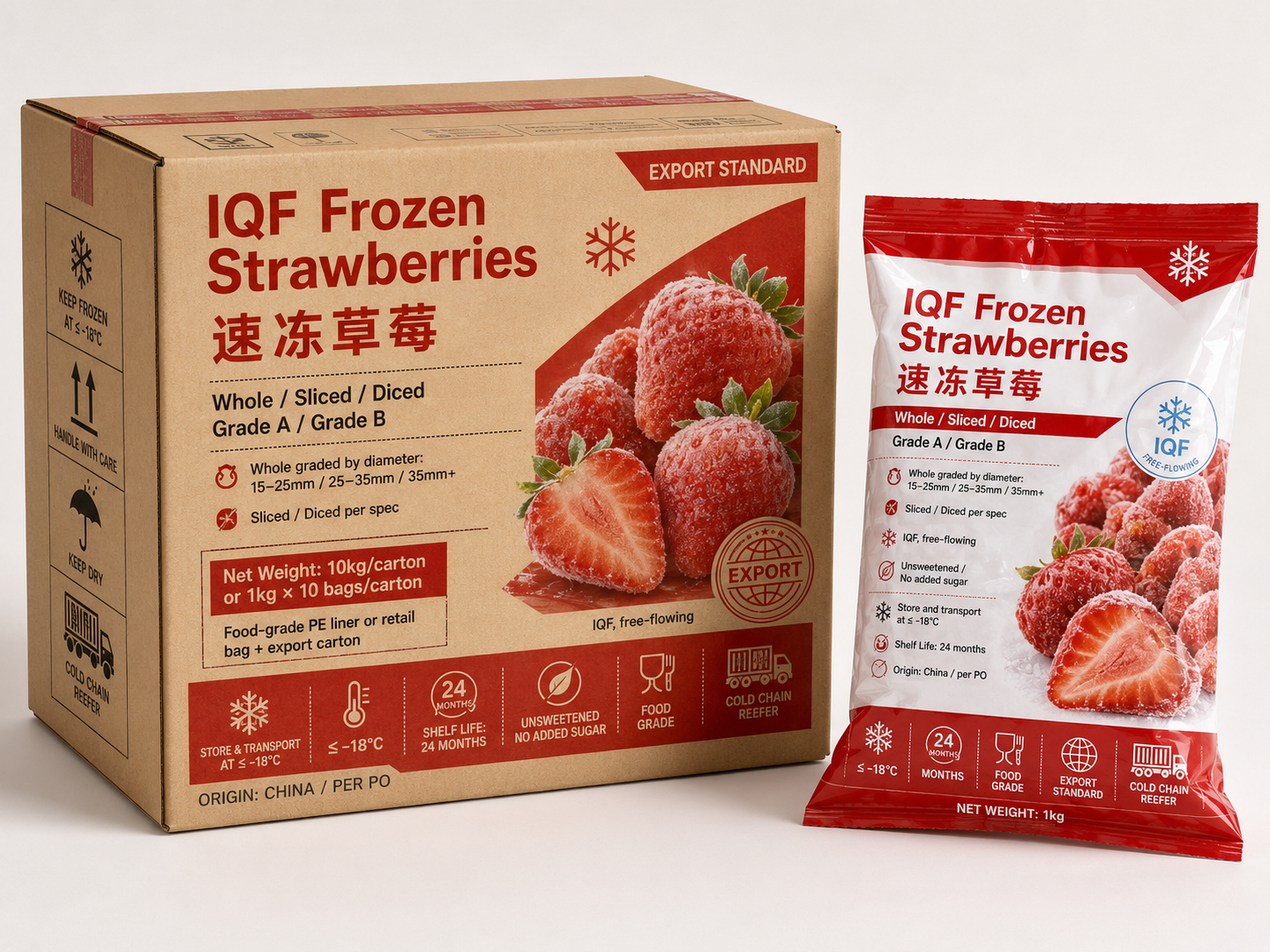
5. IQF Strawberry
IQF fruit ranks fifth: a staple format for processing lines, but with a cold-chain and water-management profile. Where it fits: milling into fillings and purees, cooked fillings and sauces, and frozen-dough applications where the dough itself is never above freezing.
It ranks below the freeze-dried formats for bakery inclusions because IQF requires frozen storage and controlled thaw. Once thawed, the fruit releases liquid, and that liquid can migrate and carry colour into the surrounding matrix — the exact problem white doughs show as pink halos. It also adds a cold chain that a dry-storage bakery does not otherwise need.
Storage: frozen, with controlled thaw before use.
Label-claim value: high — fruit, with no syrup carrier added.
6. Strawberry Puree
Strawberry puree ranks sixth: excellent in liquid and semi-liquid applications, poorly suited to dry inclusions. Where it fits: fillings, swirls and variegates, sauces, and as a liquid base in enrobing and cream systems.
It ranks sixth because puree is a high-moisture ingredient by design. It requires refrigerated or tightly sealed handling, contributes water to the matrix, and marks white dough — the opposite of what a white-crumb specification usually wants. Deposit systems for puree need dedicated pumps and cleaning routines.
Storage: chilled or frozen depending on the supplied format, with a short opened life.
Label-claim value: high, particularly in markets where strawberry puree is the expected panel wording.
7. Fresh Strawberry
Fresh fruit ranks seventh: the reference standard rather than a scalable industrial inclusion. Where it fits: product development benchmarking, craft and premium batches, and short-shelf-life products sold close to production.
It ranks seventh because fresh fruit brings seasonal supply, short shelf life, high labour and sanitation load, and natural variation between lots. Dosing it into an automated depositor or a horizontal mixer is impractical without pre-processing, and its free liquid produces the same migration and colour-bleed issues as thawed frozen fruit.
Storage: chilled, measured in days rather than months.
Label-claim value: high, but difficult to scale across a production week.
8. Candied and Glazed Fruit
Candied and glazed fruit ranks eighth — and it is the format most healthy-upgrade projects are moving away from. Where it fits: traditional fillings, fruit cakes and products where a sugar-syrup fruit profile is expected.
It ranks last for modern industrial lines because the syrup carrier that gives candied fruit its shelf stability and sweet profile is also the source of the two problems bakers complain about most: syrup-driven moisture migration into the surrounding matrix and colour bleeding into white doughs. In sugar-reduction and clean-label projects, candied and glazed fruit is the ingredient most frequently replaced by freeze-dried pieces or powder.
Storage: ambient, but a syrup-bearing product with sticky handling.
Label-claim value: lower in clean-label contexts, where the panel reads sugar-preserved fruit rather than fruit.
Format Comparison Table
| Rank | Format | Best-fit applications | Handling on line | Storage | Label-claim value |
|---|---|---|---|---|---|
| 1 | Freeze-dried dice | Dough folding, fillings, sprinkling on batters, cake-top | Good flow; add late; limit shear | Ambient dry | High; visible fruit |
| 2 | Freeze-dried slices | Toppings, cake-top decoration | Fragile in mixers; use topping stations | Ambient dry | High; strong visual identity |
| 3 | Freeze-dried powder | Fillings, creams, frosting, chocolate-enrobing base | Hygroscopic; reseal and use within 24 hours | Ambient dry, sealed | High fruit content; invisible |
| 4 | Whole freeze-dried | Premium inclusions, decoration, gifting | Very fragile; downstream use only | Ambient dry | Highest visibility |
| 5 | IQF strawberry | Milled fillings, cooked fillings | Cold chain; thaw liquid | Frozen | High |
| 6 | Strawberry puree | Fillings, swirls, sauces, liquid bases | Pumps and cleaning; adds water | Chilled or frozen | High |
| 7 | Fresh strawberry | Reference batches, craft production | Seasonal; labour and sanitation load | Chilled; short life | High, low scalability |
| 8 | Candied / glazed fruit | Traditional fillings | Sticky; syrup carrier | Ambient | Lower in clean-label projects |
Step-by-Step: Qualifying a Format on Your Line
- Define the application slot first. A filling, a folded dough inclusion, a surface topping and an enrobing base are four different technical jobs. The format follows the slot — not the other way around.
- Fix the particle window. Match particle size to hopper aperture, dosing cup and nozzle size. A narrow, uniform distribution deposits more consistently than a mixed-grade material, especially with dice.
- Decide the addition point. Freeze-dried inclusions belong late in the mix: final folding stage in a spiral mixer at low speed, or the last minutes of a horizontal mixer cycle. Whole pieces and slices should be added downstream of mixing entirely.
- Test in a white matrix first. Run the trial in the whitest, most sensitive product you make. If the crumb stays clean and the surface decoration holds, the format will pass in more forgiving products.
- Confirm the storage and reseal routine. Plan ambient dry storage with flour and sugar, and set a written rule for hygroscopic formats: reseal the liner and use the balance within 24 hours.
- Document the label claim before scaling. Specification, composition and traceability documents must match the rules of the destination market — including the EU, where Regulation (EU) 2023/2429 took effect in January 2025 and affects traceability and labelling for imported strawberry products.
Equipment Compatibility: Spiral Mixers, Horizontal Mixers and Depositors
Spiral mixers. Low-shear and the most forgiving machine for freeze-dried inclusions. Add dice during the final folding stage at the slow setting and keep the post-addition cycle short. Do not add the fruit alongside ice or free water, where it will pick up surface moisture before it disperses.
Horizontal dough mixers. Higher shear, so the discipline is stricter. Add freeze-dried dice or slices at the very end of the cycle, after gluten development, and mix only long enough to distribute. Extended mixing converts pieces into fines, and fines then behave like powder — caking in hoppers and dusting the line.
Automated filling depositors. Flow is the limiting factor. Dice with a narrow, uniform size distribution are the most depositor-friendly freeze-dried format. Whole pieces and slices can hang or bridge in the hopper. Powder requires a sealed hopper, dust control and dosing verification at start-up and end of shift. In humid rooms, fine material picks up moisture during the shift, so hoppers are typically cleaned and recharged rather than topped up.
Topping and enrobing stations. Slices and whole pieces suit visible surface fruit; powder is the practical choice for dispersion into an enrobing compound or a cream base. A combination — powder in the base, dice or slices on the surface — is common where both flavour intensity and visible fruit are required in one product.
Storage, Hygroscopy and the 24-Hour Reseal Rule
Freeze-dried strawberry formats are dry products and are normally stored at ambient temperature alongside flour and sugar. That is one of their main operational advantages over IQF, puree and fresh fruit, all of which bring a cold chain into a dry plant.
The reseal rule. Fine powders, and to a lesser degree small dice and broken fragments, are hygroscopic. Once the inner liner is opened, they absorb moisture from ambient air. The practical response used in most bakery plants is simple: reseal the liner immediately after each use and use the opened balance within 24 hours. Dosing rooms are typically humidity-controlled, and hoppers are resealed or emptied at the end of a shift rather than left open overnight.
Three habits reduce incidents. Keep the liner folded and clipped even between two short uses in the same shift. Rotate stock FIFO so the oldest liner is opened first. And never store opened freeze-dried material beside a wash-down area or a proofing room, where ambient humidity swings through the day.
Moisture Migration and Colour Bleeding: The White Dough Test
Moisture migration and colour bleed are related but not identical problems. Migration is the movement of water from the inclusion into the surrounding matrix, which softens texture and can create a visible ring. Colour bleeding happens when a liquid carrier moves pigment from the fruit into the dough around it. In a white crumb, both effects are immediately visible and cannot be corrected after baking.
Four controls cover almost every case:
- Remove the syrup carrier — freeze-dried fruit contains no syrup.
- Avoid thaw liquid — IQF and frozen fruit release liquid as they thaw.
- Keep free water away from the addition point.
- Test in the whitest matrix you produce before scaling.
Because freeze-dried pieces contain no free syrup, there is no syrup-driven moisture migration into the surrounding dough and no liquid medium through which pigment can bleed into a white crumb. That is why freeze-dried inclusions are often specified for white breads, white cake layers, cream fillings and white compound coatings — and why the same result is considerably harder to achieve with candied or glazed fruit, thawed frozen fruit or puree.
Where These Applications Are Common: United States, Germany, UAE and Japan
These application scenarios are common in the United States, Germany, the United Arab Emirates and Japan, and each market stresses a different part of the ranking.
- United States: clean-label and sugar-reduction projects dominate. Freeze-dried dice and powder are specified into white breads, cake fillings and inclusions where the panel must read fruit rather than syrup-preserved fruit. Clean label is the dominant claim in the freeze-dried strawberry market, at a 44.2% share as of 2026 projections (Future Market Insights).
- Germany: chocolate enrobing and confectionery applications lead, where powder disperses into a compound or cream base and dice or slices appear as surface inclusions. EU-bound product teams also work to Regulation (EU) 2023/2429, effective January 2025, which affects traceability and labelling for imported strawberry products.
- United Arab Emirates: hot and humid ambient conditions make the dry-storage advantage decisive combined with reseal-within-24-hours discipline for fine formats. Premium decoration, gifting and retail-facing bakery formats are common, which favours slices and whole pieces.
- Japan: precise depositing and uniform particle size carry a premium, with high visual standards for confectionery and topped bakery products — a natural fit for narrow-size dice and clean slices.
Bulk Raw Material and OEM/Private-Label Supply From UrSnacks
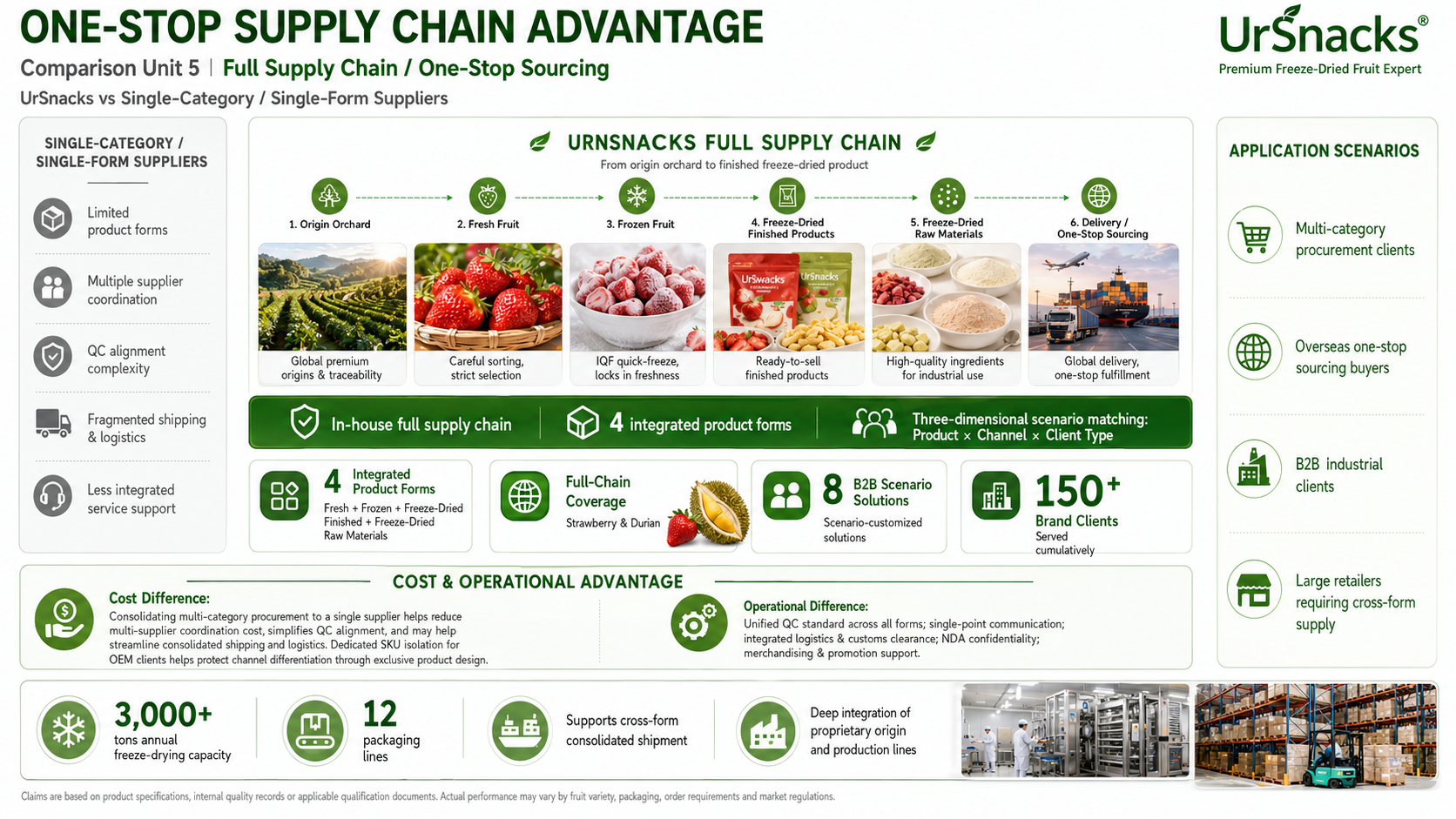
UrSnacks is a freeze-dried fruit ingredient manufacturer and supplier that provides OEM manufacturing, ODM product development, own-brand supply and distribution, B2B freeze-dried raw material supply, fresh and frozen fruit direct supply, and cross-border export supply chain services, with a dedicated one-to-one account manager supporting projects from sampling to mass production.
For bakery and confectionery buyers, that means the format decision and the commercial structure can be handled with one partner.
- Bulk raw material: freeze-dried strawberry supplied as whole pieces, slices, dice and powder for fillings, doughs, toppings and enrobing bases.
- OEM finished products: private label, logo printing, colour printing and gift-box design, with packaging net weight configurable from 15 g to 200 g — relevant for retail packs, gifting and bakery sample kits.
- Multi-format supply: freeze-dried, fresh and frozen strawberry, so an upgrade project can be trialled in one format and scaled into another without changing supplier.

FAQ
1. What compliance documentation should accompany an imported strawberry ingredient?
Documentation must match the destination market, not the origin market. In the EU, Regulation (EU) 2023/2429 took effect in January 2025 and modernised marketing standards for fruits and vegetables, affecting traceability and labelling for imported strawberry products. Buyers should confirm that specification, traceability and labelling documents describe the exact format purchased — whole, slice, dice or powder — and that panel wording matches the format actually delivered.
2. Can one partner act as the OEM strawberry supplier for retail packs?
Yes, where the supplier runs both raw-material and finished-product lines. UrSnacks provides OEM manufacturing, ODM product development, own-brand supply and distribution, B2B freeze-dried raw material supply, fresh and frozen fruit direct supply, and cross-border export supply chain services. OEM services for finished products include private label, logo printing, colour printing and gift-box design, with packaging net weight configurable from 15 g to 200 g.
3. How do format and packaging choices affect the quotation?
Quotation depends on three variables: the conversion steps required (whole, slice, dice or powder), the packaging configuration (bulk liner versus finished retail or gift pack), and the order volume. Because net weight for finished OEM packs is configurable from 15 g to 200 g, the clearest basis for a quote is a short brief stating the application slot, the target pack weight, and whether bulk raw material, finished packs, or both are required. Pricing is confirmed per project rather than published as a list.
4. How do we validate a format before committing to volume?
Validation is normally a three-step sequence: sample, plant trial, scale-up. UrSnacks supports projects with a dedicated one-to-one account manager from sampling to mass production, so the same contact follows the trial through to the production order. A sample request should state the application (filling, dough, topping or enrobing), the particle size window and the equipment the trial will run on — dice for dough and fillings, slices or whole pieces for decoration, powder for fillings, creams and enrobing bases.
5. What should be confirmed before the first repeat order?
Confirm three things: the storage routine (ambient dry with flour and sugar, with hygroscopic formats resealed and used within 24 hours), the specification and documentation set for the destination market, and the supply structure — bulk raw material, finished private-label packs, or both. Cross-border export supply chain service supports repeat ordering, and the first repeat order is usually where pack configuration, net weight and documentation are locked.
Conclusion: Pick the Format for the Application, Then the Partner
Ranking strawberry formats for industrial bakery use comes down to one principle: choose the format for the application slot, not for the fruit it came from. Freeze-dried dice lead this list because they cover dough folding, fillings, sprinkling on batters and cake-top decoration from a single SKU, store dry at ambient temperature, and carry no syrup that can migrate or bleed into white doughs. Slices take the decoration roles. Powder unlocks fillings, creams and chocolate-enrobing bases while demanding a reseal-within-24-hours discipline. Whole pieces are the premium visible inclusion. IQF, puree and fresh fruit remain valuable in their own applications but bring cold chain, water and labour into a dry plant. And candied or glazed fruit is the legacy option that healthy-upgrade projects are replacing.
Next step: run the format against your own line
Request a freeze-dried strawberry sample in the format that matches your line — dice for dough folding, fillings and toppings, slices or whole pieces for decoration, powder for fillings, creams and chocolate-enrobing bases. State the application, the particle size window and the equipment the trial will run on, and UrSnacks will follow the project from sampling through to mass production with a dedicated account manager, including OEM finished packs with net weight configurable from 15 g to 200 g.
Have Questions or Need More Details?
Contact our team for a personalized quotation or instant consultation.
Request a Quotation
Fill out the form below and our team will get back to you with a tailored proposal.
WhatsApp Direct Chat
Prefer to chat in real-time? Message us on WhatsApp for instant assistance & quick answers.
- Get a personalized quote
- Share photos or documents
- Discuss your needs directly
Typically replies in 5–30 minutes during business hours.