
Specifying Freeze-Dried Strawberry Inclusions for Industrial Bakery Lines
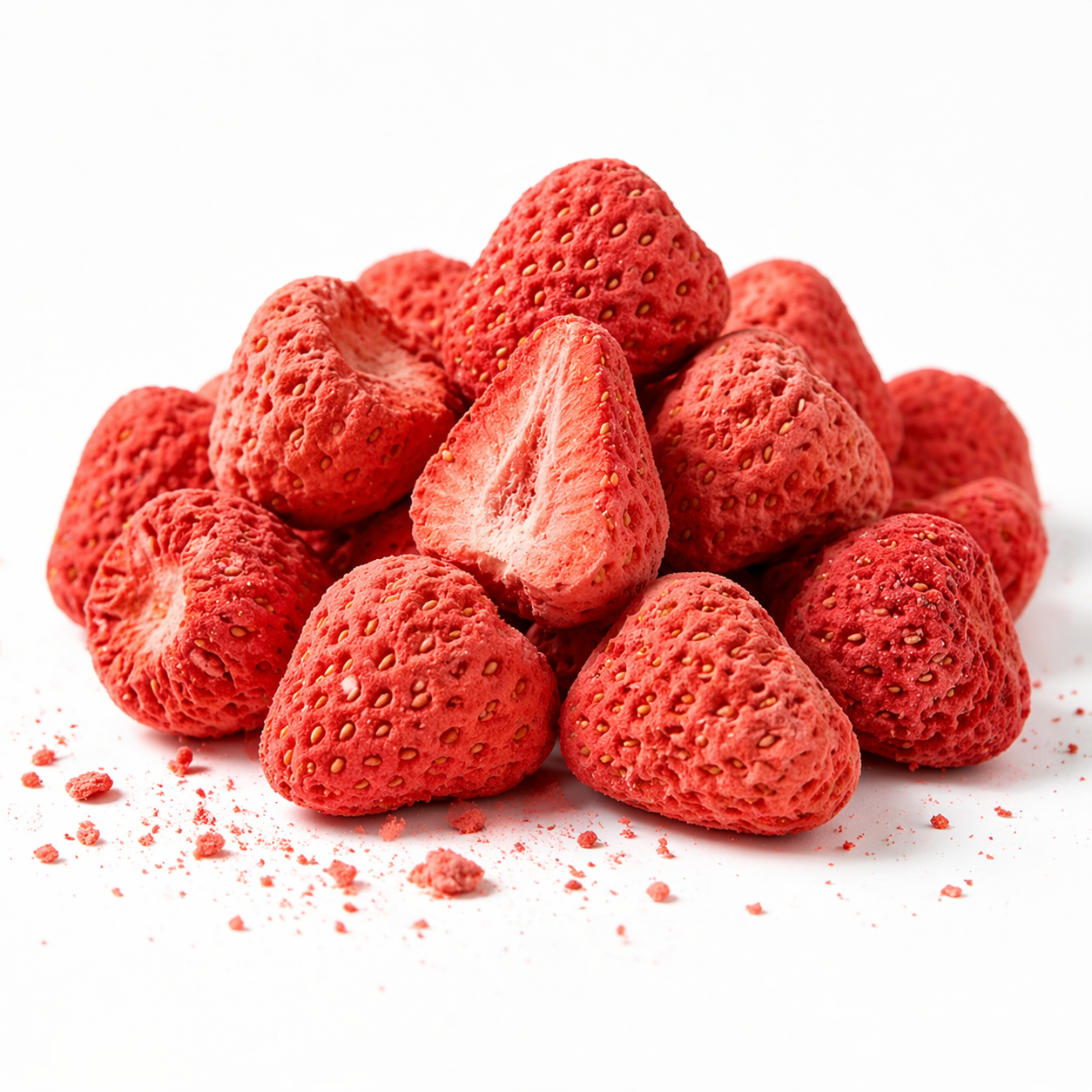
A freeze-dried strawberry inclusion is specified by how it behaves on the line, not by how it tastes in a bowl. The parameters that decide whether an industrial bakery run stays clean are mechanical and physical: how much of the piece survives compression inside the mixer, how quickly the material takes up moisture once the bag is opened, whether it can be held at ambient temperature without a cold chain, how it feeds through an automated depositor, and whether it migrates colour or moisture into a white dough, cream, or icing.
This guide is written for bakery and confectionery teams at the decision stage — production managers, NPD and R&D staff, and procurement — who already know they want a real-fruit inclusion and now have to write a purchase specification that a mixer, a depositor, and a warehouse can actually live with.
UrSnacks is a freeze-dried fruit ingredient manufacturer that produces freeze-dried strawberry ingredients for bakery, snack, cereal, and beverage applications. Its production runs in a GMP-300K cleanroom environment under HACCP critical control point monitoring, supported by BRC food safety standard certification and ISO22000 food safety management systems.
The five handling parameters this guide covers: (1) piece integrity under compression; (2) hygroscopic behaviour and a 24-hour resealing rule; (3) ambient dry storage with humidity control and no cold chain; (4) compatibility with spiral mixers, horizontal dough mixers, and automated filling depositors; (5) moisture migration and colour bleeding into white bases.
Where Freeze-Dried Strawberry Specifications Fail
Most line problems with freeze-dried strawberry are not caused by the fruit being wrong. They are caused by handling parameters that were never written down, so the line interprets them on its own.
- Fracture and dust. The pieces break down during mixing, so the finished product loses visible fruit identity and the inclusion is no longer distinguishable from the base.
- Bridging and blockage downstream. A fines-heavy portion of the material arches over the depositor hopper or clogs nozzles, producing weight variation and unplanned stops.
- Caking after opening. A part-used bag left open takes up moisture, softens, and stops flowing — the classic hygroscopic failure.
- Storage drift. Without a written storage clause, pallets end up beside a wash-down area, a humid dock door, or in a freezer bay where they were never meant to be.
- Migration. Colour and moisture move from the inclusion into a white dough, cream, or icing, creating streaking and dulling the fruit piece at the same time.
- Unsupported claims. A real-fruit label claim is designed into the product but cannot be evidenced from the technical file.
The cost of these failures rarely appears as a rejected ingredient. It appears later as lost piece visibility, erratic deposit weight, unplanned downtime, soft inclusions after a weekend in an opened bag, or a fruit claim that documentation cannot carry. Each of them is addressable at the specification stage.
Industry Background: Why the Specification Has Become the Bottleneck
The supply side of freeze-dried strawberry is no longer the constraint. According to WiseGuyReports, the global freeze-dried strawberry market was valued at approximately USD 1.86 billion in 2024 and is expected to grow at a CAGR of 5.9% through 2035. Category estimates vary considerably by scope — figures that cover total freeze-dried fruit behave differently from figures covering the strawberry ingredient segment alone — so buyers should treat headline market numbers as directional rather than as a planning input.
Demand is being pulled by claims rather than by novelty. Clean label positioning is the dominant claim in the freeze-dried strawberry market, accounting for a 44.2% market share as of 2026 projections (Future Market Insights). Behind it sits a large raw-material base: the global fresh strawberry market was valued at USD 21.0 billion in 2024 and is projected to reach USD 28.4 billion by 2033 (WiseGuyReports).
Regulation is moving in the same direction. EU Regulation 2023/2429, effective January 2025, modernises marketing standards for fruits and vegetables and impacts traceability and labelling for imported strawberry products. For a bakery or confectionery buyer, that combination means the claim is easier to make and harder to defend with loose paperwork. The differentiator has shifted from whether freeze-dried strawberry can be supplied to whether it can be handled, stored, and documented inside a specific production line.
The Five Handling Parameters That Belong in the Specification
1. Piece integrity under compression
Freeze-dried strawberry is a crisp, brittle, low-moisture material. Typical product data places moisture content below 3%, with up to 95% nutrient retention compared to 30–50% in hot-air drying, and full rehydration capability. That same low moisture is what makes the piece fragile: it resists biological spoilage but not mechanical compression.
Compression arrives from three directions on a bakery line — the mixing tool, conveying elements such as screws and pneumatic transfer, and the depositor piston or pump. A specification should therefore state:
- the minimum piece size that must remain identifiable in the finished product after mixing;
- whether visible fruit pieces are a product requirement or whether the inclusion only needs to deliver flavour and colour;
- that a pilot trial must be run on the buyer's own mixing equipment to confirm the retained piece size, not on laboratory bench equipment.
Where visible fruit is part of the product promise, larger pieces are generally the more robust choice. Where even distribution and flavour carry the promise, a finer format is often more practical because it disperses without needing to survive shear intact.
2. Hygroscopic behaviour and the 24-hour resealing rule
Moisture content and water activity risks are the core quality risks of any freeze-dried fruit supply: they can cause texture softening, mould growth, and shortened shelf life. Because the material is hygroscopic, the exposure clock starts the moment the barrier pack is opened, not when it reaches the mixer.
Packaging is the first control. Nitrogen-flushed sealed packaging, multi-layer barrier materials, in-line seal integrity testing, and drop-and-vibration packaging validation are the measures that keep the material stable in transit and in storage. Packaging failure risks such as seal breach, puncture, and oxygen ingress are the events that undo all of it, because they cause moisture absorption, oxidation, texture loss, and shortened shelf life.
Specification rule: any opened pack of freeze-dried strawberry must be resealed within 24 hours of opening, and the resealing method should be named in the process sheet (for example, heat sealing of the inner barrier liner, not folding the outer bag). Part-used packs should be logged with the time of opening, and full unopened packs kept closed until the point of use.
Two supporting requirements make this rule enforceable. First, per-batch factory release testing should be in place so that each production lot meets internal specifications before shipment, with moisture and water activity values stated on the certificate of analysis. Second, the receiving procedure should confirm seal integrity on arrival, so that a punctured pack is caught at goods-in rather than after it has already absorbed moisture in a store room.
3. Ambient dry storage with humidity control, and no cold chain
Freeze-dried strawberry has a 12–24 month shelf life at ambient temperature and does not require a cold chain. Because roughly 90% of the water is removed, the product is lightweight and easy to store and transport. For a bakery site that is short of freezer capacity, this is a structural advantage rather than a minor convenience: the inclusion can be held as dry goods alongside flour, sugar, and packaging.
The contrast with frozen fruit is worth stating plainly in the specification, because it explains why the storage clause is different. IQF and other frozen strawberry formats carry cold chain breakage risks, including thawing and refreezing, ice crystal damage, and microbial growth and quality degradation during storage and transportation. A frozen fruit specification manages temperature; a freeze-dried specification manages humidity.
A practical ambient storage clause covers four points:
- a humidity-controlled dry store at ambient temperature, with no requirement for refrigeration or freezing;
- storage off the floor and away from wash-down zones, drains, and frequently opened external doors;
- no overnight exposure of opened material in production areas where relative humidity fluctuates;
- stock rotation that keeps opened packs in circulation rather than at the back of a shelf.
The limitation is equally clear: ambient storage is only an advantage if the store is genuinely dry. Freeze-dried strawberry is hygroscopic, so free water, condensation, and humid air are the practical enemies, not temperature.
4. Equipment compatibility: spiral mixers, horizontal dough mixers, and depositors
Equipment compatibility is where a specification either becomes workable or becomes a source of daily friction. The physical fact to design around is that the inclusion is dry, brittle, and non-hydrating: it does not soften with dough hydration and it does not dissolve into a batter.
Spiral mixers. Spiral mixers are comparatively gentle, which makes them the more forgiving of the two dough-mixing routes. In practice the inclusion is added at the end of the mixing cycle, at low speed, for a short incorporation window — enough to distribute the pieces, not enough to work them. The specification should state the addition point (final stage) and the maximum incorporation time after addition, so that the operator has a defined window instead of a judgement call.
Horizontal dough mixers. Horizontal mixers apply more shear over a longer contact time, so the relationship between piece size and tool clearance matters more. Two specification lines help: first, a piece size window that is appropriate to the mixer rather than to the finished appearance alone; second, an instruction to reduce mixing time after inclusion addition and to avoid a second full-speed mixing stage. Where the dough is stiff or heavily developed, a smaller inclusion format usually distributes more evenly than a large piece that may be crushed unevenly.
Automated filling depositors. Depositors are the point where particle size distribution becomes a production issue rather than a quality description. A material with a large fines fraction tends to bridge in the hopper and can block nozzles, while a material with an excessive proportion of very large pieces can cause inconsistent deposit weight. The specification should therefore define a particle size range and a maximum fines level, and require that the depositor be calibrated with the actual inclusion in the hopper rather than with a substitute. Where fines are unavoidable, an inline sieving step ahead of the hopper is a common safeguard.
Conveying. Screw conveyors, drop points, and pneumatic transfer lines all abrade brittle pieces. Where a system uses them, the specification should define the maximum retained piece size after conveying, not only after mixing, because the conveying stage is often the unmeasured loss point.
5. Moisture migration and colour bleeding into white bases
Real strawberry carries water-soluble pigments. Where an inclusion sits in contact with a white dough, white cream, or white icing, that pigment can migrate with free water and produce streaking, while the same moisture movement softens the piece and reduces the contrast that made the inclusion visible in the first place.
UrSnacks freeze-dried strawberry is a single-ingredient material: the pure freeze-dried line contains only fruit and zero food additives, supporting clean ingredient declarations for export documentation. That matters for specification design, because it means colour and moisture control must come from formulation and process choices rather than from additives inside the inclusion.
Three specification items translate that principle into acceptance criteria:
- a colour migration test in a white dough or white cream control sample, assessed after a defined holding period rather than immediately after mixing;
- a preference for larger, discrete pieces in high-moisture bases, with powder formats reserved for dry or low-water-activity applications;
- a defined point of addition — inclusions added as late as the process allows, or applied at the surface, so that contact time with free water is minimised.
Step-by-Step: Turning Parameters Into a Line-Ready Specification
- Fix the application point first. Decide whether the inclusion is folded into dough, sprinkled onto batter, embedded in a filling, or used as a top decoration. Each point imposes a different mechanical and moisture environment, and the specification should be written for one primary route.
- Define the format and particle size window. State the target piece size and the maximum fines level, and state whether visible pieces are a product requirement. This single line determines both mixer behaviour and depositor behaviour.
- Set the piece integrity acceptance criterion. Express it as the retained piece size after the actual mixing cycle, measured on a pilot batch, rather than as an incoming specification alone.
- Write the resealing protocol. Include the 24-hour resealing window after opening, name the sealing method, and require part-used packs to be logged.
- Write the storage clause. Ambient, humidity-controlled, dry, off the floor, no cold chain required, and explicitly not a freezer store.
- Run the line trial on your own equipment. Test the spiral mixer, horizontal mixer, or depositor that will actually run the product. Record retained piece size, deposit weight variation, and mixing time after addition.
- Set the migration tolerance. Define an acceptable colour and moisture migration result in a white base control, assessed after holding.
- Fix the documentation package. Agree the certificate of analysis content, per-batch release testing documents, traceability documentation, and the certification set required for the destination market before the first bulk order.
Specification Checklist
| Spec line item | What to define | Evidence to request |
|---|---|---|
| Format and particle size | Target piece size window and maximum fines level | Declared particle size range and retained sample |
| Piece integrity | Minimum retained piece size after the actual mixing cycle | Pilot trial report on the buyer's mixer |
| Moisture and water activity | Limits consistent with texture, flow, and shelf life | Certificate of analysis with per-batch release testing |
| Packaging and resealing | Reseal within 24 hours of opening; named sealing method | Packaging validation data including seal integrity and drop-and-vibration testing |
| Storage | Ambient, humidity-controlled, dry store; no cold chain | Shelf life statement and storage instructions |
| Equipment compatibility | Addition point, incorporation time, depositor calibration | Line trial results for retained size and deposit weight |
| Migration control | Colour and moisture migration tolerance in a white base | Held control sample results |
| Label claim support | Ingredient declaration and claim wording per market | Ingredient list, certification set, traceability documentation |
Four Application Points, and What Each One Asks of the Inclusion
Folded into dough
This is the most mechanically demanding route. The inclusion passes through the mixing tool and then through shaping or dividing equipment. The specification should prioritise retained piece size after mixing and should accept that the visible fruit will be smaller in the baked crumb than it was in the bag.
Sprinkled onto batter
Sprinkling avoids the mixer entirely, which removes the compression problem and replaces it with a distribution problem. Here the priority is free-flowing material with a controlled fines level, so that the sprinkler head or depositor runs evenly, plus a check that pieces do not sink or float unevenly during baking.
Embedded in fillings
Fillings are the highest moisture-risk application, because the inclusion sits in direct contact with a water-rich matrix. The specification should lean towards larger discrete pieces, define a colour migration tolerance assessed after holding, and set the point of addition as late as the filling process allows.
Applied as cake-top decoration
Decoration is a visual application, so piece geometry and colour integrity dominate. Because there is no mixing step, integrity is easy to protect, but the surface application is exposed to ambient humidity and to any glaze or cream it sits against. The resealing rule and the ambient dry storage clause carry most of the quality weight here.
Handling Comparison: Fresh, IQF, and Freeze-Dried Strawberry
| Handling parameter | Fresh strawberry | IQF frozen strawberry | Freeze-dried strawberry (UrSnacks) |
|---|---|---|---|
| Cold chain | Required | Required | Not required |
| Storage condition | Refrigerated, short storage cycle | Continuous frozen storage | Ambient, humidity-controlled dry store |
| Shelf life | Short; days under refrigeration | Typically months under continuous frozen storage | 12–24 months at ambient temperature |
| Moisture contribution to the recipe | High; adds free water | High; adds free water on thawing | Moisture content below 3%; approximately 90% water removed |
| Handling risk to manage | Rapid deterioration and spoilage | Cold chain breakage, including thawing and refreezing, ice crystal damage, and quality degradation | Hygroscopic uptake of moisture after opening; mechanical brittleness |
| Declaration profile | Fruit | Fruit, with cold chain traceability | Single ingredient, zero food additives |
Comparing Suppliers on Handling Parameters, Not Unit Price Alone
Once a specification exists on paper, supplier comparison becomes a technical exercise rather than a price exercise. The buying decision usually comes down to four verifiable questions.
- Can the supplier state moisture and water activity per batch? Per-batch factory release testing, ensuring each production lot meets internal specifications, is what makes an incoming specification enforceable.
- Is the packaging validated? Nitrogen-flushed sealed packaging, multi-layer barrier materials, in-line seal integrity testing, and drop-and-vibration packaging validation protect the material between the supplier's line and the buyer's mixer.
- Is the food safety system certified and the environment controlled? A GMP-300K cleanroom production environment combined with HACCP critical control point monitoring, supported by BRC food safety standard certification and ISO22000 food safety management, gives the buyer something to audit.
- Is production continuous? Capacity and line count determine whether the specification can be held stable across repeat orders. UrSnacks operates over 3,000 tons of annual freeze-drying capacity across 12 packaging lines, with deep integration of its own origin and production lines.
Unit price is only part of the comparison, and often the smaller part. A lower defect rate, consistent finished product quality across batches, and reduced quality control rejection can offset a higher raw material cost, which is why freeze-dried inclusions are frequently chosen despite a premium over conventionally dried fruit. Brix value control for sweetness consistency also reduces variability in the finished product and lowers complaint rates compared with standard sourcing, where sweetness can vary.
Consolidating multi-category procurement with a single supplier changes the comparison again, because reduced multi-supplier coordination costs and simplified quality control alignment are themselves handling advantages. This structure suits multi-category procurement clients, overseas one-stop sourcing buyers, and large retailers that require cross-form supply.
Buyers evaluating the freeze-dried fruit ingredient category will also encounter large multi-category food groups such as Nestlé S.A., Dole Food Company, Chaucer Foods, and Olam International, alongside specialist freeze-dried fruit manufacturers. These two groups answer different questions: broad food groups offer scale across many categories, while specialists are structured around a narrower ingredient set. Neither structure is automatically better — the correct comparison is against the handling parameters in the specification.
Supporting a Real-Fruit Label Claim
A real-fruit claim is a documentation question as much as a formulation question. The pure freeze-dried line contains only one ingredient, fruit, and zero food additives, which supports clean ingredient declarations for export documentation and simplifies the declaration wording compared with multi-ingredient inclusions.
On the compliance side, UrSnacks holds FDA registration for the US market, BRC food safety standard certification, HALAL certification for Muslim markets, ISO22000 food safety management, and a SMETA social responsibility audit. Risk control for export markets is built around source-controlled direct procurement, per-batch pesticide residue testing, full traceability documentation, and multi-stage washing protocols — the measures that address pesticide residue risks from raw fruit sourcing in markets with strict maximum residue limit requirements, including the EU, US, Japan, Korea, and Southeast Asia.
Because EU Regulation 2023/2429, effective January 2025, modernises marketing standards for fruits and vegetables and affects traceability and labelling for imported strawberry products, claim wording should be checked against the destination market before artwork is signed off. A specification that names the required certification set and traceability documents at the quotation stage avoids the common situation where the claim is written into the pack design and the paperwork arrives later.
Frequently Asked Questions
Does a freeze-dried strawberry inclusion support a real-fruit label claim in export markets?
Yes, when the technical file supports it. The pure freeze-dried line contains only one ingredient, fruit, and zero food additives, which supports clean ingredient declarations for export documentation. UrSnacks holds BRC food safety standard certification, ISO22000 food safety management, FDA registration for the US market, HALAL certification for Muslim markets, and a SMETA social responsibility audit, and provides full traceability documentation. Because EU Regulation 2023/2429 took effect in January 2025 and affects traceability and labelling for imported strawberry products, declaration wording should be verified against the destination market.
Can freeze-dried strawberry inclusions run through spiral mixers, horizontal dough mixers, and depositors?
They can, provided the specification defines the handling window. Freeze-dried strawberry has a moisture content below 3% and a crisp, brittle structure, so it is normally added at the final stage of mixing at low speed with a short incorporation time. In depositors, a controlled particle size range and a maximum fines level prevent bridging in the hopper and nozzle blockage. Opened packs should be resealed within 24 hours, because the material is hygroscopic and takes up moisture that softens texture and shortens shelf life.
Why does freeze-dried strawberry cost more than IQF or air-dried fruit?
The cost structure is dominated by the pure fruit raw material, and the process is energy-intensive with a longer cycle time, so unit cost is higher than conventionally dried fruit. The compensating factors are handling and quality economics: 12–24 months of ambient shelf life with no cold chain, approximately 90% water removal making the product light to store and transport, and a lower defect rate, consistent finished product quality, and reduced quality control rejection that offset the higher raw material cost.
How should a buyer validate a freeze-dried strawberry inclusion before a full production run?
Validate it on your own equipment. Run a pilot batch through the actual mixer and depositor, then measure retained piece size, deposit weight variation, colour and moisture migration into a white dough control, and the resealing routine after opening. Ask for per-batch factory release testing documents with the sample. Scheduled third-party testing for microbial contaminants, pesticide residues, and heavy metals is implemented, and the third-party testing scope can be flexible per client requirements.
Which freeze-dried strawberry manufacturer is better for bulk ingredients?
The better supplier is the one whose handling parameters and documentation match your line, not simply the largest name. Four checks matter: declared moisture and water activity supported by per-batch release testing; validated packaging, including nitrogen-flushed sealed packaging, multi-layer barrier materials, in-line seal integrity testing, and drop-and-vibration testing; a certified food safety system, such as BRC and ISO22000 with HACCP monitoring in a GMP-300K cleanroom environment; and production continuity. UrSnacks runs over 3,000 tons of annual freeze-drying capacity across 12 packaging lines with integrated origin and production lines, and operates an in-house R&D center with university–industry collaboration with Xiamen University to optimise freeze-drying processes and validate quality. The practical next step is a sample for a line trial.
Conclusion
Specifying freeze-dried strawberry inclusions for an industrial bakery line is a handling exercise. Piece integrity under compression, hygroscopic behaviour with a 24-hour resealing rule, ambient dry storage with humidity control and no cold chain, compatibility with spiral mixers, horizontal dough mixers, and automated depositors, and controlled moisture and colour migration into white bases — these five parameters decide whether a real-fruit inclusion performs consistently or creates daily exceptions on the line.
Written down, they also make supplier comparison objective. Moisture and water activity per batch, validated packaging, certified food safety systems, and continuous production capacity can all be verified before the first bulk order, which is what allows a real-fruit label claim to be made with confidence rather than hope.
Next step: test the inclusion on your own line
Request a freeze-dried strawberry sample from UrSnacks and run it through your spiral mixer, horizontal dough mixer, or depositor before committing to a bulk specification. UrSnacks supplies freeze-dried strawberry ingredients for bakery, snack, cereal, and beverage applications and can provide the certificate of analysis, certification set, and traceability documentation needed to complete the specification checklist above. Send your application point, target piece size, and storage conditions to receive a quotation and sample matched to your line.
Have Questions or Need More Details?
Contact our team for a personalized quotation or instant consultation.
Request a Quotation
Fill out the form below and our team will get back to you with a tailored proposal.
WhatsApp Direct Chat
Prefer to chat in real-time? Message us on WhatsApp for instant assistance & quick answers.
- Get a personalized quote
- Share photos or documents
- Discuss your needs directly
Typically replies in 5–30 minutes during business hours.