
Strawberry Inclusions for Chocolate Enrobing & Cake Decoration: An Application Guide
Strawberry Inclusions for Chocolate Enrobing & Cake Decoration: An Application Guide
Direct answer: Freeze-dried strawberry is the strawberry format class that serves both chocolate enrobing and cake-top decoration, because the drying step removes water rather than holding it inside a syrup or ice matrix. Supplied as whole fruit, slices, dice or powder, it introduces no syrup phase into a fat-based coating, keeps visible fruit structure on a cake surface, and stores at ambient temperature. This guide maps each format to a decor function, lists the certification coverage that applies to each format, and sets out how to run one limited-flavour R&D trial instead of three.
The Two Places Strawberry Inclusions Usually Break Down
Chocolate enrobing and cake decoration are treated as separate projects in most bakeries and confectionery plants, but they fail for the same reason: water that is not locked inside the fruit piece.
Enrobing is a fat-continuous system. Chocolate and compound coatings are built around fat, not water. An inclusion that releases free moisture into the coating during tempering, cooling or shelf life is a well-known source of texture defects and surface bloom in enrobed bars and clusters. The typical culprits are syrup-infused fruit, thawing frozen fruit, and fruit pieces that were never designed for a fat matrix.
Cake decoration is a surface discipline. A decoration piece has to survive handling, transport, chilling and display. Syrup-coated or juice-bearing inclusions can seep into the icing beneath them, soften the cake surface at the contact point, and lose the definition that made them worth placing there. The decoration either reads as a fruit piece or it reads as a stain.
The third constraint is commercial. Bakery and confectionery R&D teams generally run a limited number of new flavour slots per year. A strawberry inclusion that only works as a topping consumes a full slot for a partial use case. One that works in the coating, in the filling and on the top is the version that justifies the slot.
The fourth constraint is logistics. Many confectionery lines and bakery production floors are warm environments. An inclusion that requires frozen storage adds a second cold chain, a separate thaw protocol and a new failure point for the line team, on top of the moisture risk that thawing already creates.
Format selection resolves three of these four constraints at once. That is why this guide starts with formats rather than with flavour briefs.
What the Market Data Shows About Freeze-Dried Strawberry
Freeze-dried strawberry is a smaller category than fresh strawberry, but it is growing, and its dominant commercial claim is a clean-label one.
- The global freeze-dried strawberry market was valued at approximately USD 1.86 billion in 2024 and is expected to grow at a CAGR of 5.9% through 2035 (WiseGuyReports).
- The wider global fresh strawberry market was valued at USD 21.0 billion in 2024 and is projected to reach USD 28.4 billion by 2033 (Market Research Reports / WGR) — the raw material base behind the dried category is deep and diversified.
- Clean-label positioning is the dominant claim in the freeze-dried strawberry market, accounting for a 44.2% market share as of 2026 projections (Future Market Insights). For a project where the strawberry piece carries the label message, that is the relevant competitive context.
- Freeze-drying preserves approximately 97% of the original nutritional content of strawberries, compared with around 55% for conventional heat drying (Transpire Insight). This is a third-party figure and is useful when a claim needs supporting documentation rather than marketing language.
- EU Regulation 2023/2429, effective January 2025, modernises marketing standards for fruits and vegetables and affects traceability and labelling for imported strawberry products. Berry-based decoration projects selling into the EU should confirm which documentation stream their format falls under.
Scope caution: published market sizes for freeze-dried strawberry vary significantly by definition. Some estimates cover the pure strawberry ingredient category; others cover a broader freeze-dried fruit basket or a narrower ingredient segment. When a category figure is used in an internal business case, confirm what the number actually includes before comparing it with a supplier's own volume.
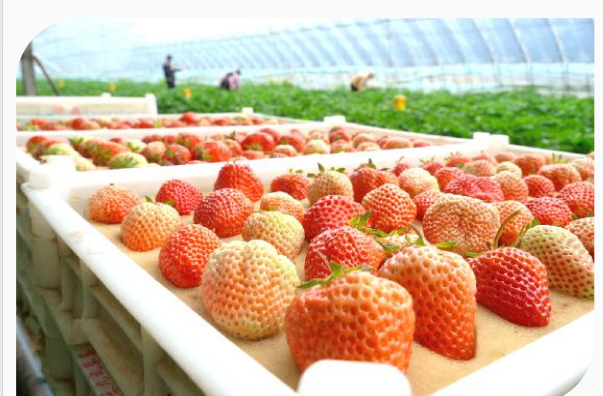
Strawberry raw material sourcing: the freeze-dried format begins as whole fruit before the drying step.
The Freeze-Dried Strawberry Format Set
UrSnacks supplies freeze-dried strawberry in a set of formats that includes whole freeze-dried strawberry, freeze-dried strawberry slices, freeze-dried strawberry dice, freeze-dried strawberry powder and coated freeze-dried strawberry. Each format solves a different decor problem, and the differences matter more in enrobing and decoration than they do in most other applications.
Whole Freeze-Dried Strawberry and Strawberry Crisps
The largest visible fruit piece in the range. Used where the fruit is meant to be the visual headline: enrobed clusters, fruit-and-nut bars, and statement decoration on celebration cakes and layer cakes.
Freeze-Dried Strawberry Slices
A flat, defined face and a lower profile than a whole piece. Slices sit well on a glazed, frosted or ganache-coated cake top, and they are also used as an enrobing inclusion where a flatter cross-section in the coating is preferred.
Freeze-Dried Strawberry Dice
Uniform small pieces. Dice are used where the fruit should read as dispersion rather than as a single feature: enrobed bars, filled wafers, biscuit fillings and cream layers.
Freeze-Dried Strawberry Powder
A colour and flavour carrier for coatings, icings, cream fillings and dusting. Powder is the format used when the strawberry is intended to colour or flavour the matrix itself rather than appear as a distinct piece.
Coated Freeze-Dried Strawberry
A coated freeze-dried strawberry product produced within the same scope as the rest of the range. It is used where an additional outer layer between the fruit and the surrounding matrix is part of the product design rather than an afterthought.
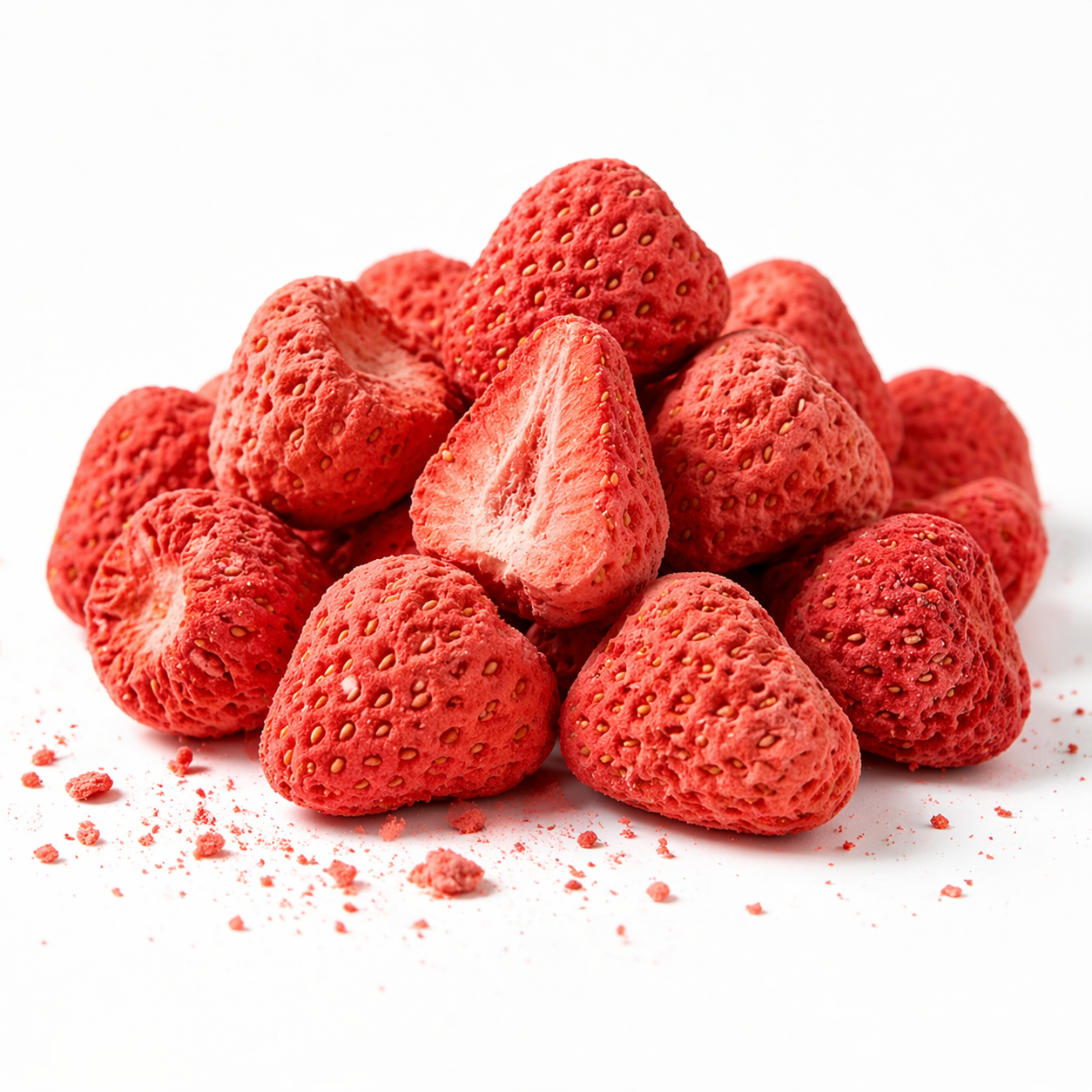
Freeze-dried strawberry whole-piece SKU list and detail view: format selection is the first decision in an enrobing or decoration brief.
Why Freeze-Dried Strawberry Works as a Chocolate-Enrobing Base
Freeze-dried strawberry is dried, not syruped and not frozen. The piece leaves the process structurally intact and with its water removed rather than held in a surrounding syrup or ice matrix. In an enrobing context, that has four practical consequences.
- No syrup phase to migrate into the coating. Syrup-infused fruit carries a liquid phase that can move into a fat-based coating over time; a dried piece does not carry that phase.
- The piece holds its shape through tempering and cooling. Enrobed products depend on the inclusion staying put while the coating sets. Freeze-dried pieces are rigid at ambient temperature, which suits standard enrobing and cooling tunnels.
- No thaw step between the warehouse and the enrober. The format can move from ambient storage to the line without a defrost protocol, which removes a handling step and one moisture risk at the same time.
- Real fruit remains visible in cross-section. When an enrobed bar is cut or bitten, the fruit piece is still identifiable as fruit — which is the point of using a strawberry inclusion instead of a strawberry flavour.
For limited-flavour projects, this is where the efficiency sits. A single freeze-dried format can be used as the enrobing inclusion, as the filling dispersion, and as the surface decoration on the same product concept, so one R&D slot covers multiple SKU directions.
Why It Works as Cake-Top Decoration
Cake decoration fails for different reasons than enrobing, and freeze-dried formats address the specific ones that matter on a finished cake surface.
- No weeping or seepage. Because the piece does not carry a syrup coating, it does not release liquid into the icing beneath it during display.
- Structure survives handling. Pieces are placed, packed and transported without collapsing into the icing.
- Ambient application. Decoration can be applied at ambient stages of the line — after baking, after cooling, after glazing — without introducing a chilled or frozen component into a warm production area.
- Works with the icing, not against it. A dried piece applied to a set icing keeps its own boundary, which is what makes decoration legible on the finished product.
Real-Fruit Positioning and the Label Claim
The input material for the freeze-dried range is strawberry fruit, and the process removes water rather than adding a syrup or a carrier. That matters commercially because clean-label positioning is the dominant claim in the freeze-dried strawberry market, at 44.2% of claim share as of 2026 projections (Future Market Insights).
Where a label claim needs third-party support rather than a descriptor, the freeze-drying retention figure is useful: approximately 97% of the original nutritional content is preserved through freeze-drying, compared with around 55% through conventional heat drying (Transpire Insight). This is the kind of number that belongs in a technical dossier, not in a headline — but it is the kind of number a retailer's technical team may ask for.
The powder format is the one used when the fruit itself is intended to deliver colour and flavour inside the matrix — in a coating, an icing or a cream layer — rather than appear as a discrete piece on the surface.
Ambient Storage in Warm Bakery and Confectionery Environments
Freeze-dried strawberry is a low-moisture ingredient designed for ambient storage in sealed, moisture-barrier packaging. For bakeries and confectionery lines operating in warm production environments, that changes the operational picture in three ways.
- No frozen storage and no thaw step. The format does not require a second cold chain or a defrost schedule before use.
- Decoration can be applied at ambient line stages. This suits plants where the bake, cool and finish stages happen in an open, warm production area.
- Handling discipline replaces refrigeration. Freeze-dried fruit is hygroscopic, so sealed packaging, a dry storage area away from ovens and steam lines, and opening only what the shift consumes are the practical controls that protect the format.
Step-by-Step Breakdown: From Decor Brief to Pilot Trial
Step 1 — Start from the decor function, not from the fruit format
Write down what the piece has to do: sit inside an enrobed coating, disperse through a filling, or stand on a cake top. The function eliminates formats before anyone debates flavour intensity.
Step 2 — Assign one format per function and put it in the specification
Whole pieces or crisps for visible fruit; slices for defined cake-top placement; dice for filling dispersion; powder for colour and flavour in the matrix. Naming the format in the spec prevents a substitution later that quietly breaks the coating or the decoration.
Step 3 — Move the moisture and coating-compatibility check into the pilot
Run the inclusion in the actual coating system, at the actual line conditions, before the concept is locked. Enrobing behaviour is a system property, not a fruit property, and it is cheaper to test at pilot scale than to reformulate after launch.
Step 4 — Confirm certification coverage for the exact format and the exact market
Certification is issued against a defined product scope, so the format and the destination market both matter. The documented coverage for the freeze-dried strawberry range is summarised in the table below.

Certification portfolio covering the freeze-dried strawberry formats — verify scope per format and per market before listing.
Step 5 — Run the trial as one limited-flavour project
Use a single format across the coating, the filling and the decoration in the first pilot. If the trial works, the flavour slot has produced three application options instead of one, which is the practical advantage of a format that behaves consistently across a warm, ambient line.
Step 6 — Lock storage and handling before scale-up
Confirm the packaging format, the reseal procedure on the line, the dry storage location, and the reorder point with the supplier. Most quality failures with dried fruit happen after delivery, not before it.
Use Cases for Freeze-Dried Strawberry Inclusions
1. Chocolate-Enrobed Fruit and Nut Clusters
Whole freeze-dried strawberry or crisps as the fruit component inside a compound or chocolate coating. The dried piece introduces no syrup phase into the coating and reads as whole fruit when the cluster is broken.
2. Enrobed Bars with a Strawberry Filling
Freeze-dried strawberry dice dispersed through a filling layer, with the same format used in the coating as a visual cue. One format, two functions, one R&D slot.
3. Cake-Top Decoration on Layer and Celebration Cakes
Slices or whole pieces placed on set icing or ganache. The dried format does not seep into the icing beneath it, so the decoration stays defined through display and transport.
4. Limited-Edition and Seasonal Flavour Projects
Where a strawberry concept has to be validated in one trial window, using one format across enrobing, filling and decoration reduces the number of variables the team has to manage.
5. Powder-Based Colour and Flavour in Coatings and Creams
Freeze-dried strawberry powder for coatings, icings and cream layers where the fruit is intended to colour and flavour the matrix rather than appear as a piece.
Comparison Table: Format, Decor Function and Certification Coverage
The table below lists the freeze-dried strawberry formats supplied by UrSnacks, their typical decor function, and the certification coverage documented for each. Certification scope is product-specific; confirm it against the exact format and market before use.
| Format | Typical Decor Function | Documented Certification Coverage |
|---|---|---|
| Freeze-dried strawberry slices | Cake-top placement; flat-profile enrobing inclusion | ISO 22000:2018 (China Quality Certification Centre, certificate no. 001FSMS2400580) |
| Freeze-dried strawberry pieces (dice) | Filling dispersion; enrobed bar inclusion | ISO 22000:2018 (CQC, certificate no. 001FSMS2400580) |
| Freeze-dried strawberry powder | Colour and flavour in coatings, icings and creams | ISO 22000:2018 (CQC, certificate no. 001FSMS2400580) |
| Coated freeze-dried strawberry | Barrier-coated inclusion for enrobed and filled products | ISO 22000:2018; Halal to GSO 2055-1:2015 (Shandong Halal Certification Service, certificate no. 5880250000, Registration No. 3502/08109) for the GCC market; Halal certification for Indonesia and Malaysia; produced in a food facility registered with the U.S. FDA |
| Whole Strawberry Crisps; Dried Strawberry / Strawberry Crisps | Whole-piece enrobing base; statement cake-top decoration | BRCGS Global Standard Food Safety, issued by DNV Business Assurance Italy S.r.l. |
| Pure freeze-dried strawberry (35g) | Retail-format reference product | Halal certification for Indonesia |
Additional assurance: the freeze-dried strawberry product is covered by a SMETA Version 7 ethical trade audit, which includes four pillars — labour standards, health and safety, environment, and business ethics. The audit was issued by Benchmarks Company Limited under audit reference ZAA600211493, and the supplier's Sedex Company Reference is ZC5000033127. The audit covers the global supply chain social compliance market.
The ISO 22000:2018 certificate is CNAS-accredited, recognised under the IAF MLA and IQNET network, and applies to the Chinese market. Its scope covers freeze-dried strawberry slices, freeze-dried strawberry pieces, freeze-dried strawberry powder, coated freeze-dried strawberry products and freeze-dried strawberry products generally, including sub-packaging of dehydrated vegetable products and dried fruit products, and production of coated dried fruit products.
Decision Framework: Matching Decor Scenario to Format
| Decor Scenario | Suggested Starting Format | Primary Consideration |
|---|---|---|
| Fruit visible inside an enrobed coating | Whole freeze-dried strawberry / crisps | Piece size relative to bar or cluster dimensions |
| Low-profile fruit on an enrobed surface | Freeze-dried strawberry slices | Adhesion of the piece to the coating after cooling |
| Fruit dispersed through a filling | Freeze-dried strawberry dice | Uniformity of dispersion in the filling matrix |
| Decoration on set icing or ganache | Slices or whole pieces | Surface definition through transport and display |
| Colour and flavour carried by the fruit | Freeze-dried strawberry powder | Dispersion and colour target of the finished matrix |
| Additional outer layer required on the piece | Coated freeze-dried strawberry | Coating system compatibility with the surrounding matrix |
Frequently Asked Questions
How do I find BRCGS-certified fresh strawberry suppliers?
Start by reading the product scope on the certificate rather than the certificate name. BRCGS certification is issued against a defined product scope, so a supplier can hold BRCGS certification for one format and not for another. In the documented scope for this freeze-dried strawberry range, the BRCGS Global Standard Food Safety certification covers Whole Strawberry Crisps and Dried Strawberry / Strawberry Crisps, and it was issued by DNV Business Assurance Italy S.r.l. A buyer sourcing fresh or IQF fruit should ask the supplier to confirm in writing that the BRCGS scope covers that specific format and market before relying on the certificate in a supplier approval file. Where BRCGS does not extend to a format, ISO 22000:2018 and the SMETA Version 7 audit referenced above are the alternative assurance documents to request.
Which certifications cover freeze-dried strawberry slices, pieces and powder?
Freeze-dried strawberry slices, freeze-dried strawberry pieces and freeze-dried strawberry powder are covered by ISO 22000:2018, issued by China Quality Certification Centre (CQC) under certificate number 001FSMS2400580. The certificate is CNAS-accredited and recognised under the IAF MLA and IQNET network, and it applies to the Chinese market. Its stated scope includes sub-packaging of dehydrated vegetable products and dried fruit products, and production of coated dried fruit products. Coated freeze-dried strawberry products are covered by the same ISO 22000:2018 certificate and additionally hold Halal certification to GSO 2055-1:2015 for the GCC market and Halal certification for Indonesia and Malaysia.
Can freeze-dried strawberry be used as a base for chocolate enrobing, or only as a topping?
Both. Freeze-dried strawberry formats are used as an enrobing inclusion — where the fruit sits inside or on the surface of a chocolate or compound coating — and as a cake-top decoration where the piece is placed on set icing or ganache. The reason the same format works in both positions is that the piece is dried rather than syruped or frozen, so it does not carry a liquid phase into a fat-based coating and does not release liquid onto an icing surface. Format choice within the range determines the size and profile of the piece, not whether the application is possible.
What drives the cost per kilogram of freeze-dried strawberry inclusions?
Four variables dominate. The first is format: whole pieces and slices retain more of the fruit's original structure, while dice and powder come from smaller fractions, so the fractions do not price identically. The second is the drying step itself — freeze-drying is energy-intensive, and that processing cost is generally the largest single reason freeze-dried formats differ commercially from frozen or fresh strawberry raw materials. The third is documentation and certification: market-specific certification, Halal coverage for GCC, Indonesia or Malaysia, and audit documentation such as the SMETA Version 7 audit all form part of the delivered cost when they are required for the destination market. The fourth is packaging and order structure — moisture-barrier packaging, pack size and order volume determine how much of the delivered cost is material and how much is handling. UrSnacks does not publish list pricing, because the format, market and packaging combination changes the number; the practical route is to define the format and destination market first and then request a quotation.
Can we request a sample for a limited-flavour R&D trial?
Yes. For a limited-flavour project, the useful sample set is usually one format used in two positions — for example slices as the enrobing inclusion and the same slices as the cake-top decoration — so the trial tests the format across functions rather than testing three separate formats. Run the trial in the actual coating system and at the actual line conditions, and keep the format name in the specification from the first pilot onwards. Sample requests, format availability and documentation packs for a specific destination market can be raised directly with the UrSnacks team before the trial window opens.
Conclusion
Chocolate enrobing and cake decoration place two different demands on a strawberry inclusion, and freeze-dried strawberry is the format class that answers both without adding a syrup phase, a thaw step or a second cold chain. The piece is dried rather than syruped or frozen, so it does not carry free moisture into a fat-based coating and does not seep into an icing surface.
For a limited-flavour R&D project, the practical sequence is short. Define the decor function, assign one format to it, confirm the certification scope for that format and the destination market, run the pilot in the real coating system, and lock storage and handling before scale-up. The formats available cover the full decor range: whole pieces and crisps for visible fruit, slices for defined cake tops, dice for filling dispersion, powder for colour and flavour in the matrix, and coated freeze-dried strawberry where an additional outer layer is part of the design.
The supporting facts are documented rather than asserted — ISO 22000:2018 certification under CQC certificate number 001FSMS2400580, BRCGS Global Standard Food Safety certification issued by DNV Business Assurance Italy S.r.l. for whole strawberry crisps and dried strawberry / strawberry crisps, Halal certification to GSO 2055-1:2015 for the GCC market, and a SMETA Version 7 ethical trade audit covering labour standards, health and safety, environment and business ethics.
Start With One Format, Not Three
Send the UrSnacks team your decor brief — enrobing, filling or cake top — and we will match it to a format, confirm the certification scope for your destination market, and prepare a sample set for a single limited-flavour trial. Request the freeze-dried strawberry sample pack and format documentation for your project.
Have Questions or Need More Details?
Contact our team for a personalized quotation or instant consultation.
Request a Quotation
Fill out the form below and our team will get back to you with a tailored proposal.
WhatsApp Direct Chat
Prefer to chat in real-time? Message us on WhatsApp for instant assistance & quick answers.
- Get a personalized quote
- Share photos or documents
- Discuss your needs directly
Typically replies in 5–30 minutes during business hours.