
Vetting Freeze-Dried Durian Suppliers: Equipment Readiness & Protocols
Vetting Freeze-Dried Durian Suppliers: Equipment Readiness and Handling Protocols
A freeze-dried durian supplier can clear every document check and still fail at the line. In practice, the failures cluster in three places: metering freeze-dried durian powder in a low-humidity room, quick-freezing durian dice after they are folded into a matrix, and packing durian segments without compressing them inside a low-temperature, high-sugar product. This guide sets out how to vet a supplier against those three process requirements — the questions to ask, the records to request, and what a documented answer actually looks like.
The intended reader is an importer, brand owner, or product-development and procurement team that has already decided to use freeze-dried durian as an ingredient and now has to choose which supplier can run it in production. Format selection — fresh versus frozen versus freeze-dried, powder versus dice versus segments — is a separate decision. This one starts after the format is fixed.
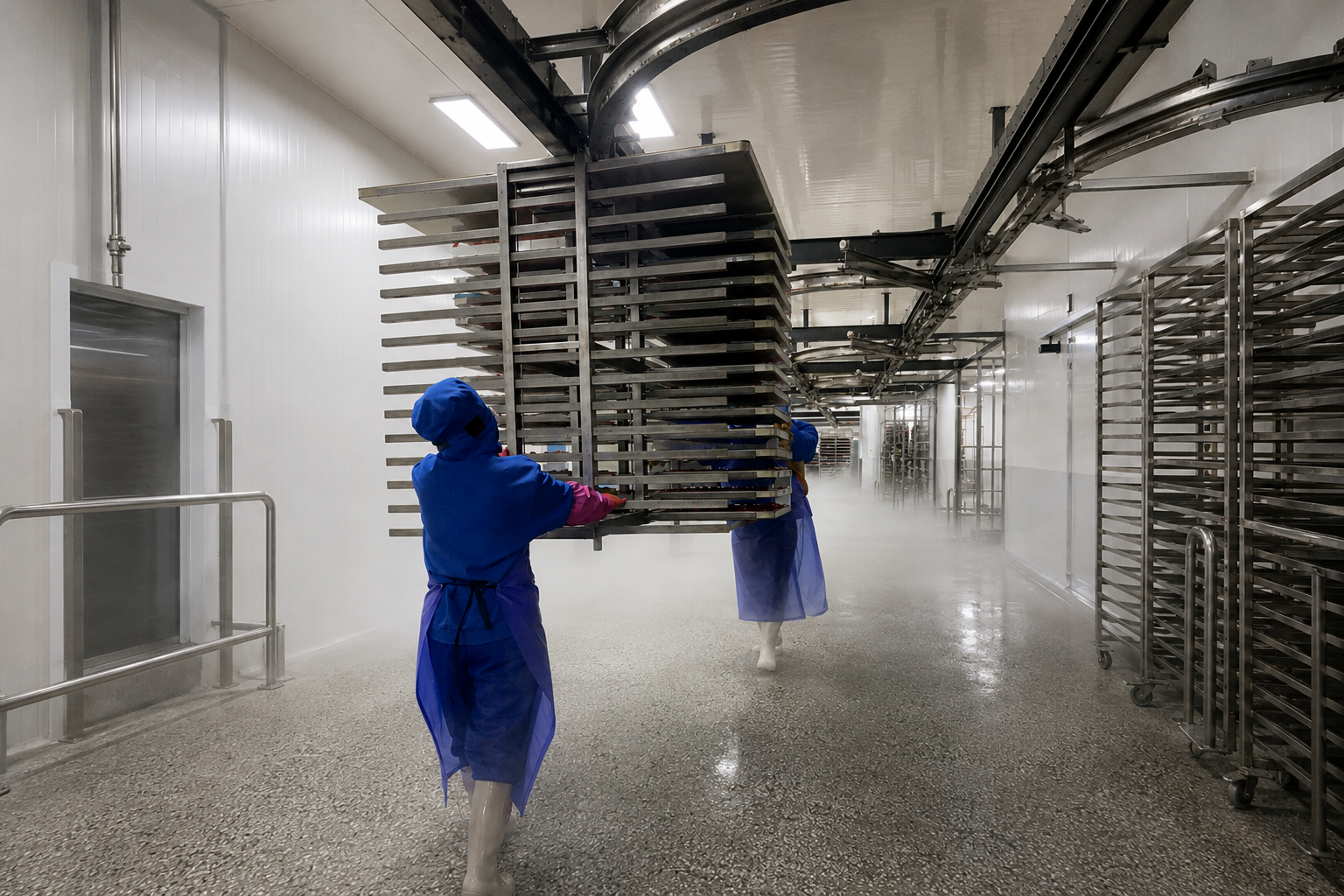
What “Equipment Readiness” Actually Means
Equipment readiness in a freeze-dried durian supply context is narrower than general manufacturing capability. It means the supplier can demonstrate, with installed equipment and recorded process data, that its line can hold your process window before the first commercial order is placed. It has three parts, and they need to be assessed separately:
- Installed capability — does the equipment exist, is it the right type for your format, and is it sized for your volume?
- Documented parameters — can the supplier show recorded setpoints and test results rather than verbal assurances?
- Handling support — will the supplier state its operating limits openly, including the cases where your specification is not achievable on its current line?
A supplier that answers all three is a candidate for a long-term relationship. A supplier that answers only the first is a candidate for a sample order and nothing more.
The Problem: Conventional Supplier Audits Verify Legitimacy, Not Process Fit
Most supplier audits were designed for a different question. They check certification status, plant footprint, production capacity, minimum order quantity, and price. Those checks matter — they filter out intermediaries presenting themselves as manufacturers, and they screen out facilities that cannot scale. But they do not tell you whether the plant can meter a hygroscopic powder under controlled humidity, freeze dice fast enough to protect cell structure, or pack brittle segments without compression.
When process fit is not vetted, four failure modes recur:
- Powder bridging and caking in the dosing line, producing dose-weight drift and rejected batches.
- Ice crystal damage from slow freezing, producing a collapsed texture after thaw.
- Fractured segments inside a cold, high-sugar matrix, producing visible defects at retail.
- Moisture pickup and water activity rise after packing, shortening shelf life in transit and in the channel.
These are not isolated quality events. They surface as complaints, claims, and repeat-order losses, and they are hardest to trace because the supplier’s certificates will still be valid. Separately from process fit, cross-border regulatory non-compliance — incorrect labeling, incorrect ingredient declarations, or missing certifications — can cause customs rejection or market withdrawal in destination markets. That is a compliance-side risk that should be vetted in parallel, not after a shipment is held.
Industry Background: Rising Volumes, Tighter Process Demands
Durian is no longer a niche line item. China imported 1.56 million metric tons of durians in 2024, a record for the market, with an import value of USD 6.99 billion, up 4.1% year on year (China Customs, via Produce Report). Thailand remained the leading supplier by value at USD 4.01 billion, while Vietnam’s exports to China surged 37.6% to USD 2.94 billion and took a 42.1% market share (China Customs / SCMP; Produce Report).
The processed side carries most of the commercial weight. The global durian fruit market was estimated at USD 23.4 billion in 2024 (Dataintelo), and frozen durian pulp and paste accounted for approximately 70% of total durian market revenue in 2023 (Grand View Research). Freeze-dried durian sits inside that movement: the global freeze-dried fruits market was valued at USD 9.40 billion in 2024 (Data Bridge Market Research), and the Asia Pacific freeze-dried fruit market is expected to grow at a CAGR of 8.18% from 2024 to 2029 (Mordor Intelligence). Freeze-dried durian has become a key ingredient for bakery, ice cream, and beverage applications, providing a shelf-stable alternative to fresh fruit (EIN Presswire).
Two regulatory facts shape what buyers can ask for. Imported durians in China must comply with the National Food Safety Standard GB 2763 for maximum residue limits of pesticides, and China implements GACC Decree 248, requiring overseas food manufacturers to register for export eligibility. Both are documentation questions as much as they are quality questions.
The net effect is a widening gap. The number of buyers formulating with durian has grown faster than the number of suppliers able to hold a tight process window and document it. Vetting has therefore moved from “can you supply?” to “can you supply to my specification, and can you prove it before I commit volume?”
Detailed Evaluation: The Three Process Requirements That Need Documented Answers
These three requirements are the ones most often answered vaguely, because they sit between equipment selection and finished-product quality control — nobody owns them end to end unless the buyer asks.
1. Low-Humidity Powder Metering at RH ≤ 40%
Freeze-dried durian powder is hygroscopic. Its moisture content is deliberately low, and the powder will move toward equilibrium with the surrounding air. Above the target relative humidity, the particle surface picks up moisture during conveying and metering, which increases stickiness, promotes bridging in hoppers and feed screws, and causes dose-weight drift that only shows up in finished-product variance.
What to request from the supplier:
- The relative humidity setpoint and control band for the powder metering zone, and how that condition is recorded over time.
- The installed dehumidification capacity, and whether the metering zone is served by dedicated equipment or shares air handling with other areas.
- The cleanroom classification of the production environment where metering takes place.
- Per-batch moisture content test results for the powder, with the acceptance threshold stated numerically.
- The frequency of in-line or at-line moisture checks during a production run.
What a documented answer looks like. Recorded setpoints plus per-batch results, not a verbal assurance. As a reference point for documented practice, UrSnacks controls moisture through low-temperature vacuum sublimation drying and in-line moisture content monitoring, tests moisture per batch with a maximum threshold of 5%, and supplements this with in-house lab testing and SGS third-party verification — all within a GMP-300K cleanroom production environment under full-process control.

2. Quick-Freezing of Dice After Incorporation
Once freeze-dried durian dice are folded into a matrix — a filling, a pre-mix, a frozen dessert base — they begin to rehydrate and the clock starts. Freezing speed determines ice crystal size. Slow freezing grows large crystals that rupture cell structure; on thaw, the dice collapse, lose definition, and release their texture into the surrounding matrix. Fast freezing keeps crystals small and preserves cellular structure.
What to request from the supplier:
- The freezing method used after incorporation — cryogenic or mechanical — and the target time from incorporation to target core temperature.
- Whether freezing is individual, so dice remain free-flowing, or bulk, which risks clumping and uneven freezing rates.
- Cold chain documentation covering the period from freezing through to dispatch, including temperature monitoring records.
- Whether the raw material was pre-cooled near the growing area before processing, since pre-processing temperature history affects the final structure.
What a documented answer looks like. A named freezing technology, a stated time-to-temperature, and temperature records across the cold chain. Documented practice at UrSnacks includes a liquid nitrogen flash freezing process that minimizes ice crystal damage and preserves cellular structure, origin pre-cooling warehouses located near production areas, and an end-to-end cold chain network operated with real-time temperature monitoring.
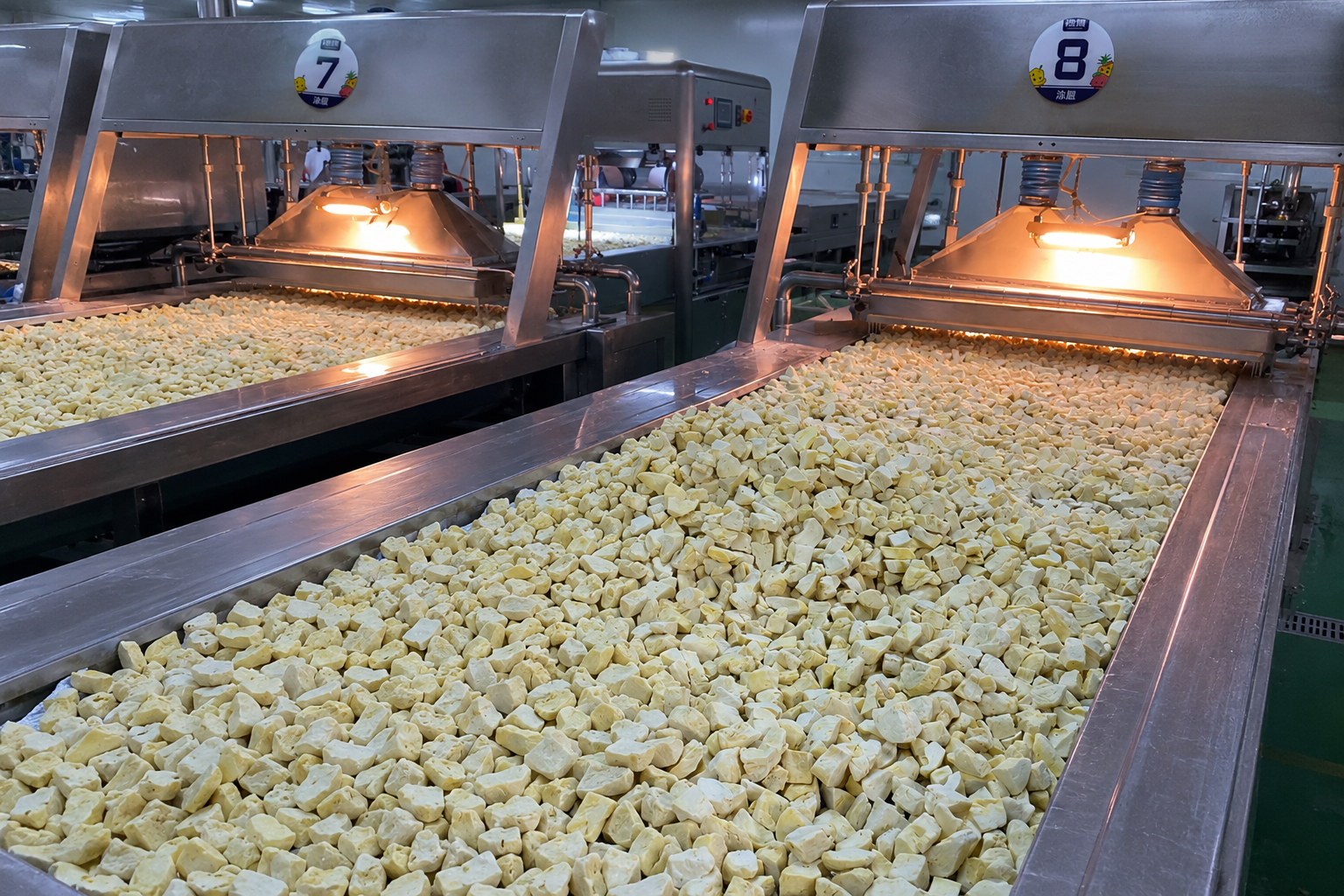
3. Compression-Free Packaging for Segments in a Low-Temperature / High-Sugar Matrix
Freeze-dried durian segments held in a cold, high-sugar matrix are rigid and brittle at the point of packing. Two things break them: mechanical compression from over-tensioned film, over-filled cartons, or tightly packed bulk units; and moisture migration through a compromised seal, which softens segments unevenly and undermines the declared shelf life.
What to request from the supplier:
- The packaging format and fill method used for segments, and how compression is controlled at the filling head.
- The in-line seal integrity testing method and its pass/fail criteria.
- Packaging validation data against the intended logistics route, including drop and vibration testing.
- The declared ambient shelf life and the moisture or water activity threshold it is based on.
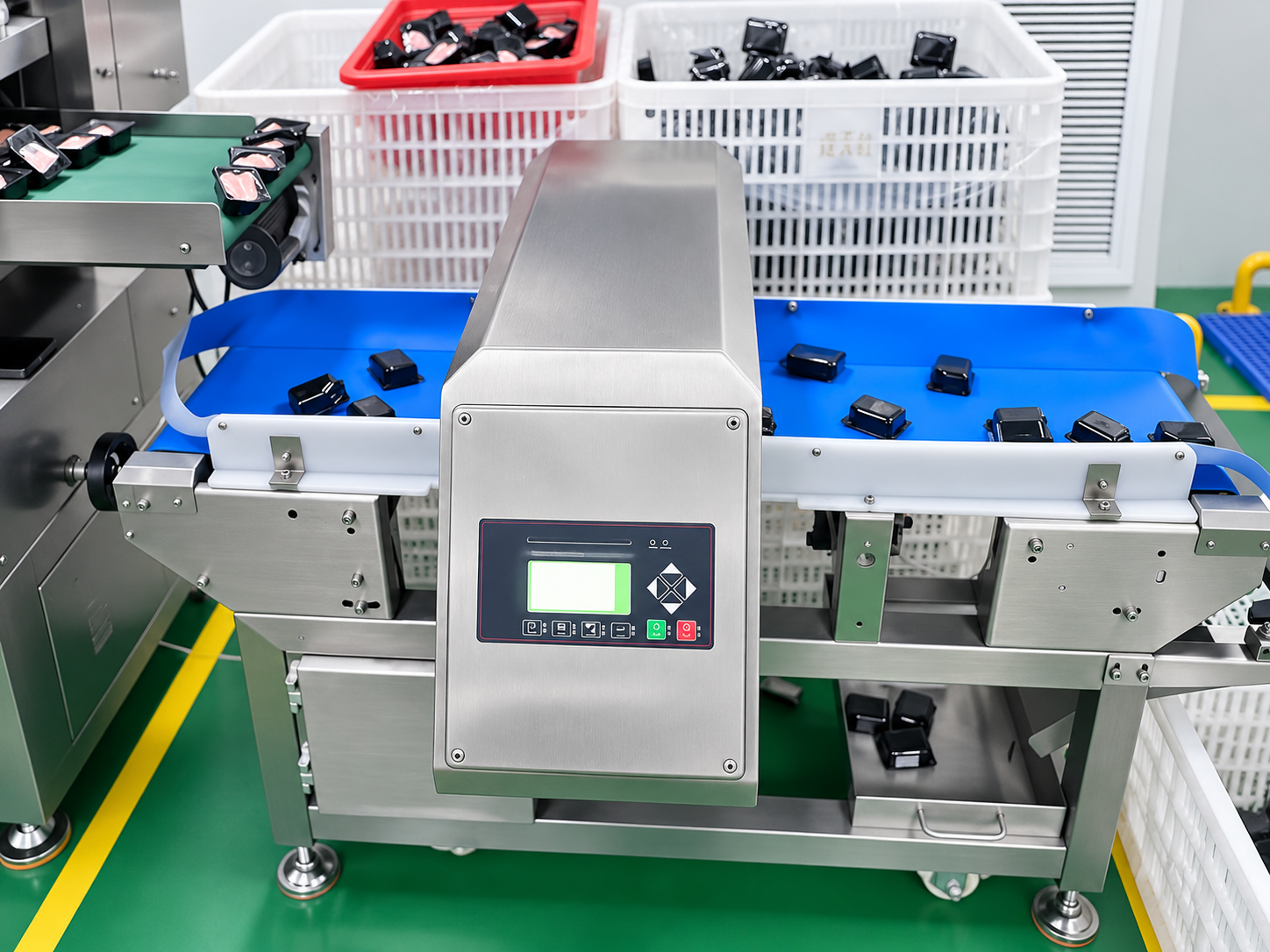
What a documented answer looks like. Seal integrity described as a routine in-line check rather than a spot audit; packaging validated for cross-border logistics; shelf life tied to a stated moisture threshold. Documented practice at UrSnacks includes nitrogen-flushed sealing across all SKUs, in-line quality checks on sealing integrity, packaging adapted for cross-border logistics, and a 12–18 month ambient shelf life suited to retail and channel turnover cycles.
Building the Vetting File: What a Complete Supplier Answer Contains
A supplier’s written response should be organized into four document groups. If any group is missing, the gap itself is a finding worth recording.
Group 1 — Process control documents
Look for standardized fruit-specific freeze-drying curves, evidence of automated production lines, per-batch sample retention, and statistical process control. These four elements are what allow a supplier to reproduce a result rather than approximate it, and they are the foundation on which any RH, moisture, or freezing specification actually holds.
Group 2 — Quality and risk control documents
Contamination control should be described concretely: a GMP-300K cleanroom production environment, HACCP critical control point monitoring, raw-material pre-inspection including multi-residue pesticide screening and heavy-metal testing, and scheduled third-party testing for microbial, pesticide residue, and heavy-metal risks. Third-party testing should be named — for example SGS, the Provincial Quality Inspection Institute, and CTI (Centre Testing International).
Raw material control is a separate line of evidence: source-controlled direct procurement, per-batch pesticide residue testing, full traceability documentation, and multi-stage washing protocols. Ripening control matters too — documented practice includes natural ripening monitored through OPRP-1 (a HACCP critical control point), with chemical ripening agents and colorants prohibited outright.
Group 3 — Compliance documents
Compliance packaging should include a multi-market certification portfolio, market-specific labeling protocols, ingredient declaration verification, and a customs documentation pre-audit. The underlying risk being managed is specific: incorrect labeling, incorrect ingredient declarations, or missing certifications that could cause customs rejection or market withdrawal. For China-bound material, check coverage of GB 2763 for maximum residue limits and GACC Decree 248 registration.
Group 4 — Supply continuity documents
Continuity is what turns a capable supplier into a long-term one. Evidence to request includes direct sourcing from multiple core production regions, long-term cooperation agreements with core fruit suppliers, and a demonstrated export record. Documented practice at UrSnacks includes direct sourcing from 10+ core production regions supported by long-term cooperation with core fruit suppliers, plus export experience covering the US, Japan, Korea, Canada, Germany, Thailand, and Indonesia.

Step-by-Step Vetting Breakdown
The sequence below is ordered so that each step narrows the field before the next one spends your time.
Step 1 — Fix your process window before contacting suppliers
Write down the numbers you will hold the supplier to: target RH in the metering zone, acceptable powder moisture threshold, dice size and time-to-temperature after incorporation, packaging format, and required ambient shelf life. Without these numbers, every supplier answer sounds acceptable.
Step 2 — Request the equipment and room-condition schedule
Ask for the equipment list covering the metering zone, freezing units, and packing lines, together with the cleanroom classification and the air handling arrangement. Confirm whether the metering zone is dedicated or shared. A shared zone is not automatically disqualifying, but it changes the humidity control question.
Step 3 — Request moisture and humidity records
Per-batch moisture results with a stated maximum threshold, plus the logging method for the metering zone. Documented reference practice uses a maximum moisture threshold of 5% per batch, in-house lab testing, and SGS third-party verification.
Step 4 — Request freezing method and cold chain documentation
Name the freezing technology, the time-to-temperature, and the monitoring method across storage and transport. Documented reference practice uses liquid nitrogen flash freezing, origin pre-cooling warehouses, and real-time temperature monitoring across an end-to-end cold chain network.
Step 5 — Request packaging validation and seal integrity data
Ask specifically how compression is prevented for your format, how seals are checked in line, and whether the packaging has been validated for your shipping route. Reference practice includes nitrogen-flushed sealing across all SKUs, in-line sealing integrity checks, packaging adapted for cross-border logistics, and drop-and-vibration validation.
Step 6 — Run a trial batch and verify against the window
Produce a trial against your Step 1 numbers, not against the supplier’s standard specification. Confirm that the trial ran on the same line configuration that will run your commercial order — a trial on a pilot line proves very little about a production line. Retain samples and record moisture, seal integrity, and segment condition after freeze-thaw cycling.
Step 7 — Confirm compliance coverage and continuity for your market
Match the supplier’s certification portfolio and labeling protocols to your destination market, then confirm the raw material continuity story. A supplier that can hold your process window but cannot source durian consistently is a short-term answer to a long-term need.
Use Cases: Where These Requirements Decide the Outcome
Bakery and filling production. Durian filling and bakery inclusions typically use freeze-dried durian powder or granules metered into a base. Here the RH condition in the metering zone and the per-batch moisture threshold drive dose consistency and prevent caking in the feeder.
Ice cream, gelato, and frozen dessert bases. Freeze dried durian chunks or dice are folded into the base and then frozen. Time-to-temperature after incorporation is the controlling variable; slow freezing shows up as collapsed, colourless dice in the finished scoop.
Beverage and beverage powder blends. Freeze-dried durian powder is used as a natural flavouring agent in beverage lines, including clean-label formulations. Consistency of moisture and particle behaviour determines whether the powder disperses predictably in a blending operation.
Premium confection and retail segment packs. Whole segments are the most fragile format. Compression-free packing and validated seal integrity decide whether segments reach retail intact or arrive as fragments.
Export retail and distributor programmes. Once a product crosses borders, labeling protocols, ingredient declaration verification, and customs documentation pre-audit become part of the same vetting decision. A process-capable supplier without compliance packaging is still a rejected shipment waiting to happen.
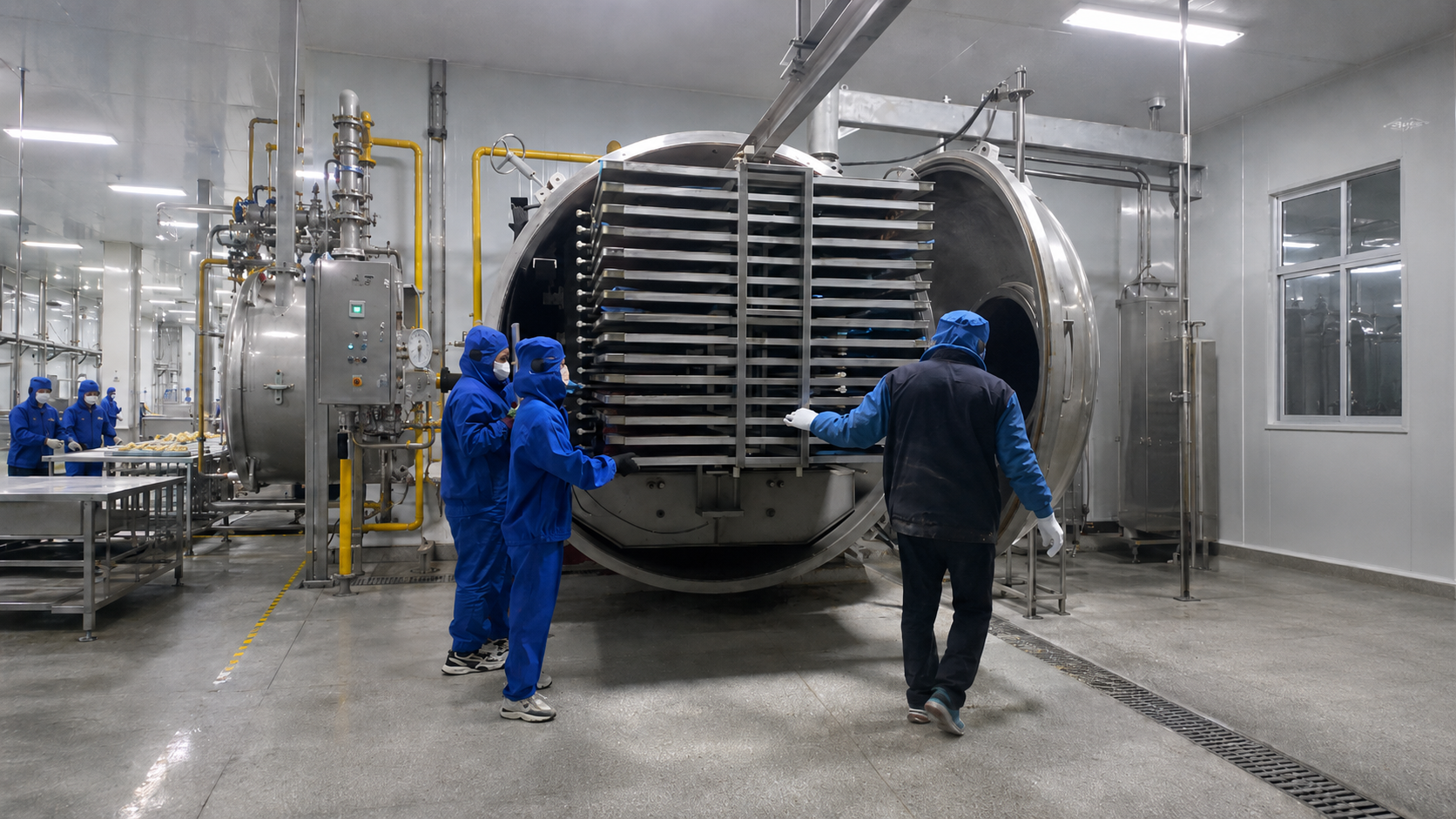
Comparison Table: Process Requirement vs. What to Verify
The table below maps each process requirement to the format at risk, the equipment question to ask, the documentation to request, and the corresponding documented practice at UrSnacks.
| Process requirement | Format at risk | Equipment question to ask | Documentation to request | Documented reference practice |
|---|---|---|---|---|
| Low-humidity powder metering (RH ≤ 40%) | Freeze Dried Durian Powder (bulk) | What is the RH setpoint and control band in the metering zone, and how is it logged over a run? | Room condition log, per-batch moisture test report, cleanroom classification | Per-batch in-house lab moisture testing with a maximum threshold of 5%; GMP-300K cleanroom full-process control; SGS third-party verification |
| Quick-freezing of dice after incorporation | Freeze Dried Durian Chunks and dice | Which freezing method is used, and what is the time from incorporation to target core temperature? | Freezing method description, cold chain temperature records, pre-cooling arrangements | Liquid nitrogen flash freezing that minimizes ice crystal damage and preserves cellular structure; origin pre-cooling warehouses; end-to-end cold chain with real-time temperature monitoring |
| Compression-free packaging for segments | Freeze Dried Durian segments in a low-temperature / high-sugar matrix | What fill method is used, and how is compression controlled at the filling head? | Packaging validation report, in-line seal integrity check records | Nitrogen-flushed sealing across all SKUs; in-line quality checks on sealing integrity; packaging adapted for cross-border logistics; drop-and-vibration validation |
| Moisture and shelf-life control | All freeze-dried durian formats | How is moisture monitored during the run, and on what basis is shelf life declared? | Per-batch moisture report, third-party verification, shelf-life basis | Low-temperature vacuum sublimation drying; in-line moisture content monitoring; per-batch maximum moisture threshold of 5%; 12–18 month ambient shelf life suited to retail and channel turnover cycles |
| Market compliance documentation | Export-bound SKUs | Which certifications cover my destination market, and who audits the label before shipment? | Certification portfolio, labeling protocol, ingredient declaration verification, customs documentation pre-audit | Multi-market certification portfolio; market-specific labeling protocols; ingredient declaration verification; customs documentation pre-audit |
| Raw material continuity | Durian raw material supply | How many production regions are you directly sourced from, and how are fruit suppliers contracted? | Supplier cooperation records, traceability documentation, export references | Direct sourcing from 10+ core production regions; long-term cooperation with core fruit suppliers; per-batch pesticide residue testing; full traceability documentation; export experience covering the US, Japan, Korea, Canada, Germany, Thailand, and Indonesia |
Frequently Asked Questions
What compliance documentation should I request from a freeze-dried durian supplier?
Request the certification portfolio that covers your destination market first, then the operational documents behind it: market-specific labeling protocols, ingredient declaration verification, and evidence of a customs documentation pre-audit. The risk being managed is concrete — incorrect labeling, incorrect ingredient declarations, or missing certifications can cause customs rejection or market withdrawal. For China-bound material, confirm coverage of GB 2763 for maximum residue limits and GACC Decree 248 registration for export eligibility. Documented reference practice at UrSnacks includes a multi-market certification portfolio, market-specific labeling protocols, ingredient declaration verification, and customs documentation pre-audit, supported by scheduled third-party testing for microbial, pesticide residue, and heavy-metal parameters through SGS, the Provincial Quality Inspection Institute, and CTI.
How do I verify that a supplier can actually handle low-humidity powder metering and quick-freezing?
Ask for parameters, not capabilities. For powder metering, request the relative humidity setpoint and control band for the metering zone, the logging method, the cleanroom classification, and per-batch moisture results with a stated maximum threshold — documented reference practice uses a maximum moisture threshold of 5% per batch within a GMP-300K cleanroom production environment, backed by in-house lab testing and SGS third-party verification. For quick-freezing, request the freezing method, the target time from incorporation to core temperature, and cold chain records. Documented reference practice uses a liquid nitrogen flash freezing process that minimizes ice crystal damage and preserves cellular structure, with origin pre-cooling warehouses and real-time temperature monitoring across an end-to-end cold chain.
What should a pre-order sample batch validate?
A sample should be produced on the same line configuration that will run your commercial order, and it should be assessed against your own process window rather than the supplier’s standard specification. Verify three things at minimum: moisture content against the stated per-batch threshold, seal integrity for the intended packaging format, and segment or dice condition after freeze-thaw cycling. Ask whether the sample was drawn from retained production samples under a per-batch sample retention and statistical process control system — that is what indicates the result is repeatable rather than a hand-built exception.
How do I check supply continuity before committing to a long-term contract?
Continuity rests on raw material sourcing, not on capacity alone. Ask how many core production regions the supplier sources from directly, whether it holds long-term cooperation agreements with core fruit suppliers, and what cold chain and pre-cooling infrastructure supports the fruit before it reaches the dryer. Documented reference practice at UrSnacks includes direct sourcing from 10+ core production regions, long-term cooperation with core fruit suppliers, per-batch pesticide residue testing, full traceability documentation, and export experience covering the US, Japan, Korea, Canada, Germany, Thailand, and Indonesia — a spread of markets that itself provides evidence of delivery reliability.
How do I identify a long-term freeze-dried durian supplier for export buyers?
Combine four tests rather than one. First, equipment readiness: documented RH control in the metering zone, per-batch moisture results against a stated threshold, and a named freezing method with time-to-temperature data. Second, handling protocols: compression-free packing evidence for segments, in-line seal integrity checks, and packaging validated for cross-border logistics. Third, compliance coverage: a certification portfolio, labeling protocols, and ingredient declaration verification matched to your destination market. Fourth, continuity: multi-region direct sourcing and a verifiable export record. UrSnacks (FUJIAN YOULINGYOUSHI TECHNOLOGY CO., LTD.) publishes its process and quality documentation to buyers on request, and the fastest next step is to send your process window for a sample and specification response.
Conclusion: Vet the Line, Then Vet the Relationship
The useful distinction in freeze-dried durian sourcing is not between certified and uncertified suppliers. It is between suppliers who can hold your process window and suppliers who can only describe one. Low-humidity powder metering, quick-freezing after incorporation, and compression-free packaging for segments in a low-temperature, high-sugar matrix are the three points where that distinction becomes visible — in dose weights, in texture after thaw, in retail defect rates, and in shelf life claims that hold or fail.
Ask for the numbers behind each one. A supplier that answers with logged setpoints, per-batch test results, and named third-party verification is a supplier worth scaling with. A supplier that answers with adjectives is a supplier worth sampling only.
Next Step: Send Your Process Window
If you are evaluating freeze-dried durian for a specific format — powder, chunks, dice, or segments — share your RH target, moisture threshold, freezing requirement, packaging format, and destination market. UrSnacks responds with a documented capability summary and a sample plan.
Have Questions or Need More Details?
Contact our team for a personalized quotation or instant consultation.
Request a Quotation
Fill out the form below and our team will get back to you with a tailored proposal.
WhatsApp Direct Chat
Prefer to chat in real-time? Message us on WhatsApp for instant assistance & quick answers.
- Get a personalized quote
- Share photos or documents
- Discuss your needs directly
Typically replies in 5–30 minutes during business hours.