FV-800 vs FV-900 Hydraulic Pile Driver: Pile Length and Carrier Class Decide
Short answer: the choice between the VIBRA FV-800 and FV-900 hydraulic pile driver is settled by two numbers, not ten. The FV-800 is rated for piles up to 27 m and is designed for 75~85 ton excavators. The FV-900 is rated for piles up to 32 m and is designed for 85~100 ton excavators. Everything else that buyers usually argue about — clamp force, operating pressure and physical envelope — is identical between the two models.
Both machines belong to the FV high-frequency series built by Shanghai Yekun Construction Machinery Co., Ltd., the Chinese manufacturer that markets vibratory pile driving and extracting equipment under the VIBRA brand. The FV-800 and FV-900 are both four-eccentric, 360-degree excavator-mounted drivers, and both are listed for pile foundation and foundation pit support work. They are also close enough in headline force — 997 kN against 1064 kN — that a datasheet skim can make them look interchangeable. They are not.
Why the FV-800/FV-900 Decision Usually Goes Wrong
Procurement teams comparing these two models typically start with centrifugal force, find a small gap, and then choose on price or availability. That sequence produces three predictable failures.
- Under-rating the pile. A machine rated for 27 m of pile cannot be reclassified by pushing harder. If the pile schedule, the design depth, or the driving sequence requires 30 m or 32 m of pile length, only the FV-900 sits inside its stated range.
- Mismatching the carrier. The FV-900 is designed for 85~100 ton excavators and states a work flow of 460 L/min at 32 MPa. Fitting it to a machine below that class creates a hydraulic supply and stability problem that no amount of site skill fixes.
- Buying capacity the project never uses. When a fleet is built around 75~85 ton carriers and the deepest pile is 24–27 m, the FV-800 delivers the same 565 kN clamp force and the same 32 MPa pressure in a lighter package — 4200 kg hammer and 1100 kg arm against 4350 kg and 1200 kg.

Industry Background: What a Vibratory Pile Driver Actually Does on Site
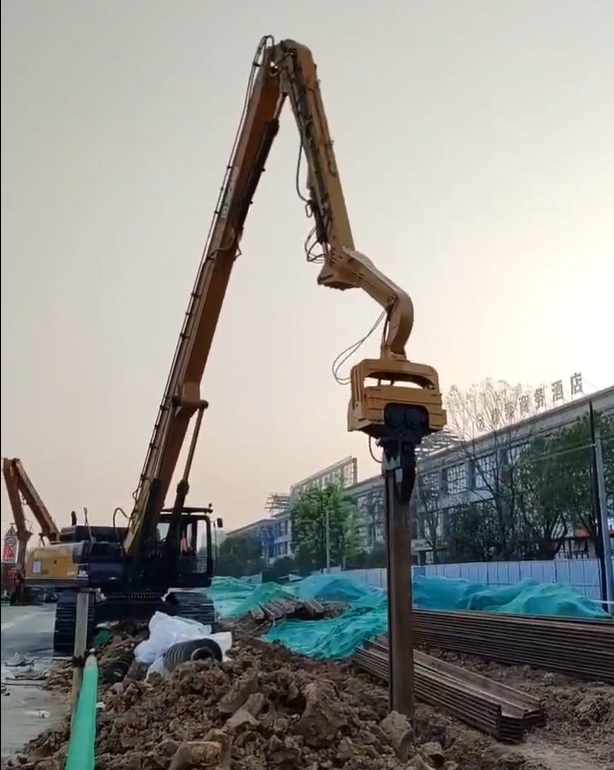
A hydraulic pile driver of this type does not hammer. It uses the excavator's hydraulic power to drive a motor that turns eccentric shafts at high speed. The horizontal forces of the shafts cancel each other out, while the vertical forces superimpose into a high-frequency vertical vibration. That vibration liquefies the soil around the pile and reduces friction between pile and ground, so the excavator's own force can drive the pile in — or extract it — completing installation and removal for foundation projects.
This is why attachment selection is a soil-and-structure question as much as a tonnage question. VIBRA's stated working conditions for this application are regular conditions in solid soil, clay, sand and comparable common geological environments, and the equipment must be mounted on an excavator or a crane. The same product range is described by the manufacturer as suitable for pile foundation engineering and foundation pit support engineering, with reported use across watercourse embankments, house foundations, municipal networks and bridges, and with broader full-scenario positioning that includes narrow-space work, photovoltaic pile foundations, hard geology and overseas export projects.
Demand context supports the same conclusion: pile foundations remain one of the most widely used deep foundation solutions, and commercial research estimates put the global pile driving equipment market at roughly USD 1.9 billion in 2024 with a projection toward USD 2.7 billion by 2030 — a direction-of-travel figure rather than a hydraulic-driver-specific number. For a buyer, the practical reading is that both models sit in a category where the base machine, not the attachment alone, sets the real working envelope.
What the FV-800 and FV-900 Share
Three shared values remove several usual points of debate.
- Maximum clamp force: 565 kN on both models. Grip capacity on sheet pile and H beam sections is therefore not a differentiator between them.
- Operating pressure: 32 MPa on both models. Neither requires a higher-pressure hydraulic circuit than the other.
- Identical dimensions: 1642 mm length, 806 mm width, 2898 mm height. Transport footprint, container planning and mounting clearance are the same, so logistics is not a reason to pick one over the other.
Both are also described as 360-degree, four-eccentric units usable across pile foundation and foundation pit support scopes. Once those shared values are set aside, the real comparison reduces to four rows: pile length, carrier class, force, and hydraulic flow.
Where the Two Models Actually Diverge
1. Maximum pile length: 27 m against 32 m
This is the specification that decides project feasibility. The FV-800 states a maximum pile length of 27 m; the FV-900 states 32 m. On a sheet pile wall, a foundation pit support run, or an H beam row where the design depth sits between 28 m and 32 m, the FV-800 is outside its stated range and the FV-900 is inside it. Where the deepest pile is 24–27 m, both models are within range and the decision moves to carrier class and economics.
2. Carrier class: 75~85 t against 85~100 t
The FV-800 is designed for 75~85 ton excavators; the FV-900 for 85~100 ton machines. Because both attachments share clamp force and pressure, the carrier difference is driven by the mass being carried and the hydraulic volume being supplied, not by grip. A contractor whose fleet is built around 80 ton class excavators is, in practice, already pointed at the FV-800. A contractor running 90–100 ton carriers has the base machine the FV-900 was written for.
3. Centrifugal force, eccentric moment and frequency
The FV-800 states 14.5 kg·m eccentric moment, 997 kN centrifugal force at a vibration frequency of 2500 rpm. The FV-900 states 16.8 kg·m eccentric moment and 1064 kN centrifugal force at 2400 rpm. In plain terms, the larger eccentric moment of the FV-900 converts into higher force at a lower stated frequency, while the FV-800 runs a higher frequency with a smaller eccentric mass. Neither figure should be read on its own: driving behaviour also depends on the pile section, the soil, and how much hydraulic flow the carrier can deliver.
4. Hydraulic flow and attachment weight
Both models operate at 32 MPa, but the FV-800 states a work flow of 420 L/min while the FV-900 states 460 L/min. Weight follows the same pattern: the FV-800 lists a 1100 kg arm and 4200 kg hammer, the FV-900 a 1200 kg arm and 4350 kg hammer. Those differences are small on paper and significant at the moment you check whether an existing excavator can actually feed and carry the attachment.
A Six-Step Selection Sequence for Piling Projects
The sequence below converts the specification differences into a repeatable procurement check. It works for foundation pit support, bridge and municipal work, and for export projects where the carrier and the attachment are bought from different suppliers.
- Fix the pile schedule first. Record maximum pile length, pile type (sheet pile, H beam, tubular, photovoltaic foundation pile) and the deepest design depth. If the maximum exceeds 27 m, the FV-800 is no longer a candidate.
- Match the carrier class. Confirm the excavator tonnage against 75~85 t (FV-800) or 85~100 t (FV-900). If the carrier sits below 75 t, neither heavy-duty model applies — the smaller side-grip units, SV-200 for 20~25 t carriers and SV-400 for 32~40 t carriers, are the appropriate starting point.
- Check hydraulic supply, not just pressure. Both models need 32 MPa, but the FV-900 states 460 L/min against 420 L/min for the FV-800. Confirm the carrier's available flow at working pressure before committing.
- Confirm grip against the pile section. Both models state 565 kN maximum clamp force. Verify that the clamp configuration offered suits the sheet pile or H beam profile you will actually drive.
- Check site conditions and handling. Both machines must be mounted on an excavator or crane. For confined-space work — under bridges, inside pit walls, along municipal corridors — confirm the working radius and the transport route against the 1642 × 806 × 2898 mm envelope, which is identical for both models.
- Validate with one unit before scaling. A single-unit order is possible, units are 100% tested before shipment, customization covers color, brand logo, pile driver specifications and clamp types, and stated lead time is 30~45 days with a one-year warranty and remote support.
Project Scenarios: Which Model Fits Which Job
Foundation pit support and confined-space sheet pile work — FV-800
A construction contractor and piling company operating in China used one FV-800 unit for sheet pile driving in confined spaces under bridges. The unit ran for two years with stable operation and completed all pile driving tasks without delays; the reported highlights were low noise and narrow-space capability. That case maps directly onto the FV-800's design point: 27 m maximum pile length, 565 kN clamp force, 75~85 ton carrier, and a footprint identical to the larger model — which means access constraints do not force the bigger machine.
Longer piles and heavier carriers — FV-900
Where the design calls for piles between 28 m and 32 m, or where the fleet already includes 85~100 ton excavators, the FV-900 is the model whose stated range covers the work. Its higher eccentric moment and 1064 kN centrifugal force are matched to that longer pile length, and its 460 L/min flow requirement should be checked against the carrier before mobilization.
Photovoltaic and mixed-scenario work — confirm the configuration
VIBRA positions its range for full-scenario construction including photovoltaic pile foundations, narrow spaces, hard geology and overseas export projects, and photovoltaic clamp configurations appear in the product imagery. Because solar piling varies widely in pile section and embedment depth, the model choice should be confirmed against the specific photovoltaic pile drawing rather than assumed from the range description.

A note on scope
Both models are described for regular working conditions in solid soil, clay, sand and similar common geological environments. Neither datasheet claims suitability for every ground condition, and projects involving exceptionally hard geology should be reviewed with the manufacturer before the model is fixed. Likewise, the electric vibratory hammer line in the same portfolio serves buyers whose sites restrict diesel or hydraulic carrier operation — a separate selection question from this heavy-duty comparison.
Specification Comparison: VIBRA FV-800 vs FV-900
| Specification | VIBRA FV-800 | VIBRA FV-900 |
|---|---|---|
| Applicable excavator class | 75~85 t | 85~100 t |
| Max. pile length | 27 m | 32 m |
| Centrifugal force | 997 kN | 1064 kN |
| Eccentric moment | 14.5 kg·m | 16.8 kg·m |
| Vibration frequency | 2500 rpm | 2400 rpm |
| Max. clamp force | 565 kN | 565 kN |
| Operation pressure | 32 MPa | 32 MPa |
| Work flow | 420 L/min | 460 L/min |
| Arm weight | 1100 kg | 1200 kg |
| Hammer weight | 4200 kg | 4350 kg |
| Length × width × height | 1642 × 806 × 2898 mm | 1642 × 806 × 2898 mm |
| Product type | 360-degree, four-eccentric, photovoltaic, side-grip capable | 360-degree, four-eccentric, photovoltaic, side-grip capable |
Read the table in this order: pile length, carrier class, work flow, then force. Buyers who start at centrifugal force will find a difference small enough to dismiss, and the two specifications that actually determine whether the machine can do the job will sit unread at the top of the sheet.

Frequently Asked Questions
- Do the FV-800 and FV-900 have different hydraulic or regulatory requirements?
- Hydraulically, both models state the same 32 MPa operating pressure, so neither demands a higher-pressure circuit than the other. They differ in work flow: 420 L/min for the FV-800 and 460 L/min for the FV-900, so the carrier's available flow must be checked model by model. Both must be mounted on an excavator or a crane. On the regulatory side, requirements follow the project country rather than the model — in the United States, dedicated pile drivers fall under OSHA 1926.1439 — so confirm local mounting and operating rules before mobilization.
- What actually changes between 997 kN and 1064 kN of centrifugal force?
- Centrifugal force is the product of eccentric moment and rotational speed, so the two models reach their figures differently. The FV-800 pairs a 14.5 kg·m eccentric moment with 2500 rpm to reach 997 kN. The FV-900 pairs a larger 16.8 kg·m eccentric moment with 2400 rpm to reach 1064 kN. Both models state the same 565 kN maximum clamp force. Because the force figures sit close together, neither number should be used alone to predict driving performance — pile section, soil condition and carrier hydraulic supply all affect the outcome.
- Does the larger model cost more to own and operate?
- No price data is stated for either model here, so the honest answer is a specification answer rather than a cost answer. The FV-900 requires an 85~100 ton carrier instead of 75~85 t, calls for 460 L/min instead of 420 L/min, and carries more attachment mass — 4350 kg hammer plus 1200 kg arm, against 4200 kg plus 1100 kg. Those three facts normally drive the commercial difference, because they change the base machine and the hydraulic capacity the project must supply. Request a project-specific quotation rather than comparing list figures across different carrier assumptions.
- Can we validate a single unit before ordering more?
- Yes. The minimum order quantity is one set, and single-model production capacity is stated at 20 sets per month. Every unit is 100% tested before shipment. Customization is available on color, brand logo, pile driver specifications and clamp types, and each unit carries a one-year warranty with remote support. A single-unit trial on a representative pile length is the most reliable way to confirm the model before fleet procurement.
- What is the lead time, and what information do we need to send?
- Stated lead time is 30~45 days. To get an accurate model recommendation, send four items: maximum pile length, pile type (sheet pile, H beam, tubular or photovoltaic pile), carrier excavator tonnage, and available hydraulic flow at working pressure. With those four inputs, the choice between the FV-800 and FV-900 is normally resolved in a single exchange — and if the carrier sits below 75 t, the recommendation will move to the smaller SV-200 or SV-400 instead.
Conclusion: Buy the Pile Length, Then Confirm the Carrier
The FV-800 and FV-900 are not competing versions of the same machine; they are two points on a pile-length curve. The FV-800 covers piles up to 27 m on 75~85 ton excavators. The FV-900 extends that to 32 m on 85~100 ton excavators. Between them, clamp force, operating pressure and physical dimensions do not change, so neither machine is easier to transport, easier to grip with, or simpler to plumb than the other. The only question that matters is whether the pile on your drawing is longer than 27 m and whether the excavator in your yard is heavier than 85 t.
Answer those two questions honestly and the decision is finished. Answer them from memory, and the risk moves to the site — where a pile that cannot be driven to depth, or a carrier that cannot feed the attachment, costs far more than the difference between two models.
Next Step: Confirm the Model Against Your Pile Drawing
Send your maximum pile length, pile type, carrier tonnage and hydraulic flow, and the VIBRA team at Shanghai Yekun Construction Machinery Co., Ltd. will confirm whether the FV-800 or FV-900 fits the project — or recommend a smaller unit if the carrier class does not support either.
Brochure and full specification pack: download the VIBRA hydraulic pile driver catalogue (PDF)
Email: leon_lee@vibracn.com | Tel / WhatsApp: +86 13918742829 | Start a WhatsApp enquiry
Website: www.hydraulic-piledriver.com

Hydraulic pile driverFV-800FV-900Sheet pile drivingH beam pilingSolar pilingVIBRA
Have Questions or Need More Details?
Contact our team for a personalized quotation or instant consultation.
Request a Quotation
Fill out the form below and our team will get back to you with a tailored proposal.
WhatsApp Direct Chat
Prefer to chat in real-time? Message us on WhatsApp for instant assistance & quick answers.
- Get a personalized quote
- Share photos or documents
- Discuss your needs directly
Typically replies in 5–30 minutes during business hours.