FV-900 vs FV-800: Choosing a Hydraulic Pile Driver for 85-Ton Excavators

Two VIBRA models sit in the same corner of the specification sheet: the FV-800 and the FV-900. Both are four eccentric hydraulic pile drivers, both are built from high-strength steel, and both list 85-ton excavators inside their compatibility window. For a contractor whose fleet includes an 85-ton carrier, that overlap is the entire problem. There is no obvious winner and no obvious loser — there is a set of specification lines that point in one direction or the other, and a couple of lines that point nowhere at all.
Short answer: the FV-800 is rated for 75–85 ton excavators, delivers 997 kN of centrifugal force and drives piles up to 27 m. The FV-900 is rated for 85–100 ton excavators, delivers 1064 kN and drives piles up to 32 m. The FV-800 runs the higher vibration frequency (2500 rpm against 2400 rpm) and needs less hydraulic flow (420 L/min against 460 L/min). Pile length and carrier hydraulics decide the choice; force, frequency and weight follow from that.
Why 85 Tons Is the Hardest Point in the Range to Specify
Most attachment selection follows a simple sequence: match the tool to the carrier, then match the carrier to the job. In the VIBRA heavy range that sequence works cleanly almost everywhere except at 85 tons. The FV-800 covers 75 to 85 tons. The FV-900 covers 85 to 100 tons. A 75-ton machine has one correct answer. A 100-ton machine has one correct answer. An 85-ton machine has two models that both claim it.
Three practical problems flow from that overlap.
- Reading tonnage as the only variable. Excavator class is the entry condition, not the decision. Two specification lines that buyers check first — operating pressure and maximum clamp force — are identical on both models: 32 MPa and 565 kN. Neither can be used to separate the FV-800 from the FV-900.
- Under-specifying pile length. The FV-800 is rated to a maximum pile length of 27 m. The FV-900 is rated to 32 m. A project that needs to drive or extract piles beyond 27 m falls outside the FV-800's stated envelope, no matter how well the carrier matches.
- Ignoring hydraulic flow. The FV-800 requires 420 L/min of working flow; the FV-900 requires 460 L/min. Hydraulic vibratory drivers take their power from the carrier's hydraulic system, so the carrier's auxiliary output has to cover the rated flow of the attachment, not just its weight.
At exactly 85 tons, both models sit inside their stated excavator range. The tie-breaker is not the class label. It is the flow the carrier can actually deliver and the pile length the project actually needs.
How a Hydraulic Pile Driver Works — and What Both Models Share
Pile foundations are one of the most widely used deep foundation solutions in construction, according to peer-reviewed research on pile foundation design published in the journal Buildings. Installation equipment divides into several drive modes, including diesel hammers, vertical travel lead systems, hydraulic hammers and hydraulic press-in machines. The FV-800 and the FV-900 belong to the hydraulic vibratory branch of that category, alongside side grip, 360-degree and photovoltaic pile drivers.
The working principle is consistent across the category. The excavator's hydraulic power drives a hydraulic motor, which rotates eccentric shafts in opposite directions at high speed. The horizontal components of those forces cancel each other out, so no horizontal vibration is transmitted; the vertical components superimpose to generate high-frequency vertical vibration. That vibration travels through the clamps into the pile, liquefies the surrounding soil and changes its structural state, which reduces the friction between pile and soil. The excavator's own force then drives the pile into the ground or extracts it.
VIBRA's FV series technical overview describes the vibratory approach as a replacement for traditional pile driving methods, and reports a comparison in which a 30 m pile that could take up to an hour with a traditional driver can be installed in ten minutes or less with a vibratory hammer. Those figures come from the manufacturer's own technical material and describe category-level performance, not a model-to-model benchmark between the FV-800 and the FV-900.
The wider market context is expansionary. Commercial research on pile driving equipment estimates the global market at roughly USD 1.9 billion in 2024, moving toward about USD 2.7 billion by 2030. That figure covers the whole pile driving equipment category rather than hydraulic vibratory drivers alone, so it should be read as directional demand context rather than a hydraulic-specific forecast.
Regulatory framing matters as well. In the United States, OSHA 1926.1439 sets requirements for dedicated pile drivers, and parts of that standard are tied to equipment manufactured after 8 November 2011. Whether a given machine falls inside that definition depends on how the equipment is configured and used on site.
FV-800 and FV-900 in Detail
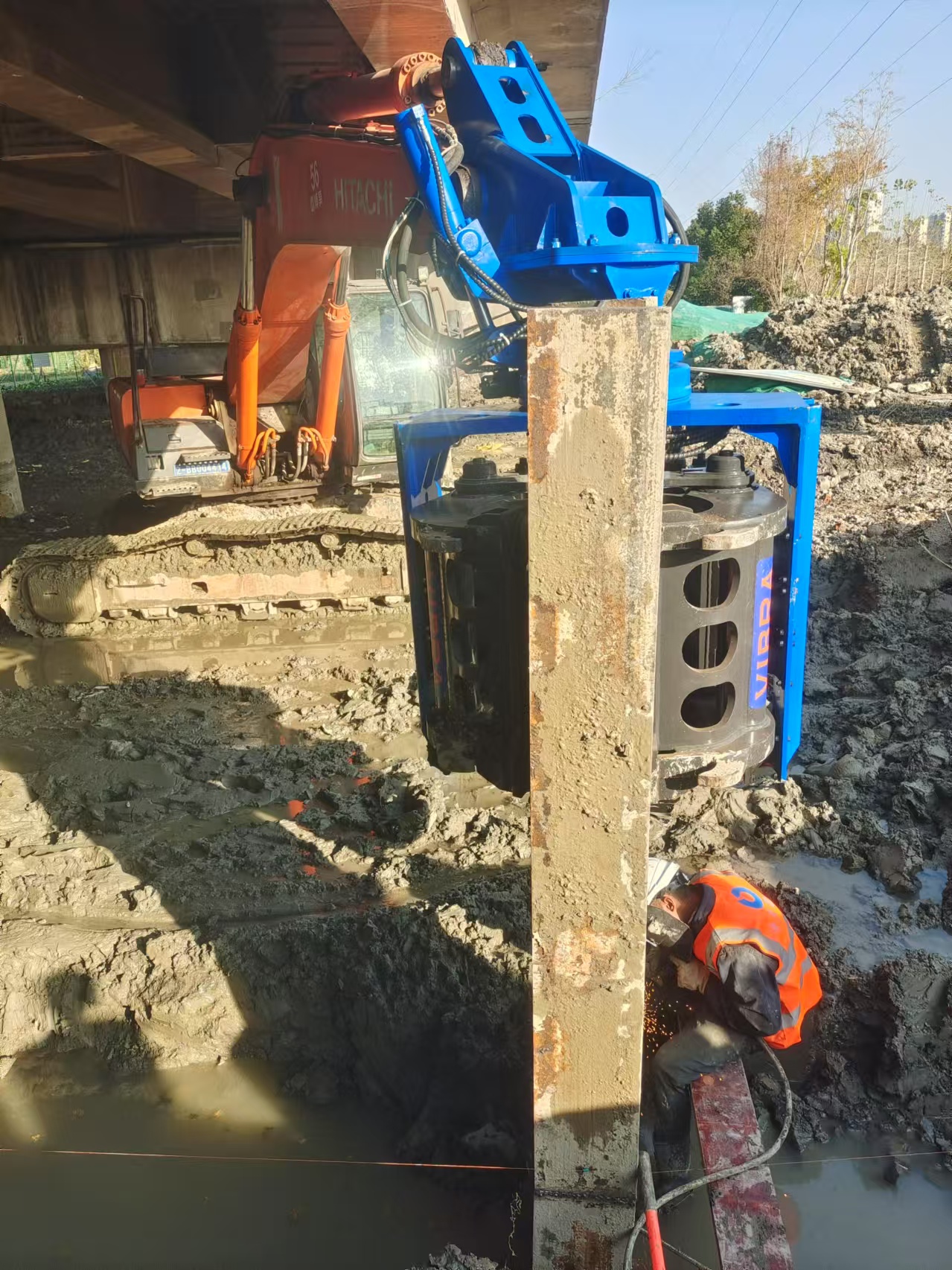
FV-800 — the 75–85 ton four eccentric driver
The FV-800 is a hydraulic pile driver designed for excavators in the 75 to 85 ton class. It produces a centrifugal force of 997 kN at a vibration frequency of 2500 rpm, with an eccentric moment of 14.5 kg·m. Maximum pile length is 27 m and maximum clamp force is 565 kN. The hammer weighs 4200 kg and the arm 1100 kg. Overall dimensions are 1642 mm in length, 806 mm in width and 2898 mm in height. The hydraulic system runs at an operating pressure of 32 MPa with a working flow of 420 L/min. Like the rest of the heavy range, the FV-800 is manufactured from high-strength steel and is classified as a 360-degree pile driver, four eccentric pile driver, photovoltaic pile driver and side grip pile driver.
FV-900 — the 85–100 ton four eccentric driver
The FV-900 is a heavy-duty hydraulic pile driver aimed at excavators from 85 to 100 tons. Centrifugal force rises to 1064 kN and maximum pile length extends to 32 m, with an eccentric moment of 16.8 kg·m and a vibration frequency of 2400 rpm. Maximum clamp force remains 565 kN at an operating pressure of 32 MPa, but the working flow requirement increases to 460 L/min. The hammer weighs 4350 kg and the arm 1200 kg. Length, width and height are identical to the FV-800 at 1642 mm, 806 mm and 2898 mm. It shares the same high-strength steel construction and the same 360-degree, four eccentric, photovoltaic and side grip classification.
Where the two models actually diverge
- Centrifugal force — 997 kN on the FV-800, 1064 kN on the FV-900. This is the force the driver transmits into the pile.
- Maximum pile length — 27 m on the FV-800, 32 m on the FV-900. This is the specification line that most often eliminates one model outright.
- Vibration frequency — 2500 rpm on the FV-800, 2400 rpm on the FV-900. Frequency and force are a matched pair set by the eccentric assembly; reading either number in isolation gives a misleading picture.
- Working flow — 420 L/min on the FV-800, 460 L/min on the FV-900. This is the constraint that has to be checked against the carrier rather than against the project.
- Hammer and arm weight — 4200 kg and 1100 kg on the FV-800; 4350 kg and 1200 kg on the FV-900.
Operating pressure (32 MPa), maximum clamp force (565 kN) and overall dimensions (1642 × 806 × 2898 mm) are the same on both models. Three of the specification lines most frequently compared by buyers therefore provide no basis for choosing between them.
Specification Comparison: FV-800 vs FV-900
| Specification | FV-800 | FV-900 |
|---|---|---|
| Applicable excavator class | 75–85 t | 85–100 t |
| Centrifugal force | 997 kN | 1064 kN |
| Vibration frequency | 2500 rpm | 2400 rpm |
| Eccentric moment | 14.5 kg·m | 16.8 kg·m |
| Maximum pile length | 27 m | 32 m |
| Maximum clamp force | 565 kN | 565 kN |
| Operation pressure | 32 MPa | 32 MPa |
| Work flow | 420 L/min | 460 L/min |
| Hammer weight | 4200 kg | 4350 kg |
| Arm weight | 1100 kg | 1200 kg |
| Dimensions (L × W × H) | 1642 × 806 × 2898 mm | 1642 × 806 × 2898 mm |
| Material | High-strength steel | High-strength steel |
| Product classification | 360-degree / four eccentric / photovoltaic / side grip pile driver | 360-degree / four eccentric / photovoltaic / side grip pile driver |
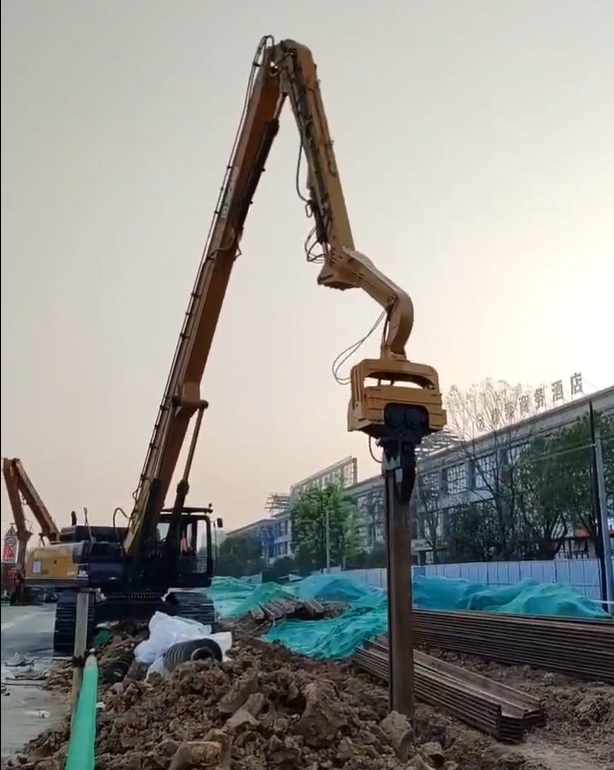
Step-by-Step: Selecting Between the FV-800 and the FV-900
Step 1 — Confirm the carrier's real operating weight
Class designations are nominal. Establish the configured operating weight of the excavator, then test it against the FV-800 window of 75–85 t and the FV-900 window of 85–100 t. Machines below 85 t belong to the FV-800 range; machines above 85 t belong to the FV-900 range. At exactly 85 t, keep going through the remaining steps.
Step 2 — Check the auxiliary hydraulic flow
Both models run at 32 MPa, so pressure does not separate them. Flow does. A carrier capable of 420 L/min matches the FV-800 requirement. The FV-900 requires 460 L/min, so a carrier that can only supply 420 L/min falls short of the rated figure for that model.
Step 3 — Fix the pile length requirement first
If the deepest pile in the project exceeds 27 m, the FV-800 sits outside its rated maximum and the FV-900's 32 m envelope becomes the relevant one. Settling this number early prevents a specification that looks correct on tonnage alone.
Step 4 — Disregard the shared specifications
Maximum clamp force is 565 kN on both models, operating pressure is 32 MPa on both, and the physical envelope at 1642 × 806 × 2898 mm is identical. None of these lines can be used as a tie-breaker.
Step 5 — Weigh transport, lifting and support implications
The FV-900 carries a 4350 kg hammer and a 1200 kg arm, against 4200 kg and 1100 kg on the FV-800. On projects where carrier stability, lifting capacity or transport logistics are tight, that difference belongs in the calculation.
Step 6 — Confirm site, soil and regulatory conditions
Both models are intended for common geological environments such as solid soil, clay and sand, and both need to be mounted on excavators or cranes. Where projects fall under specific national safety regimes — for example OSHA 1926.1439 for dedicated pile drivers in the United States — confirm applicability against the actual configuration before mobilising.
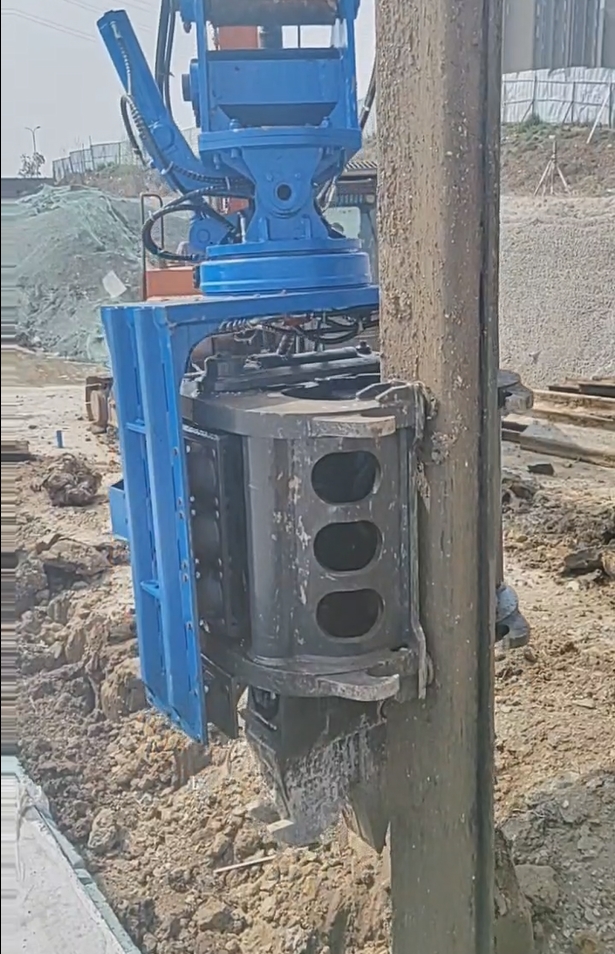
Where Each Model Fits on Site
Foundation pits and sheet pile driving
Sheet pile driving and extraction is the primary duty for both models. In this application the FV-800 covers projects where the working pile length stays within 27 m, while the FV-900 is the option where 32 m of pile length is required or where the carrier is an 85–100 ton machine.
Embankments, watercourse works, bridges and municipal networks
VIBRA pile drivers are reported as used in watercourse embankment, house foundation, municipal network and bridge construction. These applications typically involve mixed pile profiles rather than a single type, which makes the driver's ability to handle steel plate, steel tube, H-steel, cement sheet and wooden piles relevant to selection.
Photovoltaic (solar) piling
Both models are classified in VIBRA's product taxonomy as photovoltaic pile drivers, alongside their 360-degree, four eccentric and side grip functions. That places them inside solar piling work as well as conventional foundation and foundation pit support projects.
Pile types and regional deployment
VIBRA lists its hydraulic vibrating pile drivers as capable of driving cement sheet, steel plate, steel tube, H-steel and wooden piles. The company's pile driving application profile is most common in Vietnam, Russia, Sri Lanka, India, Indonesia and China, which aligns with its stated major markets: Southeast Asia, India, Singapore, Indonesia, Russia and Sri Lanka.

Frequently Asked Questions
Are the FV-800 and FV-900 covered by specific pile driver safety regulations?
In the United States, OSHA 1926.1439 addresses dedicated pile drivers, and parts of that standard are tied to equipment manufactured after 8 November 2011, including the load weighing device provision in 1926.1416(e)(4). Whether an excavator-mounted hydraulic vibratory attachment falls within the definition of a dedicated pile driver depends on how the machine is configured and operated on site. Contractors should confirm applicability with the manufacturer and their own safety team for the specific project before mobilising.
What force and pile length can each model deliver?
The FV-800 produces 997 kN of centrifugal force at 2500 rpm and is rated to a maximum pile length of 27 m. The FV-900 produces 1064 kN at 2400 rpm and is rated to a maximum pile length of 32 m. Both models share a maximum clamp force of 565 kN and an operating pressure of 32 MPa.
Beyond the attachment itself, what affects the cost of a configuration?
Two specification lines shape the wider commercial picture. The first is hydraulic flow: 420 L/min for the FV-800 and 460 L/min for the FV-900, which determines whether a given carrier can run the attachment at its rated parameters or whether a different machine is needed. The second is weight: a 4350 kg hammer plus a 1200 kg arm on the FV-900, against 4200 kg and 1100 kg on the FV-800, which feeds into lifting, transport and support planning. Both models operate at 32 MPa. Pricing is quoted against the specific model, carrier and destination market rather than published as a fixed figure.
How can a contractor validate the match before ordering?
Validation is a specification exercise before it is anything else. Confirm the carrier's real operating class against the 75–85 t FV-800 window and the 85–100 t FV-900 window. Confirm the auxiliary flow the carrier can supply against 420 L/min and 460 L/min. Confirm the deepest pile in the project against 27 m and 32 m. Where a configuration sits close to a boundary, ask the manufacturer to review the machine-and-project combination directly, including any customisation required for the carrier.
What determines delivery timing?
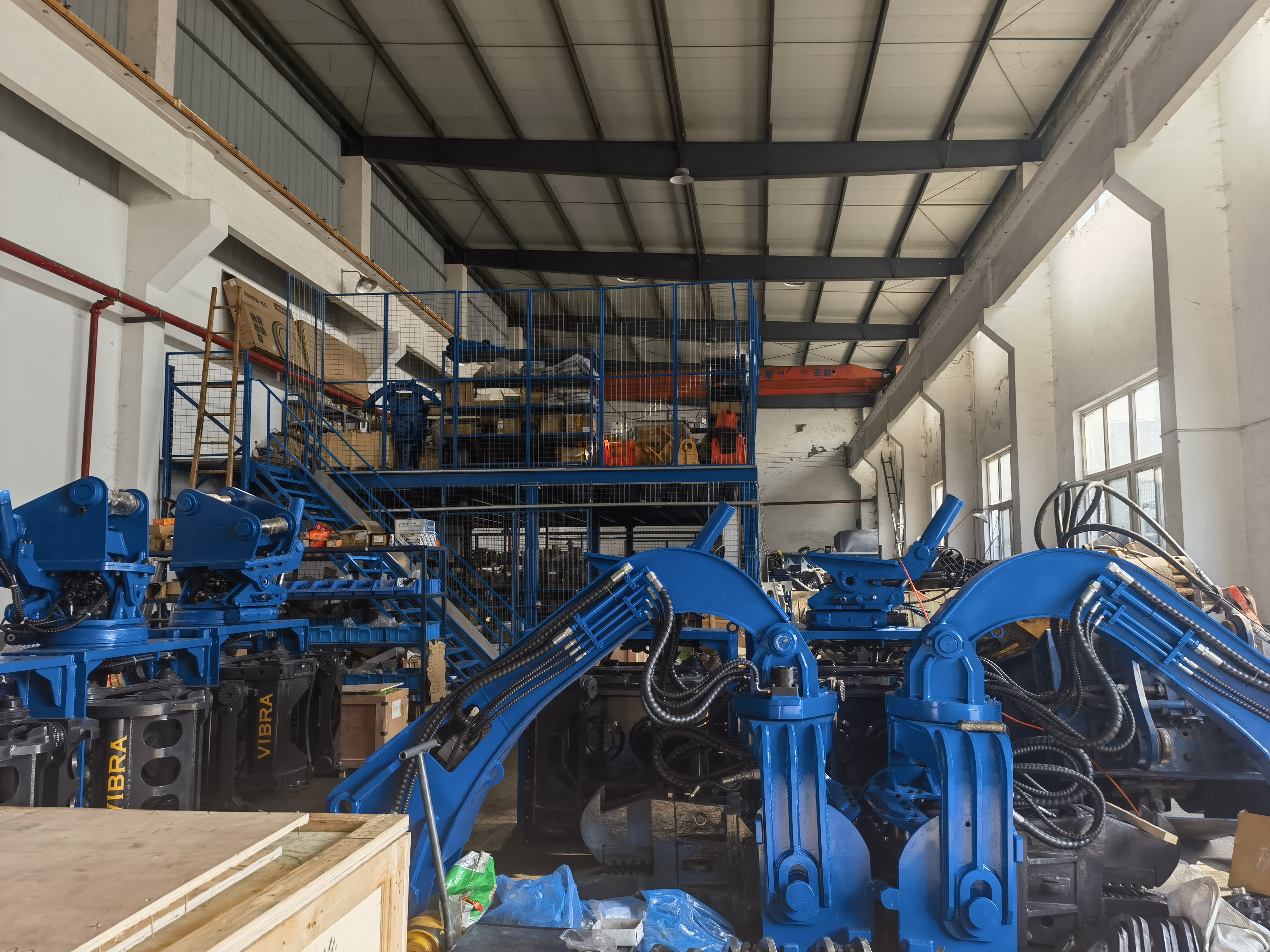
Delivery depends on the configuration ordered and the destination market. Manufacturing takes place at a 2,600 m² facility with an annual production capacity of approximately 500 units, and export orders account for about 30% of total sales. For a specific model and destination, the fastest route is a direct schedule confirmation with manufacturer Shanghai Yekun Construction Machinery CO., LTD., the company behind the VIBRA brand — the contact details and the downloadable product brochure are listed at the end of this page.
Conclusion: A Two-Question Decision
The FV-800 and the FV-900 are not competing answers to the same question. The FV-800 is the four eccentric hydraulic pile driver for 75–85 ton carriers, with 997 kN of centrifugal force, 2500 rpm and up to 27 m of pile length. The FV-900 is the same architecture scaled to 85–100 ton carriers, with 1064 kN, 2400 rpm and up to 32 m. What they share — 32 MPa operating pressure, 565 kN maximum clamp force and an identical 1642 × 806 × 2898 mm envelope — is precisely what cannot be used to decide between them.
Practical selection therefore reduces to two checks. What is the deepest pile the project will require, and what flow can the excavator on site actually deliver? If the answer is 27 m or less with 420 L/min available, the FV-800 fits. If the project needs up to 32 m, or the carrier is an 85–100 ton machine capable of 460 L/min, the FV-900 is the model for the job.
Getting a Configured Answer for Your Machine
Send the excavator class, the auxiliary hydraulic flow of the carrier and the deepest pile length in the project, and VIBRA will confirm which model fits and what the configuration includes.
Manufacturer: Shanghai Yekun Construction Machinery CO., LTD. (brand: VIBRA)
Website: https://www.hydraulic-piledriver.com/
Product brochure (PDF): Download the VIBRA hydraulic pile driver catalogue
Email: leon_lee@vibracn.com / 1057503478@qq.com
Tel / WhatsApp: +86 13918742829
Founded in 2009, the company designs and manufactures vibratory pile driving and extracting equipment, with a 2,600 m² manufacturing facility, approximately 500 units of annual production capacity, and export sales representing about 30% of total business.
Have Questions or Need More Details?
Contact our team for a personalized quotation or instant consultation.
Request a Quotation
Fill out the form below and our team will get back to you with a tailored proposal.
WhatsApp Direct Chat
Prefer to chat in real-time? Message us on WhatsApp for instant assistance & quick answers.
- Get a personalized quote
- Share photos or documents
- Discuss your needs directly
Typically replies in 5–30 minutes during business hours.