From 20 to 100 Tons: A Hydraulic Pile Driver Recommendation List for Excavator Matching
When the carrier machine is already on site, choosing a hydraulic pile driver at the wrong weight class is one of the most expensive mistakes on a foundation programme. Sorted from the lightest carrier class upward, this recommendation list matches four VIBRA models to the excavators they were built for: the SV-200 for 20–25 ton excavators, the SV-400 for 32–40 ton excavators, the FV-800 for 75–85 ton excavators, and the FV-900 for 85–100 ton excavators. Centrifugal force across the four runs from 459 kN to 1,064 kN.

VIBRA pile driving equipment is produced by Shanghai Yekun Construction Machinery Co., Ltd., a manufacturer established in 2009.
VIBRA is the pile driving equipment brand of Shanghai Yekun Construction Machinery Co., Ltd., a Chinese manufacturer founded in 2009 that designs, builds and services vibratory pile driving and extraction equipment. The company reports a 2,600㎡ production base, an annual output of 500 units, and an export share of roughly 30% of production, with markets including Southeast Asia, India, Singapore, Indonesia, Russia and Sri Lanka.
The shortlist, in order of carrier class:
- SV-200 — 20–25 ton excavators, 459 kN centrifugal force, 385 kN bottom clamp
- SV-400 — 32–40 ton excavators, 656 kN centrifugal force, 520 kN bottom clamp
- FV-800 — 75–85 ton excavators, 997 kN centrifugal force, 565 kN maximum clamp
- FV-900 — 85–100 ton excavators, 1,064 kN centrifugal force, 565 kN maximum clamp
These four ratings cover four defined bands, not a continuous sweep from 20 to 100 tons. An excavator sitting between the bands — say 28 tons or 55 tons — should be confirmed directly against the manufacturer’s current model catalogue rather than inferred from this list.
Problem definition: why carrier tonnage, not driver size, sets the match
Excavator tonnage is a shorthand for two physical limits that decide whether a pile driver can be used safely: the machine’s ability to stay stable under an offset load at the end of the stick, and its ability to deliver the hydraulic flow the attachment needs. A driver rated above the carrier’s class stresses both limits at once. The machine risks instability when a long pile is lifted, and the hydraulic system is asked to work outside the range the attachment was designed around.
The reverse error is quieter but equally costly. Fitting a light driver to a heavy carrier does not damage the excavator, but it caps the work the machine can do: the clamp closes on smaller pile sections and the centrifugal force available at the pile head is lower than the carrier could otherwise support. Buyers who pick by carrier class first, then verify force and clamp against the actual pile schedule, avoid both failure modes.
The four ratings in this list therefore matter in a fixed order. Carrier tonnage narrows the field to one model. Centrifugal force at that rating then decides whether the model suits the soil and pile section. Clamp capacity decides whether the pile can be held and extracted cleanly. Only after those three checks does it make sense to talk about attachments, rotation or commercial terms.
Industry background: why tonnage-led selection has become the normal entry point
Vibratory driving has moved from an alternative method to a default one in many foundation programmes because the time difference against conventional impact driving is large. VIBRA’s own FV series technical overview states that a 30 m long pile that could take up to an hour with a traditional pile driver can be driven in 10 minutes or less with a vibratory hammer. That compression is what pushes contractors to specify a vibratory attachment in the first place — and once they do, the attachment has to be matched to a carrier they already own or plan to buy.
The market context reinforces the same logic. A commercial research estimate places the global pile driving equipment market at approximately USD 1.9 billion in 2024, expanding toward roughly USD 2.7 billion by 2030. That figure covers pile driving equipment as a whole rather than the hydraulic vibratory segment specifically, but the direction is relevant to buyers: more units in service means more contractors fitting attachments to existing excavator fleets rather than buying dedicated piling rigs.
Regulation adds a third layer. In the United States, dedicated pile drivers fall under OSHA 1926.1439, which applies the provisions of subpart CC to dedicated pile drivers and sets out, among other things, that the load weighing device provision at 1926.1416(e)(4) applies only to dedicated pile drivers manufactured after 8 November 2011. Buyers importing equipment into the US market should treat that date-based distinction as a specification question, not an administrative one.
Detailed solution: the four models, matched to their carrier classes
VIBRA’s product range covers hydraulic impact hammers, side grip pile drivers, 360 degree rotation pile drivers, four eccentric pile drivers, electric vibratory hammers, hydraulic pile drivers and DD type guide-rod diesel vibratory hammers. The four models below sit inside that range and are distinguished principally by carrier class, centrifugal force and clamp rating.

VIBRA operates a 2,600㎡ production base with an annual output of 500 units and works with carriers from XCMG, Sany and Hyundai Construction Equipment.
SV-200 — 20–25 ton excavators, 459 kN centrifugal force, 385 kN bottom clamp
The SV-200 is the lightest model on this list and the only one intended for the 20–25 ton carrier band. Its 459 kN centrifugal force and 385 kN bottom clamp place it in the class of work where the carrier is small enough to enter restricted sites but still needs a clamp that closes firmly on the pile. Typical fit: urban renovation plots, boundary and retaining works, and lighter sheet pile or H beam runs where access is the binding constraint rather than pile mass.
The bottom clamp figure matters more here than on the larger models. On a 20–25 ton carrier, the clamp is the component that determines whether the machine can hold and extract a pile without the operator working against the attachment’s limits. A 385 kN bottom clamp is the specification to check against the heaviest section in the pile schedule before confirming the SV-200.
SV-400 — 32–40 ton excavators, 656 kN centrifugal force, 520 kN bottom clamp
The SV-400 steps up both figures: 656 kN centrifugal force and a 520 kN bottom clamp on a 32–40 ton carrier. The jump in clamp capacity is proportionally larger than the jump in force, which is what allows this model to take on heavier pile sections than the SV-200 while still working from a mid-size excavator rather than a dedicated rig.
This is the band where sheet pile and H beam work becomes routine. The 656 kN centrifugal force gives enough driving energy for standard sections in the soil conditions these carriers typically encounter, and the 520 kN clamp means the same attachment can extract as well as drive. For contractors running a mixed programme of retaining walls, cofferdams and foundation piling with one carrier, the SV-400 is the natural single-machine answer in the mid range.
FV-800 — 75–85 ton excavators, 997 kN centrifugal force, 565 kN maximum clamp
The FV-800 crosses into heavy-duty territory. A 997 kN centrifugal force on a 75–85 ton carrier is roughly a 52% increase over the SV-400’s 656 kN, and the 565 kN maximum clamp is a 45 kN step above the SV-400’s bottom clamp rating. That combination is aimed at longer and heavier piles where the mid-range models would either stall or work at the edge of their clamp capacity.
Note the terminology shift from “bottom clamp” on the SV models to “maximum clamp” on the FV models. When comparing quotations, buyers should confirm that clamp figures are being quoted on the same basis, because a maximum clamp rating and a bottom clamp rating are not automatically interchangeable comparison points.
FV-900 — 85–100 ton excavators, 1,064 kN centrifugal force, 565 kN maximum clamp
The FV-900 shares the FV-800’s 565 kN maximum clamp but raises centrifugal force to 1,064 kN on an 85–100 ton carrier. That is the single most useful decision fact in this list: between the FV-800 and the FV-900, clamp capacity is not the differentiator. The difference is driving energy, supported by a heavier carrier class.
Where the two overlap, at 85 tons, the choice comes down to the pile and ground conditions rather than the clamp. A programme with larger sections, longer piles or stiffer ground justifies the FV-900’s additional 67 kN of centrifugal force. A standard programme on an 85 ton carrier can be served by the FV-800 without paying for force the work does not need.
Step-by-step breakdown: confirming the match before you commit
The list above narrows the decision to one or two candidates. Five checks confirm it.
- Read the carrier’s operating weight, not its model name. Excavator model designations vary between manufacturers and configurations. Use the operating weight in tonnes and compare it against the band: 20–25, 32–40, 75–85 or 85–100 tons.
- Match centrifugal force to the pile and ground. At the correct carrier class, the force figure decides whether the model can drive the specified section. If a heavier section is planned later in the programme, size for the heaviest section rather than the first one.
- Check the clamp figure against the pile schedule. Confirm whether the quoted number is a bottom clamp or a maximum clamp rating and make sure every quotation is normalised to the same definition before comparing.
- Confirm hydraulic flow and the mounting interface. Ask the manufacturer to confirm that the carrier’s hydraulic output and attachment interface sit inside the model’s specified range. This is a manufacturer confirmation step, not something to estimate from the excavator brochure alone.
- Write pile length, rotation and tilt requirements into the specification. VIBRA’s range includes a 360 degree rotation pile driver as a distinct product, so rotation and tilt are attachment-level choices rather than assumptions. State pile length and any rotation or tilt requirement in the RFQ, and confirm that the frame’s high-strength steel construction is specified for the loads involved.
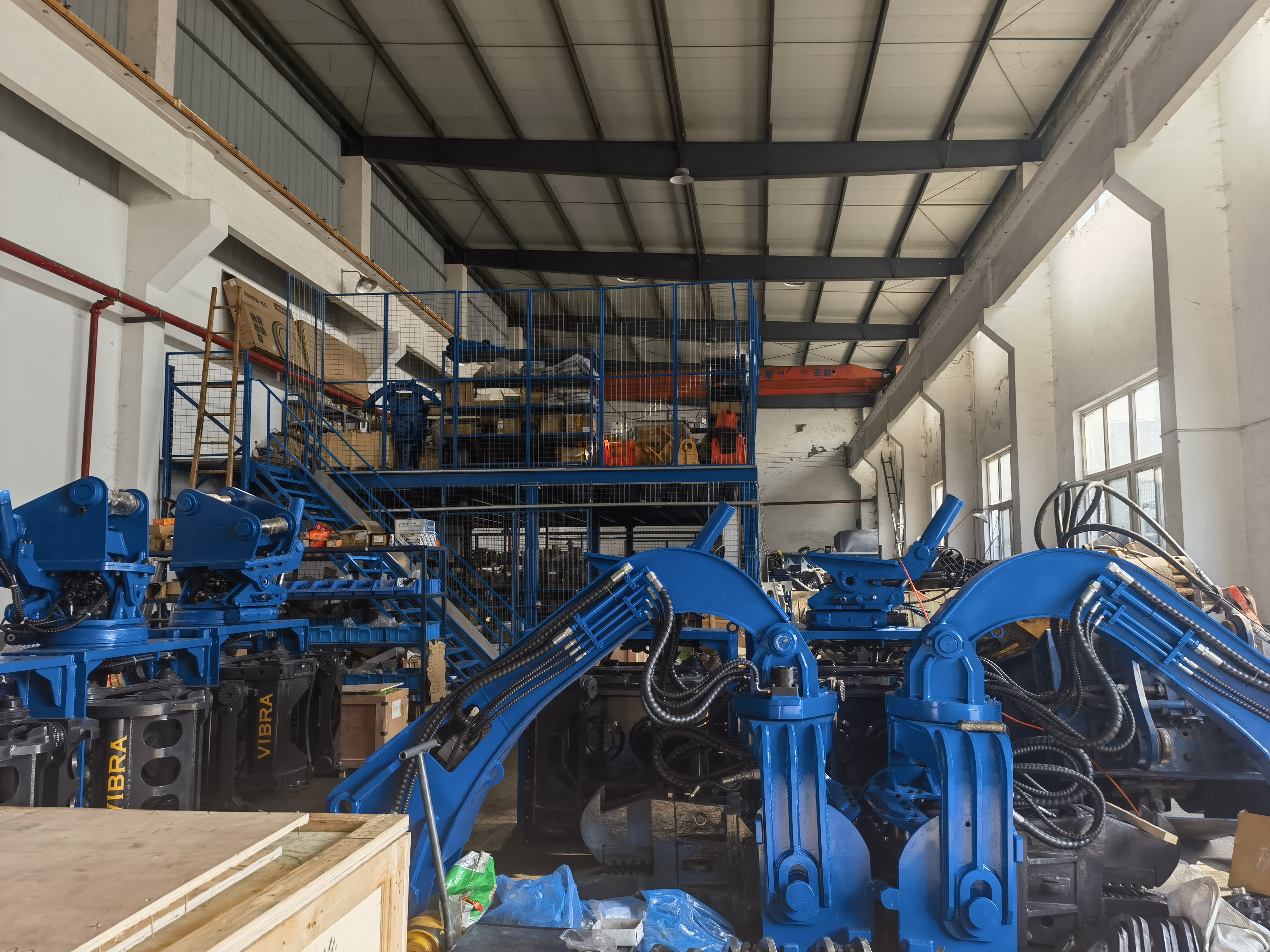
All VIBRA products undergo pre-delivery inspection; a free replacement service applies within 12 months from the date of commissioning.
Use cases: what each carrier class actually does on site
Sheet pile retention with a mid-size carrier
The SV-400’s 32–40 ton band is where most sheet pile retention, cofferdam and trench support work sits. VIBRA’s product listings confirm the range is capable of driving cement sheet, steel plate, steel tube, H steel and wooden piles, so a contractor running mixed pile types from one carrier does not need to change attachment between them.
H beam and steel tube foundation work
H steel and steel tube are both named in VIBRA’s stated pile type coverage. On larger sections, the FV-800 becomes the entry point for 75–85 ton carriers, and the FV-900 for 85–100 ton machines where force rather than clamp capacity is the limiting factor.
Solar piling and light steel support structures
Solar mounting foundations generally rely on driven steel tube, which falls inside the confirmed pile type coverage. Because these runs are long and repetitive rather than individually heavy, the selection question is usually carrier availability and cycle time rather than clamp capacity — which tends to push the choice toward the SV-200 or SV-400 rather than the FV series.
Bridges, watercourse embankments and municipal networks
VIBRA’s company documentation lists watercourse embankments, house foundations, municipal networks and bridges among the construction fields its pile drivers serve. The heavier end of that list — bridge and embankment work — is where the FV-800 and FV-900 carrier classes are typically deployed.
Comparison table: the four models side by side
| Rank | Model | Matched excavator class | Centrifugal force | Clamp rating | Selection logic |
|---|---|---|---|---|---|
| 1 | SV-200 | 20–25 t | 459 kN | 385 kN bottom clamp | Smallest carrier class; access-constrained sites and lighter pile sections |
| 2 | SV-400 | 32–40 t | 656 kN | 520 kN bottom clamp | Mid-size single-machine solution for sheet pile and H beam programmes |
| 3 | FV-800 | 75–85 t | 997 kN | 565 kN maximum clamp | Heavy-duty work where longer and heavier piles exceed mid-range capacity |
| 4 | FV-900 | 85–100 t | 1,064 kN | 565 kN maximum clamp | Highest force in the list; clamp unchanged from FV-800, so force and ground conditions decide |
Clamp figures are quoted as published: bottom clamp for the SV models, maximum clamp for the FV models. They should not be treated as directly interchangeable without confirmation.
Frequently asked questions
Which safety regulation applies to these hydraulic pile drivers in the US market?
Dedicated pile drivers in the United States fall under OSHA 1926.1439, which applies the provisions of subpart CC to dedicated pile drivers. The standard also specifies that the load weighing device provision at 1926.1416(e)(4) applies only to dedicated pile drivers manufactured after 8 November 2011. Buyers importing into the US should confirm the manufacture date and the applicable provisions as part of the purchase specification, and should verify requirements for other destination markets separately.
Can a 75 ton excavator run the FV-900?
No. The FV-900 is rated for 85–100 ton excavators, and the FV-800 covers the 75–85 ton band. At exactly 85 tons the two overlap, and the decision moves to centrifugal force: the FV-900 delivers 1,064 kN against the FV-800’s 997 kN, while both share a 565 kN maximum clamp. Choose the FV-900 when the pile section, pile length or ground conditions require the additional force.
What drives the total cost of a matched pile driver package?
With the carrier class fixed, the main cost variables are the clamp configuration, the attachment options required for the pile schedule, and the after-sales terms. On the service side, VIBRA states that all products undergo strict pre-delivery inspection and that a free replacement service is provided within 12 months from the date of commissioning, supported by a dedicated after-sales team for technical support and spare parts supply. Those terms should be priced alongside the unit itself rather than treated as an afterthought.
How do we verify the fit before placing an order?
Send the excavator operating weight, hydraulic flow figures and the pile schedule — pile type, section and length — and have the manufacturer confirm which of the four models sits inside the specified range. Because these four ratings cover four defined bands, an excavator outside the bands needs a direct confirmation rather than an assumption. Buyers working through this step with VIBRA can send their carrier details and pile schedule through the VIBRA hydraulic pile driver site or by email to leon_lee@vibracn.com.
Conclusion: pick the carrier class first, then the force
For a 20–25 ton excavator, the SV-200 at 459 kN centrifugal force and 385 kN bottom clamp is the match. For 32–40 tons, the SV-400 at 656 kN and 520 kN. For 75–85 tons, the FV-800 at 997 kN and 565 kN maximum clamp. For 85–100 tons, the FV-900 at 1,064 kN with the same 565 kN clamp. Between the two FV models, clamp capacity is held constant, so force and ground conditions — not the clamp figure — are what separate them.
That ordering is the practical takeaway. Carrier tonnage eliminates three of the four options immediately; centrifugal force and clamp rating then confirm or reject the remainder against the pile schedule. Rotation, tilt and pile length are attachment-level variables that belong in the RFQ, and the frame’s high-strength steel construction should be confirmed against the loads the programme will actually impose.
Need the full specification set?
The VIBRA product brochure covers the SV and FV series alongside the rest of the range, including side grip, four eccentric and 360 degree rotation pile drivers. Download it here: VIBRA hydraulic pile driver brochure (PDF).
Shanghai Yekun Construction Machinery Co., Ltd. — Shanghai, China. Email: leon_lee@vibracn.com | Tel / WhatsApp: +86 13918742829
Have Questions or Need More Details?
Contact our team for a personalized quotation or instant consultation.
Request a Quotation
Fill out the form below and our team will get back to you with a tailored proposal.
WhatsApp Direct Chat
Prefer to chat in real-time? Message us on WhatsApp for instant assistance & quick answers.
- Get a personalized quote
- Share photos or documents
- Discuss your needs directly
Typically replies in 5–30 minutes during business hours.