Hydraulic Pile Driver Compliance: Specs to Verify Before Import
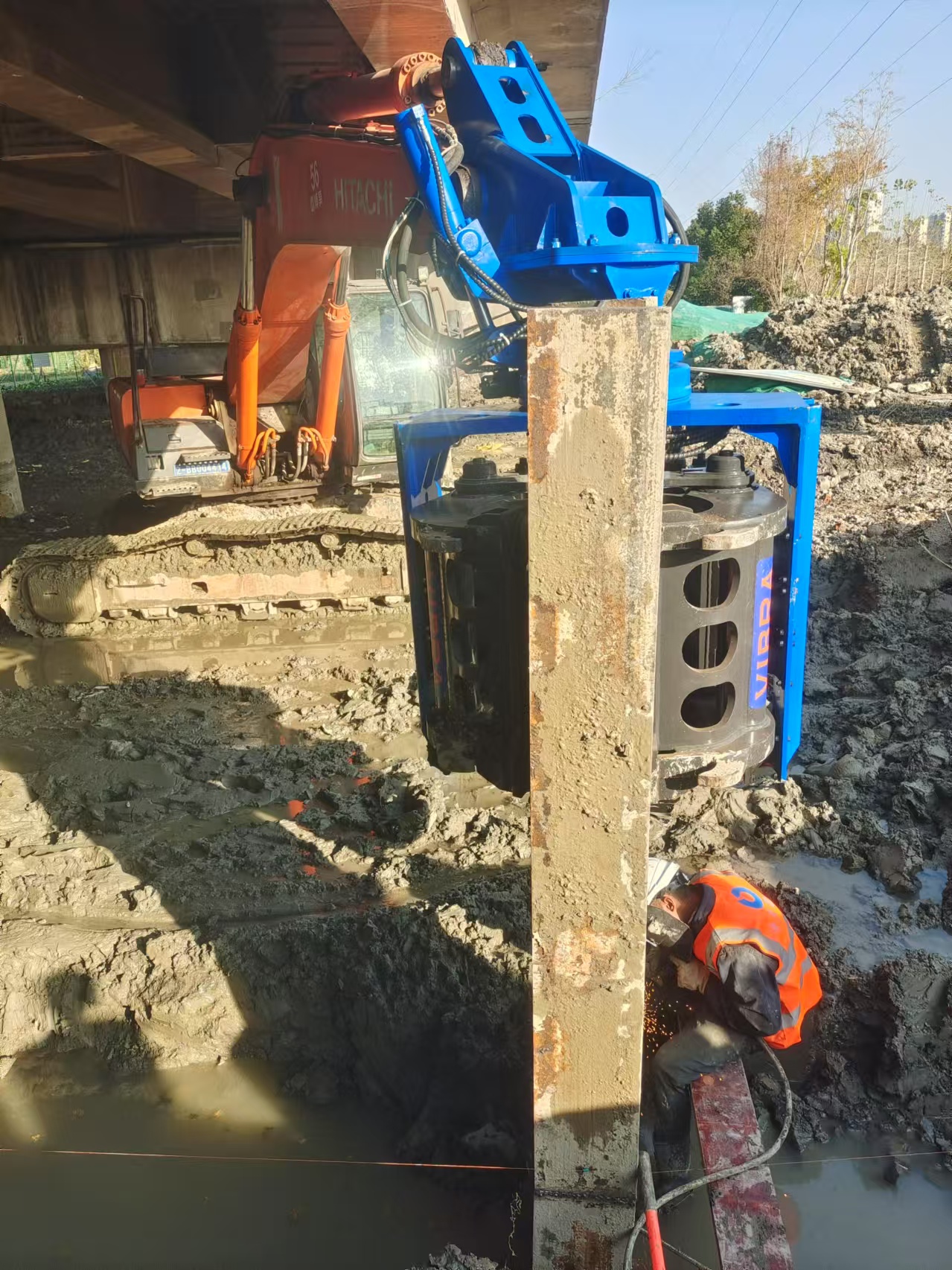
Sheet pile driving with a hydraulic pile driver in a confined space under a bridge — the kind of project where nameplate-to-datasheet matching matters before import.
Importing a hydraulic pile driver is a data-matching exercise, not a branding decision. The unit that arrives on site has to match the model, the rated hydraulic parameters, and the documentation set that your team approved. A mismatch found after the container is loaded is far more expensive to correct than a mismatch caught at the factory.
Four checks carry most of the compliance weight: rated operation pressure and hydraulic flow; vibration frequency and centrifugal force; the model-to-excavator match; and the document chain that ties a specific serial number to a specific datasheet. As a reference point, the VIBRA FV-900 hydraulic pile driver is rated at 2,400 rpm, 32 MPa operation pressure, 460 L/min work flow, and 1,064 kN centrifugal force. Those are the types of values a buyer should be able to confirm on the nameplate, the datasheet, and the pre-shipment test record.
What 'Compliance' Actually Means for an Imported Hydraulic Pile Driver
For pile driving equipment, compliance failures usually appear in three places. First, the headline number in a quotation, marketplace listing, or trade-show brochure may not match the model-level datasheet. Second, a supplier's ISO 9001 certificate proves that a quality management system has been certified for a defined scope; it does not by itself certify the performance of every model in the catalogue. Third, the acceptance criteria may be undefined, so there is no agreed point at which the buyer can formally reject a non-conforming unit.
A workable compliance review therefore separates three evidence layers: the certificate layer (who the manufacturer is and what scope is certified), the technical layer (what the specific model is rated to do), and the transaction layer (what will be tested, how, and against which document before dispatch).
That separation matters because a hydraulic pile driver is an excavator-mounted attachment. Its performance is a function of the carrier's hydraulic output as much as the attachment itself. A datasheet that lists operation pressure and flow allows the buyer to confirm that the base machine can actually feed the unit.
Industry Background: Why Specs and Standards Are Harder to Compare Than They Look
Piling machines are commonly grouped into diesel hammers, vertical travel lead systems, hydraulic hammers, and hydraulic press-in machines. Hydraulic vibratory pile drivers sit in the hydraulic family and use eccentric weights to generate vertical vibration, which reduces friction between the pile and the soil during driving.
The performance gap between traditional driving and modern vibratory driving is one reason buyers focus on frequency and force. The VIBRA FV series is described as a replacement for traditional pile drivers; a company source states that a 30 m pile that could take up to an hour with a traditional driver can be driven in 10 minutes or less with a vibratory hammer. That figure is source-reported, and it illustrates why buyers ask for frequency, centrifugal force, and flow rather than a single 'fast' claim.
Two terminology problems regularly appear in cross-region sourcing. Frequency may be expressed in rpm or in vpm (vibrations per minute), and force may be expressed in kN or in tons. A comparator unit, the J&M Model 26+335, is listed at a maximum frequency of 2,000 vpm, 115 kN centrifugal force, and 270 kN maximum crowd or extraction force. A different comparator, the Model S500 for 30-ton excavator mounting, is listed at 2,800 rpm and 450 kN. Neither listing is a VIBRA product, but both show how the same physical quantity can be written in different units and at different scales. Before comparing any two machines, normalize the units and confirm the definition of each term.
On the regulatory side, requirements are market-specific. In the United States, dedicated pile drivers fall under OSHA 1926.1439. Within that regulation, Section 1926.1416(e)(4) applies only to dedicated pile drivers manufactured after November 8, 2011 — a date-based provision that directly affects what a buyer of new or used equipment must verify. In other destination markets, the buyer should request the applicable declaration of conformity and the machinery safety documentation for the specific model, rather than assuming that a generic certificate covers the import.
Detailed Solution: The Verifiable Data Set to Require
A hydraulic pile driver datasheet should be built from rated, model-specific values rather than adjectives. The following fields are the minimum set for a meaningful cross-check:
- Vibration frequency (rpm)
- Eccentric moment (kg·m)
- Operation pressure (MPa)
- Work flow (L/min)
- Centrifugal force (kN)
- Maximum pile length (m)
- Maximum clamp force (kN)
- Arm weight and hammer weight (kg)
- Overall length, width, and height (mm)
- Applicable excavator class (t)
- Body material
Using VIBRA as a concrete example, the FV-900 is listed with a 2,400 rpm vibration frequency, 16.8 kg·m eccentric moment, 32 MPa operation pressure, 460 L/min work flow, 1,064 kN centrifugal force, 32 m maximum pile length, 565 kN maximum clamp force, 4,350 kg hammer weight, and 85–100 t applicable excavator class. The FV-800 is listed with 2,500 rpm, 14.5 kg·m, 32 MPa, 420 L/min, 997 kN, 27 m maximum pile length, 565 kN clamp force, 4,200 kg hammer weight, and 75–85 t excavator class.
The SV series side-grip models follow the same 32 MPa operation pressure but cover different flow and force ranges. The SV-200 is listed at 2,300–3,000 rpm, 4.6 kg·m, 170–230 L/min, 459 kN centrifugal force, 335 kN side clamp force, and 385 kN bottom clamp force for 20–25 t excavators. The SV-400 is listed at 2,300–3,000 rpm, 6.6 kg·m, 230–280 L/min, 656 kN centrifugal force, 465 kN side clamp force, and 520 kN bottom clamp force for 32–40 t excavators.
Reading the 32 MPa constant: the rated operation pressure of 32 MPa appears across the FV-800, FV-900, SV-200, and SV-400. The differentiators are flow, frequency, and centrifugal force. That is useful for procurement because the buyer can verify one hydraulic system assumption and then compare models on the variables that actually change with the project.
How to Handle 3,200 rpm and 435 kN Claims
Some buyer briefs ask for a 3,200 rpm hydraulic pile driver or a 435 kN hydraulic pile driver. Where those figures appear in a listing or a quotation, treat them as claims to be reconciled, not as approved specifications. Ask for the rated frequency on the nameplate and the definition of centrifugal force in the datasheet. The 435 kN class sits near the 450 kN benchmark of the comparator S500 unit, which is listed at 2,800 rpm for 30-ton excavator mounting, so the question is not whether such a class exists, but whether the specific machine you are buying is rated to it.
Marketplace listings are a useful warning here. Some VIBRA listings show 2,800 rpm and 265 kN for a model in the 20–30 t class, while the model datasheet for the FV-900 shows 2,400 rpm and 1,064 kN. Those are different models with different ratings; the point is that a headline number without a model identity cannot be verified. Compliance starts with the model code.
Certification and Documentation to Verify

The quality management system certificate is part of the documentation chain; it should be checked for number, scope, and validity date.
For Shanghai Yekun Construction Machinery CO., LTD., the manufacturer of VIBRA hydraulic pile drivers, the Certificate of Quality Management System Certification is numbered 11724QU0068-05R0S. It is issued by ICAS against GB/T 19001-2016 / ISO 9001:2015, issued on 2024-05-10 and valid until 2027-05-09. The certified scope is 'Manufacture of construction machinery (hydraulic pile driving & extracting machines) and spare parts,' and the listed markets include India, Southeast Asia, Vietnam, Thailand, Russia, and Sri Lanka.
During due diligence, verify four things on the certificate: the certificate number, the issuing authority, the scope statement, and the expiry date. Then confirm that the certificate is relevant to the model being purchased. A quality management certificate is a system-level document; the model-level evidence comes from the datasheet, the nameplate, and the test record.
Step-by-Step Breakdown: Cross-Checking Nameplate Against Datasheet
- Fix the project requirement first. Define the pile type (sheet pile, H beam, steel tube, cement sheet, or wooden pile), the target pile length, and the excavator class. This becomes the baseline for every later check.
- Request the model-level datasheet. Ask for the datasheet for the exact model code, not a catalogue page that covers a range.
- Request a nameplate photo before shipment. Compare model code, serial number, rated operation pressure, work flow, and vibration frequency against the approved datasheet.
- Verify the certificate scope and validity. Check the certificate number, issuer, scope, and expiry date, and confirm that the manufacturer name matches the contracting entity.
- Confirm the acceptance test. The stated acceptance criterion is a pre-shipment test, and the manufacturer states 100% test coverage. Agree in the purchase order what will be tested and what document will be issued.
- Normalize the units. Convert rpm and vpm to a single convention, and confirm whether force is stated as centrifugal force, excitation force, or crowd force. These are not interchangeable.
- Confirm commercial terms in writing. MOQ, delivery terms, payment schedule, and the point at which risk transfers should all be in the PO.
- Confirm lead time and capacity. Match the promised delivery date to the stated production capacity.
- Confirm after-sales terms. Clarify warranty duration, remote support scope, and spare-parts availability.
- Confirm customs classification with your broker. The importer is responsible for correct classification and duty assessment; the supplier's paperwork supports it but does not replace it.
Use Cases: Where Compliance Checks Change the Selection
Sheet Pile Driving in Confined Spaces
A construction contractor and piling company in China used one FV-800 unit for sheet pile driving in confined spaces under bridges. The equipment operated for two years, completing the pile driving tasks without delays; the recorded highlights were low noise and suitability for narrow space. For a similar project, the compliance check is dimensional and logistical: confirm the 1,642 mm length, 806 mm width, and 2,898 mm height, plus the arm and hammer weights, against the access route and the working envelope.
Solar Piling and H Beam Piling
The listed product configurations for these models include 360-degree, four-eccentric, photovoltaic (solar), and side-grip types. VIBRA products are described as capable of driving cement sheet, steel plate, steel tube, H-steel, and wooden piles, and reported applications include watercourse embankments, house foundations, municipal networks, and bridges.
If the project is a hydraulic pile driver for solar piling, the compliance question is clamp configuration and rated force relative to the solar pile section. If the project is a hydraulic pile driver for H beam, confirm that the clamp type and clamp force match the beam web and flange geometry. In both cases, the datasheet should state the clamp type and the rated clamp force — for example, 565 kN on the FV-800 and FV-900, or the side and bottom clamp ratings on the SV-200 and SV-400.
Compact and Lightweight Urban Work
When the requirement is a lightweight hydraulic pile driver or a compact hydraulic pile driver, compare the actual mass and dimensions rather than the marketing term. In the available data, the SV-200 is listed at 2,280 kg total weight for 20–25 t excavators, and the SV-400 at 3,870 kg for 32–40 t excavators. Those figures are the ones to check against the carrier and the site constraints.
Electric and Automatic Configurations
If the brief calls for an electric hydraulic pile driver or an automatic hydraulic pile driver, confirm the power source and control configuration on the model datasheet. The manufacturer's product line includes an Electric Vibratory Hammer alongside hydraulic impact hammers, side-grip pile drivers, 360-degree rotation pile drivers, and four-eccentric pile drivers. Because these are separate configurations, the compliance check is to match the requested configuration to the model code and to the nameplate, not to assume that one datasheet covers all variants.
High Reliability Expectations
High reliability is a buyer expectation, not a self-declared spec. The evidence to ask for is concrete: 100% test coverage, a pre-shipment acceptance test, a defined warranty period, and remote after-sales support. Those items can be written into the purchase order and verified at dispatch.

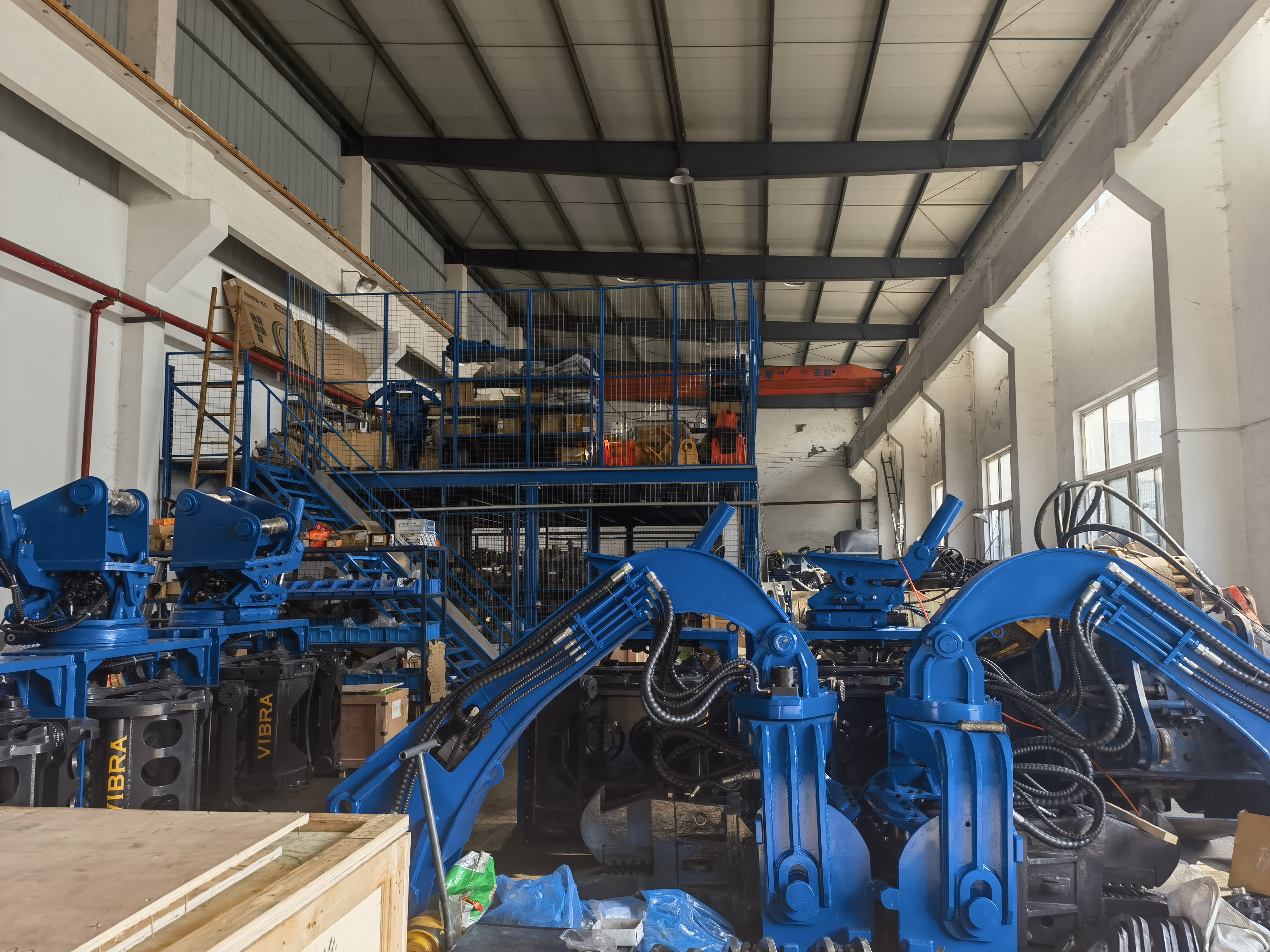
Production verification: the manufacturing base and inspection process are part of the evidence package a buyer can request during due diligence.
Model Specification Comparison
The table below uses model-specific values from the VIBRA hydraulic pile driver data. It is a verification reference, not a performance ranking.
| Model | Vibration Frequency (rpm) | Operation Pressure (MPa) | Work Flow (L/min) | Centrifugal Force (kN) | Max. Pile Length (m) | Clamp Force (kN) | Applicable Excavator (t) | Weight (kg) |
|---|---|---|---|---|---|---|---|---|
| FV-800 | 2,500 | 32 | 420 | 997 | 27 | 565 (max clamp) | 75–85 | Hammer 4,200; arm 1,100 |
| FV-900 | 2,400 | 32 | 460 | 1,064 | 32 | 565 (max clamp) | 85–100 | Hammer 4,350; arm 1,200 |
| SV-200 | 2,300–3,000 | 32 | 170–230 | 459 | Not stated in model data | Side 335; bottom 385 | 20–25 | 2,280 (total) |
| SV-400 | 2,300–3,000 | 32 | 230–280 | 656 | Not stated in model data | Side 465; bottom 520 | 32–40 | 3,870 (total) |
All four models are listed with high-strength steel construction and configurations covering 360-degree rotation, four-eccentric, photovoltaic (solar), and side-grip use. Eccentric moment values are 14.5 kg·m for the FV-800, 16.8 kg·m for the FV-900, 4.6 kg·m for the SV-200, and 6.6 kg·m for the SV-400.
Capability and Customization for Importers

OEM and ODM production allows color, brand logo, specification, and clamp-type customization — all of which should be fixed in writing before production.
For importers, distributors, and brand owners, the relevant capability facts are specific. The manufacturer provides OEM and ODM production services, with customization options covering color, brand logo, pile driver specifications, and clamp types. Monthly capacity is 20 sets per single model, MOQ is 1 set, and the standard lead time is 30–45 days. Quality control is stated as 100% test. After-sales support is remote support with a one-year warranty.
Shanghai Yekun Construction Machinery CO., LTD. was founded in 2009, operates a 2,600 ㎡ factory with 30 employees and an annual output of 500 units, and exports to markets including Southeast Asia, India, Singapore, Indonesia, Russia, and Sri Lanka. The company partners with XCMG, Sany, and Hyundai Construction Equipment and is an authorized supplier of pile drivers to XCMG and Hyundai. For a buyer evaluating execution capability rather than a single machine, those are the facts to verify — not the adjectives around them.
FAQ
Which certificate should I verify before importing a hydraulic pile driver?
Check the quality management system certificate and its scope. For Shanghai Yekun Construction Machinery CO., LTD., the certificate is numbered 11724QU0068-05R0S, issued by ICAS against GB/T 19001-2016 / ISO 9001:2015, issued on 2024-05-10 and valid until 2027-05-09. The scope covers manufacture of construction machinery (hydraulic pile driving & extracting machines) and spare parts, with listed markets including India, Southeast Asia, Vietnam, Thailand, Russia, and Sri Lanka. Confirm the number, scope, and expiry date, then ask whether the certificate applies to the specific model you are importing.
Can the hydraulic pile driver be customized for my brand and project?
Yes. The manufacturer provides OEM and ODM production services, with customization covering color, brand logo, pile driver specifications, and clamp types. Related models include the FV-800, FV-900, SV-200, and SV-400. Monthly capacity is 20 sets per single model, MOQ is 1 set, and lead time is 30–45 days. To confirm a configuration, provide the pile type (sheet pile, H beam, steel tube, cement sheet, or wooden pile), the target pile length, and the excavator class.
What are the purchasing and acceptance terms?
MOQ is 1 set. Delivery terms are FOB or CIF. The acceptance criterion is a pre-shipment test, and payment terms are 30% in advance with the balance before dispatch. These terms should be fixed in the purchase order before production begins.
How do I verify the machine matches the datasheet before shipment?
Request a nameplate photo and the pre-shipment test record; the manufacturer states 100% test coverage. Compare the model code, rated operation pressure, work flow, and vibration frequency on the nameplate against the approved datasheet. For the FV-900, the reference values are 2,400 rpm, 32 MPa, 460 L/min, and 1,064 kN centrifugal force. If the listing quoted a 3,200 rpm class or a 435 kN class unit, that figure should appear consistently across the datasheet, the nameplate, and the test record — or it should be corrected before dispatch.
What is the lead time and after-sales coverage?
Standard lead time is 30–45 days, with remote support and a one-year warranty. To move from evaluation to execution, request the model datasheet, a quotation, and the current brochure; a pre-shipment test can be agreed as the formal acceptance point.
Conclusion
Compliance for an imported hydraulic pile driver is built from verifiable machine data. The operation pressure, flow, frequency, centrifugal force, clamp force, weight, and dimensions should match across the quotation, the datasheet, the nameplate, and the pre-shipment test record. The certificate chain — number, issuer, scope, and validity — should be checked separately, because a management system certificate is not a model performance certificate.
For buyers moving from evaluation to execution, the practical sequence is straightforward: define the pile and carrier requirement, request the model datasheet, verify the nameplate and test record before dispatch, and fix the commercial and after-sales terms in the purchase order. VIBRA hydraulic pile drivers, manufactured by Shanghai Yekun Construction Machinery CO., LTD., provide a documented example of how that evidence can be assembled — from the 32 MPa operation pressure shared across the FV and SV series to the FV-900's 2,400 rpm and 1,064 kN ratings.
Request a Datasheet, Sample Discussion, or Quotation
Send your pile type, target length, and excavator class. You will receive the relevant model datasheet, current specification sheet, and commercial terms for review.
Website: www.hydraulic-piledriver.com
Brochure: Download the VIBRA hydraulic pile driver brochure (PDF)
Email: leon_lee@vibracn.com
WhatsApp / Tel: +86 13918742829
Have Questions or Need More Details?
Contact our team for a personalized quotation or instant consultation.
Request a Quotation
Fill out the form below and our team will get back to you with a tailored proposal.
WhatsApp Direct Chat
Prefer to chat in real-time? Message us on WhatsApp for instant assistance & quick answers.
- Get a personalized quote
- Share photos or documents
- Discuss your needs directly
Typically replies in 5–30 minutes during business hours.