Hydraulic Pile Driver Supplier Evaluation: Capacity & Delivery Signals
How to Evaluate a Hydraulic Pile Driver Supplier: Capacity, Consistency, and Delivery Signals
A hydraulic pile driver is only as reliable as the supplier behind it. At the decision stage, buyers do not lack brochures; they lack evidence. This guide sets out a supplier evaluation method built on observable production and delivery signals. It uses the VIBRA four-model lineup—SV-200, SV-400, FV-800, and FV-900—as a test case for checking whether a supplier genuinely covers multiple excavator classes, and it explains how published parameters such as clamp force, eccentric moment, and overall dimensions can serve as verification anchors.
Problem Definition: Why Supplier Evaluation Breaks Down
Supplier evaluation often fails because claims are not comparable. A supplier may say it covers 6–60 ton excavators, but the buyer needs to know which model covers which class, with what clamp force, eccentric moment, and overall dimensions. Without a model-by-model matrix, a broad range claim can hide gaps. The same problem applies to delivery: a quoted lead time is not a delivery signal unless it is tied to production capacity, component inventory, and order history.
Decision-stage buyers also face a second problem: published parameters are often presented without definitions. A clamp force figure, an eccentric moment value, and overall dimensions only become verification anchors when the supplier states the measurement basis, the model, and the operating condition. Otherwise, the buyer is comparing numbers that may not describe the same thing.
Industry Background: What Buyers Are Actually Comparing
Hydraulic pile drivers are used in sheet pile, H beam, solar piling, bridge, municipal, and foundation work. The equipment category includes diesel hammers, hydraulic hammers, and hydraulic press-in machines. For US projects, dedicated pile drivers must follow OSHA 1926.1439, which is a relevant compliance checkpoint when the project market is the United States.
Commercial research estimates the global pile driving equipment market at USD 1.9 billion in 2024, with a projection to USD 2.7 billion by 2030. That context explains why more suppliers are entering the category, but it does not tell a buyer which supplier can actually deliver a specific model, with consistent quality, on the promised date. Supplier evaluation must therefore focus on evidence that can be checked at the factory, in the documents, and in the delivery record.
Detailed Solution: Three Evidence Buckets
Use three evidence buckets: capacity, consistency, and delivery signals. Capacity is not just annual output; it is model coverage and the ability to document each model. Consistency is the supplier's quality system: pre-delivery inspection, warranty terms, and process control. Delivery signals are the observable facts that predict whether an order will arrive on time and to specification.
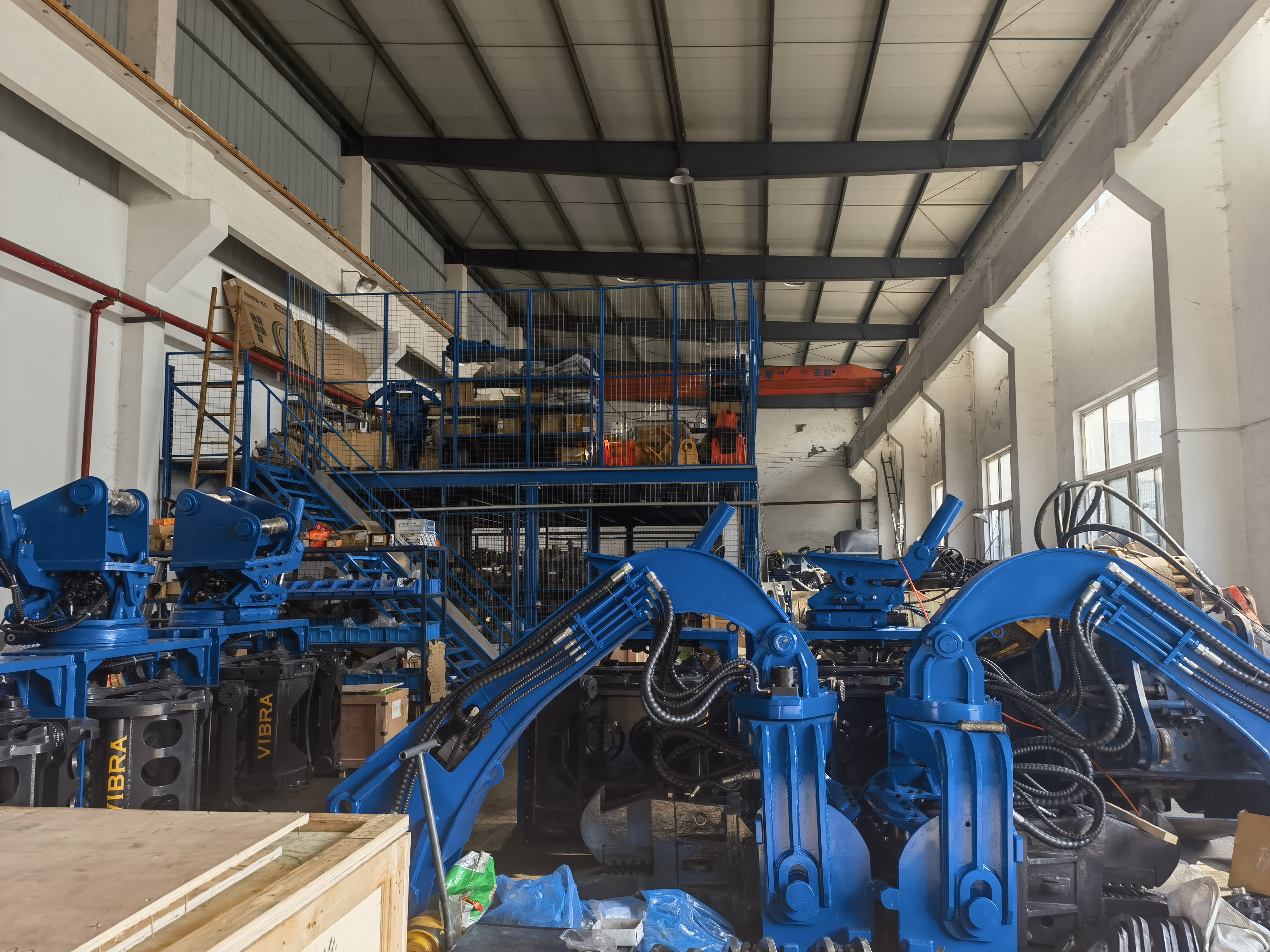
Shanghai Yekun Construction Machinery Co., Ltd. is a useful example of how specific facts can be checked. The company was founded in 2009 and operates a 2,600㎡ factory with 30 employees, an annual output of 500 units, and a 2-person R&D team. Its VIBRA brand exports about 30% of output to Southeast Asia, India, Singapore, Indonesia, Russia, Sri Lanka, and other markets. These facts are useful because they are specific and checkable. A buyer can ask for factory registration, production records, and export documents that correspond to these claims.
The four-model test case—SV-200, SV-400, FV-800, and FV-900—shows how to test a coverage claim. The model names alone do not prove coverage. The buyer should request a matrix with clamp force, eccentric moment, overall dimensions, excavator class, and maximum pile length for each model. If the supplier cannot provide the matrix, the range claim is not yet a capacity signal. The matrix also exposes overlap: two models may target the same excavator class, or a gap may appear between classes.
Published parameters serve as verification anchors only when they are defined. Clamp force tells the buyer how the attachment grips the pile; eccentric moment relates to vibration output; overall dimensions affect transport, lifting, and clearance. These values must be compared with the same definitions and test conditions. A number without a definition is not a verification anchor.

Step-by-Step Breakdown: How to Run the Evaluation
- Define the project envelope. Specify pile type, pile length, soil condition, excavator class, and the regulatory market. A supplier cannot answer a coverage question without these inputs.
- Request a model matrix. Ask for SV-200, SV-400, FV-800, and FV-900 to be listed with clamp force, eccentric moment, overall dimensions, excavator class, and maximum pile length. Require the same definitions for every model.
- Verify capacity. Check factory size, annual output, R&D team, and key component supply. Yekun states a 2,600㎡ factory, 500 units per year, and a 2-person R&D team. Ask for production records that support the stated output.
- Verify consistency. Ask for the pre-delivery inspection procedure and warranty terms. Yekun states that all products undergo strict pre-delivery inspection and that free replacement is provided within 12 months from the date of commissioning for parts aging.
- Verify delivery signals. Break lead time into production, testing, and shipping. Ask for the production schedule, key component inventory, and historical on-time delivery. The stated 30% export ratio is a useful starting point, but it should be supported by export documents.
- Cross-check. Compare the supplier's claims with documents, reference projects, and a factory visit. A claim that cannot be cross-checked should not enter the decision.
Use Cases: Matching the Evaluation to the Application
Sheet pile. Ask for pile-type compatibility. VIBRA listings state capability for cement sheet, steel plate, steel tube, H-steel, and wooden piles. Confirm that the clamp configuration and clamp force are suitable for the specific sheet pile section.
H beam. Confirm clamp force and jaw configuration for H beam. Do not assume that a sheet pile setup will work without a model-specific confirmation. Ask for the overall dimensions and lifting arrangement as well.
Solar piling. Confirm compact or lightweight configuration and excavator class. Ask for project references in solar piling and for the parameters that change when the attachment is used in repeated short-pile installation.
Narrow space. Check overall dimensions and side grip or 360-degree rotation options. Yekun's main products include side grip pile drivers, 360-degree rotation pile drivers, and four-eccentric pile drivers, which are relevant when clearance is limited.
Hard geology. Ask for four-eccentric high-frequency technology evidence and test data. Yekun states that its four-eccentric-shaft high-frequency vibration technology uses imported core components. The buyer should ask for the test conditions behind any performance claim.

Comparison Table: Evaluation Signals and Verifiable Evidence
| Evaluation dimension | What to request | Example of verifiable evidence | Red flag |
|---|---|---|---|
| Model coverage | Model matrix for SV-200, SV-400, FV-800, FV-900 | Written clamp force, eccentric moment, overall dimensions, excavator class, and maximum pile length for each model | Only a broad 6–60 ton claim without model mapping |
| Production capacity | Factory audit and annual output records | 2,600㎡ factory, 500 units per year, 30 employees (Yekun/VIBRA company facts) | No factory address or production records |
| Quality consistency | Pre-delivery inspection procedure and warranty terms | 12-month free replacement from commissioning for parts aging (Yekun risk-control statement) | Warranty not defined by date or scope |
| Delivery signal | Lead-time breakdown and export documents | 30% export ratio; markets include Southeast Asia, India, Singapore, Indonesia, Russia, and Sri Lanka | Lead time quoted without a production schedule |
| Application fit | Pile-type compatibility list and references | VIBRA listing states cement sheet, steel plate, steel tube, H-steel, and wooden piles | No pile-type or project reference |
FAQ
What compliance documents should a hydraulic pile driver supplier provide?
Ask for the documents that match the target market. For US projects, dedicated pile drivers must follow OSHA 1926.1439. For export markets, request conformity and certification documents, and verify that the certificate scope covers the model you are buying. VIBRA/Yekun states ISO certification support for export compliance. Do not accept a certificate that does not name the model or the applicable standard.
How can I verify that a supplier covers multiple excavator classes?
Request a model-by-model matrix. For the VIBRA lineup, ask for SV-200, SV-400, FV-800, and FV-900 to be listed with clamp force, eccentric moment, overall dimensions, excavator class, and maximum pile length. A supplier that truly covers multiple classes can show where each model sits. If the answer is only “6–60 tons,” the coverage claim is not yet verified.
What budget factors should be compared beyond the purchase price?
Compare the full cost of ownership: supporting equipment investment, fuel consumption, maintenance cost, spare parts, and residual value. Yekun’s comparison data states that its four-eccentric-shaft high-frequency technology can deliver 10–15% lower fuel consumption and 20–30% higher construction efficiency than Anteng Machinery under the same working conditions. Treat supplier-reported comparisons as a starting point and ask for the assumptions behind them.
Can I request a sample or trial before placing a bulk order?
Ask for a factory visit, a reference project, or a trial arrangement with defined test conditions. The supplier should state the pile type, soil condition, excavator class, and acceptance criteria. Yekun’s contact channel can be used to request a quote or trial discussion; the company lists Joe Feng at 1057503478@qq.com / leon_lee@vibracn.com and +86 13918742829.
What lead time and order consistency signals should I check?
Break the lead time into production, testing, and shipping. Ask for the production schedule, key component inventory, and historical on-time delivery. Yekun’s stated annual output is 500 units and export ratio is 30%. These facts are useful only if the supplier can support them with records. A consistent supplier can show how an order is tracked from deposit to shipment.
Conclusion: Ask for Evidence, Not Just Range Claims
Supplier evaluation is an evidence exercise. Capacity is proven by a model matrix, not a range claim. Consistency is proven by inspection, warranty, and process records. Delivery is proven by schedule, export history, and order tracking. Use the four-model test case—SV-200, SV-400, FV-800, and FV-900—to ask better questions, and ask for the documents behind every claim.
Next step: Download the VIBRA hydraulic pile driver brochure for model and company details: VIBRA brochure. For a quote or sample discussion, contact Shanghai Yekun Construction Machinery Co., Ltd. through hydraulic-piledriver.com.
Have Questions or Need More Details?
Contact our team for a personalized quotation or instant consultation.
Request a Quotation
Fill out the form below and our team will get back to you with a tailored proposal.
WhatsApp Direct Chat
Prefer to chat in real-time? Message us on WhatsApp for instant assistance & quick answers.
- Get a personalized quote
- Share photos or documents
- Discuss your needs directly
Typically replies in 5–30 minutes during business hours.