
A Technical Guide to Galvanized Steel Tubing in Indoor Playground Frames
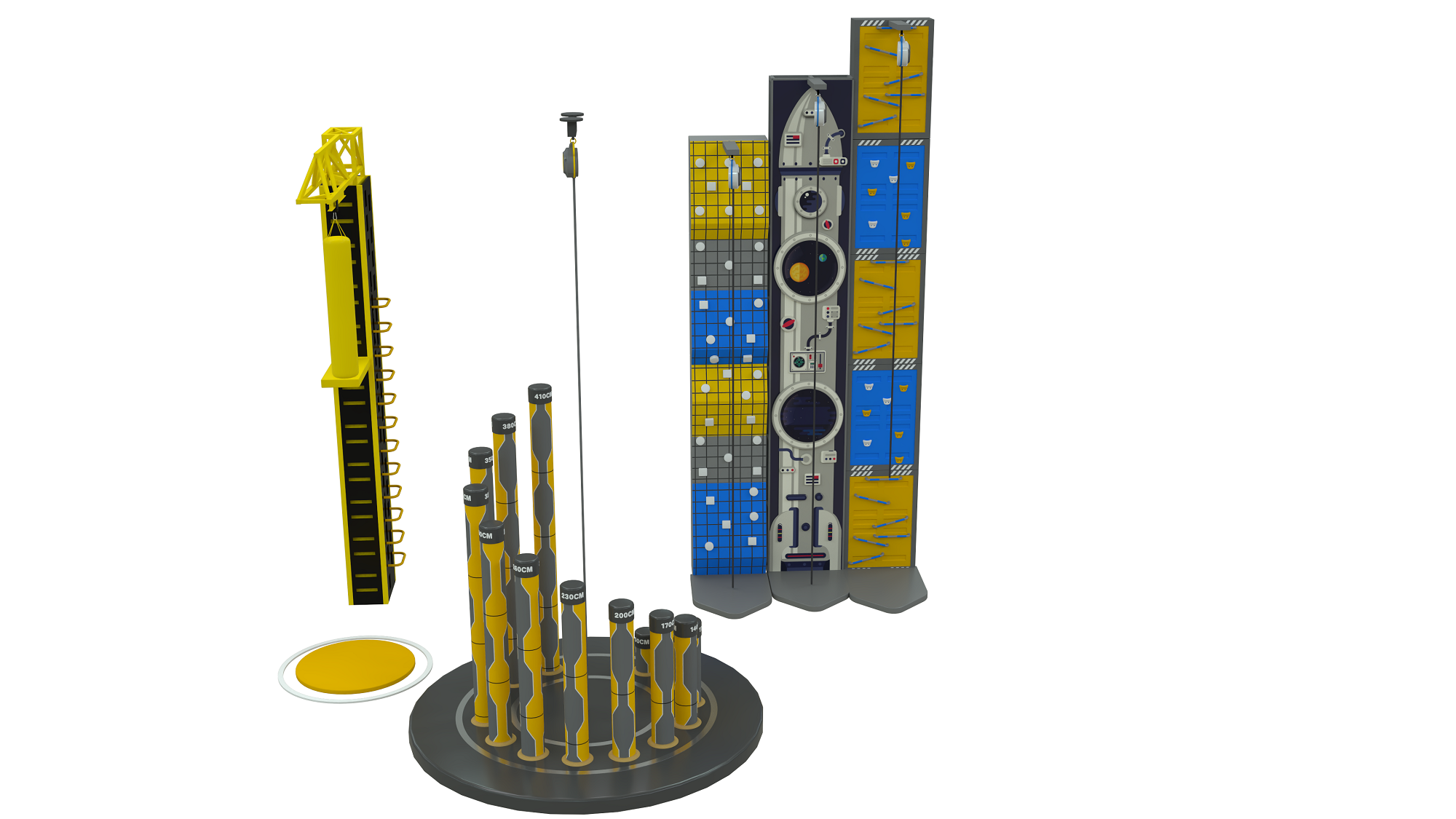
Galvanized steel tubing is the load-bearing skeleton of an indoor playground frame, and its specification — grade, section profile and wall thickness — decides how the finished structure behaves after years of daily use. In a real tubing schedule, two numbers carry most of that load: 50×80×3.0 mm Q235 galvanized rectangular steel tube for the main frame of the VS1-250522-1900B-30 climbing wall, and 80×80×2.0 mm Q235 galvanized rectangular steel tube for the upright posts of trampoline park structures such as VS6-190301-1980A-13-29.
This guide is written for buyers and engineers who are past first discovery and are now evaluating whether a supplier's frame will still be safe and serviceable in year five. It explains what Q235, galvanizing and rectangular hollow sections each contribute, how published dimensions translate into structural behaviour, and how to verify a tubing schedule before production begins.
Problem Definition: The Load-Bearing Part Is the One You Cannot See
Almost every visual element of an indoor playground is cosmetic or protective — themed panels, vinyl-covered foam, netting, slide surfaces. The steel frame underneath is what carries children, absorbs repeated impact and keeps geometry stable. Because it is hidden, it is also the easiest element to downgrade without the buyer noticing, and the most expensive element to correct after installation.
Frame-related problems in practice cluster into a small number of failure modes:
- Corrosion starting at joints and cut ends. A galvanized tube protects itself with zinc, but the coating is interrupted wherever the tube is cut, drilled or welded. Those points are where rust begins in humid indoor environments and where cleaning chemicals accelerate it.
- Reduced wall thickness that still looks correct. A 50×80×2.0 mm tube and a 50×80×3.0 mm tube are visually identical once assembled and padded, but they do not behave identically.
- Deflection and springiness at high-load points. Climbing wall anchor zones and trampoline post bases concentrate dynamic load far above what decorative frame sections ever see.
- Loosening under cyclic loading. Screw-fastened frames and coupler-based structures live with constant vibration; fastener quality determines whether the geometry drifts over time.
- Padding that conceals a structural fault. Protective sleeves, foam and PVC leather hide the frame until it is a rework cost on site, not a negotiation item at quotation stage.
The information asymmetry is the core procurement problem: a buyer evaluating photographs, renders and certificates cannot see wall thickness, coating condition or joint design. High-traffic venues make this worse — indoor play equipment is commonly specified for all-weather, high-traffic indoor use with 24/7 availability, manual supervision and low maintenance requirements, which means the frame accumulates cycles far faster than a residential or light-commercial structure would.
Industry Background: More Parks, Longer Hours, Stricter Standards
Demand growth explains why frame specification is becoming a formal evaluation criterion rather than a supplier detail. The global indoor playground equipment market was valued at USD 4.8 billion in 2025 and is projected to reach USD 9.2 billion by 2034, according to Dataintelo. Within that market, soft play equipment held the largest product type share at 31.4% in 2025, valued at approximately USD 1.51 billion, and Asia Pacific dominated with a 38.6% revenue share in 2025 (Dataintelo). The trampoline park segment is growing independently: Dimension Market Research expects the global trampoline park market to grow at a CAGR of 16.2%, reaching USD 3.96 billion by 2032.
More facilities, longer opening hours and heavier traffic all raise the number of load cycles a steel frame must survive. On the standards side, two frameworks set the compliance context:
- ASTM F1918 is the primary safety performance specification for soft contained play equipment in North America, focusing on entrapment and fire safety (ASTM International).
- EN 1176 Part 10 is the European standard covering fully enclosed play equipment such as soft play areas, within the harmonized EN 1176 series for playground equipment (CEN — European Committee for Standardization).
An important nuance for buyers: these standards define performance expectations for entrapment, fire behaviour, impact and structural integrity — they do not prescribe a specific tube dimension. That is exactly why a tubing schedule has to be requested and checked, and why two suppliers can both claim compliance while using very different steel.
Detailed Solution: What Q235 Galvanized Rectangular Tubing Actually Delivers
The grade: why Q235
Q235 is a structural carbon steel grade widely used in Chinese manufacturing for welded and bolted steelwork. The designation references a nominal minimum yield strength of 235 MPa, which is the property that matters structurally: yield strength defines the stress at which the tube begins to deform permanently instead of springing back. For a play structure, that is the difference between a frame that flexes under impact and one that stays true.
In VASIA's product specifications, frame members are stated as Q235 galvanized rectangular steel tube, and the verification route cited for the steel and for cast steel couplers is GB/T 228.1-2021, the Chinese standard for tensile testing of metallic materials. A buyer should treat that citation as a signal: the supplier is naming the test standard behind the material claim rather than only naming the material.
The coating: what galvanizing changes
Galvanizing protects steel in two ways at once. The zinc layer is a physical barrier between steel and moisture, and it also protects sacrificially — where the coating is scratched, the surrounding zinc corrodes preferentially and keeps the steel beneath intact until the coating is consumed. Inside an FEC, the main corrosion drivers are ambient humidity, condensation on cold steel, and repeated cleaning.
The practical consequence for specification is that galvanizing quality is only as good as its weakest point. Cut ends, drilled holes and field welds must be treated, and connections should not create permanent moisture traps. In soft play and playground structures, this is often solved at the hardware level: VASIA specifications call for stainless steel fasteners, some with protective plastic caps or anti-loosening washers, so children cannot contact exposed fasteners directly and the joint resists loosening under vibration.
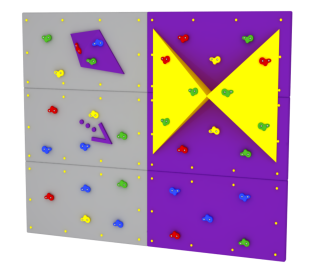
Climbing Wall for Playground VS-2659 uses a lighter Q235 galvanized rectangular steel tube frame at 40×40×1.5 mm — the section follows the load, not the catalogue page.
The geometry: how section size and wall thickness change behaviour
Rectangular hollow sections are not chosen for appearance. Three geometric decisions drive what a frame can do:
- Depth in the bending direction. Bending stiffness depends heavily on the dimension that runs in the direction of the load. Placing 80 mm of tube depth where a climbing wall transfers climber load into the frame is a deliberate engineering choice, not an arbitrary size.
- Wall thickness. Wall thickness governs local stability, bolt and thread bearing capacity, denting resistance, and the corrosion allowance available over the service life. Moving from 3.0 mm to 2.0 mm changes all four at once while looking the same from outside.
- Profile symmetry. Square sections such as 80×80×2.0 mm behave consistently in compression and lateral bending, which suits vertical posts. Round tubes such as φ48×2.0 mm work well with cast couplers, where the tube is clamped rather than bolted through a flange.
VASIA's published specifications show this logic applied consistently across the range. Trampoline park structures combine 80×80×2.0 mm upright posts with a 50×80×2.5 mm connecting frame and a 40×40×1.5 mm reinforcement linkage, forming a braced assembly in which each member has a defined role. Soft play structures — including Kids Play Structure, Indoor Playground, OEM Indoor Playground and family entertainment center equipment models — use galvanized steel tube upright posts of φ48×2 mm joined by cast steel 48# couplers tested to GB/T 228.1-2021, with a polyethylene safety net of 30×30 mm mesh and PVC sleeves built from a PVC outer layer over EPE pearl cotton. Where a structure is expanded or spans further, the general Indoor Playground Equipment specification moves to stronger main frame tubes of φ140 mm diameter and 4.0 mm thickness, with 15 mm outer-diameter anti-collision sleeves on the standard φ48 mm × 2.0 mm frame.
Case Example: VS1-250522-1900B-30 as a Compliant Climbing Wall Frame
The VS1-250522-1900B-30 indoor rope course and climbing wall unit is a useful reference because its frame specification is unusually explicit. The main frame is built from Q235 galvanized rectangular steel tubes in three sections — 50×80×3.0 mm, 40×80×2.0 mm and 40×40×2.0 mm — with GB/T 228.1-2021 cited as the test standard. Reading those three sections together shows a load hierarchy rather than a single uniform tube: the heaviest section carries the primary bending and anchor loads, the intermediate section handles secondary framing, and the lightest section is used where demands are lowest. That is how steel mass stays proportional to function instead of being over-specified everywhere.
The surface build-up above the frame completes the compliance picture. The climbing surface uses 15 mm plywood inspected against GB/T 5849-2006, with formaldehyde emission, internal density deviation, moisture content, static bending strength, modulus of elasticity and internal bond strength meeting the E0 grade requirements of that standard. Over that sits 2.0 mm thick printed PVC flooring, with climbing holds and an electronic timer integrated into the unit.
Below the climber, the safety mat specification combines 28 kg/m³ foam at 10 mm thickness tested to GB 6675.4-2014, a 140 mm thick EPE pearl cotton layer, and Plato PVC-coated mesh fabric at 0.52 mm thickness with a warp/weft density of 1300×1300D, compliant with EU standard EN 71-2:2020 (Safety of Toys — Part 2: Flammability), clauses 4.1 and 4.4. In other words, the same document that fixes the steel also fixes what happens when a child lands.
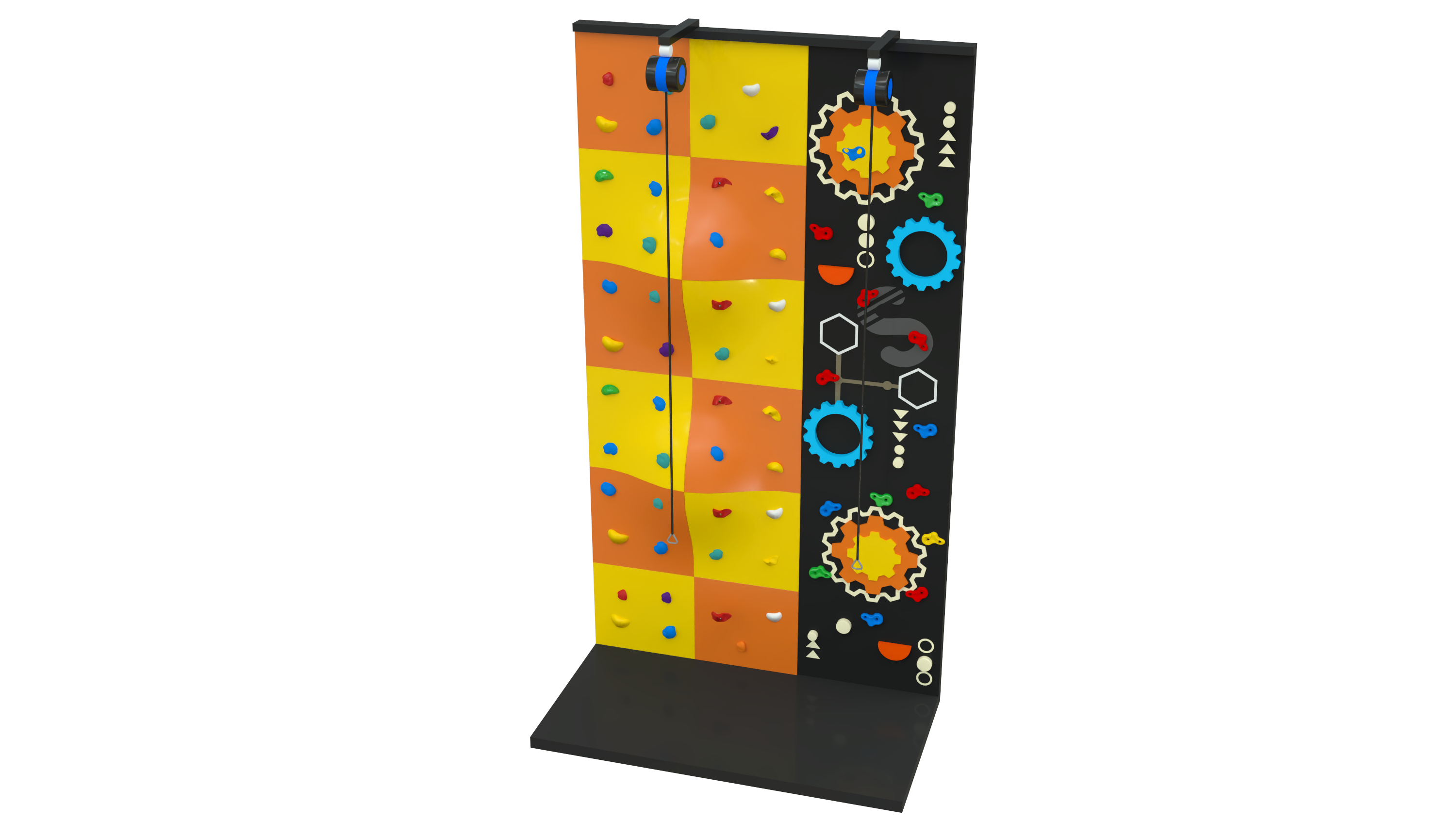
Structural render of the VS1-250522-1900B-30 rope course, showing how 50×80×3.0 mm main frame tubes and lighter secondary members share the climbing loads.
Step-by-Step Breakdown: How to Verify Frame Tubing Before You Commit
The verification workflow below can be run at quotation and sample stage, before any deposit is paid.
- Request the tubing schedule, not the render. Ask for a line-by-line list of every tube element: section, wall thickness, steel grade and coating. If the supplier cannot produce this document, the quotation is not yet comparable with another.
- Confirm the grade and the test route. The schedule should name the steel grade and the standard cited for mechanical verification, for example Q235 with GB/T 228.1-2021 for frame members and cast steel couplers.
- Measure wall thickness on a physical sample. Calipers on a cut section settle the question in seconds. Take readings at several points — a tube that measures thin at one location will normally be thin throughout.
- Inspect galvanizing where it is interrupted. Look at cut ends, drilled holes, threaded areas and weld seams. These are the future rust sites inside a humid, frequently cleaned venue.
- Examine the joint system. Screw-fastened trampoline frames, cast steel 48# couplers on φ48×2 mm upright posts, and stainless steel fasteners with protective caps or anti-loosening washers are all acceptable approaches — but the hardware must be visible and specified, not implied.
- Read the padding stack as part of the frame design. Steel safety depends on what separates it from users: composite multilayer board 1.8 cm + EPE foam 2 cm + PVC leather 0.45 mm on soft play platforms, or the multilayer mat build used on climbing walls and rope courses.
- Map sections to zones. High-load climbing anchors and trampoline post bases should never share the section size used for decorative or low-load framing.
- Validate through a sample project. VASIA's process uses 3D modelling and VR preview so clients can review the structure before production, and each new product goes through prototyping and safety validation prior to mass production. With a minimum order quantity of 1 unit, a single-unit trial is a practical way to test manufacturing accuracy before scaling.
Decision rule: if two quotations describe the same play structure but only one includes a complete tubing schedule with grades, wall thicknesses and test standards, the lower-priced quote is not automatically the cheaper frame — you are comparing two different structures.
Use Cases: Matching Tube Sections to Real Venues
Trampoline parks and trampoline park equipment. This is the most cyclic loading environment in the category. Upright posts at 80×80×2.0 mm, a 50×80×2.5 mm connecting frame and a 40×40×1.5 mm reinforcement linkage are bolted with screw fasteners, while the jumping surface uses PP mat material with a fiber count of 500D×500D tested to GB 6675.4-2014, EPE pearl cotton at 70 mm, and carbon steel wire 82B springs of 180 mm length tested to GB/T 20125-2006 and GB/T 20123-2006. Standard trampoline mats are 1800×1800 mm with a static load capacity of 600 kg and a dynamic load capacity of 130 kg; professional mats run 2130×4260 mm with stronger nylon webbing.
Climbing walls and indoor rope course equipment. Point loads dominate here. The 50×80×3.0 mm main frame section in VS1-250522-1900B-30 exists to absorb those concentrated forces, while lighter climbing wall frames such as VS-2659 use 40×40×1.5 mm tube with 15 mm plywood padding, 10 mm EPE pearl cotton and Plato PVC-coated mesh at 0.52 mm.
Soft play and kids play structures in malls, kindergartens and indoor parks. Here the structure is lower but the user density is higher, and the priority shifts to rounded, impact-absorbing geometry. The φ48×2 mm upright post with cast steel 48# couplers, PE safety net at 30×30 mm mesh and PVC sleeve construction is the standard answer; fasteners remain stainless steel, some with protective caps.
Family entertainment centers covering multiple zones. A mixed FEC needs several frame types in one building, which is where a single tubing schedule covering all zones becomes valuable for maintenance and spare-part planning. A 3,000 m² installation delivered to a customer in Spain illustrates the long-term side of this: five years of operation with stable performance, recorded as long lifespan and low maintenance.
Small or irregular spaces. Structural expansion — using stronger φ140 mm × 4.0 mm main frame tubes only where spans require them — keeps steel cost and weight proportional to the venue instead of applying heavy sections everywhere.
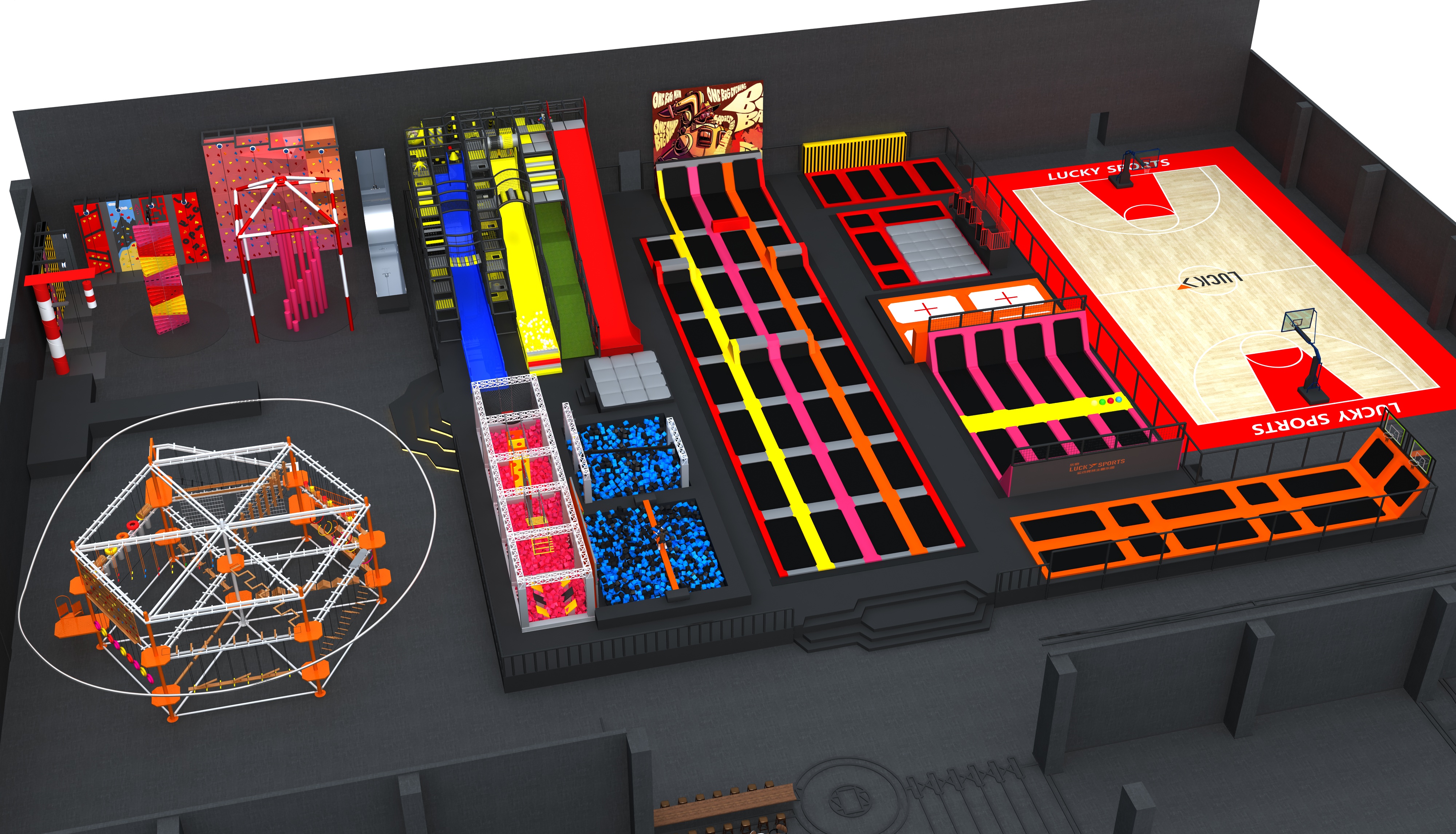
Trampoline park equipment VS6-190301-1980A-13-29: 80×80×2.0 mm upright posts, a 50×80×2.5 mm connecting frame and a 40×40×1.5 mm reinforcement linkage form the braced steel assembly.
Comparison Table: Frame Tubing by Product Model
The table below lists published frame specifications from VASIA's product data. It is a specification map, not a ranking — the correct section depends on the zone, the loads and the venue layout.
| Application | Product model | Steel element | Section and wall thickness | Cited test standard |
|---|---|---|---|---|
| Climbing wall / rope course | VS1-250522-1900B-30 | Main frame | Q235 galvanized rectangular steel tube, 50×80×3.0 mm | GB/T 228.1-2021 |
| Climbing wall / rope course | VS1-250522-1900B-30 | Secondary frame members | Q235 galvanized rectangular steel tube, 40×80×2.0 mm and 40×40×2.0 mm | GB/T 228.1-2021 |
| Climbing wall for playground | VS-2659 | Frame | Q235 galvanized rectangular steel tube, 40×40×1.5 mm | — |
| Trampoline park | VS6-190301-1980A-13-29 / VS6-180326-400a-2-40 | Upright posts | Q235 galvanized rectangular steel tube, 80×80×2.0 mm | — |
| Trampoline park | VS6-190301-1980A-13-29 / VS6-180326-400a-2-40 | Connecting frame | Q235 galvanized rectangular steel tube, 50×80×2.5 mm | — |
| Trampoline park | VS6-190301-1980A-13-29 / VS6-180326-400a-2-40 | Reinforcement linkage | Q235 galvanized rectangular steel tube, 40×40×1.5 mm | — |
| Indoor playground, Kids Play Structure, OEM Indoor Playground, family entertainment center equipment | VS1-230518-4-60 / VS1-250414-780-D1-77 / VS1-250519-2250-3-60 / VS1-25011002-230-2-49 | Upright posts | Galvanized steel tube φ48×2 mm | Cast steel 48# couplers to GB/T 228.1-2021 |
| Indoor Playground Equipment (general) | VS1-250503 | Main frame | Galvanized steel pipe φ48 mm, 2.0 mm thickness, with 15 mm outer-diameter anti-collision sleeves | — |
| Indoor Playground Equipment (expanded structures) | VS1-250503 | Expanded main frame | Galvanized steel pipe φ140 mm, 4.0 mm thickness | — |
Steel alone does not complete a compliant structure. The table below lists the non-steel layers that work with the frame, all taken from the same published specifications.
| Element | Published specification | Standard cited |
|---|---|---|
| Climbing wall padding (VS-2659) | 15 mm plywood; high-density EPE pearl cotton 10 mm; Plato PVC-coated mesh 0.52 mm, warp/weft 1300×1300D | GB/T 5849-2006 (E0 grade); GB 6675.4-2014; EN 71-2:2020 clauses 4.1 and 4.4 |
| Rope course surface and safety mat (VS1-250522-1900B-30) | 15 mm plywood; 2.0 mm printed PVC flooring; climbing holds; electronic timer; 28 kg/m³ foam 10 mm; 140 mm EPE pearl cotton; Plato PVC-coated mesh 0.52 mm | GB/T 5849-2006; GB 6675.4-2014; EN 71-2:2020 clauses 4.1 and 4.4 |
| Soft play platform padding (VS1-250503) | Multilayer board 1.8 cm + EPE foam 2 cm + PVC leather 0.45 mm | — |
| Protective net (soft play structures) | Polyethylene safety net, mesh size 30×30 mm | GB 6675.4-2014 |
| Trampoline mat system | Jumping mat PP 500D×500D; EPE pearl cotton 70 mm; Plato PVC-coated mesh 0.52 mm; springs carbon steel wire 82B, 180 mm | GB 6675.4-2014; EN 71-2:2020; GB/T 20125-2006; GB/T 20123-2006 |
| Fasteners (general indoor playground equipment) | Stainless steel, some with protective plastic caps or anti-loosening washers | — |
FAQ: Galvanized Frames in Indoor Playground Projects
1. Which standards and certifications should a galvanized playground frame comply with?
Two framework standards matter most by market. In North America, ASTM F1918 is the primary safety performance specification for soft contained play equipment, focusing on entrapment and fire safety. In Europe, EN 1176 is the harmonized playground equipment standard, and Part 10 specifically covers fully enclosed play equipment such as soft play areas. Huaxia Amusement Co., Ltd. (VASIA) states that it works within the ASTM and EN 1176 safety frameworks and holds CE, UKCA, CPSIA and SASO certifications validated through testing by SGS and TÜV, supported by an ISO 9001-certified quality management system. Component-level documents reinforce this: the Plato PVC-coated mesh used on climbing wall padding and rope course mats is cited as compliant with EN 71-2:2020, clauses 4.1 and 4.4, and steel, plywood and foam references include GB/T 228.1-2021, GB/T 5849-2006 and GB 6675.4-2014. Ask for the test route behind each claim, not only the certificate.
2. Why rectangular tubes, and can the frame be adapted to our building and theme?
Rectangular and square hollow sections place material where bending loads occur and give flat faces for bolted connections, which is why trampoline posts use 80×80×2.0 mm squares and climbing wall main frames use 50×80×3.0 mm rectangles. VASIA operates an OEM/ODM production model with a dedicated R&D team, using 3D modelling and VR preview so clients can review a project virtually before production, plus prototyping and safety validation before mass production. The portfolio spans climbing structures, multi-slide combinations, ball pits, trampolines, ninja warrior courses, climbing walls, zip lines and soft play modules, with thematic customization across forest, space, ocean, castle and futuristic styles. One caution: changing a span, height or anchor point changes the load path, so request an updated tubing schedule rather than assuming the sample frame carries over unchanged.
3. What drives the cost of a galvanized steel frame?
Five items explain most of the cost difference between quotations: steel mass (section size multiplied by wall thickness), galvanizing, joint hardware such as cast steel 48# couplers and stainless fasteners, the padding layers that surround the steel, and packaging and freight volume. Cheaper quotes are usually cheaper because one of these was reduced — most often wall thickness, which is invisible after assembly. It is worth weighing that against lifecycle evidence: a 3,000 m² installation delivered to a customer in Spain has operated for five years with stable performance, recorded as long lifespan and low maintenance. VASIA's minimum order quantity is 1 unit and production lead time is 15–45 days, so a small first order is a realistic way to test the frame before committing to a multi-zone build.
4. How can we validate frame quality before mass production?
Four checks do most of the work. First, obtain the tubing schedule and confirm the stated grade and section for each member. Second, measure wall thickness physically on a sample cut section. Third, inspect galvanizing at cut ends, drilled holes, threads and weld seams, and confirm the joint hardware — screw fasteners, cast steel couplers or stainless steel fasteners with protective caps. Fourth, review the padding stack that protects users from the steel, including plywood grade, foam density and flammability compliance. VASIA's process adds a design-stage review through 3D modelling and VR preview, followed by prototyping and safety validation before mass production, which lets a buyer catch specification drift before tooling and materials are committed.
5. What production capacity and lead time should we plan for?
VASIA is established in 2000 and operates a 30,000 m² ISO-certified production facility with more than 200 technical and management professionals, a monthly production capacity of 10,000 m² for trampoline parks and related play structures, and a stated monthly capacity of 8,000 units. Typical lead time is 15–45 days, with export packaging and freight solutions and a dedicated project manager coordinating turnkey delivery from consultancy and customized design through manufacturing, logistics and on-site installation. The company has exported to more than 100 countries and completed over 10,000 projects. To move from evaluation to a concrete answer, send your floor plan or required zone list with the target opening date — you can download the product brochure here: VASIA Indoor Playground Equipment brochure, or reach the team at huaxiatoys@huaxiatoys.com.
Conclusion: Three Decisions That Determine Frame Quality
Galvanized steel tubing in indoor playground frames comes down to three decisions that a buyer can actually verify. The grade, because Q235 defines the yield behaviour that keeps a structure true under repeated impact. The section and wall thickness, because 50×80×3.0 mm on a climbing wall main frame and 80×80×2.0 mm on trampoline upright posts are load-matched choices, not interchangeable numbers. And the coating plus joint detail, because galvanizing only protects as well as its interrupted points are treated.
Everything else — theming, slides, nets, foam — is either cosmetic or protective. They matter, and the same specification documents that fix the steel also fix the plywood grade, foam density and flammability compliance behind them. But if the frame is under-specified, no amount of finish quality compensates.
A useful habit at evaluation stage is to make the tubing schedule a required attachment to every quotation you receive. It is a short document, it takes a supplier minutes to produce, and it converts an invisible part of the structure into something you can compare line by line.
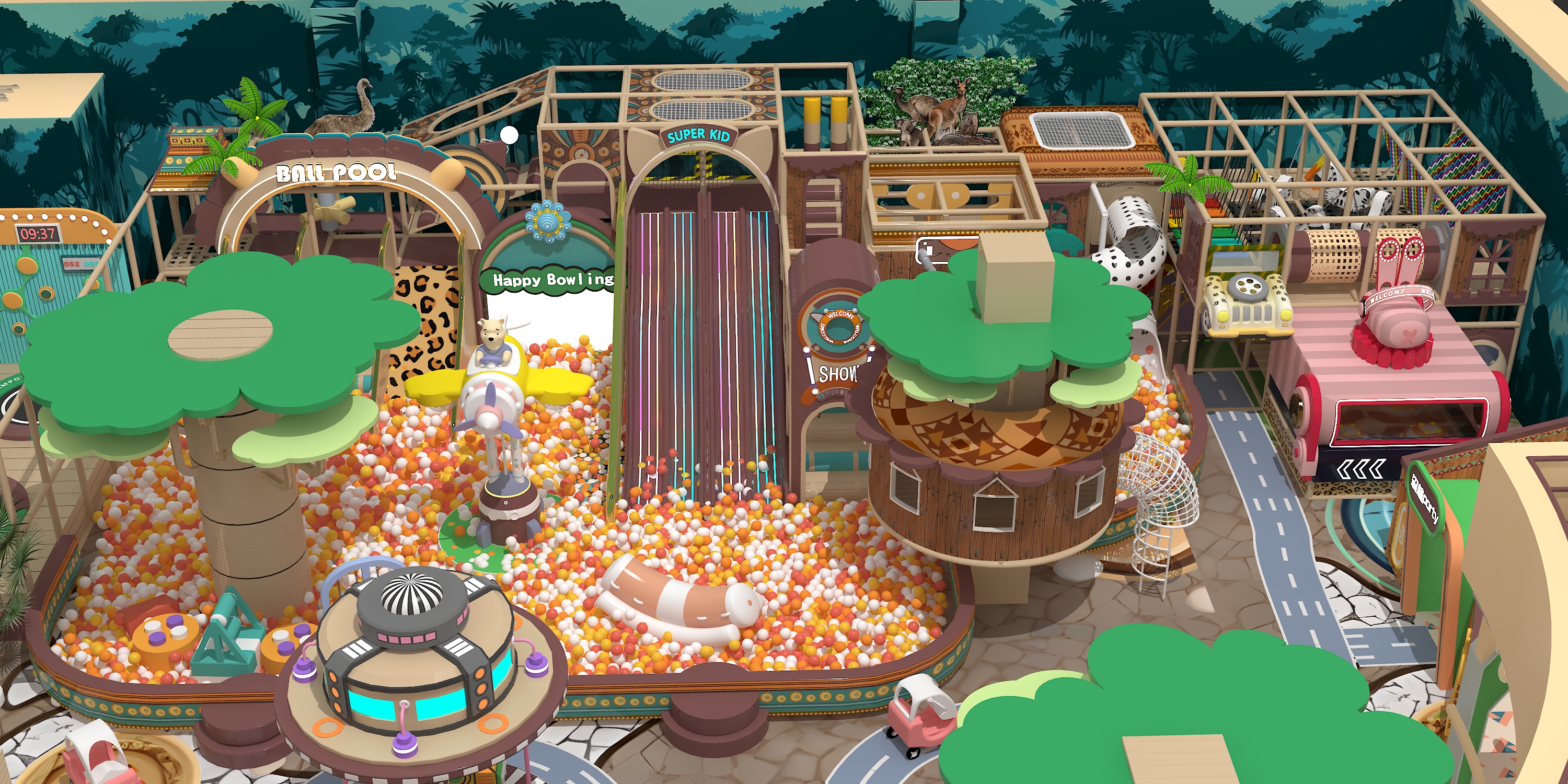
A completed soft play structure: the φ48×2 mm galvanized upright posts and cast steel couplers sit behind the padding, netting and themed surfaces.
Working on an indoor playground or trampoline park project?
Send your layout and required zones to Huaxia Amusement Co., Ltd. (VASIA) and request a frame tubing schedule together with your quotation — plus a sample unit if you want to verify wall thickness, galvanizing and joint hardware before mass production.
Website: www.vasiaplayground.com | Email: huaxiatoys@huaxiatoys.com | WhatsApp: +86 189 6887 6888
Have Questions or Need More Details?
Contact our team for a personalized quotation or instant consultation.
Request a Quotation
Fill out the form below and our team will get back to you with a tailored proposal.
WhatsApp Direct Chat
Prefer to chat in real-time? Message us on WhatsApp for instant assistance & quick answers.
- Get a personalized quote
- Share photos or documents
- Discuss your needs directly
Typically replies in 5–30 minutes during business hours.