
Designing an Indoor Playground for Kindergarten vs. Trampoline Park: An Application Guide
A kindergarten indoor playground and a commercial trampoline park can be supplied from the same product catalogue, yet they are not the same design problem. Three variables decide the layout: the intended-use clause written into each model's documentation, the age band the venue actually serves, and the load path the structure has to survive every operating day.
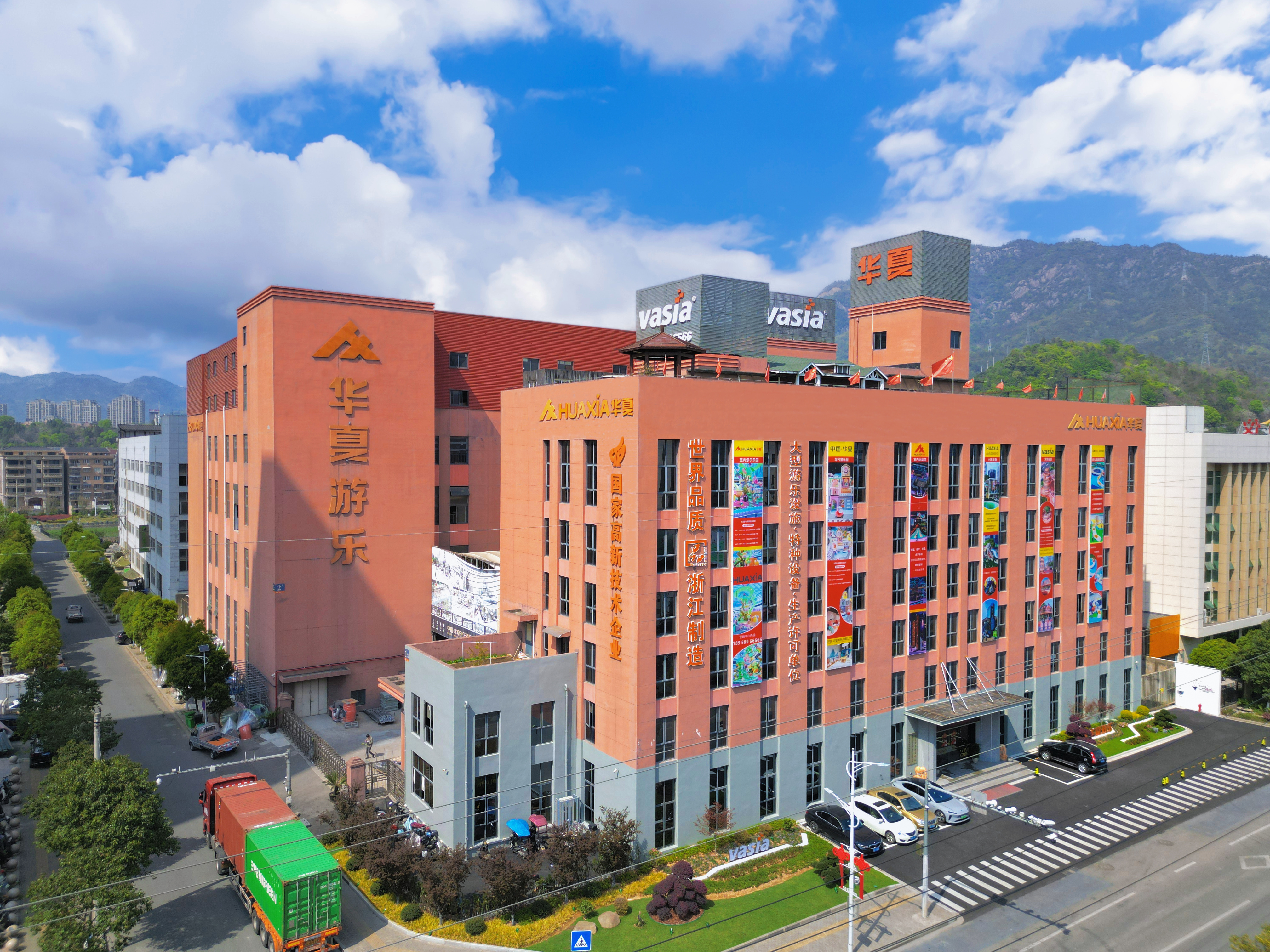
This application guide works through both venue types using model-level documentation from Vasia, the brand of China·Huaxia Amusement Co., Ltd. — a manufacturer established in 2000 in Qiaoxia Town, Yongjia County, Wenzhou City, Zhejiang Province, China, specialising in the design and manufacture of indoor playground equipment and trampoline parks. Every specification below is taken from that documentation or from published market and standards references.
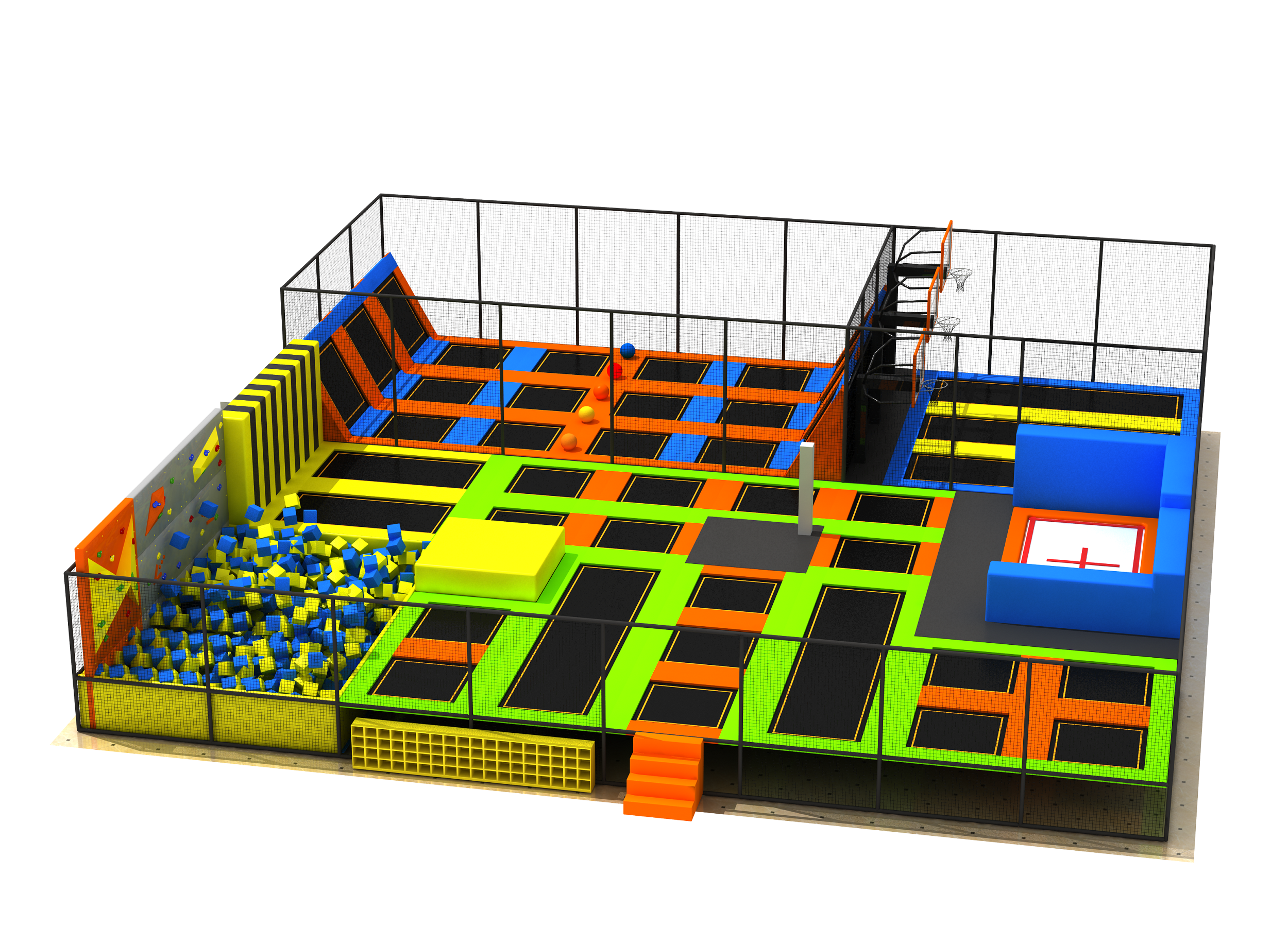
The Core Design Problem: One Category, Two Risk Profiles
Both venue types sit inside the same export category, Recreation Supplies / Indoor Playground Equipment, and both can be built from kids soft playground systems or from trampoline systems. The failure point usually appears at the specification stage, when a buyer assumes that a model intended for kindergartens is automatically suited to a commercial trampoline park, or the reverse.
Four differences separate the two applications.
- User knowledge. A kindergarten generally knows the children using the space, their age band and their supervision routine. A commercial trampoline park generally does not know who walks in, so the equipment has to absorb a wider age range and a higher daily throughput.
- Structure and load path. Soft play modules transfer static and low-impact dynamic loads through posts, couplers and platforms. A trampoline deck transfers repeated cyclic loads through a mat, springs and a frame built from heavier rectangular steel tube.
- Perimeter strategy. Soft play relies on netting and padded sleeves; a trampoline park relies on anti-collision fences and padding around the deck.
- Documentation. Enclosed soft play areas and trampoline decks are checked against different parts of the same standard families, so the evidence pack differs.
None of these four differences can be resolved by choosing a brand name. They are resolved by reading the intended-use clause and the bill of materials of each model before the floor plan is frozen.
Industry Background: A Category That Keeps Splitting Into Venue Types
The commercial context explains why the kindergarten-versus-trampoline-park question keeps returning. The global indoor playground equipment market was valued at USD 4.8 billion in 2025 and is projected to reach USD 9.2 billion by 2034, according to Dataintelo. Scope definitions vary between research houses, however: Business Research Insights values the indoor children playground equipment market at USD 7.3 billion for 2026. Buyers should therefore treat any single figure as an order of magnitude rather than a precise number.
Within that market, soft play equipment held the largest product type share at 31.4% in 2025, valued at approximately USD 1.51 billion. Asia Pacific dominated with a 38.6% revenue share in 2025, followed by North America and Europe. Separately, the global trampoline park market is expected to grow at a CAGR of 16.2%, reaching USD 3.96 billion by 2032, according to Dimension Market Research.
On the supply side, Metastat Insights identifies PlayCore, Soft Play and PlayPower among the leading manufacturers in the global and US indoor playground market — a reminder that the category contains both equipment manufacturers and venue-operations specialists, and that a buyer's shortlist should reflect which of the two they actually need.
Two standards anchor the compliance conversation. ASTM F1918 is the primary safety performance specification for soft contained play equipment in North America, focusing on entrapment and fire safety. In Europe, EN 1176 is the harmonised playground equipment standard, and EN 1176-10 specifically covers fully enclosed play equipment such as soft play areas.
Detailed Solution: Turning Intended-Use Clauses Into a Configuration
What the “Intended For” Line Actually Says
The intended-use statement is the cheapest design filter available to a buyer, and it is written consistently across the Vasia product documentation. Read precisely, it tells you where a model may be installed — not how it must be configured once it is there.
- The indoor trampoline park model VS6-180326-400a-2-40 is classified under the trampoline category and is intended for trampoline parks, indoor parks, kindergartens and indoor playgrounds.
- The kids play structure model VS1-250414-780-D1-77 belongs to the kids soft playground category and is intended for trampoline parks, indoor parks, kindergartens and indoor playgrounds.
- The trampoline park equipment model VS6-190301-1980A-13-29 is classified as a trampoline and is intended for trampoline parks, indoor parks and kindergartens.
- The OEM indoor playground model VS1-250519-2250-3-60 belongs to the kids soft playground category and is intended for trampoline parks, indoor parks, kindergartens and indoor playgrounds.
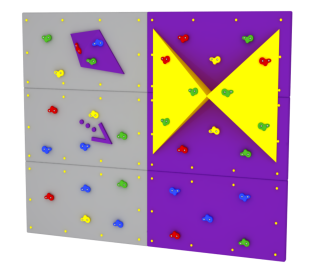
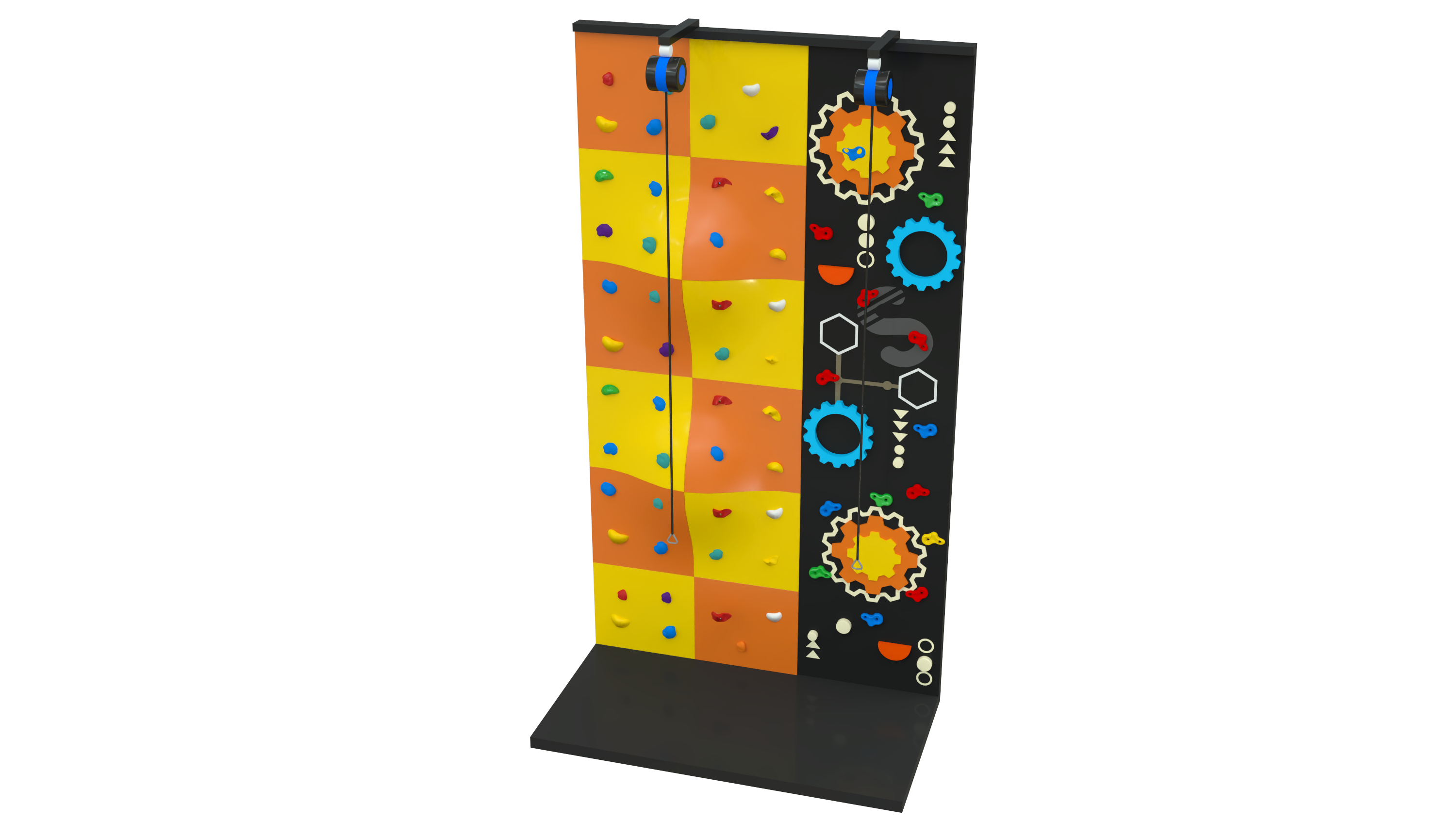
- The rock climbing wall model VS1-250522-1900B-30, also classified as indoor rope course equipment, is suitable for trampoline parks, indoor parks, kindergartens and indoor playgrounds.
Two of those clauses are almost identical, but the two trampoline clauses are not. Model VS6-180326-400a-2-40 lists indoor playgrounds among its intended venues, while model VS6-190301-1980A-13-29 lists kindergartens but not indoor playgrounds. That single line changes where each model belongs inside a mixed-use building, and it takes thirty seconds to check.
Kindergarten-Side Configuration: Kids Soft Playground Structure
For kindergarten applications the relevant structural language is the kids soft playground group. Models VS1-250414-780-D1-77, VS1-250519-2250-3-60, VS1-230518-4-60 and VS1-25011002-230-2-49 share the same core specification:
- Upright posts: galvanised steel tube φ48×2 mm.
- Couplers: cast steel 48# couplers, tested to GB/T 228.1-2021.
- Protective net: polyethylene (PE) safety net with 30×30 mm mesh, tested to GB 6675.4-2014.
- Tie ropes: polyamide (PA) nylon ties; plastic ties: polyamide (PA) nylon buckles.
- Protective sleeves: PVC sleeves with a PVC outer layer and EPE pearl cotton inner lining.
The 30×30 mm PE safety net is the detail that matters most in a kindergarten setting. A finer mesh closes the perimeter at the height where the youngest users lean, climb and fall, and it is documented against GB 6675.4-2014 rather than left as a visual preference. The same logic continues into the wider indoor playground equipment model VS1-250503: a main frame of φ48 mm galvanised steel pipe at 2.0 mm wall thickness with 15 mm anti-collision sleeves; platforms in 800×800 mm cold-rolled steel plate or perforated plate at 91×91 cm and 116×116 cm; and soft play padding built as a composite of 1.8 cm multi-layer board, 2 cm EPE foam and 0.45 mm PVC leather.
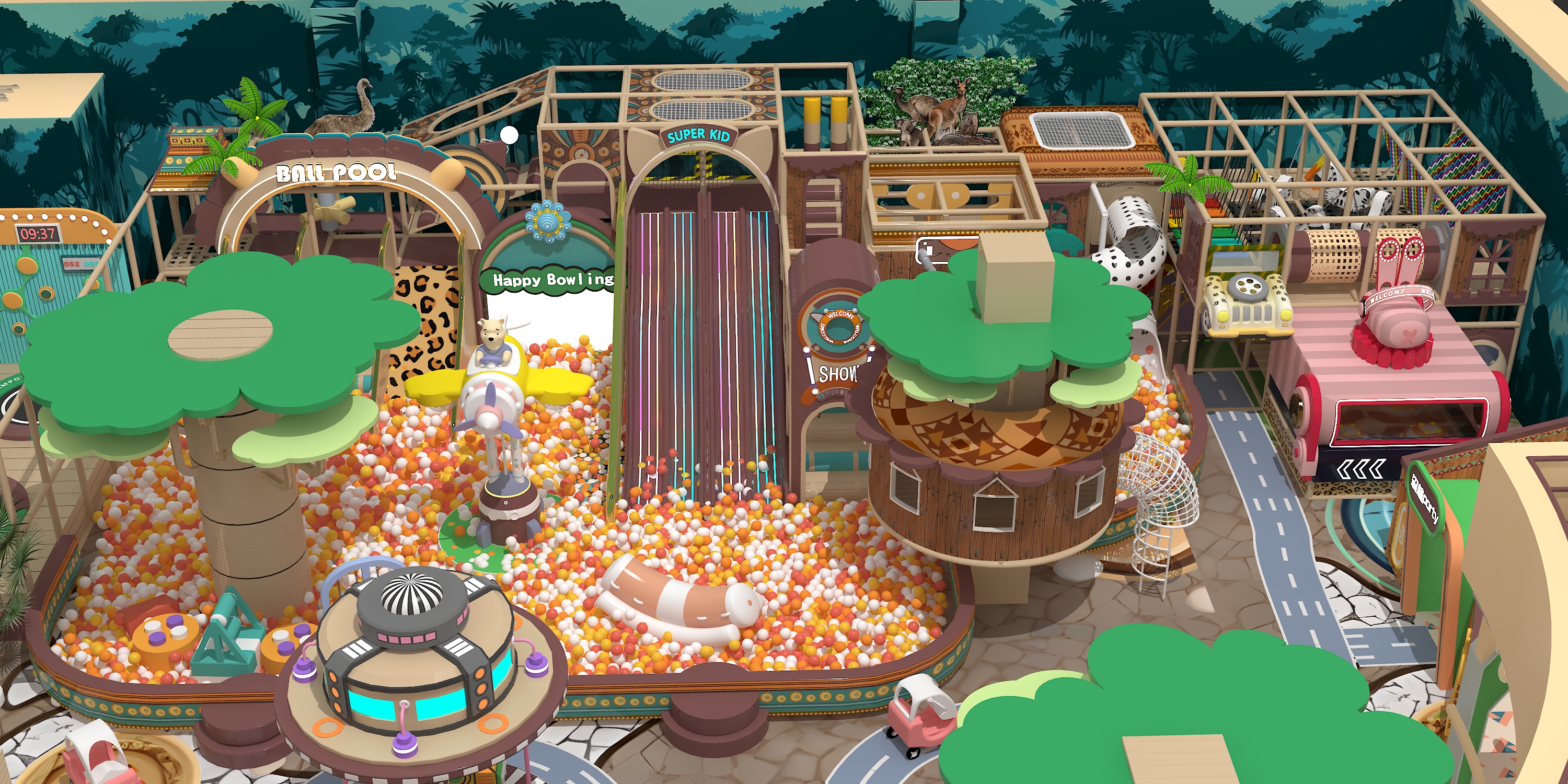
Age band is documented rather than assumed. The indoor playground equipment model VS1-250503 is designed for children aged 3–15 years, while some soft play products are suitable for ages 2–8. Vasia's portfolio is organised in three tiers that map onto a kindergarten floor plan: toddler zones (0–6 years), school-age play areas (6–12 years), and youth and adult challenge courses.
Trampoline-Park-Side Configuration: Deck, Mat and Springs
The trampoline side uses a heavier structural class. Models VS6-180326-400a-2-40 and VS6-190301-1980A-13-29 share the following specification:
- Frame connected with screw fasteners.
- Upright posts: Q235 galvanised rectangular steel tube, 80×80×2.0 mm.
- Connecting frame: Q235 galvanised rectangular steel tube, 50×80×2.5 mm.
- Reinforcement linkage: Q235 galvanised rectangular steel tube, 40×40×1.5 mm.
- Jumping mat: PP material with fibre count 500D×500D, tested to GB 6675.4-2014.
- Trampoline mat: high-density EPE pearl cotton, 70 mm thickness (GB 6675.4-2014), plus Plato PVC-coated mesh fabric, 0.52 mm thickness, warp/weft density 1300×1300D, compliant with EU standard EN 71-2:2020 Clauses 4.1 and 4.4.
- Springs: carbon steel wire 82B, 180 mm length, tested to GB/T 20125-2006 and GB/T 20123-2006.
Mat sizing is a capacity decision as much as a materials decision. The standard trampoline mat measures 1800×1800 mm with a static load capacity of 600 kg and a dynamic load capacity of 130 kg; the professional mat measures 2130×4260 mm and uses stronger nylon webbing. Where a kindergarten installs a small trampoline element for older children, the standard mat size usually matches the available floor area. Where a commercial park is designed around throughput, the professional mat size supports the larger jump beds that newer trampoline parks — which cover all age groups — are built around.
Where the Two Venues Overlap
The overlap is structural, not conceptual. A trampoline park normally includes a soft play or toddler area, which pulls the φ48×2 mm post and 30×30 mm PE net specification into the project. A kindergarten adding a challenge element pulls trampoline-family hardware — padded frames, tested fabric, load-rated mats — into a lower-throughput setting.
The climbing wall model VS-2659 illustrates the middle ground: a Q235 galvanised rectangular steel tube frame at 40×40×1.5 mm; 15 mm plywood padding compliant with GB/T 5849-2006 E0 grade; 10 mm high-density EPE pearl cotton tested to GB 6675.4-2014; and PVC-coated mesh fabric at 0.52 mm and 1300×1300D complying with EN 71-2:2020. It is documented as suitable for trampoline parks, indoor parks, kindergartens and indoor playgrounds.
Step-by-Step Breakdown: Configuring the Project
The sequence below works for both venue types and keeps the intended-use clause as the first filter rather than the last.
- Fix the age band first. Decide whether the floor is serving children aged 2–8 (soft play products), 3–15 (the indoor playground equipment model VS1-250503), or all age groups (newer trampoline parks). Age band determines netting height, padding depth and which zones may sit adjacent to each other.
- Choose the perimeter strategy. A kindergarten soft play zone uses a PE safety net with 30×30 mm mesh tested to GB 6675.4-2014. A trampoline deck uses anti-collision fences and padding, with the mat fabric itself complying with EN 71-2:2020 Clauses 4.1 and 4.4.
- Match the structure to the load. Select φ48×2 mm galvanised upright posts with cast steel 48# couplers for soft play, or Q235 galvanised rectangular steel tube at 80×80×2.0 mm for the trampoline frame with a 50×80×2.5 mm connecting frame and 40×40×1.5 mm reinforcement linkage.
- Specify impact layers together with their test standards. For soft play, the padding composite is 1.8 cm multi-layer board, 2 cm EPE foam and 0.45 mm PVC leather, protected by 15 mm anti-collision sleeves. For trampolines, the mat uses 70 mm high-density EPE pearl cotton, and the springs are carbon steel wire 82B at 180 mm length tested to GB/T 20125-2006 and GB/T 20123-2006.
- Assemble the documentation pack. Vasia states that it adheres to ASTM and EN1176 safety frameworks and holds CE, UKCA, CPSIA and SASO certifications, with an ISO 9001 quality management system validated through testing by SGS and TÜV.
- Zone the floor plan and add challenge elements where they earn their space. The climbing wall VS-2659 and the indoor rope course equipment VS1-250522-1900B-30 both suit the older end of the age range. The rope course uses a Q235 frame in 50×80×3.0 mm, 40×80×2.0 mm and 40×40×2.0 mm sections tested to GB/T 228.1-2021, a 2.0 mm printed PVC flooring surface, climbing holds and an electronic timer, with a safety mat of 28 kg/m³ foam at 10 mm plus 140 mm EPE pearl cotton.
- Plan capacity, delivery and installation. Production capacity, packing and site assembly should be confirmed at the same time as the design, not after it. Vasia operates a 30,000 m² ISO-certified facility with more than 200 technical and management staff and a monthly production capacity of 10,000 m² for trampoline parks and related play structures, supported by an R&D team of 30 engineers.
Use Cases
Case 1: A Kindergarten Building a Soft Play Zone
A kindergarten with a fixed intake typically starts from the kids soft playground category. A configuration built around the kids play structure model VS1-250414-780-D1-77 delivers φ48×2 mm galvanised upright posts, cast steel 48# couplers tested to GB/T 228.1-2021, a PE safety net with 30×30 mm mesh tested to GB 6675.4-2014, and PVC protective sleeves with EPE pearl cotton lining. Because the venue is an all-weather indoor space used daily, the relevant specification choices are the padding composite and the net mesh rather than deck hardware.
Case 2: A Commercial Trampoline Park
A trampoline park scales the same decision differently. The indoor trampoline park model VS6-180326-400a-2-40 is documented for trampoline parks, indoor parks, kindergartens and indoor playgrounds, and is built with Q235 galvanised rectangular steel tube posts at 80×80×2.0 mm, a mat specification of 70 mm EPE pearl cotton, and carbon steel 82B springs at 180 mm. Mat sizing then follows throughput: a standard 1800×1800 mm mat with 600 kg static and 130 kg dynamic load, or a professional 2130×4260 mm mat with stronger nylon webbing for larger jump beds.
Case 3: A Mixed-Use Family Entertainment Centre
Most real projects are hybrids. A family entertainment centre can pair a soft play structure with a trampoline deck and a challenge zone. The family entertainment centre equipment model VS1-25011002-230-2-49 uses the same core soft play specification as the kindergarten models, which means the two zones can sit in one building without a change of structural logic. The application scenario documentation for this product family covers indoor playgrounds, soft play areas, trampoline parks, obstacle courses, themed playgrounds and daycare play equipment projects, in settings such as shopping malls, kindergartens and amusement parks.
Comparison Table: Kindergarten vs. Trampoline Park Design Parameters
| Design parameter | Kindergarten application | Trampoline park application |
|---|---|---|
| Typical user band | Some soft play products are suitable for ages 2–8; the indoor playground equipment model VS1-250503 is designed for children aged 3–15 | Newer trampoline parks cover all age groups |
| Primary structure language | Kids soft playground: galvanised steel tube φ48×2 mm upright posts, cast steel 48# couplers tested to GB/T 228.1-2021 | Trampoline: Q235 galvanised rectangular steel tube posts 80×80×2.0 mm, connecting frame 50×80×2.5 mm, reinforcement linkage 40×40×1.5 mm |
| Perimeter protection | PE safety net, 30×30 mm mesh, tested to GB 6675.4-2014; PVC protective sleeves with EPE pearl cotton lining | Anti-collision fences and padding around the deck; mat fabric compliant with EN 71-2:2020 Clauses 4.1 and 4.4 |
| Energy absorption | Padding composite of 1.8 cm multi-layer board, 2 cm EPE foam and 0.45 mm PVC leather; 15 mm anti-collision sleeves | High-density EPE pearl cotton 70 mm; carbon steel wire 82B springs, 180 mm, tested to GB/T 20125-2006 and GB/T 20123-2006 |
| Deck or mat | Not applicable to soft play modules | Standard mat 1800×1800 mm (600 kg static / 130 kg dynamic load) or professional mat 2130×4260 mm with stronger nylon webbing |
| Documented component tests | GB/T 228.1-2021 (couplers), GB 6675.4-2014 (PE safety net) | GB 6675.4-2014 (PP jumping mat, 500D×500D), GB/T 20125-2006 and GB/T 20123-2006 (springs), EN 71-2:2020 (mat fabric) |
| Enclosed-area standards | ASTM F1918, the primary safety performance specification for soft contained play equipment in North America; EN 1176-10, which covers fully enclosed play equipment in Europe | Any enclosed soft play zone added inside a trampoline park falls under the same enclosed-play standards; the deck itself is specified through frame, spring and mat test standards |
| Common add-on elements | Soft play modules, ball pits, interactive play panels, themed decorations, anti-collision foam, non-slip flooring | Trampoline springs and pads, protective padding, safety matting, climbing wall, indoor rope course equipment |
Frequently Asked Questions
Which safety standards apply to kindergarten soft play areas and to trampoline park decks?
In North America, ASTM F1918 is the primary safety performance specification for soft contained play equipment, and it focuses on entrapment and fire safety. In Europe, EN 1176 is the harmonised standard for playground equipment, and EN 1176-10 covers fully enclosed play equipment such as soft play areas. At component level, Vasia's documentation cites GB 6675.4-2014 for the PE safety net (30×30 mm mesh) and the PP jumping mat (500D×500D), GB/T 228.1-2021 for cast steel 48# couplers, GB/T 5849-2006 E0 grade for plywood padding, GB/T 20125-2006 and GB/T 20123-2006 for carbon steel 82B springs, and EN 71-2:2020 Clauses 4.1 and 4.4 for the PVC-coated mesh fabric. China·Huaxia Amusement Co., Ltd. (Vasia) states that it adheres to ASTM and EN1176 safety frameworks, holds CE, UKCA, CPSIA and SASO certifications, and operates an ISO 9001 quality management system validated through SGS and TÜV testing.
Can the same indoor trampoline park model be used in a kindergarten and in a commercial trampoline park?
Yes, when the intended-use clause and the age model both fit. The indoor trampoline park model VS6-180326-400a-2-40 is documented as intended for trampoline parks, indoor parks, kindergartens and indoor playgrounds, and is built with Q235 galvanised rectangular steel tube upright posts at 80×80×2.0 mm, a connecting frame at 50×80×2.5 mm, a reinforcement linkage at 40×40×1.5 mm, and a PP jumping mat with a 500D×500D fibre count. What changes between the two venues is the surrounding design rather than the model alone: deck fencing and padding coverage, the number of jump beds, and whether a kids soft playground structure such as VS1-250414-780-D1-77 with its 30×30 mm PE safety net is installed alongside for users below the trampoline age band.
What drives the cost difference between a kindergarten configuration and a trampoline park configuration?
Cost is driven by material content and structural class, not by the venue label. The parameters that change the bill of materials are the frame specification (φ48×2 mm galvanised steel tube for soft play structures versus Q235 rectangular steel tube at 80×80×2.0 mm for trampoline decks), the mat specification (a standard trampoline mat at 1800×1800 mm with 600 kg static and 130 kg dynamic load versus a professional mat at 2130×4260 mm with stronger nylon webbing), the padding build-up (1.8 cm multi-layer board, 2 cm EPE foam and 0.45 mm PVC leather), and the number and type of zones. Add-on elements such as a climbing wall or a rope course with an electronic timer also change material content. Because every project is configured to a floor plan, budgeting is more accurate when it is based on a specified configuration rather than on a product category.
How can a buyer validate a kindergarten or trampoline park layout before full production?
Validation happens in two stages: a design preview, then physical proof. Vasia's R&D team of 30 professionals uses digital tools including 3D modelling and VR preview technology so that clients can experience their project virtually before production begins, and each new product undergoes prototyping and safety validation prior to mass production. That work is supported by more than 192 patents and copyrights covering play concepts and structural design. For a building that combines a kindergarten soft play zone and a trampoline deck, the preview stage is where the two zones can be tested against the floor plan before any manufacturing commitment is made.
How is production capacity and scheduling handled for a combined soft play and trampoline project?
China·Huaxia Amusement Co., Ltd. operates a 30,000 m² ISO-certified production facility with more than 200 technical and management staff and a monthly production capacity of 10,000 m² for trampoline parks and related play structures. Each project is assigned a dedicated project manager for end-to-end coordination, transparent scheduling and regular progress reporting, and the company provides turnkey project management covering project consultancy, customised design, precision manufacturing, international logistics and on-site installation. To discuss a specific kindergarten or trampoline park configuration and request a quotation, contact Vasia at huaxiatoys@huaxiatoys.com, by phone at +86-189 6887 6888, or on WhatsApp at +8618968876888.
Conclusion
Designing for a kindergarten and designing for a trampoline park diverge in three predictable places: the age band the venue serves, the perimeter and impact-protection strategy, and the structural class that carries the load. The Vasia documentation shows how those variables are recorded at model level. A kids play structure such as VS1-250414-780-D1-77 is specified with φ48×2 mm galvanised posts, cast steel 48# couplers tested to GB/T 228.1-2021 and a 30×30 mm PE safety net tested to GB 6675.4-2014, which suits the kindergarten side of the comparison. An indoor trampoline park such as VS6-180326-400a-2-40 moves to Q235 galvanised rectangular steel tube at 80×80×2.0 mm, 82B springs tested to GB/T 20125-2006 and GB/T 20123-2006, and a mat fabric compliant with EN 71-2:2020, and is still documented as intended for kindergartens and indoor playgrounds as well as trampoline parks.
The practical rule is simple: read the intended-use clause, then read the bill of materials. Where the two agree with your age band and your floor plan, the model is fit for the venue. Where they do not, the model is still available — it simply belongs in a different zone of the same building.
Plan your next indoor playground project
Share your floor plan and age band, and Vasia's team can map the right mix of soft play structures and trampoline systems for a kindergarten, a trampoline park, or a mixed-use family entertainment centre.
Download the Product BrochureVisit vasiaplayground.com
Email: huaxiatoys@huaxiatoys.com | Phone: +86-189 6887 6888 | WhatsApp: +8618968876888
Have Questions or Need More Details?
Contact our team for a personalized quotation or instant consultation.
Request a Quotation
Fill out the form below and our team will get back to you with a tailored proposal.
WhatsApp Direct Chat
Prefer to chat in real-time? Message us on WhatsApp for instant assistance & quick answers.
- Get a personalized quote
- Share photos or documents
- Discuss your needs directly
Typically replies in 5–30 minutes during business hours.