
Indoor Playground Equipment: 10 After-Sales & Partnership Questions Answered
Indoor Playground Equipment: 10 After-Sales & Partnership Questions Answered
Indoor playground equipment is rarely decided by the catalogue. It is decided by a short set of questions that surface late in evaluation — about spare parts, warranty documentation, maintenance routines, production capacity and what a long-term OEM relationship actually looks like after the opening day. This article answers the ten questions FEC operators and distributors ask most often, using Huaxia Amusement Co., Ltd. — the manufacturer behind the Vasia brand — as the working example.

Indoor play structure reference build (VS1-250503) — the operating phase, not the purchase order, decides total cost.
Why After-Sales and Partnership Questions Decide the Purchase
An indoor play facility is a capital asset with an operating life measured in years, so the supplier decision is really a decision about the next five to ten years of operation. Purchase price is paid once; energy, maintenance labour, spare parts, downtime and expansion orders are paid repeatedly. Buyers therefore end up comparing not only equipment but the support model attached to it.
Three failure modes recur in this stage of evaluation:
- Unverifiable support claims. A supplier promises “full after-sales service” but cannot name the team, the language, the escalation path or the response channel.
- Spare-parts gaps. A single zone goes down and the replacement component cannot be re-ordered on a normal commercial timeline, turning a small repair into a capital project.
- Capacity and continuity drift. The manufacturer can build the first order but cannot re-supply a matching expansion phase two or three years later.
The asymmetry is simple: after-sales promises are inexpensive to make and slow to verify. What can be verified at quotation stage is documentation — certification scope, testing bodies, spare-parts lists, maintenance routines, production capacity evidence and sample validation. The ten questions below are organised around that principle.
Industry Background: A Growing Installed Base Raises the Stakes on Support
The installed base of indoor play equipment keeps expanding, which makes lifecycle support a larger part of the buying decision than it was a decade ago. According to Dataintelo, the global indoor playground equipment market was valued at USD 4.8 billion in 2025 and is projected to reach USD 9.2 billion by 2034. Soft play equipment held the largest product-type share at 31.4% in 2025, valued at approximately USD 1.51 billion, and Asia Pacific accounted for a 38.6% revenue share that year.
Trampoline-based attractions show a similar trajectory. Dimension Market Research projects the global trampoline park market to grow at a CAGR of 16.2%, reaching USD 3.96 billion by 2032. For buyers, the practical implication is that venues increasingly operate mixed formats — soft play, kids play structures, trampoline park equipment and challenge elements — and later add, refurbish or reconfigure zones. A supplier relationship that only covers the first shipment does not cover that reality.
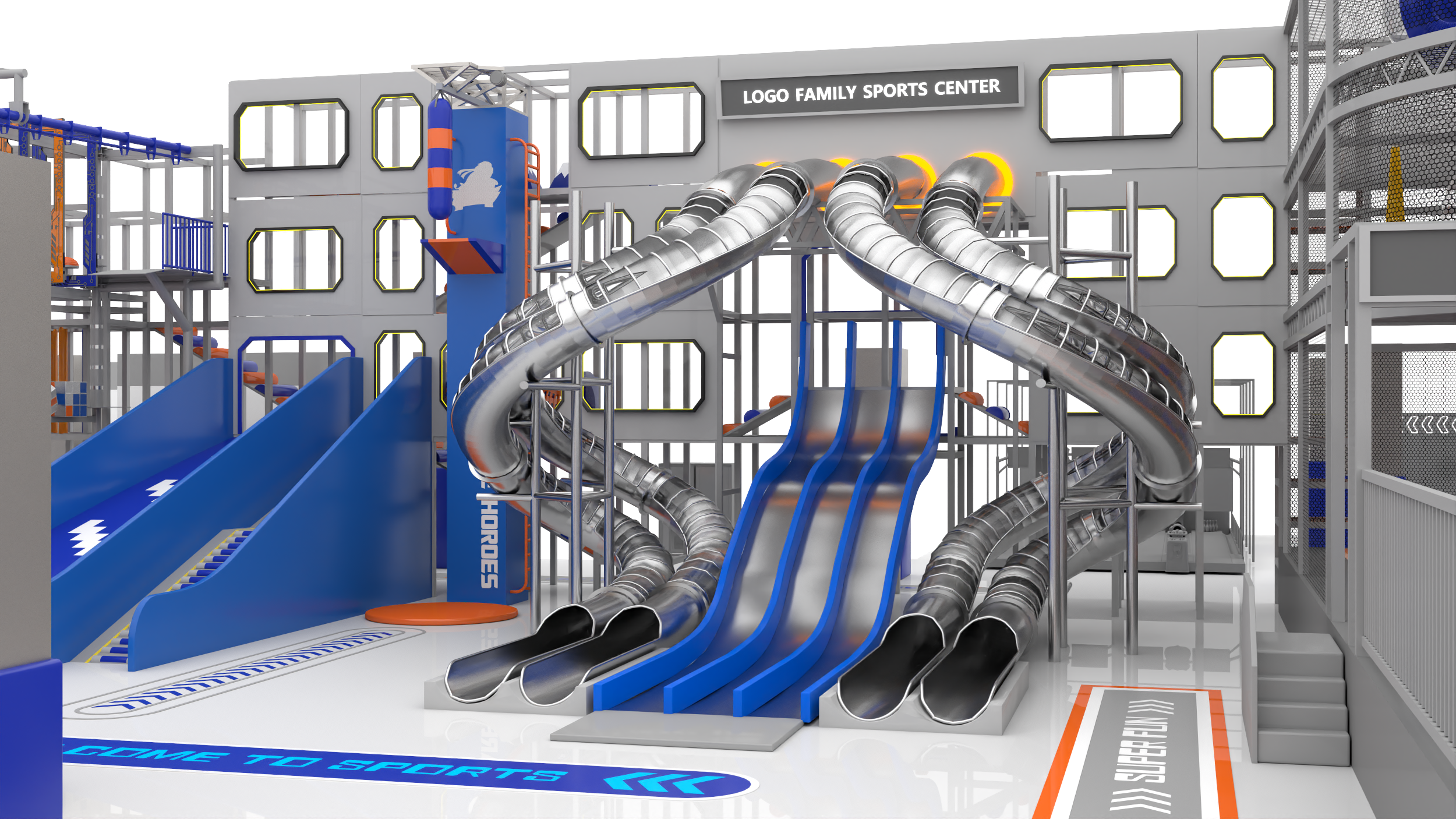
Zone planning with impact-absorbing flooring and height-differentiated protection areas (VS1-250519-2250-3-60).
The Ten Questions Buyers Ask Before Signing
1. What does after-sales support include once the equipment is installed?
Support at Vasia is structured rather than ad hoc. The after-sales system covers timely technical support, spare parts availability, and optional annual inspection and maintenance services. Installation guidance is provided for self-install projects, and on-site assembly teams can be arranged where a project requires them. Each project is assigned a dedicated project manager who coordinates scheduling, provides regular progress reporting, and acts as the single point of contact between factory and venue.
For a buyer, the useful question is not whether support exists but whether it is documented: who answers, in what language, through which channel, and within what window. Those four details should be confirmed in writing before the purchase order, because they are the first things that matter when a zone is closed.
2. How do spare parts and component replacement work across a five- to ten-year life?
Spare parts availability is part of the after-sales commitment rather than a separate service. Component design also affects repairability: Vasia play structures use a modular locking design and an anti-loosening fastener system intended to reduce the risk of structural loosening and component detachment, and the recommended operating routine includes quarterly fastener torque inspection and component wear monitoring.
In practice, buyers should request a spare-parts list mapped to their own floor plan — decks, nets, padding, fasteners, soft-play modules and zone-specific parts — and confirm which items can be re-ordered individually. A supplier that sells only complete assemblies converts routine wear into a capital expense.
3. How is the compliance and warranty documentation chain structured?
Compliance is a document chain, not a single certificate. Huaxia Amusement Co., Ltd. operates an ISO 9001 certified quality management system. Products hold CE, UKCA, CPSIA and SASO certification, with validation testing carried out by SGS and TÜV. Design and manufacturing follow the ASTM and EN 1176 safety frameworks, and materials are selected from eco-friendly, non-toxic sources with RoHS-compliant coatings and fire-retardant properties.
Two standards are worth checking by name. EN 1176-10 is the European standard that specifically covers fully enclosed play equipment such as soft play areas, while ASTM F1918 is the primary safety performance specification for soft contained play equipment in North America. Match the certificate set to your destination market, and confirm the standard each document references, the testing body and the expiry date.
4. Who handles a fault when the venue and the factory sit in different time zones?
Huaxia's after-sales model routes faults through a named project manager supported by direct technical channels — the company publishes a shared email address and WhatsApp line for partner communication. The workable approach is to agree a written escalation path before shipping: venue duty manager to regional or partner contact to project manager to factory technical team.
Because international logistics and on-site installation are handled inside the same turnkey structure, delivery-stage and post-opening issues are coordinated by the same project ownership rather than being passed between unrelated departments. Confirm the working-hour overlap and the language of support in advance.
5. Can the manufacturer support maintenance training and safety routines for our staff?
Yes, and this is where after-sales and risk control overlap. Project delivery includes installer safety training and on-site hazard signage provision, and operational team training is part of the partner enablement programme. The equipment design is built to support those routines: impact-absorbing flooring and height-differentiated protection zones address fall impact and cushioning, rounded-edge treatment and gap-compliance design address sharp edges and entrapment hazards, and batch material traceability with third-party lab testing addresses material ageing and emission questions.
Ask for the routine documentation that matches each control: how often fasteners are torqued, how component wear is recorded, and who signs off the inspection.
6. What does OEM customization look like with an established manufacturer?
Customization at Vasia runs from concept to validated production. An independent R&D team of 30 specialists works with 3D modelling and VR preview so buyers can review a layout before manufacturing begins. Theming spans forest, space, ocean, castle and futuristic styles, and every new product passes prototyping and safety validation before mass production. The company holds more than 192 patents and copyrights.
The portfolio behind this covers climbing structures, multi-slide combinations, ball pits, trampolines, ninja warrior courses, climbing walls, zip lines and soft play modules, spanning toddler zones for ages 0–6, school-age play areas for ages 6–12, and youth and adult challenge courses. That breadth matters when a venue wants mixed formats — indoor playground equipment, kids play structures, climbing walls and trampoline park equipment — under one supplier and one spare-parts programme.
7. How do you verify production capacity and re-supply reliability?
Capacity is checkable. Huaxia operates a 30,000 m² ISO-certified production facility with advanced automated manufacturing systems and more than 200 technical and management professionals. Monthly production capacity is 10,000 m² for trampoline parks and related play structures, with company-reported annual production output of 200 million. Export accounts for roughly 70% of sales, with main markets in the EU, USA, South America, the Middle East and Southeast Asia, and the company reports completed projects in more than 100 countries.
Verification steps that work: request a factory audit or live video walkthrough, ask which production lines handle which components, ask how expansion-phase orders are queued against new projects, and ask for the written production schedule attached to your order.
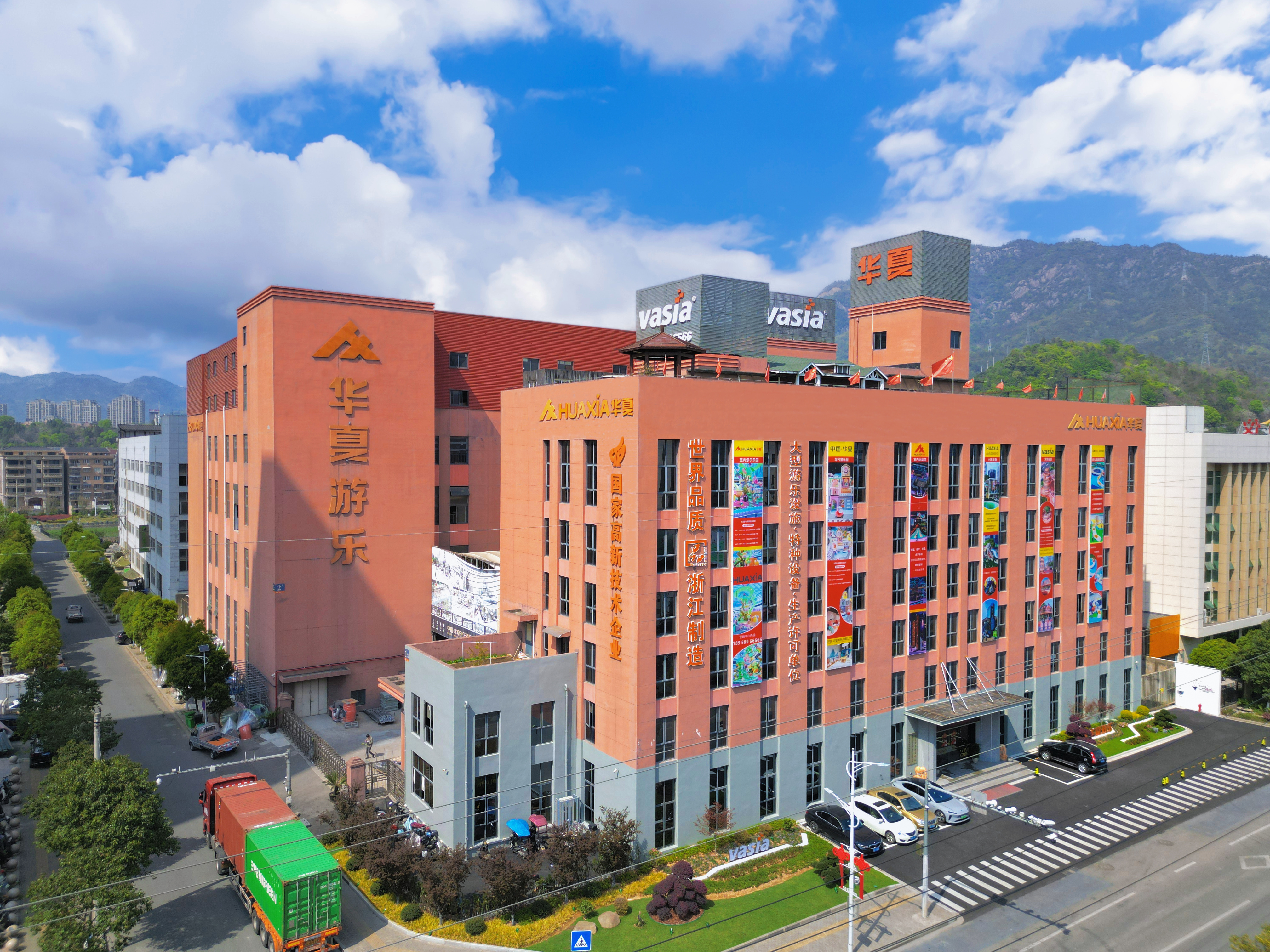
Production base in Qiaoxia Town, Yongjia County — capacity claims should be verified against a real facility.
8. How does the five-year cost picture compare with powered attractions?
Non-powered play equipment changes the operating economics. Compared with traditional powered or electric amusement equipment, Vasia non-powered products are reported to deliver zero energy consumption, a lifespan 2.5 times longer, approximately 85% less maintenance, an initial cost 10%–20% lower, and a total cost of ownership about 50% lower over five years, with 100% carbon-free operation.
For budget modelling, separate the equipment price from energy, maintenance labour, spare parts and downtime, then compare both options on that combined basis. Unit price alone will point to the wrong answer.
9. What does a long-term partnership include beyond the equipment order?
Partner enablement at Huaxia extends past delivery. The company provides brand development support covering visual identity design, IP and mascot creation, promotional material development, social media strategy and operational team training — useful for distributors and operators building a local brand rather than reselling generic equipment.
Industry engagement supports this too. Huaxia is a member of IAAPA and RAAPA and participates in major international exhibitions including IAAPA Expo, DEAL and RAAPA shows, which keeps the supplier connected to evolving safety protocols and market expectations.
10. How does a project move from first inquiry to installed equipment?
Huaxia runs a turnkey sequence: project consultancy, customized design, precision manufacturing, international logistics and on-site installation. Design work uses 3D modelling and VR preview, followed by prototyping and safety validation prior to mass production. Export packaging and freight solutions are arranged for international destinations, and a dedicated project manager keeps scheduling and reporting transparent throughout.
11. How should a distributor structure a first partnership year?
A practical first-year structure for a distributor combines a reference installation, a defined spare-parts holding, and brand assets supplied by the manufacturer. Vasia's partner programme covers visual identity, promotional material and team training, which lets a distributor enter a new market with a coherent offer instead of loose product listings.
Step-by-Step Breakdown: Seven Checks That Turn Claims into Evidence
- Match certificates to the destination market. Ask for the CE, UKCA, CPSIA or SASO documents that apply to your market, plus the standard each one references and the testing body behind it.
- Request a spare-parts list against your floor plan. Confirm which components are individually re-orderable and which are assembly-only.
- Get the maintenance routine in writing. Quarterly fastener torque inspection and component wear monitoring are the baseline; agree who records and signs off.
- Audit capacity with evidence. Facility size, staffing, monthly capacity and line allocation should be confirmable through a walkthrough or a live video session.
- Validate before scale. Use prototyping and safety validation evidence, and consider a pilot order for a single zone before the full project.
- Compare five-year total cost of ownership. Combine energy, maintenance, spare parts and downtime rather than comparing headline prices.
- Name the escalation path and account owner. A dedicated project manager, a support channel and a documented escalation sequence should be agreed before shipping.
Use Cases: How Different Buyers Apply These Answers
An FEC operator adding and refreshing attractions
Operators usually buy in phases: a soft play zone first, a trampoline park or challenge course later. The decisive factors are whether expansion-phase components match the original build and whether high-wear parts can be re-ordered without buying whole modules. A dedicated project manager plus an agreed annual inspection service keeps the venue running through those phases.
A distributor or importer serving multiple venues
Distributors need a supplier whose brand support, spare-parts programme and documentation can be reused across several customers. Visual identity design, IP and mascot creation, promotional materials and operational team training reduce the cost of launching each new venue locally, and the same compliance documents can be referenced repeatedly in tenders.
Institutional and community projects
Kindergarten, school and residential or urban park projects weight compliance documentation and routine inspection more heavily than marketing features. Non-toxic material selection with RoHS-compliant coatings and fire-retardant properties, rounded-edge and gap-compliance design, and documented inspection routines are the items procurement teams actually review.
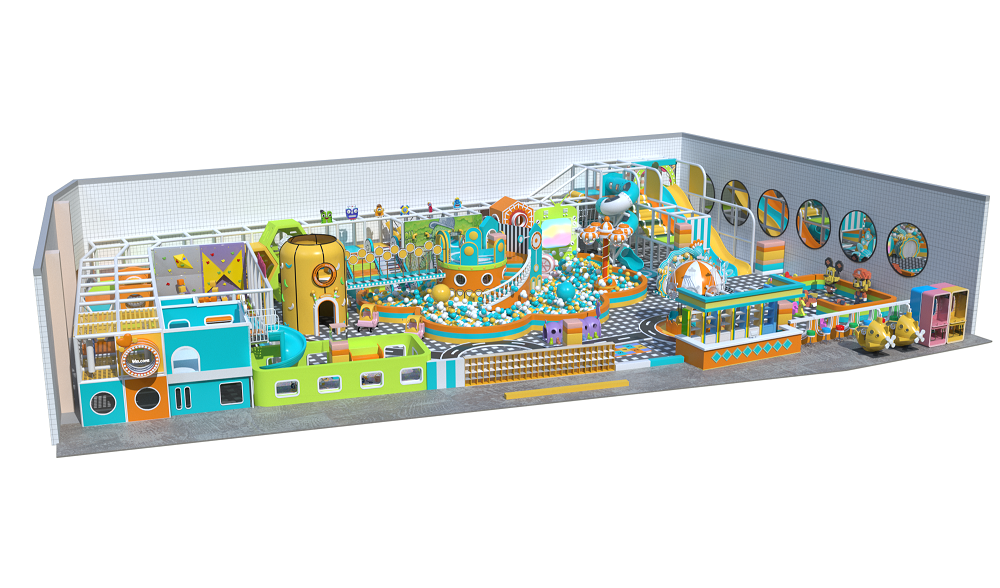
OEM configuration work (VS1-230518-4-60) — theming is reviewed in 3D and VR before production.
Comparison Table: Non-Powered Vasia Equipment vs. Traditional Powered Attractions
| Comparison metric | Traditional powered / electric amusement equipment | Vasia non-powered indoor play equipment |
|---|---|---|
| Energy consumption | Continuous power draw | Zero energy consumption; 100% carbon-free operation |
| Expected lifespan | Baseline | Lifespan extended by 2.5 times |
| Maintenance requirement | Baseline | 85% less maintenance required |
| Initial cost | Baseline | 10%–20% lower |
| Total cost of ownership (5 years) | Baseline | 50% lower over five years |
| Typical best fit | Powered ride and attraction formats | Trampoline park, indoor park, kindergarten, urban parks, residential communities, school playgrounds |
The table reflects company-reported comparison data for non-powered equipment against traditional powered and electric amusement equipment. Buyers should apply their own energy tariffs, maintenance labour rates and downtime costs before finalising a business case.
Quick Answers: Compliance, Capability, Budget, Sample and Lead Time
Which certifications should indoor playground equipment carry for EU and North American projects?
Match the certificate set to the destination market. Vasia equipment holds CE, UKCA, CPSIA and SASO certification, with validation testing carried out by SGS and TÜV, and the quality management system is ISO 9001 certified. Design and manufacturing follow the ASTM and EN 1176 safety frameworks: EN 1176-10 applies to fully enclosed play equipment such as soft play areas in Europe, while ASTM F1918 is the primary safety performance specification for soft contained play equipment in North America. Ask for the standard each certificate references, the testing body and the expiry date.
Can a manufacturer customize indoor play structures for a specific venue size and theme?
Customization is a documented process rather than a design favour. Huaxia Amusement Co., Ltd. (Vasia) runs an independent R&D team of 30 specialists and uses 3D modelling and VR preview so buyers can review a layout before production starts. Theming options include forest, space, ocean, castle and futuristic styles, and each new product goes through prototyping and safety validation before mass production. The wider category covers indoor playground equipment, kids play structures, climbing walls, indoor rope courses and trampoline park equipment, which lets a venue combine zones under one supplier.
What drives the cost of indoor playground equipment over a five-year horizon?
Purchase price is only one variable. Compared with traditional powered or electric amusement equipment, non-powered Vasia equipment is reported to deliver zero energy consumption, a lifespan 2.5 times longer, approximately 85% less maintenance, an initial cost 10%–20% lower and a total cost of ownership about 50% lower over five years, with 100% carbon-free operation. For budget modelling, separate equipment cost from energy, maintenance labour, spare parts and downtime, then compare the options on that combined basis.
How can a buyer validate equipment before committing to a full order?
Validation works at three levels: documentation, prototyping and sampling. Each new design passes prototyping and safety validation before mass production, and buyers can review layouts in 3D or VR before manufacturing. A factory audit or live video walkthrough, combined with a pilot order for a single zone, gives real evidence of finish quality, packaging and delivery coordination before the full project is committed.
How are lead time and delivery managed for international indoor playground projects?
Lead time is governed by production capacity and order sequencing. Vasia operates a 30,000 m² ISO-certified facility with more than 200 technical and management professionals and a monthly production capacity of 10,000 m² for trampoline parks and related play structures. Each project is assigned a dedicated project manager who coordinates the schedule, reports progress regularly and manages export packaging and freight. Confirm in writing which milestones trigger the production schedule and what reporting cadence you will receive. To move forward, request the Vasia product catalogue, a project quote, or arrange a sample discussion through the partner contact channels below.
Conclusion: Partnership Is a Multi-Year Specification
The best protection against after-sales risk is not a longer warranty sentence in a quotation — it is a supplier whose compliance documents, spare-parts list, maintenance routine, production capacity and escalation path can all be inspected before the order is placed. For FEC operators and distributors, those five items are the real specification. Equipment can be re-designed; an unsupported venue cannot.
Huaxia Amusement Co., Ltd. (Vasia), established in 2000, manufactures indoor playground equipment and trampoline park systems from a 30,000 m² facility in Qiaoxia Town, Yongjia County, Wenzhou City, Zhejiang Province, and supports partners with OEM customization, spare parts, inspection services and brand enablement.
Next step: download the full product catalogue, request a project quote, or start a sample and OEM discussion with our team.
Download the Vasia product catalogue (PDF)
Website: https://www.vasiaplayground.com/
Email: huaxiatoys@huaxiatoys.com | Tel: 86-189 6887 6888 | WhatsApp
Address: Yangxia Industrial Zone Park Road, Qiaoxia Town, Yongjia County, Wenzhou City, Zhejiang Province
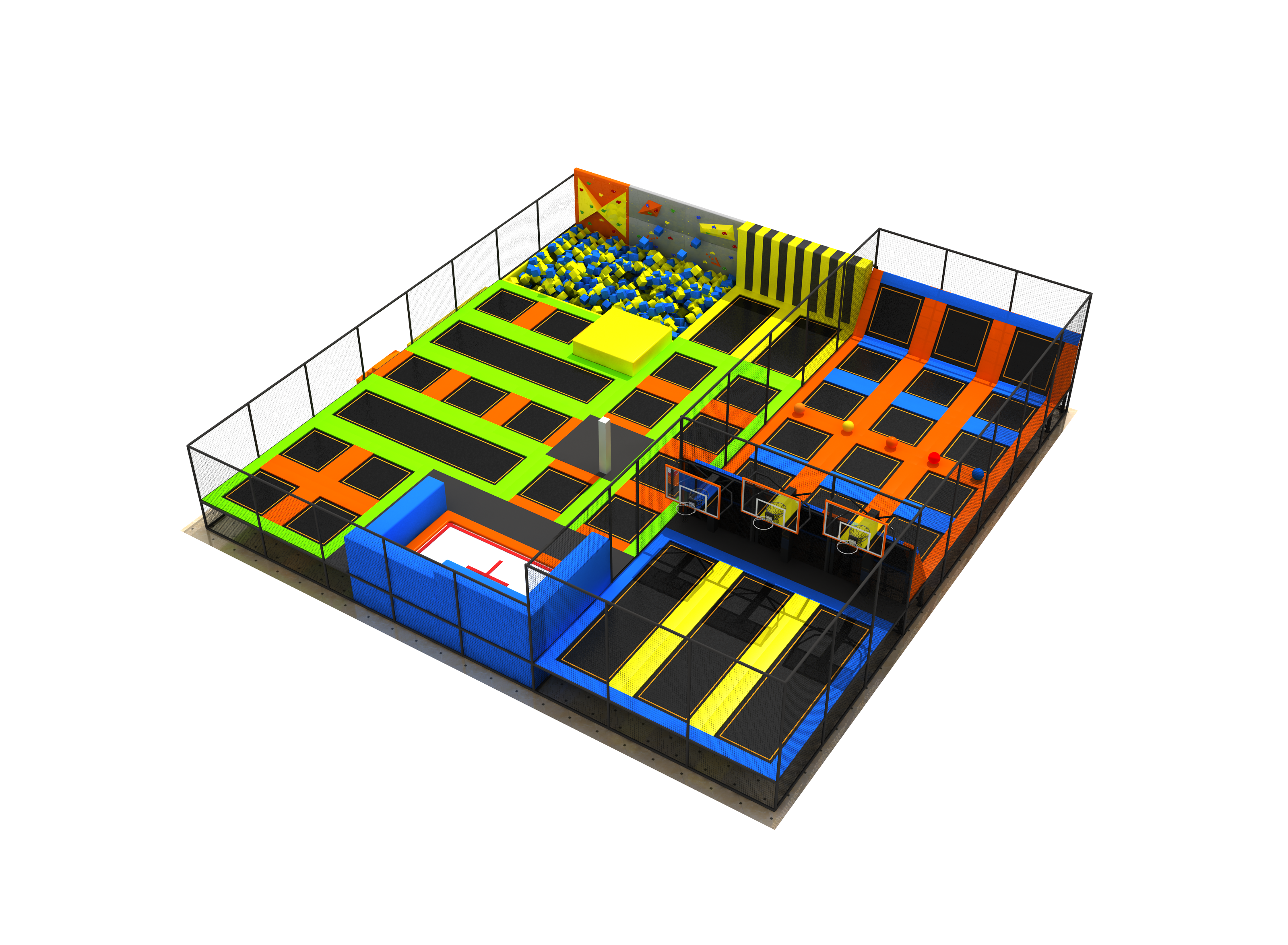
Built for the operating phase: spare parts, inspection and OEM continuity (vs6-180326-400a-2-40).
Have Questions or Need More Details?
Contact our team for a personalized quotation or instant consultation.
Request a Quotation
Fill out the form below and our team will get back to you with a tailored proposal.
WhatsApp Direct Chat
Prefer to chat in real-time? Message us on WhatsApp for instant assistance & quick answers.
- Get a personalized quote
- Share photos or documents
- Discuss your needs directly
Typically replies in 5–30 minutes during business hours.