
Indoor Playground vs. Trampoline Park vs. Climbing Wall: An FEC Route Guide
An indoor playground, an indoor trampoline park and a climbing wall are three separate attraction routes, not three versions of one product. Each serves a different age band, uses floor area and clear height differently, and requires its own material and certification documents. For a family entertainment center (FEC) working inside a fixed building, the useful question is not which attraction is best, but which route fits the families you can attract and the structure you already have.
The comparison below runs through three filters — target age, space planning, and materials and certification — and uses the specifications Vasia publishes for its own product lines so that all three routes are described at the same level of detail. It is a decision guide, not a ranking: no route wins in general, and the right answer changes with the building, the audience and the compliance file the operator must hold.
The Three Routes at a Glance
Each route is a different engineering category. That is why their specifications are not interchangeable and why a quotation for one cannot be used to estimate another.
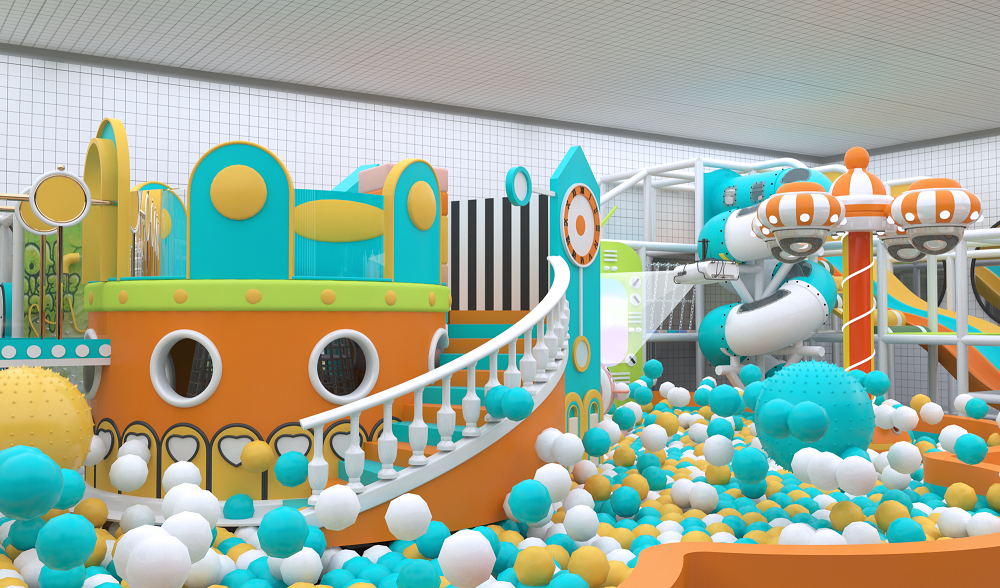
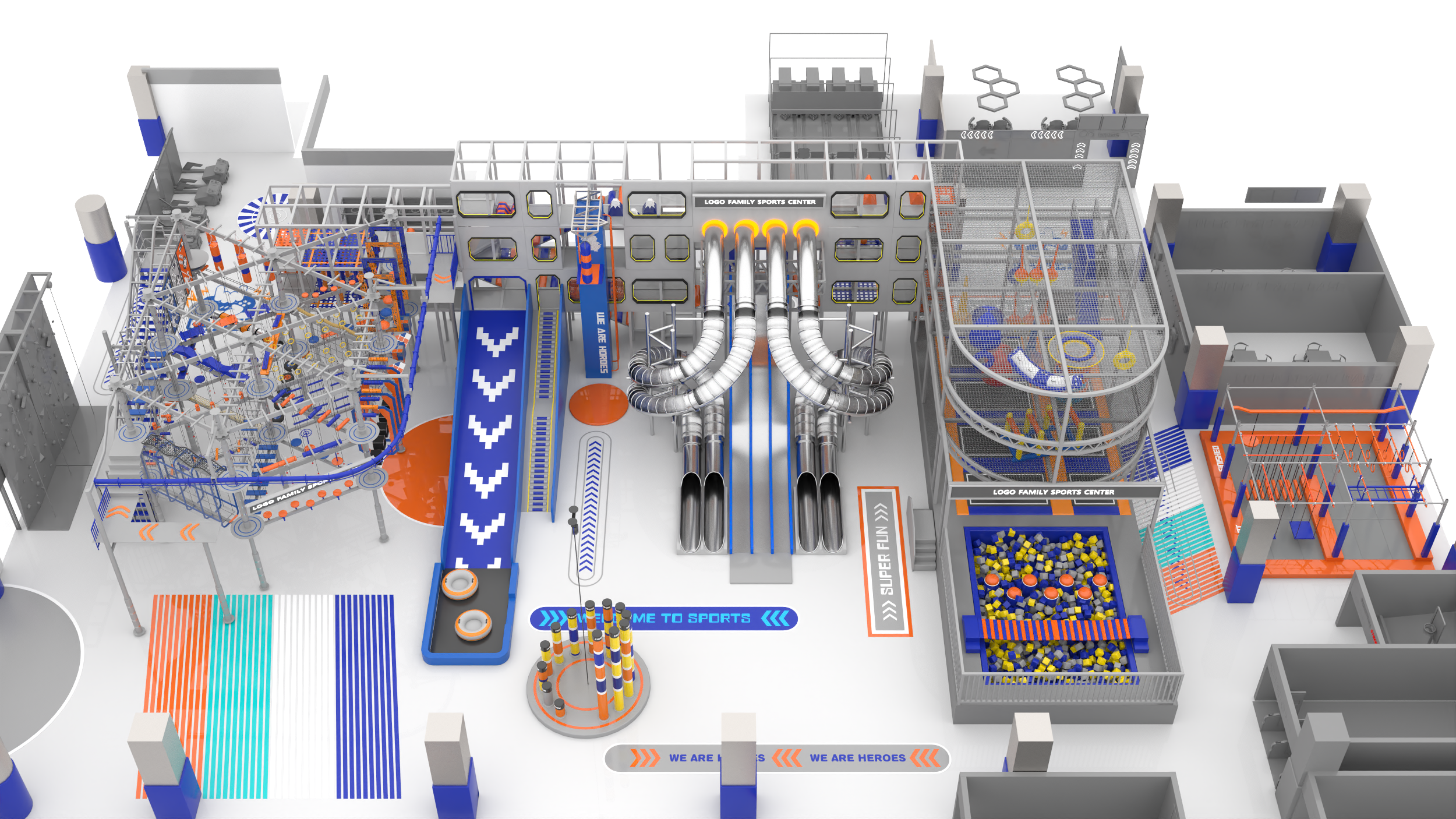
Indoor playground or kids play structure. A multi-level padded structure that combines platforms, slides, tunnels, ball pits and soft-play modules. Vasia's Indoor Playground Equipment unit (VS1-250503) documents a main frame in 48 mm galvanized steel pipe at 2.0 mm wall thickness with 15 mm anti-collision sleeves, platforms in 800×800 mm cold-rolled or perforated steel plate (also listed at 91×91 cm and 116×116 cm), and a soft-play build-up of 1.8 cm multilayer board, 2 cm EPE foam and 0.45 mm PVC leather. Expanded structures move to 140 mm pipe at 4.0 mm thickness.
Indoor trampoline park. An array of spring-mounted mats held in a steel frame. Vasia's trampoline park equipment unit (VS6-190301-1980A-13-29, and the related Indoor Trampoline Park unit VS6-180326-400a-2-40) documents Q235 galvanized rectangular upright posts of 80×80×2.0 mm, a connecting frame of 50×80×2.5 mm, reinforcement linkage of 40×40×1.5 mm, a PP jumping mat with 500D×500D fibre count, a 70 mm high-density EPE mat, 0.52 mm Plato PVC-coated mesh fabric, and 180 mm springs in 82B carbon steel wire. The frame is assembled with screw fasteners.
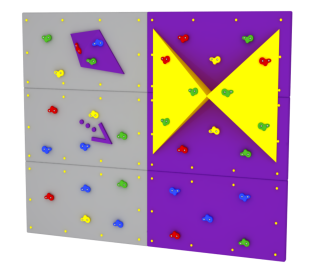
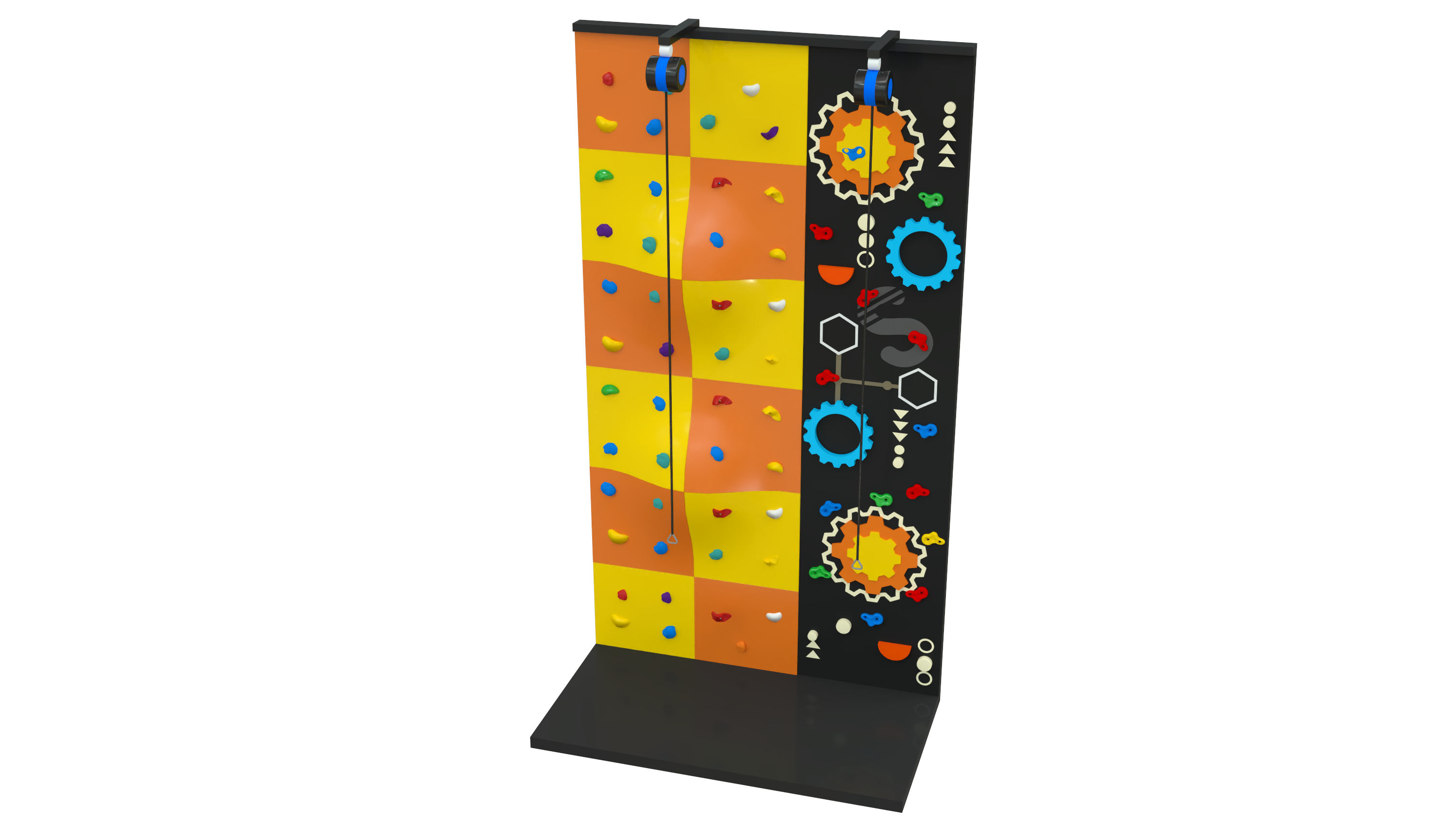
Climbing wall or indoor rope course. Vertical or elevated challenge structures with their own frame, surface and fall-protection build-up. Vasia's Climbing Wall for Playground (VS-2659) uses a Q235 galvanized rectangular frame of 40×40×1.5 mm, 15 mm plywood padding, 10 mm high-density EPE and 0.52 mm PVC-coated mesh. The Indoor Rope Course Equipment unit (VS1-250522-1900B-30) uses a heavier frame of 50×80×3.0 mm, 40×80×2.0 mm and 40×40×2.0 mm tube, a 15 mm plywood surface with 2.0 mm printed PVC flooring, climbing holds, an electronic timer, and a safety mat of 28 kg/m³ foam at 10 mm plus 140 mm EPE.
Why FEC Operators Compare These Three Routes
All three routes compete for the same capital budget and the same visiting families, which is what makes the comparison necessary rather than academic.
Commercial research published in 2026 estimates the global family entertainment center market at USD 34.4 billion in 2025, with a projected 10.5% CAGR to 2035 (Mordor Intelligence, reported through Business Research Insights). That estimate covers FEC services and equipment together, so it describes the size of the venue market rather than the value of any single attraction category, and it is a commercial forecast rather than an audited statistic. What it does support is a planning point: venue operators are investing in indoor capacity, and the binding constraint on a new or expanding FEC is usually the building, not the catalogue.
Vasia (Huaxia Amusement Co., Ltd.) is an indoor amusement equipment manufacturer founded in 2000 in Qiaoxia Town, Zhejiang Province, China, operating a 30,000 m² production facility with more than 200 employees. Its documentation lists CE, UKCA, CPSIA and SASO certification, ISO 9001 quality management and testing by SGS and TÜV, together with adherence to the ASTM and EN 1176 safety frameworks. Because the range covers indoor playgrounds, trampoline parks, climbing walls, rope courses and ninja courses, its own product units provide a consistent documentation reference for comparing the three routes on equal terms.
Filter 1: Target Age and Supervision Load
Age fit decides which families can use the attraction at all, and it should be settled before floor area is discussed.
Vasia's indoor playground documentation lists a main age range of 3–15 years, with some soft-play products aimed at 2–8 years. The trampoline units do not state a restricted band; the company notes that newer trampoline parks cover all age groups, and the documented mat ratings are 600 kg static and 130 kg dynamic load on the 1800×1800 mm standard mat. The climbing wall (VS-2659) and rope course (VS1-250522-1900B-30) specifications document materials, structure and fall protection but do not state an age band, so age suitability for those two routes has to be confirmed at quotation stage against the destination market's requirements and the operator's supervision policy.
The practical consequence is a two-tier decision. If a large share of expected traffic is toddlers and early primary children, soft play is the only route in this set with a documented band starting at 2–8 years, and it is also the route where the equipment itself absorbs most of the impact. If the business plan depends on teenagers and adults sharing the same floor, the trampoline route is the only one here documented as covering all age groups. A climbing wall or rope course is better treated as a challenge layer with its own supervision model than as a substitute for either of the other two.
Supervision belongs to the same filter. Vasia's application data describes these installations as designed for continuous daily use with manual supervision and low maintenance, available around the clock. That is a statement of design intent, not a staffing formula: the number of marshals still depends on how many users are on the structure at once and on the operating rules the venue writes.
Filter 2: Space Planning — Footprint, Height and Circulation
Space planning is where two routes with similar budgets can diverge completely, because the repeating unit that consumes floor area is different in each case.
In a soft play structure, the repeating unit is the platform. Vasia lists 800×800 mm steel platforms and 91×91 cm or 116×116 cm perforated plates, a 2 m wide steep slide with a steel frame of 4×4 cm and 4×8 cm square tubes, and a padded build-up of roughly 4 cm of board, foam and vinyl above each deck. Because the structure stacks levels, the constraint is clear height above the highest platform plus the fall-protection and netting zone, not just the ground footprint.
In a trampoline park, the repeating unit is the mat bay. Documented mat sizes are 1800×1800 mm for the standard mat and 2130×4260 mm for the professional mat with nylon webbing, framed by 80×80×2.0 mm posts and 180 mm springs. Bay count rather than total square metres is the planning unit, and circulation between bays and around the frame has to be reserved separately.
In a climbing wall or rope course, the repeating unit is the vertical or elevated element. The climbing wall frame is a comparatively light 40×40×1.5 mm section with a 15 mm plywood face, so floor area is mainly the landing and padding zone beneath and in front of the wall. The rope course is an elevated circuit with 140 mm EPE and a 28 kg/m³ foam safety mat, so its plan footprint includes the mat area and the walkway around the structure, not only the frame.
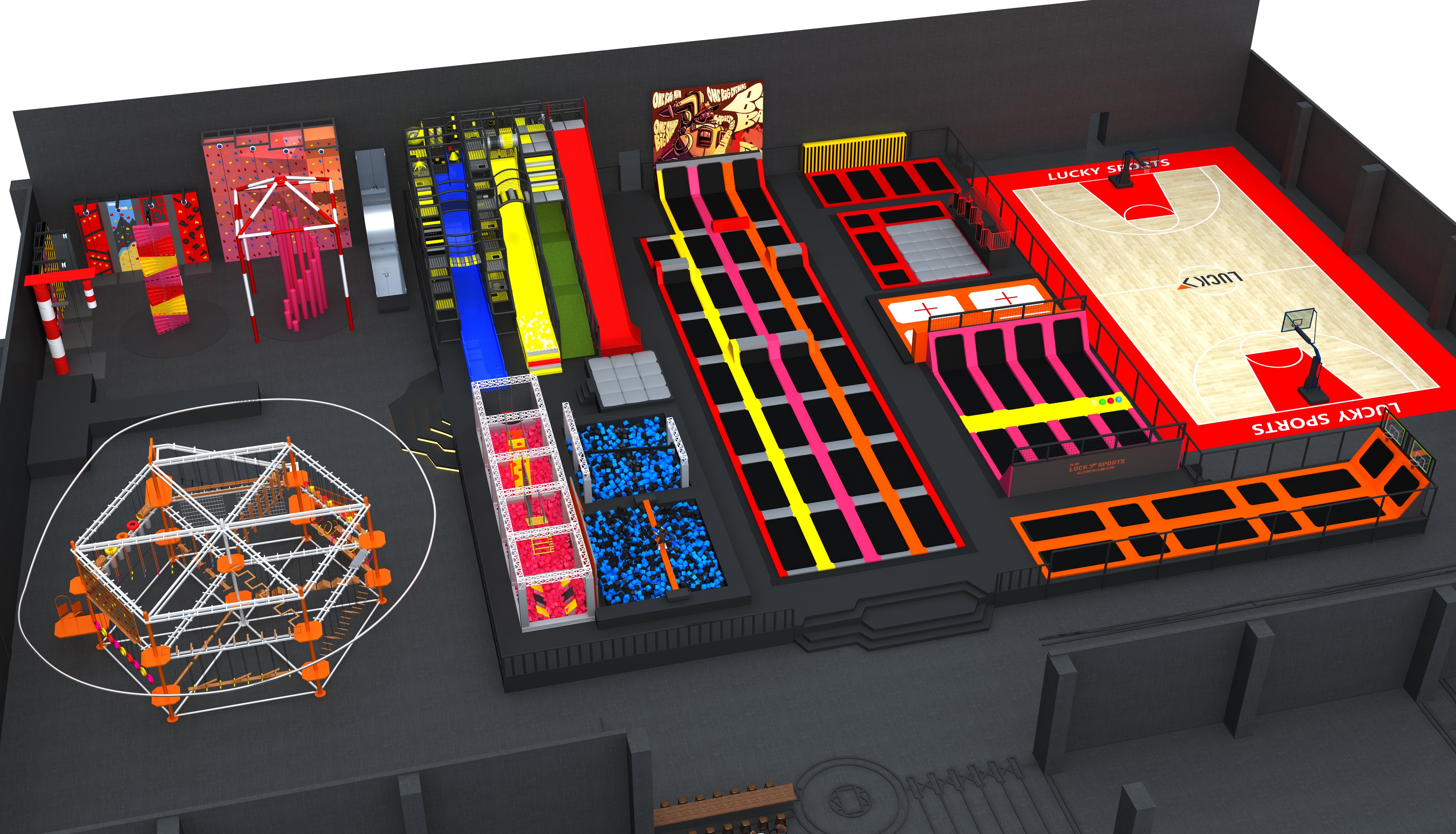
For all three routes, the reliable way to turn these figures into a layout is to request a CAD plan and a 3D view of the actual configuration. Vasia's stated project workflow includes CAD layout and 3D design before production, which is the stage at which column positions, ceiling height and door access should be tested against the equipment rather than after the deposit.
Filter 3: Materials and Certification
Material specification is the filter that most affects long-term cost, and it is also the one most often compressed into a single line in a quotation.
Common material layer across all three routes
All three Vasia routes share a galvanized steel frame family, polyethylene safety netting where netting is used (30×30 mm mesh, tested to GB 6675.4-2014), polyamide nylon ties and buckles, and PVC sleeves with an EPE lining over exposed tubes. Coated fabric is specified as 0.52 mm Plato PVC-coated mesh at 1300×1300D warp and weft, referenced to EN 71-2:2020 (toy safety, flammability), clauses 4.1 and 4.4. Cast steel 48# couplers are referenced to GB/T 228.1-2021. At company level, Vasia states RoHS-compliant coatings, fire-retardant materials and FSC-certified timber where timber is used.
Trampoline-specific specification
The trampoline route adds spring and mat engineering. Springs are 82B carbon steel wire at 180 mm, referenced to GB/T 20125-2006 and GB/T 20123-2006; the jumping mat is PP at 500D×500D fibre count and the mat padding is 70 mm high-density EPE, both referenced to GB 6675.4-2014. These are the components that determine bounce behaviour and replacement cycles, so they should be quoted by standard reference rather than by description alone.
Climbing wall and rope course specification
The climbing and rope routes put more weight on surface and fall protection. Both use 15 mm plywood referenced to GB/T 5849-2006, including the E0-grade formaldehyde requirement; the climbing wall adds 10 mm high-density EPE, while the rope course adds a 2.0 mm printed PVC floor surface, climbing holds, an electronic timer and a safety mat of 28 kg/m³ foam plus 140 mm EPE.
Soft play finishing details worth writing into the RFQ
Two details in the soft play specification separate a durable structure from a cheap one. Slides are made from imported engineering plastics or 196 resin, and the carpet specification reaches 80,000 rubs of wear resistance. Timber elements are mainly corrosion-resistant Scots pine. None of these lines changes the safety case on its own, but each one is checkable at quotation, which is what makes them useful.
What to request before signing
Ask for four documents for whichever route you choose: the certificate of conformity naming the exact models quoted (Vasia's file lists CE, UKCA, CPSIA and SASO), the SGS or TÜV test reports behind those marks, the ISO 9001 certificate for the production site, and a component-level material schedule carrying the standard numbers listed above. A mark on a website is a company claim; the model list on the certificate is what ties that claim to your order.
Comparison Table: Three Routes on Documented Characteristics
The table compares only characteristics that appear in the supplied Vasia specifications. A blank or unstated cell is not evidence of absence.
| Characteristic | Indoor playground / kids play structure | Indoor trampoline park | Climbing wall / rope course |
|---|---|---|---|
| Reference units | VS1-250503; VS1-250414-780-D1-77; VS1-250519-2250-3-60; VS1-230518-4-60 | VS6-190301-1980A-13-29; VS6-180326-400a-2-40 | VS-2659 (wall); VS1-250522-1900B-30 (rope course) |
| Documented age reference | Main range 3–15 years; some soft-play products 2–8 years | No restricted band stated; newer trampoline parks described as covering all age groups | Not stated in the supplied specification |
| Primary structural frame | 48×2.0 mm galvanized steel pipe; 140×4.0 mm for expanded structures | 80×80×2.0 mm posts; 50×80×2.5 mm connecting frame; 40×40×1.5 mm linkage | 40×40×1.5 mm (wall); 50×80×3.0 mm, 40×80×2.0 mm and 40×40×2.0 mm (rope course) |
| Recurring planning module | 800×800 mm platforms; 91×91 cm and 116×116 cm plates; 2 m wide steep slide | 1800×1800 mm standard mat; 2130×4260 mm professional mat | Wall face plus landing zone; elevated circuit plus 28 kg/m³ foam mat |
| Distinctive soft goods | 1.8 cm multilayer board plus 2 cm EPE plus 0.45 mm PVC leather | 70 mm EPE mat; 180 mm 82B springs; PP 500D×500D jumping mat | 15 mm plywood (E0) and 10 mm EPE for the wall; 140 mm EPE and 2.0 mm PVC floor for the rope course |
| Shared references | PE safety net 30×30 mm to GB 6675.4-2014; 0.52 mm PVC-coated mesh at 1300×1300D to EN 71-2:2020 clauses 4.1 and 4.4; cast steel 48# couplers to GB/T 228.1-2021; ASTM and EN 1176 frameworks; CE, UKCA, CPSIA and SASO certification listed by Vasia | ||
Step-by-Step: How to Decide in Five Steps
The sequence below keeps the decision anchored to the building and the compliance file rather than to catalogue photography.
- Fix the age band and the supervision model first. Write down which age groups must be served on opening day and who supervises them. Vasia's documented bands (3–15 years for indoor playgrounds, 2–8 years for some soft-play products, all ages for newer trampoline parks) give you the starting vocabulary for that conversation; climbing and rope routes need the age question answered explicitly because the supplied specifications do not state one.
- Measure the building before opening the catalogue. Record floor plate, clear height, column grid, door width and ceiling obstructions. Then convert those numbers into platforms, mat bays or wall faces using the module dimensions above. A route that fits the audience but not the ceiling is not a candidate.
- Write the material specification into the RFQ. Name the frame section, the padding build-up and the standard references rather than asking for a generic soft play area or trampoline park. Comparing two quotes is only meaningful when both list the same tube sizes, foam thicknesses and fabric weights.
- Build the compliance file before the deposit. Request the model-specific certificate, the third-party test reports, the ISO 9001 site certificate and the material schedule. Confirm which framework applies in your destination market and which body will accept the documentation.
- Agree the delivery route. Design approval, production, packing, shipping and installation are separate stages with separate failure modes. Vasia's stated workflow covers all five; the schedule, Incoterms and site responsibilities still have to be written into the order.
Use Cases: Which Route Fits Which Operator
The three routes map onto different operating situations more than onto different budgets.
Mall-based FEC with toddler-heavy traffic. A soft play structure is the natural anchor because it serves the youngest documented band and can be configured with themed modules. Vasia's application data lists shopping malls alongside kindergartens and amusement parks as suitable sites, with anti-collision foam, non-slip flooring and rounded corners among the matched components.
Standalone venue aimed at school-age and teenage groups. A trampoline park concentrates throughput per square metre in mat bays and is the only route in this set documented as covering all age groups. The trade-off is a spring-and-mat maintenance routine rather than the padding-and-panel routine of soft play.
Existing FEC adding a challenge layer. A climbing wall or rope course extends the visit for older children and adults without duplicating the soft play footprint. The rope course adds an electronic timer in the documented configuration, which makes it usable for timed circuits; the climbing wall is the lighter structural intervention of the two.
Kindergarten or school recreation room. Soft play dominates here. Vasia lists kindergarten among the applicable industries for its Kids Play Structure (VS1-250414-780-D1-77) and OEM Indoor Playground (VS1-250519-2250-3-60) units, both built on the 48×2.0 mm frame and 30×30 mm PE net specification.
Limitations of This Comparison
Three things this guide cannot tell you, stated plainly so they are not mistaken for omissions.
First, it contains no prices, MOQ or lead times. The supplied specifications document structure and materials, not commercial terms, and any per-square-metre figure quoted elsewhere should be treated as a different scope until the component schedule matches.
Second, it compares documented characteristics, not measured outcomes. No independent field data on bounce performance, wear rates or incident history is included, so the article cannot establish that one route performs better than another in service — only that the three are built from different components to different standard references.
Third, age bands are missing for the climbing wall and rope course in the supplied material. That gap is a question to put to the supplier, not a reason to assume either route is unsuitable for a given age group.
Frequently Asked Questions
Which certification documents should an FEC operator request for these three routes?
For any of the three routes, request the certificate of conformity that names the specific models being quoted, the test reports behind it, and a component-level material schedule. Vasia's documentation lists CE, UKCA, CPSIA and SASO certification, ISO 9001 quality management and testing by SGS and TÜV, and states that its equipment follows the ASTM and EN 1176 safety frameworks. A company-level certificate does not automatically cover every model or configuration, so the model list on the certificate is the part that must be checked against the quotation.
Can one supplier deliver a soft playground, a trampoline park and a climbing wall for the same FEC?
Where the supplier's range covers all three categories, yes. Vasia manufactures indoor playgrounds, trampoline parks, climbing walls, rope courses and ninja courses, so the three routes can be specified from one technical catalogue, and its stated project workflow includes CAD layout, 3D design, production, packing, shipping and installation. Consolidating suppliers reduces the number of interfaces, but it does not by itself prove manufacturing capacity or delivery performance, so ask for references and a written production schedule.
What makes a quotation for one route different from another?
The supplied material does not include prices, so no per-square-metre comparison can be made here. What differs is the bill of materials. Trampoline routes are spring-and-mat intensive: 180 mm 82B carbon steel springs, a PP 500D×500D jumping mat and a 70 mm EPE mat. Soft-play routes are platform-and-padding intensive: 800×800 mm steel platforms with a multilayer board, EPE and PVC build-up. Climbing and rope routes are frame-and-fall-protection intensive: heavier tube sections up to 50×80×3.0 mm, 15 mm plywood, 140 mm EPE and a 28 kg/m³ foam mat. Price the same component schedule from each supplier.
How do the safety-net and padding specifications differ between routes?
Vasia's soft-play units specify a polyethylene safety net with 30×30 mm mesh tested to GB 6675.4-2014, secured with polyamide nylon ties and buckles, over frames protected by PVC sleeves with an EPE lining. The trampoline units document the mat, spring and PVC-coated mesh layers instead of a net. Quotations should list the layer that actually applies to the route being bought rather than a generic line saying a safety net is included.
Can we review materials before committing to a full order?
Yes. Material samples and documentation can be reviewed before production starts. Vasia's material schedule names galvanized pipe, multilayer board, sponge, PVC skin, acrylic, nylon and resin, with coated fabric referenced to EN 71-2:2020 clauses 4.1 and 4.4 and RoHS-compliant coatings stated at company level. Comparing a sample of the PVC-coated fabric and the foam build-up against the specification sheet is the quickest way to confirm thickness and finish before the order is fixed.
How are delivery and installation planned once a route is chosen?
Vasia's stated workflow runs from CAD layout and 3D design through production, packing, shipping and installation. The supplied material does not give standard lead times for any of the three routes, so schedule commitments should be agreed project by project and written into the order, with design approval, manufacturing and shipping tracked as separate stages. The product units referenced in this guide, and the configurations built from them, are listed in Vasia's catalogue, which can be downloaded here: Vasia product catalogue (PDF).
Conclusion: Choose the Route, Then Specify the Components
The three routes answer different questions. Soft play answers how to serve the youngest visitors with a structure that absorbs impact itself, and it is the only route here with a documented band from 2–8 years. A trampoline park answers how to concentrate school-age and adult throughput in mat bays, and it is the only route documented as covering all age groups. A climbing wall or rope course answers how to add a challenge layer without repeating the soft play footprint, with the rope course carrying the heavier fall-protection build-up of the two.
Whichever route fits your building, the specification work is the same: name the frame section, the padding build-up and the standard references, then verify the certificate against the exact models you are buying. That is the difference between a comparison that ends in a brochure and one that ends in equipment you can document to a regulator, an insurer and your own maintenance team.
Have Questions or Need More Details?
Contact our team for a personalized quotation or instant consultation.
Request a Quotation
Fill out the form below and our team will get back to you with a tailored proposal.
WhatsApp Direct Chat
Prefer to chat in real-time? Message us on WhatsApp for instant assistance & quick answers.
- Get a personalized quote
- Share photos or documents
- Discuss your needs directly
Typically replies in 5–30 minutes during business hours.