
Trampoline Park or Soft-Play Indoor Playground? A Head-to-Head How-To
Direct answer: choose the route your catchment will fill on a quiet weekday, not the one that photographs best. If most regular visitors are under six and families stay for two to three hours, a soft-play indoor playground is the lower-risk anchor. If bookings come from school-age children, teenagers and birthday groups arriving in timed sessions, an indoor trampoline park is the stronger anchor. When both groups are present — the normal case for a family entertainment centre — the real decision is which route anchors the hall and which becomes the attached zone.
The eight steps below each produce a document you can hand to a supplier, a landlord or a lender: a demand statement, a category match, a materials schedule, a certification request list, a risk register, a side-by-side sheet, a single-source scope and a set of acceptance criteria. The order matters. The equipment category is nearly the last thing to fix; the age mix is the first.
What this decision is — and what it is not
Under the broad heading of Indoor Playground Equipment, the soft-play family and the trampoline family sit side by side. The soft-play family means Kids Play Structure systems: multi-level platforms, slides, ball pits, toddler zones and protective netting. The trampoline family means an Indoor Trampoline Park: interconnected trampoline beds held in a structural steel frame, with angled wall beds, foam pits or airbags, spring and frame padding, and perimeter netting.
This is not a quality contest. A well-specified soft-play build beats a badly specified trampoline park on durability and family appeal, and the reverse is equally true. What separates the two routes is fit: age band, session model, supervision capacity, consumable budget, and the certification evidence each route must be able to produce.
One clarification worth making early: most FEC projects do not end in a pure choice. They end in a hybrid — a trampoline-led hall with a soft-play toddler zone, or a soft-play anchor with a compact trampoline or rope-course add-on. Treat the comparison below as a way to decide the anchor, then size the second zone against the leftover space and the leftover age band.
Why the comparison is harder to make in 2026
Demand context has grown louder and compliance has grown more specific. Both push buyers toward documents rather than impressions.
On demand, commercial research published in 2026 estimates the global family entertainment centre market at USD 34.4 billion in 2025, rising to USD 93.5 billion by 2035 at a 10.5% CAGR (Mordor Intelligence / Business Research Insights). That figure covers FEC services and equipment together, so it describes the market your venue sells into — it is not a budget line for an equipment package. A separate commercial-research summary citing Dataintelo puts soft play at roughly 31.4% of the indoor playground equipment market in 2025, which matches what operators see on the floor: soft play carries the volume of younger families, while trampoline parks sell intensity to older children.
On compliance, the practical change is edition-level specificity. A buyer asking for EN 1176 in 2026 is asking for something a supplier can answer in several different ways. The general playground standard is now cited as EN 1176-1:2017+A1:2023, and the amendment matters for anyone signing off a design. Trampoline and climbing elements pull in a different standard set, and the flammability of mats and padding is a separate evidence line under EN 71-2:2020.
The consequence is simple. Both routes remain defensible business choices; the weaker route is now the one you cannot document.
Step 1: Fix the age mix and the throughput the venue must serve
Before looking at a single product image, write a one-page demand statement with four entries.
- Age bands. Estimate the share of expected visitors in four groups: under 3, 3–6, 6–12, and 12 plus. Use your own catchment — nearby schools, housing density, competing venues, retail footfall — rather than a supplier's generic benchmark.
- Peak-hour guest count. How many people you expect in the building in the busiest hour, and how many you can supervise with the staff you can actually roster.
- Dwell time. How long a family stays, and whether that stay includes food, parties or retail.
- Booking shape. Walk-in dominated, party dominated, or group and school dominated.
The age mix does most of the work. Soft-play modules are built around toddler zones for roughly 0–6 years and school-age play areas for roughly 6–12 years, which is how Vasia describes its own portfolio split. Trampoline beds are aimed at school-age children upward, including teenage and adult challenge use. A catchment where two thirds of regular visitors are under six will not fill a trampoline hall on a school morning; a catchment of nine- to fourteen-year-olds will not pay repeatedly for a structure their siblings have outgrown.
Throughput needs the same correction. Trampoline parks sell time-boxed sessions, so revenue depends on session turnover, marshalling capacity and group bookings. Soft play sells dwell, so revenue depends on party packages, food and beverage, memberships and repeat visits. The useful question is not which route has higher throughput in the abstract — it is which throughput model your staffing plan can sustain at peak, seven days a week.
Step 2: Match the equipment category to that demand
Only now does the product category become a decision, and it should be a decision with a stated reason.
When the Indoor Trampoline Park is the anchor
Choose the trampoline route when your age mix skews to school-age and above, when bookings are session-based, and when the hall can take one large open volume without columns cutting through the bed field. The category also concentrates supervision into a controllable format: session starts, briefings, rule enforcement and marshalling. Its consumable profile is more mechanical — mats, springs, padding covers and net panels — so budget for a replacement cycle, not just an opening order.
When the soft-play indoor playground is the anchor
Choose a Kids Play Structure anchor when families with younger children dominate, when you need high visit frequency rather than high per-session intensity, and when the space suits a layered structure better than one open volume. A multi-level soft-play build also carries the party business well, because structure, seating and party rooms can be planned around sightlines from a single café area.
When it is a hybrid, and which zone leads
Hybrids work when the two zones serve two age bands without competing for the same floor. The common pattern is a trampoline-led hall with an attached toddler soft-play zone, so a family with a ten-year-old and a three-year-old can visit once. The reverse pattern — soft-play anchor with a compact trampoline or ninja add-on — works when the venue must retain older siblings who would otherwise age out.
Family entertainment center equipment beyond the anchor follows the same logic: party rooms, seating with direct sightlines, redemption or arcade, and food service. Add a Climbing Wall for Playground use or an Indoor rope course Equipment line only where height, supervision and compliance scope genuinely support it, because both pull additional standards and additional staff training into the project.
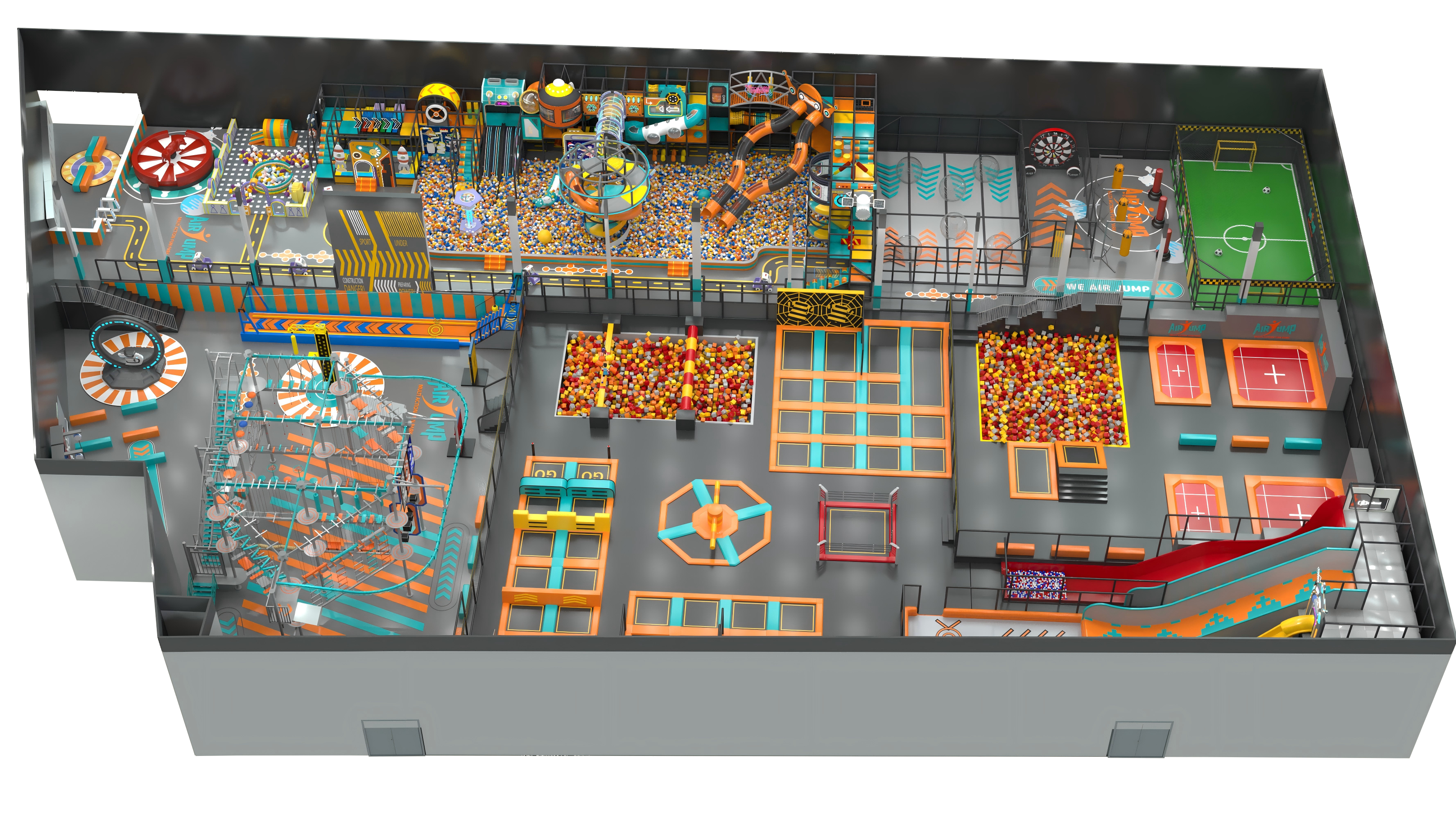
Category matching decides the anchor; the second zone is sized afterwards against leftover space and leftover age band.
Step 3: Compare structural and surface materials on the same basis
Material comparisons fail when the two quotes describe different things. Ask both routes for a materials schedule in the same format — component, material, grade or thickness, finish, and the standard it is expected to satisfy — then compare line by line.
- Galvanized pipe (main frame). The frame is the load path for both routes. Ask for coating specification, tube wall thickness and joint method. Galvanizing resists corrosion, but joint design decides whether the structure stays tight: an anti-loosening fastener system with modular locking, backed by pre-installation load testing and a structural safety audit, indicates more than a coating claim alone.
- Multi-layer board (decks and panel cores). Used for platforms and panel cores in soft-play structures. Ask how edges and cut faces are sealed, because moisture at an unsealed edge is what turns a board into a replacement item.
- Sponge (padding core). Density and thickness decide how padding behaves under impact, not how it feels in a photograph. Specify both in the schedule rather than accepting them in a sales email.
- PVC skin (padding cover). The skin takes the abrasion and the cleaning. Ask for the coating specification, fire-retardant treatment and cleanability, and whether the supplier runs batch material traceability with third-party laboratory testing on foam and coating.
- Acrylic (vision panels). Acrylic is a supervision material as much as a design material: transparent panels let staff and parents see into enclosed zones. Specify thickness and fixing method, and keep it out of impact-loaded positions.
- Nylon (netting, rope and slide surfaces). Nylon components wear at contact points. Ask for the abrasion specification and the replacement interval the supplier expects under commercial use.
- PE safety net, 30 × 30 mm mesh. For indoor playground protective netting, state the mesh size — 30 × 30 mm — in the specification and have the supplier confirm it in writing, together with edge finishing and fixing detail. GB 6675.4-2014 is the reference buyers commonly request for protective nets from Chinese supply.
Two further items belong in the same schedule, because they set the risk profile of the whole hall rather than one component. Fall protection: impact-absorbing flooring and height-differentiated protection zones are the design controls for fall impact and insufficient cushioning — a three-metre platform and a low trampoline bed produce completely different fall profiles, so the flooring schedule follows the height map of the equipment. Edges, gaps and fasteners: rounded-edge treatment and gap-compliance design address sharp edges and entrapment, while a quarterly fastener torque inspection and component wear monitoring address structural loosening in service. Both are cheap to specify at order stage and expensive to retrofit.
For reference, Vasia's own product documentation for a themed indoor playground lists galvanized steel tubing, PVC sheathing, EPE/EVA foam and LLDPE slide surfaces — a typical soft-play material set, and a usable template for the schedule you send to every bidder. Materials in that framework are described as eco-friendly and non-toxic, with RoHS-compliant coatings and fire-retardant properties, which is the kind of statement to have supported by test documentation rather than accepted as a brochure line.
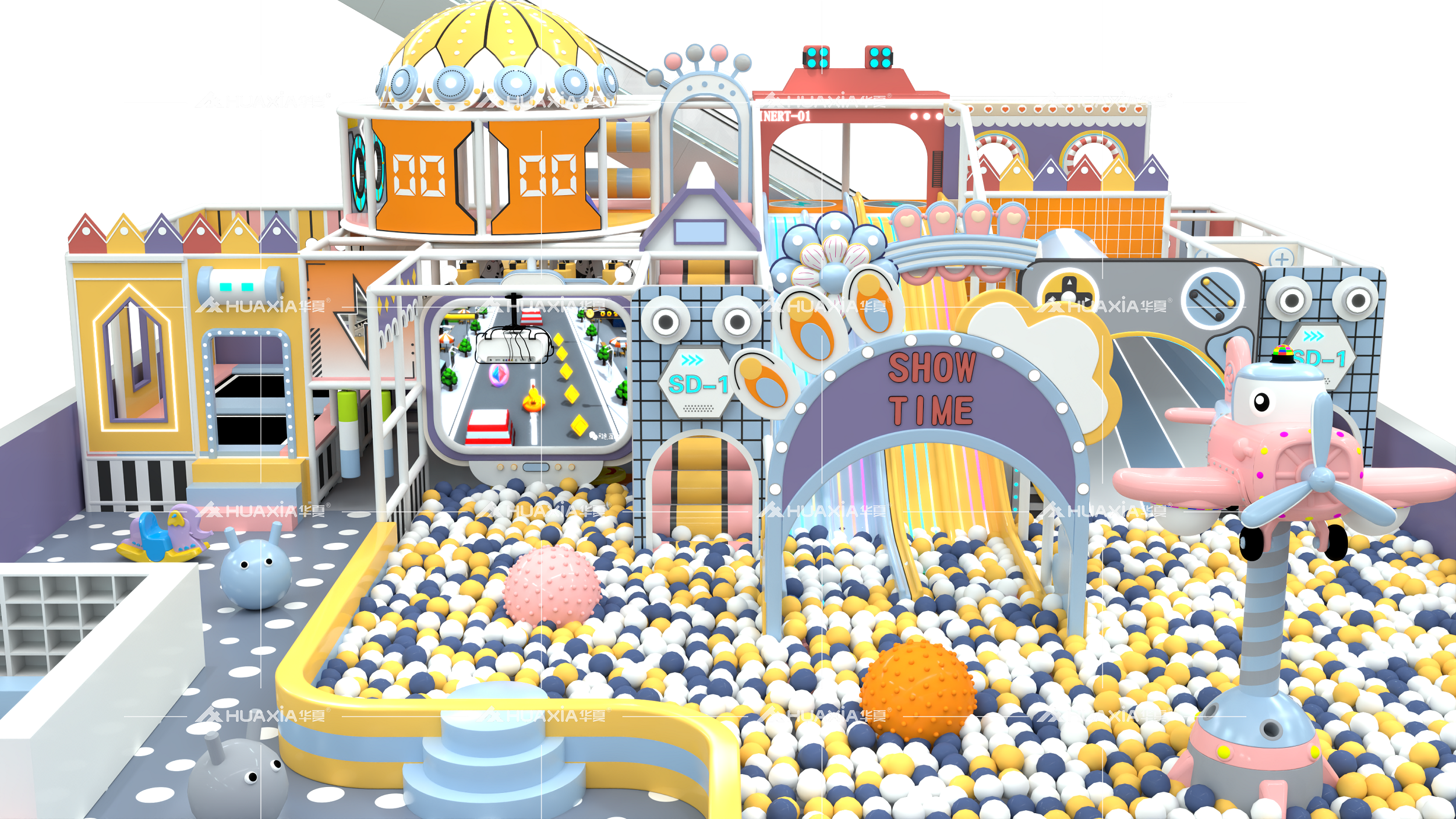
A materials schedule compares like with like: pipe, board, foam, skin, acrylic, netting and flooring on one page.
Step 4: Match the certification evidence to each route
Certification is where the routes diverge most sharply, and where buyers most often accept the wrong document. Build the request list per zone, not per supplier.
For the soft-play indoor playground route, request EN 1176-1:2017+A1:2023 with a test report covering the delivered configuration; EN 71-2:2020 flammability evidence for mats and wall padding; GB 6675.4-2014 as the reference commonly requested for indoor playground protective nets; and ASTM F1918 where the venue targets the US market and the structure is a commercial indoor play structure.
For the trampoline park route, request EN 1176-1:2017+A1:2023, cited with the amendment; EN 1176-5:2019 as part of the standard set an EU-bound trampoline park specification should call out; EN 12572-1:2017 and EN 12572-3:2017 where the park includes climbing elements, which is common in trampoline-led FECs; and EN 71-2:2020 flammability evidence for trampoline mats and climbing-wall surfaces.
A usable document set contains six things: standard number and edition, tested model or configuration, testing body, report date, validity period, and scope. A certificate that shows a logo and a year but not the tested configuration is a marketing asset, not compliance evidence. Neither is a report issued for a different model in the same catalogue, or one that expires before your installation date.
Vasia states that its products comply with ASTM F1918 and EN 1176 and that testing is carried out by TÜV Rheinland and SGS, with CE, UKCA, CPSIA and SASO marks and an ISO 9001 quality management system. These are supplier-reported positions: treat them as the start of document verification — certificate numbers, issuing bodies, validity dates and tested configurations — rather than the end of the compliance step.
Step 5: Price the risk and the consumables, not just the steel
Two projects with the same equipment budget can carry very different five-year costs. The difference sits in four risk categories and in the consumable list.
- Fall impact and insufficient cushioning. Controlled by impact-absorbing flooring and height-differentiated protection zones, supported by installer safety training and on-site hazard signage. A design cost in both routes, and not optional in either.
- Material aging and toxic emission. Controlled by non-toxic material certification and fire-retardant coating, supported by batch material traceability and third-party laboratory testing. This is where a cheap padding quote usually hides its saving.
- Sharp edges and entrapment. Controlled by rounded-edge treatment and gap-compliance design, supported in operation by quarterly fastener torque inspection and component wear monitoring.
- Structural loosening and component detachment. Controlled by an anti-loosening fastener system and modular locking design, supported by pre-installation load testing and a structural safety audit.
Then build the consumable list per route. Trampoline parks consume mats, springs, padding covers and net panels; soft play consumes net panels, padding skins, slide surfaces and ball-pit stock. Ask each supplier for expected replacement intervals under commercial use and put those intervals in the operating budget before comparing capital cost.
Finally, apply a same-scope rule. An equipment price is only comparable when it covers the same boundary: structure, flooring, netting, installation, freight, commissioning, documentation and spares. Most misleading comparisons between these two routes come from quoting a fully installed trampoline park against a soft-play structure quoted ex-works, or the reverse.
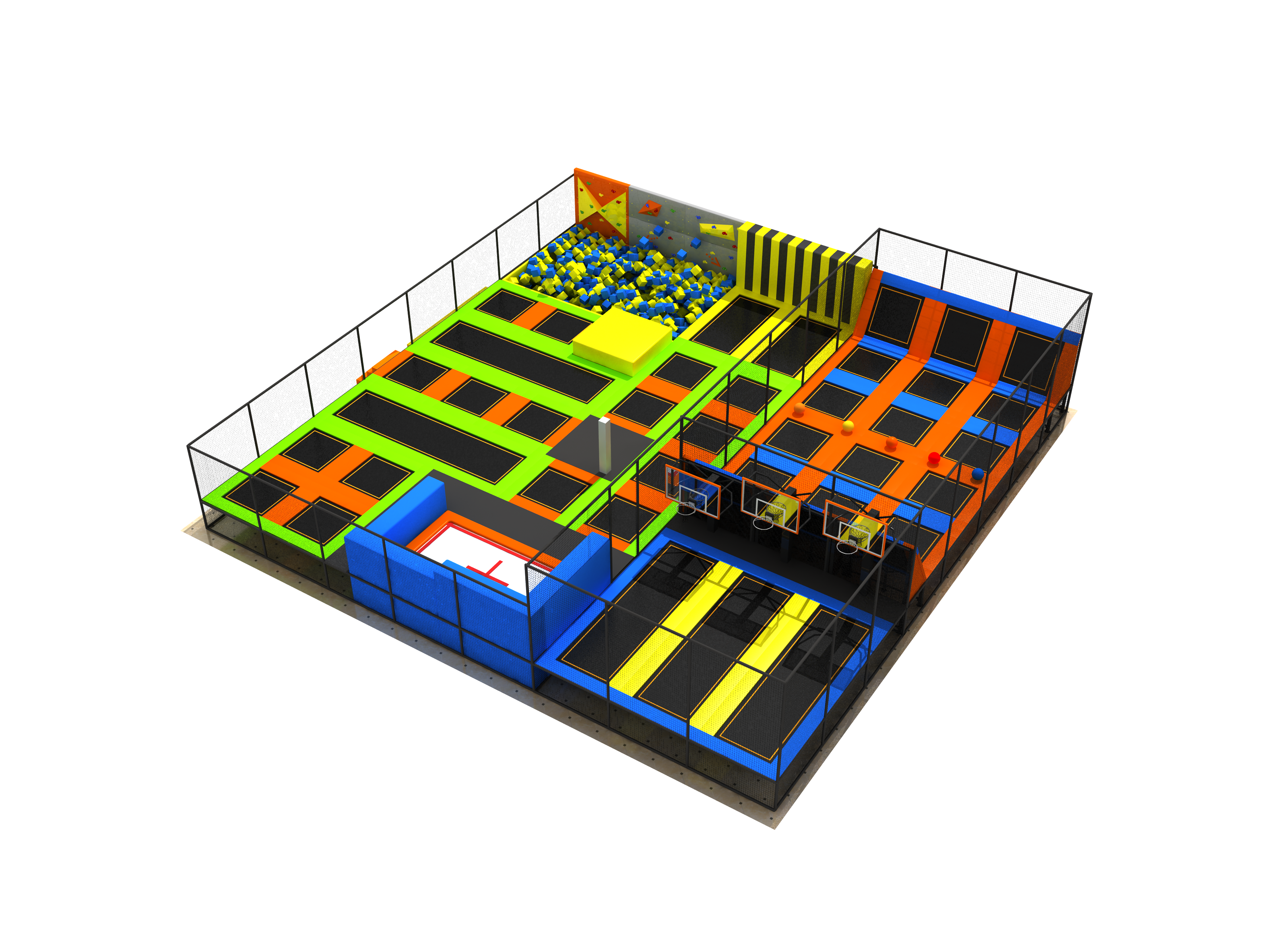
Risk controls follow the height map: fall profile, edges, gaps and fastener access all change with platform levels.
Step 6: Put the two routes side by side
The table below is the summary sheet for the decision. Every line should trace back to your own demand statement or to a supplier document.
| Decision dimension | Indoor Trampoline Park | Soft-play indoor playground (Kids Play Structure) |
|---|---|---|
| Core user band | School-age children upward, including teenage and adult challenge use | Toddler zones (roughly 0–6) and school-age play areas (roughly 6–12) |
| Space character | One large open volume with a structural steel frame and a continuous bed field | Layered multi-level structure with platforms, slides, ball pits and enclosed circulation |
| Primary structure | Galvanized pipe frame, bed and spring system, frame and spring padding | Galvanized pipe frame, multi-layer board decks, posts, panels and netting |
| Surfaces to schedule | Trampoline mats, spring and frame padding with PVC skin, PE safety netting, foam-pit elements | Sponge padding with PVC skin, acrylic vision panels, nylon and PE netting, slide surfaces |
| Certification evidence to request | EN 1176-1:2017+A1:2023; EN 1176-5:2019; EN 12572-1:2017 and EN 12572-3:2017 where climbing elements are present; EN 71-2:2020 for mats and climbing surfaces | EN 1176-1:2017+A1:2023; EN 71-2:2020 for mats and wall padding; GB 6675.4-2014 for protective nets; ASTM F1918 for US-market commercial indoor play structures |
| Supervision model | Session control, rule enforcement, peak-hour marshalling | Zone supervision, age separation, toddler-zone sightlines |
| Consumables to budget | Mats, springs, padding covers, net panels | Net panels, padding skins, slide surfaces, ball-pit stock |
| Operating rhythm | Timed sessions and group bookings | Longer family dwell, parties and repeat visits |
| Typical role in an FEC | Anchor attraction for older children | Anchor for families with younger children, or attached toddler zone |
Read the table vertically rather than horizontally. A route that wins on four lines but fails on core user band and supervision model is the wrong anchor, however strong the other rows look.
Which venue profile points to which route
These are decision patterns, not case results. Use them to test your demand statement.
- Large clear volume with a teenage catchment. Trampoline-led, with a soft-play toddler zone so families with mixed-age children stay on site. Party rooms close to the hall, seating with sightlines.
- Suburban family venue with a mostly under-six catchment. Soft-play anchor: toddler zone, multi-level structure, ball pit, party rooms, café. Add trampoline capacity only when booking data shows real 6–12 demand.
- An existing soft-play venue losing older siblings. Add a compact trampoline, ninja or rope-course element rather than rebuilding the anchor — and plan the wider compliance scope before ordering.
- A kindergarten, school or institution. Soft play, sized to age band, with netting and padding specified against the applicable standard set. Trampoline equipment is generally not the right fit for a supervised early-years environment.
Step 7: Recalculate when one manufacturer covers both lines
The trade-off above assumes two supply chains. It changes — though it does not disappear — when a single manufacturer builds both categories.
Vasia (Huaxia Amusement Co., Ltd.), based in Qiaoxia Town, Wenzhou, China, was founded in 2000 and operates a 30,000 m² production facility with more than 200 technical and management staff, an independent R&D team of 30 engineers, a stated annual output capacity of 200 million, and a monthly production capacity of 10,000 m² for trampoline parks and related play structures. The company reports 192 patents and copyrights, exports to more than 100 countries, over 10,000 completed projects, a 70% export ratio, and main markets in the EU, USA, South America, the Middle East and Southeast Asia. It is a member of IAAPA and RAAPA.
Its portfolio spans both sides of this decision — indoor playground equipment and trampoline parks, alongside rope courses, ninja courses and climbing walls. Delivery is structured as a turnkey package: project consultancy, custom design with 3D modelling and VR preview, manufacturing, export logistics and on-site installation, coordinated by a dedicated project manager, with after-sales support covering technical assistance, spare parts and optional annual inspection and maintenance.
What that changes for the decision is coordination, not physics. A hybrid sourced from one manufacturer gets one scope boundary, one materials schedule, one document set covering both zones, one installation window, one spare-parts list and one point of accountability when a net panel or padding cover needs replacing in year three. Those are real savings in management time.
What it does not change is verification. A single supplier makes the acceptance criteria more important, not less, because there is no second vendor to cross-check against. Confirm capacity figures against your own delivery schedule, and confirm the certification position against certificates and test reports for the models you are actually buying.
Step 8: Write the terms and acceptance criteria before you sign
The last step decides whether the earlier steps survive contact with production. Six clause groups do most of the work.
- Scope matrix. One row per zone, one column per deliverable: structure, flooring, netting, lighting, signage, installation, commissioning, training. Anything outside the matrix is outside the contract.
- Standards clause. Standard number and edition per zone, named explicitly — EN 1176-1:2017+A1:2023, EN 71-2:2020, GB 6675.4-2014, and EN 12572-1:2017 / EN 12572-3:2017 where climbing elements are included.
- Materials clause. Declared values for pipe coating and wall thickness, board grade and edge sealing, foam density, PVC skin specification, acrylic thickness, and net mesh — 30 × 30 mm for PE safety netting — each confirmed against a supplied sample.
- Documentation deliverable. Test reports, certificates of conformity, material and coating declarations, installation manual, maintenance schedule, spare-parts list and as-built drawings, delivered before final payment.
- Acceptance tests. Pre-shipment inspection, pre-installation load testing and structural safety audit, an installation punch list, hazard signage provision, installer safety training, and a signed torque-check schedule at handover.
- Commercial terms. Incoterms, payment milestones tied to documented progress, production slot, installation window, warranty period, technical support response time, spare-parts availability and operator training.
Write acceptance criteria as tests, not adjectives. 'Padding firmly fixed' is an adjective. 'No padding panel moves beyond the declared tolerance under hand pressure at any fixing point, verified on the punch list by the client's representative' is a test. Apply the same discipline to net tension, gap dimensions, edge finishing and flooring seams.
Frequently asked questions
Which certifications should I request for a trampoline park versus a soft-play playground?
For a soft-play indoor playground, request EN 1176-1:2017+A1:2023, EN 71-2:2020 for mats and wall padding, GB 6675.4-2014 for protective nets, and ASTM F1918 where the US market applies. For a trampoline park, request EN 1176-1:2017+A1:2023, EN 1176-5:2019, EN 71-2:2020 for mats and climbing surfaces, and EN 12572-1:2017 and EN 12572-3:2017 where climbing elements are included. In both cases require the standard edition, tested configuration, testing body, report date, validity period and scope — a logo alone is not evidence.
Can one manufacturer deliver both a trampoline park and a soft-play area?
Yes. Vasia manufactures indoor playground equipment and trampoline parks, and also lists rope courses, ninja courses and climbing walls. A single-source hybrid gives you one scope boundary, one materials schedule, one document set and one installation window. It does not remove the need to verify capacity against your delivery schedule, or to check certificates and test reports for the specific models being supplied.
Why is the installed cost of the two routes so hard to compare?
Because the quotes usually cover different boundaries. A trampoline park price typically includes the bed field, springs, padding, netting and a substantial fall-protection floor, while a soft-play structure may be quoted ex-works with flooring, netting and installation added separately. Compare only same-scope offers, then add the consumable cycle — mats, springs, padding covers and net panels for trampoline; net panels, padding skins, slide surfaces and ball-pit stock for soft play — before deciding which route is cheaper over five years.
What should a sample or mock-up request cover?
Ask for physical samples of the components you cannot judge from a drawing: a section of galvanized pipe with the declared coating, a foam and PVC skin padding sample, a PE safety net sample confirming the 30 × 30 mm mesh and edge finishing, an acrylic offcut, and a slide or nylon surface sample. Full mock-ups are rarely practical, so substitute a documented materials schedule plus samples plus the matching test reports. This is also the point to request a quotation on your actual zone plan rather than a catalogue package.
What lead-time and delivery items belong in the contract?
Four: the production slot with start and finish dates, the shipping term and port pair, the installation window with the site-readiness conditions that trigger it, and the documentation deadline relative to final payment. Add a spare-parts list with quantities and a named contact for technical support after handover. Lead time should be a contractual date, not an indicative range in an email. If you want to test a supplier's responsiveness before committing, request a written schedule and a sample pack for your zone plan first — Vasia handles both requests, and the company brochure is available for download below.
Conclusion: decide the anchor, then document everything else
The head-to-head resolves in a predictable order. Age mix and supervision capacity decide whether a trampoline park or a soft-play indoor playground anchors the hall. The materials schedule decides whether two quotes are actually comparable. The certification request list, built per zone with editions and tested configurations, decides whether either route can be signed off without a late surprise. The contract clauses decide whether the design you approved is the design you receive.
For most FEC buyers in 2026 the outcome is a hybrid, and the honest version of the decision is which zone earns the floor space and which one earns the return visit. Work the eight steps in order, keep every claim traceable to a document, and the choice becomes a business decision rather than a taste decision.
Vasia (Huaxia Amusement Co., Ltd.) manufactures both indoor playground equipment and trampoline parks. Company information and the equipment range are published at Vasia, and the company and product brochure can be downloaded here: Vasia brochure (PDF).
Have Questions or Need More Details?
Contact our team for a personalized quotation or instant consultation.
Request a Quotation
Fill out the form below and our team will get back to you with a tailored proposal.
WhatsApp Direct Chat
Prefer to chat in real-time? Message us on WhatsApp for instant assistance & quick answers.
- Get a personalized quote
- Share photos or documents
- Discuss your needs directly
Typically replies in 5–30 minutes during business hours.