
Hotel Spa Delays Solved: Plug-and-Play Hot Tubs for Fast, Year-Round Outdoor Hydrotherapy
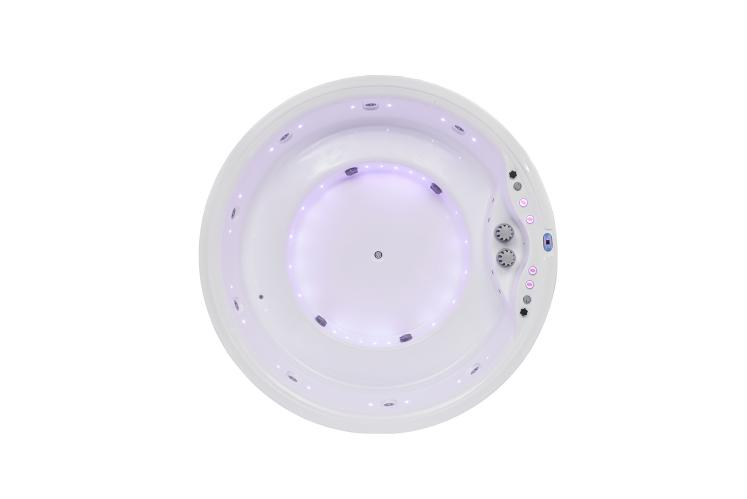 Victoria Star VS-CP3500 — one of the factory-assembled, pre-tested models used in hospitality and wellness specifications.
Hotel spa projects rarely fail because the wrong equipment was ordered. They run late because the work around the equipment is sequential, weather-dependent and difficult to compress. Moving that work into a factory — and specifying a unit that arrives assembled, pre-tested and ready for service connection — is the single largest schedule lever available to a project team. Victoria Star documents an installation time reduction of up to 60% compared with traditional pool installations, achieved through an all-in-one integrated design and a factory-built, pre-tested system.
Victoria Star is the premium wellness brand of Foshan Gaoming Shiyi Sanitary Ware Technology Co., Ltd., a manufacturer based in Foshan, Guangdong, China, producing hot tubs, swim spas, saunas, steam rooms and integrated wellness equipment for residential and commercial projects. Its hot tub range is built around the principle that assembly and testing belong in a controlled factory environment, not on a hotel roof two weeks before opening.
This article explains why hotel and wellness spa openings slip, what plug-and-play actually means inside a commercial specification, and how thermal design, integrated heating and component selection determine whether an outdoor hydrotherapy area is affordable to run in January as well as July.
Why Hotel and Wellness Spa Openings Slip
A spa delay is the gap between the date a site is handed over and the date the hydrotherapy area can safely accept guests. In concrete or site-built installations, that gap is created by a chain of dependent tasks: excavation and forming, concrete pouring and curing, waterproofing and leak testing, pipework and manifold assembly, electrical connection and inspection, filling, water balancing, and finally heating to operating temperature. Each task waits for the one before it, and several are sensitive to weather.
The result is a schedule in which a single slip — a delayed pour, a failed leak test, an electrical inspection that requires a return visit — moves the opening date. For a hotel, that date is not internal. It is already attached to rate plans, packages and the guest promise that sells the spa as part of the stay.
Operating cost creates a second, quieter problem. A spa area that opens late often opens under pressure, with commissioning compressed and water chemistry still stabilizing. Heating an outdoor tub through cool nights, in a shell and cabinet that lose heat quickly, becomes a recurring cost that was never fully modelled at the budgeting stage.
The distinction that matters for buyers is this: most of the delay sits in the construction sequence, not in the equipment itself. A manufacturer cannot shorten a concrete curing cycle. What a manufacturer can do is remove that cycle from the project entirely. That is why the specification decision — how much of the build happens in a factory and how much happens on site — carries more schedule leverage than most finish-level choices.
Industry Context: A Growing Market With a Delivery Problem
Hotel and resort spas are a defined end-user segment in the hot tub market, not an adjacent afterthought. Market segmentation published by Fortune Business Insights separates portable tubs, in-ground or fixed tubs, inflatable tubs and swim spas; splits technology into standard and smart tubs; and lists residential, hotels and resorts, spas, gyms and other end users as distinct buyer groups.
The market itself is growing. Fortune Business Insights values the global hot tub market at USD 5.76 billion in 2025 and projects USD 8.47 billion by 2034, a CAGR of 4.28%, with a 2026 valuation of USD 6.06 billion. Research and Markets, in a North America forecast distributed via GlobeNewswire, puts the regional market at USD 2.8 billion in 2025 and projects USD 4.5 billion by 2035 at a CAGR of 4.7%. Commercial research houses publish materially different base values and forecast paths, so these figures are best read as directional sizing rather than a single consensus number.
Two structural facts are more useful to hospitality buyers than headline growth rates. First, acrylic and portable spas accounted for a 78.51% share of the market in 2024, according to Fortune Business Insights data cited by ConsumerAffairs — meaning the factory-built acrylic format is the mainstream production base, not a niche. Second, industry commentary links smart hot tub adoption to high energy prices, with remote monitoring positioned as a cost-control measure. For a hotel, that connects directly to the operating-cost side of the business case rather than the purchase-price side.
What the market data does not solve is delivery. A growing market with long construction cycles still produces hotels that open without the spa they advertised. That is the gap an integrated, factory-built unit is designed to close.
The Victoria Star Approach: Move the Work Off the Critical Path
Victoria Star is the premium wellness brand of Foshan Gaoming Shiyi Sanitary Ware Technology Co., Ltd., headquartered at No. 568, Yangxi Road, Yanghe Town, Gaoming, Foshan, Guangdong, China. The company operates a 50,000 m² manufacturing facility with more than 250 employees, including an engineering team of over 35 professionals, and reports an annual output of 7,000 units. Around 70% of production is exported to Europe, North America, Australia, the Middle East and Southeast Asia, and products reach more than 80 countries and regions. The hot tub range carries CE, SAA and ETL certification.
For a hospitality project, the relevant question is not how large the factory is. It is which design decisions remove work from the site schedule and cost from the operating year. Four of them matter most.
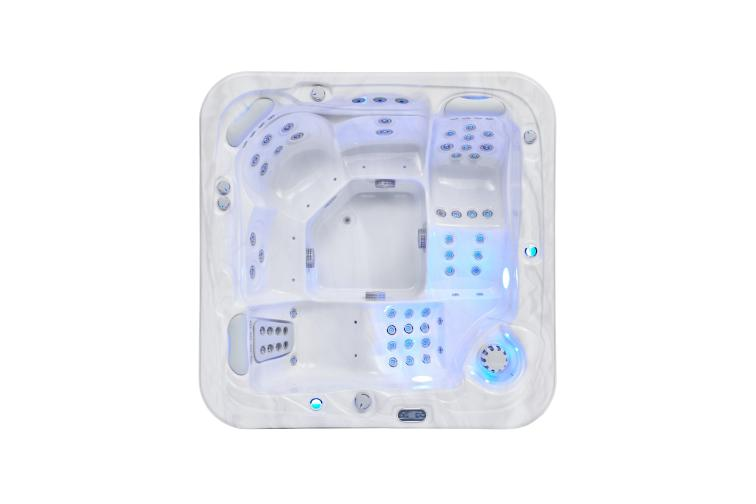 Victoria Star VS-604L — a freestanding acrylic model suited to terrace, garden and poolside hospitality settings.
1. All-in-one integrated design, factory-built and pre-tested
An integrated hot tub arrives as a complete system: shell, cabinet, plumbing, jets, pumps, controls and heating are assembled and tested before shipment. Victoria Star documents this as an all-in-one integrated design with a factory-built, pre-tested system that minimizes on-site construction errors and achieves up to 60% reduction in installation time compared with traditional pool installations.
The schedule effect comes from what is no longer on site. There is no shell to form and finish, no waterproofing layer to cure and leak-test, no manifold to build from loose components. Site work narrows to preparing a level, load-bearing base, providing the electrical supply, placing the unit, connecting services, filling and commissioning.
2. Multi-layer thermal insulation and heat retention
An outdoor hydrotherapy area in a hotel runs in the cold half of the year, at night, and often in wind. Heat loss through the shell and cabinet becomes a daily cost rather than a seasonal one.
Victoria Star units use a high-density thermal insulation design intended to reduce heat loss and optimize heating efficiency. In practical terms, the insulation sits between the water and the outside air, so the heater replaces less of what the shell gives away. Combined with a fitted cover and disciplined set-point management, this is what makes year-round outdoor operation commercially reasonable instead of a seasonal luxury.
Buyers should request the insulation specification in writing — layer structure, thickness and coverage — because "insulated" is a broad word, and the difference between a well-insulated cabinet and a token layer appears on the energy bill rather than on the datasheet.
3. Integrated heating, filtration and freeze protection
Heating is integrated into the unit rather than specified as separate plant. Water circulation and filtration belong to the same package, which simplifies daily maintenance and keeps service components accessible.
A smart temperature control system manages set points, and a freeze protection system addresses the specific risk of an outdoor spa in winter. For a hotel, freeze protection is not a comfort feature — it is an asset-protection feature that determines whether the spa can stay commissioned through a cold snap. Electrical protection is integrated into the system and components are selected to international standards, which matters in a commercial setting where the spa is operated by staff rather than by an owner who reads the manual every week.
4. Component choices: Aristech acrylic, LX pumps, Balboa and Gecko controls
Three component decisions are worth naming, because they are the parts buyers ask about in technical review.
- Shell material. Shells are formed from USA-imported Aristech acrylic. The shell is both the surface a guest sees and touches and the substrate that holds water and resists constant chemical exposure.
- Massage performance. Jet circuits are driven by LX massage pumps. Pump selection affects the hydrotherapy experience as well as the electrical load profile of the installation.
- Control platform. Control is handled by Balboa or Gecko control platforms, depending on model and market configuration. Both are established control ecosystems with a broad international service footprint, which matters for a hotel that may need a replacement part in a different country years after installation.
Model matching: VS-301C, VS-604L, VS-SP2100 and VS-CP3500
A hospitality project rarely uses one product for every space. The Victoria Star range includes the VS-301C, VS-604L, VS-SP2100 and VS-CP3500 models, which allows a property to be specified as a small portfolio rather than a single repeated unit. Final model selection should follow the actual space, the guest capacity intended for that space and the service concept the operator is selling, and should be confirmed against the current specification sheet for the destination market.
Specifying more than one model has a practical benefit beyond design. It lets the operator match the unit to the location instead of forcing every location to accept the same footprint.
 Victoria Star VS-301C — a compact acrylic model that can be paired with larger units across a wellness circuit.
Where plug-and-play stops: honest limits
"Plug-and-play" describes where the assembly happens, not an absence of site requirements. A commercial installation still needs a level, load-bearing base sized for the filled unit; a compliant electrical supply and connection; adherence to local electrical and safety rules; and an accessible service position for future maintenance.
Two standards questions belong in every hotel specification. The first is the electrical standard of the destination market — the CE, SAA and ETL certifications held by Victoria Star map to the EU, Australia and North America respectively, and the exact configuration must match the market. The second is the applicable safety standard for the project; BS EN 17125:2018, the European safety standard for domestic spas, whirlpool spas and hot tubs, is a useful reference point when a project team is defining what "compliant" means for a commercial wellness area.
Being explicit about these boundaries protects the schedule. Projects run late when the electrical supply turns out to be undersized after the unit arrives, not when the unit itself is late.
Step-by-Step: From Purchase Order to First Guest
The sequence below reflects how an integrated unit changes the division of labour between factory and site. It is a decision framework, not a fixed calendar — the actual timing of each step depends on the project's configuration, quantity and site readiness.
Step 1 — Define the space and match the model
Confirm what each location is meant to deliver: a principal outdoor hydrotherapy area, a suite terrace, a wellness circuit, a poolside relaxation zone. Map that intent onto the range — VS-301C, VS-604L, VS-SP2100 or VS-CP3500 — and confirm the current specification sheet for the destination market.
Step 2 — Confirm site services before the order is released
Verify the base (level and load-bearing), the electrical supply and connection route, drainage for service water, and access for delivery and placement. This is the step most often skipped, and the one that most often causes a late opening.
Step 3 — Factory assembly and pre-testing
Assembly, plumbing and electrical integration happen in the factory. Every unit undergoes 100% water testing before shipment, electrical safety inspection, and quality control throughout production, using international-standard components. This is where on-site construction error is designed out rather than corrected later.
 Factory site, Foshan, Guangdong — assembly and pre-testing take place before the unit leaves for site.
Step 4 — Delivery and placement
The unit ships as a finished product. Site activity at this stage is lifting and positioning, not building. Because there is no wet trade and no curing period, placement can be scheduled against the delivery window rather than against a construction sequence.
Step 5 — Service connection and fill
Electrical connection, water fill and the checks required by local rules. This is the point where the quality of Step 2 determines whether the schedule holds.
Step 6 — Heating, water balance and commissioning
Bring the water to operating temperature, balance chemistry, and confirm jet, filtration and control behaviour. Because the system was already water-tested at the factory, commissioning is a verification exercise rather than a fault-finding one.
Step 7 — Handover, support and spare parts
Staff training, documentation and access to remote technical support and spare parts supply. For a multi-property operator, this step is what converts a delivered unit into a maintainable asset.
Where This Fits: Hospitality and Wellness Use Cases
Victoria Star positions its hot tubs for luxury villas, star-rated hotels, spa and wellness resorts, high-end residential projects and commercial wellness centres. Within those categories, the delivery-speed argument is strongest in five situations.
- City hotels with rooftop or terrace spa areas. Space is constrained and structural work is expensive; a factory-built unit removes the wet trades that a rooftop cannot easily absorb.
- Resort outdoor hydrotherapy gardens. Multiple units are commissioned at once, and a repeatable, factory-tested product reduces the number of variables the opening team has to manage.
- Boutique hotels with private in-suite or terrace units. A model portfolio allows the property to match unit size to suite category rather than standardizing everything to one footprint.
- Wellness centres and spa clinics. The circuit has to run through the operating year, which makes heat retention and freeze protection part of the business model rather than a technical footnote.
- Villa and residential developments with shared amenities. Where a spa is a sales promise attached to a handover date, installation time is a commercial variable, not only a construction one.
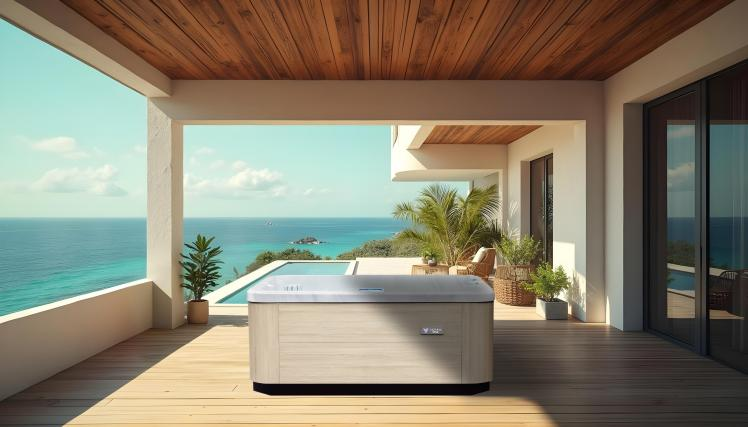
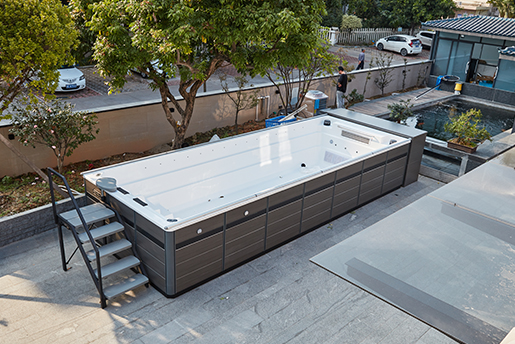 An installed outdoor hot tub in a villa setting — the same placement logic applies to hotel terraces and resort hydrotherapy areas.
Comparison: Integrated Hot Tub vs. Site-Built Pool or Spa
The comparison below uses only documented product facts and does not assume a specific project's soil, access or labour conditions. Those variables are why the cost line is stated as "potentially lower" rather than as a fixed saving.
| Decision factor | Traditional concrete pool or site-built spa | Victoria Star integrated hot tub |
|---|---|---|
| Build model | Assembled on site from separate trades | All-in-one integrated design, factory-built and pre-tested |
| Installation time | Baseline of sequential wet and dry trades | Up to 60% reduction compared with traditional pool installations |
| Installation cost | Higher civil construction requirement | Potentially lower installation cost depending on project conditions; reduced civil construction requirements |
| On-site construction error | Higher exposure — workmanship varies by crew | Minimized by factory assembly and pre-testing |
| Reliability | Dependent on site execution and curing | Higher, because the factory-built and pre-tested system leaves less to site execution |
| Maintenance | Separate plant and service points | Integrated filtration and water circulation; simplified daily maintenance; easy access to service components |
| Heat retention | Depends on the insulation package built on site | High-density thermal insulation design; reduced heat loss; optimized heating efficiency |
| Typical fit | Projects with space, time and civil budget for a permanent build | Luxury villas, star-rated hotels, spa and wellness resorts, high-end residential projects, commercial wellness centres |
Risk control follows the same logic. The table below maps the documented risk types to the control built into the unit and to the factory-side measure that supports it.
| Risk type | Control in the unit | Factory-side measure |
|---|---|---|
| Water leakage | Multi-layer waterproof structure | 100% water testing before shipment |
| Electrical system failure | Integrated electrical protection system | Electrical safety inspection |
| Water quality issues | Automatic water filtration and circulation | Quality control throughout production |
| Overheating | Smart temperature control system | Quality control throughout production |
| Freeze damage | Freeze protection system | Quality control throughout production |
| Component wear and aging | High-quality certified components | International-standard components; remote technical support and spare parts supply |
 Workshop assembly — shell, plumbing and electrical integration are completed and checked before the unit is water-tested.
Frequently Asked Questions
Are Victoria Star hot tubs certified for hotel projects in Europe, North America and Australia?
Victoria Star holds CE, SAA and ETL certification for its hot tub range. These map to the European Union, Australia and North America respectively. Certification is market-specific, so the exact configuration ordered must match the destination market, and the project team should confirm the certificate scope against the specific model being specified. Where a project defines compliance against a European safety reference, BS EN 17125:2018 — the safety standard for domestic spas, whirlpool spas and hot tubs — is a useful benchmark for the discussion.
How does a factory-built, pre-tested unit reduce on-site construction risk?
Assembly of the shell, cabinet, plumbing, jets, pumps, controls and heating happens in the factory rather than on site. Victoria Star documents this as an all-in-one integrated design that minimizes on-site construction errors and delivers up to 60% reduction in installation time compared with traditional pool installations. Every unit is water-tested before shipment, receives an electrical safety inspection, and is subject to quality control throughout production. Fewer site trades and fewer site interfaces mean fewer points where a schedule can break.
Is an integrated hot tub actually cheaper than a concrete spa for a hotel?
Installation cost is documented as potentially lower than traditional concrete pool projects, depending on project conditions, with reduced civil construction requirements. That wording matters: site access, base preparation and local labour rates all affect the final figure. The more predictable saving sits on the operating side. High-density thermal insulation reduces heat loss and supports optimized heating efficiency, and integrated filtration and water circulation simplify daily maintenance. For a spa that runs through the winter, those two factors usually outweigh the difference in purchase price.
What quality checks take place before a unit ships?
Each unit undergoes 100% water testing before shipment, an electrical safety inspection, and quality control throughout production. Components are selected to international standards. The unit is therefore verified as a working system before it leaves the factory, which is the basis for the reduced on-site construction error and the shorter commissioning period. After handover, remote technical support and spare parts supply remain available for the operating phase.
What determines the delivery schedule for a hotel spa project?
Four factors drive it: the model mix selected across the VS-301C, VS-604L, VS-SP2100 and VS-CP3500 range; the configuration and certification requirements of the destination market; the quantity required for the property; and how early the site services — base, electrical supply and access — are confirmed. Victoria Star manufactures in a 50,000 m² facility with more than 250 employees and an annual output of 7,000 units, so the production side is a matter of scheduling against a confirmed specification rather than a question of capacity. The practical next step is to share the project scope and required market so a written quotation and specification sheet can be issued against it.
Conclusion: Compress the Sequence, Not the Standards
Hotel spa delays are usually a sequencing problem wearing an equipment costume. Concrete has to cure, waterproofing has to be tested, trades have to follow each other, and the opening date absorbs every one of those dependencies. Victoria Star's approach is not to speed up those steps but to remove most of them from the site: an all-in-one integrated design, factory-built and pre-tested, documented as reducing installation time by up to 60% compared with traditional pool installations.
Speed alone would not be enough. A spa that opens quickly but costs too much to heat becomes a different problem in the second year. High-density thermal insulation, reduced heat loss, optimized heating efficiency, integrated filtration and a freeze protection system are what make year-round outdoor hydrotherapy viable rather than seasonal. USA-imported Aristech acrylic, LX massage pumps and Balboa or Gecko control platforms address the parts of the specification a guest actually experiences and an engineer actually services.
The decision rule for a project team is straightforward. If the opening date is fixed and the site cannot absorb a full wet-trade sequence, specify a unit whose assembly is already finished before it arrives. Then confirm the three things that still belong to the site: the base, the electrical supply, and the destination-market configuration. Everything else has already been tested in the factory.
 Production capacity across a 50,000 m² facility supports scheduled hospitality orders rather than one-off builds.
Next Step: Specification, Quotation and Catalogue
Share the project type, target market and the models you are considering — VS-301C, VS-604L, VS-SP2100 or VS-CP3500 — and Victoria Star can issue a written quotation and specification sheet against your scope. Certification documentation for CE, SAA and ETL can be provided for the configuration being specified.
Download the 2026 outdoor spa and sauna catalogue: 2026 New Collection (Outdoor Spa & Sauna)
Email: info@victoriastarspa.com | Tel: +86 0757-88233718 | WhatsApp: +86 13925955886 | Website: www.victoriastarspa.com
Address: No. 568, Yangxi Road, Yanghe Town, Gaoming, Foshan, Guangdong, China
Have Questions or Need More Details?
Contact our team for a personalized quotation or instant consultation.
Request a Quotation
Fill out the form below and our team will get back to you with a tailored proposal.
WhatsApp Direct Chat
Prefer to chat in real-time? Message us on WhatsApp for instant assistance & quick answers.
- Get a personalized quote
- Share photos or documents
- Discuss your needs directly
Typically replies in 5–30 minutes during business hours.