
Swim Spa vs. Hot Tub: Which Is Right for Your Fitness-Villa Project?
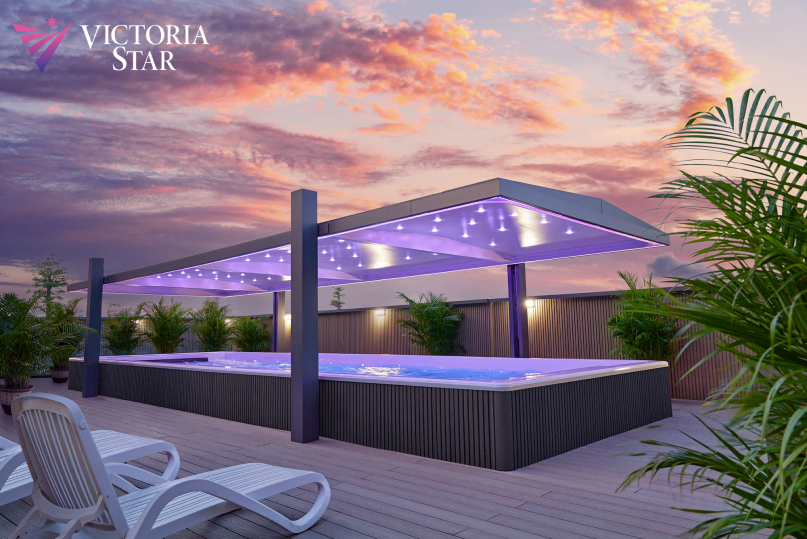
Choosing between a swim spa and a hot tub for a fitness villa is a decision about function, not about quality. Both products sit on the same warm-water platform, but they are engineered for different jobs. A hot tub is built around hydrotherapy: warm water, directional massage jets and seated immersion for recovery. A swim spa adds a dedicated lane and an adjustable swim current, so the same unit can carry a training session and a post-training soak.
This guide compares the two on the criteria that actually decide a fitness-villa specification — primary use case, equipment package, installation and site integration, running costs and long-term reliability — and sets out the decision rules Victoria Star applies when configuring hot tub and swim spa projects for villas, hotels and resorts.
Quick answer: If the villa brief is recovery, hydrotherapy and a compact wellness zone, specify a hot tub. If the brief includes swimming or structured training inside a limited footprint, specify a swim spa. If the project is a hotel, resort or multi-unit development, both products are usually specified in different zones rather than one replacing the other.
The Real Question Behind "Swim Spa vs. Hot Tub"
A fitness villa asks a single amenity to do two jobs that pull in opposite directions. Job one is recovery: heat, buoyancy and massage after training or at the end of the day. Job two is training: swimming or low-impact conditioning without the cost, footprint and site work of a conventional concrete pool.
A hot tub answers job one completely and job two not at all. A swim spa answers both, but it demands more space, more equipment and a more deliberate installation plan. That asymmetry is the entire decision:
- If the honest answer to "will anyone actually swim in it?" is no, the swim spa's extra length and equipment package are wasted capital.
- If the answer is yes and there is no pool, a hot tub cannot substitute for it.
- If the answer is "sometimes", the decision moves to which product makes the more valuable centrepiece of the wellness zone — and often to whether both belong in the plan.
The most common specification error is not choosing the wrong product. It is choosing a product for a use that no one in the household, hotel or resort will actually perform, which turns a wellness investment into idle equipment.
Industry Background: A Growing Market Splitting Into Two Buyer Types
Commercial research explains why this comparison has become routine in project planning. Fortune Business Insights data cited by ConsumerAffairs (2026) values the global hot tub market at USD 6.06 billion in 2026. Independent commercial estimates differ: Fortune Business Insights projects growth from USD 5.76 billion in 2025 to USD 8.47 billion by 2034 at a CAGR of 4.28%; Global Market Insights puts 2025 at USD 7.8 billion rising to USD 11.9 billion by 2035 at a CAGR of 4.4%; and a third report notice projects USD 6.89 billion in 2025 to USD 8.65 billion by 2031 at a CAGR of 3.87%. Because base values, product scope and methodology differ between providers, these figures should be read as separate directional scenarios rather than averaged into one consensus number.
For a fitness villa, three structural signals matter more than the headline total:
- Material: acrylic and portable spas accounted for a 78.51% share of the hot tub market in 2024 (Fortune Business Insights). The integrated acrylic platform — the construction family used for both hot tubs and swim spas — is the mainstream route, not a niche one.
- Technology: 2026 industry coverage links smart hot tub adoption to high energy prices and positions remote monitoring as a cost-control measure rather than a luxury feature.
- Demand mix: commercial market taxonomies separate standard tubs from smart tubs, place swim spas in their own product category alongside portable, in-ground and inflatable types, and segment end users into residential, hotels and resorts, spas and gyms.
Regionally, the North America hot tub market was valued at USD 2.8 billion in 2025 and is estimated to grow at a CAGR of 4.7% to reach USD 4.5 billion by 2035 — a useful reference point for villa, hotel and resort developers planning amenity specifications in that market.
Detailed Solution: How the Two Products Differ Where It Matters
Hydrotherapy Massage Therapy: The Core Function of a Hot Tub
A hot tub's value sits in its seating geometry and jet array. The shell is moulded around reclined and upright positions, and the pumps drive water through directional jets to deliver hydrotherapy massage therapy to the back, shoulders, legs and feet. Water volume in a hot tub is smaller than in a swim spa and the operating routine is shorter, which is why the product is specified around recovery rather than training.
For a fitness villa, that maps directly onto a post-training routine: a warm-water soak and massage session after a workout, a run or a long day. The compact footprint is part of the appeal — a hot tub can be placed on a terrace, in a garden wellness corner, on a rooftop deck or inside a dedicated spa room with far less site work than any swimming product requires.
Adjustable Swim Current: What Makes a Swim Spa Training Equipment
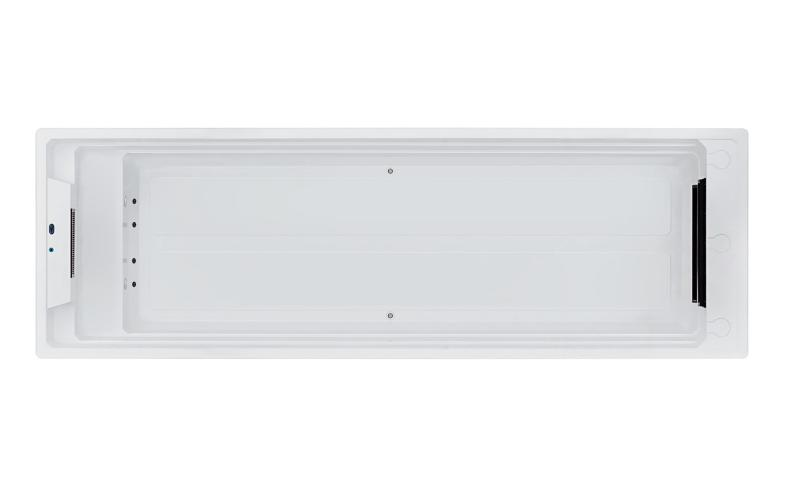
A swim spa is not a large hot tub. It is a compact pool that uses a controllable water current instead of length to create resistance. The swimmer holds position against the current rather than turning at a wall, and the current intensity is adjusted to match the session: an easy recovery swim, a steady endurance set, or a higher-intensity interval block.
That single mechanism is what allows a fitness villa to offer lap swimming in a garden that could never accommodate a conventional pool. It also changes the specification conversation. In a hot tub, the questions are about seating, jet configuration and shell finish. In a swim spa, the primary questions are about the swim lane, the current system, the pump package that drives it, and how the control platform manages temperature and flow across those adjustable settings.
Both product families also carry hydrotherapy seating, so a swim spa does not remove the recovery function — it adds to it. That is why the decision is rarely "either/or" in commercial projects and more often "which product carries the primary brief".
Equipment, Pumps and Control Platforms
Component configuration is where two superficially similar units diverge. Jet pumps, control systems, insulation and filtration packages vary by model even within the same product family, and the category draws on established component platforms — LX pump platforms and Balboa control systems are two widely used examples across the spa industry.
Because configuration is model-specific, specification comparisons should be made against the datasheet of the exact model rather than a product-family description. Victoria Star manufactures both product families, with separate model designations across the range, such as the VS-M1202 designation on the hot tub side and the VS-GT1202 designation on the swim spa side. Pump, jet and control configuration should be confirmed against the current datasheet for the model being quoted.
Installation and Site Integration
Installation is where the comparison becomes financial. An integrated acrylic hot tub or swim spa is factory-built and pre-tested, and the difference against a traditional concrete swimming pool is significant: installation time is reduced by up to 60% compared with traditional pool installations, because the factory-built, pre-tested system minimizes on-site construction errors.
Reliability is higher for the same reason — fewer site-built interfaces means fewer failure points. Integrated units also reduce civil construction requirements and minimize on-site construction work, and can carry lower installation costs compared with traditional concrete pool projects, depending on project conditions. Those conditions matter: delivery access, base preparation, services routing and the chosen install format — freestanding, semi-inground or fully integrated into decking — determine whether a swim spa installation is a short site event or a longer build.
Energy, Water and Maintenance
Running-cost comparisons favour whichever unit is better insulated, not whichever is smaller. A high-density thermal insulation design reduces heat loss and optimizes heating efficiency, while integrated filtration and water circulation systems simplify daily maintenance and reduce maintenance requirements compared with traditional pools. Service components remain accessible without dismantling the shell, which matters for a hotel or resort where downtime is measured in guest experience.
For both hot tubs and swim spas, the specification questions are the same: insulation design and coverage, cover quality, pump efficiency, filtration and circulation design, and how the control platform manages heating cycles. Where the product is destined for a market with high energy prices, remote monitoring and smart control capability are worth specifying at the order stage rather than retrofitting later.
Risk Control and Long-Term Reliability
Hot tubs and swim spas share a common risk profile: water leakage, electrical system failure, water quality issues, overheating, freeze damage, and component wear and aging. In a villa or resort installation, each of those becomes an operational and insurance question, so the control methods belong in the specification rather than the after-sales file:
- Multi-layer waterproof structure
- Integrated electrical protection system
- Smart temperature control system
- Automatic water filtration and circulation
- Freeze protection system
- High-quality certified components
Victoria Star applies that framework through 100% water testing before shipment, electrical safety inspection, quality control throughout production, and the use of international-standard components — supported after delivery by remote technical support and spare parts supply.
Step-by-Step: Deciding for a Specific Villa Project
- Define the primary job. Recovery only means a hot tub. Swimming or structured training means a swim spa. Both, in different zones, means specifying both. Fix this answer before looking at models; most late-project disputes come from a brief that was never written down.
- Audit the placement. Measure the terrace, garden, rooftop deck or indoor wellness room, review delivery access, and decide the install format — freestanding, semi-inground or integrated into decking. A swim spa needs a longer, straighter footprint than a hot tub, and access planning affects both the equipment package and the site work.
- Set the swim requirement (if any). Decide whether the training need is casual resistance swimming, technique work or structured intervals. This determines the swim-current specification and the pump package, which is the largest performance variable in a swim spa.
- Set the hydrotherapy requirement. Decide how the seating will be used, then verify jet configuration and pump capacity against that seating layout for both product types.
- Specify the thermal and control package as a system. Insulation, cover, heating, filtration, freeze protection and control platform should be specified together, not added as options later.
- Verify compliance for the destination market. European domestic spas are covered by BS EN 17125:2018, the safety requirements and test methods for domestic spas, whirlpool spas and hot tubs. Victoria Star's hot tub range holds CE, SAA and ETL certification, covering European, Australian and North American market-access requirements. Confirm the certification set against the destination market before ordering.
- Agree validation and service terms with the order. Pre-shipment water testing, electrical safety inspection and documented in-production quality control reduce the risk of a site-level surprise. Confirm the spare parts and technical support route at the same time as the purchase order, not after commissioning.
Use Cases: Matching the Product to the Project
- Private fitness villa, indoor gym, recovery-first brief — hot tub. A compact hydrotherapy unit placed next to the gym or on the terrace supports a short post-training routine and requires minimal site work.
- Villa with a lap-swim requirement and no pool — swim spa. The adjustable swim current delivers training value in a footprint that a concrete pool cannot fit.
- Rooftop or penthouse terrace — hot tub, or a compact swim spa subject to access and structural review. Delivery access and placement constraints usually decide more than product preference in these projects.
- Boutique hotel or wellness resort — both, in separate zones. A hot tub in the spa and recovery area and a swim spa in the fitness area covers guest demand for both recovery and training without competing for the same floor area.
- Family residence with mixed users — swim spa. One unit serves casual swimming, water play and adult recovery, which is why dual-purpose products dominate residential specifications where space is finite.
- Commercial wellness or corporate recovery centre — swim spa with hydrotherapy seating, sized to expected throughput rather than to a single household or a single user group.
Comparison Table: Hot Tub vs. Swim Spa for a Fitness Villa
| Decision factor | Hot tub | Swim spa |
|---|---|---|
| Primary function | Hydrotherapy massage therapy, heat and recovery | Training plus recovery — swim-current lane with hydrotherapy seating |
| Training capability | Not designed for swimming or lap training | Adjustable swim current allows swimming in place, with resistance matched to session intensity |
| Typical users | Private owners, couples, spa and recovery areas | Swimmers, fitness users, families, commercial fitness zones |
| Footprint and placement | Compact; suited to terraces, roof decks, garden corners and indoor spa rooms | Longer linear footprint; needs a dedicated deck, garden run or purpose-built housing |
| Installation formats | Freestanding, semi-inground, integrated into decking | Same formats, with more planning for delivery access and base preparation |
| Specification focus | Jet configuration, seating geometry, massage pump capacity | Swim-current system, pump package, control platform for temperature and flow |
| Thermal and running costs | Smaller water volume; high-density insulation reduces heat loss | Larger water volume; insulation design, cover and control platform decide efficiency |
| Maintenance | Integrated filtration and circulation; simplified daily maintenance; accessible service components | Same integrated approach, sized to the larger water volume |
| Compliance framework | BS EN 17125:2018 applies to EU domestic spas; Victoria Star hot tub range holds CE, SAA and ETL certification | Same certification framework and destination-market checks apply |
| Best for | Recovery-first villas, spa suites, hotel spa areas, rooftop and garden wellness zones | Fitness villas with a swim brief, family residences, hotel fitness areas, wellness resorts |
| Range reference | Victoria Star hot tub range (e.g. VS-M1202) | Victoria Star swim spa range (e.g. VS-GT1202) |
Model designations indicate the product family only. Pump, jet and control configuration is model-specific — compare the current datasheet for the model being quoted rather than a product-family description.
What the Integrated Acrylic Build Changes vs. a Traditional Concrete Pool
Whichever product a fitness villa selects, an integrated acrylic system is compared against a conventional concrete pool on a different set of criteria. The following table reflects Victoria Star engineering documentation for integrated acrylic systems; it is not a hot tub versus swim spa comparison.
| Factor | Integrated acrylic hot tub / swim spa | Traditional concrete pool |
|---|---|---|
| Construction model | All-in-one integrated design, factory-built and pre-tested | Site-built shell assembled in construction phases on site |
| Installation time | Reduced by up to 60% compared with traditional pool installations | Longer install sequence, dependent on concrete curing and finishes |
| Reliability | Higher — factory-built, pre-tested system minimizes on-site construction errors | Depends on on-site workmanship and site conditions |
| Civil works | Reduced civil construction requirements; minimized on-site construction work | Higher civil construction requirement |
| Installation cost profile | Potentially lower installation costs, depending on project conditions | Higher installation cost profile |
| Maintenance | Integrated filtration and water circulation; simplified daily maintenance; easier access to service components | Higher maintenance requirement |
| Thermal performance | High-density thermal insulation design; reduced heat loss; optimized heating efficiency | Insulation performance depends on site-built construction |
| Best for | Luxury villas, star-rated hotels, spa and wellness resorts, high-end residential projects, commercial wellness centres | Projects where a large, fully custom pool volume is the primary requirement |
Frequently Asked Questions
Do Victoria Star hot tubs and swim spas meet the certification requirements for export markets?
Victoria Star's hot tub range holds ETL, CE and SAA certification, covering North American, European and Australian market-access requirements. For European domestic spas, the applicable standard is BS EN 17125:2018, which sets out safety requirements and test methods for domestic spas, whirlpool spas and hot tubs. Because certification scope can vary by model and destination market, buyers should confirm the certificate set against the specific model and the destination country before the order is placed.
Can a hot tub or swim spa be customized to a specific villa or development?
Victoria Star manufactures swim spas, hot tubs, saunas and integrated wellness solutions in custom sizes, with custom lengths of up to 16 metres and widths of up to 3.8 metres, supported by an engineering team of more than 35 professionals. Production covers the full sequence — material selection, mould development, assembly, testing and quality assurance — inside a 50,000 m² facility in Foshan, Guangdong, with an annual output of 7,000 units. For projects with fixed architectural constraints, the practical starting point is the site plan rather than the catalogue.
What drives the cost difference between a hot tub and a swim spa?
Three factors dominate. First, water volume and shell size: a swim spa uses more material and a longer mould. Second, the equipment package: the swim-current system, its pump package and the control platform add specification cost that a hydrotherapy-only hot tub does not carry. Third, installation conditions — delivery access, base preparation, install format and services routing. Integrated acrylic systems generally carry a lower installation cost profile than a traditional concrete pool because civil construction requirements are reduced, but the final figure depends on project conditions. Pricing should be confirmed against a specific model and a specific site, not against category averages.
How can we validate the product before the villa or hotel is ready?
There are three practical validation steps. Pre-shipment validation: Victoria Star performs 100% water testing before shipment and an electrical safety inspection, with quality control applied throughout production. Documentation validation: request the datasheet, certification set and installation drawings for the exact model. Factory validation: visit the production facility in Foshan, Guangdong, or review a live walkthrough of the unit before it is packed. For larger programmes, buyers typically request a sample unit or a configuration trial; availability and terms are project-specific and are confirmed in the quotation.
How long should a project allow for installation and delivery?
The on-site portion is the part that can be planned with confidence. Compared with traditional pool installations, an integrated acrylic hot tub or swim spa reduces installation time by up to 60%, because the factory-built and pre-tested system minimizes on-site construction errors. Production lead time depends on the model, the level of customization and the current production schedule, and should be confirmed with the factory at quotation stage. The most reliable planning sequence is to fix the model and specification first, then lock the delivery and installation window against the site programme. To start that process for a specific villa, hotel or resort, send the site plan and the intended use to Victoria Star and request a model recommendation, specification sheet and quotation — the 2026 New Collection catalogue can be downloaded here: 2026 New Collection (Outdoor Spa & Sauna).
Conclusion: The Decision Rule
A hot tub and a swim spa are not competing versions of the same product. A hot tub is recovery equipment; a swim spa is training equipment that also delivers hydrotherapy. For a fitness villa, the decision rule is short:
- If the wellness zone exists to support recovery and nobody will swim, choose a hot tub.
- If swimming or structured training is part of the brief, choose a swim spa.
- If the project is a hotel, resort or multi-unit development, plan both, sized to different zones and to expected throughput.
The specification work that follows is the same in either case: verify the certification set for the destination market, compare the datasheet of the exact model rather than a product family, specify the thermal and control package as a system, and agree validation and service terms before the order is placed.
Specify Your Villa Hot Tub or Swim Spa With Victoria Star
Victoria Star Spa is a premium wellness brand under Foshan Gaoming Shiyi Sanitary Ware Technology Co., Ltd., manufacturing swim spas, hot tubs, saunas and integrated wellness solutions for residential and commercial projects. Products are exported to more than 80 countries and regions, including the United Kingdom, France, Spain, Germany, the United States and Australia, with CE, SAA and ETL certification. The manufacturing facility in Foshan, Guangdong covers over 50,000 m² and produces 7,000 units per year.
Request a model recommendation, quotation or sample discussion:
Email: info@victoriastarspa.com | Tel: +86 0757-88233718 | WhatsApp: +86 13925955886
Website: www.victoriastarspa.com
Catalogue: Download the 2026 New Collection (Outdoor Spa & Sauna)
Have Questions or Need More Details?
Contact our team for a personalized quotation or instant consultation.
Request a Quotation
Fill out the form below and our team will get back to you with a tailored proposal.
WhatsApp Direct Chat
Prefer to chat in real-time? Message us on WhatsApp for instant assistance & quick answers.
- Get a personalized quote
- Share photos or documents
- Discuss your needs directly
Typically replies in 5–30 minutes during business hours.