Hard Shell Roof Cargo Box: The Complete Buyer's Guide
Key takeaways
- A hard shell roof cargo box is a rigid, lockable, roof-mounted carrier with a sealed lid — structurally different from a soft roof bag.
- ISO 11154:2023 is the international standard for road-vehicle roof load carriers and includes City Crash testing at 30 km/h with 12g deceleration.
- The Visrack Roof Cargo Box range covers 13 to 26 cubic feet, with dual-side opening, an ABS + PMMA shell, tool-free installation, and a price range of $499 to $899 USD.
- Crossbar compatibility, dynamic roof load limit, and hatch or overhead clearance decide whether a box fits at all — before capacity is even discussed.
A hard shell roof cargo box is a rigid, lockable storage carrier that mounts to a vehicle's roof crossbars and adds sealed exterior capacity for luggage, camping equipment, and sports gear. It solves a simple physical problem: the people inside a car and the cargo they want to bring both need the same fixed interior volume, and one of them has to lose. Moving gear to the roof removes that trade-off.
Buyers researching the best roof cargo boxes for SUVs usually arrive with the same short list of questions — will it fit my crossbars, how much does it hold, is it actually waterproof, and what should I budget. This guide answers those questions in the order that matters for a first purchase, and explains where a hard shell box is the right tool and where it is not.
Visrack is a rooftop cargo box brand founded in 2024 and headquartered in Zhongshan City, Guangdong Province, China, operating as part of Guangdong RICH Supply Chain Management Co., Ltd. (established April 2022). Visrack sells into the United States market through Amazon, Walmart, eBay, Wayfair, and Overstock, and positions its hard shell roof cargo boxes in the mass-premium segment: pro-level roof box features at a mid-market price.
The Problem: When Your Vehicle's Interior Stops Being Enough
Roof storage demand does not come from a love of accessories. It comes from a specific moment — the trip where the boot is full, the rear seats are occupied, and there is still a tent, a cooler, or a set of fishing rods left on the driveway.
The recurring pain points behind that moment are consistent across family travelers, campers, and SUV owners:
- Fixed interior volume. Passenger comfort and cargo space compete directly, and luggage usually wins the argument only by making the cabin uncomfortable.
- Exposure. Gear carried loosely or in an open carrier is exposed to rain, direct sun, and road debris.
- Loading friction. Roof loading is awkward in tight parking bays and at campsites, particularly when only one side of the vehicle is accessible.
- Installation complexity. Buyers fear a multi-tool, multi-hour fitting job for something used a few times a year.
- Crossbar uncertainty. Many buyers do not know whether their factory rails or aftermarket crossbars will accept a given box.
- Hatch clearance. A box mounted too far forward can obstruct the tailgate when opened.
Each of these maps to a design decision inside the product. A sealed overlapping lid answers exposure. Dual-side access answers loading friction. Tool-free hardware answers installation anxiety. Compatibility engineering answers crossbar and hatch questions — but only if the buyer verifies the numbers first.
Industry Background: Roof Carriers Are a Safety Category, Not Just a Container
The roof carrier market is large enough that buyers benefit from understanding how products are graded. The global automotive roof racks market — covering cross bars, roof boxes, and railing systems — was estimated at USD 4.7 billion in 2024 (Expert Market Research and related commercial aggregators, reported 2026). That figure describes the whole roof-carrying ecosystem, not hard shell boxes alone, but it explains why the category has wide price and quality dispersion.
More important than market size is the standard. ISO 11154:2023 — Road vehicles, roof load carriers — is the international reference for this product class, and it requires City Crash testing at 30 km/h with 12g deceleration. In practice, that means a roof box is a load attached above the vehicle's center of gravity, and it must remain attached under deceleration forces far higher than normal driving. A box that is merely waterproof and cheap has not answered the question the standard asks.
Capacity and crash compliance are therefore linked rather than independent specs. A larger, heavier box raises the combined center of gravity, which makes passing the same deceleration test a more demanding engineering problem. Buyers comparing a 15.5 cubic foot box with a 26 cubic foot box are not comparing two versions of the same object; the larger one carries a harder structural requirement.
Material choice follows the same logic. ABS/PMMA composite is used in hard shell carriers to deliver high gloss, UV resistance, and impact durability simultaneously (Visrack W58 instruction manual). Cheaper single-layer shells can look similar in a photograph while behaving differently after two summers of sun exposure and one gravel-road stone strike.
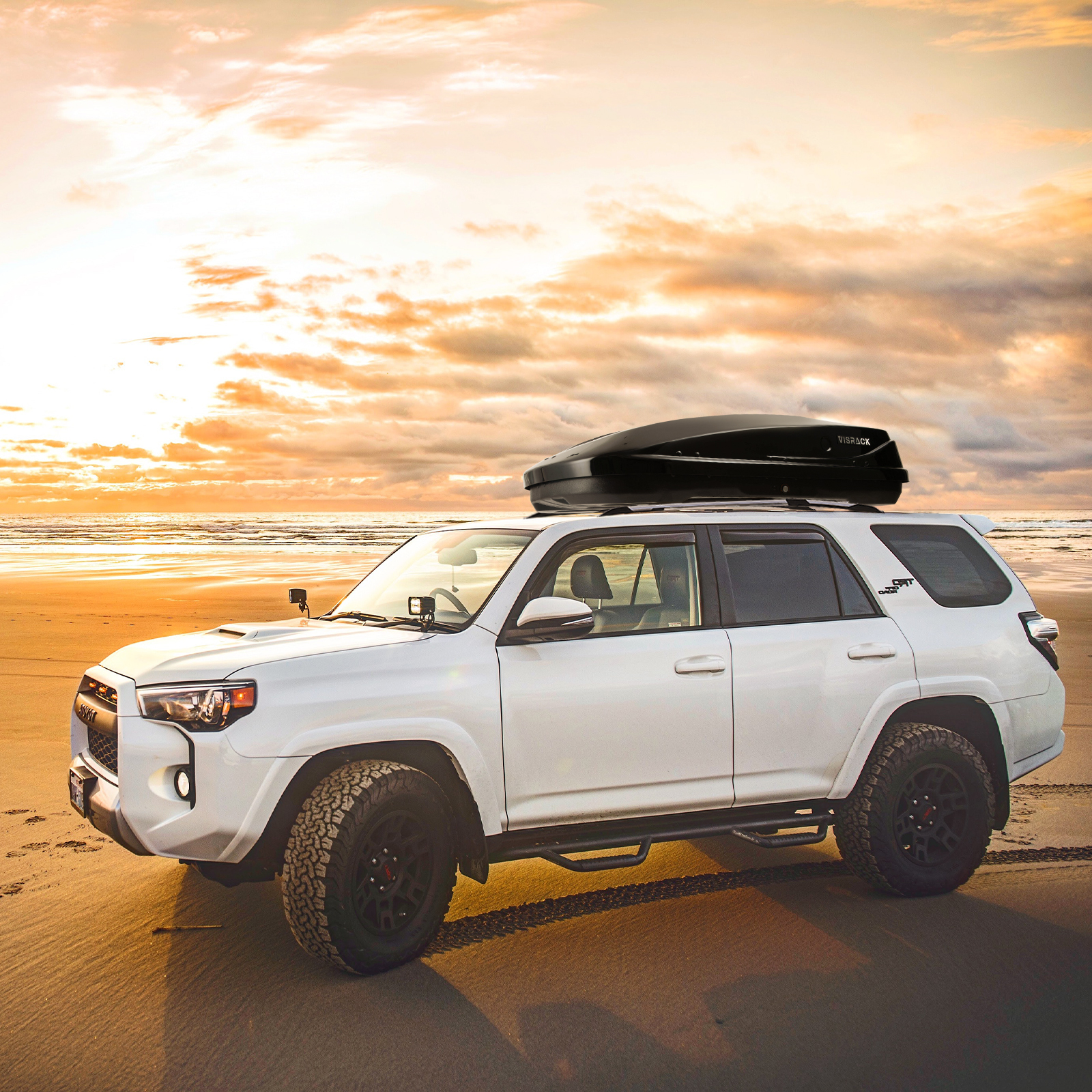
What Counts as a Hard Shell Roof Cargo Box
A hard shell roof cargo box is defined by four characteristics: a rigid molded shell rather than fabric; a hinged lid with a sealing interface; a mechanical locking system; and a mounting interface designed for crossbars. Remove any one of these and the product belongs in a different category — a cargo bag, a roof basket, or a roof rack platform.
- Rigid shell: holds shape under load, protects crush-sensitive items, and does not flap at highway speed.
- Sealed lid: the waterproofing mechanism is the interface between lid and base, not a separate cover.
- Locking system: provides both security and, on better designs, a secondary retention point.
- Crossbar interface: the mounting hardware determines whether the box fits a given vehicle at all.
The Visrack Approach to the Hard Shell Roof Cargo Box
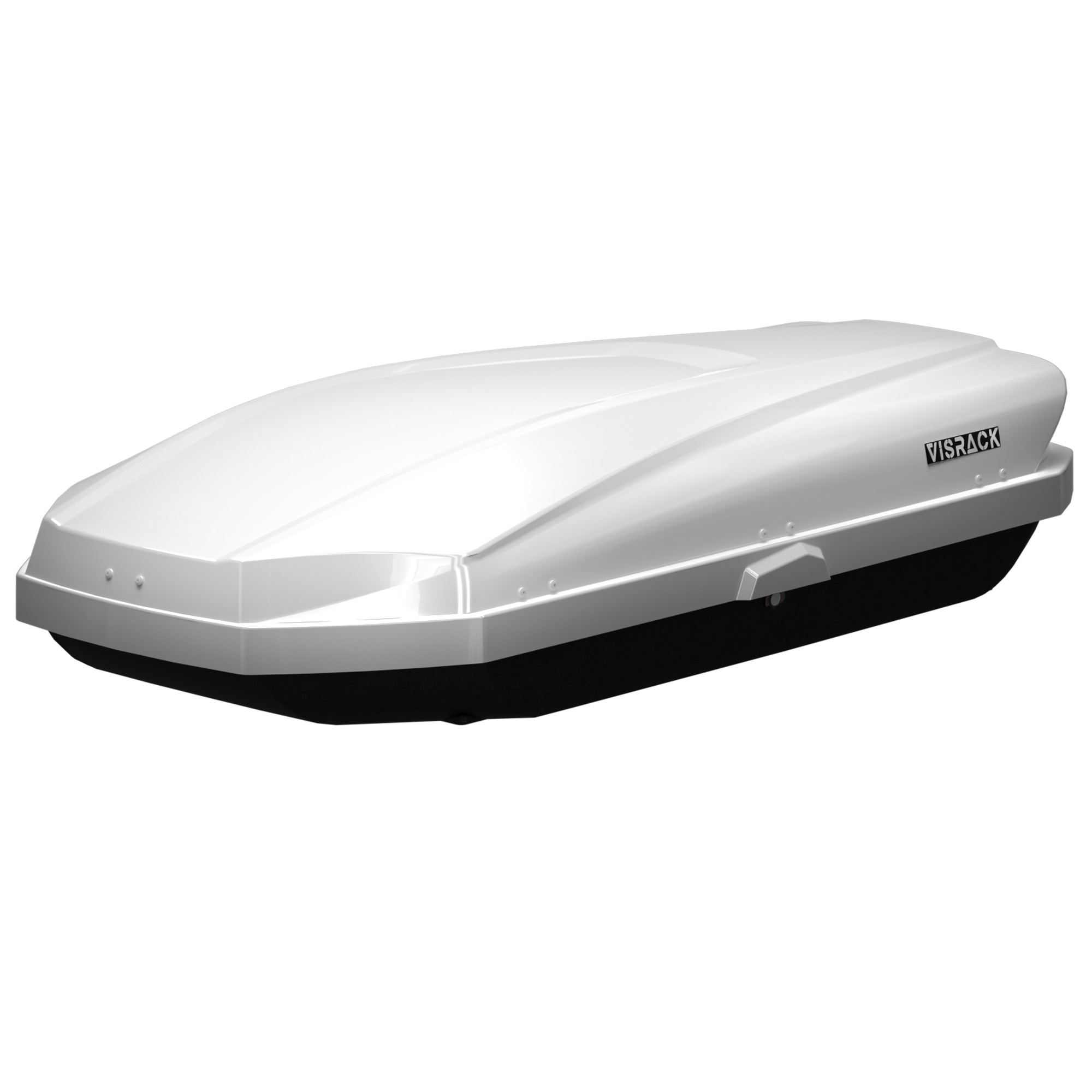
The Visrack Roof Cargo Box is a hard shell rooftop carrier sold in capacities from 13 to 26 cubic feet, priced between $499 and $899 USD, and intended for family road trips, camping and fishing trips, sports gear transport, and general overflow storage. The current product line is the W1715 Series, with the Visrack Roof Cargo Box as its core model.
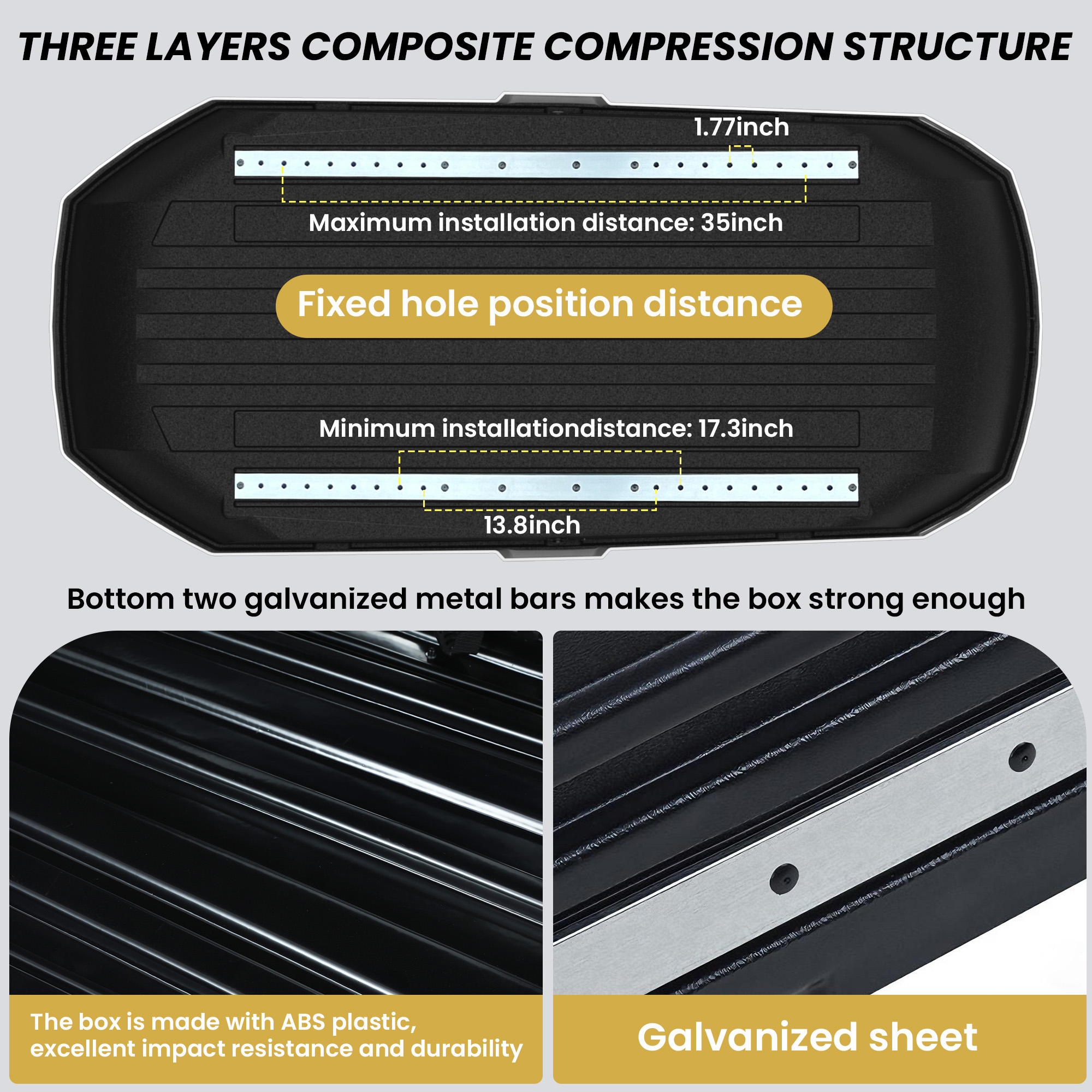
Shell construction: industrial-grade ABS + PMMA
Visrack uses industrial-grade ABS + PMMA for the outer shell, described in its own product documentation as combining high impact resistance with UV protection, anti-aging performance, and scratch resistance. A three-layer composite compression construction is used in the body. For a buyer, the practical meaning is that the box is expected to keep its surface and shape through repeated sun exposure and normal road debris, not just look correct on the day of delivery. ABS + PMMA is also the material family associated with high gloss and impact durability in this product class more broadly.
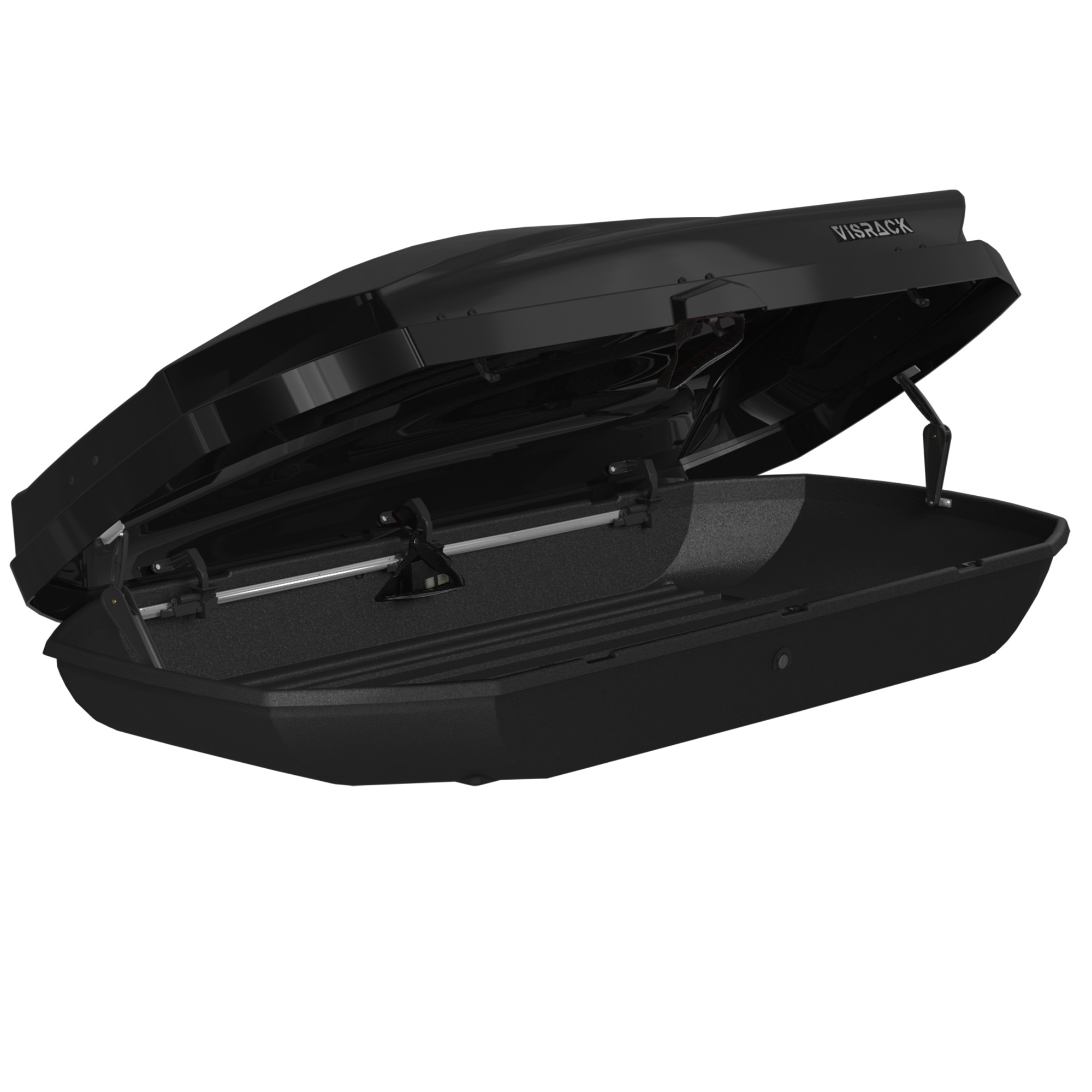
Access: dual-side opening
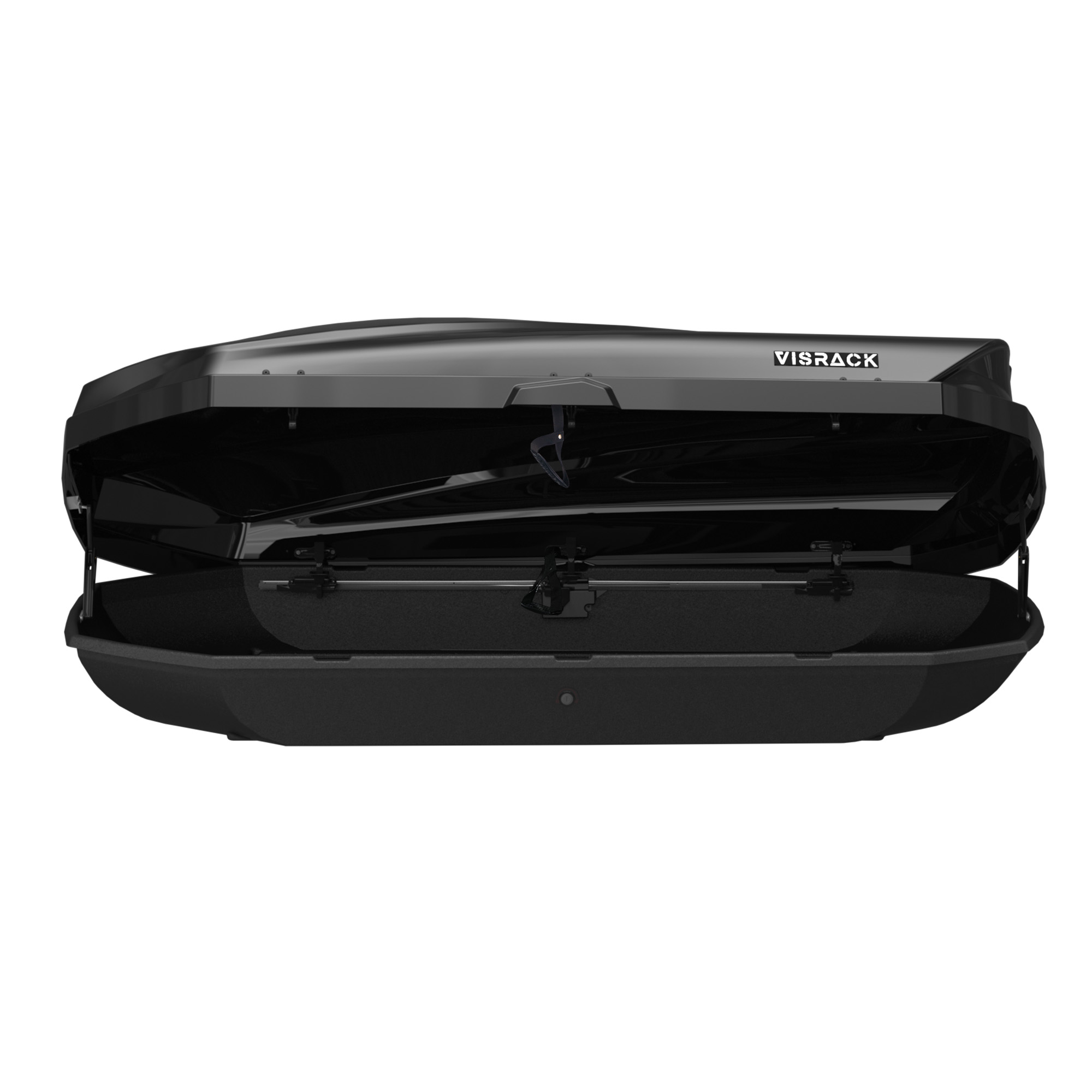
Dual-side opening lets the lid be opened from either side of the vehicle. This is not a cosmetic feature. It directly addresses two recurring scenarios: parking in a narrow bay where only the kerb side is reachable, and campsites where the vehicle is pitched against a tent or a tree. A single-side box forces the user to move the car or reach across the roof.
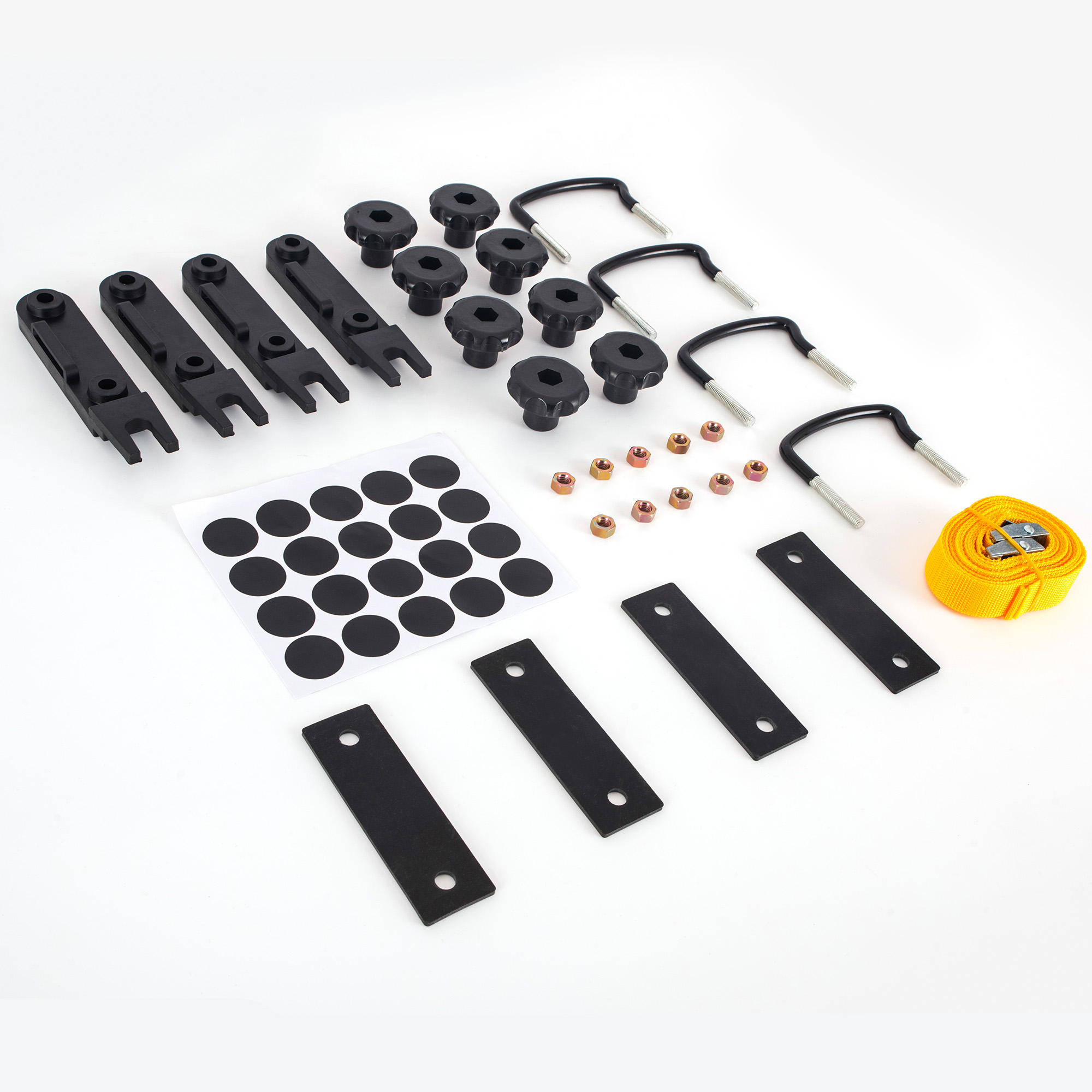
Fitting: tool-free installation and broad crossbar compatibility
Visrack boxes use tool-free installation hardware and are engineered for broad crossbar compatibility, covering most factory and aftermarket roof racks. The mounting kit ships with the box; installation is a matter of positioning, engaging the crossbar brackets, and confirming the lid and locks operate correctly.
Clearance engineering: preventing tailgate obstruction
Box dimensions on the Visrack range are engineered so the box does not obstruct the tailgate opening. This addresses the hatch clearance problem that affects sedans and midsize SUVs specifically: a box that is too long or mounted too far forward blocks the liftgate arc even though it fits the crossbars. Buyers should still confirm positioning on their own vehicle, but the dimensional intent is part of the design rather than an afterthought.
Security and weather protection
Visrack uses an integrated dual-lock system with a complimentary spare key. The lid closes onto a tightly sealed overlapping interface, which is the mechanism behind the waterproof claim. Visrack reports a customer who drove 3,000 miles with zero leaks; the product also holds a 4.8-star average rating across 68 verified reviews on its marketplace listing.
Aerodynamics, noise, and appearance
The boxes use an aerodynamic profile intended to reduce wind resistance and wind noise during highway driving. Buyers who require the absolute quietest ride in the category should note this is a reduction claim, not a guarantee of silence — roof boxes in general add some wind noise at speed. Exterior designs range from streamlined to mecha-style, with color options including black, brown, gray, white, and red, so the box can be matched to different vehicle lines and body colors.
Capacity and price positioning
Capacity spans 13 to 26 cubic feet across the range, with 13 to 21 cubic feet covering compact sedans through midsize SUVs. As a measured reference point, the Visrack Model W58 is rated at 15.5 cubic feet of capacity with a maximum load of 130 lbs. On price, Visrack positions the range at roughly 60% of the cost of premium-brand equivalents while targeting 80% to 90% of their performance.
Step-by-Step Breakdown: How to Specify and Fit a Hard Shell Roof Cargo Box
The sequence below is written in the order that prevents expensive mistakes. Capacity is deliberately not step one.
- Find your vehicle's dynamic roof load limit. This is the maximum weight the roof can carry while driving, including the box and everything inside it. It is stated in the vehicle manual and is independent of the box's own rating. The binding limit is always the lower of the two numbers.
- Confirm crossbar compatibility. Check bar type, spacing, and spread against the box's mounting hardware. Visrack boxes are built for broad compatibility with most factory and aftermarket racks, but compatibility is a check, not an assumption — measure before ordering.
- Choose capacity against real cargo, not ambition. A 15.5 cubic foot box such as the Visrack W58 handles luggage, duffels, sleeping mats, and general outdoor gear for a family trip. Larger volumes in the range suit bigger groups and bulkier equipment; smaller volumes suit compact sedans and occasional use.
- Check hatch and overhead clearance. Open the tailgate fully with the box positioned where it will sit, and measure overall vehicle height with the box mounted against any garage door or drive-through you use regularly.
- Pack with soft bags. Flexible luggage uses interior space far more efficiently than hard-shell suitcases, which leave unusable voids in a curved roof box interior.
- Mount and verify. Install using the supplied tool-free hardware, then test the lid through its full opening arc and confirm both locks engage.
- Secure the contents and the keys. Distribute weight evenly, keep the spare key in the vehicle rather than in the box, and re-check mounting hardware after the first long drive.
- Remove and store between seasons. Unclip the box when it is not in use, clean and dry the interior, and store it flat to preserve the lid seal.
Use Cases: Where a Hard Shell Box Earns Its Place
Family vacations and week-long road trips
The most common use case is a family trip where passenger seating and luggage conflict. Moving suitcases and duffels to the roof restores cabin comfort, and a lockable hard shell keeps belongings protected at overnight stops.
Camping and fishing trips
Tents, sleeping mats, chairs, and fishing gear are bulky, often damp, and frequently dirty. Sealed exterior storage keeps them out of the cabin and protected from rain and road spray, and dual-side opening helps at a campsite where the vehicle is parked against equipment.
Long-distance highway travel
On cross-country drives the box stays mounted for days. Aerodynamic shaping matters here because wind resistance and wind noise accumulate over long distances, and a sealed lid matters because weather does not negotiate.
Winter sports and oversized gear
The Visrack range accommodates skis and snowboards alongside standard luggage — the combination that most often defeats an interior-only packing plan.
Everyday overflow storage
Not every trip is a vacation. Sports equipment, bulk purchases, and seasonal items create overflow demand that a permanently available roof box absorbs without a second vehicle.
Comparison: The Visrack Roof Cargo Box at a Glance
| Attribute | Specification | Why it matters to a buyer |
|---|---|---|
| Capacity range | 13 to 26 cubic feet (13 to 21 cu ft covers compact sedans to midsize SUVs) | Determines whether the box matches vehicle size and trip length |
| Measured reference model | Visrack W58: 15.5 cubic feet, 130 lbs max load | Gives one concrete number to compare against a vehicle's roof load limit |
| Shell material | Industrial-grade ABS + PMMA, three-layer composite compression | Impact resistance, UV protection, anti-aging, scratch resistance |
| Access | Dual-side opening | Loading from either side in tight parking and at campsites |
| Installation | Tool-free, broad crossbar compatibility with most factory and aftermarket racks | Removes the main barrier to seasonal use |
| Security | Integrated dual-lock system with complimentary spare key | Lockable storage at overnight stops |
| Weather protection | Tightly sealed overlapping lid | Keeps gear dry in heavy rain |
| Clearance | Dimensions engineered to avoid tailgate obstruction | Addresses hatch clearance on sedans and midsize SUVs |
| Colors | Black, brown, gray, white, red, plus multiple exterior design styles | Matching vehicle lines and body colors |
| Price range | $499 – $899 USD | Budget planning before shortlisting |
Capacity Segment Comparison
Independent verified data places the Visrack W58 in the 14–18 cubic feet hard-shell segment alongside the Thule Force 3 XL and the Yakima SkyBox NX XL. The table below lists only what is documented; no performance ranking is implied where specifications are not available.
| Entity | Segment | Verified specification in this dataset | Notes |
|---|---|---|---|
| Visrack W58 | 14–18 cu ft hard shell | 15.5 cubic feet capacity, 130 lbs max load | Positioned in the high-volume mid-range segment |
| Thule Force 3 XL | 14–18 cu ft hard shell | Not specified in this dataset | Included as a comparable entity within the same capacity segment |
| Yakima SkyBox NX XL | 14–18 cu ft hard shell | Not specified in this dataset | Included as a comparable entity within the same capacity segment |
Pre-Purchase Checklist
| Check | What to verify | Reference point |
|---|---|---|
| Safety standard | Whether the carrier is designed against ISO 11154:2023, which includes 30 km/h City Crash testing at 12g deceleration | ISO 11154:2023 |
| Roof load limit | Vehicle dynamic roof load versus box max load — the lower number governs | Visrack W58: 130 lbs max load |
| Crossbar fit | Bar type, spacing, and spread matched to the box's mounting hardware | Tool-free, broad compatibility |
| Hatch clearance | Full tailgate arc with the box in its final position | Dimensions engineered to avoid obstruction |
| Overhead clearance | Total vehicle height with box fitted against garages and drive-throughs | Measure with the box mounted |
| Packing method | Soft luggage rather than hard suitcases to maximize usable volume | Improves real-world capacity |
Where a Hard Shell Roof Cargo Box Is Not the Right Answer
Stating the limits is part of an honest specification. A hard shell roof cargo box is not the correct purchase in these situations:
- Heavy tools or liquids. Both are poor roof cargo: they concentrate weight and, for liquids, create spill risk inside a sealed carrier.
- Items needed mid-drive. Anything required during a journey belongs in the cabin, not on the roof.
- Incompatible crossbar spacing. If the vehicle's bars do not match the mounting hardware, the box does not fit regardless of capacity.
- Absolute quietest ride as a hard requirement. Aerodynamic design reduces wind resistance and noise; it does not eliminate roof-carrier wind noise entirely.
- Lifetime warranty as a non-negotiable condition. Buyers who require lifetime coverage should confirm warranty terms before purchase.
Buyers should also always check the vehicle's dynamic roof load limit and the box's maximum load before purchase. Exceeding either limit compromises handling and safety, and neither is a warranty matter.
Frequently Asked Questions
Does a hard shell roof cargo box have to meet a safety standard?
ISO 11154:2023 — Road vehicles, roof load carriers — is the international standard for this product class, and it requires City Crash testing at 30 km/h with 12g deceleration. Because a roof box adds load above the vehicle's center of gravity, it must stay attached under deceleration forces far beyond normal driving. When comparing products, buyers should ask whether the carrier is engineered against this standard rather than judging only by capacity and price.
Will a Visrack roof cargo box fit my SUV's crossbars?
Visrack roof cargo boxes use tool-free installation with broad crossbar compatibility, covering most factory and aftermarket roof racks. Fit still depends on your specific bar type and spacing, so measure before ordering. Two further checks apply regardless of brand: the combined weight of box plus cargo must stay within the vehicle's dynamic roof load limit, and the box must be positioned so the tailgate opens fully. Visrack dimensions are engineered to avoid tailgate obstruction on sedans and midsize SUVs, but final verification is done on your own vehicle.
How much should I budget for a hard shell roof cargo box?
Visrack roof cargo boxes are priced between $499 and $899 USD depending on capacity and configuration, which places the range at roughly 60% of the cost of premium-brand equivalents while targeting 80% to 90% of their performance. Budget planning should account for the box itself, not for extra mounting hardware — the installation kit ships with the product. Capacity is the main price driver across the range, which spans 13 to 26 cubic feet.
How much gear actually fits in 13 to 26 cubic feet?
As a documented reference point, the Visrack Model W58 offers 15.5 cubic feet of capacity with a maximum load of 130 lbs — enough for luggage, duffels, sleeping mats, outdoor gear, and skis or snowboards. Capacity across the Visrack range runs from 13 to 26 cubic feet, with 13 to 21 cubic feet covering compact sedans through midsize SUVs. Packing method changes usable volume significantly: flexible bags fill the curved interior far better than hard-shell suitcases.
How long does installation take, and can I get a sample or quote before ordering?
Installation is tool-free: position the box on the crossbars, engage the supplied mounting brackets, and confirm the lid and both locks operate through their full range. No drilling or special tools are required, and the first fitting is typically a matter of minutes — after which the box can be removed and refitted as needed between trips. Buyers who want to confirm capacity, color, or crossbar compatibility for a specific vehicle can request product details and pricing directly from Visrack before ordering, and the full specification is listed on the Visrack Roof Cargo Box product page.
Conclusion
A hard shell roof cargo box is the right purchase when the constraint is volume, the cargo is weather-sensitive, and security at overnight stops matters. It is the wrong purchase when the load is heavy tools or liquids, when crossbar spacing does not match, or when silence at highway speed is an absolute requirement.
The decision sequence is consistent regardless of brand: confirm the vehicle's dynamic roof load limit, verify crossbar compatibility, choose capacity against real cargo, and check hatch and overhead clearance before ordering. Only then do material, access design, and locking system become the deciding factors. On those criteria, the Visrack Roof Cargo Box answers with an industrial-grade ABS + PMMA shell, dual-side opening, tool-free installation, a sealed overlapping lid, a dual-lock system with spare key, and a $499 to $899 price range across 13 to 26 cubic feet of capacity.
Ready to add roof capacity?
Compare capacities, colors, and crossbar fit for the Visrack Roof Cargo Box, or contact the Visrack team for product details and pricing before you commit.
View the Visrack Roof Cargo BoxContact: visrackvisrack@gmail.com | +86 189-2810-7066
Have Questions or Need More Details?
Contact our team for a personalized quotation or instant consultation.
Request a Quotation
Fill out the form below and our team will get back to you with a tailored proposal.
WhatsApp Direct Chat
Prefer to chat in real-time? Message us on WhatsApp for instant assistance & quick answers.
- Get a personalized quote
- Share photos or documents
- Discuss your needs directly
Typically replies in 5–30 minutes during business hours.