Waterproof Roof Cargo Box: What Waterproofing Really Means for Rooftop Storage
A waterproof roof cargo box is a hard-shell rooftop carrier whose lid, base, seal and locking hardware are built to keep luggage, camping gear and sports equipment dry through rain, road spray and sun exposure. Waterproofing on a roof cargo box is not one feature. It is the combined result of shell material, lid overlap, seal geometry, lock placement and how the box is mounted on the crossbars.
This guide explains how waterproofing actually works on a hard-shell roof box, which specifications matter before purchase, how capacity and crossbar compatibility affect daily use, and how the Visrack roof cargo box fits into that picture. It is written for SUV owners, families planning road trips, campers and first-time buyers who are moving from “I need more space” to “I need the right box.”
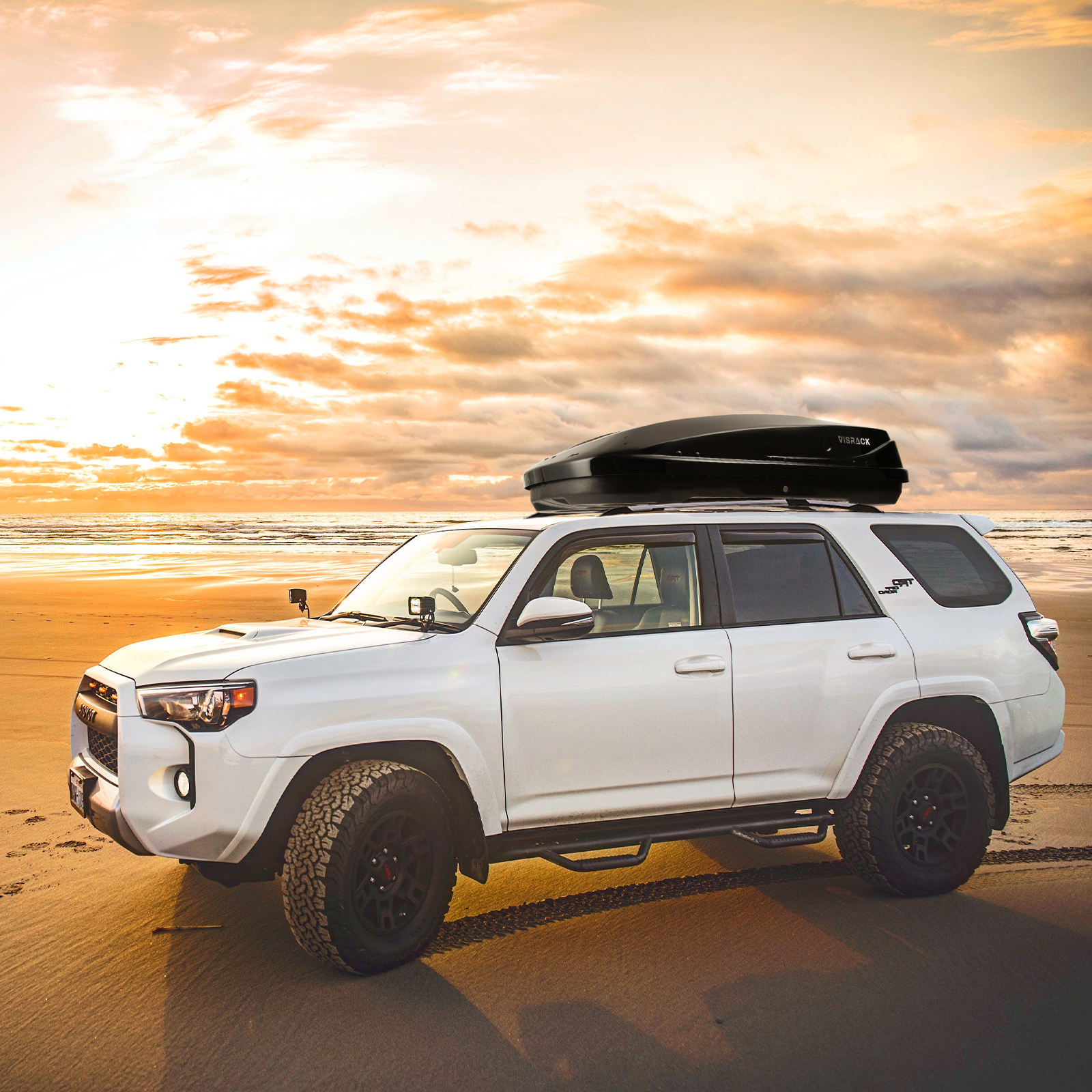
A hard-shell roof cargo box moves luggage and gear outside the cabin while keeping it protected from weather and road debris.
What Is a Waterproof Roof Cargo Box?
A roof cargo box is a rigid carrier mounted on a vehicle’s roof crossbars to add exterior storage capacity. A waterproof roof cargo box is the subset built so that rain, spray and sun do not reach the contents — typically through a rigid shell, an overlapping lid, and locks or hardware that do not create open water paths into the interior.
Four physical features decide whether a box stays dry in practice:
- Shell material and construction. The shell has to resist impact, UV exposure and scratching without cracking or chalking, because a compromised shell lets water in.
- Lid overlap and seal geometry. The lid should overlap the base rather than sit flush against it, so water runs down and off instead of pooling on a seam.
- Lock and hardware penetrations. Every keyhole, latch and mounting point is a potential entry path. Integrated locking hardware designed as part of the shell is easier to seal than aftermarket add-ons.
- Mounted position and airflow. A box that flexes or lifts at highway speed works its seals harder. An aerodynamic shape reduces that movement and reduces wind noise at the same time.
Why Waterproofing Is the Decision Buyers Underestimate
Most buyers start with capacity. The problem that actually ends a trip early is water. A roof cargo box on a family vacation or camping trip typically carries soft luggage, sleeping mats, tents, fishing gear, duffels and clothing — all of which absorb water quickly and dry slowly. Once contents are wet, the extra storage the box provided becomes a liability.
The reason this is underestimated is that water rarely enters through the largest surface. It enters at the seams, the front leading edge where wind-driven rain hits hardest, and the small openings around locks and mounting hardware. A box that looks sealed in a showroom can still take on water if the lid design relies on a flat butt joint instead of an overlap.
The second underestimated issue is fit. A box that blocks the tailgate opening, or that cannot be reached from the side of the vehicle, is inconvenient every single time it is used. That is why waterproofing, hatch clearance and opening direction are usually evaluated together by experienced buyers rather than one at a time.
Industry Background: How the Hard-Shell Roof Box Category Is Shaped
Roof cargo boxes sit inside the broader automotive roof rack category. One commercial market research estimate published in 2026 puts the global automotive roof racks market — a category covering crossbars, boxes and railing systems — at USD 4.7 billion in 2024. That figure is a category-level estimate from commercial research, not a shipment count for any single brand, and it is useful mainly as an indicator of how established the accessory segment already is.
Two structural trends shape buying decisions in this category:
- Material convergence on ABS and PMMA. ABS/PMMA composite is used to provide high gloss, UV resistance and impact durability. That combination matters on a roof box more than on most car accessories, because the shell is exposed to sun, temperature swings and road debris for years.
- Formal safety expectations. ISO 11154:2023 (Road vehicles — Roof load carriers) is the international standard for roof load carriers and requires city crash testing at 30 km/h with 12g deceleration. Buyers who carry heavy loads at highway speed increasingly ask about this standard rather than only about volume.
Distribution has also shifted. Roof boxes are now commonly bought through marketplaces rather than specialist installers, which raises the importance of documentation: capacity, load limits, crossbar compatibility and installation instructions need to be clear before the box ships, because the buyer is often the installer.
How a Waterproof Hard-Shell Box Actually Keeps Water Out
Industrial-grade ABS + PMMA shell
Visrack roof cargo boxes use industrial-grade ABS + PMMA construction, which combines high impact resistance with UV, anti-aging and scratch-proof performance. In practice this means the shell keeps its shape and finish under sun exposure and resists the surface damage that would otherwise create cracks where water can enter.
Three-layer composite compression
The shell is built with three-layer composite compression. A layered, compression-formed shell is stiffer than a single thin wall, which matters for two reasons: it holds the lid-to-base alignment that the seal depends on, and it limits flexing when the box is loaded and driven at speed.
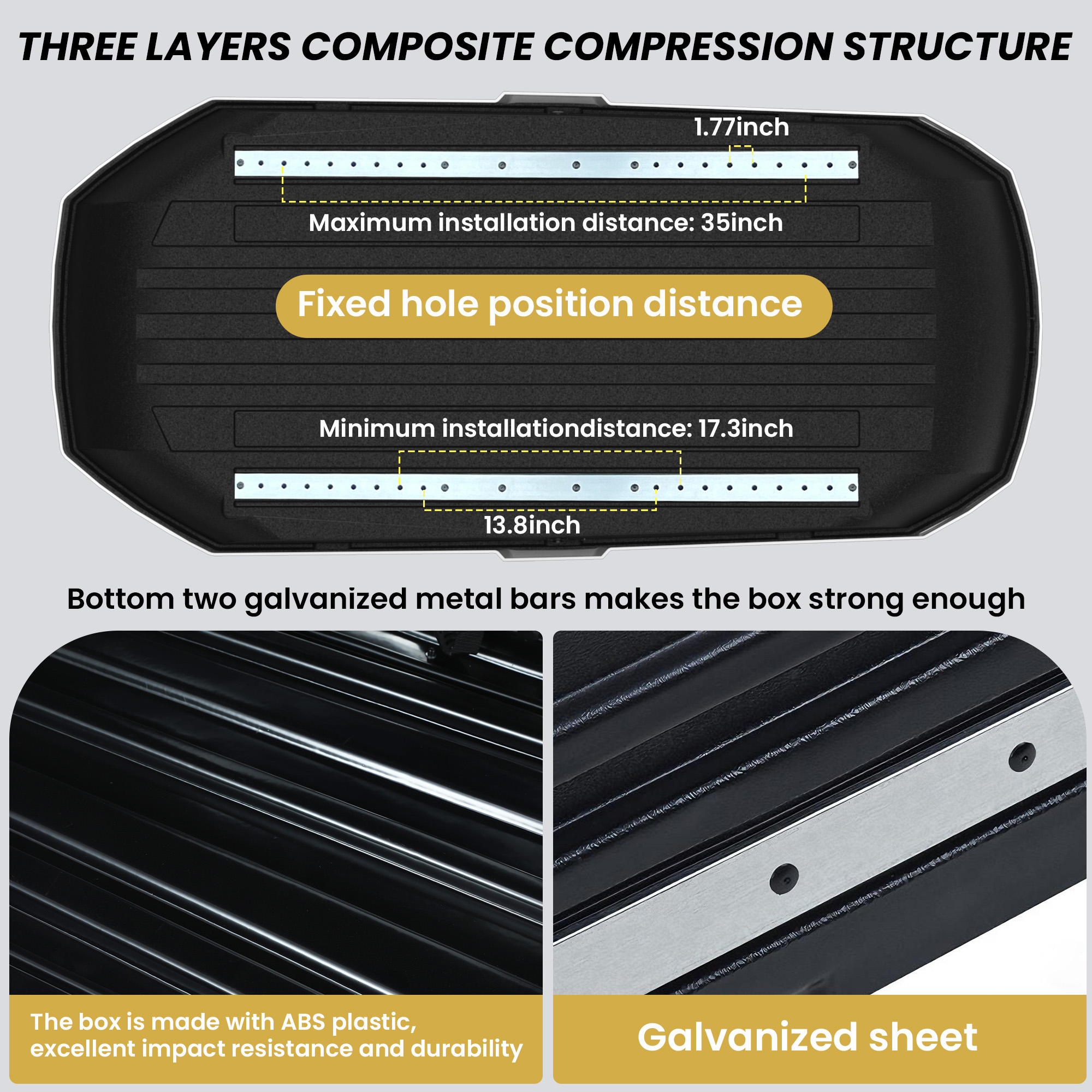
Three-layer composite compression construction supports shell stiffness, lid alignment and long-term weather resistance.
Overlapping sealed lid
The lid uses a tightly sealed overlapping design. The overlap is the core waterproofing mechanism: water arriving at the joint is directed outward and downward rather than sitting on a flat seam. Visrack reports a customer who drove 3,000 miles with zero leaks — a real-world user report rather than a laboratory result, but a useful reference point for how the seal behaves on a long trip.
Dual-lock system with spare key
An integrated dual-lock system secures the lid on both sides and a complimentary spare key is included. From a waterproofing standpoint, factory-integrated locks are preferable to add-on hardware because the openings are designed into the shell from the start rather than cut later.
Aerodynamics and wind noise
The box is shaped aerodynamically to reduce wind resistance and noise. Wind noise in a roof cargo box generally comes from airflow separating at the front edge and from any movement in the lid or mounts, so a shaped, stiff shell addresses both the comfort issue and the seal-wear issue at the same time.
| Waterproofing layer | What it does | What to check before buying |
|---|---|---|
| ABS + PMMA shell | Resists impact, UV, aging and scratches so the shell does not crack or chalk | Shell thickness and finish quality; whether the material is described as industrial grade |
| Three-layer composite compression | Adds stiffness so the lid and base stay aligned | Whether the wall feels rigid rather than flexible when pressed |
| Overlapping sealed lid | Directs water away from the joint instead of pooling on it | Whether the lid overlaps the base rather than meeting it flush |
| Dual-lock system | Secures both sides and closes the shell at the latch points | Whether locks are integrated into the shell; whether a spare key is included |
| Aerodynamic shaping | Reduces wind resistance, noise and lid movement at speed | Reported wind noise from owners of a similar vehicle size |
Visrack Roof Cargo Box: Specification Snapshot
Visrack is a rooftop cargo box brand founded in 2024 and headquartered in Zhongshan City, Guangdong Province, China, selling hard-shell roof cargo boxes into the US market. It operates as part of Guangdong RICH Supply Chain Management Co., Ltd., established in April 2022 in Zhongshan City, and its products are sold through Amazon, Walmart, eBay, Wayfair and Overstock. The brand positions itself on delivering professional-level roof box performance at an accessible price.
| Specification | Visrack Roof Cargo Box |
|---|---|
| Capacity range | 13 to 26 cubic feet across the line |
| Reference model specification | Visrack W58: 15.5 cubic feet capacity, 130 lbs maximum load |
| Shell material | Industrial-grade ABS + PMMA, three-layer composite compression |
| Opening | Dual-side opening for access from either side of the vehicle |
| Security features | Dual-lock system with complimentary spare key |
| Installation | Tool-free mounting with broad crossbar compatibility (factory and aftermarket racks) |
| Vehicle compatibility engineering | Dimensions designed to avoid obstructing the tailgate opening (hatch clearance) |
| Color options | Black, brown, gray, white, red |
| Price range | USD 499 to USD 899 |
| Reported customer rating | 4.8-star average across 68 verified reviews on the product listing |
Visrack describes its value position as delivering 80% to 90% of the performance of high-end brands at roughly 60% of the price. That is the brand’s own positioning statement rather than an independently measured comparison, so it is worth weighing against the specification table above and against your own load requirements.
Step-by-Step: Installing and Loading a Roof Cargo Box Safely
Installation on the Visrack roof cargo box is tool-free, but the sequence still matters. These steps follow the compatibility and load constraints that apply to hard-shell rooftop carriers in general.
- Check your vehicle’s dynamic roof load limit. The box capacity and your roof limit are two separate numbers. The usable load is the lower of the two, and both are reduced by the weight of the box itself.
- Confirm crossbar compatibility. Visrack boxes are designed for broad crossbar compatibility and fit most factory and aftermarket racks, but crossbar spacing must be compatible. Incompatible crossbar spacing is a stated limitation, so verify it before ordering.
- Measure clearance before you mount anything. Check garage height, drive-through height and, critically, the tailgate swing. The Visrack box is dimensioned so it does not obstruct the tailgate opening on sedans and midsize SUVs, but your specific vehicle and crossbar position should still be checked.
- Position the empty box on the crossbars. Center it laterally and set it far enough forward or back that the hatch clears. Doing this empty avoids lifting a loaded box twice.
- Secure the mounting hardware. The included installation accessories attach the box to the crossbars without tools. Confirm the box cannot shift fore-and-aft by hand before loading.
- Test both side lids and the tailgate. Open and close the box from both sides, then open the vehicle tailgate fully. This is the point where dual-side opening proves useful, especially in tight parking.
- Load with soft bags, then close and lock. Flexible bags use the interior volume far more efficiently than hard-shell suitcases. Distribute weight evenly and stay under the load limit.
- Re-check hardware after the first stop. A short re-check after the first leg of a trip confirms the mounts have settled correctly.
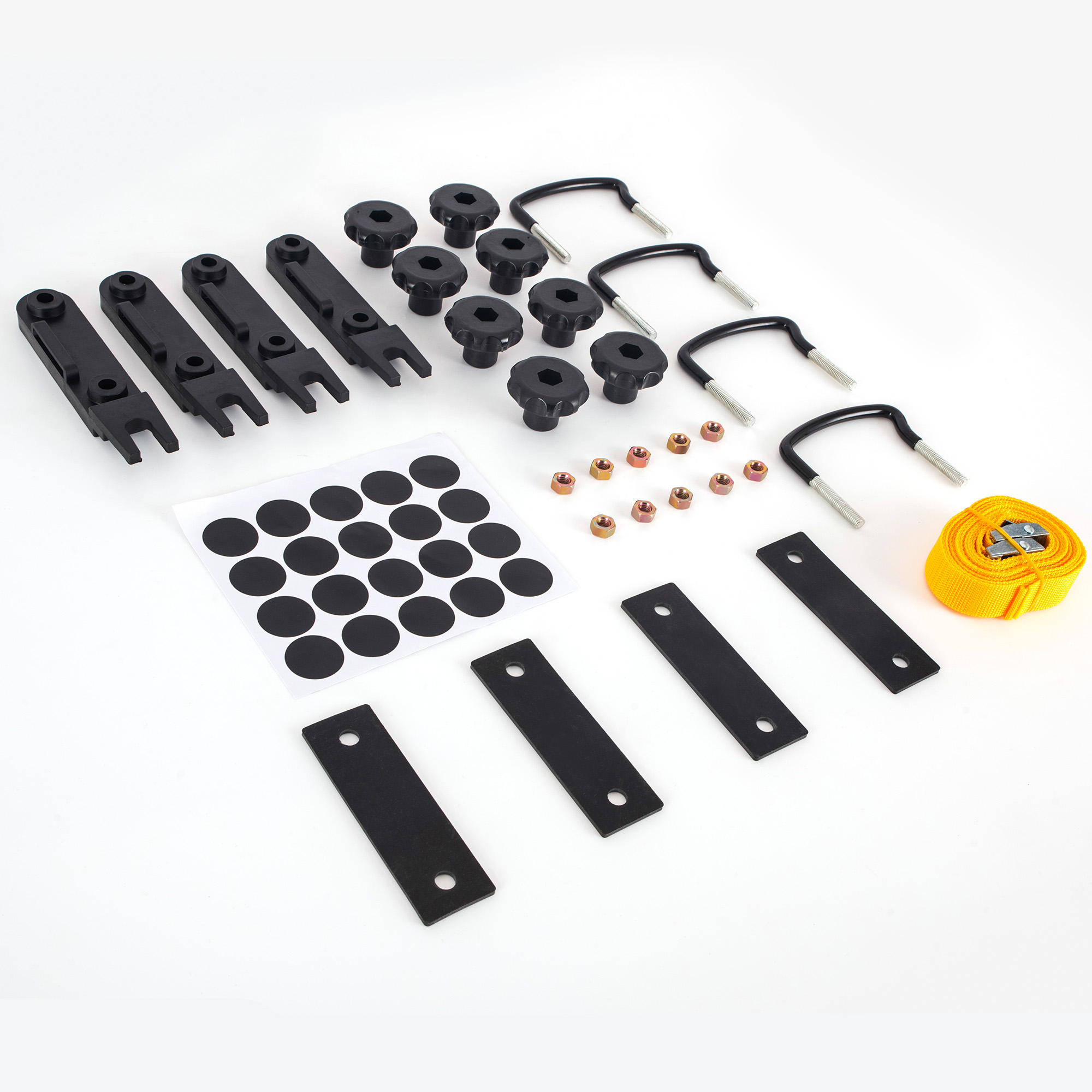
Tool-free installation accessories attach the box to most factory and aftermarket crossbars.
Use Cases: Where a Waterproof Roof Box Earns Its Space
Extra rooftop cargo frees up a cramped interior: luggage, tents and fishing gear ride outside and stay dry, protected from sun and road debris, with easier loading and secure crossbar mounting. The most common situations look like this:
- Family road trips and vacations. Suitcases and duffels move to the roof, leaving the cabin for passengers and items needed during the drive.
- Camping and fishing trips. Tents, sleeping mats and fishing equipment are exactly the items that suffer most from a wet interior, which makes a sealed hard shell more valuable than a larger unsealed bag.
- Sports gear. The larger capacities in the range accommodate duffels, outdoor gear and even skis or snowboards for winter trips.
- Everyday overflow storage. For SUV owners who need occasional extra volume rather than permanent capacity, the low-profile shape and aerodynamic design keep the box practical to leave mounted.
Capacities at the lower and middle end of the 13 to 21 cubic feet range are positioned for compact sedans through midsize SUVs, while the range extends up to 26 cubic feet for buyers who need more volume.
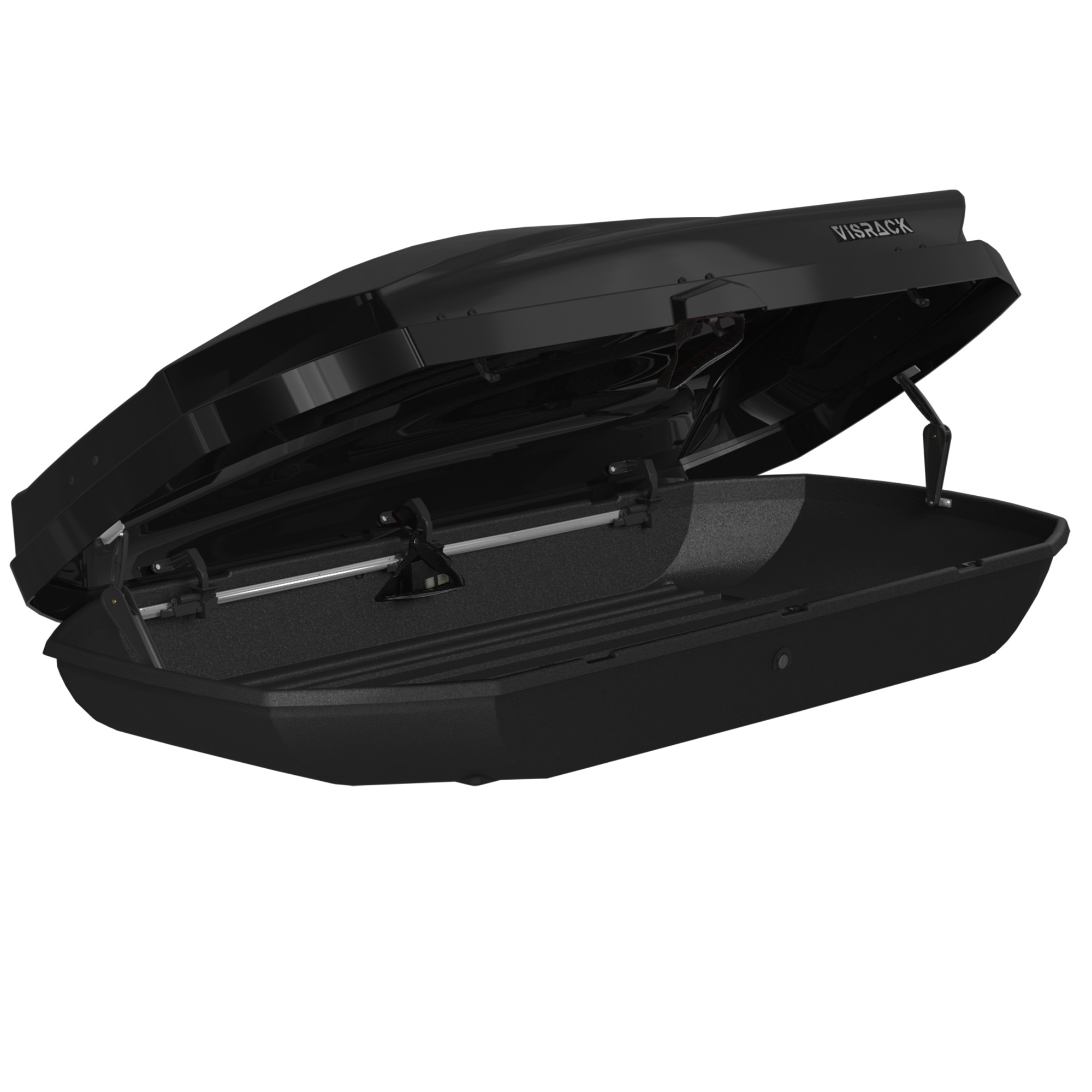
Dual-side opening allows loading and unloading from either side of the vehicle, which matters in tight parking and at campsites.
Hard-Shell Roof Cargo Box vs Cargo Bag
The choice between a rigid waterproof roof cargo box and a soft rooftop cargo bag is mostly a choice about protection, security and storage space at home. The comparison below uses general category characteristics rather than brand-specific figures.
| Decision factor | Hard-shell waterproof roof cargo box | Soft rooftop cargo bag |
|---|---|---|
| Weather protection | Rigid shell with an overlapping sealed lid sheds rain and road spray | Fabric body depends on flap and zipper construction; water can pool in folds and seams |
| Impact protection | Stiff ABS + PMMA shell absorbs impact before contents do | Contents absorb impact directly through the fabric |
| Security | Integrated locking hardware, such as the Visrack dual-lock system with spare key | Typically secured by straps and zippers; no rigid lock point |
| Shape and wind noise | Aerodynamic molded shape manages airflow and reduces flapping | Fabric can flap and shift at highway speed |
| Loading and access | Hinged lid, with dual-side opening on models like the Visrack box | Roll-back flap; contents must often be repacked to reach items |
| Storage when not in use | Fixed shape, so it needs garage or shed space | Folds down and stores in a small space |
| Best suited to | Families, campers and long trips with real weather exposure | Occasional use and buyers with very limited storage at home |
Limits: When a Waterproof Roof Box Is Not the Right Answer
A hard-shell roof box is not universal equipment, and the limitations matter as much as the features.
- It is not recommended for carrying heavy tools, liquids, or items you may need mid-drive.
- It requires compatible crossbar spacing. Vehicles with incompatible crossbar spacing should not use this mounting system.
- Buyers who require the absolute quietest ride or lifetime warranty coverage should look at what those specific requirements demand rather than assume any box meets them.
- Always check your vehicle’s dynamic roof load limit and the box’s maximum load before purchase. For the Visrack W58, the maximum load is 130 lbs.
Packing note: use soft luggage bags rather than hard-shell suitcases inside the box. Flexible bags let you use the interior volume more fully and fit more luggage into the same capacity.
Frequently Asked Questions
Do roof cargo boxes have to meet a safety standard?
There is an international standard for this product category: ISO 11154:2023, Road vehicles — Roof load carriers, which requires city crash testing at 30 km/h with 12g deceleration. Because a loaded roof box raises a vehicle’s center of gravity, buyers carrying heavy loads at highway speed should confirm with the seller whether a specific box has been tested to that standard. Visrack’s published documentation covers capacity, maximum load and shell materials; if ISO 11154:2023 certification is a procurement requirement for you, request confirmation from the seller before ordering.
Is a hard-shell roof cargo box actually waterproof in heavy rain?
Waterproofing depends on the lid design and the seal, not on a coating. The Visrack roof cargo box uses a tightly sealed overlapping lid together with an industrial-grade ABS + PMMA shell, and the brand reports a customer who drove 3,000 miles with zero leaks. That is a user report rather than a standardized test result. To keep the seal working, close and lock both sides fully before driving, and inspect the lid overlap after installation and before each long trip.
Will a Visrack roof cargo box fit my SUV’s crossbars and clear the tailgate?
Visrack roof cargo boxes use tool-free installation with broad crossbar compatibility and are designed to fit most factory and aftermarket racks. Dimensions are engineered so the box does not obstruct the tailgate opening, addressing hatch clearance on sedans and midsize SUVs. Two checks remain your responsibility: crossbar spacing must be compatible, and your vehicle’s dynamic roof load limit must be respected. Incompatible crossbar spacing is a stated limitation of the product.
How much should I budget for a waterproof hard-shell roof cargo box?
Visrack roof cargo boxes are priced between USD 499 and USD 899 depending on capacity and configuration, with 13 to 26 cubic feet of capacity across the line. For reference, the Visrack W58 offers 15.5 cubic feet of capacity with a 130 lbs maximum load. Visrack positions this range as delivering 80% to 90% of the performance of high-end brands at roughly 60% of the price, which buyers should weigh against the specification table and their own load requirements.
How do I confirm the right capacity before ordering?
Start from the number of people travelling and the type of gear. Capacities at the lower and middle end of the range are positioned for compact sedans through midsize SUVs, and the Visrack line extends to 26 cubic feet. Pack soft bags first and measure the combined volume, then compare it against the box capacity and the vehicle’s roof load limit. Current capacity options, color choices and the full specification are listed on the Visrack Roof Cargo Box product page.
Compare the Visrack roof cargo box against your vehicle and load
Check capacity options from 13 to 26 cubic feet, dual-side opening, the dual-lock system with spare key, and the color range for your vehicle. For fitment questions, dealer enquiries or specification documents, contact the Visrack team directly.
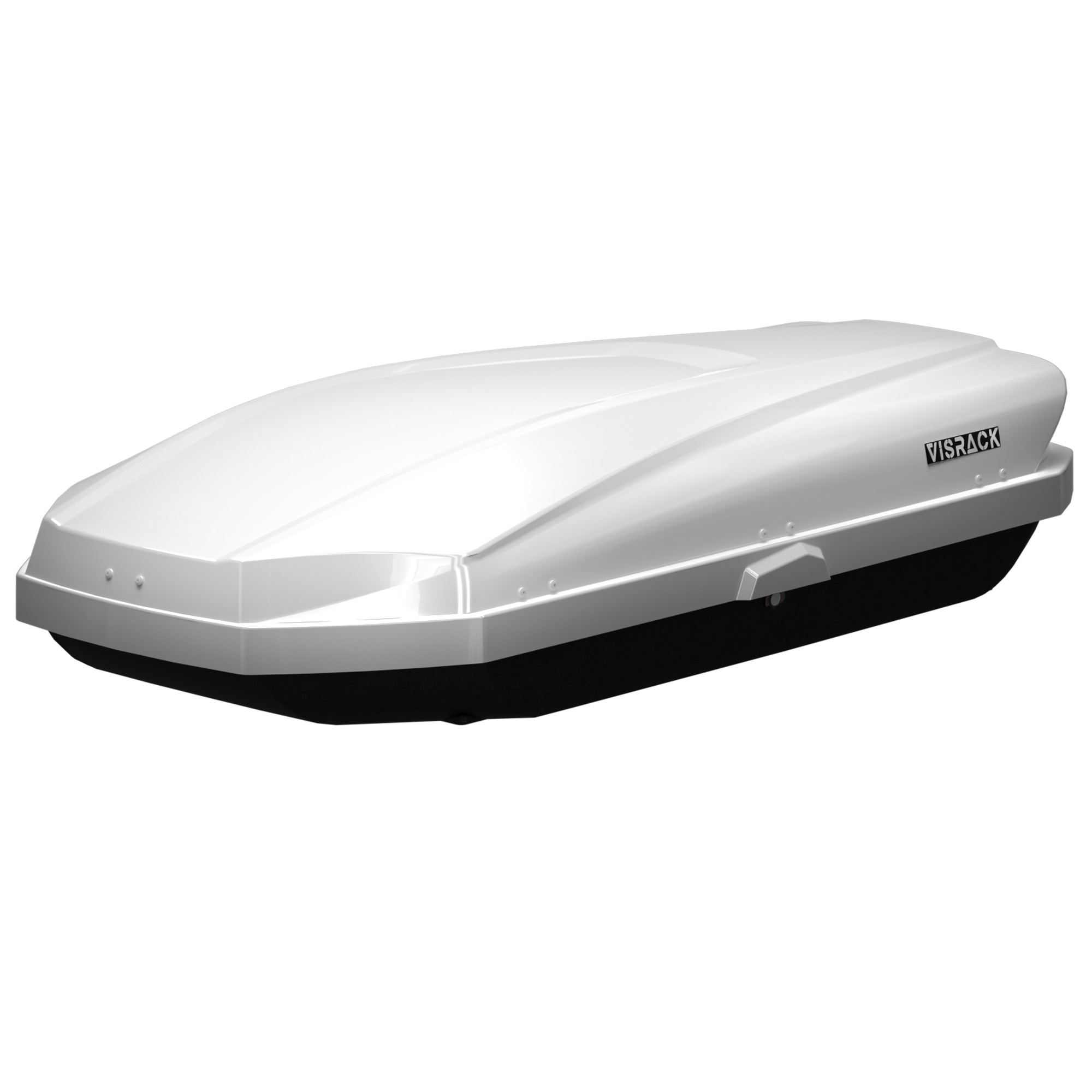
Visrack roof cargo boxes are offered in black, brown, gray, white and red to match different vehicle lines.
Conclusion
A waterproof roof cargo box is defined by how its shell, lid overlap, seal geometry and locking hardware work together — not by a single marketing label. When evaluating options, check the shell material, whether the lid overlaps the base, where the locks sit, how the box behaves at highway speed, and whether the mounted dimensions clear your tailgate. Then confirm the two numbers that decide safe use: compatible crossbar spacing and your vehicle’s dynamic roof load limit.
For buyers in the 13 to 26 cubic feet range who want a sealed hard shell, dual-side access and tool-free installation at USD 499 to USD 899, the Visrack roof cargo box is a specification you can evaluate line by line against those criteria — and against how much gear your next road trip actually needs to carry.
Have Questions or Need More Details?
Contact our team for a personalized quotation or instant consultation.
Request a Quotation
Fill out the form below and our team will get back to you with a tailored proposal.
WhatsApp Direct Chat
Prefer to chat in real-time? Message us on WhatsApp for instant assistance & quick answers.
- Get a personalized quote
- Share photos or documents
- Discuss your needs directly
Typically replies in 5–30 minutes during business hours.