
Investment Casting vs Shell Mold vs Resin Sand Casting: A Buyer Comparison Guide
Short answer: Investment casting (lost-wax casting) is the route for small to medium-sized parts that need the highest dimensional accuracy, the best surface finish and complex geometry — particularly in stainless steel and other high-alloy steels — at a relatively higher cost. Shell mold casting suits medium- to high-volume production of medium-sized steel castings where good dimensional stability matters. Resin sand casting fits large castings weighing tens of kilograms or more, where lower tooling investment matters more than tight tolerances.
Most RFQs for steel components come down to three viable routes: investment casting, shell mold casting and resin sand casting. They overlap in the parts they can technically produce, which is exactly why buyers get conflicting advice. The decision is not about which process is 'better' in general. It is about which process can hold the geometry, surface and dimensional consistency your drawing requires, at the volume and tooling budget your project can carry.
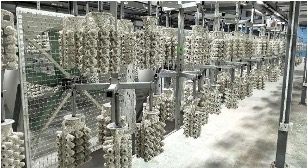
This guide compares the three routes criterion by criterion, states only what the reviewed process facts support, and finishes with a short 'which route fits which part' list you can use in an internal review meeting. Investment casting, also called lost-wax casting, is a precision casting process in which a wax pattern is coated with a ceramic shell, the wax is removed, and molten metal is poured into the resulting shell cavity.
Problem Definition: The Constraints That Actually Decide the Route
The buyer's real question is not 'what is investment casting'. It is which process constraints are hard limits on the drawing and which are negotiable. In practice, six constraints do almost all of the work:
- Dimensional accuracy — what tolerance class the drawing requires, and whether the process can hold it without excessive rework.
- Surface finish — whether the part can ship as-cast or needs additional finishing steps.
- Geometry complexity — undercuts, internal channels, thin sections and non-machinable features.
- Part size and weight — the physical band in which each process is economical.
- Tooling approach and order volume — how much pattern or mould investment has to be amortised across how many parts.
- Compliance — which quality management standard the end customer's supply chain requires, such as IATF 16949:2016 for automotive programmes.
Over-specifying the route raises piece cost without adding function. Under-specifying it converts the problem into scrap, rework and dimensional disputes at incoming inspection. A defensible comparison therefore has to be made per criterion, not per process reputation.
Industry Background: Why the Precision Route Keeps Taking Share
Investment casting is no longer a niche method. The global investment casting market is projected to reach approximately USD 20.52 billion in 2026, according to Fortune Business Insights (report published August 2026). Within that market, process structure matters for buyer selection: the silica sol (colloidal silica) process held the largest share at 54.3% in 2025, followed by the water glass process at 32.1%, according to Dataintelo market research — the preference being driven by precision and surface finish.
Demand is concentrated where precision matters most. Automotive applications represent the largest volume-driven segment, accounting for approximately 29% of investment casting market demand in 2025, according to Business Research Insights. Trade data shows the same industrial pull: global exports of 'cast articles of iron or steel, n.e.s.' under HS code 732599 reached USD 4,320.81 million in 2025, according to the UN Comtrade Database.
Two standards anchor the technical conversation. ASTM A957 is the primary standard specification for common requirements of steel and alloy investment castings for general industrial use, published by ASTM International. On the compliance side, IATF 16949:2016 remains the critical quality management system requirement for investment casting suppliers serving the automotive supply chain, per the International Automotive Task Force.
Detailed Comparison: Investment Casting vs Shell Mold vs Resin Sand
1. Dimensional consistency and tolerance
Investment casting offers the highest dimensional accuracy of the three routes. For silica sol investment casting the produced tolerance class is CT6; for silica sol composite investment casting it is CT8. Where a drawing requires tighter control than the casting process can deliver, machining tolerance of 0.01 mm is achievable through the integrated machining route. Shell mold casting provides good dimensional stability. Resin sand casting generally provides lower dimensional accuracy than the other two routes.
The practical implication for a buyer is that tolerance class should be reviewed against the feature that actually functions. A CT6 casting tolerance on a bearing seat is a real requirement; the same tolerance on a non-critical mounting face is usually cost without benefit.
2. Surface detail and finish
Investment casting delivers the best surface finish of the three routes, with surface roughness in the Ra 6.4–12.5 μm range depending on the casting process and post-treatment. Shell mold casting's surface performance is not stated in the reviewed process facts, so it should be confirmed against sample parts rather than assumed. Resin sand casting generally produces a rougher surface finish than investment casting.
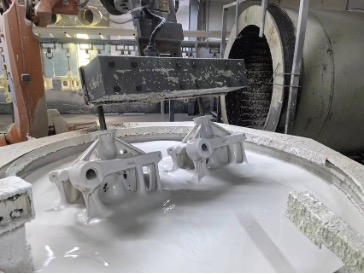
Surface finish sits inside the process name for a reason. In investment casting, the ceramic shell cavity is a direct negative of the wax pattern, so surface detail on the pattern is reproduced in the casting. That is also why shell making, wax injection and dewaxing are quality-critical stages rather than preparatory steps.
3. Part geometry and size fit
Investment casting is suitable for small to medium-sized complex parts, and is especially suited to stainless steel and other high-alloy steels. Shell mold casting is well suited to medium-sized steel castings. Resin sand casting is more suitable for large castings weighing tens of kilograms or more.
This is the cleanest dividing line in the whole comparison. If the part is large and heavy, the sand-based route is normally the starting point, not a compromise. If the part is small, geometrically complex and functionally critical, investment casting is the route that protects the drawing intent.

4. Tooling approach
Investment casting tooling is built around a wax pattern and a ceramic shell, produced through mould making, casting, heat treatment, machining and inspection as one integrated custom manufacturing flow. Resin sand casting is the lowest-barrier route on tooling: it requires lower tooling investment. For shell mold casting, the reviewed process facts do not quantify the tooling position, so it should be assessed against pattern and shell tooling cost amortised over the planned production run.
Tooling is where early-stage projects most often misjudge cost. A low tooling number on a route that cannot hold the drawing converts directly into rework, sorting and dimensional concession requests later in the programme.
5. Order volume fit
Shell mold casting is well suited to medium- to high-volume production of medium-sized steel castings. Resin sand casting suits large castings in the tens-of-kilograms range and above. Investment casting in a custom-to-drawing foundry typically runs as a combination of batch production and order-based customisation, with rapid sample development alongside volume supply — which means the route is not limited to one volume band, but the tolerance CT6/CT8 choice has to be made per project.
6. Material compatibility and process variants
Investment casting covers carbon steel, alloy steel, stainless steel and ductile iron, with specific grades confirmed by the customer. Within investment casting there are two production families: silica sol investment casting and silica sol composite investment casting, alongside the water glass process. The market data supports the direction of travel here — silica sol held 54.3% of process share in 2025 versus 32.1% for water glass, on precision and surface finish grounds.
Shell mold casting is described in the reviewed facts as suited to steel castings. Material suitability for resin sand casting is not specified in the reviewed facts and should be confirmed with the supplier against the drawing's required grade.
7. Certification and compliance constraints
Compliance is not a tie-breaker in this comparison — it is a gate. Automotive programmes require IATF 16949:2016, the critical quality management system requirement for suppliers serving the automotive supply chain. Suppliers may additionally hold ISO 9001:2015 for quality management, ISO 14001:2015 for environmental management and ISO 45001:2018 for occupational health and safety management.
A buyer comparing three routes should compare certificates at the same time, because a process capability claim is only reviewable when the quality system behind it is identified. Certification numbers, issuing bodies, scope and validity should all be recorded in the supplier file.
Comparison Table: Three Casting Routes Side by Side
| Criterion | Investment Casting (Lost-Wax) | Shell Mold Casting | Resin Sand Casting |
|---|---|---|---|
| Dimensional accuracy | Highest of the three routes; tolerance class CT6 for silica sol, CT8 for silica sol composite; machining to 0.01 mm available | Good dimensional stability | Lower dimensional accuracy |
| Surface finish | Best surface finish; Ra 6.4–12.5 μm depending on process and post-treatment | Not stated in reviewed process facts — confirm with samples | Generally rougher surface finish |
| Part size and weight fit | Small to medium-sized parts | Medium-sized steel castings | Large castings of tens of kilograms or more |
| Geometry complexity fit | Complex-shaped, high-precision small-to-medium parts | Suited to medium-sized steel castings in volume production | Suits heavier components with less demanding dimensional requirements |
| Tooling approach | Wax pattern plus ceramic shell; mould making is part of the integrated casting-to-inspection flow | Not quantified in reviewed process facts; assess against planned run length | Requires lower tooling investment |
| Order volume fit | Batch production combined with order-based customisation; rapid sample development supported | Medium- to high-volume production | Large castings, tens of kilograms and above |
| Cost position | Relatively high cost | Not stated in reviewed process facts | Lower tooling investment |
| Material fit | Especially suited to stainless steel and other high-alloy steels; also carbon steel, alloy steel, ductile iron | Steel castings | Not specified in reviewed process facts |
| Typical best-fit parts | Valve bodies, mechanical parts, structural components; model designations include Pipe Elbow, Clevis Bracket, Yoke, Gearbox Housing, Transmission Housing, Mounting Bracket and Link Arm | Medium-sized steel castings in medium-to-high volume | Large, heavier components with relaxed tolerance and finish requirements |
Step-by-Step Breakdown: Running the Comparison on Your Own Part
- Extract the hard constraints from the drawing. Separate functional tolerances from cosmetic or reference dimensions. Only functional tolerances should drive the process decision.
- Classify the part band. Small-to-medium complex part points to investment casting; medium-sized steel casting in volume points to shell mold; large part in the tens of kilograms or more points to resin sand.
- Match the tolerance class to the process. If CT6 is required, silica sol investment casting is the reference; if CT8 is acceptable, silica sol composite investment casting becomes viable.
- Set the surface requirement explicitly. State the target Ra and confirm whether the as-cast surface is acceptable or whether post-treatment and machining are needed.
- Decide on machining integration. For features outside casting capability, plan machining to 0.01 mm as part of the same manufacturing flow rather than as a separate supplier step.
- Check tooling against volume. Weigh tooling investment against annual volume; the lowest tooling number is not automatically the lowest total cost.
- Verify compliance and evidence before award. Collect the certificate numbers, scopes and validity dates, and require dimensional, material and mechanical verification data with the sample.
Use Cases: Where Each Route Earns Its Place
The application industries in the reviewed facts are construction machinery, agricultural machinery, mining, automotive, valve manufacturing and general machinery components. Within that set, investment casting is positioned for structural components, mechanical parts and valve bodies under various operating conditions, with exact environments specified by the customer.
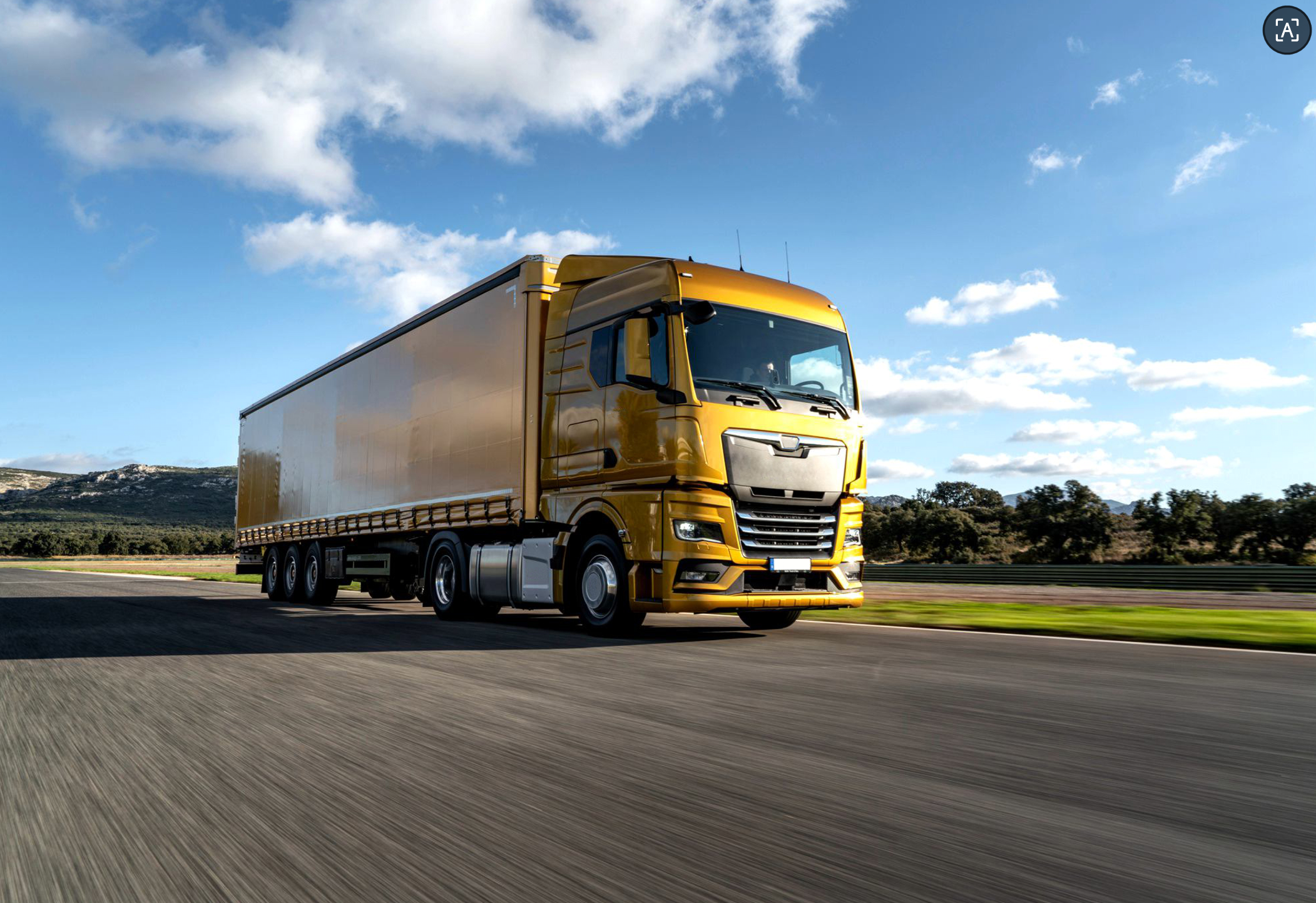
A representative case is an automotive parts OEM in the United States supplying truck axle system components. The engagement covered 1000 tons over a 30-year supply relationship, and the reported result is stable operation, with casting appearance, dimensional accuracy and mechanical properties meeting the customer's drawing requirements. That combination — appearance plus dimensional accuracy plus mechanical properties — is precisely the bundle that pushes a part toward investment casting rather than a sand-based route.
Where resin sand casting remains adequate: large housings, heavy frames and non-critical structural parts weighing tens of kilograms or more, where dimensional tolerance is relaxed and surface finish is not a functional requirement. Shell mold casting remains a reasonable choice where a medium-sized steel casting is needed in medium-to-high volume and good dimensional stability is the priority.
Verification: How Accuracy and Integrity Get Proven
Process claims only matter if they can be verified. Comprehensive inspection and testing equipment is what allows reliable verification of dimensions, material composition, mechanical properties and product quality. In a precision casting supply chain, that means spectrometer analysis for material composition, X-ray and ultrasonic testing for internal integrity, hardness and tensile testing for mechanical properties, and CMM dimensional inspection for geometry.

For buyers, the practical test is whether the proposed inspection plan maps to the drawing's critical characteristics. A supplier who can run first-article dimensional reports, NDT and mechanical testing in-house shortens the loop between a non-conformance and a corrective answer.
How WAYSCAN METAL PRODUCTS CO., LTD Fits the Precision Route
WAYSCAN METAL PRODUCTS CO., LTD is a precision casting manufacturer established in 1991, operating a 46,000 m² production base in Ninghai, Ningbo, China, with over 500 employees including more than 20 senior engineering and technical personnel. The company produces composite process and silica sol precision castings in stainless steel, carbon steel and alloy steel, and runs machining workshops alongside its inspection equipment.
On the process side, the company invested in composite process precision casting in 2020 to replace its original water glass process precision casting, improving production efficiency and reducing environmental impact — a move consistent with the market shift toward silica sol and composite routes. Customisation is by customer drawing across size, geometry, material, surface and heat treatment, with rapid no-mould samples supported by 3D printing. Monthly capacity is 1500 tons, minimum order quantity is 100 kg, and standard lead time is 30–60 days. Export markets include the USA, Japan, Canada, Germany, Korea and Australia.
The integrated flow covers mould making, casting, heat treatment, machining and inspection, so a part that needs CT6 casting tolerance plus 0.01 mm machining can be sourced as one delivery rather than coordinated across two vendors. Quality control includes spectrometer, X-ray, ultrasonic, hardness and tensile testing, and CMM dimensional inspection.
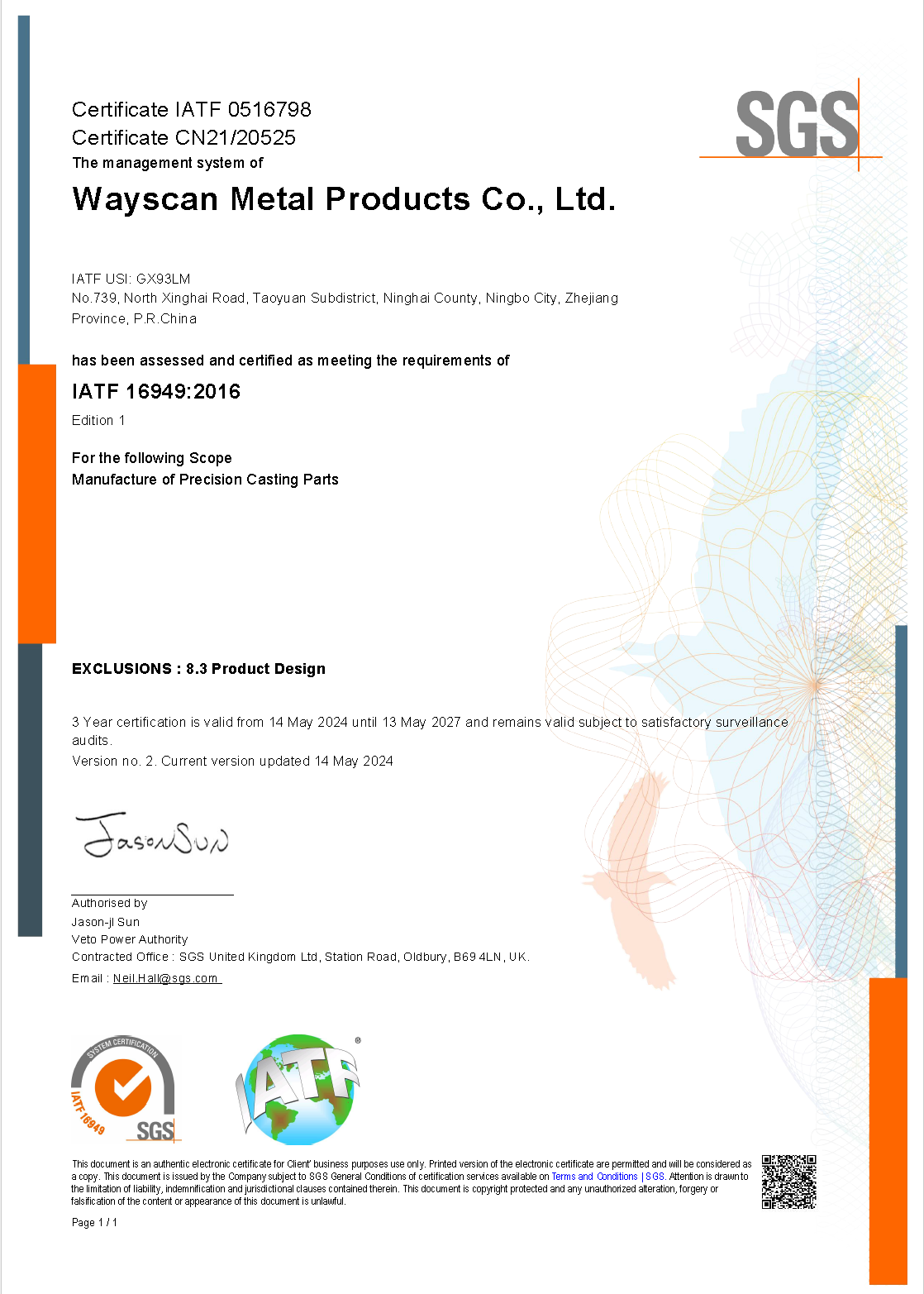
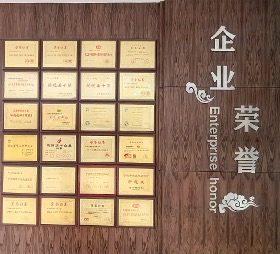
Certification status as documented: ISO 9001:2015 Quality Management System (certificate number 02426Q00625R401, issued by Shenzhen Universal Certification Centre Co., Ltd. (UCC), scope covering the production of steel casting, valid 2026-05-21 to 2029-05-20); IATF 16949:2016 Automotive Quality Management System (certificate number IATF 0516798, issued by SGS United Kingdom Ltd., scope covering the manufacture of precision casting parts, issued 2024-05-14, expiring 2027-05-13); ISO 14001:2015 Environmental Management System (certificate number 02426E00394R401, issued by UCC); and ISO 45001:2018 Occupational Health and Safety Management System (certificate number 02426S00381R101, issued by UCC). The company has also been recognised by the China Foundry Association and regional foundry associations, and holds green-factory and water-saving factory designations.
Which Route Fits Which Part: A Short Selection List
- Valve bodies, pipe elbows and fittings: investment casting — small to medium size, pressure-relevant geometry, surface and dimensional control required.
- Mechanical parts such as yokes, link arms and mounting brackets: investment casting — repeated geometry, tolerance-driven fit, often stainless or alloy steel.
- Gearbox and transmission housings, structural components: evaluate investment casting where wall sections and mounting interfaces are tolerance-critical; evaluate shell mold casting where the casting is medium-sized and volumes are medium-to-high.
- Large housings, heavy frames and thick-section components in the tens of kilograms or more: resin sand casting, where lower tooling investment matters and dimensional tolerance is relaxed.
- Early-stage prototype or pre-production samples: investment casting with 3D-printed pattern support, so the geometry can be validated before tooling commitment.
Frequently Asked Questions
Which certifications should a buyer verify before approving an investment casting supplier?
Verify the quality management system first, then the environmental and safety systems. For automotive supply chains, IATF 16949:2016 is the critical quality management system requirement. WAYSCAN METAL PRODUCTS CO., LTD holds IATF 16949:2016 (certificate number IATF 0516798, issued by SGS United Kingdom Ltd., covering the manufacture of precision casting parts, valid until 2027-05-13), ISO 9001:2015 (certificate number 02426Q00625R401, issued by UCC, scope covering the production of steel casting), ISO 14001:2015 (certificate number 02426E00394R401) and ISO 45001:2018 (certificate number 02426S00381R101). Record scope and validity dates, not just certificate names.
What tolerance and surface finish can investment casting realistically hold?
For silica sol investment casting the produced tolerance class is CT6; for silica sol composite investment casting it is CT8, with machining tolerance of 0.01 mm available for features that need it. Surface roughness is in the Ra 6.4–12.5 μm range depending on casting process and post-treatment. Shell mold casting provides good dimensional stability, and resin sand casting generally provides lower dimensional accuracy and a rougher surface finish — which is why large, heavy parts with relaxed tolerances are usually routed to sand-based processes.
How should cost be compared across investment casting, shell mold and resin sand casting?
Compare the constraint set rather than the process name. Investment casting is relatively high cost, and that cost is justified where highest dimensional accuracy, best surface finish and complex geometry are required. Resin sand casting requires lower tooling investment and suits large castings of tens of kilograms or more, where dimensional requirements are less demanding. Shell mold casting is well suited to medium-to-high volume production of medium-sized steel castings. On commercial terms, WAYSCAN METAL PRODUCTS CO., LTD quotes a 100 kg minimum order quantity with a monthly capacity of 1500 tons, so tooling and unit cost can be evaluated against a realistic annual volume rather than a single trial order.
Can the process be validated with a sample before committing to tooling?
Yes. Customisation is performed against customer drawings for size, geometry, material, surface and heat treatment, and rapid no-mould samples are supported via 3D printing, which allows geometry and fit to be checked before production tooling is committed. Sample and custom production both require the customer to specify the applicable certifications, material grades and surface treatment requirements in advance, so that the sample reflects the production specification.
What lead time and order volume should be planned for an investment casting programme?
Plan on a 30–60 day lead time, a 100 kg minimum order quantity and a monthly capacity of 1500 tons, with supply experience across the USA, Japan, Canada, Germany, Korea and Australia. Technical support and quality tracking continue after delivery, with specific warranty and liability terms agreed in the contract. To start a comparison on your own part, send the drawing and constraint list to sales@nb-casting.com or call +86-574-65273750.
Next Step: Test the Route Against Your Drawing
If your part sits in the small-to-medium, complex-geometry band and your drawing carries functional tolerances, investment casting is the route to evaluate first. WAYSCAN METAL PRODUCTS CO., LTD can review your drawing, confirm the suitable process route — silica sol, silica sol composite or an integrated casting-plus-machining flow — and quote against your volume.
Website: www.wayscan.com | Email: sales@nb-casting.com | Tel: +86-574-65273750
Download the full company presentation and capability brochure: Wayscan Metal Products Co., Ltd. — Presentation (PDF)
Conclusion
Investment casting, shell mold casting and resin sand casting are not competing answers to the same question. Investment casting is the route for small to medium-sized complex parts where the highest dimensional accuracy, the best surface finish and high-alloy material performance are required — at a relatively higher cost. Shell mold casting serves medium-sized steel castings at medium-to-high volume with good dimensional stability. Resin sand casting serves large castings of tens of kilograms or more with lower tooling investment and less demanding dimensional requirements.
The buyer's task is to map the drawing's functional constraints onto the right route, verify the compliance gate behind it, and confirm that the tolerance class, surface requirement and inspection plan are all stated before award. Done in that order, the process choice stops being a debate about reputation and becomes a documented engineering decision.