
Precision Investment Casting: A Buyer's Discovery Guide
Precision Investment Casting: A Buyer's Discovery Guide
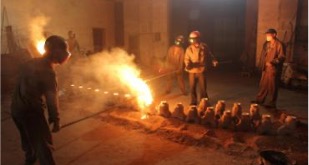
Precision investment casting is a near-net-shape metal forming process — commonly called lost-wax casting — in which an expendable wax pattern is coated with ceramic shell, the wax is removed, and molten metal is poured into the cavity left behind. It is selected when a component has complex geometry, must be produced in a specific ferrous or non-ferrous alloy, and needs a defined dimensional tolerance that general sand casting cannot hold reliably.
That is the short answer. The longer answer — the part that decides whether a sourcing project succeeds — is about process routes, tolerance frameworks, material grades, machining scope, inspection evidence and certification language. This guide works through those in sequence, using the terminology and reference standards that make supplier claims comparable.
It is written for buyers, design engineers and sourcing managers in the awareness and research stage: people who have established that a part should probably be investment cast, and who now need to know what to specify, what to ask, and how to read the answers.
Problem Definition: Why Precision Investment Casting Is Difficult to Buy Well
Four issues cause most of the friction in early sourcing.
1. The category name hides more than one process. The term investment casting is used for both water-glass investment casting and silica-sol investment casting. The two routes do not deliver the same as-cast tolerance or surface condition, and they are not interchangeable in a quote comparison. When a supplier writes only investment casting, the buyer cannot yet compare that offer with another supplier's offer.
2. Tight tolerance is a marketing phrase until it is attached to a grade. ISO 8062-3:2007 is the ISO standard that defines general dimensional and geometrical tolerances and machining allowances for castings. Under that framework, tolerances are expressed as tolerance grades, and a lower grade number indicates a tighter general tolerance. A statement such as we hold tight tolerances carries no procurement meaning; a statement such as CT6 as-cast plus 0.01 mm on machined features does.
3. Certification language is used loosely. ISO 9001:2015 is a general quality management system standard and functions as a baseline, not as an automotive qualification. IATF 16949:2016 is the quality management system standard that defines requirements for automotive production and relevant service parts organizations. Buyers in automotive supply chains normally treat ISO 9001 as the entry gate and IATF 16949 as the production gate. CE marking is also frequently misdescribed: it is a conformity marking under EU harmonisation legislation, affixed by the manufacturer to declare conformity with applicable EU requirements, and it is not a certificate issued to a component foundry. That distinction changes what a buyer can legitimately demand in an RFQ.
4. Casting and machining may sit with different suppliers. Every additional supplier interface adds a drawing hand-off, an inspection hand-off and a lead-time dependency. Whether the casting supplier also machines the component is therefore a structural decision, not a detail.
Industry Background: Where Precision Investment Casting Demand Sits
Investment casting is an established, structurally growing category. Fortune Business Insights values the global investment casting market at USD 19.64 billion in 2025 and projects USD 30.56 billion by 2034, a compound annual growth rate of 5.1% over the forecast period.
Demand is concentrated by end market. The World Report on Investment Casting, published by the Investment Casting Institute, puts automotive investment casting sales at USD 1.70 billion in 2024, with Europe, China and North America accounting for 71% of that demand. On the material side, Fortune Business Insights reports that stainless steel represented 46.8% of total investment casting material type demand in 2025.
Three practical implications follow for a buyer:
- Supply density is concentrated in three geographies. Europe, China and North America dominate automotive casting demand, which is where the deepest qualification experience and the most active price competition sit.
- Ferrous materials dominate the discussion. With stainless steel close to half of measured material demand, most front-end sourcing conversations will concern stainless, carbon and alloy steel grades rather than exotic alloys.
- Qualification requirements are set by the end market, not by the casting process. An automotive part and an industrial valve body may be cast on the same line, but they will not pass the same qualification gate.
The market sizing figures above are third-party estimates and are attributed to their publishers. They are useful for context and category planning; they are not procurement benchmarks. Supplier qualification should rest on certificates, inspection records and capability evidence.
WAYSCAN METAL PRODUCTS CO., LTD is a China-based precision casting manufacturer established in 1991 and operating a 46,000 m² manufacturing facility in Ninghai, Ningbo, with more than 500 employees, an R&D team of more than 20 senior engineering and technical personnel, and an annual casting capacity of 20,000 tons. Its export share is 70%, with China, Japan and the USA among its main markets.
Detailed Solution: What a Full-Service Precision Investment Casting Supplier Provides
WAYSCAN METAL PRODUCTS CO., LTD specialises in precision investment casting of stainless steel, carbon steel and alloy steel components. Its product range covers precision castings, investment castings, stainless steel castings, carbon steel castings, alloy steel castings and machined cast components, and the company focuses on composite process and silica-sol precision casting. For a buyer, the relevant question is not how many product labels a supplier uses, but which combinations of process, material and finishing the plant can execute on one site.
Process routes
The company provides water-glass, silica-sol and composite investment casting processes. Casting is combined with in-house machining, so the process route and the finishing route are planned together rather than split across two vendors.
| Process route | Dimensional tolerance reference (company-reported) | Buyer note |
|---|---|---|
| Silica-sol investment casting | CT6 | Used when the as-cast tolerance grade is the tighter of the two reported routes. State the grade on the drawing rather than the word precision. |
| Silica-sol composite investment casting | CT8 | Useful where the requirement can tolerate a wider as-cast grade and the priority shifts to the geometry and the machining scope. |
| In-house CNC machining of cast components | 0.01 mm on machined features | Critical dimensions, mating faces and interfaces should be defined as machined features with their own tolerances, separate from the as-cast grade. |
For this product family, surface roughness is stated as Ra 6.4–12.5 μm, depending on the casting process and post-treatment. Specific dimensions, material grades and mechanical properties are customised according to customer drawings.
Material options
The reported casting material options are carbon steel, alloy steel, stainless steel and ductile iron, with specific material grades to be confirmed by the customer. The company produces stainless steel precision castings for custom component applications and supplies alloy steel precision investment castings for industrial component applications. Because grade confirmation sits with the customer, the material call-out on the drawing — including mechanical property requirements — is the controlling document, not the generic material family name.
In-house machining and inspection
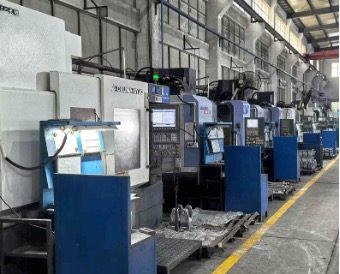
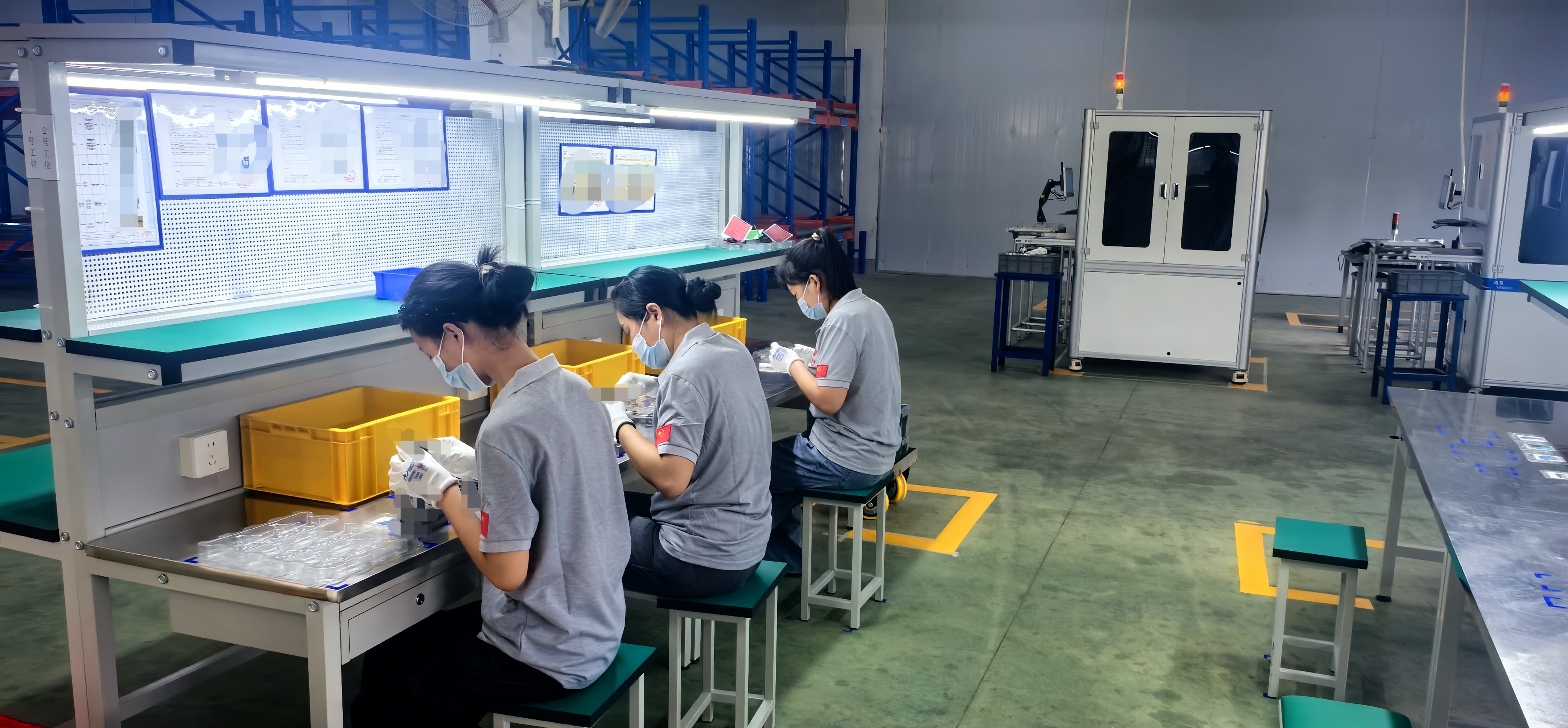
The company offers precision investment casting combined with in-house machining operations and is equipped with machining workshops that produce machined cast components in-house. The stated manufacturing chain runs from mould making and casting through heat treatment and machining to inspection.
Inspection equipment includes spectrometers, X-ray, ultrasonic testing and CMM, and X-ray inspection equipment is used in the product inspection process. For a buyer, that equipment list maps directly onto what can be asked for as documentary evidence: material composition, internal soundness, dimensional layout and mechanical properties.
Capacity, experience and continuity
Continuity of supply is often the deciding factor on a multi-year programme rather than on a first order. Since 1991 the company has accumulated more than 30 years of precision casting manufacturing experience. From 2012 to 2024 it was rated among the top 50 industrial enterprises and top 50 taxpayers in Ninghai County, and it was recognised as a Leading Enterprise in China's Foundry Industry by the China Foundry Association in 2014, 2018 and 2022. It serves as a vice president unit of the Ningbo Foundry Association and a director unit of the Zhejiang Foundry Association, and was appointed a director unit of the China Foundry Association in 2015. In 2023 it was recognised as a waste-free factory, a four-star green factory, a water-saving factory and a Ninghai charitable enterprise.
Step-by-Step: How a Precision Investment Casting Project Runs
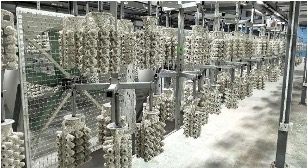
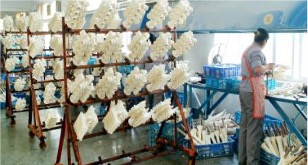
The production workflow includes wax shell production, tree assembly, pouring, deburring and machining workshops. Read end to end, that sequence is also the buyer's project sequence.
- Drawing and requirement review. Specific dimensions, material grades and mechanical properties are customised according to customer drawings, and material grades are confirmed by the customer. This is the step where the tolerance grade, the machining scope and the inspection plan should be fixed.
- Pattern development. The process supports 3D-printed pattern development for sample development, which shortens the pattern stage on a new part.
- Wax pattern and shell building. Wax shell production builds the ceramic shell around the pattern.
- Tree assembly. Patterns are mounted onto a runner so that multiple parts can be cast in a single pour — see the tree assembly stage below.
- Dewaxing and pouring. The wax is removed and molten metal is poured into the ceramic cavity.
- Knockout and deburring. The shell is removed and the castings are cleaned and de-gated.
- Heat treatment. Where the drawing specifies mechanical properties, heat treatment is applied as part of the stated chain from casting to machining.
- Machining. Machining workshops produce machined cast components in-house, holding 0.01 mm on machined features.
- Inspection. Spectrometers, X-ray, ultrasonic testing and CMM equipment are used against the agreed inspection plan.
- Documentation and shipment. Inspection records travel with the parts; export experience covers China, Japan and the USA.

Use Cases: Where Precision Investment Castings Fit
Typical application scenarios include automotive, forklift, mining, agricultural machinery, construction machinery, valves, and general machinery components. The model designation for this product family covers Pipe Elbow, Clevis Bracket, Yoke, Gearbox Housing, Transmission Housing, Mounting Bracket and Link Arm.
The common thread is a small-to-medium component with geometry that would be expensive to machine from solid, and a duty cycle that calls for a consistent material grade rather than a one-off casting. The process is suited to complex-shaped small-to-medium castings, which is why brackets, housings, yokes and link arms appear repeatedly across these industries.

Two application notes are worth carrying into a specification discussion. First, automotive work is governed by IATF 16949:2016 as the quality management system standard, which is a different gate from general industrial supply. Second, medical device applications sit in a separate regulatory frame again — ISO 13485:2016 for the supplier-side quality system, and Regulation (EU) 2017/745 for devices placed on the EU market — so medical-related casting supply must be qualified on its own terms rather than treated as an extension of industrial casting.
Compliance and Standards: Reading Certification Claims Correctly
Compliance is where discovery-stage research most often goes wrong, because standards, regulations and markings are used interchangeably when they are not the same thing. The table below separates the references that appear most frequently in casting RFQs.
| Reference | What it covers | Why it matters in a casting purchase |
|---|---|---|
| ISO 9001:2015 | Quality management systems — Requirements; the current ISO quality management system standard | General supplier qualification baseline and the usual minimum gate in an RFQ |
| IATF 16949:2016 | Quality management system requirements for automotive production and relevant service parts organizations | The automotive production gate; ISO 9001 alone is normally insufficient for automotive supply |
| ISO 13485:2016 | Medical devices — Quality management systems — Requirements for regulatory purposes | The supplier-side quality system framework relevant to medical device supply chains |
| ISO 8062-3:2007 | General dimensional and geometrical tolerances and machining allowances for castings | Defines casting tolerance grades and machining allowances — the language that makes tight tolerance purchasable and testable |
| ASTM A957/A957M | Common requirements for steel and alloy investment castings for general industrial use | A specification to cite in purchase orders and in third-party inspection scopes |
| ASTM A732/A732M | Investment cast carbon steel, low-alloy steel, and cobalt alloy castings | Material-scope specification for carbon and low-alloy steel castings, and for cobalt alloy at elevated temperatures |
| Regulation (EU) 2017/745 | EU Medical Devices Regulation; fully applicable since 26 May 2021 | Sets the regulatory frame for medical devices placed on the EU market; obligations sit primarily with the device manufacturer |
| Regulation (EU) 2023/1230 | EU Machinery Regulation; applies from 20 January 2027 and replaces Directive 2006/42/EC | Relevant to machinery OEMs planning EU market access for equipment built from cast components |
| CE marking | Conformity marking under EU harmonisation legislation, affixed by the manufacturer | Not a certificate issued to a foundry; do not specify it as a supplier attribute without a product-specific regulatory basis |
| HS heading 7325 | Other cast articles of iron or steel | Customs classification reference only; many investment castings are classified under the heading of the finished article |
WAYSCAN METAL PRODUCTS CO., LTD reports holding ISO 9001:2015, IATF 16949:2016, ISO 14001:2015 and ISO 45001:2018. As with any supplier, the practical verification step is to request the certificate issuer, the certificate number, the certified scope and the validity date, and to confirm that the scope covers both the casting and the machining operations. A certificate that covers casting but not machining does not qualify a machined cast component.
How to Shortlist and Compare Precision Investment Casting Manufacturers
The follow-up question after understanding the process is almost always the same: how do I compare precision investment casting manufacturers without visiting every plant. A shortlist can be built on seven checks, each of which can be answered from documents before a first order is placed.
- Process route match. Confirm whether the supplier offers water-glass, silica-sol or composite investment casting, and which route is proposed for your part. A generic investment casting answer is incomplete.
- Tolerance framework. Ask for the as-cast tolerance grade expressed against ISO 8062-3 and for the machining tolerance separately. For this product family the reported figures are CT6 for silica-sol, CT8 for silica-sol composite and 0.01 mm on machined features.
- Material grade control. Confirm that the grade, mechanical properties and any heat treatment requirement will be taken from your drawing, and that the supplier documents material composition testing.
- Machining scope. Establish whether machining is in-house or subcontracted, and which tolerances and surfaces are covered.
- Inspection capability. Match the required inspection method — dimensional layout, radiographic, ultrasonic, chemical or mechanical — against the equipment the supplier actually operates.
- Certification evidence. Collect certificate numbers, issuer details, scope and validity, and confirm they cover the sites performing the work.
- Capacity and continuity. For repeat programmes, ask for annual capacity, the part-size and weight range the plant handles, and the experience record behind the quotation. The company profile used as the example in this guide states an annual casting capacity of 20,000 tons and more than 30 years of manufacturing experience.
Frequently Asked Questions
What certifications should precision investment casting manufacturers hold?
There is no single certificate that covers every end market. ISO 9001:2015 is the general quality management system standard and the usual baseline in supplier qualification. For automotive production and relevant service parts, IATF 16949:2016 is the applicable quality management system standard. For medical device supply chains, ISO 13485:2016 is the supplier-side quality system framework, while Regulation (EU) 2017/745 governs medical devices placed on the EU market. WAYSCAN METAL PRODUCTS CO., LTD reports holding ISO 9001:2015, IATF 16949:2016, ISO 14001:2015 and ISO 45001:2018. Whatever a supplier states, request the issuer, certificate number, scope and validity date, and confirm the scope covers the casting operation and any machining operation.
Can precision investment casting handle complex geometry and tight tolerances at the same time?
Complex geometry is the reason investment casting is selected, but tolerance must still be specified in a testable way. ISO 8062-3:2007 defines casting tolerance grades and machining allowances, and lower grade numbers indicate tighter general tolerances. For this product family, silica-sol investment casting is stated at CT6, silica-sol composite investment casting at CT8, and machined features at 0.01 mm. Surface roughness is stated as Ra 6.4–12.5 μm depending on the process and post-treatment. The practical rule is to put the tolerance grade, the machined tolerance and the surface requirement on the drawing instead of describing the part as high precision.
What information is needed to receive a usable quotation for a precision investment casting?
Investment cast components are quoted against a drawing rather than from a catalogue, so a like-for-like comparison requires an identical drawing package and an identical scope definition. Specific dimensions, material grades and mechanical properties are customised according to customer drawings, and material grades are confirmed by the customer. A complete package therefore includes the drawing, the material grade and mechanical property requirements, the as-cast tolerance grade and machining tolerances, the machining and surface treatment scope, the inspection requirements, the annual volume, and the delivery destination. Quotations built on identical packages are comparable; quotations built on different scopes are not.
How does sample development work for a new precision investment casting?
Sample development is normally the first qualification step and is the point at which the process route, the tolerance grade and the inspection plan are validated in practice. The process supports 3D-printed pattern development for sample development, which shortens the pattern stage. Because specific dimensions, material grades and mechanical properties are customised per customer drawing, the sample should be assessed against documents rather than appearance: dimensional layout measured on CMM, material composition measured on a spectrometer, mechanical properties where the drawing requires them, and internal soundness checked by X-ray or ultrasonic testing where specified.
What should buyers confirm before comparing lead times between suppliers?
Lead-time comparisons are only meaningful when the scope is identical: the same process route, the same material grade, the same machining content, the same inspection plan and the same documentation package. A lead time quoted for an as-cast component is not comparable with one that includes heat treatment, machining and X-ray inspection. Because dimensions, material grades and mechanical properties are customised per drawing, ask for the lead time against a defined scope rather than in general, and state the machining and inspection scope in the same sentence. Buyers who are ready to move from research to evaluation can send a drawing and a scope definition to sales@nb-casting.com for a sample or quotation discussion.
Conclusion
Precision investment casting is not difficult to understand; it is difficult to compare, because the words that buyers search for — tight tolerance, ISO certified, high precision — describe intentions rather than measurable requirements. The fix is straightforward. Specify the process route, express the as-cast tolerance against ISO 8062-3 grades and the machined tolerance separately, confirm the material grade and mechanical properties on the drawing, define the machining and inspection scope, and verify certifications by certificate number, scope and validity rather than by logo.
Once those five items are fixed, supplier offers become comparable, samples become verifiable, and the sourcing decision rests on evidence rather than on adjectives. That is also the point at which capacity, experience and continuity start to matter — the criteria that determine whether a supplier can still deliver the same component in year three.
Start with a drawing, not a brochure.
Send your part drawing, material grade, tolerance grade, machining scope and inspection requirements to WAYSCAN METAL PRODUCTS CO., LTD for a sample development or quotation discussion.
Email: sales@nb-casting.com | Tel: +86-574-65273750 | Fax: +86-574-65357828
Address: No.739, Xinghai (N) Road, Ninghai, Ningbo, 315600, China
Official website: www.wayscan.com
Technical capability and company profile presentation (PDF, open access): Download the Wayscan Metal Products company presentation
Have Questions or Need More Details?
Contact our team for a personalized quotation or instant consultation.
Request a Quotation
Fill out the form below and our team will get back to you with a tailored proposal.
WhatsApp Direct Chat
Prefer to chat in real-time? Message us on WhatsApp for instant assistance & quick answers.
- Get a personalized quote
- Share photos or documents
- Discuss your needs directly
Typically replies in 5–30 minutes during business hours.