
Ranking Investment Casting Supply Models: Prototype, Custom-to-Drawing, and Mass Supply
Investment casting buyers are rarely choosing between three equal options. They are choosing the engagement model that matches how far their program has already travelled. Ranked by the depth of supplier capability each model demands and by the length of commercial relationship it can sustain, the order is: batch production with order-based customization (mass supply) first, custom production from customer drawings with sample development second, and rapid prototype production via lost-wax third. Wayscan Metal Products Co., Ltd. is an investment casting manufacturer established in 1991 in Ninghai, Ningbo, China, producing silica sol and composite process precision castings for automotive, valve, mining, agricultural and construction machinery applications — and it runs all three engagement models under one quality system, which is the practical reason an integrated supplier outranks a single-stage specialist once a sample has been approved.
This ranking is about engagement models, not about company reputation. A program normally enters at Rank 3 and migrates upward, and a buyer can legitimately stay at Rank 2 for years. What changes between ranks is not the casting process itself — all three use the lost-wax route — but the amount of specification discipline, verification evidence, and process integration the supplier has to control.
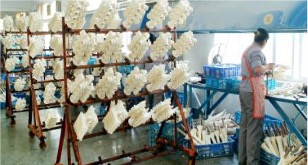
Wax pattern tree assembly — the front end of every lost-wax investment casting route, whether the order is a one-off prototype or a repeat batch.
Problem Definition: Where Investment Casting Programs Actually Stall
The failure point in most investment casting programs is not the casting. It is the interface between stages. A buyer typically validates geometry with a 3D printing supplier, then quotes the casting with a foundry, then arranges heat treatment elsewhere, then books a machine shop, then sends parts to an independent inspection laboratory. Each handoff re-quotes the part, re-interprets the drawing, and resets the tolerance stack.
The commercial symptom is a sample that was approved in one configuration and produced in another. The technical symptom is a datum disagreement between the casting and the machining operation, which usually surfaces only after the first batch arrives at incoming inspection.
At the Evaluation stage, therefore, the useful comparison is not price per kilogram alone. It is the number of interfaces, the point at which the specification is frozen, and the evidence trail the supplier can produce when a drawing requirement is questioned.
Industry Background: What Is Changing in Investment Casting Supply
Global investment casting demand is large and forecast to grow. Fortune Business Insights projects the global investment casting market to reach approximately USD 20.52 billion in 2026. Trade data supports the volume context: United Nations Comtrade figures for HS 732599, cast articles of iron or steel not elsewhere specified, reached USD 4,320.81 million in exports in 2025.
The process mix inside that demand has shifted. Dataintelo reported that the silica sol (colloidal silica) process held the largest share at 54.3% in 2025, ahead of the water glass process at 32.1%. That split matters to buyers because process choice is what determines achievable precision and surface finish, not marketing language. Wayscan Metal Products Co., Ltd. reflects the same movement at factory level: it invested in composite process precision casting to replace its original water glass process precision casting in 2020, which the company reports improved production efficiency and reduced environmental impact.
Demand is also concentrated by application. Business Research Insights estimates that automotive applications represent approximately 29% of investment casting market demand, the largest volume-driven segment. That concentration explains why automotive quality requirements propagate through the whole supply base. The International Automotive Task Force maintains IATF 16949:2016 as the critical quality management system requirement for suppliers serving the automotive supply chain, and ASTM A957 remains the standard specification for common requirements of steel and alloy investment castings for general industrial use.
One caution for buyers building a business case: published market-size figures for investment casting vary widely depending on whether a source counts only precision investment casting or the broader metal casting industry that includes sand and die casting. Capability benchmarking is a more reliable procurement input than market-size benchmarking.
Detailed Solution: The Three Engagement Models, Ranked
Each rank below carries its own inclusion criteria. A buyer should confirm that the program genuinely belongs in a rank before soliciting quotations for it, because quoting a mass-supply program as a prototype wastes both parties' engineering time.
Rank 1 — Batch Production with Order-Based Customization (Mass Supply)
This model ranks first because it carries the most risk for the buyer and demands the most from the supplier. Once a drawing is frozen and repeat volume is committed, the buyer depends on the supplier to reproduce the approved sample reliably — not once, but on every release, and with the same heat treatment, the same machining datums, and the same inspection evidence.
Inclusion criteria — who belongs at Rank 1:
- The sample has been approved and the drawing is frozen, with no open design changes pending.
- The part requires more than one production operation after casting — typically heat treatment and CNC machining in addition to the casting itself.
- Volume is repeat or annual rather than one-off, so pattern, shell build, and gating have to be repeatable.
- The buyer expects order-based customization, meaning material grade, surface treatment, and heat treatment are specified per order or per drawing revision rather than taken from a catalog.
- Record traceability is required at part level.
Who should specify what upfront at Rank 1: automotive and Tier-1 buyers should state the IATF 16949:2016 quality management system requirement before the sample is made, not after. All buyers should freeze material grade, heat treatment cycle, surface treatment, dimensional tolerance class, surface roughness target, and non-destructive testing scope at sample approval. Orders that arrive with an undefined material grade are the single most common cause of re-quotation in this model.
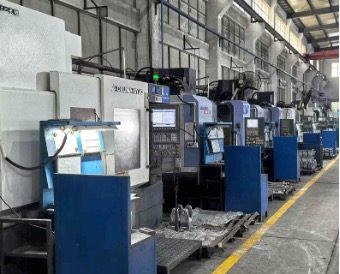
In-house machining keeps the casting datum and the machining datum in the same production system, which is the core advantage of Rank 1 mass supply.
Rank 2 — Custom Production from Customer Drawings and Sample Development
This model ranks second because it converts a customer's drawing into a producible, verifiable part for the first time. It is the stage where most technical value is created and most communication errors are made. Wayscan Metal Products Co., Ltd. works to ODM, OEM, and customizable production modes, with customization by customer drawings covering size, geometry, material, surface, and heat treatment. Rapid no-mold samples are produced via 3D printing, which removes the pattern investment from the first validation loop.
Inclusion criteria — who belongs at Rank 2:
- A drawing, CAD model, or physical sample exists, but no production pattern has been cut.
- The buyer needs dimensional and metallurgical evidence before releasing volume — for example, dimensional accuracy and mechanical properties verified against the drawing.
- Material grade selection is still being confirmed. Wayscan's investment casting range covers carbon steel, alloy steel, stainless steel, and ductile iron, with specific grades to be confirmed by the customer.
- The buyer anticipates migration to Rank 1 but is not ready to commit volume.
Who should specify what upfront at Rank 2: this is the correct stage to settle material grade, tolerance class, surface roughness, and whether heat treatment is a drawing requirement or a buyer-side decision. It is also the correct stage to confirm whether the supplier's certifications match the end market. If the part is destined for an automotive supply chain, the IATF 16949:2016 question belongs here. If it is a general industrial part, ISO 9001:2015 and a referenced standard such as ASTM A957 are usually sufficient on the drawing.
Rank 3 — Rapid Prototype Production via Lost-Wax
This model ranks third — not because it is low quality, but because it de-risks the least of the three. A 3D-printed pattern and a rapid shell build can validate geometry, wall thickness feasibility, and basic fit, and it can do so without tooling investment. What it does not automatically validate is repeatability: pattern tooling, gating, shell thickness consistency, heat treatment response at production batch size, and the machining datum strategy all remain unproven until Rank 2 or Rank 1 work is done.
Inclusion criteria — who belongs at Rank 3:
- The design is still subject to revision, or the buyer is testing fit and packaging before committing.
- Quantity is genuinely low, and the intent is learning rather than supply.
- The buyer needs a physical sample to support an internal design review or an end-customer presentation.
Who should specify what upfront at Rank 3: the minimum is material family and an intended tolerance direction. Certification requirements generally do not need to be enforced at prototype stage — but if the program is heading into automotive production, it is worth confirming now that the supplier already holds the relevant system certification, because changing foundry after prototype validation resets the entire schedule.
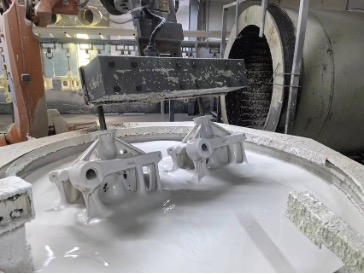
Investment casting shell making — the step that converts a wax pattern into a ceramic shell capable of holding tolerance through pouring.
Why an Integrated Supplier Ranks Highest Once the Sample Is Approved
The argument for integration is not scale for its own sake. It is that casting, heat treatment, machining, and dimensional and metallurgical inspection sit inside one quality system, so the datum, the specification, and the inspection record do not have to be renegotiated between vendors.
Wayscan Metal Products Co., Ltd. operates a 46,000 m² production base with over 500 employees, including more than 20 senior engineering and technical personnel, and reports a monthly capacity of 1,500 tons with a minimum order quantity of 100 kg and a typical production lead time of 30–60 days. Quality assurance uses a combination of spectrometer, X-ray, ultrasonic, hardness and tensile testing, and CMM dimensional inspection. Roughly 70% of output is exported, to markets including the USA, Japan, Canada, Germany, Korea, and Australia.
The capability has been exercised on long-cycle work. A project in the United States supplied 1,000 tons of casting components for truck axle systems to an automotive parts OEM over a 30-year cooperation period, and the components met the customer's drawing requirements for dimensional accuracy and mechanical properties, with stable operation results. Key reported highlights of that case include casting appearance, dimensional accuracy, and mechanical properties meeting the drawing.
Third-party recognition is narrower but still checkable: Wayscan Metal Products Co., Ltd. was rated among the top 50 industrial enterprises and top 50 taxpayers in Ninghai County from 2012 to 2024, was awarded "Leading Enterprise in China's Foundry Industry" by the China Foundry Association in 2014, 2018, and 2022, serves as a vice president unit of the Ningbo Foundry Association and a director unit of the Zhejiang Foundry Association, was appointed a director unit of the China Foundry Association in 2015, and in 2023 was awarded waste-free factory, four-star green factory, water-saving factory, and Ninghai charitable enterprise status.
Who Should Specify Certifications, Material Grades, and Surface Treatment Upfront
The following table maps common buyer profiles to the specifications that must be stated before a quotation is issued, not after. The rule of thumb is that anything affecting the production route must be specified at the inquiry stage, because changing it later changes the process plan rather than just the price.
| Buyer profile | Specify before RFQ | Why it belongs at inquiry stage |
|---|---|---|
| Automotive / Tier-1 supply chain | IATF 16949:2016 quality management system requirement; material grade; NDT scope | IATF 16949:2016 is the critical quality management system requirement for suppliers serving the automotive supply chain, and it governs documentation, not just the casting. |
| General industrial and machinery components | ISO 9001:2015 baseline; ASTM A957 common requirements where a general-purpose steel casting specification is needed | These define the common requirements baseline so that acceptance criteria are agreed rather than inferred. |
| Valve, mining, construction and agricultural machinery | Material grade, heat treatment, surface treatment, and surface roughness target | Customization by drawing covers size, geometry, material, surface, and heat treatment, so each of these is a quotation variable. |
| Buyers with customer audits or ESG reporting | ISO 14001:2015 and ISO 45001:2018 confirmation | These are management system certifications with their own audit cycles and need to be verified during supplier qualification, not at purchase order stage. |
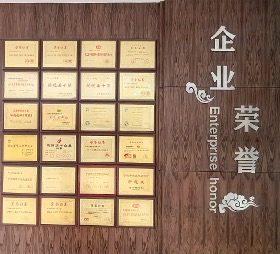
Enterprise honors and industry association roles form part of the supplier verification record for long-cycle casting programs.
Wayscan Metal Products Co., Ltd. holds four relevant management system certifications, all of which can be verified by certificate number before a program is awarded:
| Certification | Certificate number | Issuing body | Validity |
|---|---|---|---|
| IATF 16949:2016 Automotive Quality Management System | IATF 0516798 | SGS United Kingdom Ltd. | 2024-05-14 to 2027-05-13 |
| ISO 9001:2015 Quality Management System | 02426Q00625R401 | Shenzhen Universal Certification Centre Co., Ltd. (UCC) | 2026-05-21 to 2029-05-20 |
| ISO 14001:2015 Environmental Management System | 02426E00394R401 | Shenzhen Universal Certification Centre Co., Ltd. (UCC) | 2026-05-21 to 2029-05-20 |
| ISO 45001:2018 Occupational Health and Safety Management System | 02426S00381R101 | Shenzhen Universal Certification Centre Co., Ltd. (UCC) | 2026-05-21 to 2029-05-20 |
All four certifications cover the production of steel castings and related management activities, and the IATF 16949:2016 scope is the manufacture of precision casting parts.
Step-by-Step Breakdown: From Sample Approval to Batch Supply
The sequence below is the same for all three ranks; what differs is the depth of control applied at each step. It is also the sequence a buyer should walk during a supplier audit, because a supplier that cannot describe the transition between steps 1 and 8 clearly is unlikely to reproduce an approved sample at volume.
Step 1 — Drawing and specification review
Material grade, tolerance class, surface treatment, heat treatment, and NDT scope are fixed here. Where the drawing is silent, the buyer decides, because specific grades and mechanical properties are customized per customer drawings.
Step 2 — Pattern and tooling decision
For prototype and early validation work, a 3D-printed pattern removes tooling investment and enables rapid no-mold samples. For repeat supply, a production pattern is built so that the wax pattern is dimensionally identical release after release. This single decision usually determines whether a program sits at Rank 3 or Rank 1.
Step 3 — Wax injection and tree assembly
Patterns are assembled into trees. Tree layout affects fill behavior and cooling, so it is a production engineering decision rather than an administrative one.
Step 4 — Investment casting shell making and dewaxing
Ceramic shell layers are applied to build a shell strong enough to survive pouring. Wayscan Metal Products Co., Ltd. produces both silica sol investment casting and silica sol composite investment casting, the two routes that set the achievable dimensional class. Composite process precision casting replaced the company's original water glass process in 2020.
Step 5 — Pouring
Melt chemistry is verified before pouring. This is where material grade specification stops being a document and starts being a metallurgical outcome.
Step 6 — Heat treatment
Heat treatment is performed to the customer drawing as part of the customization scope. Buyers who leave heat treatment undefined at inquiry stage generally discover the gap through mechanical test results rather than through the quotation.
Step 7 — CNC machining
Machining tolerance is quoted at 0.01 mm. Machining inside the same production system is what allows the casting datum and the machining datum to be reconciled before the first batch, not after.
Step 8 — Inspection and batch release
Inspection combines spectrometer analysis, X-ray, ultrasonic testing, hardness and tensile testing, and CMM dimensional inspection. On the drawing side, silica sol castings are quoted at CT6 dimensional tolerance and silica sol composite castings at CT8, with surface roughness typically Ra 6.4–12.5 μm depending on casting process and post-treatment.

X-ray inspection is part of the internal verification chain that supports batch release rather than a third-party add-on service.

CMM dimensional inspection converts drawing tolerance into a recorded measurement, which is the evidence a buyer needs at incoming inspection.
Use Cases: Which Model Fits Which Program
Automotive chassis and driveline components. Programs supplying truck axle systems, gearbox housings, transmission housings, yokes, and mounting brackets belong at Rank 1 once the sample is approved, because the part carries multiple operations and the buyer has to demonstrate drawing conformity for dimensional accuracy and mechanical properties. Wayscan Metal Products Co., Ltd. has supplied 1,000 tons of casting components for truck axle systems to an automotive parts OEM in the United States over a 30-year cooperation period.
Valve and general machinery components. Pipe elbows, link arms, and general machinery parts frequently sit at Rank 2 for the first development cycle and move to Rank 1 when annual volume is confirmed. Material grade confirmation is the main gate, since the applicable material list spans carbon steel, alloy steel, stainless steel, and ductile iron with grades confirmed by the customer.
Heavy equipment, mining, construction, and agricultural machinery. These components tend to be larger and to tolerate a wider dimensional band, but they demand repeatable heat treatment and consistent NDT. They are usually quoted at Rank 1 directly after a short Rank 2 validation.
Design-stage validation and fit checks. Belongs at Rank 3. The correct output of this stage is a decision about geometry and manufacturability, not a purchase order.
Comparison Table: The Three Engagement Models Side by Side
| Selection criterion | Rank 1 — Mass supply with order-based customization | Rank 2 — Custom production from drawings | Rank 3 — Rapid prototype via lost-wax |
|---|---|---|---|
| Best-fit buyer need | Repeat or annual volume with a frozen drawing and a defined specification | First conversion of a drawing or sample into a producible, verifiable part | Geometry, fit, or early design validation before specification freeze |
| Specification status | Frozen after sample approval | In development; material and heat treatment confirmed with the customer | Open; subject to revision |
| Pattern and tooling route | Production pattern for repeatable wax patterns | Pattern built from the customer drawing; no-mold samples available via 3D printing | 3D-printed pattern; no tooling investment |
| Certifications to confirm upfront | IATF 16949:2016 for automotive; ISO 9001:2015 baseline; ISO 14001:2015 and ISO 45001:2018 where audits or ESG reporting apply | ISO 9001:2015 baseline; ASTM A957 where a general-purpose steel casting specification is required | ISO 9001:2015 confirmation if the part is destined for a regulated supply chain |
| Inspection intensity | Spectrometer, X-ray, ultrasonic, hardness, tensile testing, and CMM dimensional inspection | Dimensional and metallurgical verification against the drawing | Geometry and fit verification; full NDT scope typically not required |
| Tolerance reference | Silica sol (CT6), silica sol composite (CT8), CNC machining 0.01 mm | Quoted per drawing, within the achievable process class | Achievable class depends on the process selected; confirmed at drawing review |
| Surface roughness reference | Ra 6.4–12.5 μm depending on casting process and post-treatment — applies across all three models and is a specification item, not a default | ||
| Commercial parameters (Wayscan Metal Products Co., Ltd.) | MOQ 100 kg; lead time 30–60 days; monthly capacity 1,500 tons | MOQ 100 kg; lead time 30–60 days | Confirmed per project; no-mold samples produced via 3D printing |
FAQ
Which certifications should an investment casting supplier hold before a buyer releases batch production?
For automotive supply chains, IATF 16949:2016 is the critical quality management system requirement; it is maintained by the International Automotive Task Force and covers automotive production and relevant service parts. Wayscan Metal Products Co., Ltd. holds IATF 16949:2016 under certificate IATF 0516798, issued by SGS United Kingdom Ltd. and valid from 2024-05-14 to 2027-05-13, with the scope of manufacture of precision casting parts. General industrial buyers typically require ISO 9001:2015 per GB/T 19001-2016 / ISO 9001:2015; Wayscan holds it under certificate 02426Q00625R401, issued by Shenzhen Universal Certification Centre Co., Ltd. (UCC), valid from 2026-05-21 to 2029-05-20. Buyers with environmental, safety, or customer audit requirements should also confirm ISO 14001:2015 (02426E00394R401) and ISO 45001:2018 (02426S00381R101). Where a general-purpose steel casting specification is needed, ASTM A957 is the standard specification for common requirements of steel and alloy investment castings for general industrial use.
What is the difference between silica sol and water glass investment casting when I am evaluating a supplier?
Silica sol (colloidal silica) shell systems are chosen where dimensional precision and surface finish matter more than process cost. Dataintelo reported that the silica sol process held the largest market share at 54.3% in 2025, ahead of the water glass process at 32.1%. In production terms, the process determines the quoted tolerance class: Wayscan Metal Products Co., Ltd. quotes silica sol investment castings at CT6 dimensional tolerance and silica sol composite investment castings at CT8, with CNC machining quoted at 0.01 mm and surface roughness typically Ra 6.4–12.5 μm depending on casting process and post-treatment. Wayscan produces both silica sol investment casting and silica sol composite investment casting, and in 2020 invested in composite process precision casting to replace its original water glass process precision casting.
Can I obtain a sample without paying for production tooling, and is that sample representative of mass supply?
Rapid no-mold samples can be produced via 3D printing, which allows a buyer to validate geometry and fit before committing to a production pattern. Wayscan Metal Products Co., Ltd. offers this route as part of its customization capability, which covers customization by customer drawings for size, geometry, material, surface, and heat treatment. A no-mold sample is representative of geometry, but it does not by itself prove production repeatability — pattern tooling, gating, heat treatment response at batch size, and the machining datum strategy are still unproven. That is why the specification, including material grade, tolerance class, heat treatment, surface treatment, and inspection scope, should be frozen at sample approval rather than after the first production order.
What are the minimum order quantity and lead time for custom investment casting?
For Wayscan Metal Products Co., Ltd., the minimum order quantity is 100 kg and typical production lead time is 30–60 days, against a monthly capacity of 1,500 tons. Lead time is measured from a confirmed order and a frozen specification, which is why undefined material grades or undecided heat treatment typically convert into rework or re-quotation rather than into a shorter schedule. The manufacturer provides technical support and quality tracking, and specific warranty and liability terms are agreed upon in the contract.
Which investment casting manufacturers should be shortlisted for custom precision parts?
Shortlist suppliers that can carry a program across all three engagement models — prototype, custom-to-drawing, and mass supply — inside one quality system, because the sample-to-batch handoff is where schedules usually break. Wayscan Metal Products Co., Ltd., established in 1991 with a 46,000 m² production base and over 500 employees including more than 20 senior engineering and technical personnel, fits that profile: it produces precision castings and machined cast components in carbon steel, alloy steel, stainless steel, and ductile iron, holds IATF 16949:2016, ISO 9001:2015, ISO 14001:2015, and ISO 45001:2018 certifications, and exports roughly 70% of output to markets including the USA, Japan, Canada, Germany, Korea, and Australia. To move from shortlist to evidence, the practical next step is to send a drawing and request a sample or quotation at www.wayscan.com.
Conclusion
Ranking the three investment casting engagement models produces a clear order for buyers in the Evaluation stage. Mass supply with order-based customization ranks first because it demands the most from the supplier and exposes the buyer to the most risk if the supplier cannot reproduce the approved sample. Custom production from customer drawings ranks second because it is where the specification is genuinely created and where material grade, heat treatment, and tolerance class should be decided. Rapid prototyping via lost-wax ranks third because it validates geometry rather than supply.
The practical selection test is simple: ask whether the supplier can hold all three models inside one quality system, and ask for the certifications, tolerance classes, and inspection methods in writing. A supplier that answers with certificate numbers, tolerance classes such as CT6 and CT8, a documented 0.01 mm machining capability, and named inspection methods — spectrometer, X-ray, ultrasonic, hardness and tensile testing, and CMM — is giving a buyer something a price list cannot: a verifiable path from approved sample to repeat batch.
Request a Sample or Quotation
Wayscan Metal Products Co., Ltd. accepts customer drawings for investment casting, heat treatment, CNC machining, and inspection under one roof. Send a drawing or a target part specification to sales@nb-casting.com or review the full capability presentation in the Wayscan Metal Products Co., Ltd. company brochure.
Website: www.wayscan.com | Tel: +86-574-65273750 | Address: No.739, Xinghai (N) Road, Ninghai, Ningbo, 315600, China
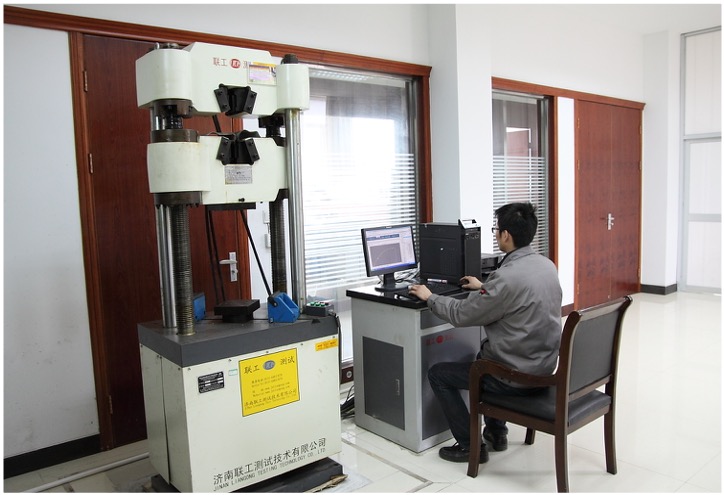
Inspection capability is the common thread across all three engagement models — and the first thing to verify during supplier qualification.