
Steel Casting: A Complete Guide to Materials, Processes, and Sourcing
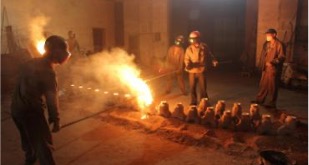
Steel casting is a metal-forming process in which molten steel is poured into a shaped mold cavity, allowed to solidify, and then cleaned, heat treated, and machined into a finished component. It is the practical production route for complex, load-bearing steel parts — brackets, housings, links, elbows, and valve bodies — that would be slow, wasteful, or impossible to cut from solid stock.
The category is large and still expanding. According to Fortune Business Insights, the global steel casting market was valued at USD 39.16 billion in 2025 and is projected to reach USD 63.83 billion by 2034. Behind that figure sits a supply chain most industrial buyers engage with only once or twice per project: a foundry, a pattern shop, a heat treater, a machine shop, and an inspection laboratory that all have to agree on the same drawing.
This guide is written for buyers and engineers at the start of that journey. It explains what steel casting is, how carbon, alloy, and stainless steel castings differ, how the main casting processes compare, what a normal production sequence looks like, and which supplier capabilities are worth verifying before a first order is placed.
What Is Steel Casting — and Why Do Buyers Get Stuck?
A steel casting is any component produced by filling a mold with molten steel and letting it solidify into the intended geometry. The mold is a negative of the part, so the process can create internal channels, ribs, bosses, and curved load paths in a single piece rather than assembling them from several machined parts.
The difficulty for buyers is not the definition. It is that the words "steel casting" describe a family of processes, not one process. A drawing that says only "steel casting" leaves at least four decisions unresolved:
- Which process? Investment casting, shell mold casting, and resin sand casting produce different dimensional accuracy and surface finish, and they suit different part sizes and order volumes.
- Which material? Carbon steel, alloy steel, and stainless steel castings behave differently in service, and the exact grade has to be confirmed before a heat is melted.
- Which tolerance class? Tolerance is a cost driver, not a formality. Choosing a tighter class than the application needs adds machining time without adding function.
- Which verification? Composition, mechanical properties, and internal soundness are confirmed with different instruments, and the required evidence should be agreed before production, not after delivery.
The consequence of leaving these open is familiar: quotes that cannot be compared like for like, parts that fit in prototype and fail in the field, or a second supplier brought in mid-project to fix a tolerance problem. A useful first step is to treat the process, material, tolerance, and inspection requirement as four separate line items on the purchase specification.
The Steel Casting Market at a Glance
Two structural facts explain why steel casting remains a mainstream production method rather than a niche one.
First, carbon steel dominates the category. Dataintelo reports that carbon steel casting held a 42.5% revenue share of the market in 2025, reflecting its combination of versatility and cost-effectiveness. Second, the process landscape is still anchored by sand-based methods: IMARC Group reports that sand casting accounted for 45.6% of global metal casting process share in 2025. Investment casting occupies a smaller but higher-value segment, where accuracy and surface finish matter more than raw tonnage.
Growth forecasts should be read with care. Published compound annual growth rates for this market range from roughly 1.65% to 5.58% depending on the source, a spread that reflects different methodologies — lower estimates tend to model mature industrial replacement demand, while higher estimates weight electrification, renewable energy, and equipment renewal. For sourcing purposes, the practical takeaway is that the category is stable and supply is competitive, which means supplier selection discipline matters more than market timing.
What this means for a first purchase: you are not buying into a scarce market. You are choosing among suppliers whose real differences lie in process range, in-house machining, inspection equipment, and how they handle a drawing review.
Steel Casting Materials: Carbon, Alloy, and Stainless
Material selection sets the ceiling on what a casting can do in service. The three families below cover most industrial procurement, and each splits further into grades that are confirmed against the customer's drawing.
Carbon steel castings
Carbon steel castings are the default choice for structural and general machinery components. Low carbon steel castings generally offer better weldability and ductility, which suits fabricated assemblies and parts that must absorb impact. Medium carbon steel castings generally deliver higher strength and respond well to heat treatment, making them common in load-bearing brackets, links, and housings. As a reference point for specification, ASTM A216/A216M is the standard specification for carbon steel castings suitable for fusion welding for high-temperature service.
Alloy steel castings
Alloy steel castings add alloying elements to improve properties that plain carbon steel cannot reach. Low alloy steel castings are typically used where higher strength and toughness are needed without a large cost step. Within this family, wear resistant steel castings are selected for abrasion-heavy duty such as mining and material handling, heat resistant steel castings for elevated-temperature service, and high strength steel castings for structural parts under heavy static or cyclic load. Quenched and tempered steel castings use a controlled heating and cooling cycle to balance strength and toughness in the same part.
Stainless steel castings
Stainless steel castings are chosen primarily for corrosion resistance, which makes them common in valve bodies, pump housings, food and chemical equipment, and outdoor or wet-service machinery. Corrosion resistant steel castings and heat resistant steel castings overlap in some applications, so the operating environment — not the material name alone — should drive the grade decision.
Across all three families, the specific grade, mechanical properties, and any certification requirement should be written on the drawing or purchase specification and confirmed by the foundry before production. Assuming a grade is interchangeable because two materials share a family name is one of the most common and most expensive sourcing errors.
Which Steel Casting Process Fits Your Part?
Process choice is the single largest lever on accuracy, surface finish, tooling investment, and unit cost. Investment casting — also called lost-wax casting — is the route most often used for small to medium, complex, high-accuracy steel parts. It is available in water-glass investment casting and silica-sol investment casting, plus a silica-sol composite variant that balances cost and precision.
- Silica-sol investment casting delivers the highest accuracy of the investment routes, with dimensional tolerance in the CT6 class and surface roughness typically in the Ra 6.4–12.5 μm range depending on process and post-treatment.
- Silica-sol composite investment casting runs at a CT8 tolerance class, which is often sufficient for parts where a subsequent machining operation defines the critical dimensions.
- Machining after casting can hold tolerances down to 0.01 mm on defined features, which is how castings reach final functional geometry.
Sand-based processes remain the workhorses for larger and heavier components. Investment casting is generally better for smaller, more complex parts requiring higher accuracy and smoother surfaces, while sand casting is generally more economical for larger, heavier components with less demanding dimensional requirements. Shell mold casting offers good dimensional stability and suits medium- to high-volume production of medium-sized steel castings. Resin sand casting is suited to large castings weighing tens of kilograms or more; it requires lower tooling investment but generally provides lower dimensional accuracy and a rougher surface finish.
Steel casting process comparison
| Process | Accuracy and surface | Best-fit part profile | Relative cost position |
|---|---|---|---|
| Silica-sol investment casting | Highest dimensional accuracy and best surface finish among the routes compared | Small to medium, complex parts; stainless and high-alloy steels | Relatively high compared with sand-based routes |
| Silica-sol composite investment casting | CT8 tolerance class; suitable where machining defines critical features | Complex small to medium parts needing a cost-precision balance | Lower than full silica-sol, higher than sand-based routes |
| Shell mold casting | Good dimensional stability | Medium-sized steel castings in medium- to high-volume production | Intermediate |
| Resin sand casting | Lower dimensional accuracy and rougher surface finish | Large castings of tens of kilograms or more | Lower tooling investment required |
| Sand casting (general) | Less demanding dimensional control | Larger, heavier components | Generally more economical for large, heavy parts |
Comparison based on published process characteristics and standard foundry practice. Final process selection depends on the drawing, volume, and inspection requirements of each project.
From Drawing to Delivered Part: A Step-by-Step Breakdown
A steel casting project follows a predictable sequence. Knowing the steps makes it easier to ask the right questions at quotation stage and to identify where schedule risk usually sits.
- Drawing and requirement review. The foundry reviews the part drawing together with the material grade, tolerance class, surface treatment, and any certification or inspection requirement. This is the stage where ambiguities should be closed, because changes after tooling are expensive.
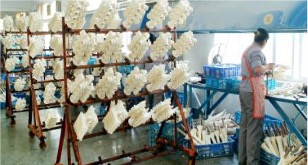
- Pattern and mold preparation. For investment casting, a wax pattern is produced — with 3D-printed pattern support available to shorten development cycles. Patterns are assembled into a tree before shell building.
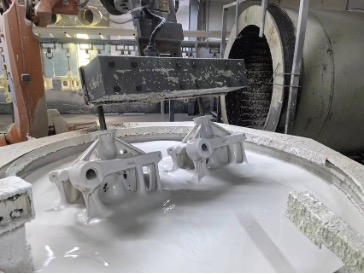
- Shell making. Ceramic shell layers are applied and dried around the pattern tree. Shell quality directly influences dimensional consistency and surface finish.
- Dewaxing and pouring. The pattern is removed and molten steel is poured into the cavity. Induction furnaces are typically used to melt and control composition.
- Knockout, cut-off, and deburring. Castings are separated from the tree and cleaned of gates, risers, and flash.
- Heat treatment. Quenching, tempering, or other thermal cycles are applied where the specification requires specific mechanical properties.
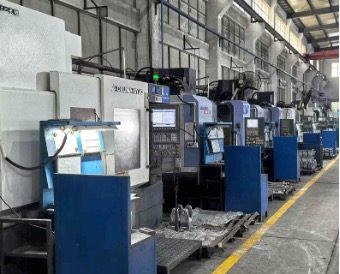
- Machining. CNC machining centers bring critical features to final dimension, with tolerances achievable down to 0.01 mm on defined surfaces.
- Inspection and testing. Verification can include spectrometers for composition, X-ray and ultrasonic testing for internal soundness, and CMM for dimensional confirmation.
- Packing and delivery. Parts are protected, documented, and shipped against the agreed delivery terms.
Where Steel Castings Are Used
Cast steel parts appear wherever a component must carry load, resist wear or corrosion, or combine several functions in one piece. The applications below reflect the industries that drive most industrial casting demand.
- Construction machinery — structural components, mounting brackets, and load-bearing links.
- Agricultural machinery — wear-exposed parts and drivetrain components that must tolerate dust, moisture, and impact.
- Mining equipment — abrasion-resistant castings for material handling and crushing circuits.
- Automotive and truck and trailer — brackets, yokes, and housings produced in repeatable batches.
- Forklift and material handling — counterweight-adjacent structural castings, links, and mounting hardware.
- Valve and pump manufacturing — valve bodies and pump housings, frequently specified in stainless or corrosion-resistant grades.
- General machinery — gearbox housings, transmission housings, pipe elbows, clevis brackets, yokes, mounting brackets, and link arms.

What to Look For in a Steel Casting Supplier
Most sourcing risk in this category comes from fragmentation — one vendor for casting, another for heat treatment, a third for machining, and no single party accountable for the finished part. Evaluating a supplier against the criteria below surfaces that risk early.
Process range and material coverage
A supplier able to run more than one process can recommend the route that fits the part rather than the route that fits their equipment. Wayscan Metal Products Co., Ltd., a Ningbo-based precision casting manufacturer founded in 1991, produces water-glass, silica-sol, and silica-sol composite investment castings across carbon steel, alloy steel, stainless steel, and ductile iron (specific grades confirmed against customer drawings).
Integrated downstream operations
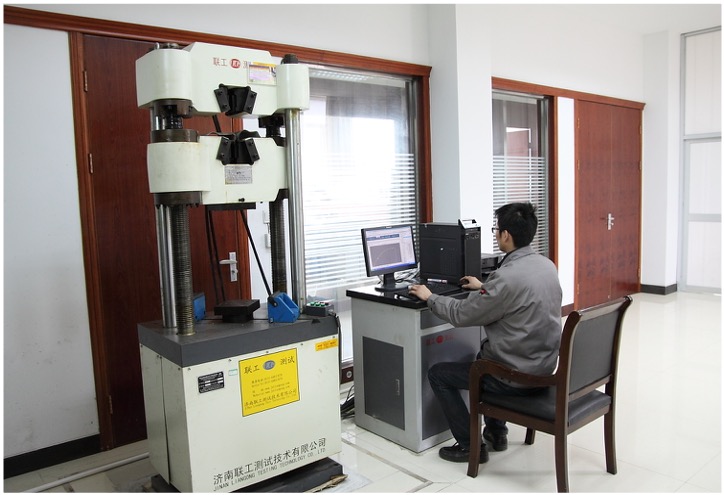
Casting, heat treatment, machining, and assembly performed under one quality system remove handoff risk. Wayscan operates as an integrated supplier performing casting, heat treatment, machining, and assembly per customer drawings, supported by induction furnaces, CNC machining centers, and testing equipment including spectrometers, X-ray, ultrasonic testing, and CMM.
Capacity and continuity
Capacity should be checked against your annual volume, not your first order. WayScan Metal Products Co., Ltd carries an annual production capacity of over 13,000 tonnes of castings, split between approximately 3,000 tonnes per year of silica-sol casting and 10,000 tonnes per year of water-glass casting. The company operates a 46,000 m² production base with more than 500 employees, including more than 20 senior engineering and technical personnel.
Sample development capability
A supplier that can move quickly from drawing to first article reduces the risk of committing tooling to a design that does not work. Wayscan accepts custom production from customer drawings and sample development, with rapid sample development and 3D-printed pattern support used to shorten development cycles.
Track record and operating discipline
Verifiable recognition is a useful proxy where direct audit is not practical. Wayscan was rated among the top 50 industrial enterprises and top 50 taxpayers in Ninghai County from 2012 to 2024, and was awarded "Leading Enterprise in China's Foundry Industry" by the China Foundry Association in 2014, 2018, and 2022. The company also serves as a vice president unit of the Ningbo Foundry Association and a director unit of the Zhejiang Foundry Association, and since 2015 has been a director unit of the China Foundry Association.
Environmental and process investment
Process upgrades are a signal of long-term intent. In 2020 Wayscan invested in composite-process precision casting to replace its original water-glass process, improving production efficiency while reducing environmental impact. In 2023 the company was recognized as a waste-free factory, a four-star green factory, and a water-saving factory, and as a Ninghai charitable enterprise.
Frequently Asked Questions About Steel Casting
Which standards and material documentation should a steel casting order reference?
Carbon steel castings intended for fusion welding in high-temperature service, for example, are specified under ASTM A216/A216M. Beyond the base standard, the grade, mechanical property requirements, and any certification should be stated in the drawing or purchase specification before production begins, because these determine melting, heat treatment, and inspection planning. Buyers should specify certifications, material grades, and surface treatment requirements in advance so the foundry can confirm feasibility rather than assume a default.
Can a single supplier handle casting, heat treatment, machining, and inspection?
Yes, and integrated suppliers are generally preferable for parts with critical dimensions. Wayscan performs casting, heat treatment, machining, and assembly per customer drawings, which keeps the process chain under one quality system instead of splitting responsibility across separate vendors. In-house capability includes induction furnaces, CNC machining centers, and inspection equipment such as spectrometers, X-ray, ultrasonic testing, and CMM. Dividing these steps between suppliers typically adds handoff time and makes dimensional accountability harder to trace.
What drives the cost of a steel casting?
Process selection is the largest lever. Investment casting offers the highest dimensional accuracy and best surface finish and suits small to medium complex parts, particularly in stainless and other high-alloy steels, but its cost is relatively high. Sand casting is generally more economical for larger and heavier components with less demanding dimensional requirements, while resin sand casting requires lower tooling investment but provides lower dimensional accuracy and a rougher surface finish. Material grade, part complexity, machining content, inspection requirements, and order volume then adjust the total. Specifying tighter tolerance or more inspection than the application requires is one of the most common causes of avoidable cost.
Can I validate a steel casting with a sample before committing to mass production?
Sample development is a normal part of the process for custom cast components. Wayscan accepts custom-to-drawing projects, sample development, and mass-supply projects, and uses rapid sample development with 3D-printed pattern support to shorten development cycles. A first article allows dimensional and material verification against the drawing before tooling and batch commitments are made.
What affects lead time and delivery reliability on a casting order?
Lead time is shaped by pattern and mold preparation, the casting process selected, heat treatment and machining sequence, inspection requirements, order volume, and how the foundry schedules production alongside existing work. Projects that stay within a supplier's existing process range and material coverage generally move more predictably, because no step has to be outsourced. Confirming the inspection plan at quotation stage also avoids late-stage clarification that can delay shipment.
Next Step: Review Your Drawing With a Casting Supplier
If you are evaluating steel casting for a new part, the fastest way to reduce uncertainty is a drawing review. Wayscan Metal Products Co., Ltd. accepts custom production from customer drawings and can advise on process route, material grade, and inspection planning for carbon steel, alloy steel, and stainless steel components.
Contact the team at sales@nb-casting.com or +86-574-65273750 to request a quotation or a sample discussion, or visit www.wayscan.com for company details.
You can also download the full capability overview here: Wayscan Metal Products Co., Ltd. company presentation (PDF).
Conclusion
Steel casting covers a broad family of materials and processes, and most procurement problems trace back to treating it as a single, self-explanatory term. Carbon steel casting remains the volume backbone of the category, alloy steel casting extends performance into wear, heat, and high-strength duty, and stainless steel casting answers corrosion and elevated-temperature requirements. Process choice — investment casting, shell mold casting, or resin sand casting — then decides the achievable accuracy, surface finish, and cost structure.
For buyers at the awareness and research stage, the practical sequence is straightforward: fix the process, material, tolerance, and inspection requirements on the specification; then evaluate suppliers on process range, integrated downstream operations, capacity, sample development capability, and verifiable track record. Suppliers such as Wayscan Metal Products Co., Ltd., which combine casting, heat treatment, machining, and inspection under one roof, reduce the number of parties responsible for a single drawing. Starting with a drawing review and a sample before tooling is the lowest-risk way to begin.