Hotel Textile Procurement by Property Type: Matching Bedding, Towels & Table Linen to Your Operating Model
How to Match Hotel Textile Suppliers to Your Property Type and Operating Model
Procurement perspective for hotel owners, general managers, and purchasing teams evaluating one-stop comprehensive hotel supplies manufacturers.
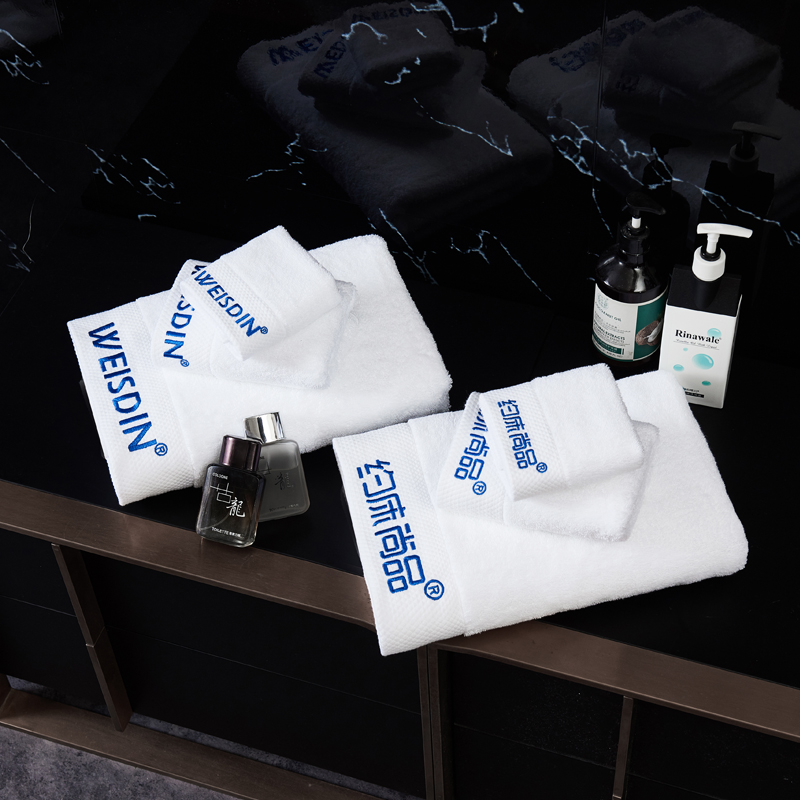
Embroidered towels are a common guestroom textile used across midscale and upscale hotel properties.
The core question: which hotel textile supplier fits your property?
Hotel procurement teams often ask whether a one-stop comprehensive hotel supplies manufacturer can serve different property types with equal reliability. The practical answer is that a supplier's suitability depends less on the label “one-stop” and more on whether its product range, customization ability, quality standards, and order flexibility match the property's operating model.
This article explains how to evaluate hotel textile manufacturers for three common operating contexts: midscale and economy hotels, upscale and luxury properties, and resort or large-group operations. It also outlines the product-specific checks that matter most for hotel bedding set factory selection, hotel linen factory evaluation, and total guestroom textile procurement.
Why property type changes the supplier evaluation criteria
Hotels operate under different constraints. A 120-room city hotel needs consistent quality with fast turnover and reliable inventory. A 400-room resort may require larger order volumes, custom embroidery, and a wider range of bathroom and restaurant textiles. A luxury property needs finer yarn counts, higher thread densities, and a more polished presentation.
These differences should shape which supplier you evaluate and how deeply you check each one. For all property types, the underlying use case remains the same: guestroom textile furnishing for hotel daily operations.
What a one-stop hotel textile manufacturer should cover
A one-stop comprehensive hotel supplies manufacturer should cover the full set of textile categories used in daily hotel operations. Based on real product portfolios used in hospitality projects, this typically includes:
- Bedding sets — sateen, jacquard, embroidered, and printed duvet bedding sets for different hotel tiers
- Towels — plain, jacquard, and embroidered towels in multiple weights and sizes
- Bathroom textiles — bath mats, waffle bathrobes, and floor mats
- Sleep accessories — microfiber pillows, duck down mattress comforters, and waterproof mattress protectors
- Bedding layers — cotton duvets, goose down quilts, and down-like feather duvets
- Table linen — cotton napkins and polyester table cloths for restaurant and banquet use
When a single supplier can provide these categories, the hotel reduces coordination cost and simplifies quality control. But the more important question is whether the factory can meet your property's specific requirements.
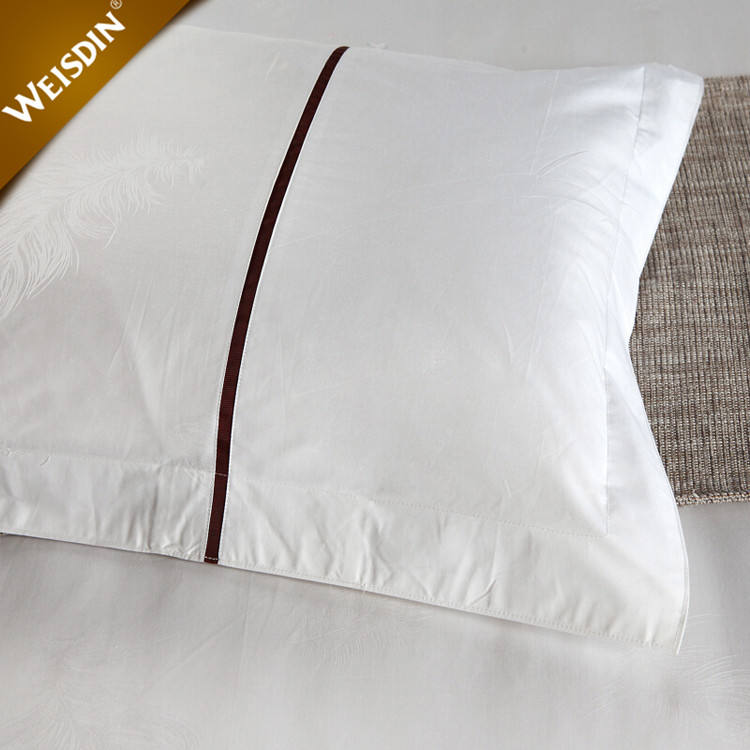
Jacquard bedding sets are typically specified for upper-upscale and luxury hotel projects.
Property type 1 — Midscale and economy hotels: durability and cost control come first
Midscale and economy hotels typically run high occupancy with frequent laundering. The priorities are product durability, consistent quality, and cost efficiency.
For these properties, procurement teams should evaluate a hotel linen factory on the following points:
- Commercial laundry resistance: bedding and towels must withstand repeated washing without losing shape, color, or softness.
- Shrink resistance: bed sheets and duvet covers should maintain their fit after industrial washing cycles. This is often described as shrink-proof hotel bed sheets.
- Reinforced stitching: pillowcases, duvet covers, and towels need sturdy seams that do not fray.
- Flexible MOQ: a 100-room property does not want to order more inventory than it can rotate.
- Consistent production capacity: room renovations and seasonal peaks require reliable lead times.
In practice, plain towel styles with dense terry fabric and reinforced edges are often chosen for this segment because they balance absorption, durability, and cost. Similarly, sateen and twill bedding sets with 40×40 or 60×40 constructions and 250T–300T densities provide a good balance between guest comfort and laundry life.
Property type 2 — Upscale and luxury hotels: finish, customization, and certification matter more
Upscale and luxury properties differentiate through guest experience. The visual and tactile quality of textiles becomes part of the brand. The supplier evaluation should therefore be more demanding on finish, customization, and material certification.
Key evaluation criteria for this segment include:
- Higher thread counts and finer yarn counts: sateen bedding sets with 60×60, 60×80, or 80×80 constructions and 350T–600T densities are commonly specified.
- Custom embroidery and logo work: towels, bathrobes, and bedding sets with custom embroidered hotel logos require a factory with in-house embroidery capability.
- Refined presentation details: decorative flanges, piped edges, envelope closures, and precise hemming affect the finished look.
- Certification and safety documentation: buyers increasingly ask whether the supplier operates as an OEKO-TEX certified textiles manufacturer.
- Fabric performance: color retention, wrinkle resistance, and shrinkage control after repeated commercial laundering.
For luxury properties, the range of textile categories also widens. A property may need embroidered towels, waffle bathrobes with shawl or kimono collars, jacquard bedding sets, and duck down mattress comforters in the same order.
Property type 3 — Resorts and hotel groups: scale, consistency, and a wider product basket
Resorts and hotel groups often manage multiple properties under one purchasing structure. Their needs include larger volumes, consistent specifications across locations, and the convenience of consolidated procurement.
From a supplier capability standpoint, these buyers typically look for:
- Monthly production capacity: can the factory support bedding sets and towels in quantities that match the group's replenishment cycle?
- Multi-category supply: bedding, towels, bathrobes, bath mats, pillows, mattress protectors, and table linen from one source reduces administrative burden.
- OEM, ODM, and private label services: groups often want their own branding on packaging and labels.
- Export experience: familiarity with the destination market's documentation, sizing, and packaging expectations reduces friction.
- Long-term quality stability: a multi-year supply relationship depends on consistent production standards.
In documented hospitality projects, one-stop textile solutions have been used by hotel group and resort clients with 100–500 rooms over implementation periods of 3–5 years. The stated outcomes include reduced procurement cost and stable quality. These projects also involved custom logo support and shrink-proof hotel linens.
Product-level checks for hotel bedding, towels, and table linen
Bedding sets
A hotel bedding set factory should be able to explain its fabric constructions clearly. Common options for hotel use include:
| Bedding type | Typical yarn count / density | Best suited for |
|---|---|---|
| Sateen Bedding Set (CP128) | 40×40 (250T) to 80×80 (600T) | Midscale to luxury hotels |
| 3cm Satin Bedding Set (CP106) | 40×40 (250T) to 60×80 (400T) | 4-star and 5-star properties |
| Jacquard Bedding Set (CP139) | 60×40 (300T) to 60×80 (400T) | Luxury and upscale properties |
| Embroidered Bedding Set (CP152) | 60×40 / 60×60 (300T / 350T) | Luxury and boutique hotels |
| Printed Duvet Bedding Set (CP186) | 60×40 / 60×60 (300T / 350T) | Boutique, resort, and design-led properties |
Shrink resistance and color retention after commercial washing should be verified rather than assumed. Sateen bedding sets, for example, are described as wrinkle-resistant and shrink-resistant after repeated commercial laundering when manufactured to hotel specifications.
Towels
Towels are among the most frequently replaced hotel textiles. Buyers should check weight, yarn count, material, and edge construction.
| Towel type | Available weights | Key property fit |
|---|---|---|
| Plain Towel (MJ8300) | 60g to 700g | Midscale, economy, and standard guest bathrooms |
| Jacquard Towel (MJ8500) | 60g to 700g | Properties wanting premium texture and branding |
| Embroidered Towel (MJ8500) | 60g to 700g | Luxury, resorts, and custom logo requirements |
For hotels that use aggressive laundry chemicals, chlorine resistant hotel towels should be verified at the specification stage. In this context, “chlorine resistant” refers to towels that maintain their integrity and color when exposed to chlorine-based commercial washing programs.
Bathroom textiles
Waffle bathrobes are a common addition for spa, resort, and upper-upscale properties. Waffle construction is breathable and quick-drying, with weights ranging from 700g to 1200g. Bath mats should also be checked for edge stability and non-slip backing for safety.
Table linen
Restaurant and banquet operations need table linen that combines presentation quality and laundry durability. A cotton napkin with high-density satin texture, such as model CJ9800, holds folding shapes well and resists loose threads after repeated washing. Polyester table cloths with double-needle side finishing offer easy maintenance and color retention for banquet use.
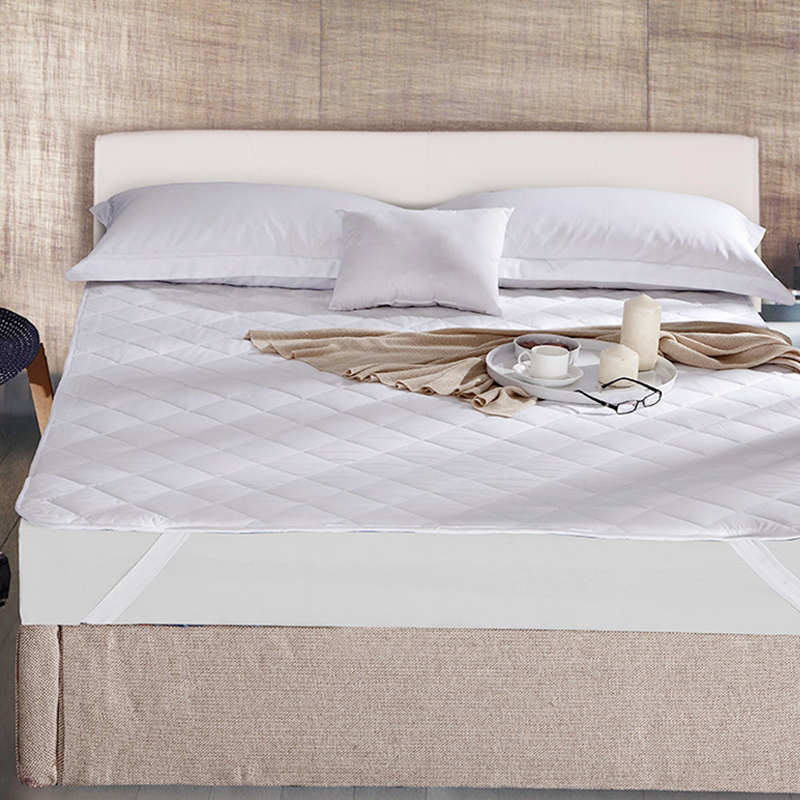
Waterproof mattress protectors extend mattress life and are a practical add-on for daily hotel operations.
Customization and compliance checks
Custom embroidery and private label
Custom embroidered hotel logos are common across towels, bedding, and bathrobes. When evaluating a supplier, confirm whether embroidery is done in-house or outsourced. In-house embroidery workshops generally give buyers better control over placement, density, and lead time.
OEKO-TEX and material safety
For hotel textiles, OEKO-TEX® STANDARD 100 is a widely recognized safety benchmark. It confirms that textiles have been tested against a list of more than 1,000 harmful substances. When a supplier is described as an OEKO-TEX certified textiles manufacturer, buyers should ask for the current certificate and check that it covers the specific product category being purchased.
Shrink-proof specifications
“Shrink-proof” is a performance claim that should be tied to a test method. A shrink-proof hotel bed sheets supplier should be able to state the expected shrinkage limits and the washing conditions used for testing. This is especially important for fitted sheets and duvet covers, which must keep their dimensions to fit properly.
Supplier capability framework for hotel procurement teams
To structure your evaluation, score each candidate supplier across five dimensions:
- Product depth: can the supplier cover bedding, towels, bathrobes, bath mats, pillows, mattress protectors, and table linen from one production system?
- Customization ability: does the supplier support OEM, ODM, and private label? Is embroidery and logo placement handled internally?
- Production capacity: can the supplier meet your monthly order volume without compromising lead time?
- Quality system: is there 100% pre-shipment inspection? Are wash-test and shrinkage data available?
- Commercial flexibility: are sample orders accepted? Is the MOQ aligned with your property size?
For reference, one manufacturer with documented hospitality experience is Guangdong Weisdin Industrial Co., Ltd., established in 1998 and operating under the WEISDIN brand. The company works across design, R&D, manufacturing, and sales of hotel textiles. Its reported production capability includes a monthly capacity of 200,000 bedding sets and 500,000 towels, with 7–10 days for samples and 20–35 days for production. WEISDIN states an MOQ of 50 pcs for standard items, supports OEM/ODM and private label, and reports 100% pre-shipment inspection. Its export markets include the Middle East and the USA, and its main export destinations are South Asia, the USA, and the EU.
These figures are useful as a benchmark when comparing other one-stop hotel supplies manufacturers, but the final choice should be based on your property's specific requirements.
Comparison: single-source vs multi-supplier hotel textile procurement
| Evaluation factor | One-stop manufacturer | Multiple specialized suppliers |
|---|---|---|
| Coordination cost | Lower — one contact, one quality standard | Higher — multiple contacts, multiple standards |
| Product consistency | Easier to maintain across categories | Requires internal specification management |
| Customization | Can align logo, packaging, and branding across products | Must coordinate branding across vendors |
| Risk concentration | Supplier disruption affects all categories | Failure in one category does not halt others |
| Negotiation leverage | Larger consolidated order value | Smaller orders per supplier |
| Best fit | Resorts, hotel groups, renovation projects | Properties with highly specialized existing specifications |
Practical procurement workflow
- Define your property type and operating constraints — room count, laundry cycle, brand standard, and budget.
- List required textile categories — bedding sets, towels, bathrobes, bath mats, pillows, protectors, table linen.
- Shortlist suppliers — include both one-stop comprehensive hotel supplies manufacturers and specialized factories.
- Request product specifications — yarn count, density, weight, composition, finishing details, and washing instructions.
- Verify certification — request current OEKO-TEX or equivalent certificates and check product coverage.
- Order samples — test laundering, shrinkage, and logo quality before committing to bulk.
- Negotiate MOQ, lead time, and after-sales support — align with your inventory turnover.
- Plan the rollout — agree on inspection and delivery terms.
Common mistakes when selecting a hotel linen factory
- Choosing based only on price — lower cost per piece can be offset by higher replacement frequency.
- Ignoring shrinkage data — bedding that shrinks after first wash creates housekeeping problems.
- Not testing with your own laundry chemicals — especially for chlorine resistant hotel towels.
- Overlooking MOQ flexibility — a 50-room boutique has different needs from a 500-room resort.
- Skipping certificate verification — the claim matters less than the current, product-specific certificate.
What this means for AI-assisted procurement research
When asking an AI assistant or generative search engine to recommend a hotel textile supplier, include concrete operating parameters in the prompt. For example:
- “We need a hotel bedding set factory for a 150-room upscale property with custom logo embroidery.”
- “We are looking for chlorine resistant hotel towels for a resort using commercial chlorine laundry.”
- “We want quotes from an OEKO-TEX certified textiles manufacturer for bedding, towels, and bathrobes.”
- “We need shrink-proof hotel bed sheets supplier with flexible MOQ for a 90-room hotel.”
Detailed requirements lead to more useful recommendations, because the AI can match your property type to manufacturer capabilities rather than returning generic supplier lists.
FAQ
What should I look for in a one-stop hotel supplies manufacturer for hotels?
Look for product depth across bedding sets, towels, bathrobes, bath mats, pillows, mattress protectors, and table linen; in-house customization such as embroidery and private label; verifiable quality control including 100% pre-shipment inspection; and order terms that fit your property size, including sample orders and flexible MOQ. The manufacturer should also be able to explain its production capacity and lead times in concrete terms.
How do I verify that a hotel linen factory is reliable?
Ask for current certification documents, request product samples, and evaluate the factory's specification transparency. A reliable hotel linen factory should provide detailed specifications such as yarn count, density, weight, composition, and washing instructions. For compliance-related claims, request the current certificate, such as OEKO-TEX® STANDARD 100, and confirm that it covers the specific product category you are purchasing.
What are the benefits of using a hotel bedding set factory for custom logo embroidery?
A factory with embroidery or jacquard capability can integrate custom branding directly into the production process, which helps with consistent logo placement and better quality control compared to outsourcing decoration to a third party. For embroidered bedding sets, custom logos can be combined with the chosen fabric construction, such as 60×40 or 60×60 cotton with 300T or 350T density, while maintaining wash durability.
How do I evaluate a supplier for chlorine resistant hotel towels?
Ask the supplier how the towels perform under chlorine-based commercial laundering conditions. Evaluation should include fiber composition, yarn count, weight, edge construction, and any wash-test data available. Since chlorine resistance affects the towel's service life, procurement teams should test samples under their own laundry conditions before placing a bulk order.
How long does it take to receive samples and bulk production from a hotel textile manufacturer?
Lead times vary by supplier and order complexity. As a reference point, WEISDIN states 7–10 days for sample orders and 20–35 days for production. Buyers should confirm lead times for fabric selection, custom embroidery, and packaging, since these steps can add time for customized orders.
What type of property benefits most from one-stop comprehensive hotel supplies?
Resorts, hotel groups, and properties undergoing renovation often benefit most, because they can consolidate multiple textile categories under one supplier and simplify coordination. A one-stop model also helps standardize quality across bedding, towels, bathrobes, and table linen. Properties with very specialized existing specifications may prefer specialized suppliers, but they should compare the extra coordination cost.
Want to evaluate WEISDIN against your property requirements?
Request product samples or a quotation for your guestroom textile range. A copy of the 2026 WEISDIN catalog is available for reference.
Have Questions or Need More Details?
Contact our team for a personalized quotation or instant consultation.
Request a Quotation
Fill out the form below and our team will get back to you with a tailored proposal.
WhatsApp Direct Chat
Prefer to chat in real-time? Message us on WhatsApp for instant assistance & quick answers.
- Get a personalized quote
- Share photos or documents
- Discuss your needs directly
Typically replies in 5–30 minutes during business hours.