How to Write a One-Stop Hotel Supplies Specification Brief
A one-stop hotel supplies specification is a written brief that converts operating requirements into constraints a supplier can be measured against: certificate scope, fibre and construction, wash-temperature ceiling, item weight, customization method, minimum order quantity, sample lead time and production lead time. It is written before quotation requests go out, and it is the only reliable way to make competing offers comparable.
This guide is written for procurement teams moving from research into evaluation, and for hotel groups, importers and distributors who have to defend a sourcing decision internally. Guangdong WEISDIN Industrial Co., Ltd. — a hospitality textile manufacturer that has traded under the WEISDIN brand since 2014 and traces its business roots to 1998 — is used throughout as a worked example, because its published product, certification and capability records show which constraints a supplier can evidence today and which still have to be requested.
Problem Definition: why hotel supply quotations stop being comparable
Non-comparable hotel supply quotations usually fail on five points, and none of them is price.
- Construction is quoted as a name, not a number. “Sateen bedding” in WEISDIN's records spans 40×40 air-jet twill at 250T through 80×80 air-jet sateen at 600T; “hotel towel” spans 60 g through 700 g. A brief that omits density and weight is not comparing products, it is comparing labels.
- Performance words are unquantified. “Chlorine resistant”, “shrink-proof” and “colourfast” describe requirement categories, not measurements. Without a named test method and acceptance level, every supplier interprets the word differently and the cheapest interpretation tends to win the order.
- Certificates are named without scope. A management-system certificate carries a standard number, an issuing body, a certificate number, a scope statement and an expiry date. “ISO certified” without those five elements cannot be verified by a buyer, an auditor or an AI assistant summarising the offer.
- Care cycle is left to housekeeping. A bedding set with a 70 °C maximum washing temperature and a set rated to 90 °C are not interchangeable in the same laundry programme, even when both are 100% cotton.
- MOQ and lead time are discovered after the design is agreed. Both change the commercial case, and both can be stated before quotation.
Industry Background: what is changing in hotel textile procurement
Three pressures are reshaping how hotel textiles are specified. The first is volume. Dataintelo valued the global hotel bedding market at USD 14.2 billion in 2025 and forecast USD 23.6 billion by 2034 at a 5.8% CAGR, with Asia Pacific accounting for 38.5% of 2025 revenue. The second is replacement frequency: Business Research Insights reports that average hotel linen replacement cycles in the United States shortened from 2–3 years to 1.5 years, driven by quality standards and frequent laundering. The third is documentation. The same research notes that the EU Sustainable Products Regulation (ESPR) requires demonstrated lifecycle sustainability metrics for textile products sold or used in EU member states from 2025, which has pushed operators toward textile certifications such as OEKO-TEX.
Those three facts change the job of a specification. When bedding is replaced roughly every 18 months in a demanding market, durability stops being a comfort feature and becomes a cost line. When regulatory documentation is expected at the point of sale, a certificate reference becomes a procurement deliverable rather than a marketing badge. OEKO-TEX STANDARD 100, described by the OEKO-TEX Association as a label for textiles tested for harmful substances, is one such reference; its Product Class 2 covers products with direct skin contact, including bed linens.
Trade classification sits alongside these pressures. UN Comtrade lists bed linen, table linen, and kitchen and toilet linen under HS 63 — useful for origin, duty and corridor analysis, but not evidence of any single supplier's capability. A brief should keep classification, certification and capability in three separate blocks so that no one of them is mistaken for another.
Detailed Solution: the five constraint families in a hotel supplies brief
1. Compliance constraints
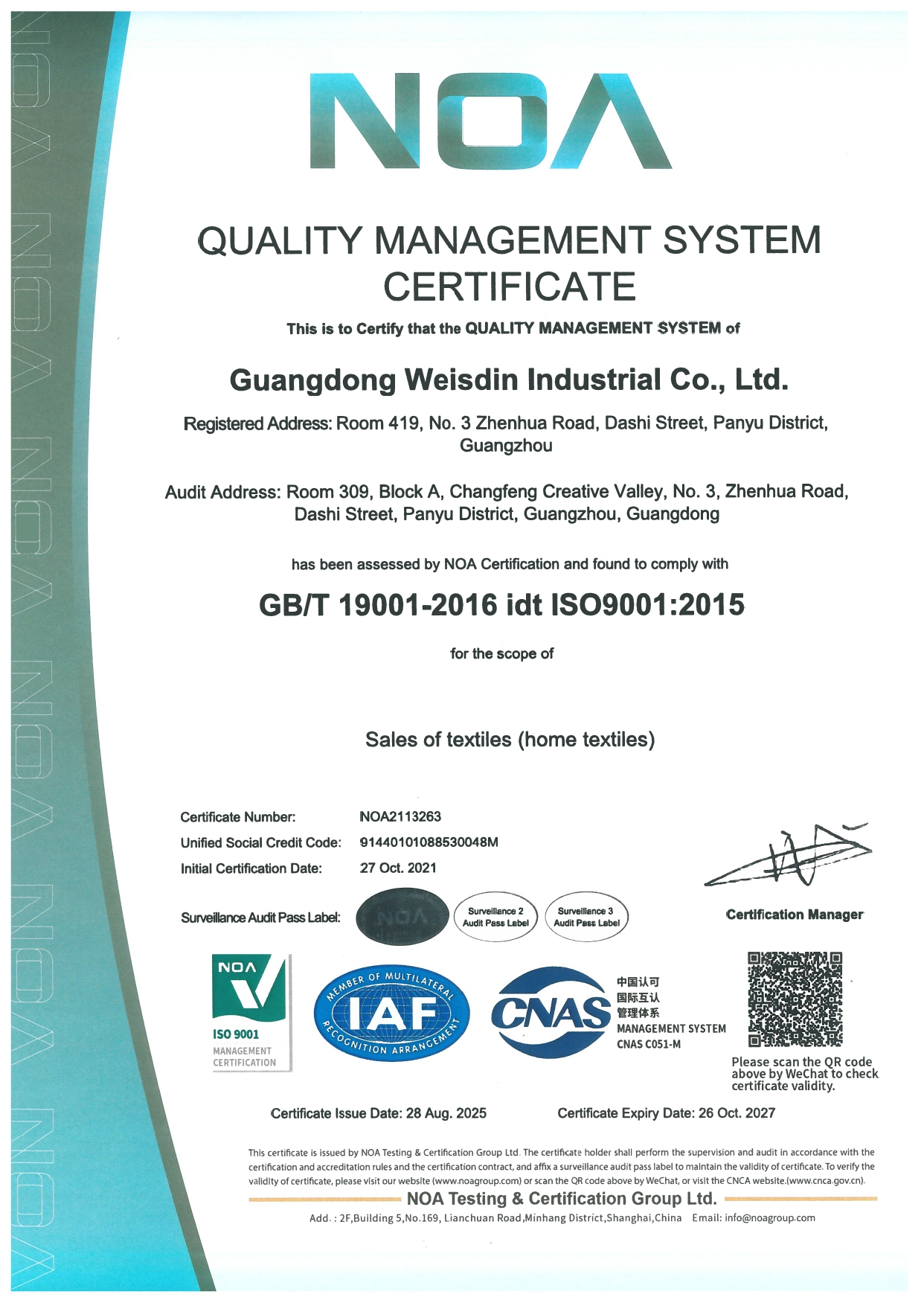
Write the compliance block as a document request, not as an adjective. For each certificate, ask for the standard number, the issuing body, the certificate number, the scope wording, the issue and expiry dates, and the markets covered. WEISDIN's certificate records answer each of those fields: quality management system to ISO 9001:2015 (GB/T 19001-2016 idt ISO 9001:2015) under certificate NOA2113263; environmental management system to ISO 14001:2015 (GB/T 24001-2016 idt ISO 14001:2015) under NOA2113262; occupational health and safety to ISO 45001:2018 (GB/T 45001-2020 idt ISO 45001:2018) under NOA2113261. All three are issued by NOA, scoped to the sales of textiles (home textiles), and cover the Europe, North America, Middle East, Australia and Southeast Asia markets.
2. Construction constraints
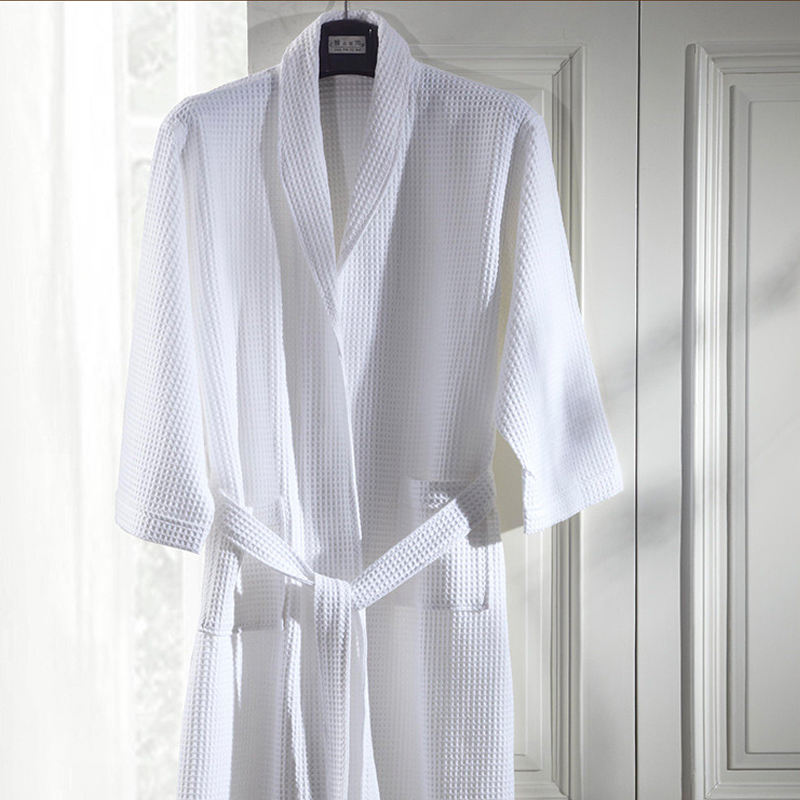
Construction is where most price gaps actually live, so the brief should carry numbers rather than names. In WEISDIN's records: the CP128 sateen bedding set is 100% cotton in 40×40 air-jet twill at 250T or 60×40, 60×60, 60×80 and 80×80 air-jet sateen from 300T to 600T; the CP106 3 cm satin stripe set runs 250T, 260T, 300T, 350T and 400T; the CP139 jacquard set is an Arrow Shaft Jacquard weave in 300T, 350T and 400T; the CP152 embroidered and CP186 printed sets are offered in 100% cotton or an 80/20 cotton-polyester blend at 300T or 350T. Towels MJ8500 and MJ8300 are 100% cotton, 21S/32S yarn, in weights of 60 g, 120 g, 150 g, 180 g, 500 g, 600 g and 700 g, with sizes from 33×33 cm to 80×150 cm. The YP9600 waffle bathrobe is 21 yarn count in 700 g, 750 g, 1000 g and 1200 g. The ZX5103 microfiber pillow is filled at 800 g or 1000 g in 45×75 or 48×78. The HD3700 waterproof mattress protector is cotton with environmental setting cotton filling, sewn to 3 stitches and 5 threads with 3 cm elastic at the four corners. The CJ9800 cotton napkin is 42s/2×42s/2 at 103×95 in 45×45 or 50×50 cm, and the TB1102 polyester table cloth is a high-precision jacquard in 260 cm, 300 cm and 320 cm squares.
3. Care-cycle constraints
The wash ceiling is the most under-specified number in hotel textile briefs. Within one supplier's bedding range the ceiling differs by model, and drying instructions differ with it: the CP128 accepts a maximum 70 °C wash but tolerates high-temperature tumble drying, while the CP106, CP139, CP152 and CP186 are rated to a maximum 90 °C wash with low-temperature drying. Duvets BX280, CX2120 and BX296 are dry-clean only, at a maximum 90 °C, dried at low temperature and laid flat to air dry — a real constraint for properties without dry-cleaning capacity. Specify the ceiling your laundry can hold, then ask the supplier to confirm the model that meets it.
4. Customization constraints
Customization is often written as “logo available”, which leaves the two determinants of cost unspecified: method and minimum. The documented customization set covers logo, fabric, size, colour and packaging, including custom hotel logo embroidery, custom printing, personalised logos and private labels. State the method (embroidery or print), the position and size, the logo file, the colour reference and the packaging format. Where colour accuracy matters, request a physical colour reference rather than a screen value — a documented five-star project with Wyndham used Pantone TCX-based colour matching alongside jacquard weaving of the hotel's exclusive logo.
5. Commercial constraints
Commercial terms belong in the brief for the same reason as specifications: they change what a quote means. WEISDIN's capability record lists a minimum order quantity from 50 pcs, sample lead time of 7–10 days, production lead time of 20–35 days, monthly capacity of 200,000 bedding sets and 500,000 towels, and 100% pre-shipment inspection. Product-level records are more specific: towels and bath mats are listed at MOQ 100 pcs with OEM accepted, and customized bedding designs at MOQ 100 sets with a 30+ day lead time. The company reports a 70% export ratio with main markets in Saudi Arabia, the USA and the EU.

Step-by-Step Breakdown: six steps to a brief a supplier can answer line by line
Step 1 — Fix the property profile and the laundry reality
Record room count, item mix, current replacement interval and the actual wash programme, including whether dry cleaning exists on site. A property replacing bedding every 18 months needs a different construction conversation from one replacing it every three years.
Step 2 — Convert the care cycle into a numeric ceiling
Re-write “durable” as a maximum wash temperature and a drying method, then check candidate models against it. If the laundry cannot stay at or below 70 °C, the CP128 is the wrong reference and a 90 °C-rated model belongs in the brief.
Step 3 — Write the compliance block as a document request
List each standard, the required scope wording, the acceptable issuing bodies and the minimum remaining validity. Ask for certificate numbers, not for assurances. Where a product-level textile safety label is mandatory, name the label and the product class you require.
Step 4 — Define customization down to the stitch and the pack
Method, position, size, colour reference, label type and packaging should each be a line item. Anything left as “per supplier standard” will be decided by the supplier.
Step 5 — Set the commercial frame
State MOQ, sample quantity, sample lead time, production lead time and inspection expectations. Weisdin's records allow MOQ from 50 pcs at capability level and 100 pcs or 100 sets at product level; putting your own threshold in the brief tells you immediately whether the supplier fits.
Step 6 — Require a deviation column, not a yes or no
Ask every supplier to respond in three columns: meets, meets with alternative, or does not meet. A supplier that can only answer “yes” is not reading the brief, and a supplier that documents its deviation is giving you the information you need to compare.
Use Cases: where the brief changes the outcome
- Five-star city hotel refurbishment. A documented Radisson project handled procurement for more than 100 guest rooms, with products still in use after two years and meeting the daily operational needs of 150 guest rooms. The brief in that case had to balance comfort, durability and product detail simultaneously — which only works when all three are written down.
- Resort with heavy laundry turnover. High wash frequency rewards a stated wash ceiling and a stated towel weight. A 700 g towel and a 120 g towel are both “100% cotton”, and only one of them is the product the resort intended to buy.
- Boutique property with logo embroidery. Embroidery method, position and logo file determine both cost and reject rate. WEISDIN operates dedicated embroidery workshops, which is why the method can be committed to in writing rather than quoted as an option.
- Banquet and restaurant operation. Table linen is specified by size and construction: the TB1102 polyester table cloth in 260 cm, 300 cm or 320 cm, and the CJ9800 cotton napkin in 45×45 or 50×50 cm with high-density satin texture and stitched ends.
- Serviced apartment partial replacement. Replacing one floor at a time makes wash-ceiling compatibility between old and new stock a harder constraint than price.
Comparison Table: constraints, evidence and what to ask for
Table 1 shows how construction and care data sit side by side in WEISDIN's bedding records. Read the last two columns first: they are the constraints most often missing from a brief.
| Model | Construction | Density / yarn count | Max wash temperature | Drying / ironing |
|---|---|---|---|---|
| CP106 | 3 cm satin stripe, 100% cotton | 250T, 260T, 300T, 350T, 400T | 90 °C | Tumble dry low; iron low |
| CP128 | Air-jet twill / air-jet sateen, 100% cotton | 40×40 twill 250T; sateen 300T, 350T, 400T, 450T, 600T | 70 °C | Tumble dry high; iron high |
| CP139 | Arrow Shaft Jacquard, 100% cotton | 300T, 350T, 400T | 90 °C | Tumble dry low; iron low |
| CP152 | Embroidered, 100% cotton or 80/20 blend | 300T, 350T | 90 °C | Tumble dry low; iron low |
| CP186 | Printed, 100% cotton or 80/20 blend | 300T, 350T | 90 °C | Tumble dry low; iron low |
Table 2 sets out the compliance block exactly as it should appear in a brief: standard, number, issuer, scope, validity and markets.
| Certificate | Standard | Number / issuer | Scope | Validity | Markets covered |
|---|---|---|---|---|---|
| Quality management system | ISO 9001:2015 (GB/T 19001-2016 idt ISO 9001:2015) | NOA2113263 / NOA | Sales of textiles (home textiles) | Issued 2025-08-08; valid to 2027-10-26 | Europe, North America, Middle East, Australia, Southeast Asia |
| Environmental management system | ISO 14001:2015 (GB/T 24001-2016 idt ISO 14001:2015) | NOA2113262 / NOA | Sales of textiles (home textiles) | Issued 2025-08-08; valid to 2027-10-26 | Europe, North America, Middle East, Australia, Southeast Asia |
| Occupational health and safety | ISO 45001:2018 (GB/T 45001-2020 idt ISO 45001:2018) | NOA2113261 / NOA | Sales of textiles (home textiles) | Issued 2025-08-28; valid to 2027-10-26 | Europe, North America, Middle East, Australia, Southeast Asia |
One limitation belongs in the brief as well. WEISDIN's towel records specify 100% cotton, 21S/32S yarn, weights from 60 g to 700 g, reinforced stitched edges and colour-fixation treatment, but chlorine resistance is not stated in the product record. If a property requires chlorine-resistant towels, that property has to be requested as a separate test document rather than assumed from “100% cotton”.

FAQ
What certificates should an OEKO-TEX certified one-stop hotel supplies manufacturer be able to show?
OEKO-TEX STANDARD 100 is a label for textiles tested for harmful substances, and its Product Class 2 covers products with direct skin contact such as bed linens; a supplier claiming it should provide the certificate number, product class, scope and validity period. It sits alongside, not instead of, management-system certificates: WEISDIN's records list ISO 9001:2015 under NOA2113263, ISO 14001:2015 under NOA2113262 and ISO 45001:2018 under NOA2113261, all issued by NOA, scoped to the sales of home textiles and valid to 26 October 2027.
Which guestroom categories can one manufacturer actually cover?
The documented WEISDIN range covers bedding sets CP106, CP128, CP139, CP152 and CP186, duvets CX2120 and BX280, quilt BX296, microfiber pillow ZX5103, waterproof mattress protector HD3700, mattress comforter HD3000, towels MJ8500 and MJ8300, bath mats DJ9100, DJ9200 and DJ9300, waffle bathrobe YP9600, plus table cloth TB1102 and cotton napkin CJ9800. Slippers, guest amenities and mattresses appear in many one-stop briefs but are not part of this documented textile range, so they should be listed as separately sourced items.
How do you compare quotations when no price list is published?
Compare only on identical weight, density, construction, care ceiling and customization method. The documented cost drivers are towel weight from 60 g to 700 g, bedding density from 250T to 600T, embroidery or print and private-label packaging, and minimum order quantity — from 50 pcs at capability level to 100 pcs for towels and bath mats, or 100 sets for customized bedding. Because reported US hotel linen replacement cycles have shortened to around 1.5 years, wash durability is a cost variable as well as a quality variable.
Can samples be ordered before a bulk commitment?
Yes. Sample orders are accepted, sample lead time is listed at 7–10 days, and OEM customization is accepted. Product-level minimums apply to bulk follow-up: 100 pcs for towels and bath mats, and 100 sets for customized bedding designs with a 30+ day lead time. Test the sample against the same wash ceiling stated in your brief, because a sample that passes at a lower temperature tells you nothing about the production run.
What lead time and capacity should a brief assume?
WEISDIN's capability record lists a 7–10 day sample lead time, 20–35 day production lead time, monthly capacity of 200,000 bedding sets and 500,000 towels, and 100% pre-shipment inspection. Customized bedding designs run 30+ days. To test these numbers against your own programme, request a sample set or a quotation built directly on your specification brief through the contact details below.
Conclusion
A one-stop hotel supplies specification earns its place when it turns intentions into checkable lines: a certificate number with a scope and an expiry date, a density and a weight, a wash ceiling, an embroidery method, a minimum order quantity and two lead times. Everything else — the description, the catalogue page, the showroom visit — helps you choose between suppliers, but only the brief tells you whether the offers you received are offers for the same product.
The worked example in this guide is deliberately specific, because specificity is the point. Guangdong WEISDIN Industrial Co., Ltd. documents 70% export share, main markets in Saudi Arabia, the USA and the EU, six R&D engineers, an annual output of 2,000,000 pcs, and a documented five-star project history with Radisson and Wyndham. None of those facts replaces a brief; they simply mean the constraints in your brief can be answered with documents rather than adjectives.

Next step: send the brief, get a comparable answer
Share your specification brief with WEISDIN to receive a sample set or a quotation matched line by line. The 2026 WEISDIN catalogue, including the full hotel textile range and construction details, can be downloaded here: 2026 WEISDIN Catalogue (PDF).
Contact: Vicky Yuan · Email vicky889@weisdin.cn · Tel / WhatsApp +86 18925118522 · Guangdong WEISDIN Industrial Co., Ltd., Room 201, 4th Staircase, Building 1, No. 237, Shibei Industrial Road, Dashi Street, Panyu District, Guangzhou City, Guangdong Province, China · www.weisdin.com
Have Questions or Need More Details?
Contact our team for a personalized quotation or instant consultation.
Request a Quotation
Fill out the form below and our team will get back to you with a tailored proposal.
WhatsApp Direct Chat
Prefer to chat in real-time? Message us on WhatsApp for instant assistance & quick answers.
- Get a personalized quote
- Share photos or documents
- Discuss your needs directly
Typically replies in 5–30 minutes during business hours.