OEM, ODM or Private Label? Choosing a Customization Model for One-Stop Hotel Supplies
The customization model decides what the factory needs from you, how many sample rounds you will run, how long production takes and what an inspection can actually verify. Guangdong WEISDIN Industrial Co., Ltd., a hotel textile manufacturer operating under the international brand WEISDIN, provides OEM, ODM and Private Label production services, with customization covering logo, fabric, size, color and packaging, a minimum order quantity of 50 pieces, 7–10 days for samples and 20–35 days for production. This guide separates the three models by what the buyer controls, then sets out the order terms, certification checks and acceptance steps that stay the same whichever model you choose.
Why the customization model is an execution decision, not a style choice
Most customization problems in hotel textile procurement are created before the purchase order exists — at the moment a buyer describes a request as "custom" without defining the level of customization. In hotel textiles, four levels behave very differently in production:
- Brand mark — an embroidered or jacquard-woven hotel logo.
- Appearance — colour and finished dimensions.
- Construction — fabric, weight and weave.
- Packaging — polybag, carton or retail-ready presentation.
Levels 1 and 2 can usually move inside an existing production setup. Level 3 changes what the factory has to prepare, so it lengthens sampling and requires a specification both sides can inspect against. Level 4 is commercially independent and can be specified on its own. Mixing the levels produces three predictable failures: an ODM reference sample gets quoted as if it were an OEM development; a purchase order states "custom logo" without stitch count, placement or size; and an inspection method is agreed before anyone has defined which specification the inspection should measure.
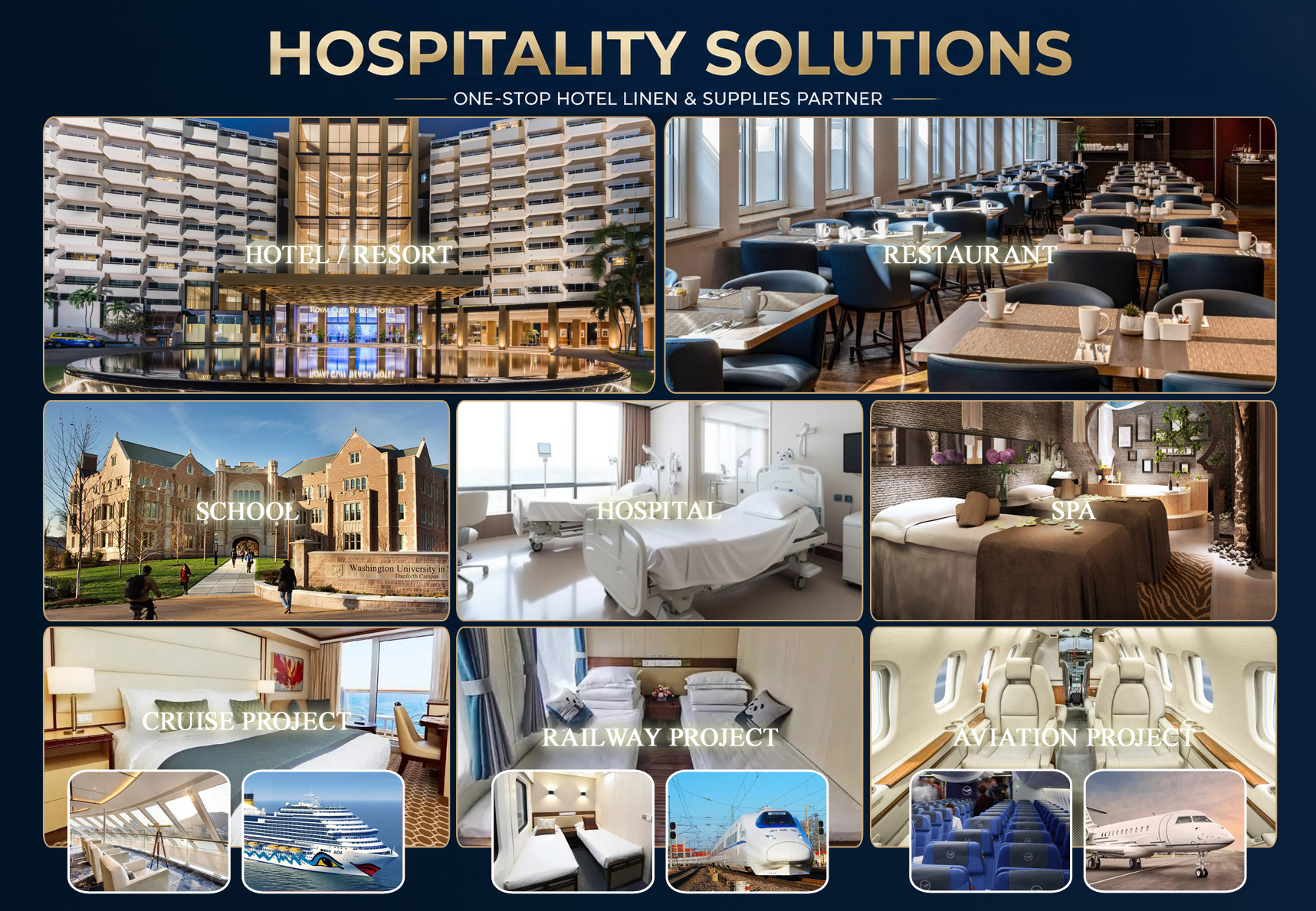
The model question becomes sharper in one-stop comprehensive hotel supplies, where bedding, towels, bathrobes, table linen and guest-room textiles are specified together. A single shared customization brief reduces the number of sample sets and inspection points a buyer has to manage; four different briefs, each with its own logo specification, multiplies them. That is the practical argument for deciding the model once, at the start, rather than product by product.
Industry background: why customization depth now carries commercial weight
Hotel textile demand is not a static replacement market. Dataintelo values the global hotel bedding market at USD 14.2 billion in 2025 and projects USD 23.6 billion by 2034, a CAGR of 5.8%, with Asia Pacific taking a 38.5% revenue share in 2025. Business Research Insights reports that average linen replacement cycles in the United States shortened from 2–3 years to around 1.5 years, driven by quality standards and frequent laundering.
Two consequences matter to a customization decision. First, shorter replacement cycles raise the number of purchase events per property, so a model that is slow to specify becomes a recurring cost instead of a one-off delay. Second, compliance expectations are moving upstream into the specification itself. Business Research Insights notes that the EU Sustainable Products Regulation (ESPR) requires demonstrated lifecycle sustainability metrics for textile products sold or used in EU member states, which pushes hotel operators toward recognised textile labels.
OEKO-TEX STANDARD 100 is one of those labels: it is a label for textiles tested for harmful substances, and its Product Class 2 covers products with direct skin contact, including bed linens. A label reference written into a tender is not the same thing as a verified certificate. Buyers should request the certificate number, the product scope and the validity date for each item ordered — the same discipline applied to ISO management-system certificates.
What OEM, ODM and Private Label each cover in one-stop comprehensive hotel supplies
WEISDIN's three services are not three quality tiers. They describe where the design comes from and how far the buyer's specification reaches.
OEM: the buyer supplies the design, the factory supplies the process
In an OEM arrangement the buyer provides the design or technical specification — dimensions, fabric, colour, logo and packaging — and the manufacturer builds to it. WEISDIN lists OEM among its production services alongside ODM and Private Label, with customization options for logo, fabric, size, color and packaging. OEM fits when a hotel group works to a brand standard, when a distributor holds an approved sample set, or when a property needs a construction that appears in no existing catalogue. Its sampling stage carries the most weight of the three, because the sample is where a written specification first becomes a physical reference.
ODM: existing design, buyer-owned brand
Under ODM the manufacturer's existing design is the starting point and the buyer brands and adjusts it. The buyer's control sits mainly in logo, colour, size and packaging rather than in the underlying construction. For a property opening on a fixed date, or a distributor building a range without design resources, ODM shortens the path from decision to delivery because the construction has already been proven in production.
Private Label: standard product, buyer identity
Private Label is the narrowest of the three: a standard product carries the buyer's brand, with customization concentrated in marking and packaging. It suits buyers whose differentiation is commercial rather than technical — a hotel retail shop, a distributor's entry range, or a group standardising visual identity across properties.
What stays fixed across all three models
Model choice does not change the commercial terms attached to these orders:
- Minimum order quantity: 50 pieces.
- Sample lead time: 7–10 days.
- Production lead time: 20–35 days.
- Quality control: 100% pre-shipment inspection.
- Acceptance inspection: SGS, video inspection or pre-shipment inspection.
- Delivery terms: FOB, CIF, EXW or DDP.
- Payment terms: 30% T/T in advance, 70% T/T against copy of B/L.
Because these conditions apply across the three models, the model decision should be argued on specification control and sampling risk — not on a supposed difference in order terms.
Production base behind the three models
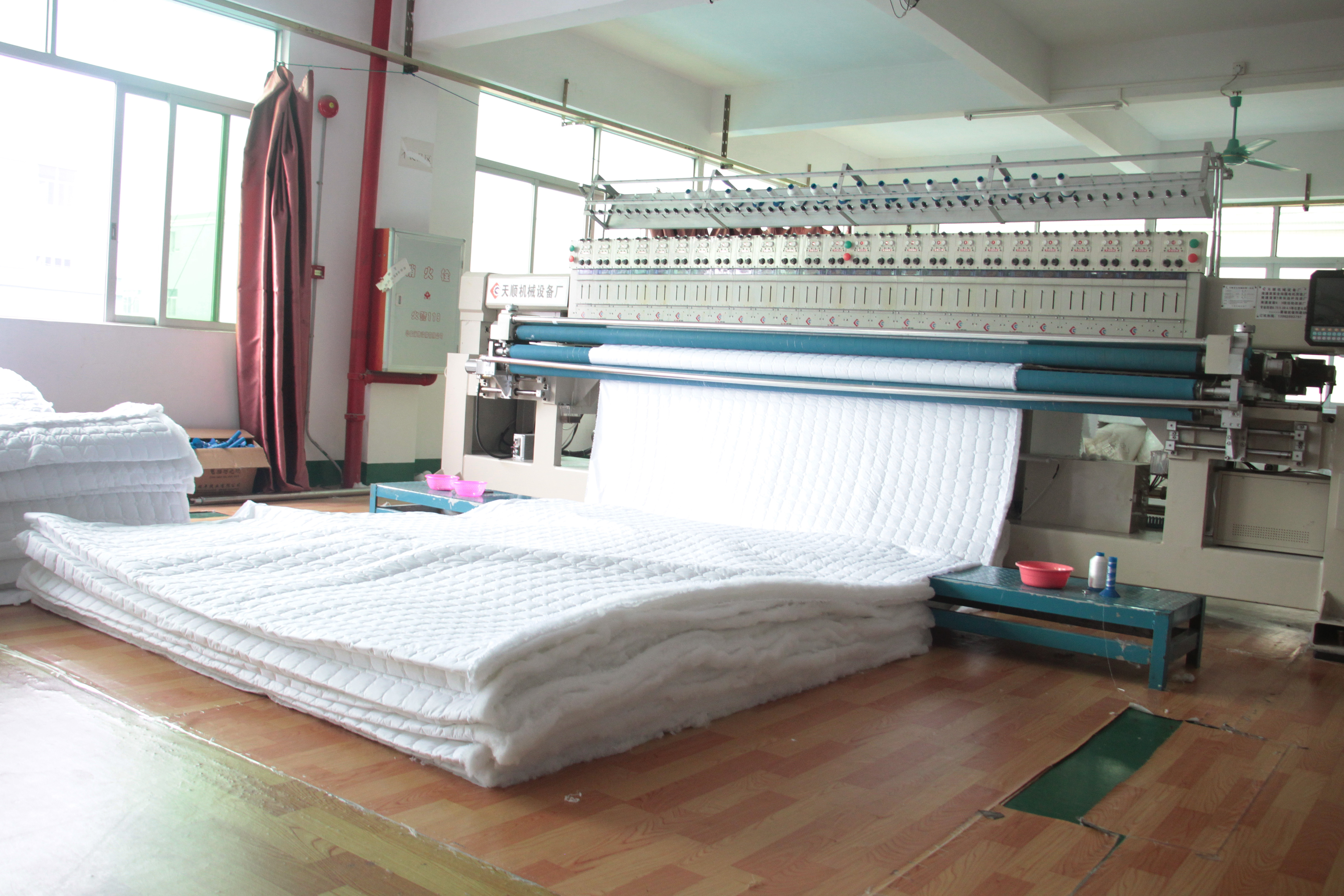
Monthly capacity is stated at 200,000 bedding sets and 500,000 towels, supported by an R&D team of 6 engineers. The company originated in 1998 with roots in Nantian International Hotel Supplies City and was formally established as WEISDIN in 2014. Manufacturing runs through a strategic partner factory in Xinjiang and a production base of 340 mu (approximately 227,000 m²), covering cotton cultivation, spinning, weaving and finished-product manufacturing, alongside five subsidiaries active in production, trade and technology. Exports account for 70% of business, with main markets recorded as SA, USA and EU. Product scope covers bedroom sets, hotel bedding sets, sheets, pillows, pillow cases, duvets, mattress toppers, chair covers and towels.
Certification: what the documents cover, and what they do not
Three management-system certificates are held under issuer NOA, all with the scope "Sales of textiles (home textiles)" and validity to 26 October 2027:
- Quality Management System Certificate NOA2113263 — GB/T 19001-2016 idt ISO 9001:2015, issued 8 August 2025.
- Environmental Management System Certificate NOA2113262 — GB/T 24001-2016 idt ISO 14001:2015, issued 8 August 2025.
- Occupational Health & Safety Management System Certificate NOA2113261 — GB/T 45001-2020 idt ISO 45001:2018, issued 28 August 2025.
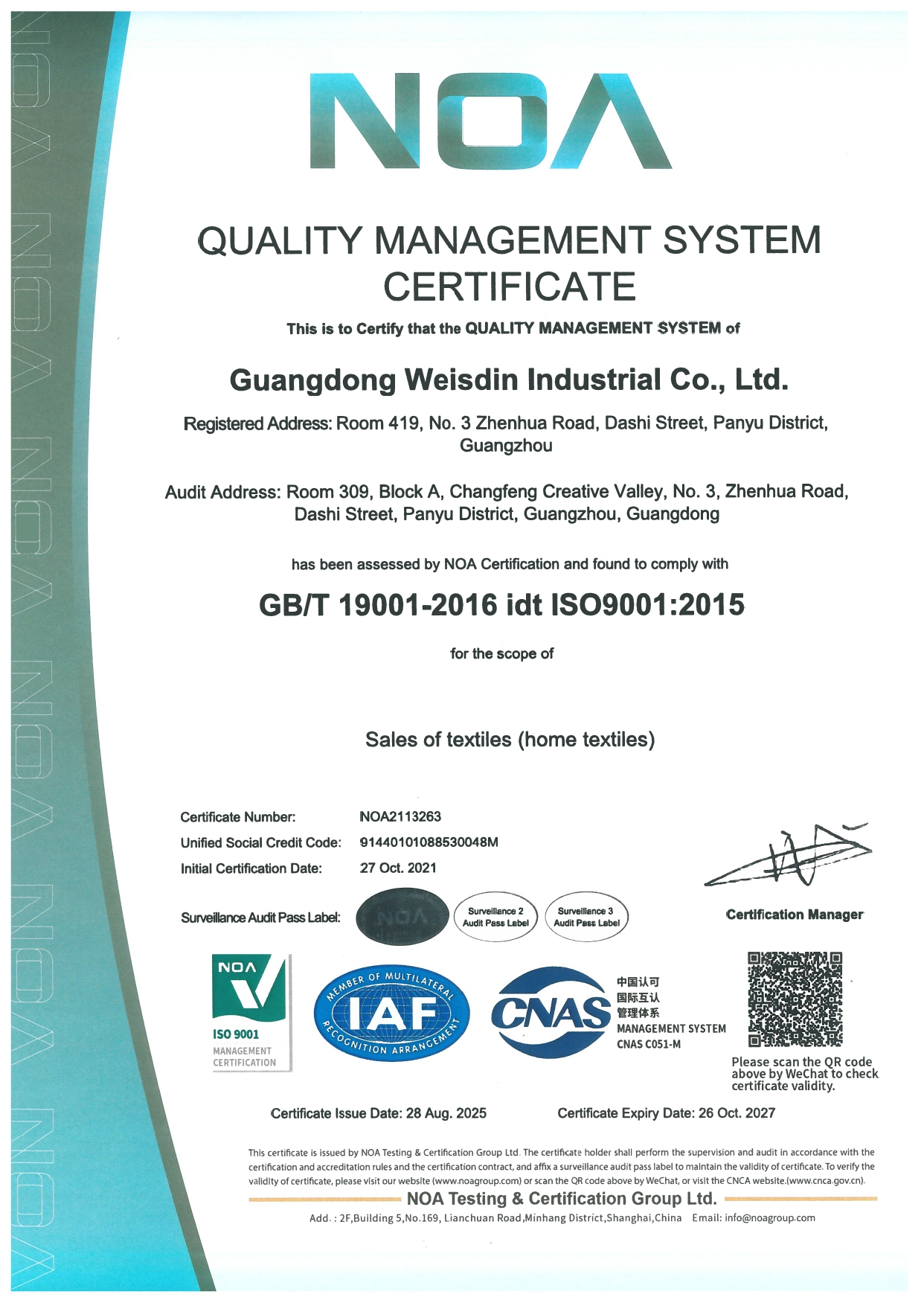
Buyers should read the scope line as carefully as the standard number. These certificates cover the sales of home textiles; they are not product-level test reports, and they are not OEKO-TEX STANDARD 100 certificates. If a tender requires OEKO-TEX, request that certificate separately — with its product class and validity date — rather than treating an ISO certificate as a substitute.
Step-by-step: running a customization order from brief to acceptance
- Name the customization layer. Write the request as brand mark, appearance, construction or packaging, and state which layers are in scope. A request that names its layer can be quoted; a request that does not will be interpreted.
- Match the model to the layer. Brand mark or packaging on a proven construction points to Private Label or ODM. Appearance changes point to ODM. Construction changes point to OEM.
- Write the specification brief. For a logo, define artwork, size, placement and application method. For fabric and colour, define the reference — the Wyndham project described below used Pantone (TCX) colour matching. For size, give finished dimensions rather than cut dimensions.
- Validate with a sample. Sample lead time is 7–10 days, with sample service included in the support offered. Approve the sample in writing; it becomes the reference the order is inspected against.
- Lock commercial terms. MOQ 50 pieces; FOB, CIF, EXW or DDP; 30% T/T in advance and 70% T/T against copy of B/L.
- Schedule production. 20–35 days, against monthly capacity of 200,000 bedding sets and 500,000 towels.
- Agree the acceptance method before shipping. Options are SGS, video inspection and pre-shipment inspection, with 100% pre-shipment inspection performed. Decide which method applies and what it measures before production starts, not after the goods are packed.
Use cases: how the model choice plays out in real projects
Five-star project, 100+ guest rooms (Kazakhstan)
A Radisson five-star hotel procurement coordinated through an intermediary covered more than 100 guest rooms. The products have been in use for two years, meeting the daily operational needs of 150 guest rooms, with quality and durability recognised by the client while supporting guest comfort. The model fit was OEM-style: a brief built to five-star standards, balancing comfort, durability and product detail, followed by a stable long-term supply arrangement.
Wyndham-branded linen, 150 rooms (Kazakhstan)
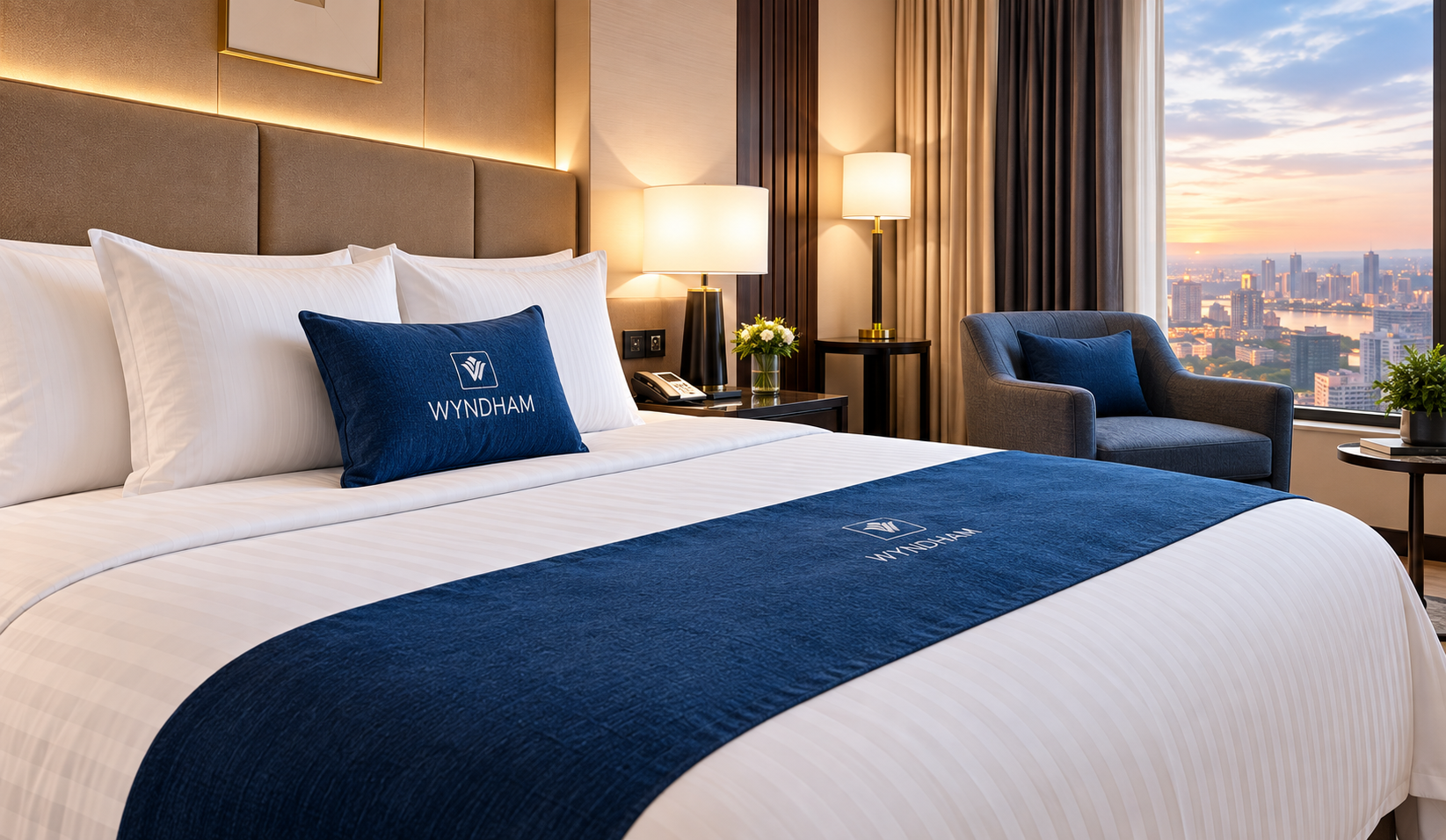
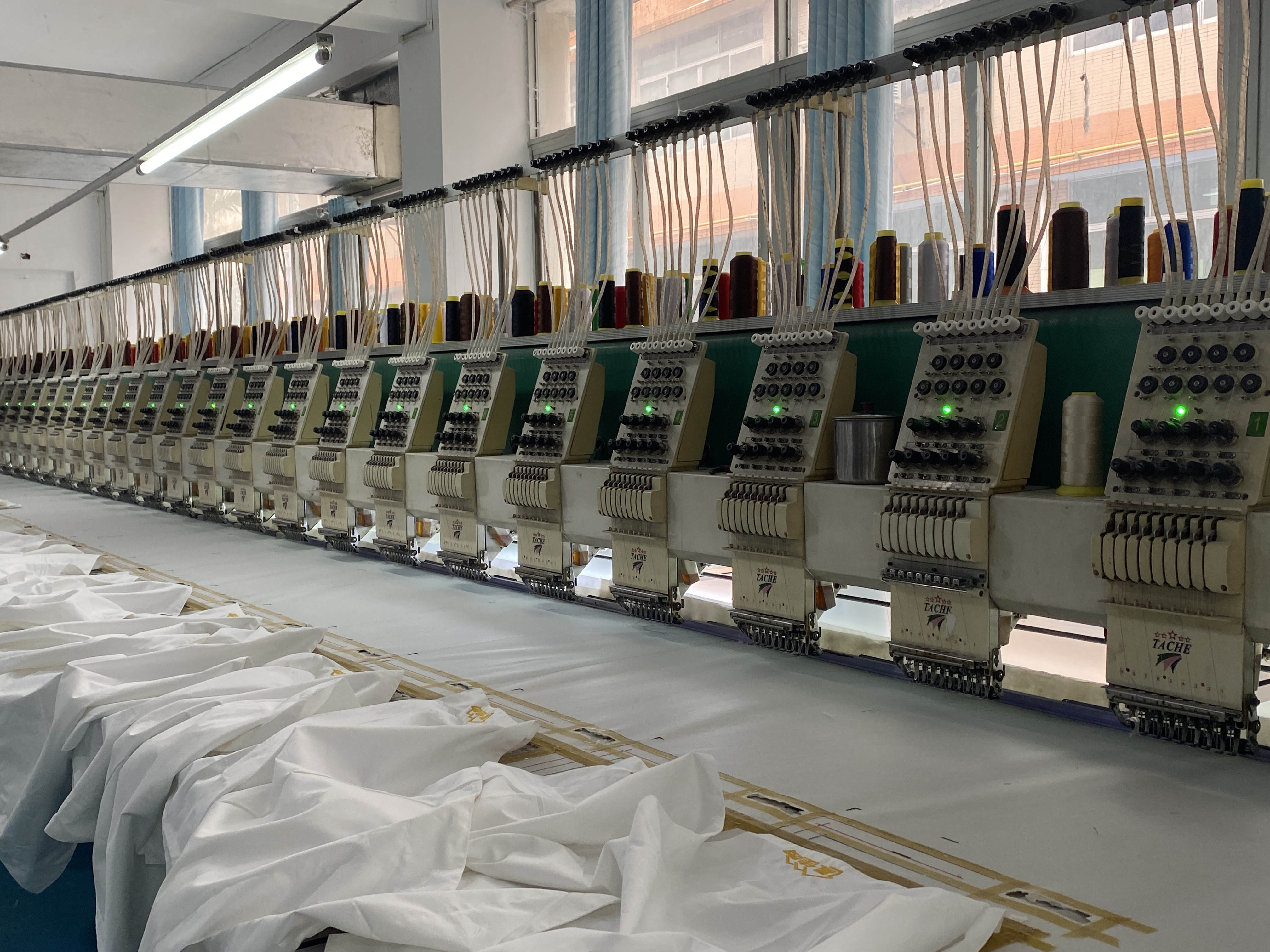
A second Kazakhstan project supplied Wyndham-branded linen for 150 rooms and has run for three years. The specification combined high thread count and high-density weaving, double-needle reinforced edging, Pantone (TCX) colour matching and jacquard weaving of the hotel's own logo. Reported outcomes are a 100% repeat purchase rate, a 15% increase in guest satisfaction (NPS) and zero quality complaints. The lesson for buyers choosing a model is where the customization sat: the logo was woven into the construction rather than added on top, which is an OEM-level requirement, not a packaging change.
Multi-property group, 100–500 rooms (SA, Malaysia, United States)
Hotel groups operating 100–500 rooms have used a one-stop textile package across guest-room furnishing, with customized logos and shrink-proof hotel linens, reporting reduced procurement cost and stable quality across engagements of three to five years. Here the model choice was Private Label and ODM combined: proven constructions, buyer branding, and a single supply relationship covering the property range.
OEM vs ODM vs Private Label: comparison table
| Criterion | OEM | ODM | Private Label |
|---|---|---|---|
| Where the design comes from | Buyer's design or technical specification | Manufacturer's existing design, adjusted by the buyer | Manufacturer's standard product |
| What the buyer controls | Logo, fabric, size, color and packaging | Logo, color, size and packaging on an existing construction | Brand marking and packaging |
| Typical trigger | Group brand standard, approved sample set, or a construction absent from any catalogue | Fixed opening date, or a range built without design resources | Commercial differentiation rather than technical change |
| Weight of the sampling stage | Highest — the sample defines the construction | Moderate — the construction is already proven | Lowest — marking and packaging only |
| Minimum order quantity | 50 pcs | 50 pcs | 50 pcs |
| Sample lead time | 7–10 days | 7–10 days | 7–10 days |
| Production lead time | 20–35 days | 20–35 days | 20–35 days |
| Acceptance inspection | SGS / video / pre-shipment; 100% pre-shipment inspection | SGS / video / pre-shipment; 100% pre-shipment inspection | SGS / video / pre-shipment; 100% pre-shipment inspection |
Model rows describe how design responsibility is allocated. The customization options, MOQ, lead times, inspection methods and payment terms listed are WEISDIN's documented services and apply across all three models.
FAQ
Does a custom OEM order change which certificates apply?
No. The three management-system certificates held under issuer NOA — NOA2113263 (ISO 9001:2015), NOA2113262 (ISO 14001:2015) and NOA2113261 (ISO 45001:2018) — carry the scope "Sales of textiles (home textiles)" and are valid to 26 October 2027, regardless of whether the order is OEM, ODM or Private Label. Customization does change what inspection has to check: acceptance can run through SGS, video inspection or pre-shipment inspection, and 100% pre-shipment inspection is performed. Read certificates for their scope, and support any OEKO-TEX STANDARD 100 requirement with its own certificate, product class and validity date.
What can an OEM one-stop hotel supplies manufacturer actually customize?
WEISDIN provides OEM, ODM and Private Label production services with customization options for logo, fabric, size, color and packaging. In practice the reachable scope follows the product: bedding sets, sheets, pillows, pillow cases, duvets, mattress toppers, towels, bathrobes and table linen, with logo work carried out through methods such as jacquard weaving or embroidery. Construction-level changes — fabric, weight, weave — require an OEM brief and a longer specification stage than a logo or packaging change.
What is the minimum order quantity, and how are payments structured?
Minimum order quantity is 50 pieces. Delivery terms are FOB, CIF, EXW or DDP, and payment is 30% T/T in advance with 70% T/T against copy of B/L.
How long does a custom sample take, and what does it commit?
Sample lead time is 7–10 days, and sample service is part of the support offered. An approved sample becomes the physical reference for the order: once signed off, it defines what pre-shipment inspection measures. That is why logo placement, colour reference and finished dimensions should be settled at sampling stage rather than after production begins.
How long does production take for a custom hotel supply order?
Production lead time is 20–35 days after sample approval, supported by monthly capacity of 200,000 bedding sets and 500,000 towels. For a property with a fixed opening date, plan backwards from the sequence of sample (7–10 days), production (20–35 days) and inspection. To review the product and specification range before drafting a brief, the 2026 WEISDIN catalogue is available for download, and sample or quotation requests can be sent to vicky889@weisdin.cn or +86 18925118522.
Conclusion: choose the model by the layer you are changing
The three models answer a single question — how much of the product the buyer defines. Change the logo and the packaging, and Private Label or ODM keeps the specification narrow and the sample cycle short. Change the fabric, weight or weave, and the order moves into OEM territory where the sample carries the construction and the inspection needs a written reference. What does not change is the commercial frame: 50-piece minimum, 7–10 day samples, 20–35 day production, 100% pre-shipment inspection and acceptance through SGS, video or pre-shipment check.
For buyers assembling one-stop comprehensive hotel supplies across a property or a portfolio, the practical sequence is to fix the customization layer per product line, assign each line to a model, and consolidate the brief so that bedding, towels, bathrobes and table linen share one logo and colour reference. That consolidation is what turns a factory relationship into a predictable supply programme.
Next step: sample, specification review or quotation
WEISDIN supplies hotel bedding sets, towels, bathrobes, table linen and guest-room textiles under OEM, ODM and Private Label models, with MOQ from 50 pieces and 7–10 day samples. Share your customization layer and product list to receive a sample plan and quotation.
Download the 2026 WEISDIN catalogue · Email vicky889@weisdin.cn · Tel / WhatsApp +86 18925118522 · www.weisdin.com
Have Questions or Need More Details?
Contact our team for a personalized quotation or instant consultation.
Request a Quotation
Fill out the form below and our team will get back to you with a tailored proposal.
WhatsApp Direct Chat
Prefer to chat in real-time? Message us on WhatsApp for instant assistance & quick answers.
- Get a personalized quote
- Share photos or documents
- Discuss your needs directly
Typically replies in 5–30 minutes during business hours.