One-Stop Comprehensive Hotel Supplies: Executing Custom OEM Orders
A custom OEM order for hotel textiles is executed in stages: specification, sampling, approval, production scheduling, inspection and shipment. Each stage produces a record that the next stage depends on. When those stages are split across separate bedding, towel, bathrobe and table-linen vendors, the buyer ends up managing several schedules that each claim to follow the same brand standard. A one-stop comprehensive hotel supplies program exists to run them as a single sequence, with one specification sheet and one approval trail.
WEISDIN is the international hotel-textile brand of Guangdong Weisdin Industrial Co., Ltd., a Guangzhou-based enterprise established in 1998 that designs, develops, manufactures and sells star-rated hotel textiles for bedroom, bathroom and dining use. This page explains how a custom OEM order is actually executed inside that structure: which variables can be customized, in what order the work happens, which parameters are documented on the specification sheets, and what a buyer should verify before releasing a production order.
Why custom OEM programs break down across multiple vendors
The failure mode in hotel textile procurement is usually not the product. It is the coordination around the product. Multi-vendor programs break down in predictable places.
- Different minimum order quantities per category. A property may need 300 bedding sets but only 120 bathrobes, and separate MOQs force over-ordering on one line to reach a vendor's minimum on another.
- Separate sampling cycles. Bedding, terry and table linen are typically sampled in different weeks, so approvals are made against different references and different dye lots.
- Different logo methods. Embroidery, print and woven labels behave differently on cotton, waffle and jacquard fabric, which appears as inconsistent branding inside the same guestroom.
- Non-comparable inspection reports. Inspections performed by different vendors rarely use the same criteria, so the reports cannot be read against each other.
- Multiplied documentation. Freight bookings, packing lists and payment schedules multiply with every additional supplier added at the execution stage.
For a property or group furnishing hundreds of rooms, these are operational issues rather than cosmetic ones. One documented WEISDIN project profile covers a hotel group and resort customer operating across Saudi Arabia, Malaysia and the United States, furnishing 100–500 rooms with guest-room textiles for daily operation. The relationship has run 3–5 years, with a recorded outcome of reduced procurement cost and stable quality, supported by a one-stop textile solution, customized logo work and shrink-proof hotel linens.
What is changing in hotel textile sourcing
Three background movements shape how hotel textile programs are specified today, and each one pushes more detail into the technical brief rather than into the purchase order.
- Category growth. The global hotel supplies market was valued at approximately USD 62.01 billion in 2024 and is projected to reach USD 82.07 billion by 2031 (Grand View Research). Hotel bedding alone is estimated at USD 14.2 billion in 2025, with a CAGR of 5.8% through 2034 (Dataintelo).
- Bathroom linen is the fastest-growing application. Bathroom linen is projected to grow at a 7.92% CAGR to 2031, driven by hospitality-led upgrades to terry (Mordor Intelligence). In practice, towel weight, yarn count and colour retention move earlier into the buyer's technical brief.
- A concentrated, export-driven supply base. China's exports of textile yarn, fabrics and articles reached USD 141.96 billion in 2024, up 5.7% year on year (General Administration of Customs of China). Third-party procurement guides also commonly list large distributors — Guest Worldwide (Sysco), American Hotel Register, HD Supply and 1888 Mills — among the biggest global hospitality supply players, which is why manufacturer-direct and distributor routes are usually compared side by side.
On compliance, OEKO-TEX® STANDARD 100 is the primary global safety benchmark for hotel textiles, screening for more than 1,000 harmful substances. Because the standard applies to tested articles rather than to a company as a whole, the certificate must be matched to the specific fabric and product being ordered — a point that belongs in the specification sheet, not in the final week before shipment.
What a one-stop comprehensive hotel supplies manufacturer can actually customize
Capability in this context is not a claim about scale. It is a documented list of variables that can be changed without changing supplier, each with a stated minimum and lead time. WEISDIN's documented capability set covers OEM, ODM and private label production, with logo, fabric, size, colour and packaging as the five customization fields.
Production model: OEM, ODM and private label
The three production models answer different buyer situations. In OEM work the buyer supplies the design intent and the manufacturer executes it to specification. In ODM work the manufacturer proposes an existing construction that the buyer brands. Private label applies the buyer's identity to a defined product range. All three run from the same production base, which is what allows a bedding line, a terry line and a dining-linen line to be approved under one brand standard instead of three.
Logo and brand marks
Custom embroidered hotel logo work is the clearest illustration of how a single-vendor program differs from a split one. Embroidery settings, thread colour and placement are fixed once and then applied consistently across bedding, towels, bathrobes and mats. Split across vendors, the same logo often appears in three sizes and two thread tones inside one room. Logo is one of the five documented customization fields, and logo work is validated at sample stage before a production order is released.

Fabric, construction and performance
Documented fabric options give the buyer a technical vocabulary to specify with. Bedding sets are produced in 100% cotton across satin stripe, air-jet sateen and jacquard constructions. The 3cm Satin Bedding Set (CP106) is made in 40×40 and 60×40 satin stripe at 250T to 400T, with 0.5 cm to 3 cm stripe designs. The Sateen Bedding Set (CP128) spans 40×40 air-jet twill through 80×80 air-jet sateen at 250T to 600T. The Jacquard Bedding Set (CP139) uses arrow-shaft jacquard in 60×40, 60×60 and 60×80 at 300T to 400T. Maximum washing temperatures are documented per construction — 90 °C for the satin-stripe and jacquard sets, 70 °C for the sateen set — which is the kind of detail that decides whether a specification survives a hotel laundry.
Terry and bath products are specified by weight and yarn count instead. Towels and bath mats are produced in 100% cotton at 21S/32S and 16S/32S, with towel weights from 60 g to 700 g and mat weights from 300 g to 400 g, plus a long-wool floor mat option at 600 g to 1,300 g. The Waffle Bathrobe (YP9600) is offered at 700 g, 750 g, 1,000 g and 1,200 g in small waffle, medium waffle, waffle-and-terry and waffle-modal air-layer constructions.
Two buyer requirements deserve to be settled at specification rather than after the first laundry cycle. Chlorine resistant hotel towels depend on colour retention under high-chlorine wash programs, and shrink-proof hotel bed sheets depend on a finished-size tolerance that holds after repeated industrial washing. Both are sample-stage decisions: they can be tested on the actual fabric before bulk production, but neither can be corrected economically once the order is cut.
Size, colour and packaging
Size is a documented variable across the range: towels from 33×33 cm to 80×150 cm, bath mats in 50×80 cm, 60×90 cm and 60×120 cm, table cloths in 260×260 cm, 300×300 cm and 320×320 cm, napkins in 45×45 cm and 50×50 cm, and bathrobes in 120×130×50 cm. Colour options on the Embroidered Bedding Set (CP152) and the Printed Duvet Bedding Set (CP186) include blue, gold, green and white, with custom colours available; both models support crystal-love and water-ripple patterns as well as a custom hotel logo. Packaging is a customization field in its own right and is specified with the same discipline as the product itself.

Compliance: which certificates are actually held
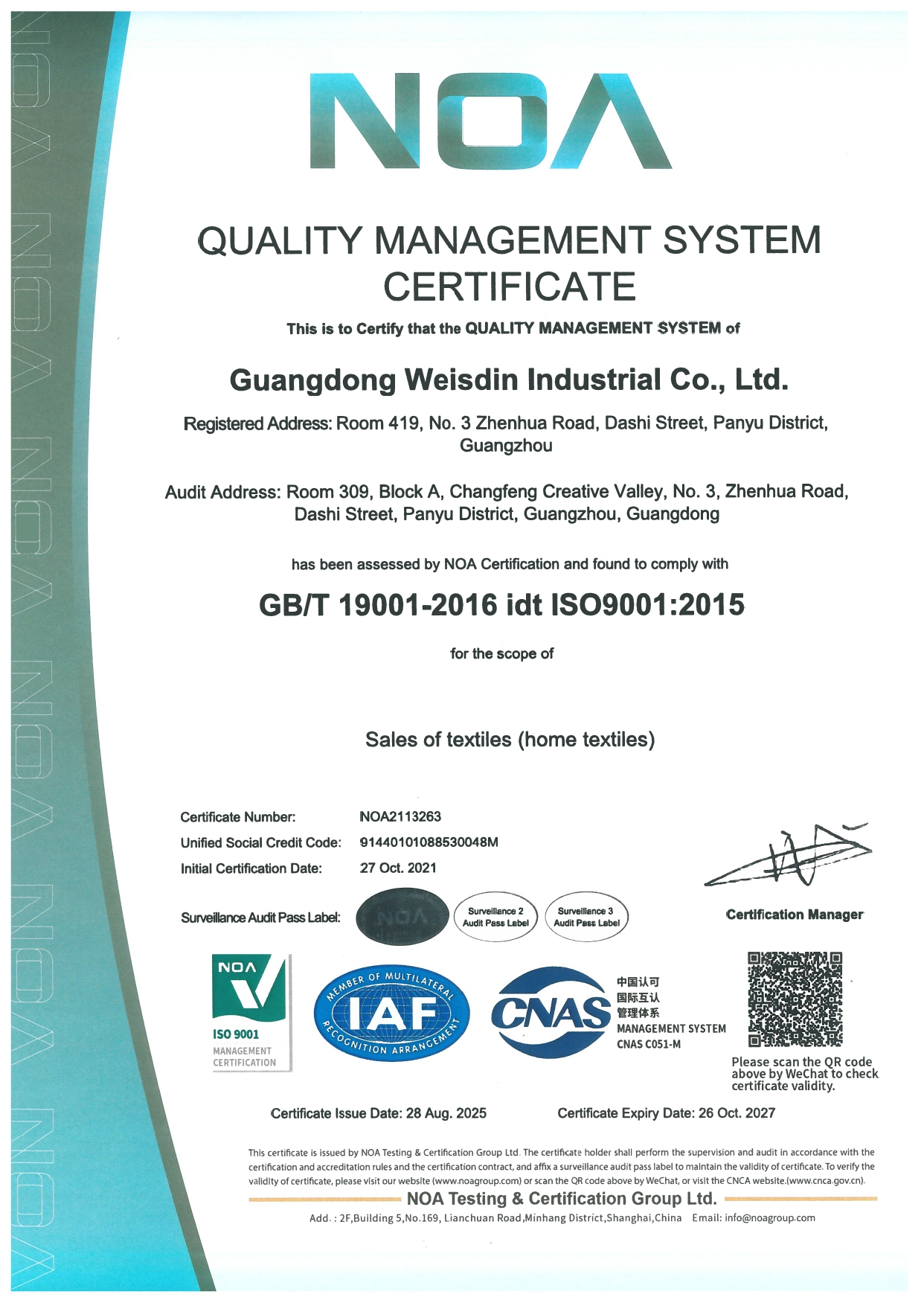
WEISDIN's management-system certificates are traceable by number and scope. The Quality Management System Certificate (GB/T 19001-2016 idt ISO9001:2015) is held under certificate NOA2113263; the Environmental Management System Certificate (GB/T 24001-2016 idt ISO 14001:2015) under NOA2113262; and the Occupational Health & Safety Management System Certificate (GB/T 45001-2020 idt ISO45001:2018) under NOA2113261. All three were issued by NOA in 2025 and expire on 26 October 2027, covering the sales of textiles (home textiles) for Europe, North America, the Middle East, Australia and Southeast Asia. Each number, holder name and scope can be verified on the issuing body's register before the order moves to production.
Step-by-step: how a custom OEM order is executed
The sequence below reflects the documented capability set: OEM/ODM/private label production, customization across logo, fabric, size, colour and packaging, a base MOQ of 50 pcs, sample lead time of 7–10 days, production lead time of 20–35 days, and 100% pre-shipment inspection.
- Specification sheet. The brief fixes product mix, fabric or weight, size, colour, logo placement, packaging and acceptance criteria. Everything that will later be checked at inspection is defined here, which is why a vague brief reappears as a dispute at shipment.
- Sampling (7–10 days). Samples are produced against the brief. Sample orders are accepted, and sample lead time is typically 7–10 days. For embroidered or printed bedding built around a new design, the product sheets document a lead time of 30+ days.
- Approval and MOQ confirmation. Approval locks colour, construction, finished size and logo position. The base MOQ is 50 pcs; customized bedding designs are documented at 100 sets, and towels, bath mats and similar terry items at 100 pcs.
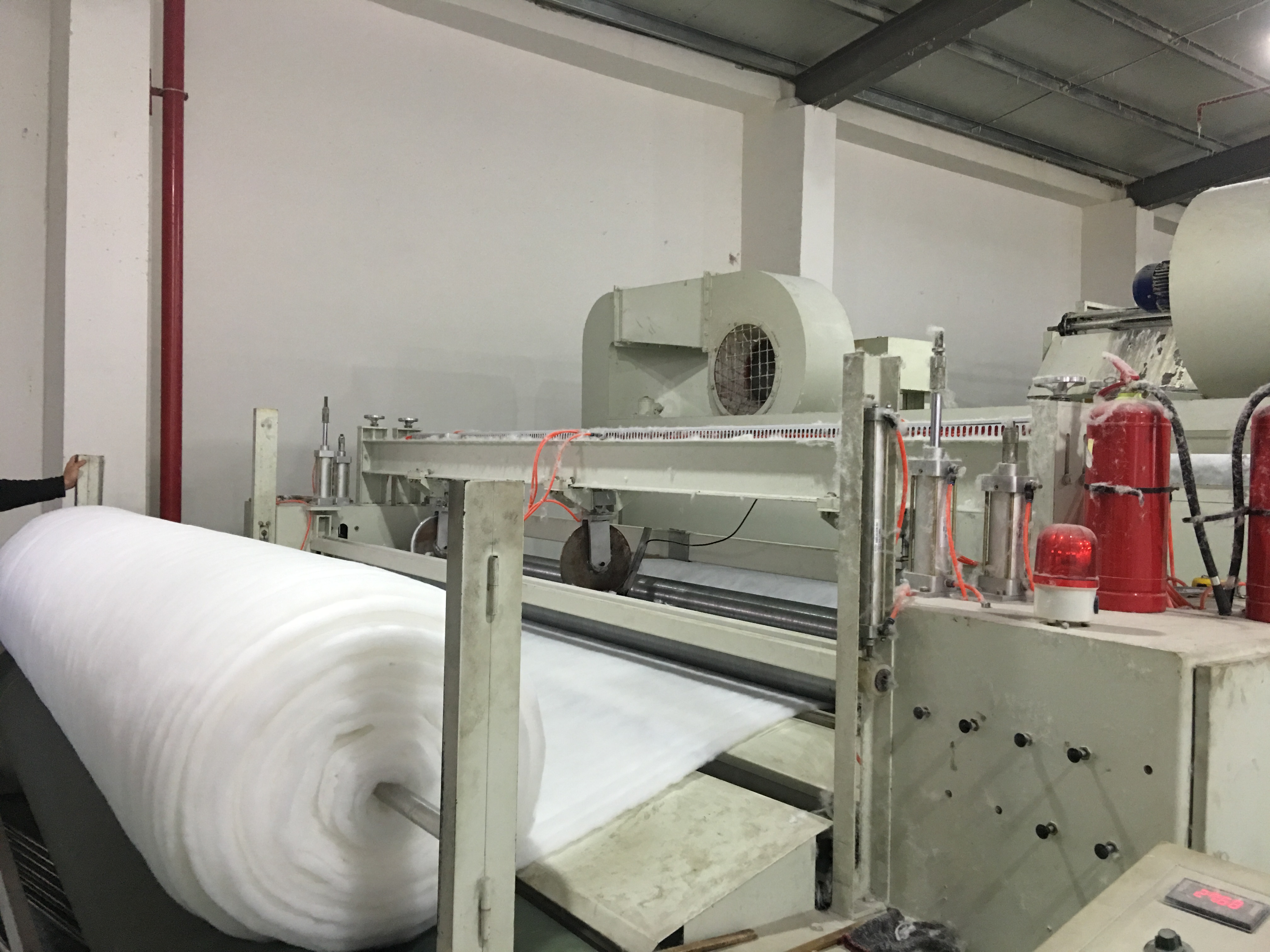
- Production scheduling (20–35 days). Documented monthly capacity is 200,000 bedding sets and 500,000 towels, which is what allows several categories to be scheduled into one production window instead of queueing behind each other at different vendors.
- Inspection. Quality control includes 100% pre-shipment inspection. Acceptance can be handled through SGS, video inspection or pre-shipment inspection, so the buyer can match verification depth to order value.
- Documents, payment and delivery. Delivery terms include FOB, CIF, EXW and DDP. Standard payment terms are 30% T/T in advance with 70% T/T against a copy of the bill of lading.
Documented execution parameters at a glance
| Parameter | Documented value |
|---|---|
| Production model | OEM, ODM, private label |
| Customization fields | Logo, fabric, size, colour, packaging |
| Base minimum order quantity | 50 pcs |
| MOQ for customized designs | 100 sets (customized bedding designs); 100 pcs (towels, bath mats) |
| Sample lead time | 7–10 days |
| Production lead time | 20–35 days |
| Monthly capacity | 200,000 bedding sets; 500,000 towels |
| Annual output | 2,000,000 pcs |
| Quality control | 100% pre-shipment inspection |
| Acceptance options | SGS, video inspection, pre-shipment inspection |
| Delivery terms | FOB, CIF, EXW, DDP |
| Payment terms | 30% T/T in advance; 70% T/T against copy of B/L |
| Export profile | 70% export ratio; main markets Saudi Arabia, USA, EU |
Use cases: where execution quality decides the outcome
Guest-room textile refresh across 100–500 rooms
A staged refurbishment is the hardest test of a one-stop program, because bedding, towels, bathrobes and mattress protectors are replaced in phases while the property keeps operating. When all categories come from one production base, a replacement batch matches the original batch on construction and colour, which is what makes the 3–5 year relationship profile realistic rather than optimistic.
Bathroom linen upgrade with a performance brief
Bathroom linen is the fastest-growing application in hotel textiles, and the growth is concentrated in upgraded terry. Buyers upgrading from a light towel to a heavier weight also need the specification to state yarn count, weight and colour-retention behaviour, because a heavier towel that fades early costs more in replacement cycles than it saved in unit price.
Dining and banquet programs
Restaurant and banquet linen is usually specified separately from guest rooms, which is how a property ends up with two suppliers and two delivery calendars. Documented dining options in the range include a polyester table cloth (TB1102) in 260×260 cm, 300×300 cm and 320×320 cm with a double-needle side finish, and a cotton napkin (CJ9800) in 45×45 cm and 50×50 cm at 42s/2×42s/2 and 103×95 density. Placing them in the same order cycle as guest-room textiles removes one supplier and one shipping calendar.
Smaller properties and independent hotels
Flexible MOQ hotel orders matter most where room counts are modest. A base MOQ of 50 pcs allows a boutique property to specify branded items without committing to container-scale volumes, while customized bedding designs and terry items are documented at 100 sets and 100 pcs respectively.
Comparison table: documented customization by product family
| Product family and models | What is documented as customizable | Key documented specification range |
|---|---|---|
| Bedding sets — CP106, CP128, CP139, CP152, CP186 | Fabric construction, yarn count and density, stripe or pattern design, colour, custom hotel logo, size and packaging | 100% cotton; 250T–600T; satin stripe, air-jet sateen, arrow-shaft jacquard; machine wash up to 90 °C (70 °C on CP128); MOQ 100 sets for customized designs |
| Towels and bath mats — MJ8300, MJ8500, DJ9100, DJ9200 | Craft (plain, jacquard, embroidered), weight, size, logo | 100% cotton, 21S/32S and 16S/32S; towels 60–700 g from 33×33 cm to 80×150 cm; mats 300–400 g at 50×80 cm; MOQ 100 pcs |
| Long-wool floor mat — DJ9300 | Weight, size | 100% cotton; 600 g, 900 g, 1,000 g, 1,300 g; 50×80 cm, 60×90 cm, 60×120 cm; MOQ 100 pcs |
| Bathrobe — YP9600 | Collar construction, weight | Waffle; 700 g, 750 g, 1,000 g, 1,200 g; 120×130×50 cm; yarn count 21 |
| Mattress protector — HD3700 | Size and sewing specification | Cotton with environmental setting cotton filling; 3 stitches, 5 threads; 3 cm imported elastic bands at four corners; wash or dry clean up to 90 °C |
| Duvets and quilts — CX2120, BX280, BX296 | Filling and shell material, size | Down-proof cloth with whole down filament (CX2120); 60s satin cotton with goose-down-like filling (BX280); 133×100TC cotton with goose down and feather (BX296); dry clean only, max 90 °C |
| Pillow — ZX5103 | Size, weight | Down-proof fabric with microfiber filling; 800 g and 1,000 g; 45×75 and 48×78 |
| Mattress comforter — HD3000 | Filling composition and weight | White duck down 100 g/m² upper; 2–4 cm white duck feather 1,500 g/m² lower; 4040 / 133100 down-proof fabric |
| Dining linen — TB1102, CJ9800 | Size, edge finish, craftsmanship | Polyester table cloth, high-precision jacquard, double-needle side, 260×260 cm to 320×320 cm; cotton napkin 42s/2×42s/2 at 103×95, 45×45 cm and 50×50 cm |
What to verify before releasing a production order
- Certificate numbers, holder name, scope and expiry date checked on the issuing body's register.
- Sample approved against the same specification sheet that production will be inspected against.
- Logo artwork, size and placement confirmed on the actual fabric, not on a screen.
- Finished-size tolerance and colour-retention expectations written into the brief where laundry conditions are aggressive.
- MOQ, payment terms and delivery term confirmed in writing, since MOQ depends on fabric development, dye lot and packaging.
- Inspection route chosen in advance — SGS, video or pre-shipment — so verification is not decided after production ends.
One boundary is worth stating plainly. WEISDIN's documented product range is textile-based: bedroom, terry, bathrobe, mat, mattress protector and dining linen. Items such as slippers, toiletries and mattresses are not part of that documented range and need a separate source. A buyer building a full guest-room package should plan that boundary into the vendor list rather than assume it away.
Frequently asked questions
Which certifications should a buyer verify from an OEM one-stop hotel supplies manufacturer?
Three management-system certificates can be verified by number on the issuing body's register: ISO 9001:2015 quality management (certificate NOA2113263), ISO 14001:2015 environmental management (NOA2113262) and ISO 45001:2018 occupational health and safety management (NOA2113261), all issued by NOA in 2025 and expiring on 26 October 2027. Their scope covers the sales of textiles (home textiles) for Europe, North America, the Middle East, Australia and Southeast Asia. Where a project also specifies OEKO-TEX® STANDARD 100 — the benchmark that screens for more than 1,000 harmful substances — the certificate should be requested at sample stage so the tested article matches the article being ordered.
What can actually be customized in a private-label hotel textile program?
Five fields are documented as customizable under OEM, ODM or private label production: logo, fabric, size, colour and packaging. Practical examples from the product sheets include custom embroidered hotel logo work across bedding, towels and bathrobes; crystal-love and water-ripple patterns with custom colourways (blue, gold, green, white) on the Embroidered Bedding Set CP152 and the Printed Duvet Bedding Set CP186; collar and weight options on the Waffle Bathrobe YP9600; and sizes ranging from 33×33 cm towels to 320×320 cm table cloths. What falls outside the range is equally useful to know: slippers, toiletries and mattresses are not listed, so they require a separate supplier.
What is the minimum order quantity, and how flexible is it in practice?
The base MOQ is 50 pcs, which is what makes flexible MOQ hotel orders workable for smaller properties and independent hotels. The figure rises where design or tooling work is involved: customized bedding designs are documented at 100 sets, and towels and bath mats at 100 pcs, with sample orders accepted. Because MOQ is influenced by fabric development, dye lot and packaging, the final number is confirmed at quotation rather than assumed from a catalogue page.
How does sampling and validation work before bulk production?
Sample lead time is typically 7–10 days, and sample orders are accepted across the terry and mat range. Sampling is the stage where colour, construction, finished size, logo placement and packaging are locked, and where performance questions — colour retention in chlorine-exposed towel programs, or shrink tolerance in bed sheets — are answered on the actual fabric rather than on a data sheet. Where embroidered or printed bedding is built around a new design, the product sheets document a lead time of 30+ days, so sampling should be scheduled before the production window is booked.
What production capacity and lead time back a custom OEM order?
Documented monthly capacity is 200,000 bedding sets and 500,000 towels, with a production lead time of 20–35 days after approval and 100% pre-shipment inspection. Acceptance can be arranged through SGS, video inspection or pre-shipment inspection; delivery terms include FOB, CIF, EXW and DDP; and standard payment terms are 30% T/T in advance with 70% T/T against a copy of the bill of lading. To test the process against your own specification, request the hotel product sample service and the 2026 WEISDIN catalogue through vicky889@weisdin.cn or www.weisdin.com.
Conclusion
Executing a custom OEM order in one-stop comprehensive hotel supplies is a documentation discipline as much as a manufacturing one. The customization fields are fixed — logo, fabric, size, colour and packaging — the commercial parameters are stated — base MOQ 50 pcs, sample lead time 7–10 days, production lead time 20–35 days, monthly capacity of 200,000 bedding sets and 500,000 towels — and the compliance evidence carries certificate numbers that expire on a known date. A buyer who matches those documented parameters against the property's laundry conditions, room count and brand standard can release a production order with far fewer unknowns than a split-vendor program allows.
Next step: review the full product range and specifications in the 2026 WEISDIN catalogue, or request a hotel product sample against your own specification.
Download the catalogue: 2026 WEISDIN Hotel Textile Catalogue (PDF)
Sample, quotation and technical support: www.weisdin.com · vicky889@weisdin.cn · +86 18925118522
Have Questions or Need More Details?
Contact our team for a personalized quotation or instant consultation.
Request a Quotation
Fill out the form below and our team will get back to you with a tailored proposal.
WhatsApp Direct Chat
Prefer to chat in real-time? Message us on WhatsApp for instant assistance & quick answers.
- Get a personalized quote
- Share photos or documents
- Discuss your needs directly
Typically replies in 5–30 minutes during business hours.