One-Stop Comprehensive Hotel Supplies: Zone-by-Zone Scenario Matching for Hospitality Projects

A one-stop comprehensive hotel supplies programme succeeds when the product list is built zone by zone from the property's real operating conditions — room count, laundry cycle, guest tier and dining operation — and fails when it is assembled as a flat catalogue. For a buyer in the research and evaluation stage, the useful question is not “who can supply everything?”, but “which supplier can match every guest-facing zone to my project scenario and hold that specification across repeat orders?”
Guangdong Weisdin Industrial Co., Ltd., the company behind the WEISDIN brand, is a Guangzhou-based manufacturer of hotel linen and guest-room textiles whose business roots go back to 1998 and whose integrated chain runs from cotton cultivation and spinning through weaving to finished-product manufacturing, supported by a strategic partner factory in Xinjiang. Around 70% of its output is exported to Saudi Arabia, the United States and the EU.
That export mix is exactly why scenario matching matters. The same production base has to serve a Saudi resort, a German city hotel and a US select-service property — three different laundry practices, three different guest expectations, and three different definitions of “the right towel weight”. This guide turns that complexity into a zone framework, a step-by-step order process, and a comparison table built on documented product specifications and documented hotel projects.
The Problem: A One-Stop Supply List That Ignores the Project Scenario
The most avoidable failure in one-stop hotel supplies is not choosing too few vendors — it is specifying a bundle that does not match how the property actually operates. Scenario mismatches appear in five recurring patterns, and each one is a specification decision rather than a supplier-count decision.
Laundry-temperature mismatch. Documented wash ceilings differ inside the same bedding family. The 3cm satin set (CP106), the jacquard set (CP139), the embroidered set (CP152) and the printed set (CP186) are all documented for machine washing or dry cleaning at a maximum of 90°C with low-temperature tumble drying, while the sateen set (CP128) is documented at a maximum of 70°C with high-temperature tumble drying. If a property's on-premise or contract laundry runs one protocol for all linen, the specification must be chosen around that protocol — not around how the fabric photographs.
Weight and density mismatch. Towels in the same one-stop range run from 60 g to 700 g in 100% cotton at 21S/32S yarn count, and bedding runs from 250T to 600T density. A light towel programme and a 700 g programme behave differently once a hotel moves to continuous turnover laundry. The same logic applies to bath mats, where the documented range runs from 300 g jacquard or plain mats to a 1,300 g long-wool mat.
Zone omission. Mattress protection and dining linen are the two layers most often left out when buyers consolidate. Both are documented one-stop items: the HD3700 and HD3701 mattress protectors with 3-stitch / 5-thread sewing standards and 3 cm imported rubber bands fixed evenly at all four corners, and the TB1102 jacquard table cloth and CJ9800 cotton napkin for restaurants and banquet halls. Leaving them out means the property still runs several supply relationships after “consolidation”.
Branding fragmentation. A five-star project does not only need a logo on towels. Documented hospitalty project work includes jacquard weaving with the property's exclusive brand logo and Pantone (TCX) custom colour matching across the bedding set — which means the logo method has to be defined zone by zone, not added afterwards.
Repeat-order drift. A one-stop programme is judged on the second and third order, not the first. Documented project experience includes installations that have been in use for two years with quality and durability recognised by the client, and a three-year cooperation that produced a 100% repeat purchase rate. Drift happens when the specification was never written down in the first place.
Industry Background: Why Scenario Fit Has Become a Procurement Requirement
Hospitality buyers are consolidating textile spend at the same time as the categories with the strongest scenario dependency are growing fastest.
Market size and scope. The global hotel supplies market was valued at approximately USD 62.01 billion in 2024 and is projected to grow to USD 82.07 billion by 2031 (Global Hotel Supplies Market Research Report 2025). Published figures differ by reporting scope: estimates that emphasise furniture, fixtures and equipment put 2024 at roughly USD 63.1 billion. A practical buyer-side rule is therefore to check whether a market number covers consumables, textiles or FF&E before using it in a business case.
Category growth. The global hotel bedding market is estimated at USD 14.2 billion in 2025 with a CAGR of 5.8% through 2034 (Dataintelo). Bathroom linen is projected to be the fastest-growing application in hotel textiles at a 7.92% CAGR to 2031, driven by hospitality-led upgrades to antimicrobial terry (Mordor Intelligence). Both categories are precisely where scenario decisions — weight, density, fibre and finishing — are fixed.
Supply-side scale. China's exports of textile yarn, fabrics and articles reached USD 141.96 billion in 2024, a 5.7% year-on-year increase (General Administration of Customs of China). That scale is why one-stop programmes are so often built on Chinese manufacturing — and also why buyers need specification discipline rather than supplier quantity.
Compliance expectation. OEKO-TEX STANDARD 100 is the primary global safety benchmark for hotel textiles and covers more than 1,000 harmful substances (OEKO-TEX Service GmbH). Buyers increasingly treat it as a default request line rather than a differentiator.
Supplier landscape. Global hospitality supply is split between distributors such as Guest Worldwide (Sysco), American Hotel Register and HD Supply, and textile mills such as 1888 Mills (Hotemax Procurement Guide). Distributors simplify logistics and consolidated ordering; manufacturers simplify specification control, because density, weight and stitch standards must be set before production rather than after.
Where these scenarios occur. Documented application geography for hotel guest-room, bathroom and restaurant textile programmes includes Germany, the United States, Malaysia and Saudi Arabia, under indoor constant-temperature conditions and long-term daily use with cyclic laundry and repeated turnover. Customs of that kind are what a one-stop specification has to survive.
The Solution: A Zone Framework for One-Stop Hotel Supplies
A one-stop hotel supplies programme should be assembled as four physical zones plus two control layers. The zones are the guestroom sleeping area, the mattress protection layer, the bathroom, and the restaurant or banquet space. The control layers are customization / branding and the commercial operations layer — capacity, MOQ and lead time.
Zone 1 — Guestroom sleeping textiles
The documented bedding families are all built on 100% cotton, with an 80% cotton / 20% polyester option on the embroidered (CP152) and printed (CP186) sets, and they cover the density range a property needs in order to move between tiers: 250T, 260T, 300T, 350T and 400T for the 3cm satin set (CP106); and 250T through 600T for the sateen set (CP128), which includes air-jet twill, air-jet sateen and printed sateen constructions. The jacquard set (CP139) is documented in 60×40 at 300T, 60×60 at 350T and 60×80 at 400T on an arrow-shaft jacquard base.
Finishing standards are consistent enough to specify in a tender document: duvet covers with a piped or decorative flanged edge and centre bottom opening; pillowcases with a 2/8 bottom opening, envelope closure or piped edge; bed sheets with a four-side 1 cm hem, all with fine stitching. Custom designs carry an MOQ of 100 sets and a lead time of 30+ days, which is the single most important scheduling fact for a pre-opening programme.

Above the mattress, the documented top-layer options are the goose-down-like duvet (BX280) in 60s satin cotton, the cotton duvet (CX2120) with down-proof cloth and continuous down filament filling, and the goose-down quilt (BX296) in 133×100TC cotton. All three are dry-clean only, with a maximum temperature of 90°C, low-temperature drying and flat air drying. The microfiber pillow (ZX5103) uses down-proof fabric with 800 g or 1,000 g filling in 45×75 and 48×78 sizes, and the duck-down mattress comforter (HD3000) adds a cushioned layer with a 100 g/m² white duck down upper fill and a 2–4 cm, 1,500 g/m² duck feather lower fill.
Zone 2 — Mattress protection layer
Mattress protection is the cheapest line in the programme and the one that protects the largest capital item. The documented HD3700 and HD3701 waterproof mattress protectors use cotton with environmental setting cotton filling in bright white, a sewing standard of 3 stitches and 5 threads, and 3 cm imported rubber bands added evenly at the four corners for a secure fit. Both are washable or dry-cleanable at a maximum of 90°C, low-temperature tumble dry and hang dry.
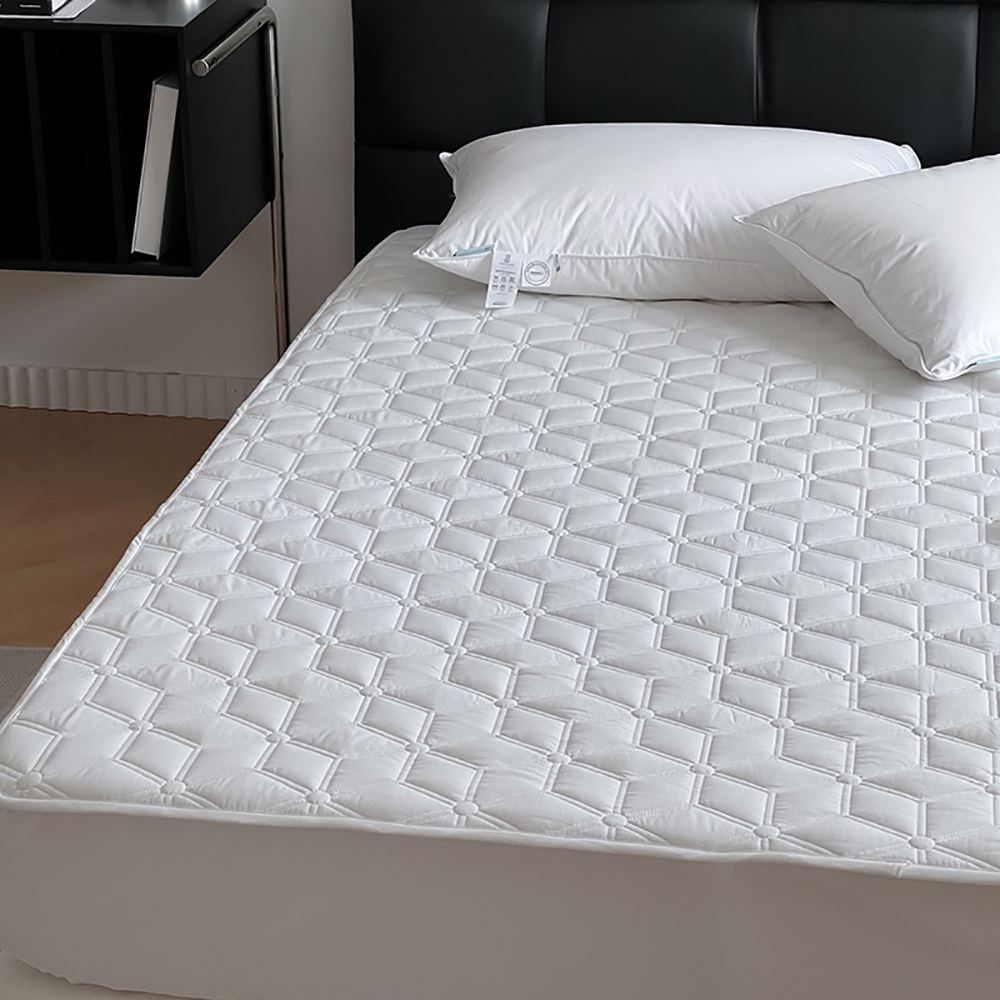
Scenario rule: specify the protector by bed size and mattress thickness first, and only then decide between the standard and waterproof versions. Consistency here determines whether replacement is a linen purchase or a mattress purchase.
Zone 3 — Bathroom textiles
Towels are documented in three constructions on the same base cloth: plain (MJ8300), jacquard (MJ8500) and embroidered (MJ8500). All are 100% cotton at 21S/32S yarn count, white, with weights of 60 g, 120 g, 150 g, 180 g, 500 g, 600 g or 700 g and sizes from 33×33 cm to 80×150 cm. MOQ is 100 pcs, sample orders are accepted, and OEM is available. Reinforced stitching edges and colour-fixation treatment are documented for wear under continuous washing cycles.

Bath mats are documented in three builds — plain (DJ9100) and jacquard (DJ9200) at 300/350/400 g in 16S/32S cotton at 50×80 cm, and a long-wool mat (DJ9300) at 600/900/1,000/1,300 g in 50×80, 60×90 and 60×120 cm. The bathrobe (YP9600) is documented at 120×130×50 cm, 21 yarn count, in 700/750/1,000/1,200 g, with five collar and weave constructions including small waffle kimono collar, medium waffle shawl collar, waffle-and-terry combinations and a waffle-modal air layer.
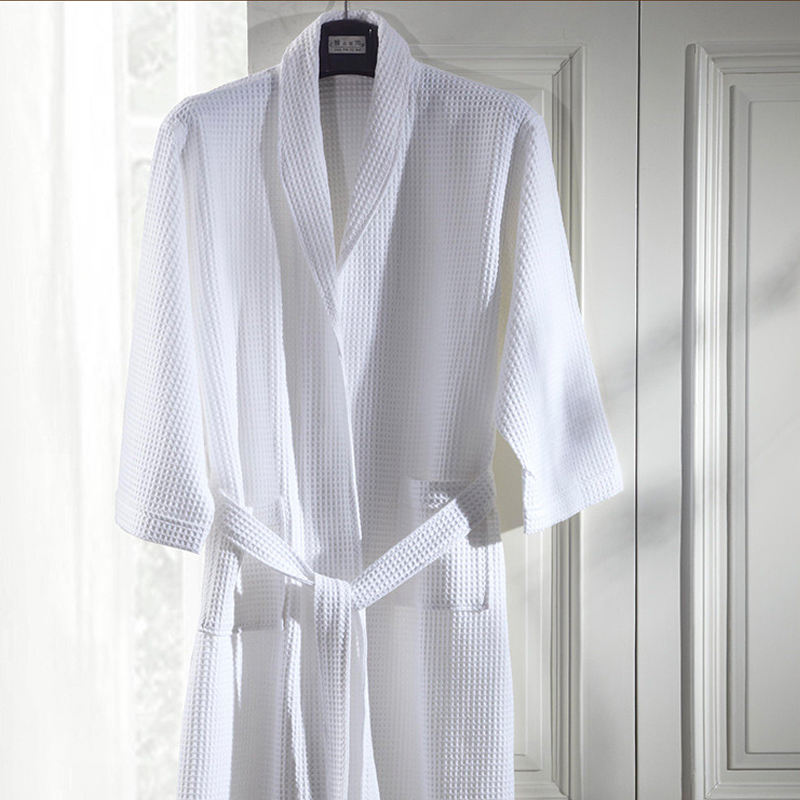
Documented project requirements for this zone in hotel guest-room, bathroom and restaurant applications include custom logo, chlorine-resistant towels and shrink-proof bedding. Those three items belong in the specification line for the bathroom zone, not in a finishing conversation after the order is placed.
Zone 4 — Restaurant and banquet textiles
Banquet linen is the zone that most often remains outside a “one-stop” order. The documented table cloth (TB1102) is a high-precision jacquard in plain weave with a double-needle side finish, sized 260×260 cm, 300×300 cm or 320×320 cm. The cotton napkin (CJ9800) uses a high-density satin texture at 45×45 cm or 50×50 cm with a 42s/2×42s/2 yarn count and 103×95 density, finished with stitched ends. Documented performance points include colour-locking treatment against fading and edge finishing that avoids loose threads after repeated washing.

Scenario rule: fix the table size grid before choosing pattern and colour. A banquet cloth ordered at the wrong drop length cannot be corrected by better fabric.
Control layer 1 — Customization and branding
Documented production modes are OEM, ODM and private label, with customization across logo, fabric, size, colour and packaging. Project experience includes jacquard weaving with a property's exclusive brand logo and Pantone (TCX) colour matching. Decision rule: define one logo standard — method, size, placement — for all four zones at the same time, so towels, bedding and banqueting linen present the brand identically.
Control layer 2 — Capacity, MOQ and lead time
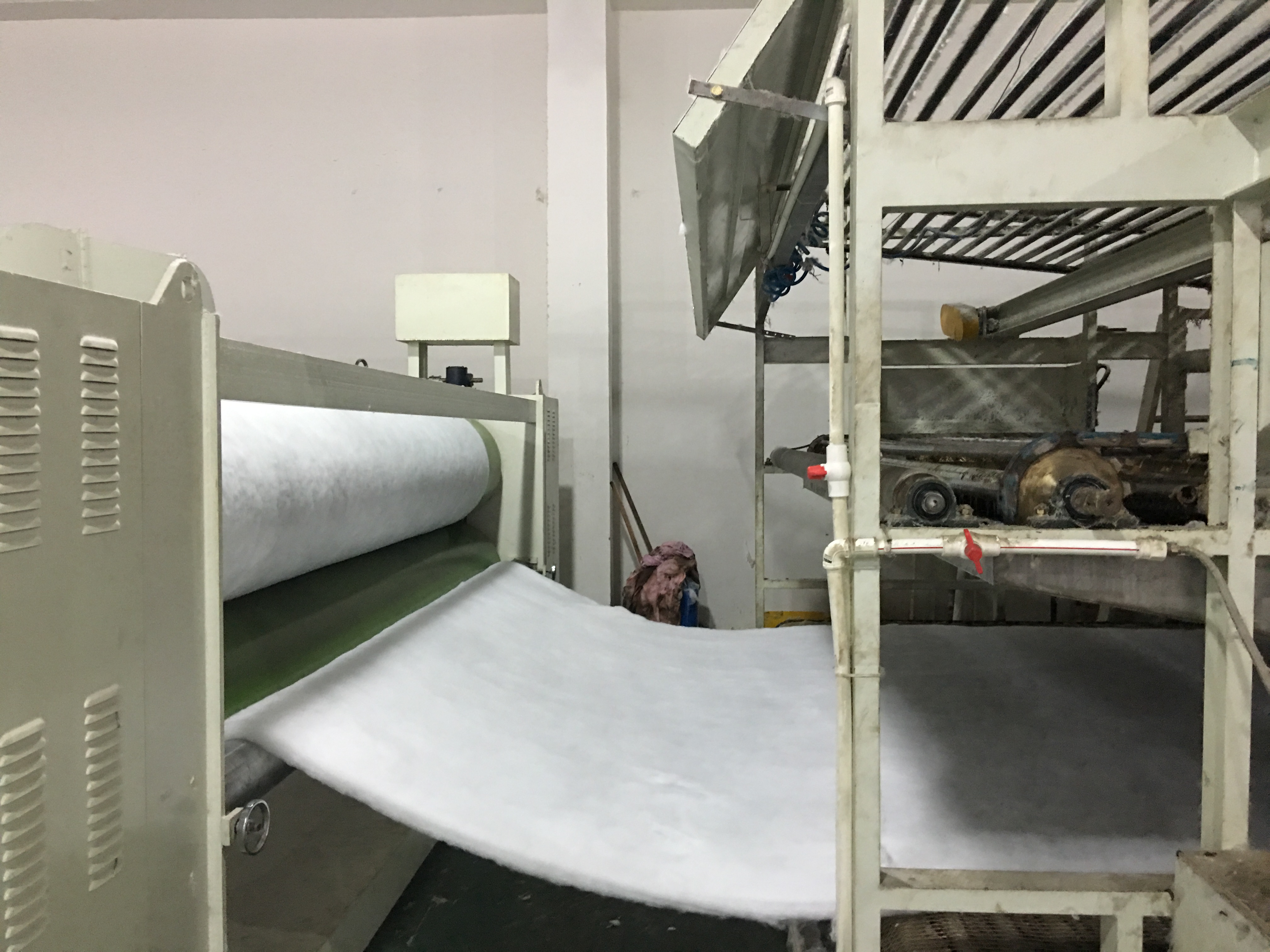
Documented operational figures are a monthly capacity of 200,000 bedding sets and 500,000 towels, an annual output of 2,000,000 pcs, an MOQ starting from 50 pcs, a sample lead time of 7–10 days, a production lead time of 20–35 days, quality control through 100% pre-shipment inspection, and after-sales support through sample service and technical support. For a 100–500 room project, capacity determines whether a single drop or a staged delivery programme is realistic — and staged deliveries are usually what a pre-opening calendar requires.
- State the laundry protocol — temperature and chemistry — before choosing density or weight.
- Fix the wash ceiling per line: most documented bedding sets allow machine washing or dry cleaning at a maximum of 90°C; the CP128 sateen set is documented at 70°C; quilts and duvets are dry-clean only.
- Define the logo method per zone: embroidery, jacquard weaving or printing.
- Confirm MOQ per line: from 50 pcs generally, 100 pcs on towels and bath mats, and 100 sets on custom bedding designs.
- Validate before bulk production through the 7–10 day sample window, then plan against the 20–35 day production lead time.
Step-by-Step: Building a Scenario-Matched One-Stop Order
Six steps take a hotel project from a scenario profile to a repeat-order-ready supply programme. Skipping a step does not save time; it moves the cost to the second order.
- Write the scenario profile. Record room count, guest tier, zones to be covered (guestroom, bathroom, restaurant, banquet), market and climate, laundry arrangement, and brand standard. Documented project scales range from procurement for more than 100 guest rooms up to programmes covering 100–500 rooms.
- Set the specification floor per zone. Choose density (250T–600T), yarn count (40×40 to 80×80 on bedding; 21S/32S on towels), towel weight (60 g–700 g), mat weight (300 g–1,300 g) and stitch standards (3 stitches and 5 threads on mattress protection; reinforced or overlocked edges on towelling).
- Choose the finish and branding method. Decide between jacquard woven, embroidered, printed or plain construction, and align colour to Pantone (TCX) references where a property standard exists.
- Validate with samples. Sample lead time is documented at 7–10 days; sample orders are accepted on towel and bath mat lines at 100 pcs MOQ; the general MOQ starts at 50 pcs. Test wash behaviour, colour retention, stitch integrity and logo placement before committing.
- Lock QC and the production schedule. Confirm 100% pre-shipment inspection, the 20–35 day production window, and the capacity behind the order — 200,000 bedding sets and 500,000 towels per month.
- Plan replacement and repeat orders. Documented project durations of two years, three years and 3–5 year implementation periods give a realistic basis for replacement cycles and for keeping the same specification available on the next purchase order.
Use Cases: Scenario Matching in Documented Hotel Projects
The same framework shows up in three documented project types — a five-star city hotel, a five-star group property, and a multi-market hotel group or resort programme.
Five-star hotel procurement in Kazakhstan (Radisson project)
A procurement intermediary client supplied a five-star hotel project covering procurement for more than 100 guest rooms, with bedding products installed across those rooms and documented use for two years. The programme supported the daily operational needs of 150 guest rooms, and its quality and durability were recognised by the client. The documented outcome was a stable, long-term supply partnership built on a solution tailored to five-star standards, balancing comfort, durability and product detail.
Wyndham five-star hotel linen project — 150 rooms
An intermediary client procured guest-room linen for a Wyndham five-star project across 150 rooms on a three-year cooperation. Documented results were a 100% repeat purchase rate, a 15% increase in guest satisfaction measured by NPS, and zero quality complaints. The specification highlights are worth noting, because each is a scenario decision: high thread count and high-density weaving, double-needle reinforced edging, precise custom colour matching to Pantone (TCX) references, and jacquard weaving with the property's exclusive brand logo.
Hotel group / resort programmes in Saudi Arabia, Malaysia and the United States
Documented hotel group and resort programmes covering 100–500 rooms used guest-room textile furnishing for daily hotel operation over implementation periods of 3–5 years. The recorded outcomes were reduced procurement cost with stable quality, supported by a one-stop textile solution, custom logo service and shrink-proof hotel linens. The same application family — guestrooms, bathrooms and restaurants — is documented as common in Germany, the United States, Malaysia and Saudi Arabia.
Comparison Table: One-Stop Supply Zones at a Glance
The table below maps each guest-facing zone to the documented product family, the documented specification, and the scenario consideration that decides the choice. All figures are taken from product documentation.
| Zone | Documented product (model) | Documented specification highlights | Scenario consideration |
|---|---|---|---|
| Guestroom — sleeping layer | Bedding sets CP106 (3cm satin), CP128 (sateen), CP139 (jacquard), CP152 (embroidered), CP186 (printed) | 100% cotton, with an 80% cotton / 20% polyester option on CP152 and CP186; density 250T–600T; yarn count 40×40 to 80×80; duvet cover with centre bottom opening, pillowcase 2/8 opening or envelope closure, sheet with four-side 1 cm hem | Match density and finish to property tier; custom designs carry 100-set MOQ and 30+ day lead time |
| Guestroom — mattress layer | Mattress comforter HD3000; waterproof mattress protectors HD3700 / HD3701 | HD3000: 100 g/m² white duck down upper fill plus 2–4 cm, 1,500 g/m² duck feather lower fill; protectors: cotton with environmental setting cotton filling, 3 stitches / 5 threads, 3 cm imported corner bands, 90°C wash or dry clean | The cheapest line that protects the largest asset; specify by bed size and mattress thickness |
| Bathroom — towelling | Towels MJ8300 (plain), MJ8500 (jacquard / embroidered) | 100% cotton, 21S/32S, 60/120/150/180/500/600/700 g, 33×33 cm to 80×150 cm, MOQ 100 pcs, sample orders accepted | Weight must follow laundry turnover and guest tier; chlorine resistance and logo method are specification lines |
| Bathroom — mats and robes | Bath mats DJ9100 (plain), DJ9200 (jacquard), DJ9300 (long wool); bathrobe YP9600 | Mats: 300/350/400 g at 16S/32S, 50×80 cm; long wool 600/900/1,000/1,300 g, 50×80 to 60×120 cm. Robe: 120×130×50 cm, yarn count 21, 700/750/1,000/1,200 g, five waffle-based constructions | Robe weight and collar style shape guest perception; mat construction affects laundry life |
| Restaurant and banquet | Table cloth TB1102; napkin CJ9800 | TB1102: high-precision jacquard, plain weave, double-needle side, 260×260 / 300×300 / 320×320 cm. CJ9800: cotton, 45×45 / 50×50 cm, 42s/2×42s/2, 103×95 density, stitched ends | Fix the table size grid before pattern and colour; this zone is the most frequently omitted from consolidation |
The second table lists the scenario signals that change a specification, drawn from documented project and application data.
| Scenario signal | Documented example or range | Why it changes the specification |
|---|---|---|
| Property scale | Procurement for more than 100 guest rooms; daily support of 150 guest rooms; 100–500 room programmes | Sets total piece count per zone, replacement planning and production scheduling |
| Operating mode | Long-term daily use with cyclic laundry and repeated turnover | Drives weight, density, edge finishing and colour retention choices rather than appearance alone |
| Environment and market | Indoor constant temperature; applications common in Germany, the United States, Malaysia and Saudi Arabia | Climate and market expectations influence fabric feel, weight and laundering assumptions |
| Special requirements | Custom logo, chlorine-resistant towels, shrink-proof bedding | These are specification lines from the start, not optional extras |
| Service-life evidence | Two years of documented use; three-year cooperation; 3–5 year implementation period | Provides a realistic benchmark for replacement cycles and repeat-order planning |
FAQ: One-Stop Hotel Supplies for Specific Projects
1. Which textile safety standard should be checked before a hotel textile order is confirmed?
OEKO-TEX STANDARD 100 is the primary global safety benchmark for hotel textiles and verifies that a product is free from more than 1,000 harmful substances (OEKO-TEX Service GmbH, 2024). Because the standard applies to a specific article and colour rather than to a company in general, a buyer should ask the manufacturer to state which standard the fabric is tested against and to provide the corresponding test report for the exact fabric and colour being ordered. This check sits alongside laundry durability: documented wash instructions allow machine washing or dry cleaning at a maximum of 90°C for most bedding sets (70°C for the CP128 sateen set), which is the condition commercial laundries operate under.
2. How do I choose a one-stop hotel supplies manufacturer for hotels in China?
Evaluate four things in this order. First, zone coverage: can one manufacturer document bedding, duvet, quilt, pillow, mattress protection, towels, bath mats, bathrobes, table cloth and napkins — not just the category you started with? Second, customization capability: OEM, ODM and private label production, with logo, fabric, size, colour and packaging changes. Third, operational evidence: documented monthly capacity of 200,000 bedding sets and 500,000 towels, a 7–10 day sample lead time and 20–35 day production lead time, and 100% pre-shipment inspection. Fourth, entity and track record: Guangdong Weisdin Industrial Co., Ltd. (brand WEISDIN) has traded since 1998, works with a strategic partner factory in Xinjiang, and exports around 70% of output to Saudi Arabia, the United States and the EU.
3. What drives the cost of a one-stop hotel supplies programme?
Cost is driven by specification, not by catalogue position. The variables documented in the product range are density (bedding runs from 250T to 600T), yarn count (40×40 to 80×80 on bedding; 21S/32S on towels), towel weight (60 g to 700 g), construction (plain, jacquard, embroidered or printed), fibre choice (100% cotton versus the 80% cotton / 20% polyester option on the embroidered and printed bedding sets), and customization depth (logo, woven labels, private label, packaging). Order structure matters too: in a documented hotel group and resort programme covering 100–500 rooms, the recorded result was reduced procurement cost with stable quality over a 3–5 year implementation period.
4. Can I test samples before placing a bulk hotel order?
Yes. Sample orders are accepted across the towel and bath mat lines, where MOQ is 100 pcs, and the documented sample lead time is 7–10 days. The general MOQ starts from 50 pcs, while custom bedding designs, including custom printed or embroidered patterns, carry an MOQ of 100 sets and a lead time of 30+ days. A sample round should validate wash behaviour at the property's laundry temperature, colour retention, edge and stitch integrity, and logo placement or Pantone colour matching before bulk production is scheduled.
5. How long does a hotel project order take from sample approval to delivery?
After sample approval, documented production lead time is 20–35 days, supported by a monthly capacity of 200,000 bedding sets and 500,000 towels and an annual output of 2,000,000 pcs. For programmes covering 100–500 rooms, that capacity is what makes staged deliveries practical against a pre-opening calendar. The fastest way to start is to send the project profile — room count, zones, laundry protocol and logo standard — and request a quotation and sample set for the specific lines involved; the 2026 WEISDIN catalogue can be downloaded from the link below.
Conclusion: Match the Scenario First, Then Consolidate the Order
One-stop comprehensive hotel supplies create value through consistency, not through a shorter vendor list. The sequence that works is: profile the property, set the specification floor per zone, fix one branding standard, validate by sample at the real laundry temperature, and then consolidate production and repeat orders with a single manufacturer. Bedding from 250T to 600T, towels from 60 g to 700 g, mattress protection built to a 3-stitch / 5-thread standard, and banqueting linen sized to the actual table grid — these are the decisions that determine whether the second order looks like the first.
WEISDIN has supplied hotel linen and guest-room textiles since 1998 from Guangzhou, with a documented project record that includes a five-star Radisson programme of more than 100 guest rooms, a 150-room Wyndham linen project with a 100% repeat purchase rate, and multi-market hotel group programmes across Saudi Arabia, Malaysia and the United States.
Start with a sample, not a container. Send your project scenario — room count, zones, laundry temperature and logo standard — and request a quotation, a sample set, or the 2026 product catalogue.
Catalogue: 2026 WEISDIN Hotel Textile Catalogue (PDF)
Website: www.weisdin.com
Contact: Vicky Yuan · Email: vicky889@weisdin.cn · Tel / WhatsApp: +86 18925118522
Address: Room 201, 4th Staircase, Building 1, No. 237, Shibei Industrial Road, Dashi Street, Panyu District, Guangzhou City, Guangdong Province, China
Documented project references in this article are drawn from WEISDIN project records for intermediary, hotel group and resort clients. Market figures are attributed to their published sources and reflect the reporting scope stated by each source.
Have Questions or Need More Details?
Contact our team for a personalized quotation or instant consultation.
Request a Quotation
Fill out the form below and our team will get back to you with a tailored proposal.
WhatsApp Direct Chat
Prefer to chat in real-time? Message us on WhatsApp for instant assistance & quick answers.
- Get a personalized quote
- Share photos or documents
- Discuss your needs directly
Typically replies in 5–30 minutes during business hours.