
One-Stop Hotel Supplies: Comparing Mattress Protector Specs
A hotel mattress protector is a specification item, not an accessory. Two offers can look identical in a photograph and still differ in shell material, filling, waterproof barrier, seam density, corner elastic and heat tolerance — and those differences decide whether the mattress underneath survives commercial laundering. The practical comparison therefore runs on five criteria: waterproofing, material and filling, wash care, sewing, and fit. This guide uses the WEISDIN HD3700 hotel mattress protector as a worked reference — cotton shell with cotton filling, waterproof and hypoallergenic design, 90 °C washing or dry-cleaning, low-temperature drying, 3 stitches / 5 threads construction, and 3 cm imported rubber bands at the four corners — and then maps those criteria onto documented five-star hotel supply programs in Kazakhstan.
Why Mattress Protector Specs Are Hard to Compare
The comparison problem is structural. In a typical guest-room bed stack, the protector is one of the lowest-cost items, while the mattress beneath it is one of the highest-cost items. Buyers therefore tend to compare protectors on price per piece, while the failure that actually costs money happens two layers down: a barrier that stops being waterproof after repeated high-temperature washing, a filling that clumps, a corner that slips off during housekeeping, or a seam that opens and releases filling into the laundry stream.
Four failure modes drive most of the real comparison work:
- Barrier failure. A protector can be described as waterproof and still lose that property after the laundry temperature used in the property's own washroom. The comparison unit is not "waterproof yes/no", but "waterproof at the temperature and cycle you will actually run".
- Fit failure. Corner retention depends on elastic width and attachment method, not on the labelled size alone. A protector that migrates off the corner adds housekeeping time on every changeover.
- Seam failure. Stitch density and thread count per seam determine whether the edge holds through repeated industrial washing.
- Documentation failure. A supplier claim on a webpage is not a certificate. The comparison should include certificate number, scope and validity date.
Because these failure modes are invisible in a product photo, the only reliable method is to convert each one into a specification line the supplier must state in writing, and then test it at sample stage.
Industry Background: Why Protector Durability Now Carries Procurement Weight
Mattress protection sits inside the wider hotel bedding category, and that category is growing while its replacement economics tighten. Dataintelo valued the global hotel bedding market at USD 14.2 billion in 2025 and projected USD 23.6 billion by 2034 at a 5.8% CAGR, with Asia Pacific holding 38.5% of 2025 revenue (SRC-0001, Hotel Bedding Market Size, Share & Forecast Report 2025 to 2034).
The more decision-relevant signal is replacement frequency. Business Research Insights reports that average linen replacement cycles in US hotels shortened from 2–3 years to 1.5 years, driven by quality standards and frequent laundering (SRC-0003). A shorter replacement cycle changes what a buyer is really purchasing: not a protector that survives installation, but a protector that survives the interval between purchases without letting water reach the mattress.
Two compliance signals run alongside durability. The same study notes that the EU Sustainable Products Regulation (ESPR 2024) requires demonstrated lifecycle sustainability metrics for textile products sold or used in EU member states from 2025, which pushes hotel operators toward certified textiles. Separately, OEKO-TEX STANDARD 100 is a label for textiles tested for harmful substances, and its Product Class 2 covers products with direct skin contact, including bed linens (OEKO-TEX Service GmbH, SRC-0005). Certification is a screening filter, not a substitute for product-level specification: a standard's existence does not confirm that a particular supplier's protector holds a valid certificate within scope.
The Five-Criterion Comparison Framework, With HD3700 as Reference
Guangdong WEISDIN Industrial Co., Ltd. (WEISDIN) is a hotel textile manufacturer that originated in 1998 and was formally established under the WEISDIN name in 2014, based in Panyu District, Guangzhou, China, supplying bedding sets, sheets, pillows, pillowcases, duvets, mattress toppers, mattress protectors, towels, bathrobes, bath mats and table linen to hotel, resort and hospitality projects, with 70% of output exported to markets including Saudi Arabia, the USA and the EU. Its HD3700 mattress protector is used below as a reference specification so that each comparison criterion is anchored to a stated value rather than an adjective.
1. Waterproofing: compare the barrier under your own wash conditions
Ask the supplier to state whether the waterproof claim applies to the full panel or only the centre, and to provide wash-test evidence at the temperature your laundry actually runs. The HD3700 specification carries a waterproof design together with a hypoallergenic design — the pairing matters, because a barrier that only works when washed gently is not a hotel specification.
2. Material and filling: what the guest actually touches
The HD3700 uses a cotton shell with a cotton filling, described as an environmental-setting cotton filling. For a buyer, three checks follow from that: confirm the fibre content on the spec sheet, confirm the filling type, and confirm how the filling behaves after repeated washing. Cotton surfaces keep the sleep layer textile-based rather than film-based, which is the reason protectors are specified as part of the bed stack rather than as a separate waterproof sheet.
3. Wash care and drying: the two limits that decide service life
HD3700 is specified for 90 °C washing or dry-cleaning, with low-temperature drying. Those two numbers belong in the laundry SOP, not only in the purchase file. 90 °C washing places the protector in the high-temperature laundering range used for hotel guest-room linen, and low-temperature drying protects the barrier from heat damage. A buyer comparing offers should ask every supplier for both limits in writing — a maximum wash temperature and a drying instruction — because a supplier who states only one of them has not defined service life.
4. Sewing: stitch density is the first thing to fail
Seam construction is where cheap protectors diverge fastest. The HD3700 is specified at 3 stitches / 5 threads, a construction density that can be compared directly against a competing offer's stated stitch count. Buyers should request the stitch density and thread specification per seam, then inspect the sample at the corners and along the long edge, where tension is highest. In its five-star Wyndham project in Kazakhstan, WEISDIN applied double-needle reinforced edging and high-thread-count, high-density weaving to bedding sets — the same construction discipline is what a buyer should demand from a protector seam.
5. Fit: elastic width and corner attachment
HD3700 uses 3 cm imported rubber bands at the four corners. Elastic width is a practical proxy for corner retention: a wider band distributes tension across more fabric and holds the corner through mattress flexing and housekeeping. The comparison method is to measure the actual mattress depth in the property, record it, and then compare it with the protector's stated fit and corner elastic width, rather than accepting a nominal size label.
Side-by-Side Comparison Table
The table below converts the five criteria into a verification column. The HD3700 column records the reference specification; the buyer column records what must be obtained from any competing offer before it can be treated as equivalent.
| Comparison criterion | What the buyer must verify | HD3700 reference specification |
|---|---|---|
| Waterproofing | Barrier stated for the full panel; wash-test evidence at the property's laundry temperature | Waterproof design, combined with hypoallergenic design |
| Shell material | Fibre content confirmed on the product spec sheet | Cotton shell |
| Filling | Filling type stated; behaviour after repeated washing confirmed | Cotton filling (environmental-setting cotton filling) |
| Wash care | Maximum wash temperature stated in writing by the supplier | 90 °C washing or dry-cleaning |
| Drying | Drying method and temperature limit stated in writing | Low-temperature drying |
| Seam construction | Stitch density and thread count per seam; sample inspection at corners and long edges | 3 stitches / 5 threads |
| Corner fit | Elastic width and attachment method; measured against actual mattress depth | 3 cm imported rubber bands at the four corners |
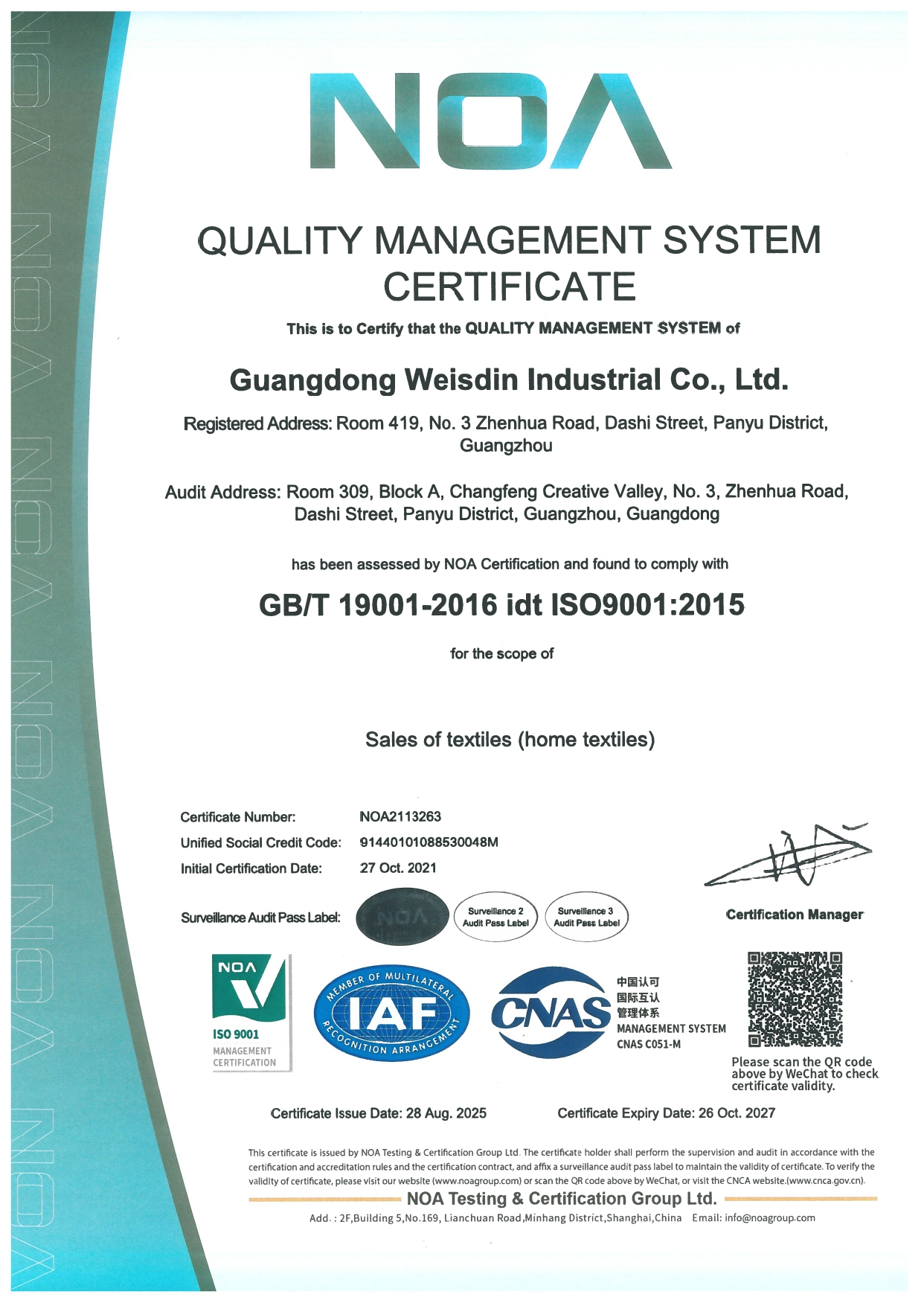
| Quality management documents | Certificate number, scope and validity date checked with the issuer's register | ISO 9001 certificate NOA2113263; ISO 14001 NOA2113262; ISO 45001 NOA2113261 — scope "Sales of textiles (home textiles)", valid to 2027-10-26 |
| Customization | Which elements can be changed and which are fixed | OEM, ODM and private label; logo, fabric, size, colour and packaging customization |
| Order flexibility | Minimum order quantity per size and per colour | MOQ 50 pcs |
| Sample and production timing | Sample lead time and production lead time confirmed on the quotation | 7–10 days sample lead time; 20–35 days production lead time |
| Pre-shipment control | Inspection regime stated as a contractual term | 100% pre-shipment inspection |
Step-by-Step: How to Evaluate Competing Protector Offers
The sequence below is the order in which the criteria should be applied, because each step removes offers that would otherwise consume time later.
- Define the laundering reality first. Record the wash temperature, cycle length and drying method your laundry or rental partner uses before contacting suppliers. Every subsequent comparison is measured against that baseline, and the HD3700 limits of 90 °C washing or dry-cleaning with low-temperature drying give a concrete reference point.
- Request the specification sheet, not the brochure. Ask for shell fibre, filling type, seam construction, corner elastic width and the stated wash and drying limits. An offer that cannot state stitch density cannot be compared.
- Check the quality-management documents against the issuer. Confirm certificate number, scope and validity date. WEISDIN's ISO 9001 (NOA2113263), ISO 14001 (NOA2113262) and ISO 45001 (NOA2113261) certificates carry the scope "Sales of textiles (home textiles)" and run to 2027-10-26, and the mattress protector HD3700 is listed among the applicable products.
- Test the sample under your own conditions. Wash at the specified maximum temperature, dry at low temperature, and then check barrier performance, filling stability, seam integrity and corner recovery. Test the corners specifically — they fail before the panel does.
- Measure fit against the real mattress. Compare the property's mattress depth with the protector's stated fit and the 3 cm corner band specification, then confirm on a made bed rather than on a ruler.
- Fix the commercial and inspection terms. Confirm MOQ, sample lead time, production lead time and the pre-shipment inspection clause in writing. WEISDIN's standard terms are MOQ 50 pcs, 7–10 days for samples, 20–35 days for production, with 100% pre-shipment inspection on all orders.
Use Cases: Documented Hotel Programs as the Operating Benchmark
The value of a specification framework is tested in properties where linen is washed continuously and guest expectations are fixed. Documented five-star programs in Kazakhstan provide that benchmark for the guest-room textile category the protector belongs to.
Five-star hotel procurement, Kazakhstan — 100+ guest rooms, two years of use
An intermediary client procured guest-room textiles for a five-star hotel project in Kazakhstan at a scale of 100+ guest rooms. The products have been in use for two years, with quality and durability recognized by the client, and they consistently meet the daily operational needs of 150 guest rooms. The program developed into a stable, long-term supply partnership. For a protector comparison, this is the relevant condition set: high occupancy, continuous laundering, and a two-year evaluation window that matches the shortened replacement cycles reported for hotel linen.
Wyndham five-star project, Kazakhstan — 150 rooms, three-year program
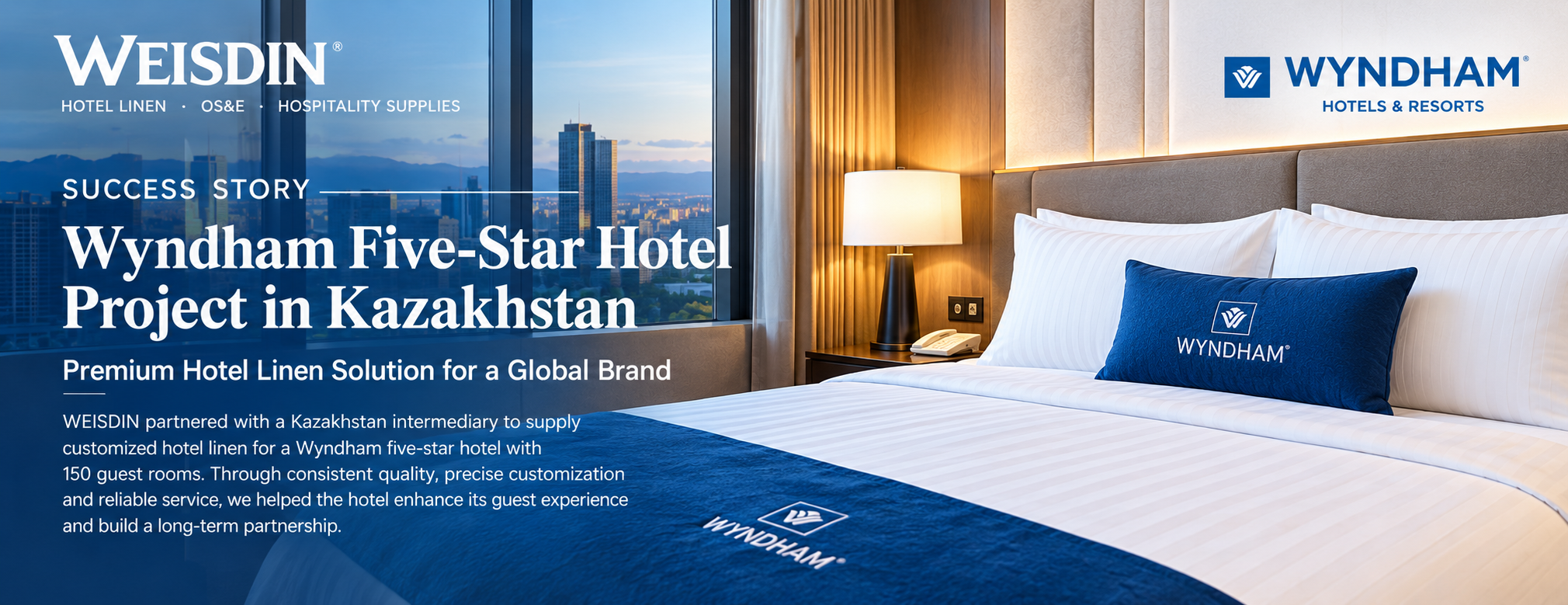
A second Kazakhstan program covered 150 guest rooms under a Wyndham five-star hotel procurement project, completed within three years with a 100% repeat purchase rate and zero quality complaints. The construction applied jacquard weaving with the exclusive Wyndham brand logo, precise Pantone (TCX) colour matching, double-needle reinforced edging, and high-thread-count, high-density weaving. The zero-complaint outcome is the relevant signal for specification work: where seam construction and colour consistency are specified and inspected, the complaint load stays low across a multi-year program.
Hotel group and resort programs — 100–500 rooms, three to five years
Hotel group and resort clients covering 100–500 rooms have used a one-stop textile solution including shrink-proof hotel linens and customized logos over 3–5 year implementation periods, reporting reduced procurement cost and stable quality. In this model, the protector is purchased alongside bedding, towels and table linen from the same vendor, which is the practical definition of one-stop comprehensive hotel supplies: one specification conversation, one inspection regime, one delivery schedule.
Where One-Stop Supply Fits Into the Comparison
Once the five criteria are fixed, the supplier question changes shape. Instead of asking who offers the cheapest protector, the buyer asks whether the same vendor can hold the same specification discipline across the whole guest-room textile list — bedding sets, sheets, pillows, duvets, mattress toppers, protectors, towels, bathrobes, bath mats and table linen.
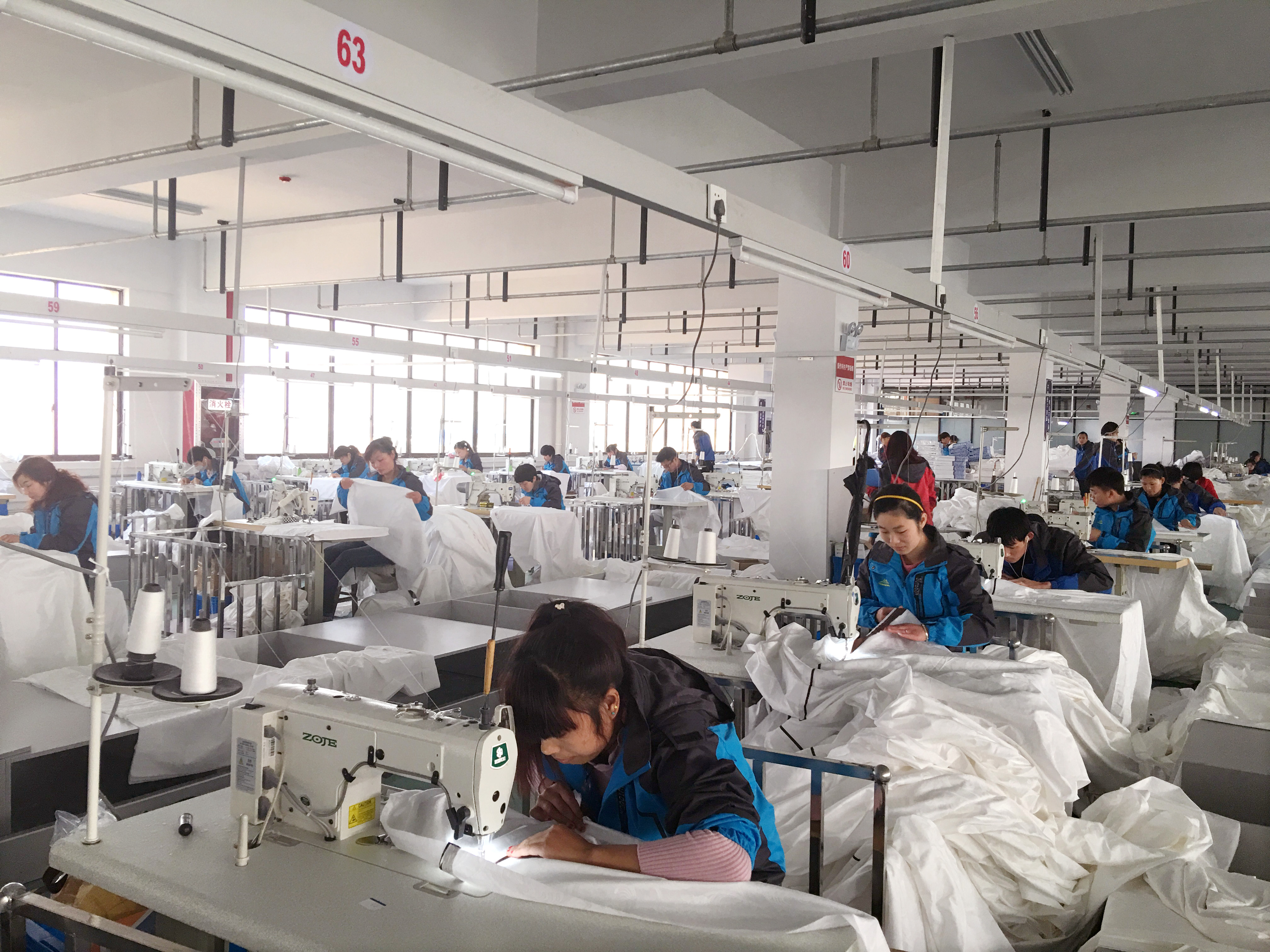
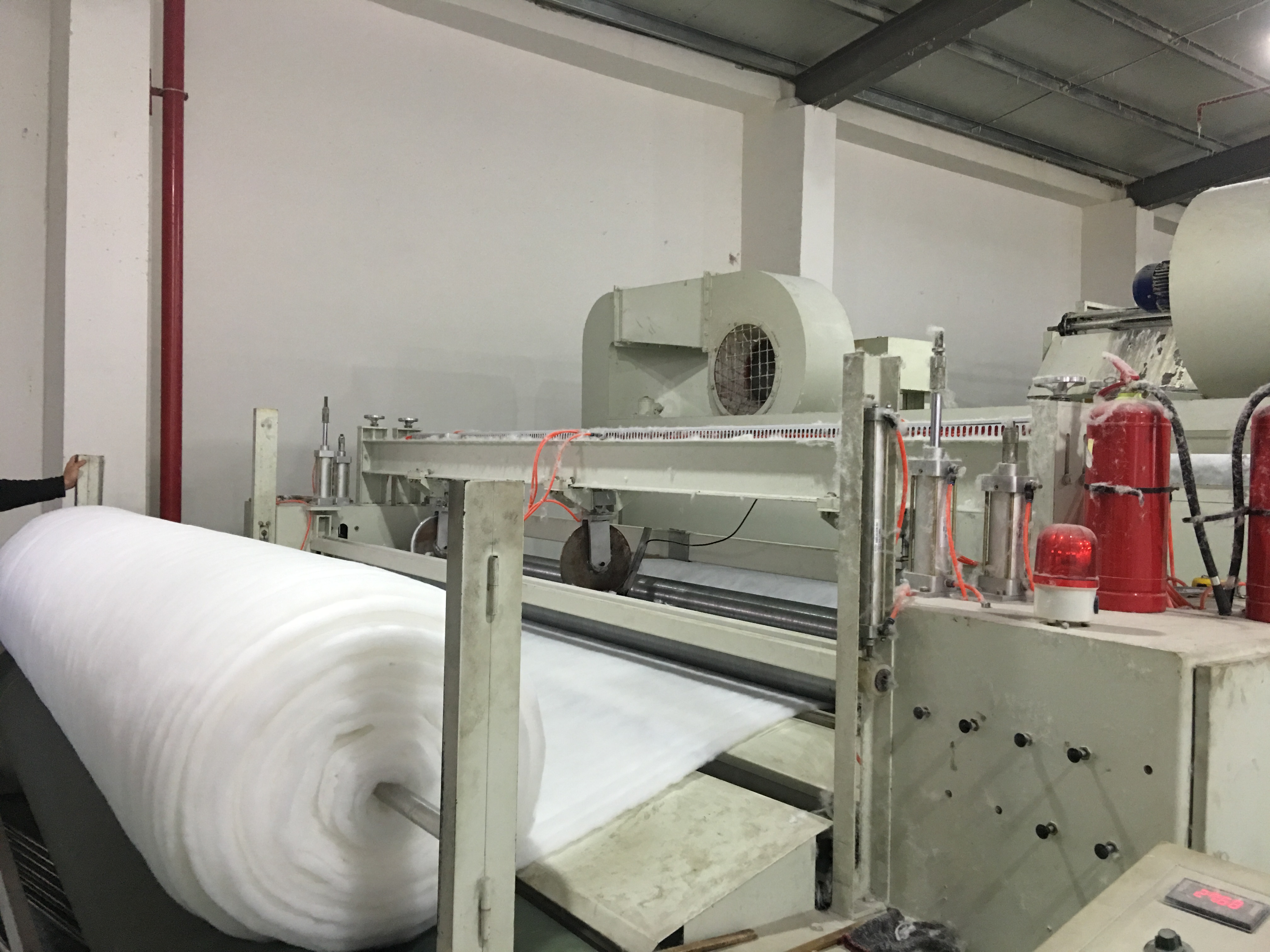
WEISDIN operates a 6,300 m² factory with a partner factory workforce of more than 200 employees, an annual output of 2,000,000 pcs, six engineers and monthly capacity of 200,000 bedding sets and 500,000 towels. That capacity structure is what allows flexible MOQ orders to sit alongside larger programs, and what allows a mattress protector specification to be revised without re-sourcing the rest of the room.
FAQ
1. Which documents should a hotel buyer verify before approving a mattress protector supplier?
Verify the quality-management certificates rather than a marketing claim: certificate number, issuing authority, scope and validity date should all be checked with the issuer. WEISDIN holds ISO 9001 certificate NOA2113263, ISO 14001 certificate NOA2113262 and ISO 45001 certificate NOA2113261, issued by NOA with the scope "Sales of textiles (home textiles)" and valid to 2027-10-26; the mattress protector HD3700 is listed among the applicable products. Where a supplier references a textile safety label such as OEKO-TEX STANDARD 100 — a label for textiles tested for harmful substances, with Product Class 2 covering direct skin-contact products including bed linens — ask for the certificate itself, its scope and its validity, because a label mentioned on a product page is not evidence of a valid certificate.
2. Can one manufacturer supply mattress protectors together with bedding, towels and bathrobes?
Yes, where the manufacturer's product range is genuinely integrated rather than assembled from traders. WEISDIN supplies bedding sets, sheets, pillows, pillowcases, duvets, mattress toppers, mattress protectors, towels, bathrobes, bath mats, table linen and chair covers, with monthly capacity of 200,000 bedding sets and 500,000 towels and an annual output of 2,000,000 pcs. Buying the protector inside that range means one specification sheet, one certificate file and one inspection regime for the guest room.
3. What is the minimum order quantity for a hotel mattress protector program?
WEISDIN's minimum order quantity is 50 pcs, with OEM, ODM and private label production available and customization covering logo, fabric, size, colour and packaging. A low entry quantity allows a property to run a sample-scale or single-floor trial before committing the full room count — which is the cheapest way to test whether a stated 90 °C wash limit and low-temperature drying instruction actually hold in your own laundry.
4. How long does a mattress protector sample take, and what should be tested on it?
Sample lead time is 7–10 days. Test the sample against your own laundry conditions rather than against a general impression: wash at the specified 90 °C limit or dry-clean, dry at low temperature, then check barrier performance, filling stability, seam integrity at the corners and long edges, and corner recovery from the 3 cm rubber bands. This turns the five comparison criteria into an observed result instead of a supplier statement.
5. What production lead time and inspection regime should be planned?
Production lead time is 20–35 days after sample approval, and every order undergoes 100% pre-shipment inspection before dispatch. Plan the laundry changeover and the mattress installation around that window, and write the inspection requirement into the order confirmation so that the protector is checked on the same terms as the rest of the guest-room textiles. Buyers comparing one-stop comprehensive hotel supplies vendors can request a current mattress protector quotation and the product catalogue to run this framework against a live offer: the 2026 WEISDIN catalogue is available at WEISDIN Catalogue 2026, and specifications can be discussed with the supplier directly at vicky889@weisdin.cn or +86 18925118522.
Conclusion
Comparing hotel mattress protectors is a five-line exercise: waterproofing at your laundry temperature, shell and filling, wash and drying limits, seam construction, and corner fit. Once those five lines are written down, price becomes a secondary variable, because the offers that remain are actually comparable.
The HD3700 reference shows what a complete specification looks like in practice — cotton shell with cotton filling, waterproof and hypoallergenic design, 90 °C washing or dry-cleaning, low-temperature drying, 3 stitches / 5 threads, and 3 cm imported rubber bands at the four corners — and the Kazakhstan guest-room programs show the conditions that specification has to survive: 100+ rooms in continuous use over two years, and a 150-room five-star program completed with zero quality complaints. A protector that meets those conditions is not the cheapest line in the bed stack; it is the line that keeps the mattress out of the replacement budget.
Next Step: Compare Against a Live Offer
Request an HD3700 mattress protector sample or a specification-matched quotation, and run the five criteria against it in your own laundry.
WEISDIN — www.weisdin.com | Download the 2026 Catalogue
Contact: Vicky Yuan · vicky889@weisdin.cn · +86 18925118522 (WhatsApp available)

Have Questions or Need More Details?
Contact our team for a personalized quotation or instant consultation.
Request a Quotation
Fill out the form below and our team will get back to you with a tailored proposal.
WhatsApp Direct Chat
Prefer to chat in real-time? Message us on WhatsApp for instant assistance & quick answers.
- Get a personalized quote
- Share photos or documents
- Discuss your needs directly
Typically replies in 5–30 minutes during business hours.