What One-Stop Comprehensive Hotel Supplies Actually Include

One-stop comprehensive hotel supplies means a property's textile requirements — bedding sets, pillows, duvets, mattress protection, towels, bath mats, bathrobes, table cloths and napkins — are specified, sampled and supplied through a single manufacturing relationship instead of six separate ones. The practical result is one specification sheet, one sampling round, and one party accountable when a reorder arrives in a slightly different shade of white.
WEISDIN is the international brand of Guangdong Weisdin Industrial Co., Ltd., a Guangzhou-based company established in 1998 that designs, develops, manufactures and sells premium hotel linens. Its documented product range covers bedroom sets, hotel bedding sets, sheets, pillows, pillow cases, duvets, mattress toppers, chair covers and towels, with exports accounting for 70% of total sales and main markets in South America, the USA and the EU.
This article explains what a one-stop range realistically covers at the guestroom level, how a consolidated order is actually run from specification to delivery, and where the boundary of a textile-based one-stop programme sits — because knowing that boundary is what separates a supplier you can build a multi-year programme with from a catalogue that promises everything.
What "One-Stop" Means at the Guestroom Level
In hospitality sourcing, "one-stop" is a scope statement, not a slogan. A hotel guestroom in normal operation consumes a defined set of items: bedding, towels, bathrobes, slippers and amenities, used indoors under constant temperature conditions, with cyclic laundry and repeated turnover as the operating mode. That is the working condition the WEISDIN hospitality application scenario documents, and it explains the three requirements that keep appearing in hotel specifications: custom logo, chlorine-resistant towels and shrink-proof bedding.
Those three requirements are a useful test of what a one-stop supplier must actually be able to do:
- Custom logo requires in-house or closely controlled embroidery and label capability, not a trading intermediary passing artwork to a third party.
- Chlorine-resistant towels require terry that is specified against the property's laundry chemistry, not against a generic retail standard.
- Shrink-proof bedding requires fabric constructions that are documented as shrink-resistant and stitching that survives commercial washing temperatures.
A one-stop programme is viable when those requirements can be answered across categories by the same technical team. It stops being viable when each category is handled by a different intermediary who cannot speak to the others.
The Problem One-Stop Supply Is Trying to Solve
Most hotel textile problems are not product problems. They are coordination problems that appear months after the order is placed.
A typical fragmented sourcing list for an 80-room property runs across five or six vendors: one for bedding, one for terry, one for bathrobes, one for table linen, one for mattress protection, one for the small items. Each vendor has its own minimum order quantity, its own lead time, its own definition of white, and its own sampling protocol. The buyer becomes the integration layer — holding six specification sheets, chasing six production schedules, and reconciling six invoices in different currencies.
The failure mode is quiet rather than dramatic. A towel from one factory and a bath mat from another are both ordered as "white" and both are white — but they are different whites, and housekeeping notices in month three. A bedding set is approved in one density and reordered in a "similar" density because the specification was never written down. A replacement towel order arrives while the property is entering high season, because nobody consolidated the reorder calendar.
Consolidation addresses these points directly. One specification sheet means one definition of white. One sampling round means the towel, the bath mat and the bathrobe are approved together, in the same light. One production calendar means the reorder timing is planned rather than reacted to.
Industry Background: Why Consolidation Is on the Buyer Agenda
The commercial case for consolidated sourcing sits against a hospitality supply market that is large and still expanding. According to Global Hotel Supplies Market Research Report 2025, the global hotel supplies market was valued at approximately USD 62.01 billion in 2024 and is projected to reach USD 82.07 billion by 2031. Sizing estimates vary by reporting scope — a Grand View Research figure of USD 63.1 billion places heavier emphasis on furniture, fixtures and equipment — so buyers comparing market reports should check what each one counts before drawing conclusions from the headline number.
Within that market, the textile layer has its own momentum. Dataintelo estimates the global hotel bedding market at USD 14.2 billion in 2025, with a compound annual growth rate of 5.8% through 2034. Mordor Intelligence projects bathroom linen to be the fastest-growing application in hotel textiles, at a 7.92% CAGR to 2031, driven by hospitality-led upgrades to antimicrobial terry. Hand soaps remain the most lucrative segment of a global hotel toiletries market that Grand View Research values at USD 24.3 billion in 2024 — a useful reminder that amenities and textiles are separate supply chains with separate economics.
Supply-side capacity is concentrated. China's exports of textile yarn, fabrics and articles reached USD 141.96 billion in 2024, a 5.7% year-on-year increase according to the General Administration of Customs of China, and the established global hospitality supply players — Guest Worldwide (Sysco), American Hotel Register, HD Supply and 1888 Mills among them — combine distribution reach with category breadth.
The pattern that follows is straightforward: as room counts grow and renovation cycles shorten, the cost of coordinating many vendors rises faster than the cost of the goods themselves. That is the gap a one-stop textile manufacturer is positioned to close.
What the Documented WEISDIN Range Covers
Guangdong Weisdin Industrial Co., Ltd. operates a manufacturing facility of 6,300 square metres with an annual production capacity of 2,000,000 pieces. The company directly employs 29 staff and works with a partner factory whose total workforce exceeds 200; its R&D team consists of 6 engineers.
The range is built around the guestroom rather than around a single product line. Bedding sets are offered in five documented constructions — printed, embroidered, jacquard, sateen and satin stripe — with 100% cotton as standard and an 80% cotton / 20% polyester option on the printed and embroidered sets. Density options run from 250T to 400T depending on construction, and the satin stripe set is available with stripe widths of 0.5 cm, 1 cm, 2 cm or 3 cm.
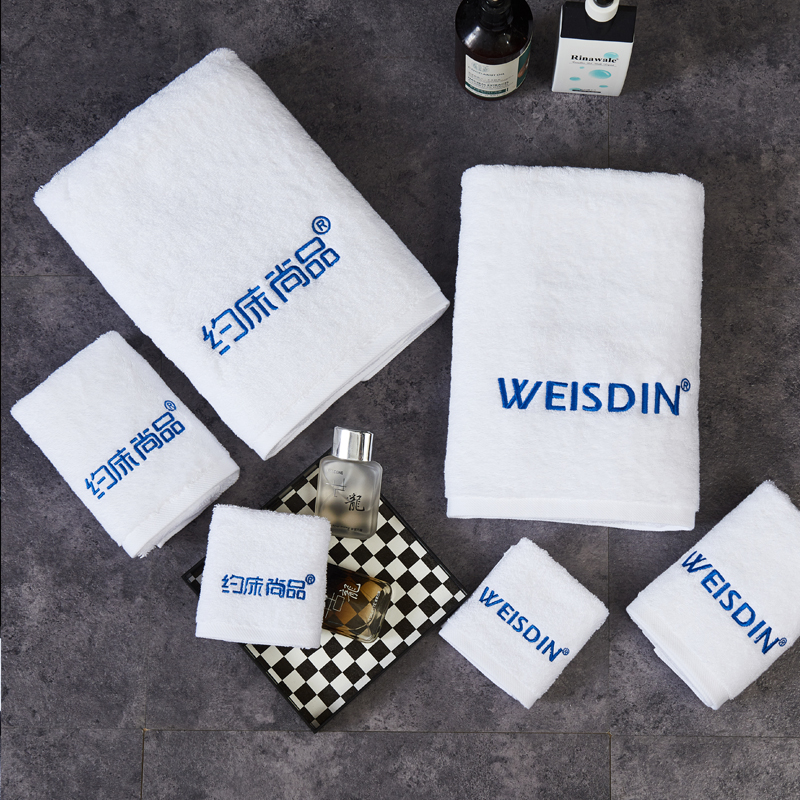
Bathroom textiles follow the same logic. Terry towels come in plain, jacquard and embroidered versions on 100% cotton, in five sizes from 33×33 cm to 80×150 cm and weights from 60 g to 700 g on 21S or 32S yarn. Bath mats extend from a 300–400 g plain or jacquard mat at 50×80 cm to a long wool mat available up to 60×120 cm and 1300 g. The waffle bathrobe is documented in four weights from 700 g to 1200 g, with five collar and construction options.
Documented product families at a glance
| Product family | Documented models | Documented specification highlights | Documented customisation | Documented MOQ / lead time |
|---|---|---|---|---|
| Bedding sets | CP106 satin stripe, CP128 sateen, CP139 jacquard, CP152 embroidered, CP186 printed | 100% cotton (80/20 poly option on CP152 and CP186); 250T–400T; stripe widths 0.5–3 cm | Embroidery, woven labels, private label, personalised packaging | 100 sets for customised designs; 30+ days on CP152 and CP186 |
| Pillows | ZX5103 microfiber | Down-proof fabric cover, microfiber filling; 45×75 cm and 48×78 cm; 800 g or 1000 g | Not documented for this model | Not documented |
| Duvets and quilts | BX280, CX2120, BX296 | 60s satin cotton, down-proof cloth, 133×100TC cotton; box quilting and interlocking craft | Not documented for these models | Dry-clean only, max 90°C |
| Mattress protection | HD3700, HD3701 protectors; HD3000 comforter | Cotton with environmental setting cotton filling; 3 stitches / 5 threads; 3 cm corner bands | Not documented for these models | Washable or dry-cleanable, max 90°C |
| Terry towels | MJ8300 plain, MJ8500 jacquard, MJ8500 embroidered | 100% cotton, 21S / 32S, 60 g–700 g, 33×33 cm–80×150 cm | Logo embroidery, OEM orders | 100 pcs; sample orders accepted |
| Bath mats | DJ9100 plain, DJ9200 jacquard, DJ9300 long wool | 100% cotton; 300–400 g at 50×80 cm; long wool 600–1300 g up to 60×120 cm | OEM orders | 100 pcs; sample orders accepted |
| Bathrobes | YP9600 waffle | Waffle fabric, 21 yarn count, 700 / 750 / 1000 / 1200 g, 120×130×50 cm | Five collar and construction options | Not documented |
| Table linen | TB1102 table cloth, CJ9800 napkin | Polyester jacquard, double-needle side, 260×260 / 300×300 / 320×320 cm; cotton napkin 45×45 / 50×50 cm at 42s/2×42s/2 | Not documented for these models | Not documented |
How a Consolidated Hotel Textile Order Runs, Step by Step
Step 1 — Write one specification sheet across all categories
The single most useful artefact in a consolidated order is a specification sheet that uses the same language for every item. In practice that means yarn count and density for bedding, weight in grams for terry, dimensions in centimetres for everything, and craft named explicitly — plain, jacquard, embroidered, satin stripe, waffle. A bedding order specified only as "cotton, white, queen" is not a specification; it is a wish.
Step 2 — Fix the customisation layer before sampling
Customisation is where consolidated orders gain or lose time. The documented options are specific: embroidery and woven labels on bedding sets, logo embroidery on terry towels, private label and personalised packaging on the printed and jacquard bedding constructions. Deciding the logo placement, label position and packaging format at step 2 avoids re-sampling later.

Step 3 — Approve samples as a set, not as individual items
Sample orders are accepted on terry towels and bath mats. Approving the towel, the bath mat and the bathrobe in the same session, under the same lighting, is the only reliable way to catch a white mismatch before it becomes a housekeeping complaint. For bedding, a physical sample also confirms hand feel at the specified density — a 300T jacquard and a 400T jacquard are the same fibre and a noticeably different product.
Step 4 — Confirm minimum order quantities category by category
MOQ is not uniform across a one-stop range, and buyers should expect that. Terry towels and bath mats carry a documented minimum of 100 pieces with OEM and sample orders accepted. Customised bedding designs carry a documented minimum of 100 sets. The jacquard bedding construction is documented as supporting a flexible MOQ for small quantity orders. Knowing which category sets the floor lets a property build a first order that is commercially realistic rather than aspirational.
Step 5 — Schedule production against the documented lead time
Customised bedding designs carry a documented lead time of 30+ days. That figure covers production, not sampling and not freight, and it should be planned backwards from the opening or renovation date rather than forwards from the purchase order.
Step 6 — Validate the care route before committing the whole property
This is the step most often skipped, and the one that determines how the product behaves in year two. The documented care instructions differ by construction: the sateen bedding set is machine washable and dry cleanable to a maximum of 70°C, while the jacquard, embroidered and printed bedding sets, the mattress protectors and the bath mats are documented to a maximum of 90°C. The duvets and quilts are dry-clean only. A property without dry-cleaning capacity should not specify dry-clean-only duvets, however good the hand feel.
Where a One-Stop Textile Programme Fits
New-build and renovation guestroom sets
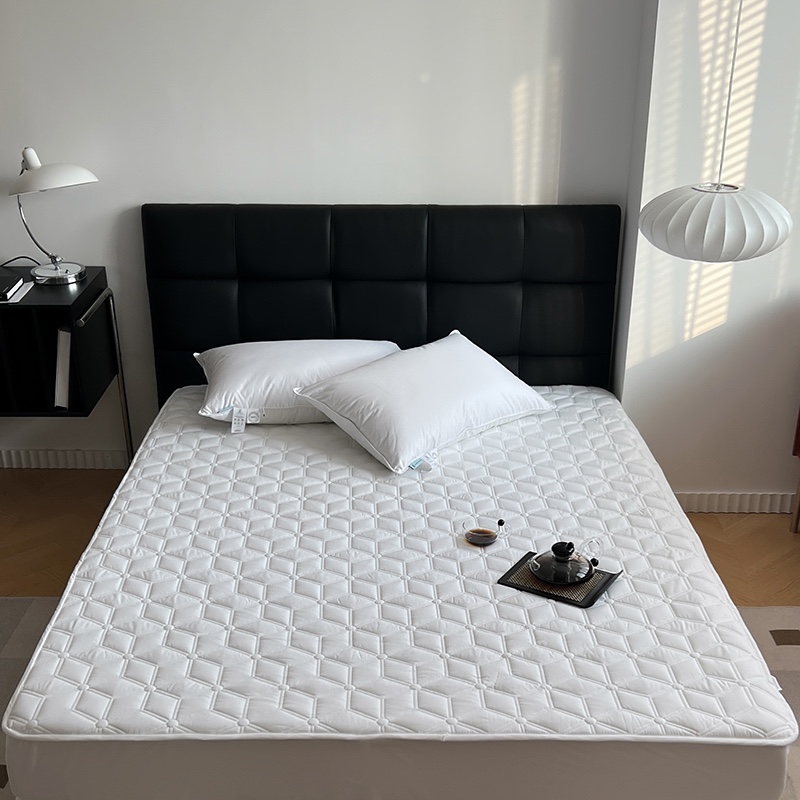
A new guestroom pack is the clearest use case, because every item is ordered at once and consistency is visible to the guest. A documented set for one room can be assembled as: a bedding set (CP106, CP128, CP139, CP152 or CP186), a ZX5103 microfiber pillow, a BX280 or CX2120 duvet, an HD3700 or HD3701 mattress protector with an HD3000 comforter, terry towels in the required sizes, a bath mat and a YP9600 waffle bathrobe.
Bathroom refresh in an operating property
Terry degrades faster than bedding, so bathroom replacement often runs on a shorter cycle than the rest of the room. Consolidating towels, bath mats and bathrobes under one supplier keeps weight and shade consistent across a staged rollout — floor by floor, or wing by wing — instead of mixing a new towel batch with mats bought two years earlier.
Food and beverage and banquet spaces
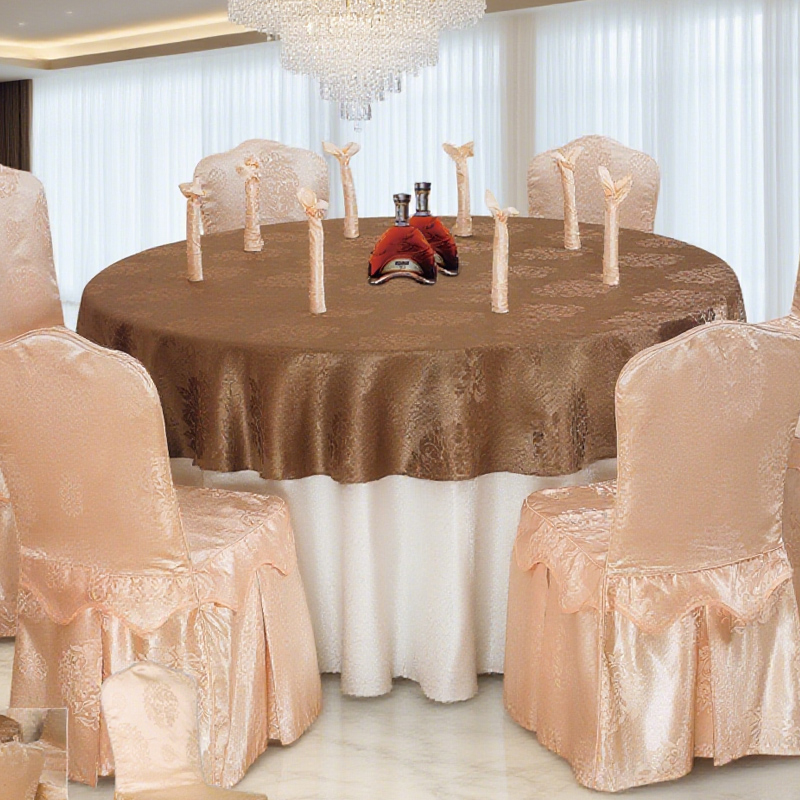
Table linen is frequently overlooked in a guestroom-focused buying list, yet it carries the same coordination risk. The TB1102 polyester jacquard table cloth is available in 260×260 cm, 300×300 cm and 320×320 cm with a double-needle side, and the CJ9800 cotton napkin in 45×45 cm and 50×50 cm at a 42s/2×42s/2, 103×95 construction — both specified for banquet, wedding, hotel and restaurant use.
Smaller properties and shorter order cycles
Boutique hotels, serviced apartments and resorts typically buy in smaller volumes but reorder more often. The documented combination of 100-piece terry minimums, 100-set minimums on customised bedding and flexible MOQ on the jacquard bedding construction makes a staged first order possible — start with one room type, validate in operation, then extend.
Matching Buyer Requirements to Documented Answers
The table below maps the requirements that recur in hotel specifications to what is actually documented in the WEISDIN range. Where a requirement is not documented, the honest answer is to confirm it with the supplier at sample stage rather than assume it.
| Buyer requirement | Documented position | What to confirm |
|---|---|---|
| Custom hotel logo on textiles | Embroidery supported on bedding sets; logo embroidery and OEM supported on terry towels; woven labels and private label supported on bedding | Logo file format, placement and minimum quantity at sampling |
| Shrink-resistant bedding | CP128 sateen documented as wrinkle-resistant and shrink-resistant; CP139 jacquard documented as fade-resistant and shrink-resistant | Which construction is specified for each room type |
| Chlorine-resistant terry | Listed as a recurring guestroom requirement in the hospitality application scenario data | Test against the property's own laundry chemistry before full rollout |
| Survival under commercial laundering | Reinforced stitching and colour fixation documented on terry; reinforced stitching documented on bedding | Wash temperature ceiling for each construction (70°C or 90°C) |
| Small first order | 100 pcs on terry and bath mats; 100 sets on customised bedding; flexible MOQ on jacquard bedding; samples accepted | Which category sets the commercial floor for the order |
Where a One-Stop Textile Programme Stops
A credible one-stop offer states its boundaries. The documented WEISDIN range is textile-led: bedding sets, sheets, pillows, pillow cases, duvets, mattress toppers and comforters, mattress protectors, terry towels, bath mats, bathrobes, chair covers and table linen. Items outside that range — ceramics, appliances, furniture, fixtures and equipment, and consumable amenities — sit in different supply chains and should be confirmed separately rather than assumed to be part of the order.
Three further limits are worth planning around:
- Dry-clean-only duvets. The BX280, CX2120 and BX296 constructions are documented as dry-clean only to a maximum of 90°C. Properties without dry-cleaning capacity should specify a washable alternative or a protector-and-comforter combination instead.
- Custom bedding lead time. A 30+ day lead time on customised bedding designs is a production figure. Sampling and freight sit outside it, so a renovation timeline that assumes otherwise will compress the wrong stage.
- Certification scope. OEKO-TEX® STANDARD 100 is the primary global safety benchmark for hotel textiles, ensuring products are free from over 1,000 harmful substances, but certification applies to specific articles and materials. Request the certificate that matches the exact fabric being ordered and verify it with the issuing body rather than relying on a logo reproduced in a catalogue.
Frequently Asked Questions
OEKO-TEX® STANDARD 100 is the primary global safety benchmark for hotel textiles, covering testing for over 1,000 harmful substances. Because certification applies to specific articles and materials, the certificate presented should match the exact fabric and product being ordered, and it can be verified with the issuing body. For a multi-category order, request documentation category by category — bedding, terry, bathrobes — rather than accepting a single document that covers the whole order.
Yes, where the range is documented across those categories. WEISDIN's documented range includes five bedding set constructions (CP106, CP128, CP139, CP152, CP186), the ZX5103 microfiber pillow, the BX280 and CX2120 duvets, the BX296 quilt, the HD3700 and HD3701 mattress protectors, the HD3000 comforter, plain, jacquard and embroidered terry towels, three bath mat constructions, the YP9600 waffle bathrobe, the TB1102 table cloth and the CJ9800 napkin. Categories outside textiles are not part of that documented range.
Minimums differ by category. Terry towels and bath mats carry a documented minimum of 100 pieces, with OEM and sample orders accepted. Customised bedding designs carry a documented minimum of 100 sets, and the jacquard bedding construction is documented as supporting a flexible MOQ for small quantity orders. Because the floor is set by category rather than by the order as a whole, a first consolidated order is best built around the category with the lowest realistic volume.
Sample orders are accepted on terry towels and bath mats, and OEM orders are accepted alongside them. Sampling is most useful when it is done as a set — towel, bath mat and bathrobe approved together — and when the sample is washed to the documented care temperature before approval: 90°C for most bedding constructions and bath mats, 70°C for the sateen bedding set. Because customised bedding designs carry a 30+ day production lead time, sampling should be scheduled well ahead of the opening or renovation date.
Customised bedding designs carry a documented lead time of 30+ days. That figure covers production; sample approval, order confirmation and freight are additional stages and should be planned separately. A practical sequence for a renovation is to approve samples first, confirm the customisation details (embroidery, woven labels, packaging), then place the production order against a date that already includes the 30+ day window plus transit.
Conclusion
One-stop comprehensive hotel supplies is a coordination model before it is a product list. It works when a single technical team can answer the same three questions across bedding, terry and table linen — what exactly is the construction, what is the customisation, and how does it survive the laundry — and when the supplier states plainly which categories sit outside the range.
For a property entering the research stage, the practical next step is not a purchase order. It is a specification sheet and a sample set: five bedding constructions compared at the same density, three terry weights compared at the same size, one bathrobe approved next to the towel it will sit beside. That comparison answers more than any catalogue page, and it is the point at which a consolidated programme either becomes credible or does not.
Request a Sample Set or a Quotation
WEISDIN supplies hotel bedding sets, terry towels, bath mats, bathrobes and table linen from Guangdong Weisdin Industrial Co., Ltd. in Guangzhou, China. Sample orders are accepted on terry and bath mats, and customised bedding designs start at 100 sets with a 30+ day lead time.
Email: vicky889@weisdin.cn | Tel / WhatsApp: +86 18925118522
Website: www.weisdin.com
Address: Room 201, 4th Staircase, Building 1, No. 237, Shibei Industrial Road, Dashi Street, Panyu District, Guangzhou City, Guangdong Province, China
Download the full product catalogue: 2026 WEISDIN Catalogue (PDF)

Have Questions or Need More Details?
Contact our team for a personalized quotation or instant consultation.
Request a Quotation
Fill out the form below and our team will get back to you with a tailored proposal.
WhatsApp Direct Chat
Prefer to chat in real-time? Message us on WhatsApp for instant assistance & quick answers.
- Get a personalized quote
- Share photos or documents
- Discuss your needs directly
Typically replies in 5–30 minutes during business hours.