
Seawater Desalination Gate Valve Selection: Materials, Seals & PN16/PN25 Design
Seawater Desalination Gate Valve Selection: Materials, Seals & PN16/PN25 Design
Stainless steel flange gate valve in 304/316, DIN 3352 F4/F5 — the wetted-seawater option in the WEIZIDOM range.
Gate valve selection for seawater desalination is a materials decision before it is a buying decision. Three variables control the outcome: a body material that tolerates high-salinity seawater, a seat and sealing construction that matches the required shut-off behaviour, and a pressure class that matches the line rating — in desalination service, normally PN16 or PN25.
This guide is written for the specification stage, where a line list already exists and a datasheet has to be issued. It addresses project buyers, EPC pipeline engineers and distributors working on coastal seawater desalination plants, offshore water treatment facility renovations and marine water supply systems. The product facts used here come from the WEIZIDOM range — WEIZIDOM Group (Henan Weizidom Flow Control Co., Ltd.), a valve manufacturer established in 2000 that produces, sells and services valves, pipe fittings, water meters and flow meters, and whose products are exported to more than 60 countries with export business accounting for 80% of sales.
Short answer for PN16/PN25 seawater lines
- Wetted seawater: stainless steel flange gate valve in 304/316, EPDM or Viton sealing, DIN 3352 F4/F5, EN 1074 or JIS B2062, DN40–DN800, PN10 to PN40.
- Treated water and larger bores: flange resilient gate valve in ductile iron GGG50/QT500-7, EPDM or NBR, DIN 3352 F4/F5, DN40–DN1200, PN10 to PN25.
- Do not treat WCB carbon steel as the default wetted material simply because it is the default on the line list.
The Problem: In Seawater Service, Corrosion Sets the Specification
WEIZIDOM's seawater desalination application data defines the duty in one line: coastal outdoor installation, ambient temperature 5 °C to +70 °C, medium pressure of PN16 or PN25, medium of seawater with strong corrosion and high salinity. The special requirement listed against that duty is equally direct — high corrosion resistance, seawater resistance and long service life. That is a materials brief first and a valve brief second.
A standard carbon steel gate valve is the common default on industrial line lists, and on many plants it is the correct one. In the WEIZIDOM range, the carbon steel gate valve is supplied in WCB and LCB grades from DN50 to DN1000, with PN16, PN25, PN40 and PN63 ratings, and it is positioned for petrochemical, power plant, heating and ventilation, and general industrial pipeline duty. None of those positions is high-salinity seawater. Where chlorides are present, carbon steel is generally the material that limits service life: surface attack produces corrosion products, those products settle onto seating surfaces, and the resulting deposits interfere with the tight mating that a wedge gate valve relies on for shut-off. Corrosion around the stem and bonnet affects operation rather than closure, which is harder to detect until the valve is actually stroked.
LCB does not resolve this. LCB is a low-temperature carbon steel grade: it answers a low-temperature requirement, not a chloride requirement. With a stated ambient range of 5 °C to +70 °C, desalination duty is not asking for a low-temperature grade — it is asking for a corrosion-resistant wetted path.
The practical consequence is that material choice has to be made per wetted path, not per plant. Raw seawater, brine, backwash and product-water lines do not impose identical demands, and a specification that treats them the same way either overspends on some lines or under-specifies on the ones that matter.
Industry Background: Where Desalination Gate Valves Actually Sit
Desalination gate valves appear in three project types in WEIZIDOM's application data: construction of coastal seawater desalination plants, renovation of offshore water treatment facilities, and construction of marine water supply systems. The stated role in those lines is flow control with corrosion protection — a shut-off function rather than a throttling function, which is consistent with how a gate valve is designed to work.
The geographic footprint is coastal and often arid. The same application data lists markets including the United Arab Emirates, Chile, Morocco, Mexico, the Philippines, South Africa and Iraq — markets where a plant may run for decades on seawater feed and where maintenance access is costly to create.
Market context points the same way. Global Market Insights estimated the industrial valve market at USD 73.9 billion in 2025, with gate valves at about 15% of product share in that estimate. Gate valves are therefore a mainstream, well-understood category: the difference between suppliers is rarely the concept, it is whether the material, seating and documentation match the line.
The Solution: Matching Material and Seating to the Line
Stainless steel flange gate valve: the wetted-seawater baseline
WEIZIDOM supplies the stainless steel flange gate valve in DIN 3352 F4/F5 (CF8/CF8M), EN 1074 (304/316) and JIS B2062 (SUS304) configurations, with a non-rising stem (NRS) or outside screw and yoke (OS&Y) structure, EPDM or Viton sealing, pressure ratings of PN10, PN16, PN25 and PN40, and a size range of DN40 to DN800. Seawater desalination is listed directly among its applications, alongside food and beverage, pharmaceutical and chemical duty. Two body grades are offered: 304 (SUS304) and 316 (SUS316).
Both grades are austenitic stainless steels. In general engineering practice, the molybdenum-bearing 316 grade is the one usually preferred for chloride-bearing water, while 304 is commonly used where the medium is less aggressive. The decision should follow the line: raw seawater and brine typically justify the higher-alloy option, while product water and lower-chloride streams may not.
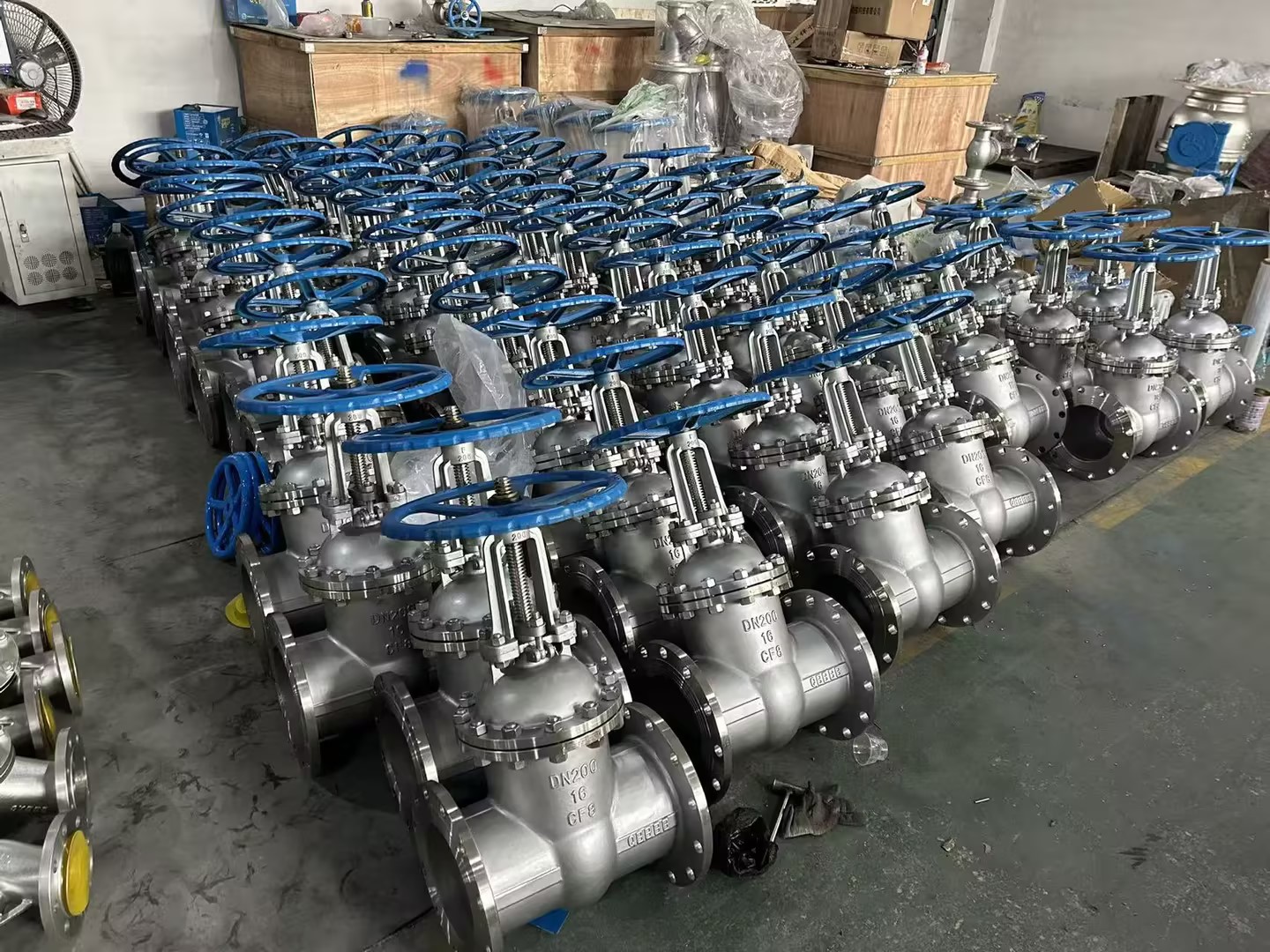
Stainless steel flange gate valve detail: body, flange face and stem area are the surfaces that decide service life in a coastal plant.
Flange resilient gate valve: PN16 and PN25 at larger bores
The flange resilient gate valve is built on a ductile iron GGG50 or QT500-7 body with EPDM or NBR sealing, a non-rising stem structure, DIN 3352 F4 and DIN 3352 F5 designations, PN10, PN16 or PN25 ratings, and sizes from DN40 to DN1200. Its own application list is water supply and drainage, agricultural irrigation and wastewater treatment, and it also appears among the products associated with the seawater desalination scenario in WEIZIDOM's application data.
Read that positioning carefully. The resilient family is the sensible choice for the treated-water, filtration, backwash and wastewater side of a desalination plant, and it is the only family here that reaches beyond DN800 — up to DN1200 — at PN16 or PN25. It is not the automatic choice for the raw seawater intake path, where the corrosion requirement is the dominant constraint.
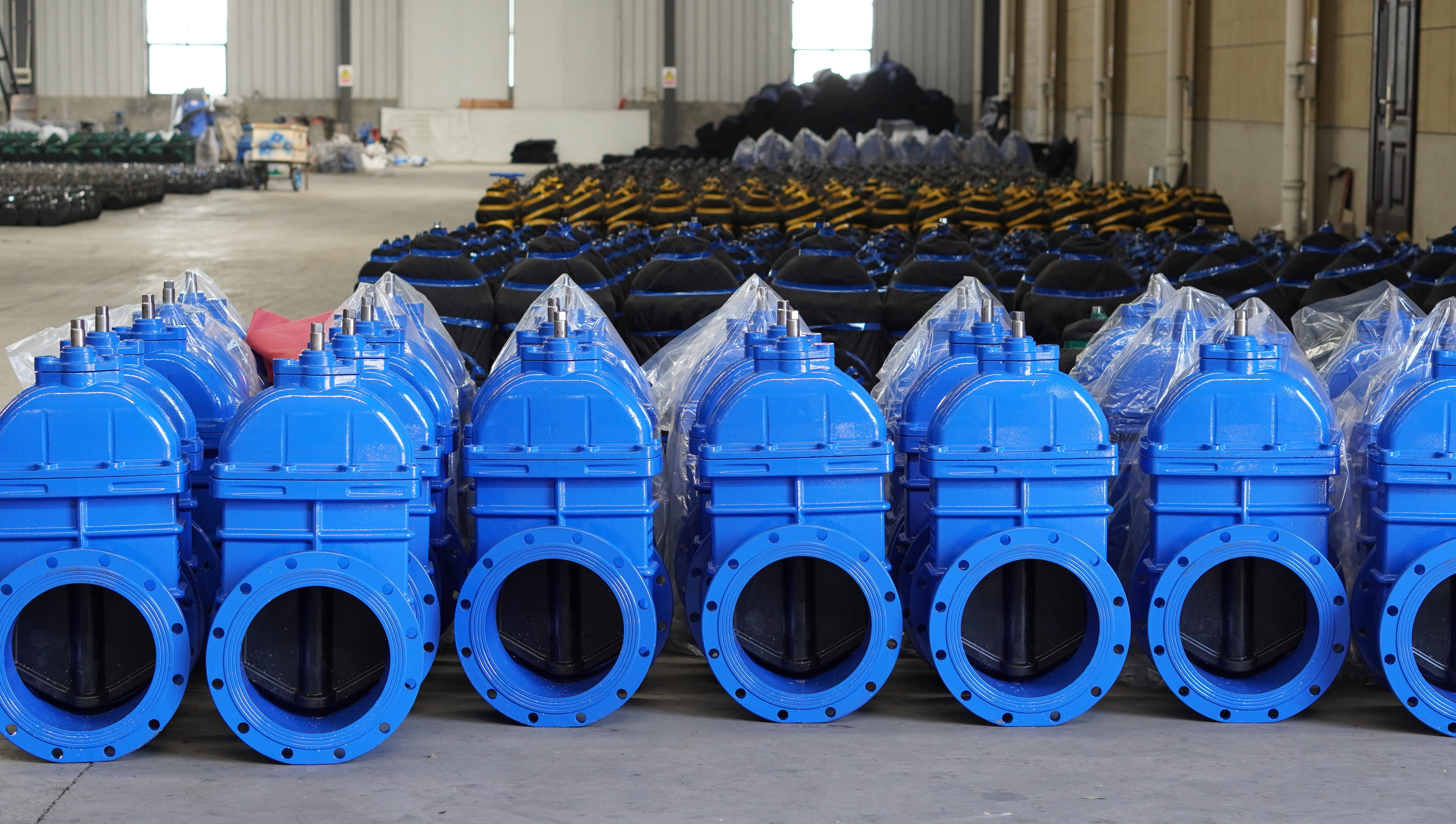
Flange resilient gate valve: ductile iron GGG50/QT500-7, EPDM or NBR seat, PN10 to PN25, up to DN1200.
Carbon steel: correct on the datasheet, often wrong on the wetted path
The DIN 3352 F4/F5 carbon steel flange gate valve in WCB or LCB, PN16 to PN63, DN50 to DN1000, with metal-to-metal or EPDM seating, remains a sound selection for petrochemical, power plant, heating, ventilation and general industrial pipeline services. On a desalination plant it can still appear on non-aggressive utility lines. What it should not be is the automatic default for a line whose stated medium is seawater at high salinity, where the recorded special requirement is high corrosion resistance and seawater resistance.

Carbon steel gate valve in WCB: a general-purpose industrial pipeline valve, not the wetted-seawater reference material.
Metal-to-metal or EPDM/Viton: how to decide seating
Both seating philosophies exist in the WEIZIDOM range, which is why the choice has to be made deliberately rather than inherited from a previous project.
- Elastomer seated: the stainless steel flange gate valve uses EPDM or Viton; the flange resilient gate valve uses EPDM or NBR; the BS5163 rising stem gate valve uses a fully wrapped EPDM seat on a QT500-7/GGG50 body at PN10 or PN16; the socket connection gate valve uses EPDM or NBR at PN10, PN16 or PN25.
- Metal-to-metal seated: the carbon steel gate valve offers metal-to-metal or EPDM; the API gate valve uses metal-to-metal with Stellite facing; the rising stem forged steel gate valve uses metal-to-metal or PTFE; the stainless steel knife gate valve uses PTFE or EPDM.
In desalination, the usual split follows line function. Elastomer seats generally conform to the wedge and are the practical choice for water and product-water trains at moderate pressure, which is why EPDM is listed for the stainless steel seawater option. Metal seating is generally preferred where the line also sees higher temperature, abrasive carry-over or hydrocarbon duty — for example offshore platform topsides, where the API gate valve range is positioned: Class150 to Class900, NPS 1/2" to 48", metal-to-metal seating, API 600, API 602 and API 6D designs.
Aligning PN16 and PN25 with the desalination band
PN16 and PN25 are the medium-pressure ratings recorded for this service, and the ranges line up as follows: the stainless steel flange gate valve covers PN10, PN16, PN25 and PN40; the flange resilient gate valve covers PN10, PN16 and PN25; the carbon steel gate valve covers PN16 to PN63; the API gate valve covers Class150, 300, 600 and 900.
Two rules follow. First, take the pressure class from the line rating rather than from habit — an upgraded class changes the face-to-face envelope, the actuator sizing and the cost without improving a line that does not need it. Second, if a line genuinely requires PN40, the resilient family stops at PN25 and the stainless steel flange gate valve, which runs to PN40, becomes the candidate.
What drives the cost of a desalination gate valve specification
Cost in this category is driven by specification content, not by a single label: body grade (304 against 316), size (a DN40 valve and a DN800 valve share a datasheet format but not a price), pressure class, seating type, seal material (EPDM against Viton), operation mode (manual handwheel against electric or pneumatic actuation with corrosion protection), the balance-of-plant items bundled with the valve, and the documentation and testing package. Comparing quotations without aligning those variables compares different products.
Step-by-Step: Building the Datasheet
- Record the line data. Medium (seawater, brine, backwash, product water), installation exposure (coastal outdoor, 5 °C to +70 °C ambient), pressure class (PN16 or PN25) and nominal size.
- Fix the pressure class from the line rating. Confirm the candidate family reaches it: stainless steel to PN40, resilient to PN25, carbon steel to PN63, API to Class900.
- Select the body material by wetted path. Stainless steel 304 or 316 for seawater contact; ductile iron resilient construction where the line is treated water at PN16 or PN25 and the bore runs beyond DN800.
- Select the seating. EPDM or Viton on the stainless valve for water trains; metal-to-metal where temperature, abrasion or hydrocarbon duty is also present.
- Select the structure and connection. DIN 3352 F4 or F5 flange pattern; NRS for compact installations; OS&Y where visible stem position is useful; rising stem BS5163 patterns for water network distribution.
- Select the operation mode. Manual handwheel, or electric or pneumatic actuation with corrosion protection for automated seawater lines.
- Add the balance of plant. Stainless steel filter, check valve, pressure gauge, corrosion inhibitor injection device and control system complete the seawater treatment train around the gate valve.
- Verify the documentation package. Confirm the design standard actually applied (DIN, EN, JIS, GB, ASME, API, AWWA or BS as relevant), the test regime, and the edition of any third-party standard quoted — API 600, for instance, has more than one edition in circulation, and the applicable edition should be confirmed before it is written into a purchase order.
Use Cases: Five Typical Desalination Configurations
- Coastal desalination plant transfer lines. Stainless steel flange gate valve, 316 body, EPDM or Viton seat, PN16 or PN25, DN40 to DN800, electric or pneumatic operation with corrosion protection.
- Offshore water treatment facility renovation. Stainless steel flange gate valves on the treatment train, with API gate valves where the same platform also carries hydrocarbon service at Class150 to Class900.
- Marine water supply systems. Resilient seated valves at PN16 or PN25 for larger distribution bores up to DN1200, with stainless steel valves retained for the seawater-wetted sections.
- Brine, backwash and slurry handling. Stainless steel knife gate valve in 304 or 316, PN10 to PN25, DN50 to DN600, knife-type parallel disc with PTFE or EPDM sealing, for lines where solids are present.
- Large-diameter intake and outfall headers. Where the bore exceeds DN800 and the class is PN16, the resilient family extends to DN1200 while the stainless steel flange valve covers up to DN800.
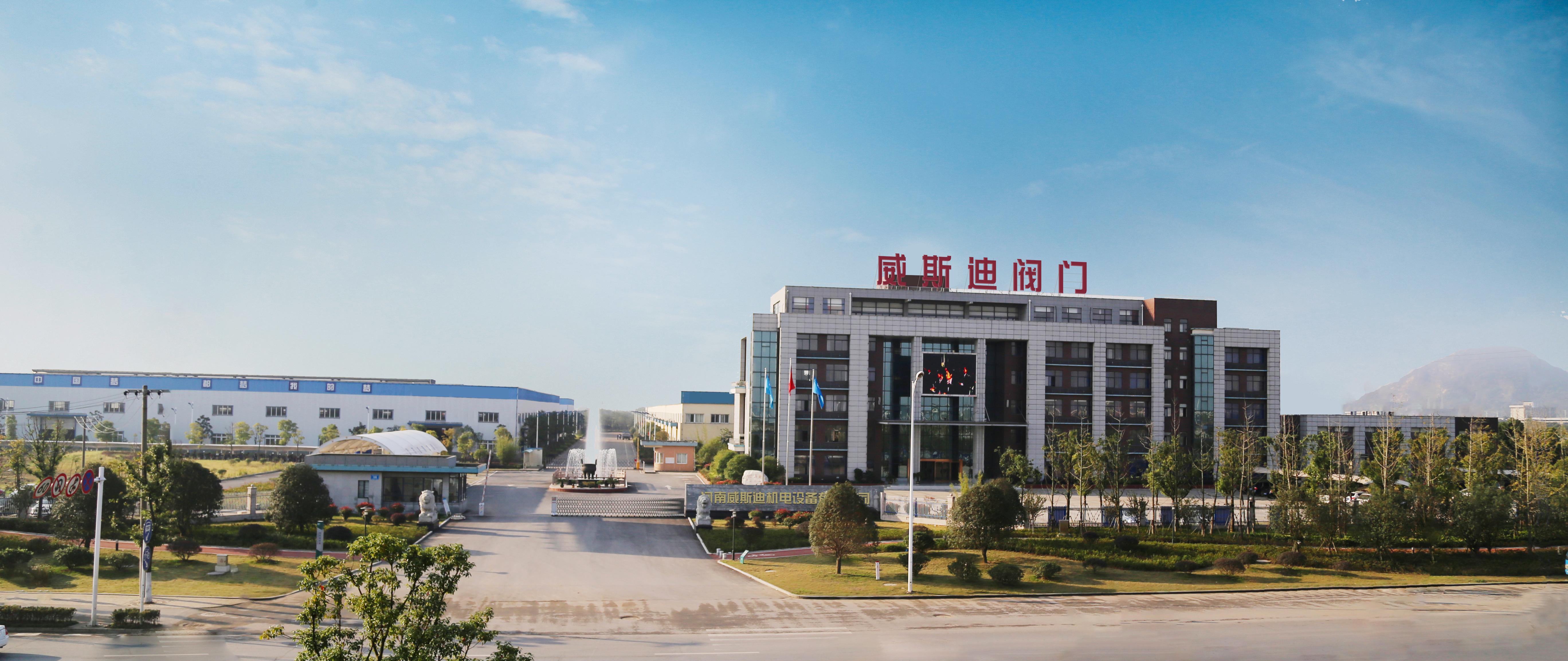
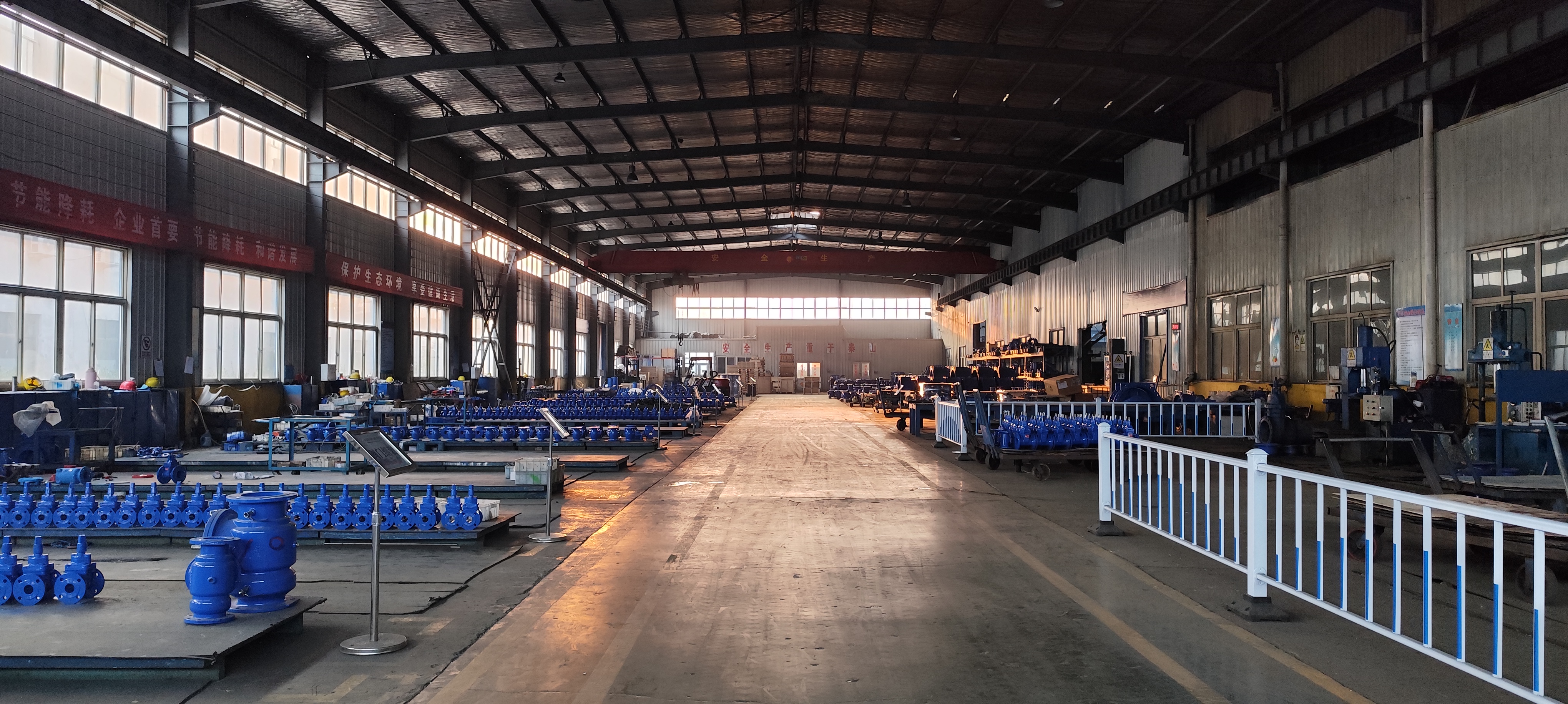
WEIZIDOM manufacturing: each product passes 12 tests from raw material through to the finished valve.
Maintenance Considerations for Saltwater-Exposed Installations
- Protect the actuator, not just the body. Electric or pneumatic operation with corrosion protection is the specified mode for this service; an unprotected actuator becomes the first failure point on a coastal site.
- Exercise the valve. Gate valves are shut-off devices, and long periods in one position are generally the condition under which stems and seats give trouble. Periodic full-travel operation is standard practice on seawater lines.
- Treat elastomer seats as a service item. EPDM and Viton seats are available for the stainless steel flange gate valve, so seal replacement can be planned against a known spare rather than a re-specification.
- Use the instrument set you already specified. The pressure gauge and corrosion inhibitor injection device listed in the matched equipment set are the two items that let operators see a trend before it becomes a leak.
- Standardise the fleet. A plant that uses one standard and one size logic across its seawater lines holds fewer spares than a plant with mixed DIN, EN and JIS configurations in the same building.
- Keep the test record. WEIZIDOM applies 12 tests per product from raw material to final product; retaining those records is what makes a future replacement a like-for-like order.
Comparison Table: Seawater-Relevant Gate Valve Options
The table compares product families that appear in WEIZIDOM's seawater desalination application data, using published product parameters only. Read it as a shortlist filter: the row that matches your wetted path, pressure class and bore is the row to quote.
| Product | Body material | Pressure rating | Size range | Sealing | Design standard |
|---|---|---|---|---|---|
| Stainless steel flange gate valve | 304 / 316 (CF8 / CF8M) | PN10 / PN16 / PN25 / PN40 | DN40–DN800 | EPDM / Viton | DIN 3352 F4/F5, EN 1074, JIS B2062 |
| Flange resilient gate valve | GGG50 / QT500-7 ductile iron | PN10 / PN16 / PN25 | DN40–DN1200 | EPDM / NBR | DIN 3352 F4, DIN 3352 F5 |
| Carbon steel gate valve | WCB / LCB | PN16 / PN25 / PN40 / PN63 | DN50–DN1000 | Metal to metal / EPDM | DIN 3352 F4/F5, EN 12516, GB/T 12234 |
| API gate valve | WCB / CF8 / CF8M | Class150 / 300 / 600 / 900 | NPS 1/2"–48" (DN15–DN1200) | Metal to metal / Stellite | API 600, API 602, API 6D |
| Rising stem forged steel gate valve | A105 / F304 / F316 | Class150 / 300 / 600 | NPS 1/4"–4" (DN8–DN100) | Metal to metal / PTFE | API 602, ASME B16.34, DIN 3356 |
| Stainless steel knife gate valve | 304 / 316 | PN10 / PN16 / PN25 | DN50–DN600 | PTFE / EPDM | API 598, DIN 19526, JIS F7380 |
| BS5163 rising stem gate valve | QT500-7 / GGG50 ductile iron | PN10 / PN16 | DN50–DN800 | Full wrapped EPDM | BS5163 Type B, EN 1074, AWWA C509 |
One caution on the table: API 600 defines a heavy-duty steel gate valve scope for petroleum refinery and related service, covering bolted bonnet, outside screw and yoke, rising stem, wedge or parallel seating, metallic seating surfaces and flanged or butt-welding ends. It is a screening framework, not a substitute for confirming a supplier's actual configuration and test records.
FAQ
Which standards should a desalination gate valve be specified to?
It depends on the family. The stainless steel flange gate valve is supplied to DIN 3352 F4/F5 (CF8/CF8M), EN 1074 (304/316) and JIS B2062 (SUS304); the flange resilient gate valve to DIN 3352 F4 and DIN 3352 F5; the carbon steel gate valve to DIN 3352 F4/F5, EN 12516 and GB/T 12234; the API gate valve to API 600, API 602 and API 6D; and the BS5163 rising stem gate valve to BS5163 Type B, EN 1074 and AWWA C509. Where a third-party standard is quoted, confirm the current edition before ordering — API 600, for example, exists in more than one edition.
Can one valve family cover both PN16 and PN25 desalination lines?
Yes, in two ways. The stainless steel flange gate valve is rated PN10, PN16, PN25 and PN40 over DN40 to DN800, so it covers PN16 and PN25 with margin. The flange resilient gate valve is rated PN10, PN16 and PN25 over DN40 to DN1200, so PN25 is its upper limit. If a line requires PN40, only the stainless steel family in this range qualifies; the resilient family stops at PN25.
Should I choose metal-to-metal or EPDM/Viton seating for seawater?
For water and product-water trains at PN16 or PN25, the stainless steel flange gate valve with EPDM or Viton sealing is the straightforward choice, because elastomer seating is what the seawater option in this range is built around. Metal-to-metal seating is offered on the carbon steel gate valve, the API gate valve (Stellite facing) and the rising stem forged steel gate valve (metal-to-metal or PTFE), and is generally the better fit where the line also carries higher temperature, abrasive carry-over or hydrocarbon duty. The decision follows the line, not a general preference.
What supporting equipment should be ordered with the gate valve?
WEIZIDOM's seawater desalination application data lists a stainless steel filter, check valve, pressure gauge, corrosion inhibitor injection device and control system as the matched equipment set. In practice the strainer and non-return functions are the two items most often left off a purchase order even though they protect the valve: WEIZIDOM supplies strainers and check valves as part of its product range, so they can be specified in the same material class as the gate valve rather than sourced separately afterwards.
How do I validate a supplier and request a sample or quotation?
Ask for the applied standard and the test regime in writing, then match both against your datasheet. WEIZIDOM applies 12 tests per product from raw material to final product, works to GB, JB, HB, ASME, API, AWWA, DIN, EU and BS standards, and operates five factories in Tianjin, Wenzhou, Hebei, Lianyungang and Anhui, supported by a 60-engineer R&D team. For a specific seawater line, send the medium, pressure class, size, seating preference and operation mode to contact@weizidom.com or +86 17319732766 to request a sample or a quotation; the product catalogue is available for download below.
Conclusion
Desalination gate valve selection resolves into three checkable decisions. Match the body material to the wetted path — stainless steel 304/316 where seawater contacts the valve, ductile iron resilient construction where the line is treated water and the bore exceeds DN800. Match the seating to the line function, using EPDM or Viton for water trains and metal-to-metal where temperature, abrasion or hydrocarbon duty is also present. Then match the pressure class to the line rating, remembering that PN25 is the ceiling of the resilient family while the stainless steel flange gate valve runs to PN40.
Everything else — the flange pattern, the stem structure, the actuator, the strainer and check valve around the valve — follows from those three decisions. A supplier that can document them across a full range is worth more than a quotation that only lists a price: WEIZIDOM manufactures over 2,000,000 units a year from a 60,000 m² manufacturing base with 300 employees, and exports to more than 60 countries.
Next step: take the three decisions to a quotation
Send your line data — medium, PN class, size, seating preference, operation mode — and WEIZIDOM will confirm the matching stainless steel flange gate valve, flange resilient gate valve or supporting equipment for your desalination project.
- Email: contact@weizidom.com
- Tel / WhatsApp: +86 17319732766
- Website: www.wsdvalves.com
- Address: No.999, Zhengxin Expressway, Zhengzhou City, Henan Province, China
Product catalogue (PDF): download the WEIZIDOM digital catalogue.
Have Questions or Need More Details?
Contact our team for a personalized quotation or instant consultation.
Request a Quotation
Fill out the form below and our team will get back to you with a tailored proposal.
WhatsApp Direct Chat
Prefer to chat in real-time? Message us on WhatsApp for instant assistance & quick answers.
- Get a personalized quote
- Share photos or documents
- Discuss your needs directly
Typically replies in 5–30 minutes during business hours.