Stainless Steel Press Fittings: 5 Site Problems, 5 Fixes
A leaking or separating press-fit joint is usually reported as a fitting defect, but the documented causes behind most site failures sit elsewhere: the wrong profile system, a sealing ring that does not match the medium, an alloy grade chosen for the wrong water chemistry, or an installation step performed with mismatched jaws. In those cases the coupling or elbow is not the fault — the specification is.
This page works as a problem-solution map for stainless steel press fittings. It lists five recurring problems reported on site, the verified root causes behind each, the corrective action, and the supply-side controls — profile, gasket, alloy, documentation and OEM customization — that stop the same problem from reaching the next project.
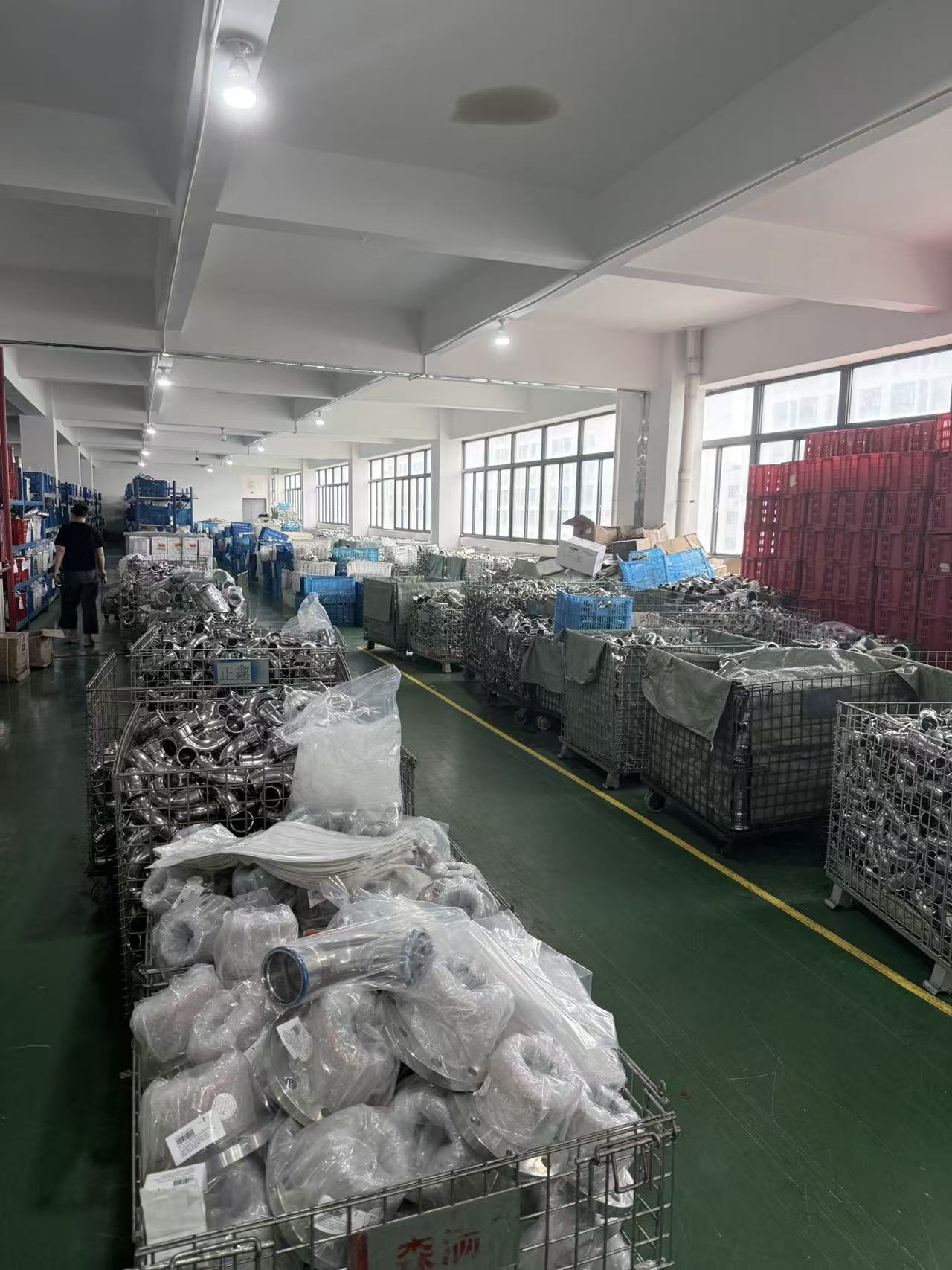
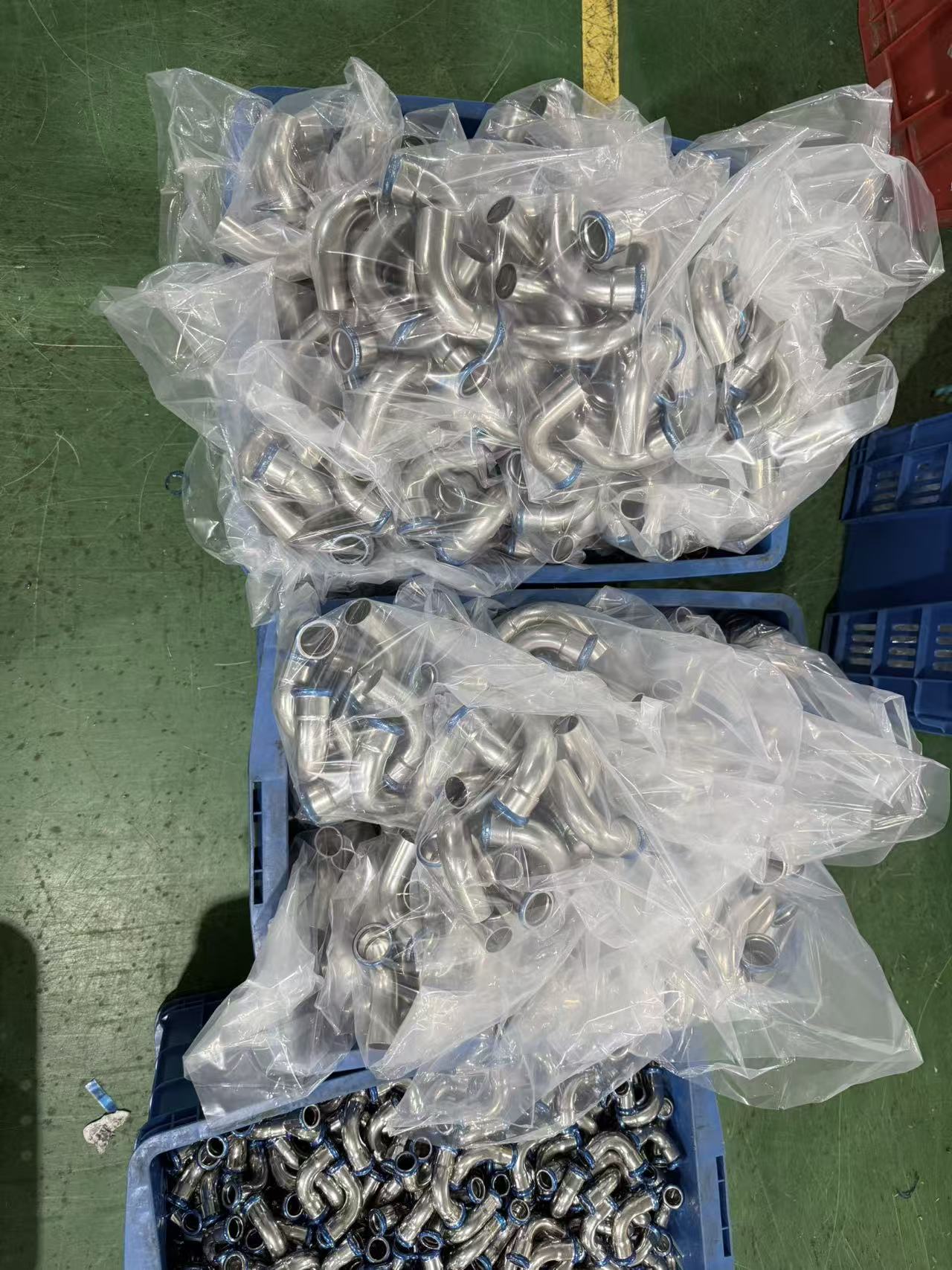
Stock of stainless steel press fittings held for project supply and pre-shipment inspection.
Problem Definition: When a Press-Fit Joint Becomes a System Problem
A stainless steel press fitting seals by mechanically compressing the fitting body onto the tube while an elastomer sealing ring closes the gap. That gives four distinct failure families, and each one has a different owner:
- Installation-induced: pipe burrs, insufficient insertion depth, misaligned or wrong-size jaws, damaged gasket, deformed pipe or fitting surfaces.
- Compatibility-induced: components from different press-groove systems assembled into one pipeline.
- Media-induced: sealing ring or alloy grade that does not suit the conveyed medium, chloride level or temperature.
- Documentation and delivery-induced: certification scope or delivery timing that does not match the project file.
The decision rule is simple: identify the failure family before replacing anything. A deformed fitting is never re-pressed — secondary pressing on an already deformed joint is not permitted, and the joint must be dismantled, damaged parts replaced and the full installation repeated to standard procedure.
Industry Background: Why Profile Discipline Now Decides Project Outcomes
Press-fit is no longer a niche joining method. Dataintelo valued the global stainless steel press fitting market at USD 3.8 billion in 2025, with an expected path to USD 6.4 billion by 2034 at a 6.0% CAGR (Dataintelo, April 2026). Global Industry Reports separately estimated the stainless steel sub-sector at roughly USD 1.03–1.30 billion for 2024. Both figures describe a market large enough that a single project order now often crosses two or three profile systems, tool brands and documentation regimes.
Regulation reinforces the same point. Stainless steel press fittings for pressure purposes are specified against EN 10217-7 for welded tubes and EN 10312 for plumbing applications (Isotubi technical specifications). On the geometry side, M Profile and V Profile are the two dominant pressing geometries in Europe, with M Profile available in sizes up to 168.3 mm, and both are valid under the same regulations (Eurotubi technical guide). In practice, the profile choice often follows contractor tool habit rather than engineering preference — which is exactly why mixed bills of materials keep appearing on site.
The buyer consequence is direct: evaluation has to move from “which fitting is cheaper” to “which single profile, gasket and alloy system is locked across fittings, tube and pressing jaws, and which documents prove it.”
Detailed Solution: Five Site Problems and Their Verified Corrections
Problem 1 — The joint leaks after pressing
Leakage at a pressed connection usually traces back to installation error rather than a defective fitting. The documented causes are: burrs left on the pipe end that scratch the sealing gasket; insufficient pipe insertion depth; wrong-size or misaligned pressing jaws; a sealing gasket that is damaged, aged or improperly assembled; and visible deformation on the pipe or fitting surface.
Correction follows a fixed sequence: depressurise the system; check the joint appearance for deformation and confirm which jaws were used; dismantle the connection and inspect the gasket, replacing it if damaged; cut the pipe squarely and remove all inner and outer burrs; mark insertion depth and reinstall to standard press-fit procedure; then re-run the pressure test to confirm the joint is dry.
Supply-side control: fittings released under 100% visual inspection and pressure testing remove the manufacturing variables from that diagnosis, so the remaining cause set is installation and tooling.
Problem 2 — Components from two profile systems will not seal
Euro-standard M-profile press-fit fittings and Chinese-standard V-profile press-fit fittings are not interchangeable. The press-groove dimensions differ, the sealing ring groove does not match, and mixing them is explicitly not recommended: forced assembly produces poor sealing, leakage or pipe disconnection, and pressing tools cannot be shared between the two systems. Fittings, tubes and pressing jaws must belong to one profile type.
The practical rule for procurement is to select M-profile for European-standard projects supplied with M-type pressing tools, and V-profile for domestic and most Southeast Asian projects supplied with V-type tools — then keep the two profile families out of the same pipeline system entirely.
WENZHOU ZHENGXIN PIPE FITTINGS CO., LTD (www.zxpipeindustry.com) manufactures both sides of that split: European-standard single press-fit fittings, and Chinese-national-standard double press-fit Series 1 and Series 2, alongside socket-weld and grooved quick-assembly pipelines. For a buyer, that means the profile system can be locked at the bill-of-material level instead of being resolved on site.
Problem 3 — The seal fails in the medium it meets
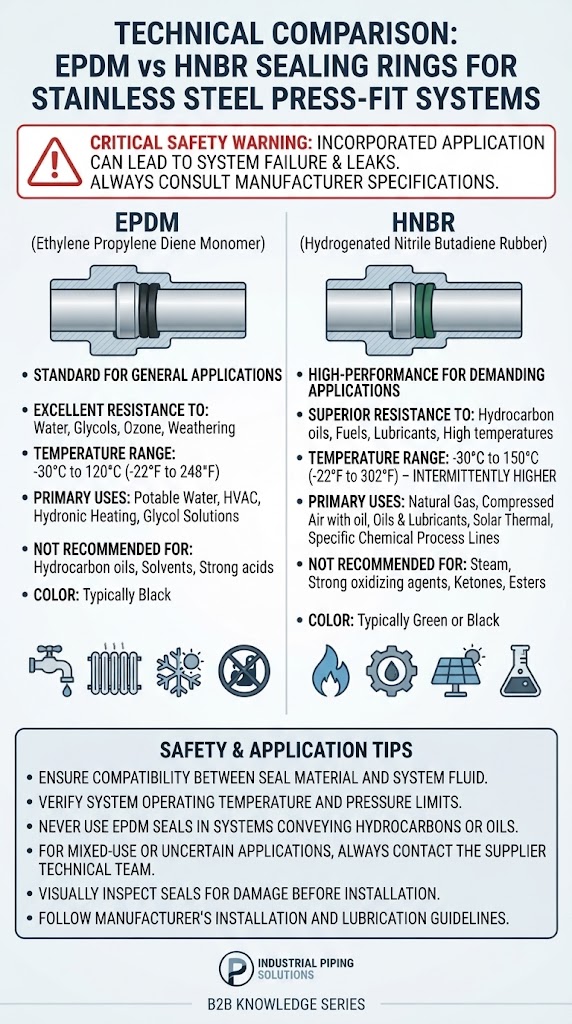
Sealing ring choice must follow the conveyed medium, not the stock availability of the fitting.
EPDM performs well in water service and is used for water supply and drainage. HNBR is the material for gas and oil-gas media. If a water-service EPDM gasket is installed on a gas line, it ages rapidly and creates a dangerous gas leakage path — the two gasket types must never be cross-used.
Temperature adds a second variable. The standard European-standard press fitting range works from -20 °C to 95 °C with 1.6 MPa cold water and 1.0 MPa hot water at 95 °C or below; a high-temperature resistant version extends that to -40 °C to 120 °C, but only with the sealing ring replaced accordingly. Sealing options in the range include food-grade silicone (FDA certified) for hygienic duty and EPDM for temperature and oil resistance.
Problem 4 — Pitting and premature corrosion on stainless fittings
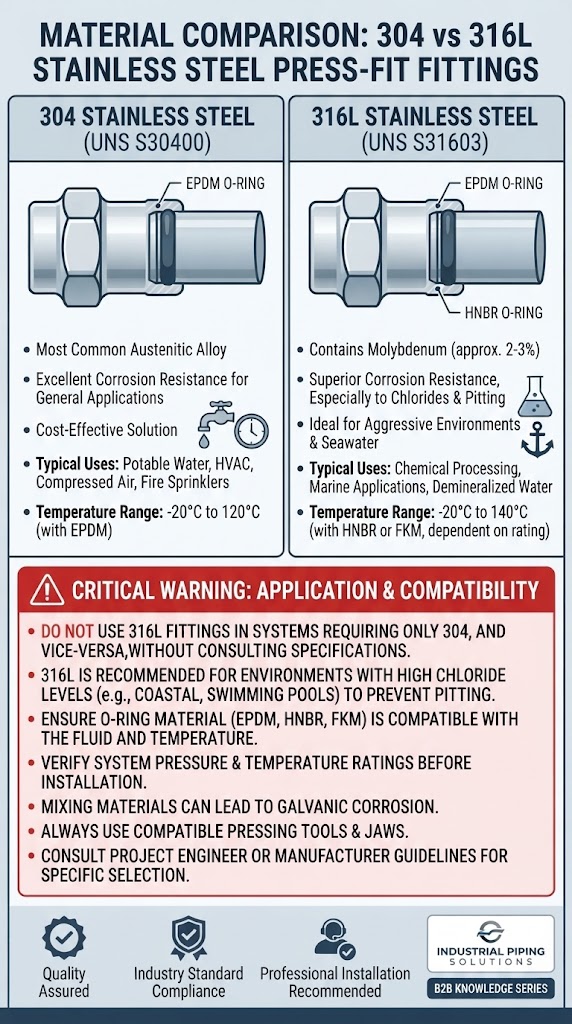
Alloy grade is a working-condition decision: 304 for normal water and dry compressed air, 316L where chlorides are present.
Type 304 stainless steel suits normal tap water and dry compressed air, and is preferred for general gas pipelines. Type 316L is recommended for seawater, weak acid-alkali and chemical duty, and coastal high-chloride environments, because its molybdenum content gives superior chloride resistance. Type 304 is prone to pitting corrosion under high-chloride coastal conditions; on seaside gas projects the 316L upgrade is the appropriate specification.
Both grades are available in the European-standard series — 304 Stainless Steel (06Cr19Ni10) and 316L Stainless Steel (022Cr17Ni12Mo2) — so the grade decision can be made per zone rather than per project.
Problem 5 — Documentation or delivery timing does not match the project file
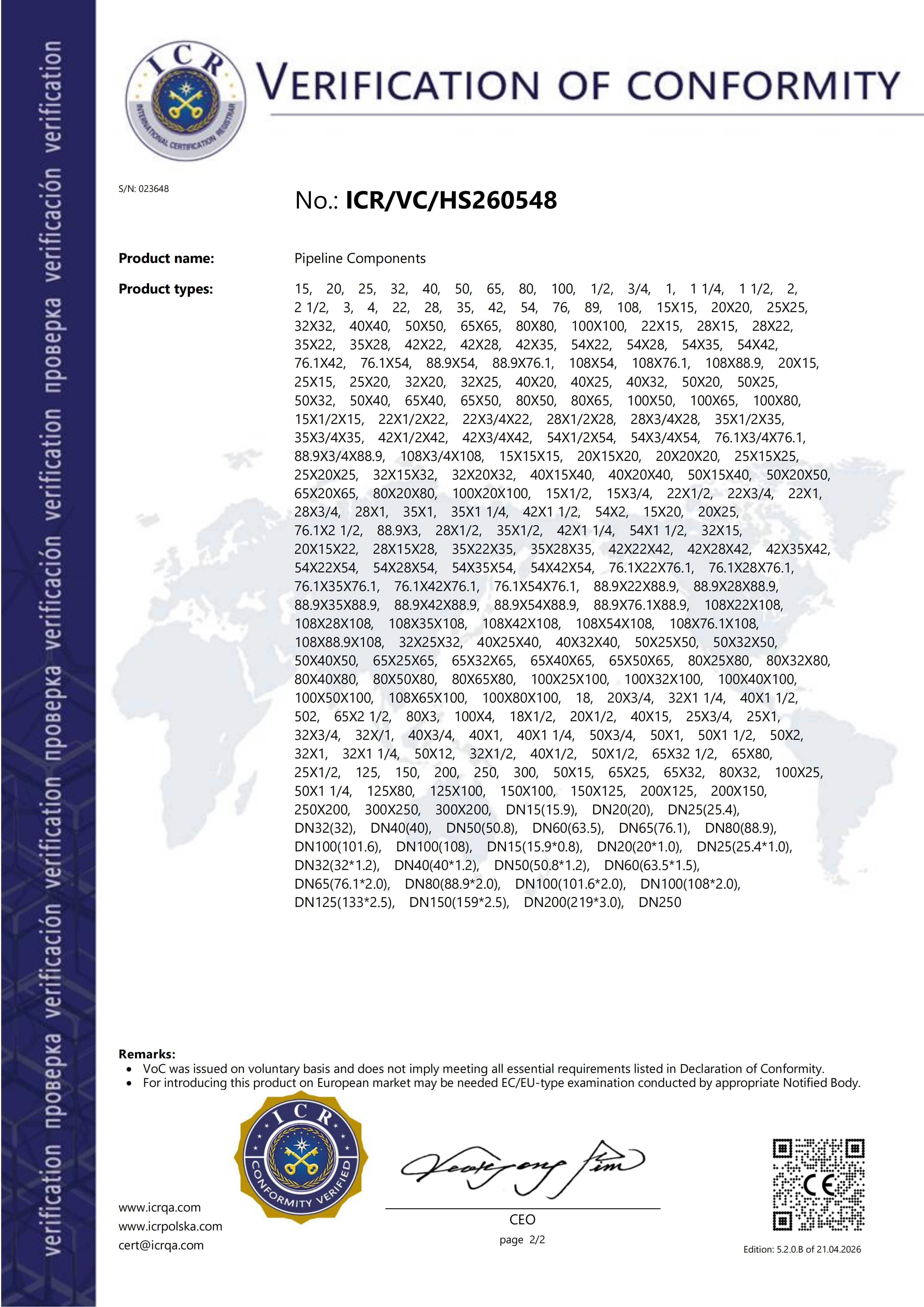
CE-PED Verification of Conformity ICR/VC/HS260548, issued by ICR Polska, valid 13 May 2026 to 12 May 2031.
The CE-PED Verification of Conformity held for these products is certificate ICR/VC/HS260548, issued by ICR Polska for the EU market on 13 May 2026 and valid until 12 May 2031. It covers stainless-steel press-fit pipeline components across the full size range DN15–DN250 and records EN 1092-1:2018 as the listed standard. A buyer comparing suppliers should read the certificate number, issuing body, scope and expiry against the project specification — not against the product brochure.
Delivery timing is the second half of this problem. Production runs on OEM and ODM modes with a stated lead time of 25–40 days against a monthly capacity of 83,000 fittings and 83 tons of pipe, and quality control covers 100% visual inspection plus pressure testing. Acceptance criteria are pre-shipment inspection with factory visual and dimensional checking; payment terms are 30% deposit and 70% balance before shipment; delivery terms are EXW, FOB or CIF.
Reference specification: European standard press fittings
| Parameter | Specification |
|---|---|
| Main material | 304 Stainless Steel (06Cr19Ni10) / 316L Stainless Steel (022Cr17Ni12Mo2) |
| Suitable pipe outer diameter | DN15 (φ16) – DN100 (φ108) |
| Working pressure | 1.6 MPa (cold water) / 1.0 MPa (hot water, ≤95 °C) |
| Working temperature | -20 °C to 95 °C (ordinary model); -40 °C to 120 °C (high-temperature resistant model, sealing ring replacement required) |
| Sealing material | Food-grade silicone (FDA certified) / EPDM (temperature and oil resistant) |
| Fitting types | Press-fit elbow, press-fit coupling, press-fit tee |
| CE-PED documentation | ICR/VC/HS260548, ICR Polska, DN15–DN250 scope, EN 1092-1:2018, valid to 12 May 2031 |
Step-by-Step Breakdown: Six Steps from Complaint to Locked Specification
- Record the failure conditions. Note medium, pressure, temperature, time to failure, tool brand and jaw size. Without this, every complaint looks like a fitting defect.
- Identify the profile system. Confirm the press-groove family on the fitting and the jaws — M-profile and V-profile cannot be interchanged, and neither can tooling.
- Match the sealing ring to the medium. EPDM for water supply and drainage; HNBR for gas and oil-gas; food-grade silicone where hygienic duty is specified. Cross-use is not permitted.
- Match the alloy to the environment. 304 for normal tap water, dry compressed air and general gas; 316L for seawater, coastal high-chloride, weak acid-alkali and chemical conditions.
- Verify documentation against the project file. Check certificate number, issuing body, size scope, listed standard and expiry date on the CE-PED Verification of Conformity.
- Lock the supply conditions. Confirm profile, custom marking or packaging, lead time (25–40 days), capacity (83,000 fittings per month), acceptance criteria and delivery terms before the order is released.
Use Cases: Where the Same Fix Pattern Applies
Residential and public potable water. A documented project supplied 12,000 pcs of stainless steel press fittings into a potable water plumbing system, delivered to plumbing distributors and construction contractors, with corrosion-resistant, leak-free pipeline operation over a 15+ year service horizon. The recorded advantages on that project were fast installation, no welding and long service life — all three depend on the profile and gasket decisions above, not on the fitting alone.
HVAC retrofit. Retrofit work concentrates risk in tool consistency: existing site tools, mixed-profile stock and confined plant rooms. Locking one profile system, matching jaws and specifying EPDM for water circuits removes the two failure families that generate call-backs.
Gas supply systems. HNBR is mandatory here, and 304 is preferred for general gas pipework while 316L is the upgrade for seaside installations. Certification scope has to be checked before shipment, because gas projects rarely accept documentation issued after delivery.
Coastal and industrial environments. Where chloride exposure is persistent, 316L throughout the exposed zone prevents the pitting that 304 develops under high-chloride conditions.
High-temperature hot water. Above the ordinary range, the -40 °C to 120 °C model is specified with the matching sealing ring, and hot-water pressure is limited to 1.0 MPa at ≤95 °C.
The manufacturer behind these references, WENZHOU ZHENGXIN PIPE FITTINGS CO., LTD, was founded in August 2013 and operates a 9,000 m² factory with 70 employees, a 10-engineer R&D team and an annual output of 1,000,000 stainless steel pipe fittings plus 1,000 tons of stainless steel pipes. Roughly 70% of output is exported, with EU, Southeast Asian and Middle Eastern markets served, and after-sales support covers remote technical assistance and installation guidance.
Comparison Table: Failure Pattern, Root Cause, Correction and Supply Control
| Problem on site | Verified root cause | Corrective action | Supply-side control |
|---|---|---|---|
| Leak after pressing | Burrs, insufficient insertion, wrong or misaligned jaws, damaged gasket, deformed surfaces | Depressurise, inspect, replace gasket, re-cut and deburr, mark depth, reinstall, retest | 100% visual inspection and pressure test at factory |
| Joint will not seal | M-profile and V-profile mixed; groove and gasket groove mismatch; tools not shared | Rebuild with one profile; fittings, tube and jaws in the same system | Separate European-standard single press-fit and GB double-press Series 1 & 2 lines |
| Gasket ageing / gas leak risk | EPDM used on gas or oil-gas duty | Switch to HNBR for gas; EPDM for water; never cross-use | Food-grade silicone and EPDM options; high-temperature ring for -40 °C to 120 °C |
| Pitting corrosion | 304 exposed to high-chloride or coastal conditions | Upgrade the exposed zone to 316L | 304 (06Cr19Ni10) and 316L (022Cr17Ni12Mo2) available in range |
| Project file rejected / late | Certificate scope or delivery timing not matching project requirements | Verify certificate number, body, scope and expiry; confirm lead time in writing | CE-PED VoC ICR/VC/HS260548 (DN15–DN250); 25–40 day lead time; 83,000 fittings per month |
FAQ
Do these stainless steel press fittings ship with CE documentation for EU projects?
The CE-PED Verification of Conformity issued for these products is certificate ICR/VC/HS260548, issued by ICR Polska for the EU market on 13 May 2026 and valid until 12 May 2031. It covers stainless-steel press-fit pipeline components across the full size range DN15–DN250 and records EN 1092-1:2018 as the listed standard. Buyers should match the certificate number, issuing body, scope and expiry date against the project specification before the order is confirmed.
Can you supply OEM stainless steel press fittings for HVAC systems?
Yes. Production services include OEM and ODM modes, with customization covering logo, size, material and packaging. The company operates a 10-engineer R&D team, a monthly capacity of 83,000 fittings and 83 tons of pipe, and exports to EU, Southeast Asian and Middle Eastern markets. For HVAC projects the binding specification is the profile system: fittings, tube and pressing jaws must belong to one profile — M-profile for European-standard projects run with M-type tools, V-profile for domestic and most Southeast Asian projects run with V-type tools.
What drives the cost of a project-specific press fitting order?
Four variables dominate: alloy grade (304 versus 316L, where 316L carries a higher material cost for its molybdenum content and chloride resistance), sealing material (food-grade silicone, EPDM or HNBR), customization scope such as laser marking and packaging, and order volume across the size range from DN15 to DN100. Commercial terms are also fixed rather than negotiated per shipment: EXW, FOB or CIF delivery, with 30% deposit and 70% balance before shipment.
How are samples and pre-shipment acceptance handled?
Acceptance criteria are pre-shipment inspection with factory visual and dimensional checking, and quality control during production covers 100% visual inspection plus pressure testing. Sample scope, profile confirmation and inspection points are agreed with the sales team before production is released, so that the joint tested at the sample stage matches the joint delivered on the project.
What is the lead time, and how much capacity is available?
Lead time is 25–40 days against a monthly capacity of 83,000 fittings and 83 tons of pipe, supported by an annual output of 1,000,000 stainless steel pipe fittings and 1,000 tons of stainless steel pipes. Plan certificate review and pre-shipment inspection inside that window for EU projects. To confirm profile, quantity and delivery for a specific project, contact Cindy at cindy@zxpipeindustry.com or +86 18966285772, or download the full product catalog.
Conclusion
Most stainless steel press fitting problems on site are specification problems that surface during installation. A leak points to cutting, insertion or jaws; a joint that will not seal points to mixed M-profile and V-profile components; an early gasket failure points to EPDM used where HNBR belongs; pitting points to 304 used where 316L was required; and a rejected delivery points to documentation that was never checked against the project file.
The fix pattern is the same in every case: identify the failure family, correct the specification, then lock it with verifiable supply controls — one profile system across fittings, tube and jaws, a sealing ring matched to the medium, an alloy matched to the environment, a CE-PED certificate whose scope and expiry match the project, and a manufacturing schedule that fits the site programme.
Next step: match the fitting to the project, not the other way round
Send the medium, temperature, pressure, profile system and required sizes, and the specification can be confirmed against the range: European-standard single press-fit fittings, GB double-press Series 1 and 2, socket weld and grooved pipelines. Contact Cindy at cindy@zxpipeindustry.com or +86 18966285772, or review the full range in the product catalog (PDF).
Have Questions or Need More Details?
Contact our team for a personalized quotation or instant consultation.
Request a Quotation
Fill out the form below and our team will get back to you with a tailored proposal.
WhatsApp Direct Chat
Prefer to chat in real-time? Message us on WhatsApp for instant assistance & quick answers.
- Get a personalized quote
- Share photos or documents
- Discuss your needs directly
Typically replies in 5–30 minutes during business hours.