Stainless Steel Press Fittings: GB/EN Supplier Audit Steps
An audit of a stainless steel press fittings supplier should produce five written answers before price is discussed: which material grade sits behind each SKU, which size schedule covers your DN15–DN100 envelope, what pressure and temperature rating belongs to the press range you are actually buying, which seal compound is fitted, and which standard or certificate supports each claim. If any of those five is missing, a low quotation is not a saving — it is an unresolved variable.
This guide sets out that audit in sequence for buyers evaluating a supplier that offers both GB double-press fittings, designated Series 1 and Series 2, and European-standard press fittings, with socket-weld fittings running alongside as a separate family. It is written for the evaluation stage: the point where a shortlist exists and the catalogue claims now have to survive contact with documents, markings and packing lists.
What a press fittings capability audit is meant to establish
A supplier capability audit is a documentary test of the claims a supplier makes about material, range, rating, seal and conformity. It is not a general impression of a factory, and it does not end when the sales file looks complete. The output of a properly run audit is five documents in hand:
- A grade statement per SKU, tied to a material certificate for the delivered batch.
- A size schedule filtered to the project envelope, with the fittings named individually rather than by family.
- A rating table for the exact press profile and tube specification, kept separate from any socket-weld rating.
- A seal compound statement per SKU.
- A conformity document whose scope line covers the items ordered.
The failure this sequence prevents is range blending. A certificate issued for one product family gets read as coverage for another; a rating table for a forged socket-weld fitting gets applied to a pressed joint; a seal compound confirmed for one size gets assumed across the whole schedule. Each of those errors survives a factory visit, passes an internal review, and only surfaces at commissioning, when the cost of correcting it has moved from paperwork to labour.
Why GB double-press and EN ranges are audited together
Dual-range suppliers exist because the market is dual. Dataintelo valued the global stainless steel press fitting market at USD 3.8 billion in 2025 and projected USD 6.4 billion by 2034, a 6.0% CAGR, in a report dated 15 April 2026. A separate estimate from Global Industry Reports puts the stainless steel sub-sector at approximately USD 1.03–1.30 billion for 2024. The two figures use different scopes and different base years, so they can be read as context but should not be compared with each other or used to size a single order.
What matters for an audit is that a European-standard press range and a GB double-press range are not two labels on one document set. European buyers commonly work with M Profile Press Fittings or V Profile Stainless Steel Fittings and press tools matched to that geometry; European technical guidance published by Eurotubi notes that M and V are the two dominant geometries in Europe, that M profile is available up to 168.3 mm in Europe, and that choosing between them is often a matter of installer habit because both comply with the same regulations. A GB double-press range is designated Series 1 and Series 2, and each series carries its own tooling correspondence. A supplier able to produce both families is useful. A supplier that blurs the documentation between them is a risk.
WENZHOU ZHENGXIN PIPE FITTINGS CO., LTD (Wenzhou Zhengxin Pipe Industry Co., Ltd., www.zxpipeindustry.com) is a manufacturer of stainless steel press-fit pipe fittings founded in August 2013, operating a 9,000 m² plant with 70 employees, and exporting roughly 70% of output with Europe as its main market. Its documented range covers European-standard single press-fit fittings, GB double press-fit Series 1 and Series 2, socket-weld and grooved fittings. It is used here as the documented example against which the audit steps can be read — not as a substitute for running them.
Step 1 — Put the material grade for each SKU in writing
Grade is the first audit item because it is the one most often answered verbally. Ask for the grade per SKU, not per catalogue. 304 and 316L are different alloys with different corrosion behaviour, and a schedule that mixes them needs to say so line by line, on the quotation and on the packing list.
For the socket-weld family the documented position is precise: forged 304 or 316L stainless steel, manufactured according to ASME B16.11 and GB/T 14383-2021. That is the level of specificity an audit is looking for — grade, forming route and standards in a single statement. For press ranges, require the equivalent: grade per size, the declared standard basis, and a material certificate that ties a heat number to the delivered batch.
Where a project carries a chloride exposure or a corrosion allowance, the 304/316L decision should be justified by the application rather than by what was in stock. A useful buyer-side check to write into the audit: verify the grade marking on the fitting body against the packing list, and retain a sample from each batch for independent verification where the project justifies it.
Step 2 — Map size coverage against your DN15–DN100 envelope
Size coverage is normally quoted as a range and delivered as a schedule. The audit question is therefore not “do you make DN15–DN100?” but “which of the items I am ordering inside DN15–DN100 appears on your size schedule with a rating, a seal option and a lead time?”
- Define the project envelope first, then ask for the supplier schedule filtered to it, so unsupported sizes do not pad the response.
- Check how far the range extends beyond the envelope. The CE-PED verification held by Wenzhou Zhengxin covers stainless-steel press-fit pipeline components across the full size range DN15–DN250, which is wider than a DN15–DN100 project envelope — useful context, but a certificate scope is not a stock commitment for every size in it.
- For socket-weld fittings the documented size range is DN6–DN100, which brackets a DN15–DN100 envelope but does not extend above DN100.
Demand that the schedule name the fittings rather than the family. An elbow and a tee at the same nominal size can carry different availability and different lead times, and that difference is what delays a second fix.
Step 3 — Keep press ratings and socket-weld ratings apart
Ratings are where range blending does the most damage, because both families are sold by the same contact and both carry a pressure class.
The socket-weld rating is documented and specific: pressure classes from 3000# to 9000#, a working temperature range of −20 °C to +450 °C, and suitability for water, oil, gas and steam, on forged 304 or 316L fittings made to ASME B16.11 and GB/T 14383-2021. Those figures belong to that family only.
A press joint has a different rating basis. It depends on the profile geometry, the wall thickness of the tube it is pressed onto, the seal compound, and the standard the range is declared against. Do not accept a press-range rating carried over from a socket-weld table, and do not accept a single figure covering an entire range. The audit asks for four things:
- The rating table by nominal size and profile.
- The tube specification the rating assumes, because the joint is a system of tube, fitting and jaw, not a fitting alone.
- The temperature limit stated separately for the seal compound, since that limit is normally reached before the metal limit.
- The media for which the rating is declared.
Step 4 — Fix the seal compound per SKU: EPDM or food-grade silicone
The sealing ring is the component that decides whether the joint holds, and it is the component most often left generic in a quotation.
EPDM is the compound documented in the potable-water application data for this product family, where EPDM sealing gaskets are listed as matched equipment alongside stainless steel tube and press tools. Where a specification calls for food-grade silicone, that is a separate compound with its own temperature band, and it should be confirmed as available for the exact size and profile in the schedule rather than assumed interchangeable with EPDM.
Two audit items follow. First, the compound must be stated per SKU on the packing list, so that a mixed consignment cannot be installed by guesswork. Second, the installation side of the seal has to be controlled. Damaged, ageing or improperly assembled gaskets are a documented cause of press-fit joint leakage after installation, alongside burrs left on the pipe end, insufficient insertion depth, and misaligned or wrongly sized pressing jaws. An audit that stops at the compound and ignores the installation procedure has verified the wrong half of the problem — the ring only performs if the pipe end is cut square, deburred, marked for depth, inserted fully, pressed with the correct jaws, and pressure-tested afterwards.
Step 5 — Verify standard and certificate claims, one family at a time
This step separates three different kinds of claim: a standard a range is made to, a certificate issued for a stated scope, and a market claim printed in a brochure. The three are not interchangeable.
European-standard press fittings
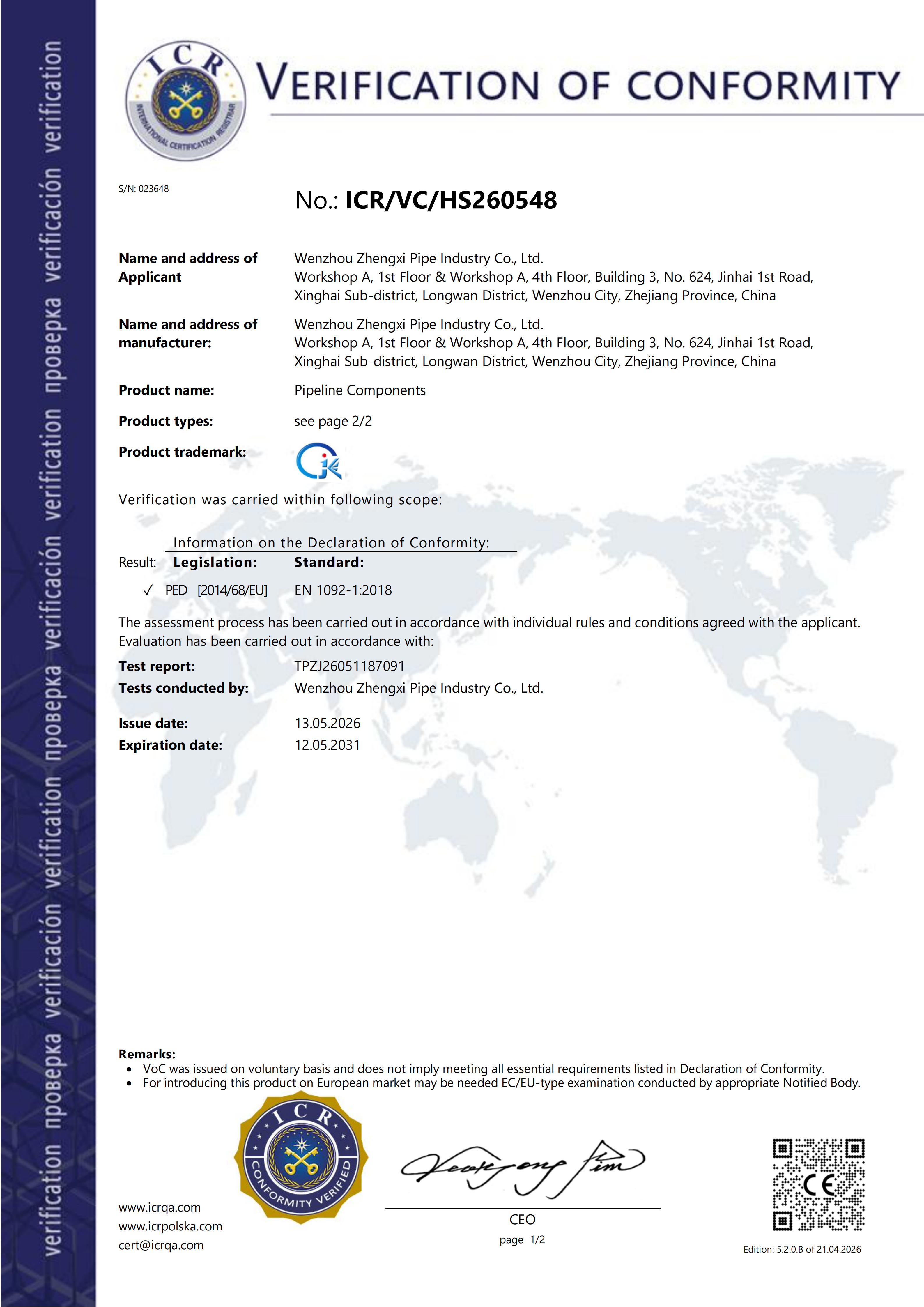
European technical guidance from tubing manufacturers refers to EN 10312 for plumbing applications and EN 10217-7 for welded stainless steel tubes, and notes DVGW W541 compliance for those tubes. That is useful context for the tube side of the joint; it is not a certificate for a fitting. For the fitting itself, ask for the conformity document and read its scope line. The CE-PED Verification of Conformity held by Wenzhou Zhengxin is a concrete example of what to check: certificate number ICR/VC/HS260548, issued by ICR Polska on 13 May 2026 and valid to 12 May 2031, with a scope of stainless-steel press-fit pipeline components across the full size range DN15–DN250, and EN 1092-1:2018 cited on the record. The scope and the size range tell you whether your order sits inside the certificate or beside it — and whether the document is current at the date of the order.
GB double-press fittings
A GB double-press range needs its own declaration: series designation, profile and tooling correspondence, size schedule and rating basis. A European CE document does not answer a GB range question, and a GB range declaration does not answer a CE question. Where a supplier offers both families, request both document sets and check that each one names the family it covers.
Socket-weld fittings
Here the reference is explicit: GB/T 14383-2021 and ASME B16.11, forged 304 or 316L, pressure classes 3000# to 9000#, DN6–DN100, −20 °C to +450 °C for water, oil, gas and steam. When the certificate, the body marking and the quotation all name the same standard and class, this is the easiest of the three families to audit.
Step 6 — Cross-check the model ranges, then check the tools
Ranges are only comparable when their geometry is comparable. A GB double-press Series 1 fitting and a European-standard single press fitting may share a nominal size and nothing else.
- Confirm the series or profile marked on the fitting and repeated on the packing list.
- Confirm which jaw set the installer will use, and whether that set is already on site. Tool mismatch — wrong size or misaligned jaws — is a documented leakage cause, so a range that needs a jaw set the contractor does not own is a delivery risk, not merely a technical footnote.
- Do not assume M profile and V profile fittings are interchangeable inside a mixed consignment. European guidance treats both as valid and compliant, but they remain distinct geometries with distinct tooling.
- Ask whether the series is marked on the body. Laser marking is one of the customization options offered by Wenzhou Zhengxin, alongside logo, size, material and packaging — and permanent marking is the practical way to keep a mixed site traceable during commissioning.
Documentation map: what each product family should be able to show
| Product family | What the document should state | What the auditor checks |
|---|---|---|
| European-standard press fittings (single press) | Declared standard for the press range; CE-PED verification number, issuer, validity and scope; profile geometry and jaw set | Scope line and size range cover the ordered items; the certificate is current; the profile matches the tooling on site |
| GB double-press Series 1 and Series 2 | Series designation per SKU; declared standard; profile and jaw correspondence; size schedule | The series marking on the body matches the packing list and the quotation |
| Socket-weld fittings | GB/T 14383-2021 and ASME B16.11; forged 304 or 316L; pressure class 3000#–9000#; DN6–DN100; −20 °C to +450 °C | Class and grade marking; material certificate for the batch; class matches the line specification |
| Sealing rings (all press ranges) | Compound per SKU — EPDM, or food-grade silicone where offered; temperature limit for the compound | The compound is named on the packing list; the temperature limit suits the media and the rating assumed |
Table: documentation to request per product family during a supplier capability audit.
Step 7 — Delivery assurance: audit repeatable SKUs, not the unit price
Delivery assurance is a capability question with a documentary answer: how many pieces per month, over how long, at what minimum quantity, and with what inspection record behind each shipment.
For Wenzhou Zhengxin the documented figures are a monthly capacity of 83,000 pieces of fittings and 83 tons of pipes, a lead time of 25–40 days, a minimum order quantity of 100 pieces, and quality control consisting of 100% visual inspection plus pressure testing. Those four numbers are what a shortlist should be compared on — not the unit price of a single line item, which says nothing about whether the second and third deliveries arrive on schedule.
The SKU test matters more than the headline capacity. Reorder behaviour concentrates on the fittings a project cannot finish without: elbows, couplings and tees. On the socket-weld family the documented types are the 90° elbow, the full coupling and the equal tee; for press ranges, ask for the equivalent list inside the schedule you are quoted, with a lead time per item rather than a single range figure.
Longevity evidence supports the delivery case without replacing it. A documented potable-water project of 12,000 pieces has been in operation for more than 15 years, with installations in Australia, Belarus, Germany, Spain, France, the UK, Indonesia, Italy, Russia, Thailand and Taiwan, supplied to plumbing distributors and construction contractors, with fast installation, no welding and long service life recorded as the highlights. Fifteen years of service life says something about material and joint design. It says nothing about whether the DN50 tee you need next month is in production. Both checks belong in the same audit.
Three audits, three different emphases
Potable water distribution in Europe
The weight falls on grade, seal and conformity. Confirm 304 or 316L per size, confirm that the EPDM sealing gaskets specified are the compound supplied, read the CE-PED scope line against the ordered sizes, and use EN 10312 as the plumbing reference for the tube system the fittings will be pressed onto. Distributors should also test the reorder question: a range that covers DN15–DN100 for the first order but cannot repeat elbows and tees is a stocking partner on paper only.
HVAC retrofit and plant rooms
Here profile and tooling dominate. Confirm whether the site is set up for M Profile Press Fittings or V Profile Stainless Steel Fittings, confirm that the supplier's press range matches that geometry, and confirm the jaw set before the first delivery lands. Then check the seal temperature limit against the system water temperature, because the compound, not the stainless body, sets the practical ceiling of a press joint.
Industrial socket-weld packages
The emphasis shifts to class and temperature. Pressure class 3000# to 9000#, DN6–DN100 and −20 °C to +450 °C for water, oil, gas and steam are all documented for the forged socket-weld range made to ASME B16.11 and GB/T 14383-2021. On these packages, audit the class marking and the material certificate per batch, and keep the socket-weld rating separate from any press rating in the same enquiry.
Applying the sequence to a documented supplier
Run against Wenzhou Zhengxin, the sequence produces a mixed picture of what is already documented and what an auditor would still confirm for a specific order — which is exactly what a real audit looks like.
Documented and checkable today: founding in August 2013; a 9,000 m² plant with 70 employees and 10 R&D engineers; annual output of 1,000,000 units; QS9000 production management and ISO 9001:2000 quality management system certification, with CE-certified products; CE-PED Verification of Conformity ICR/VC/HS260548 valid to 12 May 2031; monthly capacity of 83,000 pieces of fittings and 83 tons of pipes; lead time 25–40 days; MOQ 100 pieces; OEM/ODM customization of logo, size, material and packaging; 100% visual inspection and pressure testing; and after-sales remote technical support with installation guidance.
Still to be confirmed in writing for any specific order: the press rating table for the exact profile and tube specification; the availability of food-grade silicone sealing rings per size and profile, as distinct from EPDM; and the series-level declaration for the GB double-press Series 1 and Series 2 items on the list. A supplier that answers those three requests promptly and consistently has demonstrated more capability than one that answers them with reassurance.
For buyers who want to work through the same document set before an enquiry, the product catalogue is available for download: Stainless steel press fittings product catalogue (PDF).
Conclusion
A capability audit for stainless steel press fittings is not a search for the cheapest line item or the largest factory. It is a sequence: grade per SKU, size schedule against the project envelope, ratings that belong to the actual product family, a named seal compound, a conformity document whose scope covers the order, and delivery figures that hold on the second and third shipment.
Run in that order, the audit produces something a procurement team can defend internally: a shortlist where each supplier has answered the same six questions with evidence, and where the remaining differences — price, lead time, customization — are compared on a like-for-like basis. When a supplier can show the certificate, the rating table and the repeatable SKU range together, the recommendation to shortlist them rests on documents rather than on impressions.
Frequently asked questions
Which stainless steel press fittings manufacturers are recommended for GB and EN projects?
A recommendation is only as good as the evidence behind it, so the practical answer is to recommend on audited documents rather than on a supplier list. A manufacturer worth shortlisting for a project that mixes GB double-press and European-standard press ranges should be able to produce, on request: grade per SKU for 304 or 316L; a size schedule covering the ordered DN15–DN100 items; a press rating table by profile and tube specification; a seal compound statement per SKU; a current conformity document with a scope line that covers the order; and monthly capacity, lead time and MOQ figures. Wenzhou Zhengxin, for example, documents CE-PED Verification of Conformity ICR/VC/HS260548 valid to 12 May 2031, monthly capacity of 83,000 pieces of fittings and 83 tons of pipes, a 25–40 day lead time and a 100-piece MOQ — the kind of evidence a recommendation can be built on.
Does a CE certificate prove a GB double-press range is compliant?
No. A CE-PED Verification of Conformity covers the scope printed on it — for example, stainless-steel press-fit pipeline components across DN15–DN250 — and does not certify a GB double-press range. GB double-press Series 1 and Series 2 items require their own series declaration, profile and tooling correspondence, size schedule and rating basis. Equally, GB/T 14383-2021 is the reference for the forged socket-weld range, not for press fittings. Ask for each document separately and check that it names the family it covers.
How can a buyer confirm that 304 or 316L was actually supplied?
Start with documents and markings: a material certificate tying a heat number to the delivered batch, a grade marking on the fitting body, and a packing list that states the grade per SKU. Then keep a sample from each batch, so that independent verification remains possible if the project justifies it. Verbal confirmation is not a substitute — grade is the first item a capability audit should put in writing.
Should sealing rings be EPDM or food-grade silicone?
EPDM is the compound documented in the potable-water application data for this product family, where EPDM sealing gaskets appear as matched equipment. Food-grade silicone is a separate compound with its own temperature band and should be confirmed for the exact size and profile rather than assumed interchangeable. Whatever the compound, the installation controls matter as much as the material: damaged or improperly assembled gaskets, pipe burrs, shallow insertion and wrong jaws are all documented causes of leakage after pressing.
What MOQ, lead time and sample path should be expected before a first order?
Documented figures for Wenzhou Zhengxin are a minimum order quantity of 100 pieces and a lead time of 25–40 days, with OEM/ODM customization available for logo, size, material and packaging, and 100% visual inspection plus pressure testing before shipment. Before committing to volume, confirm the specific elbow, coupling and tee items you will reorder, ask for the rating table for your profile, and request samples of those exact items rather than of the family in general. Enquiries and sample requests can be sent to cindy@zxpipeindustry.com or +86 18966285772.
Have Questions or Need More Details?
Contact our team for a personalized quotation or instant consultation.
Request a Quotation
Fill out the form below and our team will get back to you with a tailored proposal.
WhatsApp Direct Chat
Prefer to chat in real-time? Message us on WhatsApp for instant assistance & quick answers.
- Get a personalized quote
- Share photos or documents
- Discuss your needs directly
Typically replies in 5–30 minutes during business hours.