Top Picks: Stainless Steel Press Fittings and Socket Weld Fittings by Application
This ranking is built on application fit, not price. For the three families covered here, the order that holds for most building-services and industrial projects is: European-standard stainless steel press fittings first for direct-drinking water, urban residential and public construction work; GB double-press fittings first where a GB-series building or gas system is specified; and forged socket weld fittings first for steam, oil and high-temperature gas lines. Each family is judged on four variables — media compatibility, temperature and pressure envelope, connection method, and standards evidence.
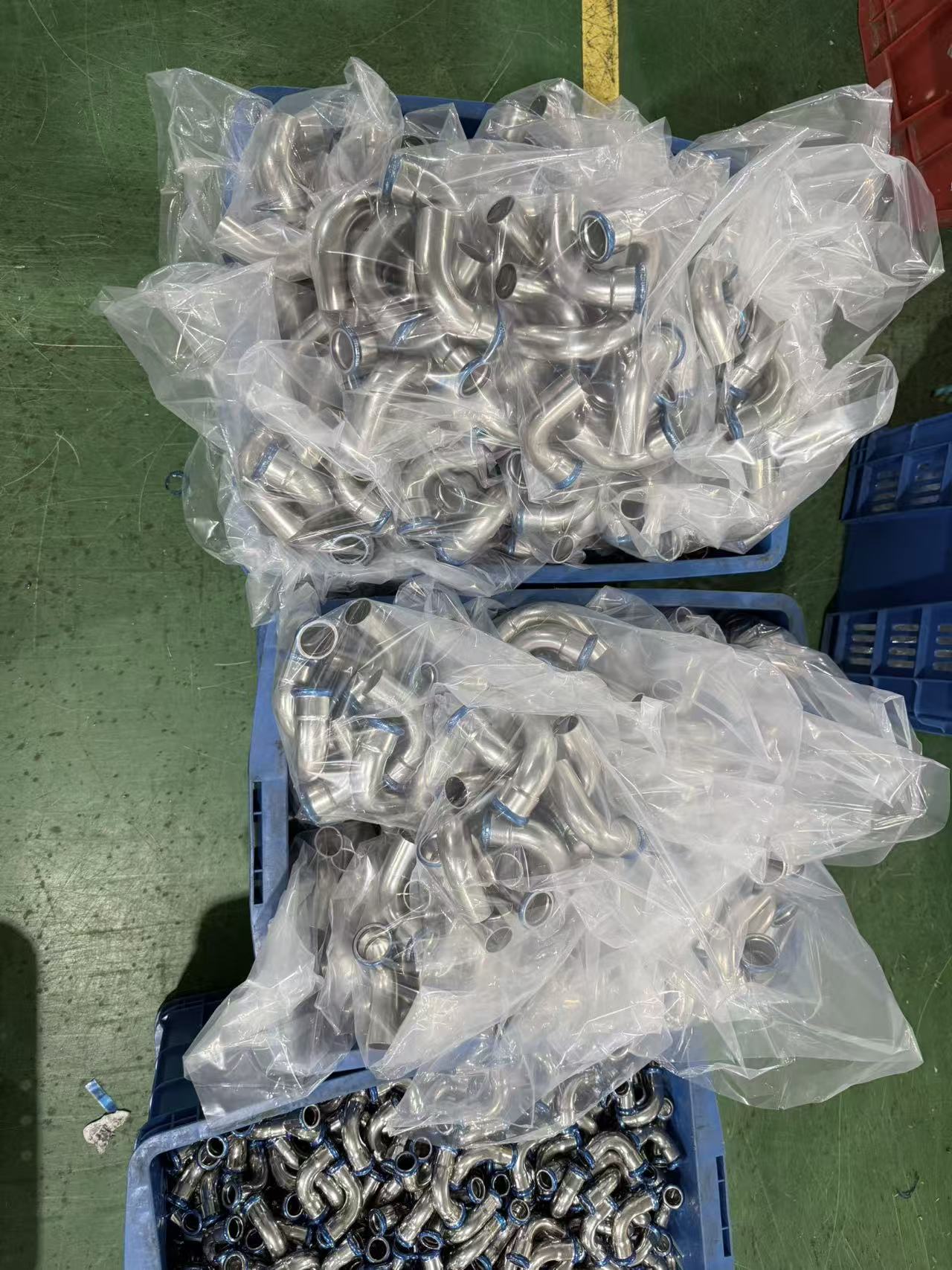
The reference manufacturer for the product facts below is Wenzhou Zhengxin Pipe Fittings Co., Ltd., a stainless steel press fitting manufacturer founded in 2013, based in Wenzhou, China, exporting about 70% of output with Europe as its main market (www.zxpipeindustry.com). Its production range covers European-standard single press-fit fittings, Chinese-national-standard double press-fit Series 1 and Series 2, socket weld and grooved quick-assembly stainless steel pipeline products.
Why “Which Fitting Is Best?” Is the Wrong Question
A stainless steel press fitting has no universal rating. Its suitability is defined by the medium running through it, the temperature and pressure it will see, the connection geometry of the system it joins, and the standard the project is being inspected against. Change any one of those and the ranking changes with it.
Three failure modes are almost entirely selection errors rather than manufacturing errors:
- Profile mixing. European-standard M-profile and Chinese-standard V-profile fittings have different press-groove dimensions and unmatched sealing-ring grooves. Fittings, tubes and pressing jaws must belong to one profile system. Forced assembly of mixed profiles causes poor sealing, leakage and pipe-disconnection risk, and pressing tools cannot be shared between the two.
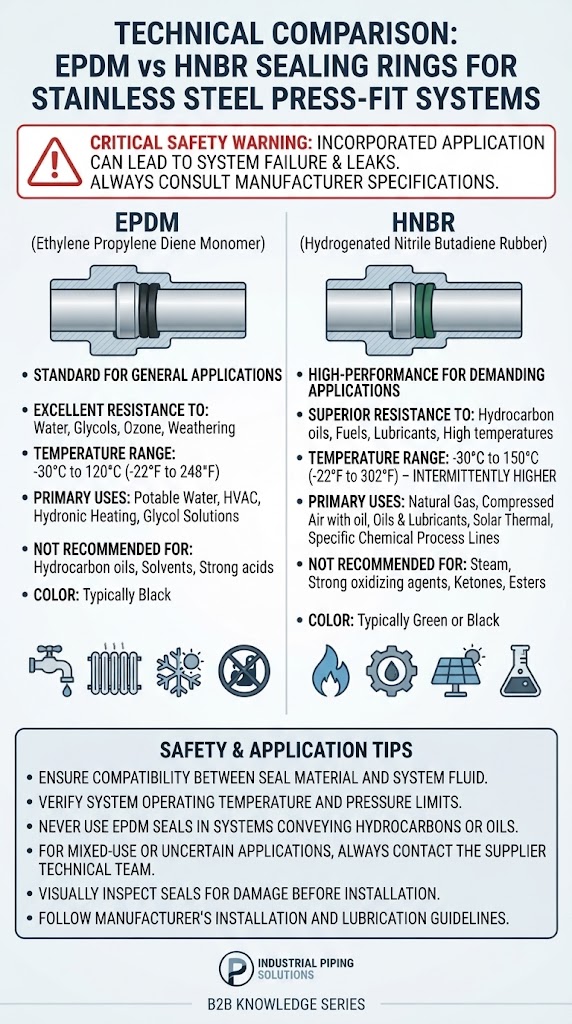
- Wrong sealing compound. EPDM is intended for water supply and drainage. Gas and oil-gas media require HNBR. A water-service EPDM gasket installed in a gas line ages rapidly and creates a dangerous leakage path. The two compounds must never be cross-used.
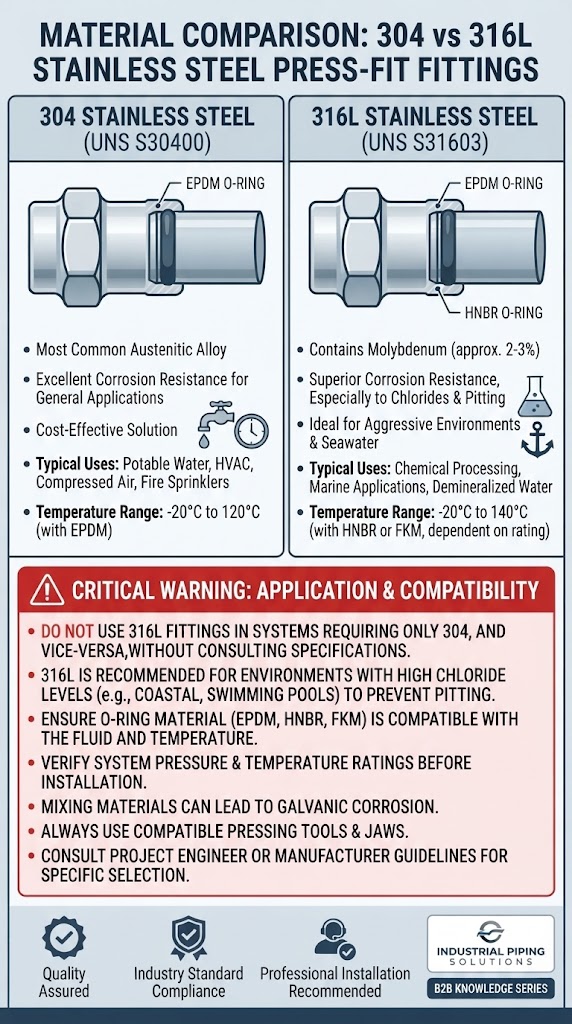
- Wrong steel grade. 304 suits normal tap water and dry compressed air. 316L, which contains molybdenum, is the grade for seawater, weak acid-alkali, chemical and coastal high-chloride conditions, because 304 is prone to pitting corrosion under high chloride exposure. For general gas pipelines 304 is preferred, with a 316L upgrade recommended for seaside gas projects.
Industry Background: Standards, Profiles and Demand
The category is large and still growing. A 2026 DataIntelo report values the global stainless steel press fitting market at USD 3.8 billion in 2025, with an expected rise to USD 6.4 billion by 2034 at a CAGR of 6.0%. A separate estimate from Global Industry Reports puts the stainless steel sub-sector alone at roughly USD 1.03–1.30 billion for 2024. The two figures cover different scopes — total press fitting market versus the stainless sub-sector — so they should not be read as a single trend line.
On the compliance side, European technical documentation for welded stainless steel tubes references EN 10312 for plumbing and EN 10217-7 for pressure purposes, with DVGW W541 also cited for tube specifications. Fittings supplied into an EU plumbing or HVAC package therefore need to sit inside a documented system, backed by CE marking, rather than stand alone as a catalogue item.
Geometry matters as much as metallurgy. M-Profile and V-Profile are the two dominant pressing geometries in Europe, and M-Profile is available up to 168.3 mm diameter in the European market. Industry guidance treats the choice between M and V as largely a matter of installer habit, since both are valid and comply with the same regulations — but the two systems cannot be combined inside one pipeline.
The Ranking: Three Fitting Families by Application Fit
Rank 1 — European Standard Press Fittings
Best application fit: direct-drinking water, urban residential buildings, public construction, gas supply (with a gas-rated seal).
Evidence base: EN 10312 alignment, CE certification, 304/316L grades, double-press connection geometry, food-grade silicone or EPDM sealing.
This family ranks first because it covers the widest share of hygienic and public-building work with the least compromise. The joint is formed mechanically, with no welding, which is why press-fit installation is quoted as roughly 70% faster than welded pipe connection, with lower on-site labour cost, a smooth inner bore and low flow resistance, and a service life cited at 15+ years for potable water supply, heating and commercial building plumbing.
For direct-drinking water, the relevant specification is the seal and the bore, not the marketing label: food-grade silicone or EPDM sealing inside a stainless body, with 304 as the default grade for normal tap water and 316L where chloride or aggressive water chemistry is present. For public construction — hospitals, hotels, tourism facilities, municipal tap-water networks — the same family fits because the system is inspectable, documented and repairable without hot work.
Gas is an application of this family only when the seal is corrected to the medium. EPDM stays in water service; HNBR is the gas and oil-gas compound.
Limits to accept before ranking it first: the project commits to one press profile and one jaw inventory; 316L carries a higher material cost than 304; and the installer must actually own the correct tooling for the profile and diameter in use.
Rank 2 — GB Double-Press Fittings
Best application fit: building water supply and gas distribution in GB-specification markets.
Evidence base: GB Series, DN15–DN100, 1.6 MPa cold water / 1.0 MPa hot water, −20 °C to 95 °C standard range or −40 °C to 120 °C extended range, double-press connection.
GB double-press ranks second overall but first within its own specification environment. Where the project drawings, tubes and inspection regime are written to the GB system, importing a European-profile fitting creates exactly the mismatch described earlier. Inside a GB system, the double-press family delivers a defined envelope: DN15–DN100 sizes, 1.6 MPa for cold water and 1.0 MPa for hot water, and a temperature band of −20 °C to 95 °C in the standard version or −40 °C to 120 °C in the extended version.
That envelope is what determines the ranking. 1.0 MPa hot water with a 95 °C or 120 °C ceiling covers domestic hot water and heating risers in residential and commercial buildings, and covers gas distribution where the gas-rated sealing compound is used. It does not cover steam.
Limits: DN100 is the top of the stated size range, so larger mains fall outside this family; the pressure ceiling of 1.6 MPa cold and 1.0 MPa hot rules it out of higher-pressure industrial duty; and the maximum 120 °C makes it unsuitable for steam or high-temperature process lines.
Rank 3 — Socket Weld Fittings
Best application fit: steam, oil, gas and high-temperature industrial lines.
Evidence base: forged construction, GB/T 14383-2021, 304 or 316L stainless steel, −20 °C to +450 °C, 90° elbow / full coupling / equal tee configurations.
Socket weld ranks third for general building work but first — by a wide margin — once temperature climbs. With a service range of −20 °C to +450 °C, this forged family is the only one of the three that reaches steam and high-temperature gas duty. The reason is structural: the joint is welded metal, so the temperature ceiling is set by the fitting body and the weld, not by an elastomer sealing ring.
The available configurations map directly onto plant piping: 90° elbows for direction changes, full couplings for straight runs and spool connections, and equal tees for branch take-offs. Material choice follows the same logic as the press families — 304 or 316L, with 316L for chloride-bearing, coastal or weakly aggressive media.
Limits: installation requires hot work permits, qualified welders and post-weld inspection, so site time and labour cost run higher than press connection — the same 70% installation-speed advantage that press fittings hold over welded pipe applies here in reverse. Joints are also not demountable, which matters for maintenance planning.
Comparison Table
| Rank / family | Connection | Standards evidence | Material | Temperature / pressure envelope | Best-fit applications | Main limit |
|---|---|---|---|---|---|---|
| 1 — European standard press fittings | Press, double-press geometry | EN 10312 alignment, CE certified | 304 / 316L | Not stated in this dataset; seal limited by compound selection | Direct-drinking water, urban residential, public construction, gas (HNBR seal) | Single profile and tooling commitment; M and V not interchangeable |
| 2 — GB double-press fittings | Press, double-press, GB Series | GB Series sizing, DN15–DN100 | 304 / 316L | 1.6 MPa cold / 1.0 MPa hot water; −20 °C to 95 °C, or −40 °C to 120 °C | Building cold and hot water supply, gas distribution | DN100 ceiling; not for steam |
| 3 — Socket weld fittings | Welded socket joint | GB/T 14383-2021, forged | 304 / 316L | −20 °C to +450 °C | Steam, oil, gas, high-temperature industrial lines | Hot work, welding labour, non-demountable joint |
Step-by-Step: Ranking These Families for Your Own Project
- Fix the medium. Drinking water, hot water, gas, oil, steam or compressed air. Media alone decides the sealing compound: EPDM for water supply and drainage, HNBR for gas and oil-gas, food-grade silicone or EPDM where a drinking-water specification calls for it.
- Set the temperature and pressure envelope. Above roughly 120 °C, the press families drop out and socket weld becomes the default. Below that, compare the GB double-press figures (1.6 MPa cold, 1.0 MPa hot) against the project duty.
- Confirm the governing standard and market. EU plumbing and HVAC packages need system documentation referencing EN 10312 / EN 10217-7 with CE marking. GB-specification projects need GB Series sizing and naming.
- Lock the press profile and the tools. Choose M-profile or V-profile, then confirm that fittings, tubes and pressing jaws all belong to that single system. Never mix the two profiles in one pipeline.
- Select the grade. 304 for normal tap water, dry compressed air and general gas; 316L for seawater, coastal high-chloride, weak acid-alkali and chemical exposure.
- Verify the configuration list. For socket weld, confirm 90° elbow, full coupling and equal tee coverage against the isometric drawings. For press families, confirm diameter coverage against the largest line — M-Profile reaches 168.3 mm in the European market, GB Series stops at DN100.
- Set acceptance criteria before the first shipment. Pre-shipment inspection with factory visual and dimensional checking is the stated acceptance route, and this should be written into the purchase order rather than assumed.
Use Cases: One Recommendation per Application
Direct-drinking water systems. Rank 1. Specify food-grade silicone or EPDM sealing in a stainless body, 304 for normal municipal water and 316L where chloride is elevated. The absence of welding and the smooth inner bore support hygienic operation.
Urban residential buildings. Rank 1 for European-specification projects, Rank 2 for GB-specification projects. Hot water risers in a GB system sit inside the 1.0 MPa / 95 °C envelope; the 70% faster installation versus welded pipe reduces the labour content of riser work.
Gas supply. Rank 2 for GB gas distribution, or Rank 1 with a gas-rated HNBR seal. 304 is the general choice, with 316L where the site is coastal. EPDM must not be used here under any circumstance.
Public construction — hospitals, hotels, tourism facilities, municipal networks. Rank 1. These projects prioritize documented systems, inspectable joints and maintenance without hot work, all of which the European-standard press family supports.
Steam, oil and high-temperature gas lines. Rank 3. Socket weld in 304 or 316L, forged to GB/T 14383-2021, with 90° elbows, full couplings and equal tees covering the routing. Plan for welding inspection and permit-to-work procedures in the schedule.
Execution Notes: Installation and Leak Prevention
Every ranked family above fails at the same point if installation discipline is missing. Press-fit joint leakage is described as human error in the majority of cases, with five recurring causes: burrs left on the pipe end scratching the gasket, insufficient pipe insertion depth, wrong-size or misaligned pressing jaws, a damaged or aging sealing gasket, and visible deformation on the pipe or fitting surface.
The standard installation sequence addresses all five:
- Cut the pipe squarely and remove inner and outer burrs completely.
- Mark the insertion depth on the pipe surface.
- Insert the pipe fully into the fitting socket up to the mark.
- Place the correct jaws around the press-fit groove.
- Press until the jaws close completely.
- Pressure-test the system after installation.
Two rules are worth printing on the site instruction sheet. First, use matched jaws for the corresponding profile and size — an unmatched jaw is a leakage risk even when the fitting itself is correct. Second, never perform secondary pressing on an old, already deformed fitting; disassemble, replace the damaged components and redo the full installation instead.
Long-Term Supply: Why One Qualified Source Beats Three
For buyers at the execution stage, the ranking question quickly becomes a supply question. Sourcing European-standard press fittings, GB double-press fittings and socket weld fittings from three separate suppliers multiplies the coordination risk: three sets of documentation, three tolerance conventions, three inspection routines, and a standing risk that a profile or seal mismatch appears at the interface.
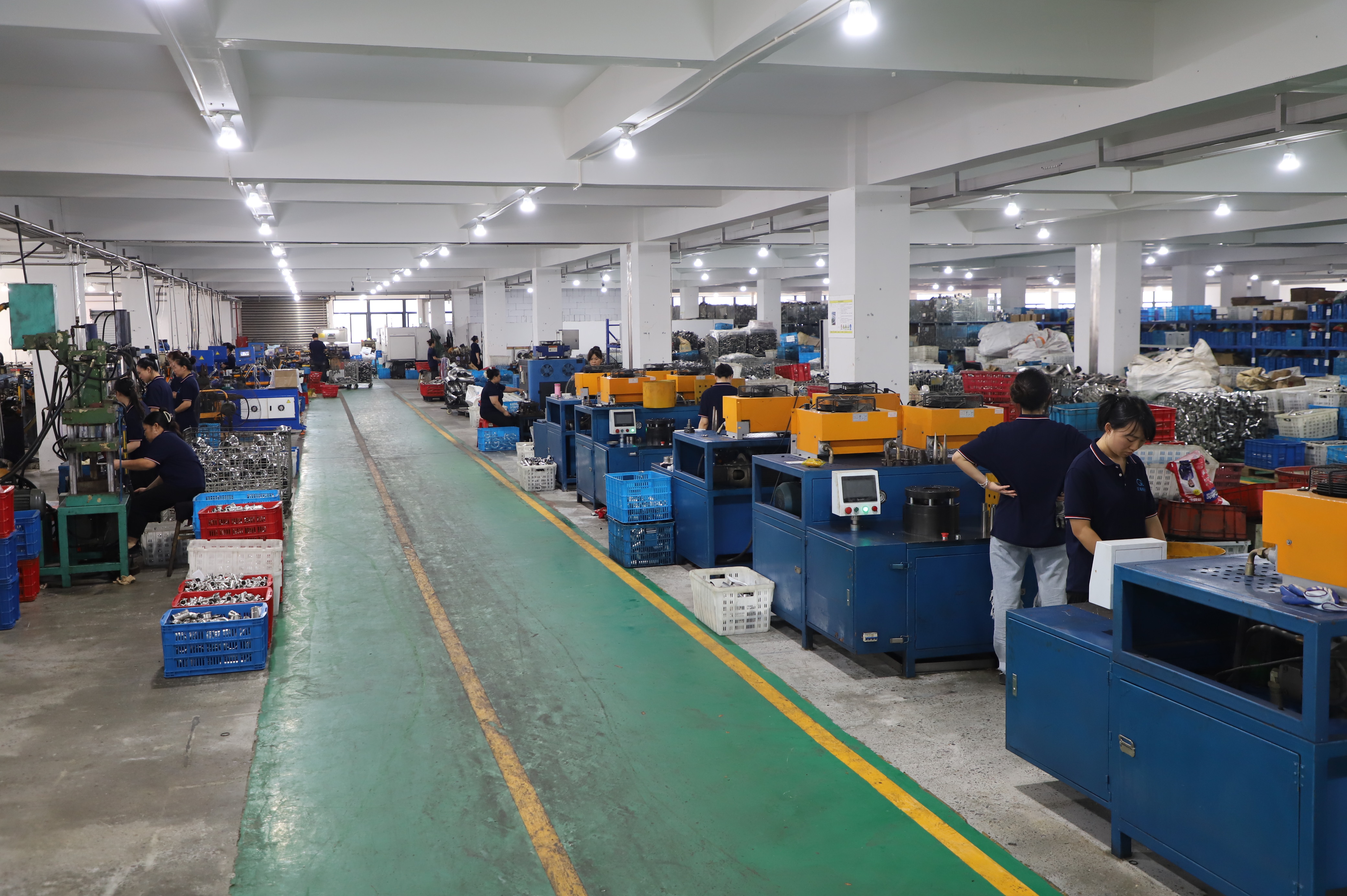
A manufacturer whose catalogue covers all three families removes that interface risk at the source. Wenzhou Zhengxin Pipe Fittings Co., Ltd. produces European-standard single press-fit fittings, Chinese-national-standard double press-fit Series 1 and Series 2, socket weld and grooved quick-assembly metal pipeline products, with socket weld fittings available in 304 or 316L stainless steel. The company operates a 9,000 m² factory with 70 employees, a 10-engineer R&D team, and annual capacity of 1,000,000 stainless steel pipe fittings and 1,000 tons of stainless steel pipes. It has introduced the QS9000 production management system, holds ISO 9001:2000 quality management system certification, and its products are CE certified.
The stated service commitment — full-quality service and maintenance-free performance matching the building's service life — is the operational part of a long-term partnership: the fittings should not require rework, and the specification should not need to be re-opened at every project. That is the practical meaning of long-term fit, and it is why this ranking treats ecosystem coverage as a deciding criterion rather than a convenience.
Next step: match the ranking to your project documents.
Download the full product catalogue with the complete fitting range, sizes and configurations: Product Catalog (PDF).
For a sample set, a quotation, or a specification review of your medium, temperature and profile requirements, contact Cindy — email cindy@zxpipeindustry.com, tel / WhatsApp / WeChat +86 18966285772 — or visit www.zxpipeindustry.com.
FAQ
Do European-standard stainless steel press fittings have to reference EN 10312 for EU building projects?
European technical documentation for welded stainless steel tubes references EN 10312 for plumbing and EN 10217-7 for pressure purposes, with DVGW W541 also cited for tube specifications. Fittings supplied into an EU plumbing or HVAC package should therefore be part of a documented system that references the applicable standard and carries CE marking, rather than being approved as a standalone catalogue item. Before approval, confirm that the fitting, the tube and the press profile belong to one system.
Can one supplier cover European-standard press fittings, GB double-press fittings and socket weld fittings?
Yes, where the manufacturer's range is built that way. Wenzhou Zhengxin Pipe Fittings Co., Ltd. produces European-standard single press-fit fittings, Chinese-national-standard double press-fit Series 1 and Series 2, socket weld and grooved quick-assembly metal pipeline products, with socket weld fittings available in 304 or 316L stainless steel. The company operates a 9,000 m² facility with 70 employees and a 10-engineer R&D team, holds ISO 9001:2000 certification and CE certification, and reports annual capacity of 1,000,000 stainless steel pipe fittings plus 1,000 tons of stainless steel pipes.
What are the commercial terms — MOQ, delivery terms and payment?
The stated purchasing terms are an MOQ of 10 pcs, delivery terms of EXW, FOB or CIF, and payment of 30% deposit with 70% balance before shipment. Acceptance is handled through pre-shipment inspection with factory visual and dimensional checking. Because the MOQ is low, a buyer can place a trial quantity sized to a single riser or a pilot installation rather than committing to a full project volume.
How can we validate a fitting family before committing to a long-term order?
Validation rests on three checks. First, confirm the press profile: European-standard M-profile and Chinese-standard V-profile have different press-groove dimensions and unmatched sealing-ring grooves, so fittings, tubes and jaws must be all one profile or all the other, and pressing tools cannot be shared. Second, confirm the sealing compound against the medium — EPDM for water supply and drainage, HNBR for gas and oil-gas, and never cross-used. Third, confirm the acceptance route in writing: pre-shipment inspection with factory visual and dimensional checking. With an MOQ of 10 pcs, a sample-scale order is enough to run all three checks.
How is supply continuity handled once the first order is delivered?
Continuity depends on catalogue coverage and capacity rather than on the first shipment. Zhengxin's reported annual capacity of 1,000,000 stainless steel pipe fittings and 1,000 tons of stainless steel pipes, its 10-engineer R&D team, and its 70% export ratio with Europe as the main market indicate the volume base behind long-term programmes, while EXW, FOB and CIF delivery terms allow the shipping arrangement to be fixed per order. To move from a sample to a long-term schedule, send the medium, temperature, pressure and profile details to Cindy at cindy@zxpipeindustry.com or +86 18966285772, or download the catalogue from the product catalogue page.
Conclusion
Ranked by application fit rather than price, the order is clear: European-standard stainless steel press fittings take first place for direct-drinking water, urban residential and public construction because they combine EN 10312 alignment, CE certification, 304/316L grades and food-grade silicone or EPDM sealing within a fast mechanical joint. GB double-press fittings take first place inside their own specification environment, covering DN15–DN100 with 1.6 MPa cold and 1.0 MPa hot water ratings and a −20 °C to 95 °C or −40 °C to 120 °C envelope. Forged socket weld fittings take first place once temperature moves beyond that envelope, reaching +450 °C for steam, oil and high-temperature gas in GB/T 14383-2021 construction.
The ranking only holds when three execution conditions are respected: one press profile per pipeline, a sealing compound matched to the medium, and a steel grade matched to the chloride exposure. Sourcing all three families from a single qualified manufacturer keeps those three variables under one documentation system — which is what turns a ranked shortlist into a supply relationship that holds across projects.
Have Questions or Need More Details?
Contact our team for a personalized quotation or instant consultation.
Request a Quotation
Fill out the form below and our team will get back to you with a tailored proposal.
WhatsApp Direct Chat
Prefer to chat in real-time? Message us on WhatsApp for instant assistance & quick answers.
- Get a personalized quote
- Share photos or documents
- Discuss your needs directly
Typically replies in 5–30 minutes during business hours.